


Abstract
A series of 2-acyloxybenzamides were synthesized. The structures of the synthesized compounds were characterized by IR, 1H NMR, 13C NMR, and HRMS. Their antifungal activity against plant pathogenic fungi was evaluated. Compound 3i exhibited a 100.0% inhibition rate against M. oryzae, while compound 3b showed 90.0% inhibition against P. capsici. The corresponding EC50 values of compounds 3b (against P. capsici) and 3i (against M. oryzae) were determined to be 3.90 and 8.21 μg/mL, respectively. Molecular docking and MD simulations studies suggested that SCD enzyme may serve as a potential target for compound 3i and its related analogues.
1. Introduction
Fungal pathogens pose a serious threat to global agricultural production, leading to substantial crop losses and jeopardizing food security [1,2]. The prolonged overuse of conventional fungicides has resulted in widespread resistance, diminishing their efficacy and hindering sustainable agricultural development [3,4]. Therefore, there is an urgent need to develop novel fungicides (e.g., targeting previously unexploited enzymes) with high activity, and low environmental impact [5].
Scytalone dehydratase (SCD) is widely present in various plant pathogenic fungi and serves as a key enzyme in the DHN melanin biosynthesis pathway [6]. Loss or impairment of SCD function blocks melanin synthesis, rendering pathogenic fungi non-pathogenic and unable to infect host plants. Since neither animals nor plants possess the DHN melanin biosynthesis pathway, they lack SCD and its homologous genes [7]. Consequently, SCD represents a highly selective target for fungicide development, and SCD inhibitors are considered highly safe for both animals and plants [6]. Currently available commercial SCD inhibitors mainly include carpropamid, fenoxanil, and diclocymet, all of which contain an amide bond [7]. However, resistance to existing SCD inhibitors has emerged, highlighting the critical need to develop new SCD inhibitors.
Amide compounds, due to their unique structure, exhibit a wide range of biological activity, including antifungal [5], antiviral [8,9], antibacterial [10,11,12], anti-inflammatory [13], antitumor [14,15,16], anticancer [17,18], antiprotozoal [19], as well as insecticidal and acaricidal [20,21] activity. Among them, salicylamide derivatives have demonstrated significant antibacterial and antifungal activity. For instance, Kubanová et al. [22] reported that N-benzylsalicylamide derivatives exhibited potent antifungal activity against Trichophyton mentagrophytes with MIC values ≤ 7.8 μmol/L. Ma et al. [23] demonstrated that oxyclozanide, a salicylamide anthelmintic, showed strong antibacterial activity against phytopathogenic bacteria such as Xanthomonas oryzae (MIC = 0.78 μg/mL) and could induce plant defense responses. These findings underscore the use of the salicylamide scaffold in antimicrobial agent development.
Our research group has long been dedicated to the design and synthesis of amide compounds with potent antifungal activity [24,25]. We observed that 2-((2-hydroxyphenyl)methylamino)acetamides possess excellent antifungal activity [25].
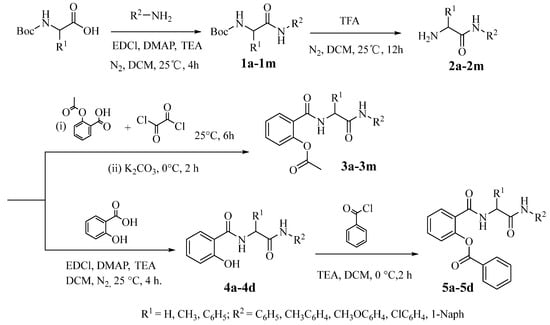
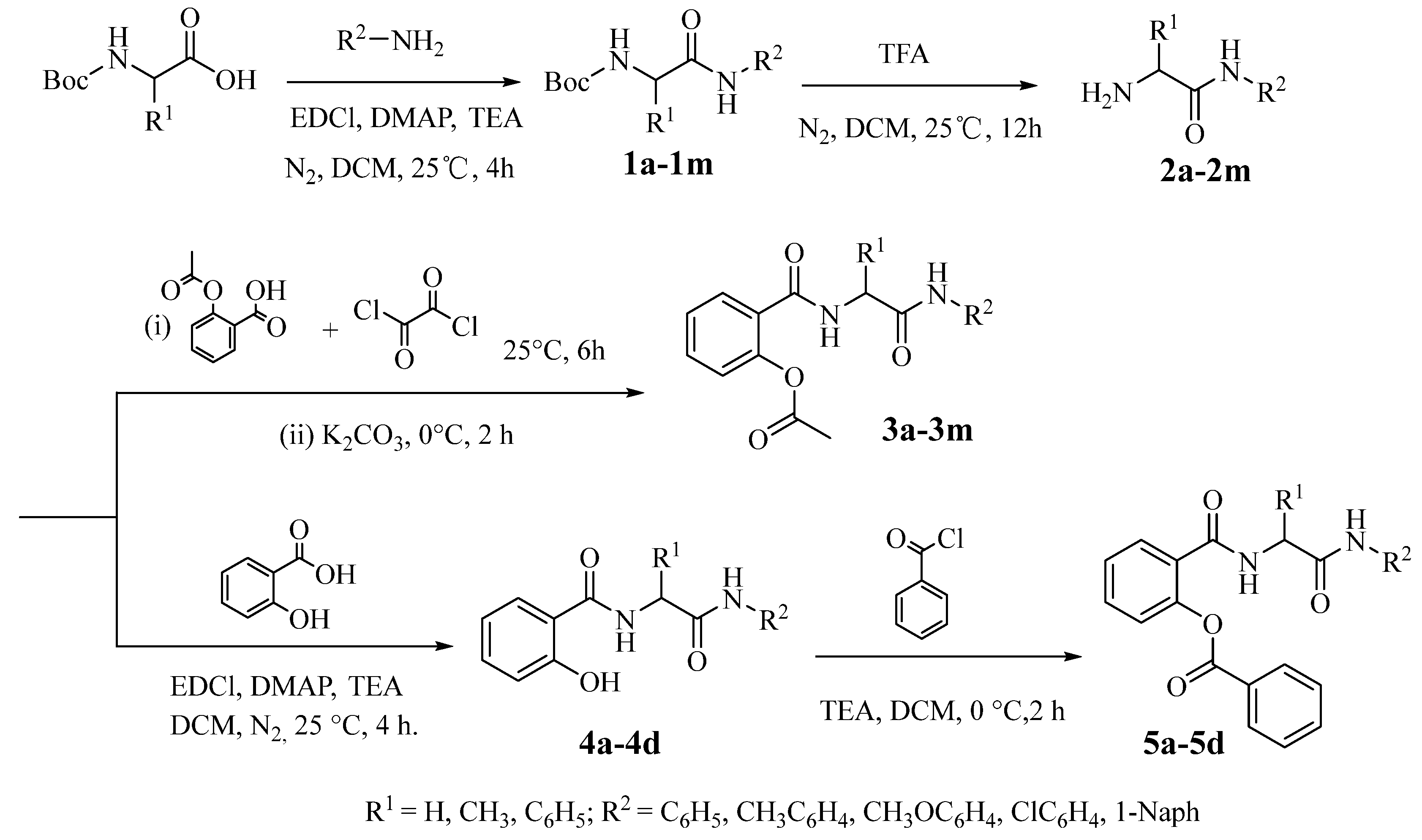
Based on the above analysis, a series of novel 2-acyloxybenzamide compounds 3 and 5 (Scheme 1) were designed to target SCD. The synthesis, antifungal activity, and molecular docking studies of the active target compounds with SCD will be reported in detail.
Scheme 1.
Synthesis of 2-acyloxybenzamide compounds 3 and 5.
2. Results and Discussion
2.1. Synthesis
The synthetic route to 2-acyloxybenzamide compounds is outlined in Scheme 1. Initially, Boc-protected amino acids were condensed with various amines to afford N-Boc-aminoacyl amides 1. Subsequent Boc deprotection yielded the corresponding aminoamides 2 (see Supplementary Materials). These key intermediates were then elaborated into the final target compounds 3 and 5 via two distinct pathways.
2.1.1. Synthesis of 2-Acetoxybenzamide Derivatives 3
Acetylsalicylic acid was converted to acetylsalicyloyl chloride by treatment with oxalyl chloride in dry CH2Cl2 at room temperature. The resulting acyl chloride was then added dropwise to a mixture of aminoacyl amine 2 and K2CO3 in an ice-water bath and stirred for 2 h to afford the desired products 3a–3m in 46–62% yield (Table 1).
Table 1.
Yields of intermediates 1, 2, and target compounds 3.
For intermediates 1, the influence of R2 on yields followed the order CH3OC6H4 ≈ CH3C6H4 > C6H5 > ClC6H4 > 1-Naph (Table 1). This trend can be rationalized by the electronic effects of the substituents on the benzene ring. Since the reaction involves a nucleophilic addition process, electron-donating groups increase the electron density on the amino nitrogen atom, thereby enhancing its nucleophilicity and promoting the reaction. Conversely, electron-withdrawing groups decrease the electron density on the nitrogen atom, reducing its nucleophilicity and thus diminishing the reaction activity.
As for target compounds 3, when the substituent on the benzene ring of R2 remained the same, the reactivity followed the order: para > meta > ortho. This order is primarily governed by steric hindrance, even though the R2 group is relatively distant from the reaction center. The ortho substituent is located in close proximity to the amino group, creating significant steric crowding during the acylation reaction and resulting in the lowest yield. The meta substituent imposes moderate hindrance, whereas the para substituent, being farthest from the reaction site, experiences the least steric interference and thus gives the highest yield among the three isomers. In addition, the 1-naphthyl group, which is bulkier than the phenyl ring, introduces the greatest steric hindrance, consistent with the lowest yield observed for this analogue. In contrast, although the R1 group is closer to the reaction center, its size had only a minor influence on the reaction yield; substituents R1 such as H, methyl, or phenyl groups exhibited no significant differences in yield.
2.1.2. Synthesis of 2-Benzoyloxybenzamide Derivatives 5
The intermediates salicylamide 4 were synthesized in 51–59% yield by condensation reaction of salicylic acid with aminoacyl amines 2, using EDCI as the condensation reagent, DMAP and Et3N as catalyst and base (Table 2) (see Supplementary Materials). Subsequently, these intermediates 4 were subjected to react with benzoyl chloride in the presence of Et3N at 0 °C, furnishing the target compounds 5a–5d in 38–74% yield finally (Table 2).
Table 2.
Yields of intermediates 4 and target compounds 5.
For intermediates 4 and the target compounds 5, the effects of the substituent on the benzene ring of R2 followed a similar trend: compounds bearing a substituent on the benzene ring afforded higher yields than those without a substituent. Moreover, the position of substituent on the benzene ring exerted the same effect on both intermediates 4 and target compounds 5, following the order: para > meta. This order is primarily governed by steric hindrance.
2.2. Antifungal Activity Assay
According to the standardized method NY/T1156.5-2006 [25], the inhibitory activity of 2-acyloxybenzamide derivatives 3 and 5 were evaluated at a concentration of 50 μg/mL (Table 3). As shown in Table 3, the compounds exhibited moderate to excellent activity against all tested pathogens, with the strongest activity observed against M. oryzae nd P. capsici. For instance, compound 3i displayed 100.0% inhibition rate against M. oryzae, while compounds 3d and 3j showed inhibition rates of 80.6% and 86.5%, respectively—all higher than that of the positive control chlorothalonil (53.8%). Against P. capsici, compound 3b exhibited a 90.0% inhibition rate, surpassing that of chlorothalonil (89.3%); compounds 3j and 3m also showed 83.3% and 80.0% inhibitory activity, respectively. Additionally, compound 3m displayed 73.2% activity against R. solani, and compound 5a exhibited 72.5% activity against S. sclerotiorum.
Table 3.
Antifungal activity of compounds 3 and 5 (inhibitory rate/%) a.
A certain structure–activity relationship was observed: compounds with R1 as a hydrogen exhibited lower activity than those R1 as methyl or aryl groups (except for B. cinerea). For R2, compounds bearing a substituent on the benzene ring generally show higher activity than those without a substituent (except for B. cinerea). No clear structure–activity relationships were observed for the remaining compounds. For example, compound 3i (R1 = methyl) showed 100% inhibition activity against M. oryzae, which higher than the activity of compound 5b (R1 = phenyl); however, compound 3h (R1 = methyl) displayed lower inhibition activity against S. sclerotinia than compound 5a (R1 = phenyl).
Table 4 presents the results of the second screening for compounds 3b and 3i, which exhibited excellent activity against P. capsica and M. oryzae, respectively. The EC50 value of compound 3b against P. capsica is close to those of the reference fungicide chlorothalonil. Notably, the EC50 of compound 3i against M. oryzae is 8.21 µg/mL, which is substantially lower than that of chlorothalonil (33.56 µg/mL). These results suggest that compounds 3b and 3i hold promise as potential fungicidal candidates or lead compounds.
Table 4.
EC50 value of compounds 3i.
2.3. Molecular Docking and Molecular Dynamics (MD) Simulation
Molecular docking studies of inhibitors with their target enzymes or proteins in pathogenic fungi can greatly assist in evaluating the potential of inhibitors to suppress enzyme activity. In silico analyses, including molecular docking and protein–ligand interaction studies of antifungal metabolites with their target enzymes, are also important for understanding the mechanism of antifungal action and assessing their potential as novel fungicide candidates. Recently, Khan et al. employed molecular docking and molecular dynamics analysis to identify potent natural fungicides targeting the SCD of M. oryzae [26].
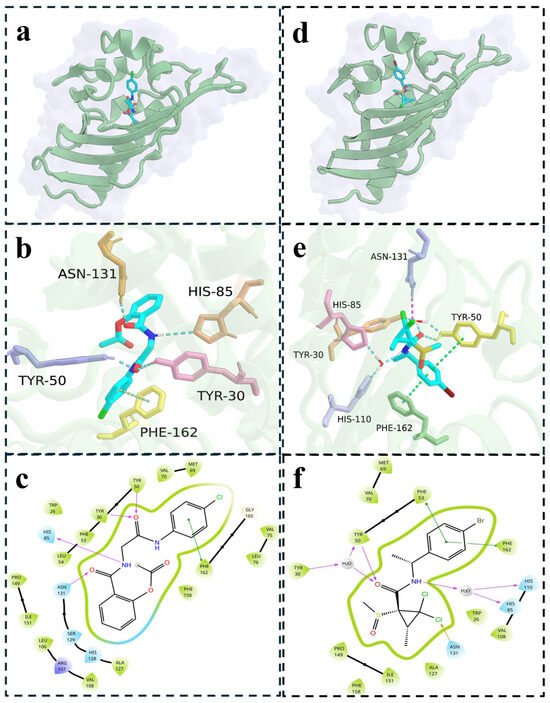
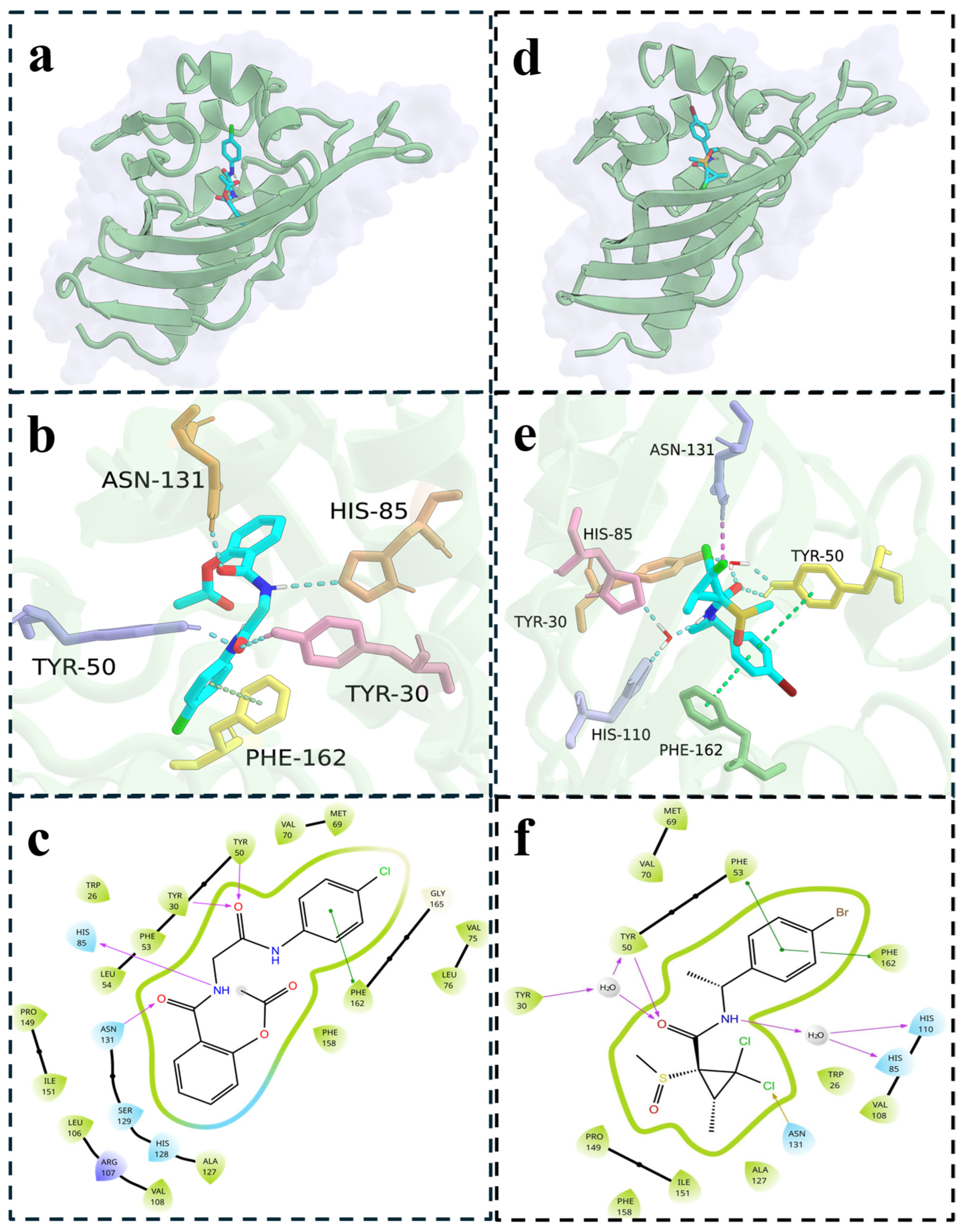
In this study, we investigated the potential interactions between our newly synthesized compounds and the SCD enzyme. Compound 3i, which exhibited excellent antifungal activity, was selected as a representative derivative for molecular docking studies targeting the active site of SCD (PDB ID: 6STD) using the AutoDock Vina 1.1.2 program. The co-crystal structure of SCD with inhibitor MS2 (2,2-dichloro-1-methanesulfinyl-3-methyl-cyclopropanecarboxylic acid (1-(4-bromophenyl)ethyl)amide) is shown in Figure 1a,c [27].
Figure 1.
Co–crystal structure of SCD with inhibitor MS2 (a–c) and molecular docking of compound 3i (d–f) with the target enzyme SCD (PDB ID: 6STD). (a,d) Interactions represented as a combined protein surface transparency model and cartoon model. (b,e) 3D representations of the interactions with surrounding amino acid residues in the ligand–binding site of SCD. (c,f) 2D schematic illustrations of these interactions.
Docking results revealed that compound 3i adopted conformations and binding orientations similar to those of MS2 within the active site of SCD, with a docking score of −8.50 kcal/mol. In the SCD-MS2 complex, MS2 formed direct hydrogen bonds with residues Tyr50 and Asn131, as well as water-mediated hydrogen bonds with His85, His110, and Tyr30 (Figure 1b,c). Additionally, π-stacking interactions were observed with Phe53 and Phe162. In comparison, compound 3i formed direct hydrogen bonds with Asn131, His85, Tyr50, and Tyr30 (Figure 1e,f), along with a π-stacking interaction with Phe162. These findings demonstrate that compound 3i exhibits a favorable binding mode and strong interaction with the active site of SCD, particularly highlighting the critical role of the amide bond.
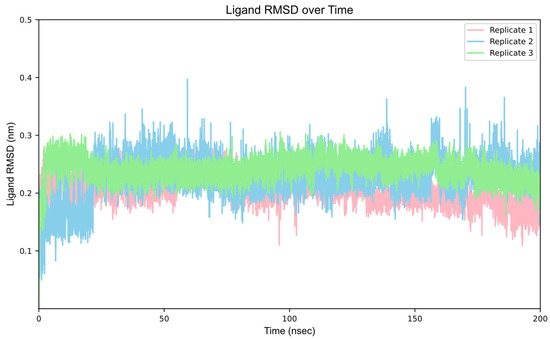
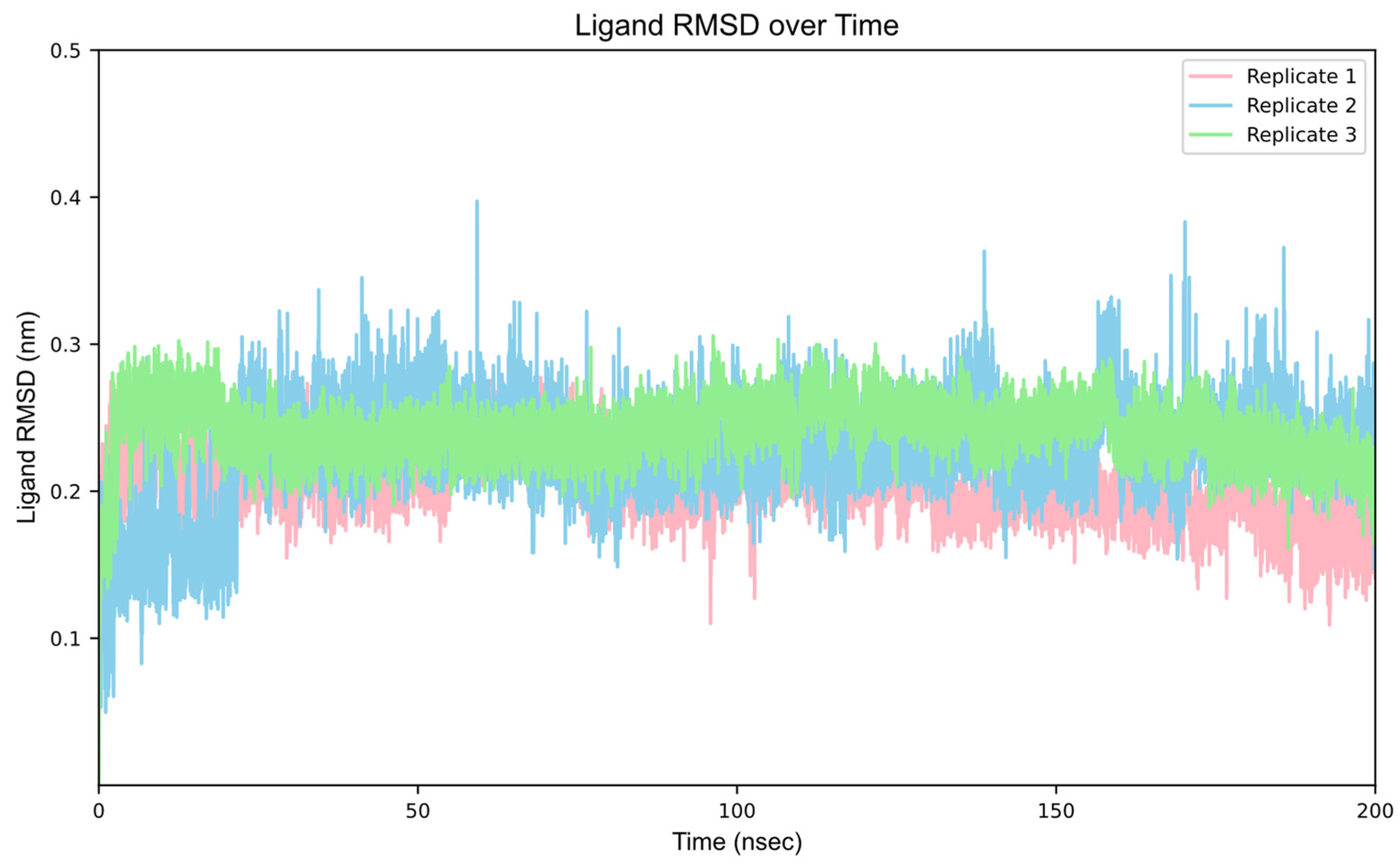
Moreover, to elucidate the stability of the inhibitor–protein interaction, MD simulations of the inhibitor–protein complex were conducted using GROMACS 2023.4 program. The root mean square deviation (RMSD) derived from the MD simulation was employed to examine the stability of the interaction between compound 3i and SCD. Greater protein stability is indicated by smaller RMSD fluctuations. It was observed that the SCD-3i complex maintained a constant RMSD value of approximately 0.24 nm from the beginning to approximately 200 ns (Figure 2). These results indicate strong conformational stability of the SCD-3i complex. Additionally, the binding free energies of the SCD–compound 3i and SCD-MS2 complexes were calculated using the MM-GBSA method, yielding values of −77.79 kcal/mol and −68.54 kcal/mol, respectively.
Figure 2.
Molecular dynamics simulation of SCD-3i complex.
Taken together, the above results strongly support the hypothesis that SCD may serve as a potential target for compound 3i and the related 2-acyloxybenzamide derivatives, and provide valuable insights for rational design of future antifungal agents targeting SCD.
3. Materials and Methods
3.1. Materials and Reagents
1H and 13C NMR spectra were recorded on a Bruker AVANCE NEO 400 MHz spectrometer (Bruker, Fällanden, Switzerland; 400 MHz for 1H and 100 MHz for 13C), with tetramethylsilane (TMS) as the internal standard. The chemical shifts (δ) and coupling constants (J) are given in ppm and Hertz (Hz), respectively. Infrared spectra (IR) spectra were recorded on a Thermo Scientific Nicolet-6700 FT-IR spectrometer (Thermo Fisher Scientific Inc., Dover, DE, USA). High-resolution mass spectra (HRMS) were recorded on Waters ACQUITY UPLC H-Class/Waters Xevo G2-S QTof instrument (Waters, Milford, MA, USA). Melting points were determined on a WRS-2 digital melting point apparatus (Shanghai Instrument Physical Optics Instrument Co., Ltd., Shanghai, China) and were uncorrected. Column chromatography was performed using silica gel with a particle size of 200–300 mesh. Reagents were purchased from MERYER or Energy Chemical Company (Shanghai, China) as analytical grade and used without further purification. All anhydrous solvents were dried by standard procedures.
3.2. Chemical Synthesis
3.2.1. Synthesis of 2-Acetoxybenzamide Derivatives 3a–3m
General Procedure: In a 50 mL round-bottom flask, acetylsalicylic acid (0.181 g, 1.0 mmol) and 10 mL of dry dichloromethane were added. Under nitrogen atmosphere, oxalyl chloride (0.254 g, 2.0 mmol) was added dropwise at room temperature while stirring. After reacting for 0.5 h, a drop of N,N-dimethylformamide (DMF) was added, and the reaction was continued for 6 h to obtain 2-acetylsalicyloyl chloride. In a 100 mL round-bottom flask, N-phenyl-2-aminoacetamide (2a) (0.300 g, 2.0 mmol), K2CO3 (0.166 g, 1.2 mmol), and 10 mL of dry dichloromethane were added, and the mixture was placed in an ice-water bath. 2-Acetylsalicyloyl chloride was added dropwise while stirring, and the reaction was continued for 2 h. After the reaction was complete (monitored by TLC), the solvent was removed under reduced pressure, 30 mL of distilled water was added, and the mixture was extracted with dichloromethane (30 mL × 3). The combined organic phases were dried over anhydrous Na2SO4, filtered, and the solvent was removed under reduced pressure. The remaining residue was purified by column chromatography (eluent: petroleum ether/ethyl acetate = 3:1, Rf = 0.25) to obtain product 3a as a white solid with a yield of 48%.
N-(Phenylcarbamoylmethyl)-2-acetoxybenzamide (3a): Yield 48%, white solid, mp 172.2–174.2 °C. 1H NMR (400 MHz, DMSO-d6) δ: 10.04 (s, 1H), 8.51 (t, J = 5.7 Hz, 1H), 7.72 (d, J = 6.1 Hz, 1H), 7.61 (d, J = 8.0 Hz, 2H), 7.55 (t, J = 6.8 Hz, 1H), 7.39-7.30 (m, 3H), 7.21 (d, J = 8.0 Hz, 1H), 7.06 (t, J = 7.4 Hz, 1H), 4.05 (d, J = 5.7 Hz, 2H), 2.27 (s, 3H). 13C NMR (100 MHz, DMSO-d6) δ: 169.15, 167.50, 165.34, 148.13, 139.93, 131.69, 129.46, 128.86(2C), 128.46, 125.96, 123.55, 123.33, 119.12 (2C), 43.14, 20.91. IR (KBr, cm−1): 3398, 3283, 3145, 2997, 2842, 1773,1701, 1640, 1602, 1558, 1523, 1480, 1445, 1369, 1286, 1256, 1176, 1047, 910, 757. HRMS(ESI) calcd for C17H16N2O4Na (M + Na)+: 335.1008, found: 335.1010.
N-((2-methylphenylamino)carbonylmethyl)-2-acetoxybenzamide (3b): Yield 46%, white solid, mp 157.1–157.8 °C. 1H NMR (400 MHz, DMSO-d6) δ: 9.35 (s, 1H), 8.55 (t, J = 5.8 Hz, 1H), 7.76-7.73 (m, 1H), 7.55-7.53 (m, 1H), 7.46 (t, J = 8.1 Hz, 1H), 7.39-7.35 (m, 1H), 7.23-7.18 (m, 3H), 7.09 (t, J = 7.4 Hz, 1H), 4.09 (d, J = 5.7 Hz, 2H), 2.28 (s, 3H), 2.27 (s, 3H). 13C NMR (100 MHz, DMSO-d6) δ: 169.07, 167.55, 165.35, 138.14, 136.05, 131.67, 131.58, 130.35, 129.46, 128.35, 126.02, 125.91, 125.22, 124.72, 123.50, 43.04, 20.85, 17.80. IR (KBr, cm−1): 3419, 3278, 3066, 2929, 2856, 1747, 1671, 1655, 1606, 1589, 1528, 1457, 1373, 1286, 1249, 1221, 1192, 760. HRMS (ESI) calcd for C18H18N2O4Na (M + Na)+: 349.1164, found: 349.1166.
N-((3-methylphenylamino)carbonylmethyl)-2-acetoxybenzamide (3c): Yield 48%, white solid, mp 156.6–157.6 °C. 1H NMR (400 MHz, DMSO-d6) δ: 9.93 (s, 1H), 8.48 (t, J = 5.7 Hz, 1H), 7.73 (d, J = 7.7 Hz, 1H), 7.57-7.52 (m, 1H), 7.44-7.35 (m, 3H), 7.20 (t, J = 8.1 Hz, 2H), 6.88 (d, J = 7.5Hz, 1H), 4.04 (d, J = 5.9 Hz, 2H), 2.28 (s, 3H), 2.27 (s, 3H). 13C NMR (100 MHz, DMSO-d6) δ: 169.11, 167.39, 165.32, 148.13, 138.84, 138.00, 131.66, 129.44, 128.66, 128.44, 125.93, 124.03, 123.52, 119.65, 116.33, 43.15, 21.23, 20.88. IR (KBr, cm−1): 3404, 3291, 3093, 2987, 2922, 1772, 1701, 1631, 1612, 1552, 1522, 1482, 1433, 1352, 1257, 1178, 756. HRMS (ESI) calcd for C18H18N2O4Na (M + Na)+: 349.1164, found: 349.1163.
N-((4-methylphenylamino)carbonylmethyl)-2-acetoxybenzamide (3d): Yield 49%, white solid, mp 182.4–183.7 °C. 1H NMR (400 MHz, DMSO-d6) δ: 9.94 (s, 1H), 8.49 (t, J = 5.8 Hz, 1H), 7.73-7.71 (m, 1H), 7.56-7.46 (m, 3H), 7.38-7.34 (m, 1H), 7.21 (d, J = 8.1 Hz, 1H), 7.12 (d, J = 8.1 Hz, 2H), 4.04 (d, J = 5.6 Hz, 2H), 2.27 (s, 3H), 2.25 (s, 3H). 13C NMR (100 MHz, DMSO-d6) δ: 169.07, 167.55, 165.35, 148.14, 136.05, 131.67, 131.58, 130.35, 129.46, 128.36, 126.02, 125.91, 125.22, 124.72, 123.50,43.04, 20.85, 17.80. IR (KBr, cm−1): 3405, 3275, 3124, 2923, 1776, 1700, 1631, 1600, 1566, 1514, 1478, 1429, 1351, 1296, 1215, 1174, 910, 756. HRMS (ESI) calcd for C18H18N2O4Na (M + Na)+: 349.1164, found: 349.1169.
N-((2-methoxyphenylamino)carbonylmethyl)-2-acetoxybenzamide (3e): Yield 49%, white solid, mp 80.4–81.6 °C. 1H NMR (400 MHz, DMSO-d6) δ: 9.18 (s, 1H), 8.63 (t, J = 5.8 Hz, 1H), 8.04 (d, J = 8.0 Hz, 1H), 7.73-7.70 (m, 1H), 7.57-7.53 (m, 1H), 7.41-7.39 (m, 1H), 7.23-7.19 (m, 1H), 7.10-7.03 (m, 2H), 6.96-6.89 (m, 1H), 4.08 (d, J = 5.9 Hz, 2H), 3.83 (s, 3H), 2.24 (s, 3H). 13C NMR (100 MHz, DMSO-d6) δ: 169.00, 167.52, 165.47, 149.03, 148.11, 131.70, 129.25, 128.37, 127.03, 125.93, 124.26, 123.55, 120.91, 120.37, 111.11, 55.72, 43.47, 20.79. IR (KBr, cm−1): 3404, 3325, 3076, 2965, 2839, 1763, 1689, 1661, 1605, 1524, 1489, 1351, 1174, 1191, 1029, 910, 741. HRMS(ESI) calcd for C18H18N2O5Na (M + Na)+: 365.1113, found: 365.1118.
N-((3-methoxyphenylamino)carbonylmethyl)-2-acetoxybenzamide (3f): Yield 51%, white solid, mp 183.8–184.9 °C. 1H NMR (400 MHz, DMSO-d6) δ: 10.03 (s, 1H), 8.49 (t, J = 5.7 Hz, 1H), 7.72-7.70 (m, 1H), 7.56-7.52 (m, 1H), 7.38-7.34 (m, 1H), 7.31 (s, 1H), 7.24-7.19 (m, 2H), 7.13 (d, J = 7.8 Hz, 1H), 7.65-6.63 (m, 1H), 4.03 (d, J = 5.8 Hz, 2H), 3.72 (s, 3H), 2.27 (s, 3H). 13C NMR (100 MHz, DMSO-d6) δ: 169.26, 167.62, 165.49, 159.67, 148.19, 140.13, 131.79, 129.76, 129.49, 128.51, 126.06, 123.62, 111.52, 108.81, 105.09, 55.09, 43.23, 20.95. IR (KBr, cm−1): 3394, 3317, 3281, 2935, 1769, 1702, 1631, 1603, 1561, 1527, 1482, 1413, 1351, 1231, 1176, 1093, 773. HRMS(ESI) calcd for C18H18N2O5Na (M + Na)+: 365.1113, found: 365.1115.
N-((4-methoxyphenylamino)carbonylmethyl)-2-acetoxybenzamide (3g): Yield 52%, white solid, mp 160.3–161.5 °C. 1H NMR (400 MHz, DMSO-d6) δ: 9.91 (s, 1H), 8.96-8.94 (m, 1H), 8.84 (t, J = 4.8 Hz, 1H), 8.61-8.54 (m, 3H), 8.41- 8.37k (m, 1H), 8.24 (d, J = 7.1 Hz, 1H), 7.93-7.89(m, 2H), 5.41 (d, J = 4.8 Hz, 2H), 4.85 (s, 3H), 3.47 (s, 3H). 13C NMR (100 MHz, DMSO-d6) δ: 169.10, 166.93, 165.23, 155.22, 148.10, 132.04, 131.64, 129.44, 128.43, 125.91, 123.50, 120.64(2C), 113.91 (2C), 55.15, 42.99, 20.88. IR (KBr, cm−1): 3388, 3269, 3097, 2921, 1776, 1690, 1630, 1610, 1563, 1511, 1479, 1372, 1242, 1182, 1035, 824, 756. HRMS(ESI) calcd for C18H18N2O5Na (M + Na)+: 365.1113, found: 365.1110.
N-((3-chlorophenylamino)carbonylmethyl)-2-acetoxybenzamide (3h): Yield 46%, white solid, mp 162.1–163.1 °C. 1H NMR (400 MHz, DMSO-d6) δ: 10.25 (s, 1H), 8.54 (t, J = 5.8 Hz, 1H), 7.82 (s, 1H), 7.73-7.71 (m, 1H), 7.57-7.53 (m, 1H), 7.47 (d, J = 7.2 Hz, 1H), 7.35 (q, J = 7.9 Hz, 2H), 7.22-7.20 (m, 1H), 7.13-7.11 (m, 1H), 4.05 (d, J = 5.8 Hz, 2H), 2.27 (s, 3H). 13C NMR (100 MHz, DMSO-d6) δ: 169.08, 167.93, 165.40, 148.13, 140.35, 133.14, 131.68, 130.56, 129.40, 128.40, 125.93, 123.53, 123.53, 123.03, 118.57, 117.48, 43.18, 20.88. IR (KBr, cm−1): 3393, 3323, 3201, 2923, 1782, 1691, 1631, 1604, 1524, 1481, 1351, 1240, 1187, 1096, 700. HRMS(ESI) calcd for C17H15ClN2O4Na (M + Na)+: 369.0618, found: 369.0621.
N-((4-chlorophenylamino)carbonylmethyl)-2-acetoxybenzamide (3i): Yield 48%, white solid, mp 166.8–167.1 °C. 1H NMR (400 MHz, DMSO-d6) δ: 10.19 (s, 1H), 8.52 (t, J = 5.8 Hz, 1H), 7.73-7.70(m, 1H), 7.64 (d, J = 8.5 Hz, 2H), 7.56-7.52 (m, 1H), 7.39-7.36 (m, 3H), 7.21 (d, J = 8.0 Hz, 1H), 4.05 (d, J = 5.7 Hz, 2H), 2.27 (s, 3H). 13C NMR (100 MHz, DMSO-d6) δ: 169.10, 167.69, 165.36, 148.12, 137.88, 131.68, 129.43, 128.75(2C), 128.42, 126.86, 125.94, 123.53, 120.65 (2C), 43.16, 20.90. IR (KBr, cm−1): 3313, 3280, 2981, 2926, 1774, 1660, 1631, 1612, 1553, 1494, 1442, 1351, 1184, 1080, 754. HRMS(ESI) calcd for C17H15ClN2O4Na (M + Na)+: 369.0618, found: 369.0620.
N-((1-(2-Methoxyphenylamino)carbonyl)-1-phenylmethyl)-2-acetoxybenzamide (3j): Yield 49%, white solid, mp 146.8–147.2 °C. 1H NMR (400 MHz, DMSO-d6) δ: 9.59 (s, 1H), 8.85 (d, J = 7.7 Hz, 1H), 7.94-7.92 (m, 1H), 7.74-7.72(m, 1H), 7.61-7.55 (m, 3H), 7.41-7.32 (m, 4H), 7.23 (d, J = 8.1 Hz, 1H), 7.09-7.02 (m, 2H), 6.93- 6.89 (m, 1H), 6.06 (d, J = 7.7 Hz, 1H), 3.80 (s, 3H), 2.18 (s, 3H). 13C NMR (100 MHz, DMSO-d6) δ: 168.93, 168.68, 164.46, 149.73, 148.05, 138.20, 131.79, 129.79, 128.50(2C), 128.15, 127.88, 126.76, 127.59(2C), 125.95, 124.93, 123.40, 121.73, 120.36, 111.36, 57.14, 55.76, 20.68. IR (KBr, cm−1): 3327, 3265, 2939, 2833, 1753, 1656, 1632, 1604, 1528, 1493, 1460, 1365, 1288, 1261, 1220, 1029, 752. HRMS(ESI) calcd for C24H22N2O5Na (M + Na)+: 441.1426, found: 441.1427.
N-((1-(3-Methoxyphenylamino)carbonyl)-1-ethyl)-2-acetoxybenzamide (3k): Yield 51%, transparent oil. 1H NMR (400 MHz, DMSO-d6) δ: 10.03 (s, 1H), 8.45 (d, J = 7.0 Hz, 1H), 7.71-7.68 (m, 1H), 7.55-7.51 (m, 1H), 7.37-7.33 (m, 2H), 7.24-7.15 (m, 3H), 6.66-6.63 (m, 3H), 4.56 (p, J = 7.1 Hz, 1H), 3.73 (s, 3H), 2.24 (s, 3H), 1.38 (d, J = 7.1 Hz, 3H). 13C NMR (100 MHz, DMSO-d6) δ: 171.13, 169.00, 164.85, 159.56, 148.05, 140.18, 131.58, 129.61, 129.53, 128.57, 125.87, 123.35, 111.52, 108.84, 105.02, 55.01, 49.65, 20.82, 18.03. IR (KBr, cm−1): 3375, 3286, 2937, 2833, 2654, 1752, 1697, 1631, 1605, 1546, 1453, 1381, 1288, 1246, 1158, 1042, 756. HRMS(ESI) calcd for C19H20N2O5Na (M + Na)+: 379.1270, found: 379.1272.
N-(phenylcarbamoyl)-1-ethyl-2-acetoxybenzamide (3l): Yield 62%, white solid, mp 125.1–127.1 °C. 1H NMR (400 MHz, DMSO-d6) δ: 10.05 (s, 1H), 8.45 (d, J = 7.2 Hz, 1H), 7.72-7.70k (m, 3H), 7.63 (d, J = 7.2 Hz, 2H), 7.55-7.51 (m, 1H), 7.37-7.30 (m, 3H), 7.20 (d, J = 8.2 Hz, 1H), 7.06 (t, J = 7.4 Hz, 1H), 4.59 (p, J = 7.1 Hz, 1H), 2.24 (s, 3H), 1.40 (d, J = 7.2 Hz, 3H). 13C NMR (100 MHz, DMSO-d6) δ: 171.06, 168.97, 164.81, 148.04, 138.99, 131.57, 129.55, 128.78(2C), 128.55, 125.85, 123.38, 123.34, 119.24(2C), 49.60, 20.80, 18.08. IR (KBr, cm−1): 3311, 3219, 2979, 2937, 1760, 1662, 1642, 1602, 1549, 1492, 1440, 1351, 1326, 1283, 1199, 1080, 764. HRMS(ESI) calcd for C18H18N2O4Na (M + Na)+: 349.1164, found: 349.1165.
N-((1-naphthylaminocarbonyl)-1-ethyl)-2-acetoxybenzamide (3m): Yield 46%, white solid, mp 132.4–133.3 °C. 1H NMR (400 MHz, DMSO-d6) δ: 10.04 (s, 1H), 8.54 (d, J = 7.0 Hz, 1H), 8.10-8.07 (m, 1H), 7.96-7.94 (m, 1H), 7.81-7.74 (m, 2H), 7.66 (d, J = 7.4 Hz, 1H), 7.56-7.49 (m, 4H), 7.39-7.37 (m, 1H), 7.22 (d, J = 8.0 Hz, 1H), 4.80 (p, J = 7.0 Hz, 1H), 2.22 (s, 3H), 1.52 (d, J = 7.1 Hz, 3H). 13C NMR (100 MHz, DMSO-d6) δ: 171.82, 168.93, 164.95, 148.07, 133.71, 133.31, 131.58, 129.59, 128.49, 128.12, 128.06, 126.08, 125.94, 125.83, 125.56(2C), 123.34, 122.76, 121.96, 49.47, 20.79, 18.12. IR (KBr, cm−1): 3264, 3053, 2973, 2924, 2812, 1752, 1658, 1631, 1608,1531, 1450, 1350, 1293, 1249, 1202, 1097, 1014, 793. HRMS(ESI) calcd for C22H20N2O4Na (M + Na)+: 399.1321, found: 399.1321.
3.2.2. Synthesis of 2-Benzoyloxybenzamide Derivatives 5a–5d
General Procedure: In a 50 mL round-bottom flask, N-((3-chloroanilino)carbonylmethyl)salicylamide (4a) (0.365 g, 1.2 mmol), triethylamine (0.121 g, 1.2 mmol), and 10 mL of dry dichloromethane were added. The mixture was placed in an ice-water bath, and benzoyl chloride (0.140 g, 1.0 mmol) was added dropwise while stirring. The reaction was allowed to proceed for 2 h. After the reaction was complete (monitored by TLC), the solvent was removed under reduced pressure. Distilled water (20 mL) was added, and the mixture was then extracted with dichloromethane (20 mL × 3). The combined organic layers were dried over anhydrous Na2SO4, filtered, and the solvent was removed under reduced pressure. The resulting residue was purified by column chromatography (eluent: petroleum ether/ethyl acetate = 2:1, Rf = 0.28) to obtain product 5a as a yellow solid with a yield of 64%.
N-((3-chlorophenylamino)carbonylmethyl)-2-benzoyloxybenzamide (5a): Yield 64%, yellow solid, mp 150.9–152.5 °C. 1H NMR (400 MHz, DMSO-d6) δ: 10.14 (s, 1H), 8.76 (t, J = 5.9 Hz, 1H), 8.12-8.09 (m, 2H), 7.79 (s, 1H), 7.74-7.67 (m, 2H), 7.61 (t, J = 7.7 Hz, 1H), 7.53 (t, J = 7.7 Hz, 2H), 7.45-7.37 (m, 3H), 7.33 (t, J = 8.0 Hz, 1H), 7.11 (dd, J = 7.8, 2.1 Hz, 1H), 3.95 (d, J = 5.8 Hz, 2H). 13C NMR (100 MHz, DMSO-d6) δ: 167.75, 165.77, 164.46, 148.19, 140.30, 133.74, 133.08, 131.48, 130.42, 129.97, 129.11, 129.05, 128.96, 128.66, 126.02, 123.60, 122.92, 118.53, 117.41, 43.19. IR (KBr, cm−1): 3388, 3282, 3201, 2925, 1776, 1701, 1633, 1600, 1521, 1440, 1368, 1308, 1253, 1174, 1097, 755. HRMS(ESI) calcd for C22H17ClN2O4Na (M + Na)+: 431.0775, found: 431.0777.
N-((4-chlorophenylamino)carbonylmethyl)-2-benzoyloxybenzamide (5b): Yield 74%, white solid, mp 183.6–184.0 °C. 1H NMR (400 MHz, DMSO-d6) δ: 10.07 (s, 1H), 8.73 (t, J = 5.9 Hz, 1H), 8.11 (d, J = 6.9 Hz, 2H), 7.74-7.68 (m, 2H), 7.60-7.52 (m, 5H), 7.45-7.41 (m, 1H), 7.39-7.34 (m, 3H), 3.94 (d, J = 5.9 Hz, 2H). 13C NMR (100 MHz, DMSO-d6) δ: 167.51, 165.74, 164.46, 148.20, 137.82, 133.75, 131.48, 129.96, 129.10, 129.06, 128.95, 128.70, 128.62, 126.76, 126.02, 123.59, 120.59, 43.15. IR (KBr, cm−1): 3377, 3313, 3289, 3196, 2937, 1749, 1697, 1647, 1602, 1550, 1516, 1424, 1402, 1353, 1256, 1176, 1088, 1051, 823, 747. HRMS(ESI) calcd for C22H17ClN2O4Na (M + Na)+: 431.0775, found: 431.0776.
N-(phenylcarbamoylmethyl)-2-benzoyloxybenzamide (5c): Yield 45%, white solid, mp 63.8–64.8 °C. 1H NMR (400 MHz, DMSO-d6) δ: 9.93 (s, 1H), 8.73 (t, J = 5.9 Hz, 1H), 8.11 (d, J = 6.9 Hz, 2H), 7.75-7.67 (m, 2H), 7.60-7.51 (m, 5H), 7.45-7.37 (m, 2H), 7.30 (t, J = 7.9 Hz, 2H), 7.05 (t, J = 7.4 Hz, 1H), 3.95 (d, J = 6.0 Hz, 2H). 13C NMR (100 MHz, DMSO-d6) δ: 167.36, 165.77, 164.53, 148.23, 138.89, 133.80, 131.53, 130.01, 129.10, 129.10, 129.01, 128.75, 128.75, 126.08, 123.63, 123.26, 119.10, 43.16. IR (KBr, cm−1): 3412, 3304, 3071, 2944, 1736, 1672, 1651, 1598, 1533, 1480, 1445, 1351, 1269, 1165, 1063, 774. HRMS(ESI) calcd for C22H18N2O4Na (M + Na)+: 397.1164, found: 397.1169.
N-((phenylcarbamoyl)-1-ethyl)-2-benzoyloxybenzamide (5d): Yield 38%, white solid, mp 134.6–135.7 °C. 1H NMR (400 MHz, DMSO-d6) δ: 9.93 (s, 1H), 8.63 (d, J = 7.0 Hz, 1H), 8.09 (d, J = 7.9 Hz, 2H), 7.71-7.66 (m, 2H), 7.60-7.49 (m, 5H), 7.43-7.36 (m, 2H), 7.29 (t, J = 7.7 Hz, 2H), 7.04 (t, J = 7.3 Hz, 1H), 4.42 (p, J = 7.1 Hz, 1H), 1.24 (s, 3H). 13C NMR (100 MHz, DMSO-d6) δ: 171.00, 165.20, 164.42, 148.04, 138.98, 133.86, 131.43, 129.97, 129.35, 129.15, 128.97, 128.75, 128.70, 126.01, 123.39, 123.25, 119.15, 49.68, 17.64. IR (KBr, cm−1): 3408, 3289, 3065, 2976, 1743, 1670, 1663, 1598, 1533, 1447, 1389, 1270, 1173, 1098, 1060, 752, 704. HRMS(ESI) calcd for C23H20N2O4Na (M + Na)+: 411.1321, found: 411.1323.
3.3. Antifungal Activity Testing
The in vitro inhibition of mycelium in the agar culture medium caused by the target compounds against six phytopathogenic fungi: Sclerotonia sclerotiorum, Botrytis cinerea, Rhizoctonia solani, Gibberella zeae, Phytophythora capsic, and Magnaporthe oryzae was performed according to the standard method NY/T1156.5-2006 [25]. The antifungal activity assays adopted the drug-containing medium method with chlorothalonil used as a reference compound. The concentration of compound was 50 µg/mL. The operation procedure is detailed in our previous paper [25]. The inhibition percent was calculated according to the following equation:
where I is the inhibition rate, D1 is the average diameter of mycelia the blank test, and D0 is the average diameter of mycelia in the presence of compounds. Three replicates were performed for each compound.
I = [(D1 − D0)/D1 − 4] × 100%
3.4. Computational Methods
3.4.1. Molecular Docking
To investigate the potential interactions between the newly synthesized compounds and the target protein scytalone dehydratase, molecular docking was performed in this study. The three-dimensional crystal structure of the target protein was retrieved from the Protein Data Bank (PDB, https://www.rcsb.org/ (accessed on 10 June 2026)) using the PDB ID 6STD, and the three-dimensional structures of the ligands were constructed using the MolDraw platform (https://www.moldraw.com/ (accessed on 10 June 2026)). The protein structure was preprocessed as follows: the binding pocket was first predicted using the PrankWeb platform (https://prankweb.cz/ (accessed on 10 June 2026)) to define the docking grid box; subsequently, AutoDockTools 1.5.7 was used to add hydrogen atoms to the protein, assign atomic charges, and set the grid box parameters. Ten independent docking runs were performed using AutoDock Vina 1.1.2, and the complex conformation with the highest binding affinity was selected. Finally, the ligand–receptor interactions (e.g., hydrogen bonds and hydrophobic interactions) were analyzed and visualized using Maestro viewer.
3.4.2. Molecular Dynamics Simulation
To elucidate the stability of the ligand–protein interaction, molecular dynamics (MD) simulations were performed based on the optimal docking pose using GROMACS 2023.4. The geometry of the ligand was optimized at the B3LYP-D3(BJ)/def2-SVP level using Gaussian 16, followed by single-point energy calculation at the def2-TZVP level to derive MK electrostatic potential charges. RESP charges were then fitted using Multiwfn 3.8, and the GAFF force field parameters were assigned, with the ligand topology generated by Sobtop V2026.1.16 [28]. The protein was described with the Amber14sb force field, solvated in a TIP3P water model, and the system was neutralized with Na+/Cl− ions. After energy minimization using the steepest descent algorithm, the system was equilibrated under NVT and NPT conditions (100 ps each). Production MD was run for 200 ns with a 2 fs time step, and trajectory frames were saved every 10 ps. Trajectory analysis afforded root-mean-square deviation (RMSD) values to monitor the conformational stability of the complex.
4. Conclusions
We have prepared a series of 2-acyloxybenzamide compounds in 38–74% yield. Antifungal activity evaluation revealed that compound 3i exhibited 100.0% inhibition rate against M. oryzae, while compounds 3d and 3j showed inhibition rates of 80.6%, 86.5%, respectively, which are all higher than that of the control fungicide chlorothalonil (53.8%). Compounds 3b, 3j and 3m displayed 90.0%, 83.3%, and 80.0% inhibition against P. capsici, respectively. The EC50 values of compounds 3b and 3i were 3.90 and 8.21 μg/mL, respectively. Molecular docking and MD simulations studies further suggested that SCD enzyme may act as a potential target for compound 3i and its related analogues. These findings provide valuable insights for rational design of future antifungal agents.
Supplementary Materials
The following supporting information can be downloaded at https://www.mdpi.com/article/10.3390/molecules31132261/s1, the synthesis of compounds 2 and 4; 1H NMR, 13C NMR, HRMS and IR spectra of Compound 3, 5; Molecular docking studies of compounds 3a and 3h with the SCD enzyme.
Author Contributions
Conceptualization, Z.T.; methodology, Z.T. and Q.H. and M.Y.; validation, Z.T.; investigation, Z.T., Q.H. and M.Y.; data curation, Z.T., Q.H., M.Y., L.P., J.C. and Y.Y.; writing—original draft preparation, Z.T. and Q.H.; writing—review and editing, Z.T. and Y.W.; funding acquisition, Z.T. All authors have read and agreed to the published version of the manuscript.
Funding
This research was funded by National Natural Science Foundation of China (Grant Nos. 22277025), Natural Science Foundation of Hunan Province of China (Grant Nos. 2022JJ30240).
Institutional Review Board Statement
Not applicable.
Informed Consent Statement
Not applicable.
Data Availability Statement
The data that support the findings of this study are available from the corresponding authors upon reasonable request.
Conflicts of Interest
The authors declare no conflicts of interest.
References
- Liu, C.; Wang, D.; Rietjens, I.M.C.M.; Zheng, L. Current and Emerging Issues in Chemical Food Safety. Curr. Opin. Food Sci. 2025, 62, 101284. [Google Scholar] [CrossRef] [Scilit]
- Cole, M.B.; Augustin, M.A.; Robertson, M.J.; Manners, J.M. The Science of Food Security. npj Sci. Food 2018, 2, 14. [Google Scholar] [CrossRef] [Scilit] [PubMed]
- Liu, H.; Zhu, X.; Zhuo, F.; Li, Y.; Wang, F.; Li, P.; Ge, Z.; Guo, Y.; Liu, W. Evaluation of pest control contributions to the production of three major grain crops in China. Crop Health 2025, 3, 22. [Google Scholar] [CrossRef] [Scilit] [PubMed]
- Oerke, E.-C. Crop Losses to Pests. J. Agric. Sci. 2006, 144, 31–43. [Google Scholar] [CrossRef] [Scilit]
- Mi, Y.; Li, Q.; Miao, Q.; Tan, W.; Zhang, J.; Guo, Z. Enhanced Antifungal and Antioxidant Activities of New Chitosan Derivatives Modified with Schiff Base Bearing Benzenoid/Heterocyclic Moieties. Int. J. Biol. Macromol. 2022, 208, 586–595. [Google Scholar] [CrossRef] [Scilit] [PubMed]
- Cordero, R.J.B.; Casadevall, A. Melanin. Curr. Biol. 2020, 30, R142–R143. [Google Scholar] [CrossRef] [Scilit] [PubMed]
- Motoyama, T.; Kondoh, Y.; Shimizu, T.; Hayashi, T.; Honda, K.; Uchida, M.; Osada, H. Identification of Scytalone Dehydratase Inhibitors Effective against Melanin Biosynthesis Dehydratase Inhibitor-Resistant Pyricularia oryzae. J. Agric. Food Chem. 2022, 70, 3109–3116. [Google Scholar] [CrossRef] [Scilit] [PubMed]
- Madrid, P.B.; Panchal, R.G.; Warren, T.K.; Shurtleff, A.C.; Endsley, A.N.; Green, C.E.; Kolokoltsov, A.; Davey, R.; Manger, I.D.; Gilfillan, L.; et al. Evaluation of Ebola Virus Inhibitors for Drug Repurposing. ACS Infect. Dis. 2015, 1, 317–326. [Google Scholar] [CrossRef] [Scilit] [PubMed]
- Goel, A.; Mazur, S.J.; Fattah, R.J.; Hartman, T.L.; Turpin, J.A.; Huang, M.; Rice, W.G.; Appella, E.; Inman, J.K. Benzamide-Based Thiolcarbamates: A New Class of HIV-1 NCp7 Inhibitors. Bioorg. Med. Chem. Lett. 2002, 12, 767–770. [Google Scholar] [CrossRef] [Scilit] [PubMed]
- Imramovsky, A.; Pesko, M.; Kralova, K.; Jampilek, J. Investigating Spectrum of Biological Activity of 4-and 5-Chloro-2-hydroxy-N-[2-(arylamino)-1-alkyl-2-oxoethyl] Benzamides. Molecules 2011, 16, 2414–2430. [Google Scholar] [CrossRef] [Scilit] [PubMed]
- Miao, P.; Wang, H.; Wang, W.; Wang, Z.; Ke, H.; Cheng, H.; Ni, J.; Liang, J.; Yao, Y.F.; Wang, J.; et al. A Widespread Plant Defense Compound Disarms Bacterial Type III Injectisome Assembly. Science 2025, 387, eads0377. [Google Scholar] [CrossRef] [Scilit] [PubMed]
- Bradosty, S.W.; Omar Abdullah, M.; N Hamad, A.; Ghafur Ahmed, N.; Yasin Sabr, S.; Ismael, G.; Zuber, F.; Mikael, M. Antibacterial Investigation of Two Benzamide Derived Compounds against Some Pathogenic Bacteria. J. Surv. Fish. Sci. 2023, 10, 6246–6253. [Google Scholar] [CrossRef] [Scilit]
- Strangman, W.K.; Kwon, H.C.; Broide, D.; Jensen, P.R.; Fenical, W. Potent Inhibitors of Pro-Inflammatory Cytokine Production Produced by a Marine-Derived Bacterium. J. Med. Chem. 2009, 52, 2317–2327. [Google Scholar] [CrossRef] [Scilit] [PubMed]
- Lu, Y.; Chen, F.; Chen, Y.; Wang, J.; Huang, S. Synthesis and Antitumor Activity of New Series of Isopimaric Heterocyclic Sulfonamides Derivatives. Ind. Crops Prod. 2025, 224, 120300. [Google Scholar] [CrossRef] [Scilit]
- Wang, J.; Yuan, M.; Li, J.M.; Zhou, P.; Ye, W.F.; Zhang, E.L. Design, Synthesis and Antitumor Activity of n-Butyroyloxybenzamide Derivatives. Chin. J. New Drugs. 2013, 22, 1684–1690. [Google Scholar]
- Mao, C.F.; Xu, C.J.; Wang, X.M.; Bai, M.M.; Ni, J.J.; Zhang, X.W. Design, Synthesis and Antitumor Activity of Novel Farnesyl Thiosalicylamide Derivatives. J. China Pharm. Univ. 2015, 46, 162–168. [Google Scholar] [CrossRef]
- Liu, H.; Gong, Y.; Zhang, T.; Li, N.; Zhao, Q.; Chen, Y.; Liu, B.; Zheng, Y. Syntheses, Cytotoxicity and Properties of CO Releasing Molecules Containing Acetyl Salicylamide-3-pyridine. Chin. J. Chem. 2015, 33, 739–748. [Google Scholar] [CrossRef] [Scilit]
- Zhao, S.; Zhen, Y.; Fu, L.; Gao, F.; Zhou, X.; Huang, S.; Zhang, L. Design, Synthesis and Biological Evaluation of Benzamide Derivatives as Novel NTCP Inhibitors That Induce Apoptosis in HepG2 Cells. Bioorg. Med. Chem. Lett. 2019, 29, 126623. [Google Scholar] [CrossRef] [Scilit] [PubMed]
- Stec, J.; Huang, Q.; Pieroni, M.; Kaiser, M.; Fomovska, A.; Mui, E.; Witola, W.H.; Bettis, S.; McLeod, R.; Brun, R.; et al. Synthesis, Biological Evaluation, and Structure-Activity Relationships of N-Benzoyl-2-hydroxybenzamides as Agents Active against P. falciparum (K1 strain), Trypanosomes, and Leishmania. J. Med. Chem. 2012, 55, 3088–3100. [Google Scholar] [CrossRef] [Scilit] [PubMed]
- Wu, M.F.; Long, C.Y.; Liu, A.P.; Ren, Y.G.; Li, J.M.; Huang, Z.C.; Zhang, P.; Liu, X.P.; Li, T.; Liu, W.D. Insecticidal/Acaricidal Activity of Novel Bisamide Compounds. Fine Chem. Intermed. 2022, 52, 17–20. [Google Scholar]
- Pearson, R.D.; Hewlett, E.L. Niclosamide Therapy for Tapeworm Infections. Ann. Intern. Med. 1985, 102, 550–551. [Google Scholar] [CrossRef] [Scilit] [PubMed]
- Kubanová, P.; Buchta, V.; Peřina, M.; Waisser, K.; Pour, M. Evaluation of in Vitro Antifungal Activity of N-Benzylsalicylamide Derivatives. Folia Microbiol. 2003, 48, 346–350. [Google Scholar] [CrossRef] [Scilit] [PubMed]
- Ma, Y.; He, Y.H.; Deng, P.; Zhang, S.Y.; Ding, Y.Y.; Zhang, Z.J.; Zhang, B.Q.; An, J.X.; Wang, Y.R.; Liu, Y.Q. Repurposing Salicylamides to Combat Phytopathogenic Bacteria and Induce Plant Defense Responses. Chem. Biodivers. 2023, 20, e202300998. [Google Scholar] [CrossRef] [Scilit] [PubMed]
- Tang, Z.-L.; Wang, L.; Tan, J.-Z.; Wan, Y.-C.; Jiao, Y.-C. Synthesis and Fungicidal Activity of 1-(Carbamoylmethyl)-2-aryl-3,1-benzoxazines. Molecules 2017, 22, 1103. [Google Scholar] [CrossRef] [Scilit] [PubMed]
- Tang, Z.; Li, X.; Yao, Y.; Qi, Y.; Wang, M.; Dai, N.; Wen, Y.; Wan, Y.; Peng, L. Design, Synthesis, Fungicidal Activity and Molecular Docking Studies of Novel 2-((2-Hydroxyphenyl)methylamino)acetamide Derivatives. Bioorg. Med. Chem. 2019, 27, 2572–2578. [Google Scholar] [CrossRef] [Scilit] [PubMed]
- Khan, M.A.; Khan, M.A.A.M.; Mahfuz, A.M.U.B.; Sanjana, J.M.; Ahsan, A.; Gupta, D.R.; Hoque, M.N.; Islam, T. Highly potent natural fungicides identified in silico against the cereal killer fungus Magnaporthe oryzae. Sci. Rep. 2022, 12, 20232. [Google Scholar] [CrossRef] [Scilit] [PubMed]
- Wawrzak, Z.; Sandalova, T.; Steffens, J.J.; Basarab, G.S.; Lundqvist, T.; Lindqvist, Y.; Jordan, D.B. High-Resolution Structures of Scytalone Dehydratase-Inhibitor Complexes Crystallized at Physiological pH. Proteins 1999, 35, 25–439. [Google Scholar] [CrossRef]
- Lu, T. Sobtop, Version 2026.1.16. Available online: http://sobereva.com/soft/Sobtop (accessed on 10 June 2026).

Disclaimer/Publisher’s Note: The statements, opinions and data contained in all publications are solely those of the individual author(s) and contributor(s) and not of MDPI and/or the editor(s). MDPI and/or the editor(s) disclaim responsibility for any injury to people or property resulting from any ideas, methods, instructions or products referred to in the content. |
© 2026 by the authors. Licensee MDPI, Basel, Switzerland. This article is an open access article distributed under the terms and conditions of the Creative Commons Attribution (CC BY) license.