


Abstract
The halogen bond has been widely used as an important supramolecular tool in various research areas. However, there are relatively few studies on halogen bonding related to molecular chirality. 3-(2-Halophenyl)quinazoline-4-thione derivatives have stable atropisomeric structures due to the rotational restriction around an N-C single bond. In X-ray single crystal structures of the racemic and optically pure N-C axially chiral quinazoline-4-thiones, we found that different types of intermolecular halogen bonds (C=S⋯X) are formed. That is, in the racemic crystals, the intermolecular halogen bond between the ortho-halogen atom and sulfur atom was found to be oriented in a periplanar conformation toward the thiocarbonyl plane, leading to a syndiotactic zig-zag array. On the other hand, the halogen bond in the enantiomerically pure crystals was oriented orthogonally toward the thiocarbonyl plane, resulting in the formation of a homochiral dimer. These results indicate that the corresponding racemic and optically pure forms in chiral molecules are expected to display different halogen bonding properties, respectively, and should be separately studied as different chemical entities.
1. Introduction
Atropisomers arising from the rotational restriction around a biaryl bond are key structural components in chiral catalysts, natural products, biologically active compounds and chiral functional materials [1,2,3,4], and their enantioselective construction has been studied by many groups [5,6]. In contrast to well-known atropisomeric biaryls, atropisomers that emerge due to the rotational restriction around an N-C single bond, namely, N-C axially chiral compounds have attracted scant attention until recently [7]. In 2005 and 2010, we reported highly enantioselective syntheses of ortho-tert-butyl anilides (N-C axially chiral amides) and N-(ortho-tert-butylphenyl)-2-arylindoles (N-C axially chiral nitrogen-containing aromatic heterocycles) through chiral Pd-catalyzed N-C bond forming reactions [8,9]. Since the publication of these reactions, N-C axially chiral compounds have been widely accepted as new target molecules for catalytic asymmetric reactions, and highly enantioselective catalytic syntheses of diverse N-C axially chiral compounds have been achieved (more than one hundred original papers on the catalytic enantioselective synthesis of N-C axially chiral compounds have been published to date) [10,11,12]. Furthermore, the synthetic utility of N-C axially chiral products has been demonstrated through their application in various asymmetric reactions [10,11,12]. At the present time, N-C axially chiral chemistry has become a hot research topic in the field of synthetic organic chemistry.
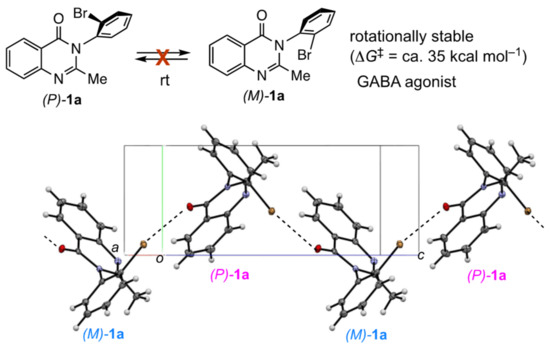
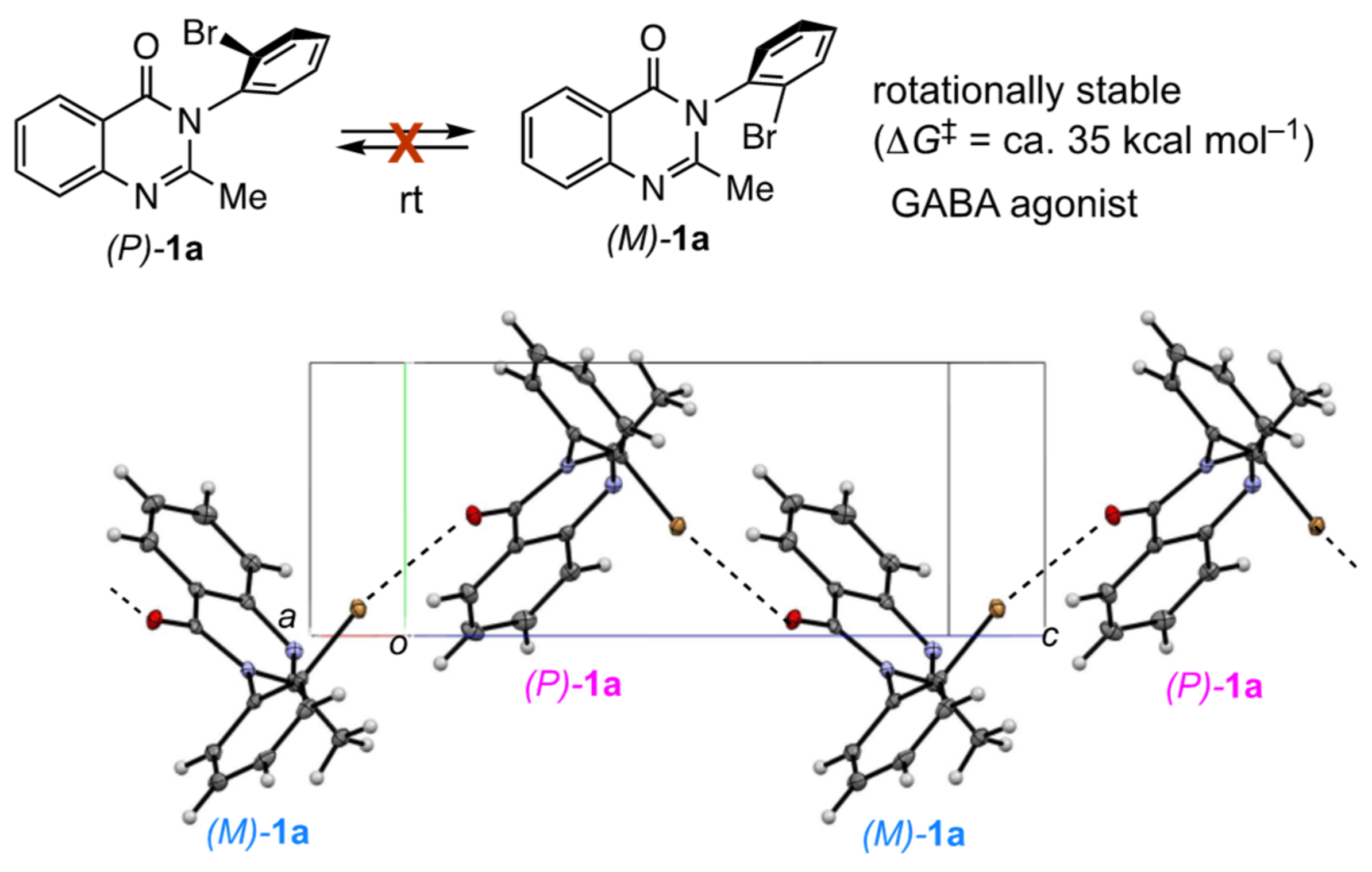
These N-C axially chiral derivatives are also pharmaceutically attractive compounds. For example, 3-(2-halophenyl)quinazolin-4-one derivatives 1a and 1b, which are also known as mebroqualone and mecloqualone, are stable atropisomeric compounds due to the rotational restriction around an N-Ar bond (the rotational barriers = ΔG‡ = ≥31.5 kcal mol−1) and they possess a tranquilizing effect based on GABA receptor agonist activity (Figure 1 and Scheme 1) [13,14]. In 2016, we succeeded in the catalytic asymmetric synthesis of axially chiral mebroqualone 1a and its derivatives [15].
Figure 1.
N-C axially chiral mebroqualone 1a and the intermolecular halogen bond (C=O⋯Br) observed in the crystal of racemic 1a.
Scheme 1.
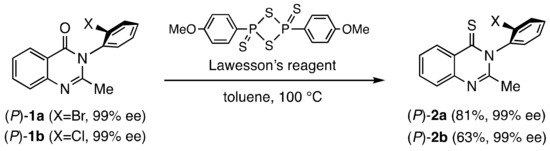
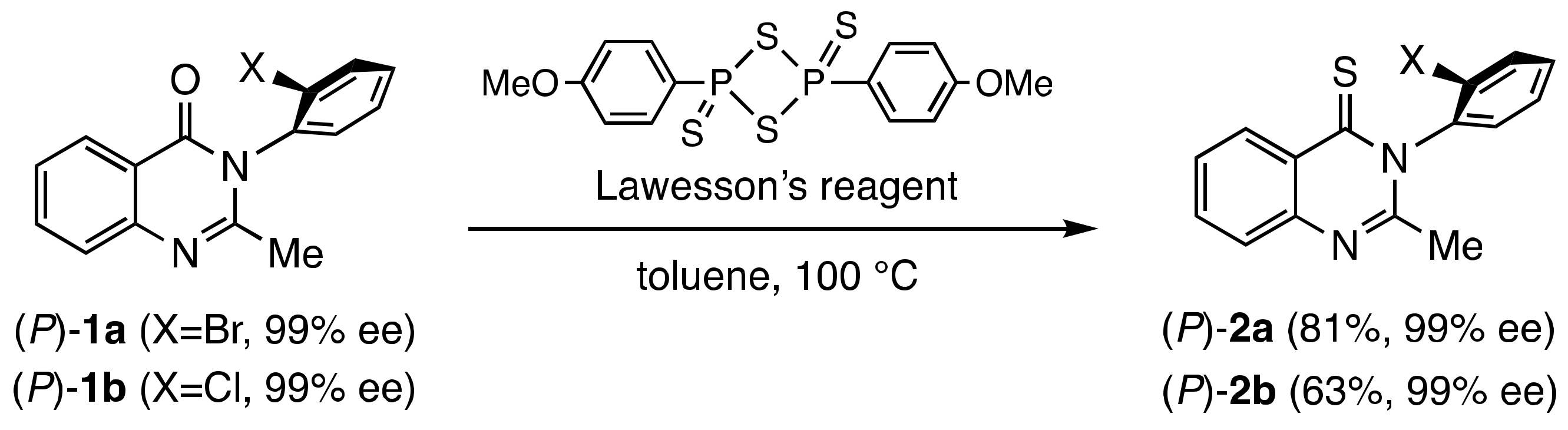
The conversion of optically pure N-C axially chiral quinazolinones to thione analogues.
In the course of this study, a unique property of a halogen bond (chirality-dependent halogen bond) was found in the crystals of 1a and 1b [16]. As shown in Figure 1, in the crystal of racemic 1a (and 1b), an intermolecular halogen bond (C=O⋯X) between the ortho-halogen and carbonyl oxygen atoms was formed, leading to the syndiotactic zig-zag array in which molecules of opposite absolute configuration were alternately connected. In contrast, the analogous formation of a halogen bond was not found in the crystals of optically pure 1a and 1b. Over the last two decades, halogen bonding (X⋯B) has aroused great interest as a new type of noncovalent interaction and has been widely used as an important supramolecular tool in various fields such as crystal engineering, liquid crystals, material science, and biological systems [17,18,19,20,21,22,23,24]. On the other hand, although halogen bond-mediated chiral recognitions and chiral catalysts with halogen bond donor functionality have also been reported, there are relatively few studies on halogen bonding related to molecular chirality such as those shown in Figure 1 [25,26,27,28,29,30]. The halogen bond observed in axially chiral quinazolinones 1a and 1b suggests that in the case of chiral compounds, the corresponding racemic and optically active forms, ought to have different halogen bonding properties, and should be explored as different chemical entities. In addition, since homo- and hetero-chiral associations sometimes affect the pharmacokinetics and drug efficacy [31], the chirality-dependent halogen bond may offer meaningful information to contemplate the difference in pharmacological activity between the optically pure forms and the racemates.
It has been reported that the conversion of quinazolinones to quinazolinone-thione analogues significantly increased their pharmacological activity [32,33,34]. Quite recently, we found that optically pure mebroqualone 1a and mecloqualone 1b can be converted to the corresponding thione analogues, i.e. 3-(2-bromophenyl)-2-methylquinazoline-4-thione (2a) and 3-(2-chlorophenyl)-2-methylquinazoline-4-thione (2b), respectively, without a decrease in enantiomeric excess through the reaction with Lawesson’s reagent (Scheme 1) [35]. The obtained thione derivatives 2a and 2b have higher rotational barriers than the corresponding quinazolinones 1a and 1b. The reaction in Scheme 1 is the first example of the conversion of optically active N-C axially chiral amides to thioamide analogues. The sulfur atom of the C=S group is also known to work as a Lewis base in the halogen bond [36,37,38,39,40,41], while it is less commonly studied in comparison with halogen bonding with C=O and C=N functional groups. We were curious about whether the chirality-dependent halogen bond detected in 1a and 1b is also observed in crystals of the thione analogues 2a and 2b.
In this article, we report the crystal structure and intermolecular halogen bonds (C=S⋯X) which were detected in the crystals of racemic and optically pure N-C axially chiral 3-(2-halophenyl)quinazoline-4-thione derivatives. In contrast to quinazolin-4-one derivatives, in quinazoline-4-thione analogues, the intermolecular halogen bond was detected in not only racemic crystals but also in optically pure crystals. Meanwhile, the halogen bonds in the racemate and optically pure form were found to be oriented in a different direction (angle) toward thiocarbonyl plane.
2. Results and Discussion
2.1. Crystallization and Structure of 2
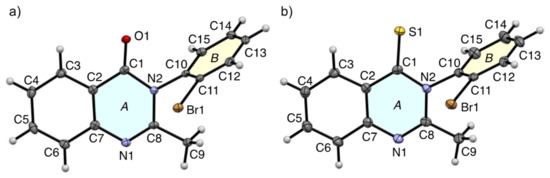
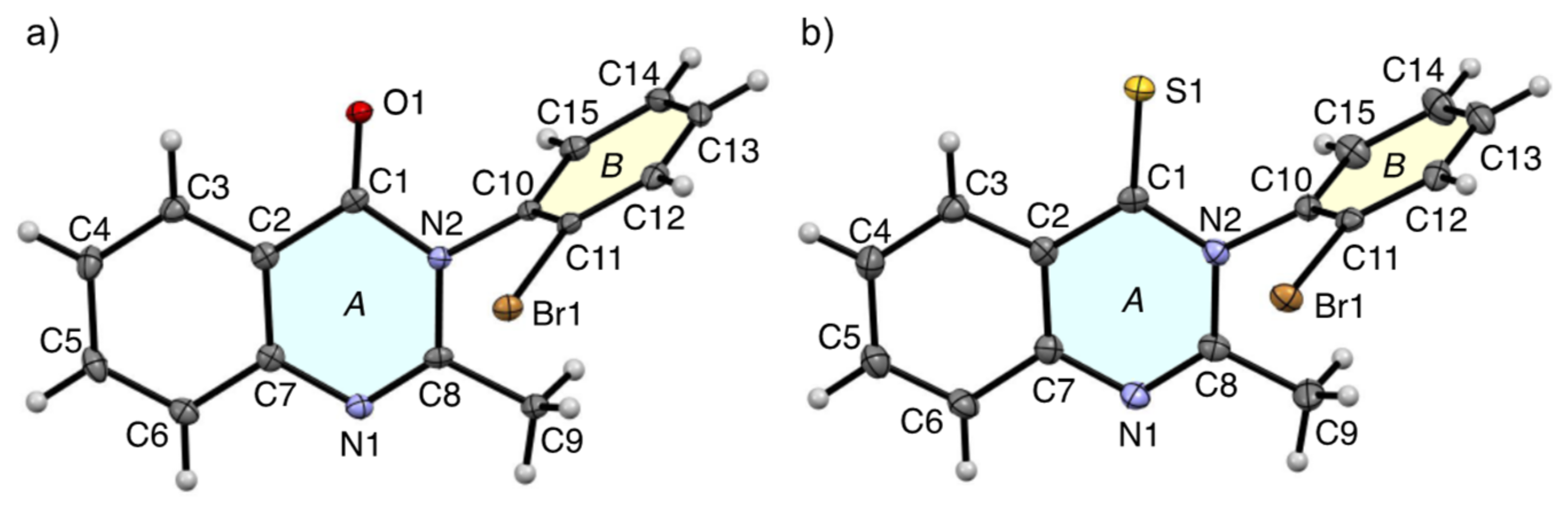
Single crystals of quinazoline-4-thiones 2a and 2b (racemic and optically pure forms) were prepared through recrystallization by natural evaporation from a solution of hexane and chloroform (1:1) which yielded yellow prismatic crystals suitable for X-ray crystallographic studies. Racemates 2a and 2b have an isomorphic relationship with the same Orthorhombic Pbca space group and have quite similar molecular structures. The structure of 2a in the racemic crystals is shown in Figure 2b with the corresponding numbering schemes (the structure of quinazolinone 1a is also shown in Figure 2a for comparison). Selected intramolecular bond distances and angles of racemic 1a,b and 2a,b are summarized in Table 1, showing their similar structure; the bond lengths of C1-S1 for 2a and 2b are 1.659(2) and 1.6587(14) Å, respectively. Most of the molecular structural details are similar, but when oxygen is converted to sulfur, the dihedral angle between ring-A and ring-B of the molecules in the racemic crystals 2a and 2b increases to become orthogonal.
Figure 2.
The molecular structures of (a) 1a (from CCDC1561609) and (b) 2a at 90 and 100 K, respectively, showing the atom-labelling schemes. Displacement ellipsoids are drawn at the 50% probability level.
Table 1.
Selected bond distances (Å) and angles (°) and dihedral angle (°) for racemic 1a, 2a, 1b and 2b.
2.2. Supramolecular Association of 2a
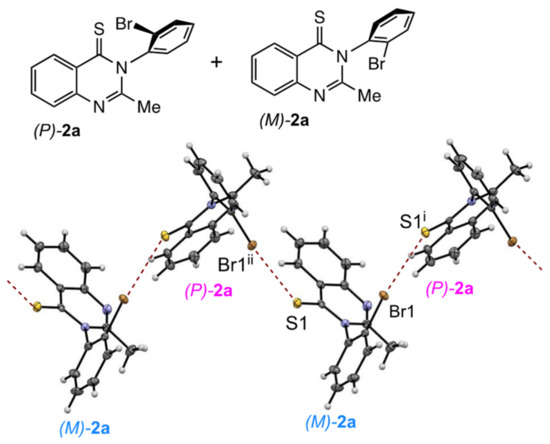
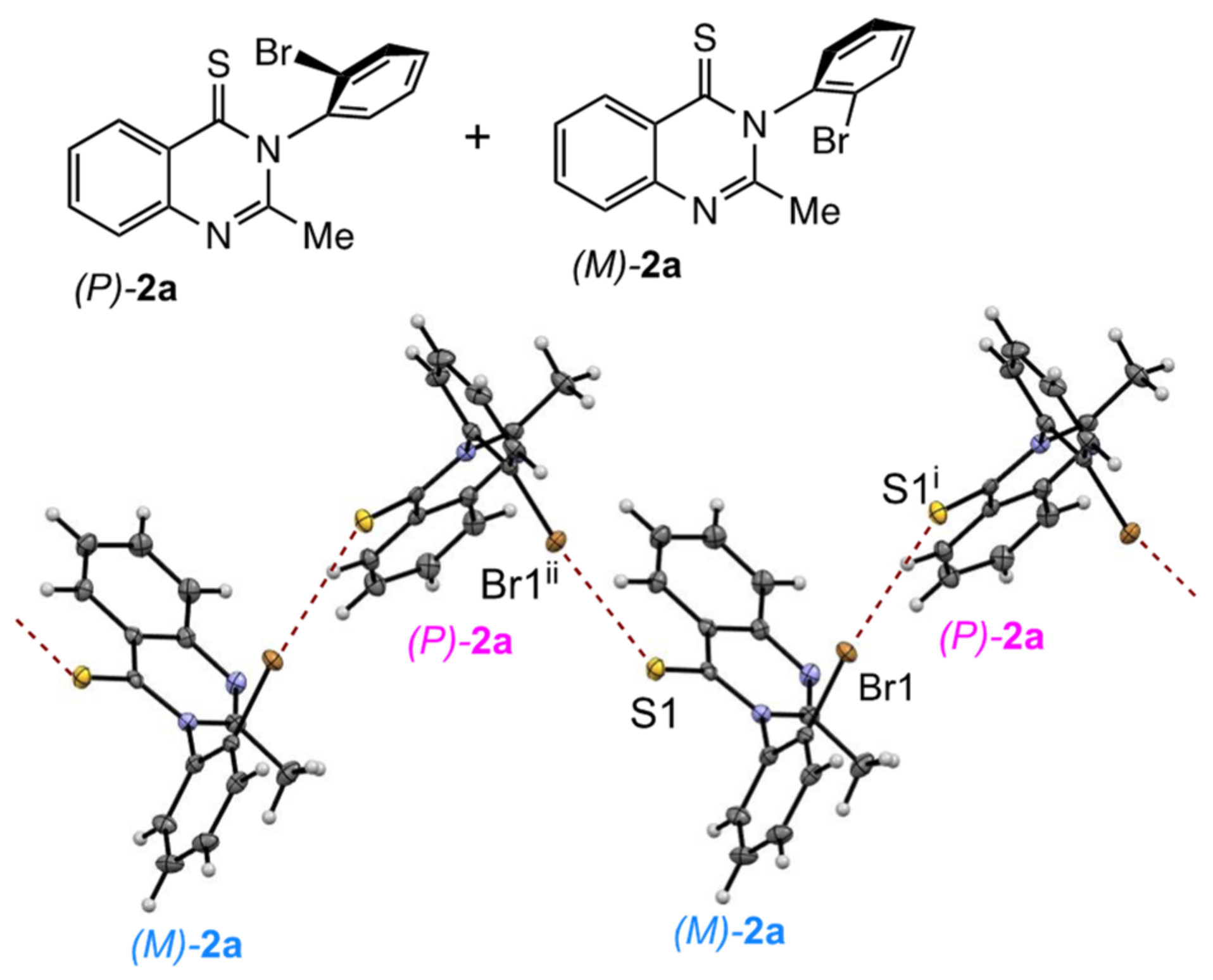
The crystal packing and remarkable halogen bond of racemic mebroqualone thione analogue 2a are shown in Figure 3. The structure of racemic 2a is very similar to that of racemic mebroqualone 1a shown in Figure 1. That is, syndiotactic zig-zag arrays, in which molecules of opposite absolute configuration are alternately connected [⋯(P)-2a⋯(M)-2a⋯], are formed by the intermolecular interaction between the sulfur and ortho-bromine atoms. The intermolecular distance of S⋯Br is 3.4143(6) Å and is 6.5% shorter than the sum of van der Waals radii of bromine and sulfur atoms, which is 3.65 Å. The arrangement of C11-Br1⋯S1i (i: 1/2 − x, 1/2 + y, z) is nearly linear [the bond angle = 172.04(6)°] and this strongly supports the formation of the halogen bond (C=S⋯Br).
Figure 3.
A part of packing structure of racemic 2a at 100 K with 50% probability thermal ellipsoids. Symmetry operations: (i) 1/2 − x, 1/2 + y, z, (ii) 1/2 − x, −1/2 + y, z.
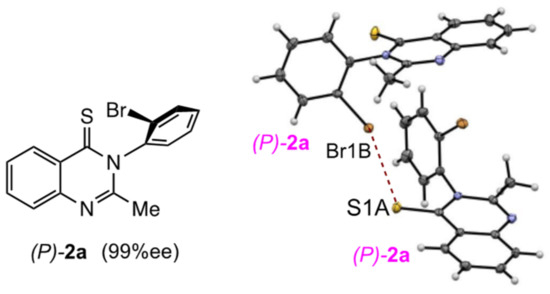
In the crystal of optically pure (P)-2a, although the isotactic arrays were not found, the formation of a homochiral dimer due to the intermolecular interactions between the sulfur and ortho-bromine atoms were detected (Figure 4). The intermolecular distance of S⋯Br is 3.422(1) Å and is 6.2% shorter than the sum of van der Waals radii of bromine and sulfur atoms, which is 3.65 Å. This result is remarkably in contrast to optically pure (P)-1a in which the intermolecular interaction between the carbonyl oxygen and ortho-bromo atoms was not detected. The bond angles of C11B-Br1B⋯S1A is 158.2(1)°, showing a somewhat bent arrangement in comparison with that (172.05°) of racemic 2a; nevertheless, the arrangement would still be within the acceptable range of halogen bonding [40]. Interestingly, the ortho-bromine atom in racemic 2a is located in the periplanar region of the thiocarbonyl group [the torsion angle of C2-C1=S1⋯Br1ii = −19.6(2)°] (ii: 1/2 − x, −1/2 + y, z), while that in (P)-2a lies in the direction orthogonal to the thiocarbonyl plane [the torsion angle of C-C=S⋯Br is 109.0(3)°]. Thus, the angle of halogen bonds toward the thiocarbonyl plane was revealed to be significantly different in racemic 2a and (P)-2a.
Figure 4.
A part of the packing structure of (P)-2a at 100 K with 50% probability thermal ellipsoids.
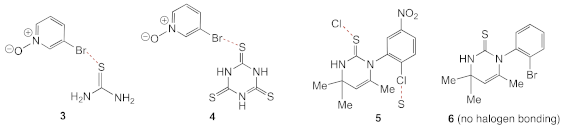
The comparative distances and angles of the detected and previously reported halogen bonds are summarized in Table 2. The intermolecular halogen bonds (C=S⋯Br) between achiral substrates, e.g., thiourea and 3-bromopyridine-N-oxide (3, CCDC1979836) or trithiocyanuric acid and 3-bromopyridine-N-oxide (4, CCDC2011097) have been previously reported [41,42]. The halogen bond in 3 is oriented orthogonally toward the thiocarbonyl plane [the torsion angle of N-C=S⋯Br is 99.88°] like (P)-2a, while the torsion angle of N-C=S⋯Br in 4 was 50.95° and −55.90°. The bond angles of S⋯Br-C in 3 and 4 are 168.11° and 172.54–178.97°, respectively and these values are similar to that (172.04°) of racemic 2a. Although the magnitude of the shortening (2.0%) of halogen bonds in 3 (the distance of S⋯Br is 3.580 Å) was smaller than those (6.5 and 6.2%) in racemic 2a and (P)-2a, those (9.1 and 9.3%) in 4 (the distances of S⋯Br are 3.320 and 3.313 Å) were significantly larger in comparison with those in 2a.
Table 2.
The distances (Å), bond angles (°) and torsion angles (°) of short non-hydrogen intermolecular contacts for 1a, 2a–b, and 3–5.
2.3. Supramolecular Association of 2b
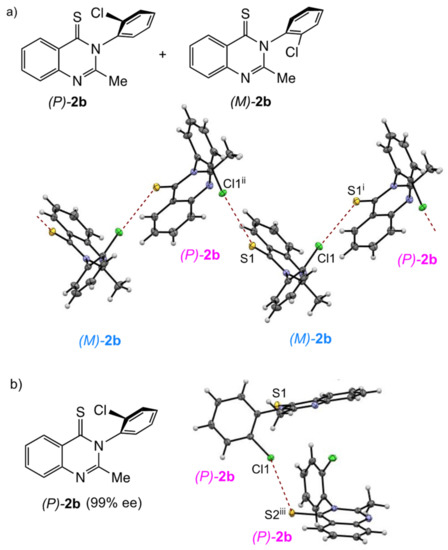
The formation of halogen bonds bearing the different torsion angles (<C-C=S⋯X) detected in racemic 2a and (P)-2a was also observed in 2-methylquinazoline-4-thione 2b, bearing an ortho-chlorophenyl group. The X-ray crystal structures of racemic 2b and optically pure (P)-2b are shown in Figure 5. Similar to the ortho-bromo derivative 2a and quinazolinones 1a,b, in the crystal of racemic 2b, syndiotactic zig-zag arrays [⋯(P)-2b⋯(M)-2b⋯], which were formed by intermolecular halogen bonds between the sulfur and ortho-chloro atoms, were found (Figure 5a). The intermolecular distance of S⋯Cl is 3.4847(6) Å and is 1.8% shorter than the sum of van der Waals radii of chlorine and sulfur atoms, which is 3.55 Å. The bond angle of C11-Cl1⋯S2i is 173.86(5)°, showing the formation of halogen bond (C=S⋯Cl). Similar to racemic 2a, the chlorine atom is located in the periplanar region of the thiocarbonyl plane [the torsion angle of C-C=S⋯Cl is 20.0(2)°].
Figure 5.
Parts of the packing structure of (a) racemic 2b and (b) (P)-2b at 100 K with 50% probability thermal ellipsoids. Symmetry operations: (i) 1/2 − x, 1/2 + y, z, (ii) 1/2 − x, −1/2 + y, z; (iii) x, y, 1 + z.
In the crystal of optically pure (P)-2b, similar to (P)-2a, the formation of a homochiral dimer through the intermolecular interaction between the sulfur and ortho-chloro atoms was found (Figure 5b). The intermolecular distance of S⋯Cl is 3.464(1) Å and is 2.4% shorter than the sum of van der Waals radii of chlorine and sulfur atoms, which is 3.55 Å [In optically pure (P)-1b, no intermolecular O⋯Cl interaction was observed]. The bond angles of C11-Cl1⋯S2iii (iii: x, y, 1 + z) and the torsion angle of C-C=S⋯Cl are 158.2(6)° and 112.3(2)°, respectively. This torsion angle indicates that the halogen bond of (P)-2b is directed orthogonally toward the thiocarbonyl plane, as observed for (P)-2a.
Din et al. previously reported the intermolecular halogen bond (C=S⋯Cl) between the ortho-chloro and sulfur atoms in 1-(2-chloro-5-nitrophenyl)-4,4,6-trimethyl-3,4-dihydropyrimidine-2(1H)-thione 5 (Table 2, CCDC1419338) [43]. The bond angles of S⋯Cl-C and the torsion angle of N-C=S⋯Cl are 166.7° and −49.28°, respectively and these were values between racemic 2b (173.86° and 20.0°) and (P)-2b (156.7 °and 112.3°). The magnitude of the shortening (1.6%) of halogen bond in 5 (the distance of S⋯Cl = 3.493 Å) was slightly smaller than those (1.8 and 2.4%) in racemic 2b and (P)-2b. Although Din et al. didn’t mention on the chirality of pyrimidine-2-thione 5 in the literature, the NMR spectra and X-ray crystal structure suggest that 5 may possess stable N-C axially chiral structure like 2b. Interestingly, in the crystal of 5 (racemate), (P)- and (M)-isotactic arrays, which consist of (P)- and (M)-5, respectively, were formed by the intermolecular halogen bond (C=S⋯Cl). The formation of isotactic array in racemic 5 is remarkably in contrast to syndiotactic array detected in the crystal of racemic 2b. On the other hand, such halogen bonding was not found in the crystal of pyrimidine-2-thione 6 bearing ortho-bromophenyl group (Table 2, CCDC 1063500).
Since the magnitudes of the shortening of the halogen bonds of ortho-chloro derivatives 2b and (P)-2b (1.8% and 2.4%, respectively) are smaller than those of ortho-bromo derivatives 2a and (P)-2a (6.5% and 6.2%, respectively), it is obvious that the S⋯Br interaction is stronger in comparison with the S⋯Cl interaction.
2.4. Crystal Packing of 2a and 2b
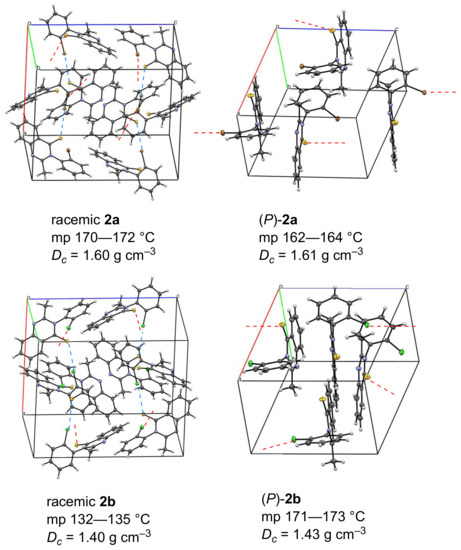
Figure 6 shows the crystal packings in racemic 2a,b and (P)-2a,b. A crystal lattice of racemic 2a,b is constructed by four (P)- and (M)-molecules (total eight molecules), and four halogen bonds between heterochiral molecules are formed in each lattice (blue dashed lines). In addition, four heterochiral halogen bonds with molecules in different lattices were found (red dashed lines). In optically pure (P)-2a,b, the crystal lattice consists of four molecules, and each molecule forms homochiral halogen bonds between molecules in the different lattices (red dashed lines). The melting point and crystal density in racemic 2a and (P)-2a are not so different, while in the ortho-chloro derivative 2b, those of (P)-2b are higher than those of racemic 2b.
Figure 6.
Packing structures of racemic 2a,b and (P)-2a,b.
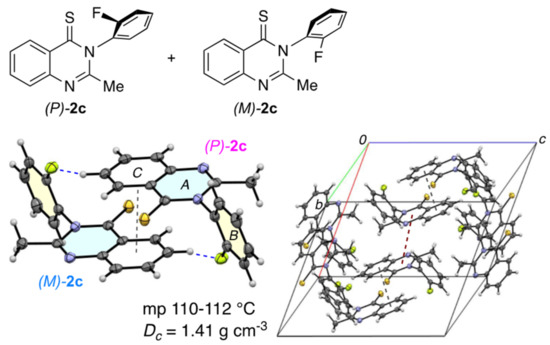
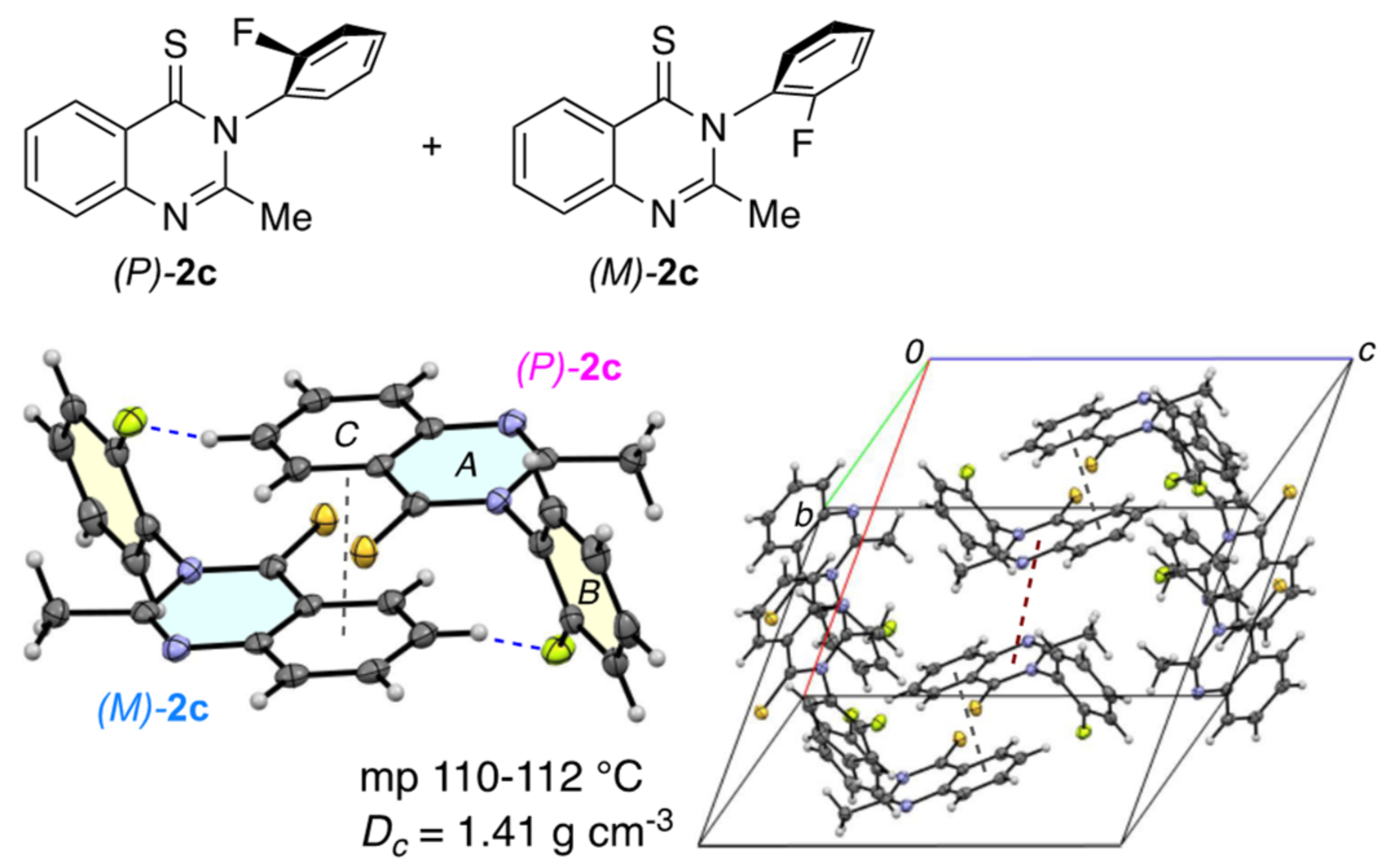
2.5. Crystal Structures of 3-(2-Fluorophenyl)-2-methylquinazoline-4-thione (2c)
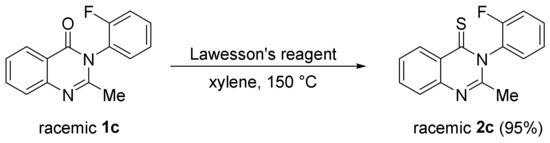
We previously reported that 3-(2-fluorophenyl)-2-methylquinazolin-4-one 1c is a rare atropisomeric compound bearing an ortho-fluorophenyl group and the rotational barrier is high enough (ΔG‡ = 26.1 kcal mol−1) for enantiomer separation via a chiral HPLC method (half-life of racemization = t1/2 = 8.7 days at 298 K) [44]. On the other hand, in the crystal of racemic 1c, the intermolecular halogen bond (C=O⋯F) between the ortho-fluorine and carbonyl oxygen atoms was not found [16]. We converted quinazolinone 1c to the thione analogue 2c through the reaction with Lawesson’s reagent (Scheme 2) and attempted to conduct X-ray crystal structural analysis. The crystallization of 2c was achieved through natural evaporation from a solution of hexane and chloroform (1:1) to give yellow prismatic crystals.
Scheme 2.
The conversion of racemic 3-(2fluorophenyl)quinazolinone 1c to the thione analogue 2c.
Similar to racemic ortho-bromo and chloro derivatives 2a,b, the crystal lattice in racemic 2c is constructed by four (P)- and (M)-molecules (total eight molecules) as shown in Figure 7. The molecular structures of 2a–c are similar but the dihedral angle between ring-A and ring-B of the molecules in the crystal 2c is slightly small, 82.64° in comparison with those in the crystals 2a,b (86.93° and 87.84°, respectively). In the packing structure, the intermolecular π⋯π stackings between quinazolinone rings were found to give the dimer between (P)- and (M)-2c. Typically, the intermolecular distance between two ring-C centroids is 3.5335(13) Å [the corresponding perpendicular distance is 3.3672(8) Å], showing the strong stacked structure, and the dimer further interacts between two ring-A centroids with a distance of 4.2843(12) Å [the corresponding perpendicular distance is 3.4393(7) Å] to give columnar stacking along the a axis. The weak C-H⋯π and CH⋯F interactions were also observed in the packing. Unfortunately, the intermolecular halogen bond (C=S⋯F) between ortho-fluoro and sulfur atoms was not detected. It is well known that the order of strength of the halogen bond is I⋯B > Br⋯B > Cl⋯B >> F⋯B and that halogen bonds (F⋯B) between fluorine atoms and a Lewis base are uncommon.
Figure 7.
Parts of the packing structure of racemic 2c at 100 K with 50% probability thermal ellipsoids.
To understand all the intermolecular interactions, the Hirshfeld surface (HS) analysis [45] was carried out for the crystals of 2a–c using Crystal Explorer 17.5 and the results are summarized in Supplementary Materials. The main interactions for the whole structure of racemic 2a are H(inside)⋯H(outside) and C⋯H/H⋯C contributing 36.5% and 24.7%, respectively, to the overall crystal packing due to the high surface area of the aromatic. The presence of two halogen bonds are found to be the contributions of the S⋯Br (1.2%) and Br⋯S (1.2%) contacts with the sharp finger plots, indicating the 1D alternate zig-zag arrangement. No contribution of the C⋯C (1.0%), Br⋯Br (0%), and S⋯S (0%) shows the predominant halogen bonds. The N⋯H/H⋯N contribution is also observed 5.3% between the quinazoline rings. On the other hand, the results of (P)-2a shows only one-way halogen bonds and the corresponding contributions of the S⋯Br/Br⋯S is 1.0% with the sharp finger plot. The contributions of H⋯H, C⋯H/H⋯C, C⋯C, Br⋯Br, S⋯S, and N⋯H/H⋯N are 35.6%, 27.8%, 0.8%, 1.1%, 0%, and 4.7%, respectively. The characteristics of the interaction of racemic 2a and (P)-2a are also reflected well in chloro-derivatives 2b, but the halogen bonds of 2a are more effective; the S⋯Cl/Cl⋯S for racemic 2b and (P)-2b are 2.1% and 0.9%, respectively. The HS analysis of 2c shows the weak intermolecular interactions and the corresponding contribution of π⋯π, C-H⋯π, and H⋯F interactions through C⋯C (5.4%), C⋯H/H⋯C (23.4%), and H⋯F/F⋯H (9.4%), respectively. The contributions of S⋯F/F⋯S and N⋯H/H⋯N are 1.8% and 7.1%, respectively, on the HS but no direct halogen bonds were detected from the finger plots.
We also succeeded in the synthesis of optically pure 2-methylquinazoline-4-thione bearing an ortho-iodophenyl group, through the reaction shown in Scheme 1. However, since the ortho-iodo derivative is extremely unstable, gradual decomposition occurs during the crystallization and the preparation of a single crystal was not possible.
3. Materials and Methods
3.1. General Information
The melting points were uncorrected. The 1H and 13C NMR spectra were recorded on a 400 MHz spectrometer. In the 1H and 13C NMR spectra, chemical shifts were expressed in δ (ppm) downfield from CHCl3 (7.26 ppm) and CDCl3 (77.0 ppm), respectively. HRMS were recorded on a double focusing magnetic sector mass spectrometer using electron impact ionization. Column chromatography was performed on silica gel (75–150 μm). Medium-pressure liquid chromatography (MPLC) was performed on a 25 × 4 cm i.d. prepacked column (silica gel, 10 μm) with a UV detector. High-performance liquid chromatography (HPLC) was performed on a 25 × 0.4 cm i.d. chiral column with a UV detector.
3.2. Racemic and Optically Pure 3-(2-Halophenyl)-2-methylquinazoline-4-thiones 2a–c
Racemic and optically pure forms of 3-(2-bromophenyl)-2-methylquinazoline-4(3H)-thione (2a) and 3-(2-chlorophenyl)-2-methylquinazoline-4(3H)-thione (2b) were prepared in accordance with the synthetic procedure that we previously reported [15,16,35].
3-(2-Fluorophenyl)-2-methylquinazoline-4(3H)-thione (2c). Under N2 atmosphere, 3-(2-fluorophenyl)-2-methylquinazolin-4(3H)-one 1c [44] (76 mg, 0.3 mmol) and Lawesson’s reagent (182 mg, 0.45 mmol) in xylene (5 mL) were stirred for 3 h under xylene reflux conditions (oil bath at 150 °C). The mixture was poured into water and extracted with AcOEt. The AcOEt extracts were washed with brine, dried over MgSO4, and evaporated to dryness. Purification of the residue by column chromatography (hexane/AcOEt = 6) gave racemic 2c (77 mg, 95%). 2c: yellow solid; mp 110–112 °C (racemate); IR (neat) 1595, 1497 cm−1; 1H NMR (400 MHz, CDCl3) δ: 8.74 (1H, dd, J = 1.2, 7.9 Hz), 7.80 (1H, td, J = 1.2, 6.7 Hz), 7.69 (1H, dd, J = 1.2, 8.6 Hz), 7.48–7.57 (2H, m), 7.28–7.39 (3H, m), 2.32 (3H, s); 13C NMR (100 MHz, CDCl3) δ: 190.3, 157.1 (d, JC–F = 249.8 Hz), 153.1, 142.7, 135.4, 131.8 (d, JC–F = 7.6 Hz), 131.5, 130.0 (d, JC–F = 13.3 Hz), 129.7, 128.7, 128.3, 127.8, 125.9 (d, JC–F = 3.8 Hz), 117.5 (d, JC–F = 19.1 Hz), 25.0; MS (m/z) 271 (MH+); HRMS. Calcd for C15H12FN2S (MH+) 271.0705. Found: 271.0713.
3.3. X-ray Single Crystal Structural Analysis
The single crystal X-ray structures were determined by a Bruker D8 Quest with MoKα radiation (λ = 0.71073 Å) generated at 50 kV and 1 mA. All the crystals were coated with paratone-N oil and measured at 100 K. SHELXT program was used for solving the structures [46]. Refinement and further calculations were carried out using SHELXL [47]. The crystal data and structure refinement of four crystals are summarized in Table 3. H atoms were placed in geometrically idealized positions and refined as riding, with aromatic C-H = 0.95 Å and Uiso(H) = 1.2Ueq(C). The chiral crystal (P)-2b shows the correct absolute structure and the flack parameter is −0.02(3). CCDC 2153821 (rac-2a), 2153822 (rac-2b), 2153823 [(P)-2b], and 2153825 (rac-2c) contain the Supplementary Materials for this paper. These data can be obtained free of charge via http://www.ccdc.cam.ac.uk/conts/retrieving.html, accessed on 3 February 2022. The structural information of CCDC1561609 (rac-1a), 1897963 (rac-1b), and 2032428 [(P)-2a] was used [16,35].
Table 3.
Crystal data and structure refinement for 2.
4. Conclusions
We found that in the crystals of racemic and optically pure N-C axially chiral 3-(2-bromo- and 2-chloro-phenyl)-2-methylquinazoline-4-thiones, different types of intermolecular halogen bonds between ortho-halogens and sulfur atoms are formed. The halogen bonds detected in the racemic crystals are located in the periplanar region of the thiocarbonyl plane, leading to the syndiotactic zig-zag array in which molecules of opposite absolute configuration are alternately connected. The modes of halogen bonding and association are very similar to those detected in the corresponding racemic carbonyl analogues (mebroqualone and mecroqualone). On the other hand, the halogen bonds in the optically pure crystals are oriented orthogonally toward the thiocarbonyl plane, resulting in the formation of a homochiral dimer. This is in remarkable contrast to the optically pure carbonyl analogues in which no intermolecular interaction between carbonyl oxygen and ortho-halogen atoms was detected. Although it is well known that the different types of hydrogen bonding are formed in racemic and enantiomerically pure crystals [48,49], homo- and hetero-chirality dependent halogen bonds mentioned in this paper are quite rare [16]. These results clearly expose the fact that the corresponding racemic and enantiomerically pure forms of chiral substances are expected to display different halogen bonding properties and should be separately studied as different chemical entities.
Supplementary Materials
The following are available online at https://www.mdpi.com/article/10.3390/molecules27072369/s1. Copies of NMR chart for a new compound 2c, and CheckCIF and HS results of compounds 2a–c.
Author Contributions
Synthesis and characterizations, R.M., E.N., T.I., A.S. and Y.N.; single-crystal X-ray diffraction analysis, H.K. and A.H.; writing—review and editing, O.K. and A.H.; supervision and project administration, O.K.; funding acquisition, O.K. All authors have read and agreed to the published version of the manuscript.
Funding
This research was supported by JSPS KAKENHI Grant Number C 20K06945.
Institutional Review Board Statement
Not applicable.
Informed Consent Statement
Not applicable.
Data Availability Statement
Not applicable.
Conflicts of Interest
The authors declare no conflict of interest.
Sample Availability
Samples of the compounds are available from the authors.
References
- Da, B.-C.; Tan, B. Application for Axially Chiral Ligands. In Axially Chiral Compounds: Asymmetric Synthesis and Applications Part II; Tan, B., Ed.; Wiley-Vch: Hoboken, NJ, USA, 2021; pp. 245–274. [Google Scholar] [CrossRef] [Scilit]
- Akiyama, T. Application for Axially Chiral Organocatalyst. In Axially Chiral Compounds: Asymmetric Synthesis and Applications Part II; Tan, B., Ed.; Wiley-Vch: Hoboken, NJ, USA, 2021; pp. 275–296. [Google Scholar] [CrossRef] [Scilit]
- Keller, P.A.; Butler, N.M.; McCosker, P.M. Axially Chiral Natural Products and Bioactive Compounds. In Atropisomerism and Axially Chirality; Lassaletta, J.M., Ed.; World Scientific: Singapore, 2019; pp. 611–656. [Google Scholar] [CrossRef] [Scilit]
- Wang, Y.-B.; Xiang, S.-H.; Tan, B. Application in Drugs and Materials. In Axially Chiral Compounds: Asymmetric Synthesis and Applications Part II; Tan, B., Ed.; Wiley-Vch: Hoboken, NJ, USA, 2021; pp. 297–315. [Google Scholar] [CrossRef] [Scilit]
- Bringmann, G.; Mortimer, A.J.P.; Keller, P.A.; Gresser, M.J.; Garner, J.; Breuning, M. Atroposelective Synthesis of Axially Chiral Biaryl Compounds. Angew. Chem. Int. Ed. 2005, 44, 5384–5427. [Google Scholar] [CrossRef] [Scilit] [PubMed]
- Loxq, P.; Manoury, E.; Poli, R.; Deydier, E.; Labande, A. Synthesis of Axially Chiral Biaryl Compounds by Asymmetric Catalytic Reactions with Transition Metals. Coord. Chem. Rev. 2016, 308, 131–190. [Google Scholar] [CrossRef] [Scilit]
- Alkorta, I.; Elguero, J.; Roussel, C.; Vanthuyne, N.; Piras, P. Atropisomerism and Axial Chirality in Heteroaromatic Compounds. Adv. Heterocycl. Chem. 2012, 105, 1–188. [Google Scholar] [CrossRef] [Scilit]
- Kitagawa, O.; Takahashi, M.; Yoshikawa, M.; Taguchi, T. Efficient Synthesis of Optically Active Atropisomeric Anilides through Catalytic Asymmetric N-Arylation Reaction. J. Am. Chem. Soc. 2005, 127, 3676–3677. [Google Scholar] [CrossRef] [Scilit]
- Ototake, N.; Morimoto, Y.; Mokuya, A.; Fukaya, H.; Shida, Y.; Kitagawa, O. Catalytic Enantioselective Synthesis of Atropisomeric Indoles Having an N-C Chiral Axis. Chem. Eur. J. 2010, 16, 6752–6755. [Google Scholar] [CrossRef] [Scilit]
- Takahashi, I.; Suzuki, Y.; Kitagawa, O. Asymmetric Synthesis of Atropisomeric Compounds with an N-C Chiral Axis. Org. Prep. Proc. Int. 2014, 46, 1–23. [Google Scholar] [CrossRef] [Scilit]
- Kitagawa, O. Chiral Pd-Catalyzed Enantioselective Syntheses of Various N-C Axially Chiral Compounds and Their Synthetic Application. Acc. Chem. Res. 2021, 54, 719–730. [Google Scholar] [CrossRef] [Scilit]
- Wu, W.-J.; Liao, G.; Shi, B.-F. Stereoselective construction of atropisomerers feauring a C-N chiral axis. Green Syn. Catal. 2022, in press. [Google Scholar] [CrossRef] [Scilit]
- Grishina, V.M. Relation between chemical structure and action in a series of halosubstituted 4-quinolinones. Tr. Perm. Farm. Inst. 1967, 2, 9–11. [Google Scholar]
- Koe, B.K.; Minor, K.W.; Kondratas, E.; Lebel, L.A.; Koch, S.W. Enhancement of benzodiazepine binding by methaqualone and related quinazolinones. Drug Dev. Res. 1986, 7, 255–268. [Google Scholar] [CrossRef] [Scilit]
- Hirai, M.; Terada, S.; Yoshida, H.; Ebine, K.; Hirata, T.; Kitagawa, O. Catalytic Enantioselective Synthesis of N-C Axially Chiral Mebroqualone and Its Derivatives through Reductive Asymmetric Desymmetrization. Org. Lett. 2016, 18, 5700–5703. [Google Scholar] [CrossRef] [Scilit] [PubMed]
- Imai, T.; Niijima, E.; Terada, S.; Wzorek, A.; Soloshonok, V.A.; Hori, A.; Kitagawa, O. Chirality-dependent halogen bond in axially chiral quinazolin-4-one derivatives bearing ortho-halophenyl group. CrystEngComm 2019, 21, 3385–3389. [Google Scholar] [CrossRef] [Scilit]
- Metrangolo, P.; Neukirch, H.; Pilati, T.; Resnati, G. Halogen Bonding Based Recognition Processes: A World Parallel to Hydrogen Bonding. Acc. Chem. Res. 2005, 38, 386–395. [Google Scholar] [CrossRef] [Scilit] [PubMed]
- Parisini, E.; Metrangolo, P.; Pilati, T.; Resnati, G.; Terraneo, G. Halogen bonding in halocarbon–protein complexes: A structural survey. Chem. Soc. Rev. 2011, 40, 2267–2278. [Google Scholar] [CrossRef] [Scilit] [PubMed]
- Erdélyi, M. Halogen bonding in solution. Chem. Soc. Rev. 2012, 41, 3547–3557. [Google Scholar] [CrossRef] [Scilit]
- Beale, T.M.; Chudzinski, M.G.; Sarwar, M.G.; Taylor, M.S. Halogen bonding in solution: Thermodynamics and applications. Chem. Soc. Rev. 2013, 42, 1667–1680. [Google Scholar] [CrossRef] [Scilit]
- Gilday, L.C.; Robinson, S.W.; Barendt, T.A.; Langton, M.J.; Mullaney, B.R.; Beer, P.D. Halogen Bonding in Supramolecular Chemistry. Chem. Rev. 2015, 115, 7118–7195. [Google Scholar] [CrossRef] [Scilit]
- Cavallo, G.; Metrangolo, P.; Milani, R.; Pilati, T.; Priimagi, A.; Resnati, G.; Terraneo, G. The Halogen Bond. Chem. Rev. 2016, 116, 2478–2601. [Google Scholar] [CrossRef] [Scilit]
- Bulfield, D.; Huber, S.M. Halogen Bonding in Organic Synthesis and Organocatalysis. Chem. Eur. J. 2016, 22, 14434–14450. [Google Scholar] [CrossRef] [Scilit]
- Mendez, L.; Henriquez, G.; Sirimulla, S.; Narayan, M. Looking Back, Looking Forward at Halogen Bonding in Drug Discovery. Molecules 2017, 22, 1397. [Google Scholar] [CrossRef] [Scilit]
- Farina, A.; Meille, S.V.; Messina, M.T.; Metrangolo, P.; Resnati, G.; Vecchio, G. Resolution of Racemic 1,2-Dibromohexafluoropropane through Halogen-Bonded Supramolecular Helices. Angew. Chem. Int. Ed. 1999, 38, 2433–2436. [Google Scholar] [CrossRef]
- Lindsay, V.N.G.; Charette, A.B. Design and Synthesis of Chiral Heteroleptic Rhodium(II) Carboxylate Catalysts: Experimental Investigation of Halogen Bond Rigidification Effects in Asymmetric Cyclopropanation. ACS Catal. 2012, 2, 1221–1225. [Google Scholar] [CrossRef] [Scilit]
- Nakatsuji, H.; Sawamura, Y.; Sakakura, A.; Ishihara, K. Cooperative Activation with Chiral Nucleophilic Catalysts and N-Haloimides: Enantioselective Iodolactonization of 4-Arylmethyl-4-pentenoic Acids. Angew.Chem. Int. Ed. 2014, 53, 6974–6977. [Google Scholar] [CrossRef] [Scilit] [PubMed]
- Sasaki, T.; Ida, Y.; Hisaki, I.; Tsuzuki, S.; Tohnai, N.; Coquerel, G.; Sato, H.; Miyata, M. Construction of Chiral Polar Crystals from Achiral Molecules by Stacking Control of Hydrogen-Bonded Layers Using Type II Halogen Bonds. Cryst. Growth Des. 2016, 16, 1626–1635. [Google Scholar] [CrossRef] [Scilit]
- Lim, J.Y.C.; Marques, I.; Félix, V.; Beer, P.D. Enantioselective Anion Recognition by Chiral Halogen-Bonding Rotaxanes. J. Am. Chem. Soc. 2017, 139, 12228–12239. [Google Scholar] [CrossRef] [Scilit]
- Kuwano, S.; Suzuki, T.; Hosaka, Y.; Arai, T. A chiral organic base catalyst with halogen-bonding-donor functionality: Asymmetric Mannich reactions of malononitrile with N-Boc aldimines and ketimines. Chem. Commun. 2018, 54, 3847–3850. [Google Scholar] [CrossRef] [Scilit]
- Tokunaga, E.; Yamamoto, T.; Ito, E.; Shibata, N. Understanding the Thalidomide Chirality in Biological Processed by the Self-dispoportionation of Enantiomers. Sci. Rep. 2018, 8, 17131. [Google Scholar] [CrossRef] [Scilit]
- Jantová, S.; Greif, G.; Spirková, K.; Stankovský, S.; Oravcová, M. Antibacterial effects of trisubstituted quinazoline derivatives. Folia Microbiol. 2000, 45, 133–1337. [Google Scholar] [CrossRef] [Scilit]
- Kubicová, L.; Sustr, M.; Král’ová, K.; Chobot, V.; Vytlacilová, J.; Jahodár, L.; Vourela, P.; Machácek, M.; Kaustová, J. Synthesis and Biological Evaluation of Quinazoline-4-thiones. Molecules 2003, 8, 756–769. [Google Scholar] [CrossRef] [Scilit]
- El-Azab, A.S.; Eltahir, K.E.H. Design and synthesis of novel 7-aminoquinazoline derivatives: Antitumor and anticonvulsant activities. Bioorg. Med. Chem. Lett. 2012, 22, 1879–1885. [Google Scholar] [CrossRef] [Scilit]
- Niijima, E.; Imai, T.; Suzuki, H.; Fujimoto, Y.; Kitagawa, O. Thionation of Optically Pure N-C Axially Chiral Quinazolin-4-one Derivatives with Lawesson’s Reagent. J. Org. Chem. 2021, 86, 709–715. [Google Scholar] [CrossRef] [Scilit]
- Jay, J.I.; Padgett, C.W.; Walsh, R.D.B.; Hanks, T.W.; Pennington, W.T. Noncovalent Interactions in 2-Mercapto-1-methylimidazole Complexes with Organic Iodides. Cryst. Growth Des. 2001, 1, 501–507. [Google Scholar] [CrossRef] [Scilit]
- Arman, H.D.; Gieseking, R.L.; Hanks, T.W.; Pennington, W.T. Complementary halogen and hydrogen bonding: Sulfuriodine interactions and thioamide ribbons. Chem. Commun. 2010, 46, 1854–1856. [Google Scholar] [CrossRef] [Scilit] [PubMed]
- Le Questel, J.Y.; Laurence, C.; Graton, J. Halogen-bond interactions: A crystallographic basicity scale towards iodoorganic compounds. CrystEngComm 2013, 15, 3212. [Google Scholar] [CrossRef] [Scilit]
- Eccles, K.S.; Morrison, R.E.; Sinha, A.S.; Maguire, A.R.; Lawrence, S.E. Investigating C=S·I Halogen Bonding for Cocrystallization with Primary Thioamides. Cryst. Growth Des. 2015, 15, 3442–3451. [Google Scholar] [CrossRef] [Scilit]
- Happonen, L.; Rautiainen, J.M.; Valkonen, A. Halogen Bonding between Thiocarbonyl compounds and 1,2- and 1,4-Diiodotetrafluorobenzenes. Cryst. Growth Des. 2021, 21, 3409–3419. [Google Scholar] [CrossRef] [Scilit]
- Wzgarda-Raj, K.; Rybarczyk-Pirek, A.J.; Wojtulewski, S.; Palusiak, M. C–Br⋯S halogen bonds in novel thiourea N-oxide cocrystal: Analysis of energetic and QTAIM parameters. Acta Cryst. 2020, C76, 170–176. [Google Scholar] [CrossRef] [Scilit]
- Wzgarda-Raj, K.; Palusiak, M.; Wojtulewski, S.; Rybarczyk-Pirek, A.J. The role of sulfur interactions in crystal architecture: Experimental and quantum theoretical studies on hydrogen, halogen, and chalcogen bonds in trithiocyanuric acid–pyridine N-oxide co-crystals. CrystEngComm 2021, 23, 324–334. [Google Scholar] [CrossRef] [Scilit]
- Andleeb, S.; Rauf, M.K.; Azam, S.S.; Badshah, A.; Sadaf, H.; Raheel, A.; Tahir, M.N.; Razac, S. A one-pot multicomponent facile synthesis of dihydropyrimidin-2(1H)-thione derivatives using triphenylgermane as a catalyst and its binding pattern validation. RSC Adv. 2016, 6, 79651–79661. [Google Scholar] [CrossRef] [Scilit]
- Iida, A.; Matsuoka, M.; Hasegawa, H.; Vanthuyne, N.; Farran, D.; Roussel, C.; Kitagawa, O. N-C Axially Chiral Compounds with an ortho-Fluoro Substituents and Steric Discrimination between Hydrogen and Fluorine Atoms Based on a Diastereoselective Model Reaction. J. Org. Chem. 2019, 84, 3169–3175. [Google Scholar] [CrossRef] [Scilit]
- Spackman, M.A.; Jayatilaka, D. Hirshfeld surface analysis. CrystEngComm 2009, 11, 19–32. [Google Scholar] [CrossRef] [Scilit]
- Sheldrick, G.M. SHELXT-Integrated space-group and crystal-structure determination. Acta Cryst. 2015, A71, 3–8. [Google Scholar] [CrossRef] [Scilit] [PubMed]
- Sheldrick, G.M. Crystal structure refinement with SHELXL. Acta Cryst. 2015, C71, 3–8. [Google Scholar] [CrossRef] [Scilit]
- Soloshonok, V.A.; Ueki, H.; Yasumoto, M.; Mekela, S.; Hirschi, J.S.; Singleton, D.A. Phenomenon of Optical Self-purification of Chiral Non-racemic Compounds. J. Am. Chem. Soc. 2007, 129, 12112–12113. [Google Scholar] [CrossRef] [Scilit] [PubMed]
- Alkorta, I.; Elguero, J. Self-Discrimination of Enantiomers in Hydrogen-Bonded dimers. J. Am. Chem. Soc. 2002, 124, 1488–1493. [Google Scholar] [CrossRef] [Scilit] [PubMed]

Publisher’s Note: MDPI stays neutral with regard to jurisdictional claims in published maps and institutional affiliations. |
© 2022 by the authors. Licensee MDPI, Basel, Switzerland. This article is an open access article distributed under the terms and conditions of the Creative Commons Attribution (CC BY) license (https://creativecommons.org/licenses/by/4.0/).