Review

Graphene-Based Nanomaterials as Efficient Peroxidase Mimetic Catalysts for Biosensing Applications: An Overview
1
Department of Chemistry, National Tsing Hua University, Hsinchu 30013, Taiwan
2
Department of Chemistry, Government Degree College, Champawat 262523, Uttarakhand, India
*
Authors to whom correspondence should be addressed.
Molecules 2015, 20(8), 14155-14190; https://doi.org/10.3390/molecules200814155

Submission received: 23 June 2015 / Accepted: 27 July 2015 / Published: 4 August 2015
(This article belongs to the Special Issue Frontier in Green Chemistry Approaches)

Abstract

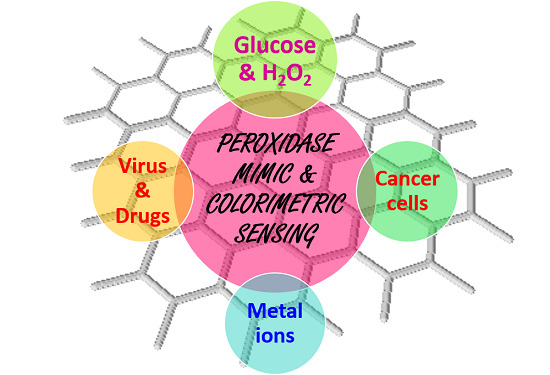
“Artificial enzymes”, a term coined by Breslow for enzyme mimics is an exciting and promising branch of biomimetic chemistry aiming to imitate the general and essential principles of natural enzymes using a variety of alternative materials including heterogeneous catalysts. Peroxidase enzymes represent a large family of oxidoreductases that typically catalyze biological reactions with high substrate affinity and specificity under relatively mild conditions and thus offer a wide range of practical applications in many areas of science. The increasing understanding of general principles as well as intrinsic drawbacks such as low operational stability, high cost, difficulty in purification and storage, and sensitivity of catalytic activity towards atmospheric conditions of peroxidases has triggered a dynamic field in nanotechnology, biochemical, and material science that aims at joining the better of three worlds by combining the concept adapted from nature with the processability of catalytically active graphene-based nanomaterials (G-NMs) as excellent peroxidase mimetic catalysts. This comprehensive review discusses an up-to-date synthesis, kinetics, mechanisms, and biosensing applications of a variety of G-NMs that have been explored as promising catalysts to mimic natural peroxidases.
Keywords: graphene; graphene oxide; graphene-based nanomaterials; peroxidases; enzyme mimetics; heterogeneous catalysts; biosensing and diagnostics; tetramethylbenzidine; hydrogen peroxide graphene; graphene oxide; graphene-based nanomaterials; peroxidases; enzyme mimetics; heterogeneous catalysts; biosensing and diagnostics; tetramethylbenzidine; hydrogen peroxide
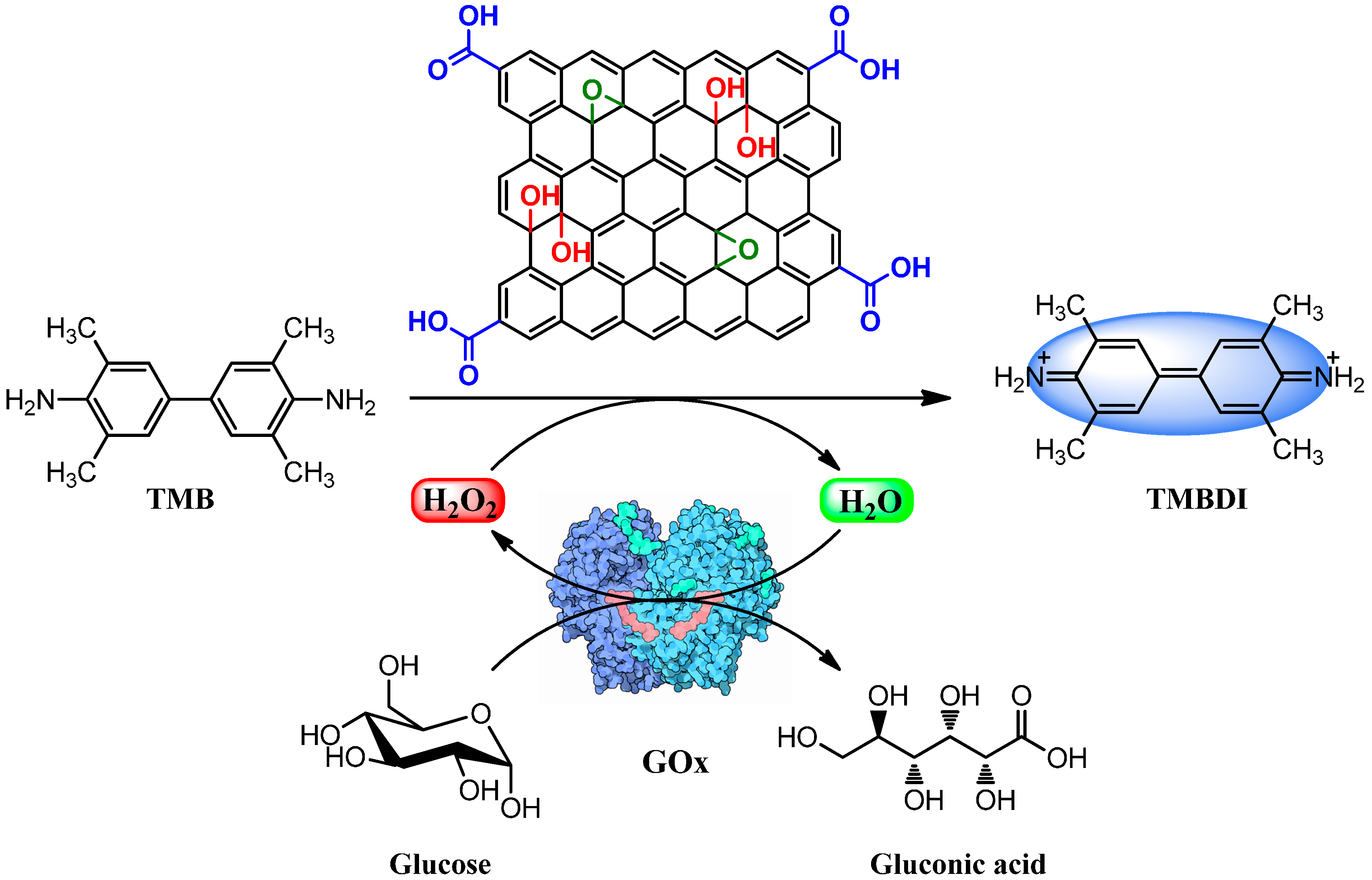
Graphical Abstract