


Abstract
The purpose of this research is to examine the factors affecting consumer attitude within the context of green credit card services. Specifically, this research examines (1) the effect of individual characteristics (i.e., green knowledge, innovativeness) on attitude toward green credit card services; and (2) the mediating role of self-accountability and the moderating role of regulatory focus in the relationships. With a sample of 1000 green credit/debit card users, structural equation modelling and moderated mediation analyses were implemented to investigate the relationships involving green knowledge, innovativeness, self-accountability, regulatory focus, and attitude. The results indicate that (1) while the effect of green knowledge on attitude is not significant, innovativeness has a positive impact on attitude; (2) self-accountability mediates the relationship between (a) green knowledge and (b) innovativeness and attitude; and (3) regulatory focus moderates the relationship between self-accountability and attitude, such that the positive relationship is stronger for consumers with a prevention (vs. promotion) focus. Furthermore, moderated mediation was observed; that is, the mediation effects of self-accountability on the relationship between (a) green knowledge and (b) innovativeness and attitude are stronger for prevention- (vs. promotion-) focused consumers. The findings provide an important insight into how credit card companies approaching ESG issues can enhance their consumers’ attitude toward green credit card services.
1. Introduction
As the concerns related to global warming, climate change, depletion of natural resources, and air and water pollution increase, more consumers are becoming conscious of environmental degradations [1]. The environmental degradations yielded the emergence of green marketing and sustainability/ESG practices of organizations [2,3]. Green marketing within business involves the development and marketing of green products/services and stimulating pro-environmental attitudes and behaviors [4]. Likewise, in the financial services industry, financial institutions and banks are responsible for bringing ethical finance and green finance as a priority, and thus they must market products/services related to green finance [5]. Green products/services associated with green finance achieve resource utilization efficiency followed by improved financial performance [6]. A green credit card, in particular, is one of the widely adopted green financing strategies [7]. Revitalizing the eco-friendly life of the people, a green credit card offers various benefits to card users for supporting the environment [8]. For example, green credit cards help card users deposit points by calculating the distance which they travel on foot or by bicycle.
Many earlier studies have identified numerous factors affecting consumers’ green attitude and purchase behavior [1,9,10,11,12,13,14,15,16]. In the financial services sector, however, there has been little research on the factors influencing green consumption behavior, with notable exceptions [8,17,18,19]. Moreover, little is known about the mediating and moderating mechanisms underlying the relationships between individual factors and green consumption attitude. Therefore, the current research aims to investigate the factors influencing consumer attitude within the context of green credit card services. Of all the factors that can affect consumer attitude, in particular, we mainly focus on individual characteristics such as green knowledge, innovativeness, self-accountability, and regulatory focus. That is, we examine the relationships between the individual characteristics (i.e., green knowledge, innovativeness) and attitude toward green credit card services and further examine the underlying mediation and moderation mechanisms. Specifically, we construct a moderated mediation model to answer the following main questions: (1) whether self-accountability would mediate the link between (a) green knowledge and (b) innovativeness and attitude; (2) whether regulatory focus would moderate the direct link between self-accountability and attitude; and (3) whether regulatory focus would moderate the mediating effect of self-accountability.
In sum, the present research first tests the effect of individual characteristics (i.e., green knowledge, innovativeness) on attitude toward green credit card services. This research also examines the relationships by investigating the mediating role of self-accountability and the moderating role of regulatory focus. Furthermore, this research examines a moderated mediation model of self-accountability and regulatory focus. More specifically, we propose that (1) (a) green knowledge, (b) innovativeness, and (c) self-accountability have a positive impact on attitude toward green credit card services; (2) self-accountability mediates the relationship between (a) green knowledge and (b) innovativeness and attitude toward green credit card services; (3) regulatory focus moderates the relationship between self-accountability and attitude toward green credit card services, such that the positive relationship is stronger for prevention-focused than for promotion-focused consumers; and (4) the mediation effect of self-accountability on the relationship between (a) green knowledge and (b) innovativeness and attitude toward green credit card services is stronger for prevention-focused than for promotion-focused consumers.
2. Theoretical Framework and Hypotheses Development
2.1. Green Knowledge, Innovativeness, and Attitude
Attitude represents what consumers like and dislike and consumers’ purchasing decisions are often based on their attitudes [20,21]. Attitude has been emphasized as one of the vital antecedents of behavioral intention and actual behavior in the studies of green consumer psychology [22]. Attitude captures consumers’ evaluation of perceived benefit and cost implications of green products consumption [23]. Previous green marketing studies have noted that consumer attitude toward green products or services significantly influences green purchase intention [1,12,13,24,25].
Green knowledge, also known as “environmental knowledge” or “ecological knowledge,” is defined as the general knowledge of facts, concepts and relationship concerning the natural environment and its major ecosystem [26]. Aini et al. [27] defined green knowledge as the individual’s capability to assess the impacts of environment and ecosystems on the society, and an individual’s amount of knowledge on environmental issues, including the problems, causes, solutions, and others. According to Darnall et al. [28,29], there are two types of green knowledge: general knowledge and action-based knowledge. General knowledge involves a broad awareness of basic terminologies and concepts about environmental issues, whereas action-based knowledge relates to consumers’ understanding of the activities and solutions required to reduce environmental problems. Similarly, Schahn and Holzer [30] distinguished factual knowledge from action-based knowledge. Compared to general or factual knowledge, action-related knowledge is more likely to influence behavior [31].
Previous studies relevant to green purchasing show that an individual’s ecological behavior is influenced by their knowledge of environmental issues as environmental knowledge influences individuals’ motivation and ability to act in an environmentally friendly way [29,32,33,34]. Specifically, most studies have shown that consumers’ knowledge of social and environmental issues positively influences their attitude and actual purchasing of green products [1,22,31,35,36,37,38], whereas some studies have reported only a weak relation between the consumers’ level of knowledge and environmental concern, attitude, and actual green purchase decision [39]. One possible explanation for this may be that only a basic understanding of ecological and social problems might not be enough to motivate consumers towards adopting sustainable consumption practices [10]. Overall, the above findings suggest that green knowledge can have a positive impact on consumer attitude toward green products or services. Accordingly, the following hypothesis is proposed:
Hypothesis 1 (H1):
Green knowledge has a positive influence on attitude toward green credit card services.
Consumer innovativeness is a consumer’s predisposition to seek out and try or accept new products [40,41]. For most consumers, trying green products and environmentally responsible behaviors are innovative actions [42]. To the extent that pro-environmental actions are perceived as new and/or uncommon, a consumer’s propensity to be innovative would influence the likelihood of engaging in pro-environmental behavior [43]. As compared with ordinary products/services, sustainable products/services offer greater economic and environmental benefits and values, thereby leading consumers with higher innovativeness to perceive the benefits of sustainable products/services and thus develop a positive attitude toward sustainable products/services [44,45]. In a similar vein, extant studies have provided evidence on the presence of a significant positive effect of consumer innovativeness on green consumption behavior [9,25,46,47,48,49]. Accordingly, the following hypothesis is proposed:
Hypothesis 2 (H2):
Innovativeness has a positive influence on attitude toward green credit card services.
2.2. The Mediating Role of Self-Accountabiility
Self-accountability is defined as the activation of a person’s desire to live up to internal self-standards [50]. Prior studies have stressed the importance of self-accountability in inducing consumers’ ethical consumption behaviors and environmentally friendly behaviors [50,51,52,53]. In the context of green consumption, self-accountability refers to the desire of consumers to practice environmental self-standards. When environmental self-accountability as a source of motivation for green consumption is prominent, consumers are more likely to adhere to these standards and assess or adjust their actions according to these criteria [50]. Thus, consumers’ environmental self-accountability positively affects their attitudes toward green buying [16,35,54]. Accordingly, the following hypothesis is proposed:
Hypothesis 3 (H3):
Self-accountability has a positive influence on attitude toward green credit card services.
As stated, green knowledge as well as innovativeness affect individuals’ motivation and ability to act in an environmentally friendly way [32,34,43]. Thus, consumers who have environmental knowledge and higher innovativeness are more likely to be accountable for environmental issues and problems [34,35,55]. That is, consumers’ green knowledge as well as innovativeness can serve as a driver of environmental self-accountability, thereby influencing consumer attitude toward green products or services. Hence, based on the above discussion, it can be postulated that self-accountability is a mediator linking the relationship between (a) green knowledge and (b) innovativeness and attitude toward green credit card services. Consequently, the following hypotheses are proposed:
Hypothesis 4 (H4):
Self-accountability mediates the relationship between green knowledge and attitude toward green credit card services.
Hypothesis 5 (H5):
Self-accountability mediates the relationship between innovativeness and attitude toward green credit card services.
2.3. The Moderating Role of Regulatory Focus
According to Higgins’ regulatory focus theory [56], two types of motivational orientations co-exist in every individual: promotion focus, characterized by a focus on hopes, aspirations, and the attachment of positive outcomes, and prevention focus, characterized by a focus on responsibilities, duties, and the avoidance of negative outcomes. Regarding the effect of individuals’ regulatory focus on their ethical behavior, prior studies have shown that prevention focus is more compatible with consumer ethics than promotion focus [2,57,58,59]. In a similar vein, recent research by Kim [8] found that prevention- (vs. promotion-) focused individuals have more ethical behavioral intentions in the context of green credit card services.
As noted, heightening self-accountability makes consumers become more aware of the importance of their desired responsibilities and duties, thereby enhancing consumers’ ethical behavior [50,51,52,53]. Moreover, drawing on the regulatory focus theory [56], prevention- (vs. promotion-) focused consumers perceive their self-standards, responsibilities, and duties as more important. Combined, we predict that the effect of self-accountability on attitude will be moderated by regulatory focus; that is, self-accountability will lead prevention- (vs. promotion-) focused consumers to form more positive attitudes toward green credit card services. Hence, the following hypothesis is proposed:
Hypothesis 6 (H6):
Regulatory focus moderates the relationship between self-accountability and attitude toward green credit card services, such that the positive relationship is stronger for prevention-focused than for promotion-focused consumers.
As hypothesized in H4, H5, and H6, the preceding arguments indicate an integrated framework in which self-accountability mediates the positive relationship between (a) green knowledge and (b) innovativeness and attitude, and regulatory focus moderates the relationship between self-accountability and attitude. Considering that self-accountability is positively related to attitude, regulatory focus may also moderate the mediation effects of self-accountability on the relationship between (a) green knowledge and (b) innovativeness and attitude. In other words, the indirect effect of (a) green knowledge and (b) innovativeness on attitude via self-accountability might differ according to regulatory focus. Based on this reasoning, therefore, the following moderated-mediation hypotheses are proposed:
Hypothesis 7 (H7):
The mediation effect of self-accountability on the relationship between green knowledge and attitude toward green credit card services is stronger for prevention-focused than for promotion-focused consumers.
Hypothesis 8 (H8):
The mediation effect of self-accountability on the relationship between innovativeness and attitude toward green credit card services is stronger for prevention-focused than for promotion-focused consumers.
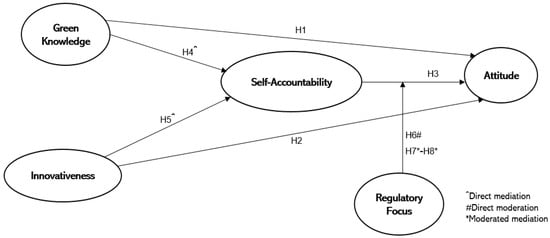
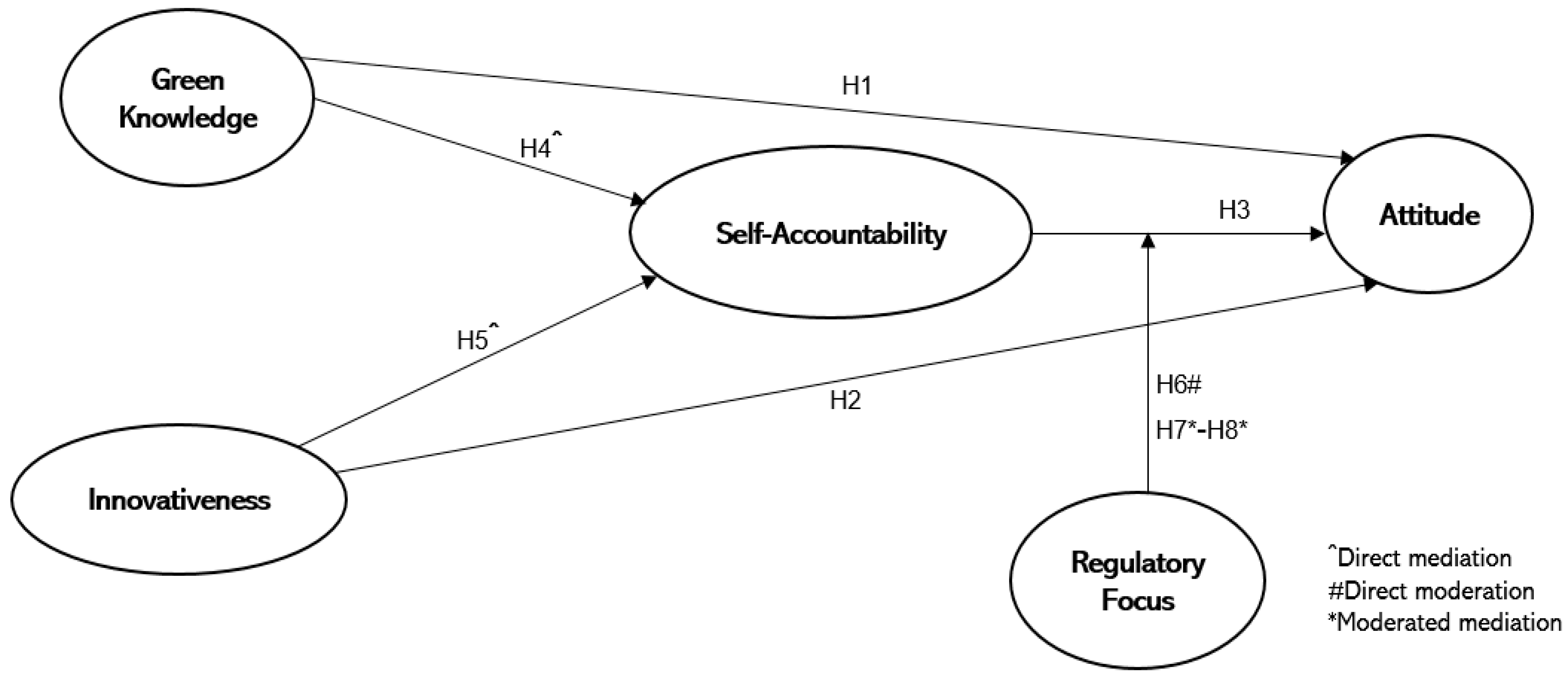
In summary, all the hypothesized relationships (H1–H8) were developed as described above, and our conceptual framework is illustrated in Figure 1.
Figure 1.
Conceptual framework.
3. Method
3.1. Data Collection
The targeted population of this study is Korean consumers aged 20 and over who have held and used green credit or debit cards. The sample was drawn using a panel maintained by a market research company in Korea, ensuring the representativeness of the target population. Potential respondents were sent an email with a link to an online questionnaire. Questionnaires were self-administered over a two-week period in July 2019. The questionnaire results could not be submitted without complete answers. Thus, all of the online questionnaires received were completed. The response rate for the panel was nearly 100%, and the respondents were relatively well distributed in terms of demographic variables. Finally, a total of 1000 valid questionnaires were used for analysis.
In preparing and administering the questionnaire, we took particular care to minimize method biases. To reduce evaluation apprehension and social desirability biases, respondents were fully given freedom of choice and freedom of expression assuring that the responses will be kept highly confidential and for the study purposes only. We also reassured respondents that there were no right or wrong answers and explicitly asked them to answer questions honestly. Furthermore, the order of questions was randomized, and the data were collected on different days.
The demographic profiles of the sample are shown in Table 1. The final sample was composed of 466 women (46.6%) and 534 men (53.4%). The age profile was as follows: 20 to 29 years = 21.1%; 30 to 39 years = 34.3%; 40 to 49 years = 26.4%; 50 to 59 years = 13.5%; and 60 years and older = 4.7%. The majority of the respondents had a college or university degree (72.6%), and 18.4% of the respondents had a high school education or less, and 9.0% had a postgraduate degree. Most respondents (53.1%) reported a yearly household income of less than $30,000; 29.1% fell within an income range of $30,000 to $49,999; 12.2% were in the $50,000 to $69,999 range; 4.0% were in the $70,000 to $99,999 range; and 1.6% reported income of more than $100,000.
Table 1.
Demographic profiles of the sample (N = 1000).
3.2. Measures
This study used a seven-point Likert scale, with 1 to 7 corresponding to strong disagreement to strong agreement, to measure the questionnaire items (see Table A1 in Appendix A). Specifically, green knowledge was measured using a three-item scale adapted from previous research [28,29]. That is, we measured both types of respondents’ environmental knowledge (i.e., general and action-based knowledge). To measure respondents’ general knowledge, we assessed their familiarity with the terms related to “climate change” and “carbon or CO2 emissions” (two items). Respondents’ action-based knowledge was measured by assessing their familiarity with the term “carbon labelling” (one item). Innovativeness was measured using four items adapted from previous studies [9,43,60]. Self-accountability was measured using a three-item scale provided by Peloza et al. [50]. Attitude toward green credit card services was measured with three items [61]. To test the effect of regulatory focus, chronic individual differences or situational factors (i.e., primed through situational cues) can be used. In this study, we measured chronic differences in regulatory focus. The chronic regulatory focus scale has been validated in previous research [62]. The scale had 10 items, half of which measured promotion focus and the other half measured prevention focus. Using a 7-point scale, respondents indicated the extent to which they endorsed items relevant to a promotion focus and items relevant to a prevention focus. The responses were averaged (Cronbach’s α = 0.822 for promotion focus, and Cronbach’s α = 0.811 for prevention focus). Following previous research [62], a single composite measure of chronic regulatory focus was created by subtracting the prevention focus score (M = 4.75, SD = 1.06) from the promotion focus score (M = 4.99, SD = 1.01). High scores of the single composite regulatory focus index reflected relative stronger promotion focus than prevention focus (M = 0.24, SD = 1.09).
3.3. Data Analysis
This research used structural equation modelling (SEM) to investigate the proposed model (see Figure 1). SEM is usually used to explain multiple statistical relationships simultaneously through visualization and model validation [63]. SEM is a robust multivariate technique that examines two levels of analysis—the measurement model and the structural model. It also analyzes direct and indirect paths to establish full or partial mediation, if any. The use of SEM to check mediated relationships is more appropriate and robust than any other analysis technique [64]. Researchers need to apply the SEM technique that best suits their research objective, data characteristics, and model set-up [65,66]. As compared to other SEM techniques such as partial least squares structural equation modeling (PLS-SEM), covariance-based structural equation modeling (CB-SEM) is more suitable for our study because the justification for the specification of the relationships in our model is entirely theory-driven, and CB-SEM is most suited when the research objective is to test or extend a profoundly theory-driven path model [67]. Thus, we used AMOS to perform the desired CB-SEM analysis in this study because of its user-friendliness and global reach.
Overall, this research used SPSS and AMOS to examine the measurement model and test the hypotheses in the structural model. As Anderson and Gerbing [68] suggested, the data analysis began with confirmatory factor analysis to determine whether all indicator variables appropriately reflect their underlying constructs, and whether the measurement model has acceptable fit to the data. The path analysis was then used to test the predicted relationships among the latent constructs (structural model) and determine whether the model provides acceptable fit to the data. Specifically, all the hypotheses were tested at the four stages: testing the direct effects (H1, H2, and H3), testing the mediation effects (H4 and H5), testing the moderation effect (H6), and testing the moderated mediation effects (H7 and H8).
4. Results
4.1. Measurement Model
Prior to testing the hypotheses, this research examined the reliabilities and validities of measurement items used for the four constructs (i.e., green knowledge, innovativeness, self-accountability, and attitude). A confirmatory factor analysis (CFA) was conducted by using AMOS for the four constructs (see Table 2). The goodness-of-fit statistics indicated an adequate fit of the measurement model (χ2/d.f. = 715.331/59 = 12.124 (p = 0.000); GFI = 0.911; NFI = 0.924; IFI = 0.930; TLI = 0.908; CFI = 0.930; RMSEA = 0.090). Reliabilities were assessed by internal consistency (Cronbach’s α > 0.8) as well as composite reliability (CR) measures. The Cronbach’s alphas and the CRs exceeded a cut-off value of 0.7 for the four constructs, supporting the reliability of the measurement items used for each construct. Convergent validities were assessed by standardized loading estimates and average variance extracted (AVE). Running a CFA reveals that the standardized factor loadings for all constructs exceeded the threshold of 0.5; and AVEs exceeded 0.5, supporting the convergent validity for each construct. The square root of AVE for each construct was greater than the correlations between the construct and other constructs included in the model (see Table 3), verifying the discriminant validity of the four constructs. In addition, nomological validity was assessed based on the correlation matrix of the four constructs. The results showed that these constructs were positively related to one another, corresponding to the discussions this study presented earlier.
Table 2.
Measurement model: Results of confirmatory factory analysis.
Table 3.
Means, standard deviations, and correlation matrix.
To detect multicollinearity, we first examined the correlation matrix of the exogenous latent constructs. As shown in Table 3, there is no problem of multicollinearity in the present study, given that a correlation coefficient of 0.9 and above indicates multicollinearity between exogenous latent constructs. Another way to verify the issue of multicollinearity is through the examination of Variance Inflation Factors (VIFs) and tolerance values. The results indicate that multicollinearity is not a concern, because the tolerance values are greater than 0.2 and the VIFs range from 1.170 to 2.254 which is acceptable. Thus, it is concluded that multicollinearity is not an issue in this study.
Two methods were used to address the issue of common method bias. First, we adopted Harman’s single-factor test. The results showed that the first component constitutes 37.972%, which is less than 50%, indicating this study does not have a serious problem of common method bias. Second, we applied common latent factor method to test for common method bias. The CFA was again conducted with an extra factor, which is considered as an indicator for all the measures. The difference between the standardized regression weights without common latent factor and the standardized regression weights with common latent factor were less than 0.2. Thus, common method bias is unlikely to be a concern.
To see if the respondents were representative of the target population, we tested non-response bias by assessing the differences between the early (the first 75%) and late (the final 25%) respondents of completed questionnaires regarding the means of all the variables [69]. The t-tests yielded no statistically significant differences between the early and late response groups, suggesting that non-response bias was not a major concern in this study.
4.2. Hypotheses Testing: Structural Model
Running the structural model shows adequate overall fit fulfilling the usual fit criteria recommended in literature: χ2/d.f. = 715.331/59 = 12.124 (p = 0.000); GFI = 0.911; NFI = 0.924; IFI = 0.930; TLI = 0.908; CFI = 0.930; RMSEA = 0.089. As shown in Table 4, the results of hypothesis testing indicate that the effect of green knowledge on attitude is not significant (ß = −0.077, p > 0.10), which does not support H1. Innovativeness is positively related to attitude (ß = 0.117, p = 0.002), supporting H2. Self-accountability yields a positive effect on attitude (ß = 0.354, p < 0.001), supporting H3. Although not formally hypothesized, we also tested the path from green knowledge to self-accountability as well as the path from innovativeness to self-accountability. Green knowledge is positively related to self-accountability (ß = 0.756, p < 0.001). Innovativeness is positively related to self-accountability (ß = 0.150, p < 0.001). Consequently, the findings support H2 and H3, while H1 is not supported.
Table 4.
Results of hypothesis testing.
To further confirm the robustness of the proposed model, we included consumer characteristics (i.e., age, gender, and education) as control variables. However, adding control variables reduced model fit; a chi-square difference test indicated a better fit of the tested proposed model (△χ2 (30) = 98.766, p < 0.005) and all the coefficients remained stable in strength. We therefore conclude that our proposed model is robust.
As stated, our measure of “Green Knowledge” included three items relevant to both general and action-based knowledge. Additionally, exploratory factor analysis (principal component analysis (PCA) with varimax rotation) was conducted on all three items measuring “Green Knowledge” to estimate empirically the number of factors extracted. The result revealed a two-factor solution; the two factors accounted for general and action-based knowledge. Overall, the two factors explained 93.4% of variance and the factor pattern coefficients ranged from 0.899 to 0.966. Specifically, the first factor contained two items related to general knowledge of environment, which accounted for 72.8% of variance. Thus, the items in this factor can be named “general knowledge.” The second factor had one item, which accounted for 20.6% of variance. As the item measures the action-based knowledge of environment, this factor can be named “action-based knowledge.”
When for “Green Knowledge” construct, two-item construct (i.e., general knowledge; r = 0.80, p < 0.001; M = 5.11, SD = 1.20) was used for the hypothesis testing, the results of the maximum likelihood estimation provide adequate fit to the data (χ2/d.f. = 649.215/48 = 13.525 (p = 0.000); GFI = 0.912; NFI = 0.928; CFI = 0.933). The results indicate that the effect of green knowledge on attitude is not significant, with a standardized path coefficient of −0.095 (t = −1.437; p > 0.10), which does not support H1. Innovativeness is positively related to attitude, with a standardized path coefficient of 0.118 (t = 3.139; p = 0.002), supporting H2. Self-accountability has a positive effect on attitude, with a standardized path coefficient of 0.367 (t = 5.353; p < 0.001), supporting H3. Additionally, green knowledge is positively related to self-accountability, with a standardized path coefficient of 0.742 (t = 22.841; p < 0.001). Innovativeness is positively related to self-accountability, with a standardized path coefficient of 0.162 (t = 6.040; p < 0.001). Hence, consistent with the results reported in Table 4, H2 and H3 are supported, whereas H1 is not supported.
In contrast, when for the “Green Knowledge” construct, a single-item construct (i.e., action-based knowledge; M = 5.12, SD = 1.43) was included in the proposed model, the results of the maximum likelihood estimation provide adequate fit to the data (χ2/d.f. = 600.349/39 = 15.394 (p = 0.000); GFI = 0.913; NFI = 0.920; CFI = 0.925). The results demonstrate that green knowledge is positively related to attitude, with a standardized path coefficient of 0.179 (t = 2.703; p = 0.007), supporting H1. Given that action-based knowledge, compared with general knowledge, is more strongly associated with overall green consumption [29,31], the single-item construct related to action-based knowledge was found to exert a significant impact on attitude. Innovativeness is positively related to attitude, with a standardized path coefficient of 0.091 (t = 2.376; p = 0.017), supporting H2. Self-accountability has a positive effect on attitude, with a standardized path coefficient of 0.179 (t = 3.224; p = 0.001), supporting H3. In addition, green knowledge is positively related to self-accountability, with a standardized path coefficient of 0.557 (t = 11.157; p < 0.001). Innovativeness is positively related to self-accountability, with a standardized path coefficient of 0.248 (t = 6.572; p < 0.001). Consequently, H1, H2, and H3 are all supported.
4.3. Mediation Analysis
Hypotheses 4 and 5 propose that self-accountability mediates (a) the relationship between green knowledge and attitude and (b) the relationship between innovativeness and attitude, respectively. To test the mediating effect of self-accountability in the proposed model, we first examined conditions required for the mediation effects. As shown in the results of direct effects in Table 4, we found that conditions for mediation are satisfied as there is a significant relationship between predictor and mediator, and between mediator and outcome variable. Next, we also applied the bootstrapping bias-corrected confidence interval procedure through SEM in AMOS, as Preacher and Hayes [70] suggested. To obtain confidence intervals, we used 5000 samples, and the bias-corrected percentile method generated 95% confidence intervals. Table 5 presents the results of mediation analyses. The results indicate that the indirect effects of green knowledge and innovativeness on attitude through self-accountability are significantly different from zero at p < 0.001. The indirect effect of green knowledge on attitude via self-accountability is 0.267 (95% CI = 0.153 to 0.397). The indirect effect of innovativeness on attitude via self-accountability is 0.053 (95% CI = 0.027 to 0.092). Moreover, the direct effect of green knowledge on attitude is not significant (ß = −0.077, 95% CI = −0.235 to 0.073), while the direct effect of innovativeness on attitude is significant (ß = 0.117, 95% CI = 0.031 to 0.204). According to Baron and Kenny [71], if the direct effect and indirect effect are both significant, partial mediation is sustained. However, if the indirect effect is significant and direct effect is not significant, full mediation will hold [72]. Hence, given that green knowledge has an indirect effect but no direct effect on attitude, full mediation is sustained. Moreover, as innovativeness has both direct and indirect effects on attitude, partial mediation is sustained. Overall, the results reveal that green knowledge and innovativeness significantly influence attitude toward green credit card services via self-accountability, supporting H4 and H5.
Table 5.
Results of mediation analyses.
4.4. Moderation Analysis
Hypothesis 6 asserts that regulatory focus moderates the relationship between self-accountability and attitude; that is, the magnitude of the positive effect of self-accountability on attitude is stronger for consumers with prevention focus as opposed to those with promotion focus. To examine the moderating effect of regulatory focus, we conducted a multiple group analysis with a median split on regulatory focus. First, after calculating the median of the moderator (i.e., chronic regulatory focus), we split the sample into promotion focus (n = 445) and prevention focus (n = 555) groups based on the median (Mdn = 0). Prior to conducting multiple group analysis, we tested for measurement invariance between the two groups (i.e., the equality between the factor loadings of both groups) and found support for full-metric invariance, which indicates that an invariance test of the two-group structural model can be conducted. Specifically, CFA was conducted for both groups without factor loadings (unconstrained model); while another CFA was performed for both groups with full factor loadings (full-metric invariance model). Then, the two different models were contrasted. The fit indices of unconstrained (χ2/d.f. = 812.996/118 = 6.890 (p = 0.000); NFI = 0.915; IFI = 0.926; TLI = 0.902; CFI = 0.926; RMSEA = 0.077) and full-metric invariance models (χ2/d.f. = 820.748/127 = 6.463 (p = 0.000); NFI = 0.914; IFI = 0.926; TLI = 0.909; CFI = 0.926; RMSEA = 0.074) show that both models achieve a good model fit. Moreover, the χ2 difference between both models is not significant (△χ2 (9) = 7.752, p = 0.559).
As shown in Table 6, a multiple group analysis indicated that there exists a moderating effect of regulatory focus between self-accountability and attitude; that is, self-accountability has a positive effect on attitude for prevention-focused consumers but not for promotion-focused consumers. Specifically, the effect of self-accountability on attitude was significant in the prevention focus group (ß = 0.508, p < 0.001), whereas the effect is not significant in the promotion focus group (ß = 0.091, p > 0.10). The difference, △χ2 (1) = 8.868, p = 0.003, between the unconstrained model (χ2/d.f. = 812.996/118 = 6.890 (p = 0.000); GFI = 0.902; NFI = 0.915; IFI = 0.926; TLI = 0.902; CFI = 0.926; RMSEA = 0.077) and the constrained model (χ2/d.f. = 821.864/119 = 6.906 (p = 0.000); GFI = 0.901; NFI = 0.914; IFI = 0.925; TLI = 0.902; CFI = 0.925; RMSEA = 0.077) was significant, which supports H6.
Table 6.
Results of moderation testing.
4.5. Moderated Mediation Analysis
To test Hypotheses 7 and 8, we conducted moderated mediation analyses using Model 14 in the PROCESS macro with 5000 iterations to derive a 95% confidence interval [73,74]. First, in the moderated mediation model for testing H7, we entered green knowledge as the independent variable; self-accountability as the mediator; attitude as the dependent variable; and regulatory focus as the moderator. The results of H7 are found in Table 7. The overall model was significant (F(4, 995) = 36.789, p = 0.000, R2 = 0.129). The interaction between self-accountability and regulatory focus was significant as the CI does not include zero (B = 0244, SE = 0.065, p = 0.000, 95% CI = −0.372 to −0.117). The conditional indirect effect was calculated based on regulatory focus, using 5000 bootstrap resamples. The results revealed that the conditional indirect effect between green knowledge and attitude through self-accountability was stronger for prevention-focused (B = 0.271, SEboot. = 0.044, 95% CI = 0.185 to 0.359) than for promotion-focused consumers (B = 0.106, SEboot. = 0.046, 95% CI = 0.021 to 0.199). The CI for the index of moderated mediation did not include zero (B = −0.165, SEboot. = 0.050, 95% CI = −0.262 to −0.066). This index indicates that the indirect effect of green knowledge on attitude (via self-accountability) is moderated by regulatory focus, supporting the moderated mediation for H7.
Table 7.
Results of moderated mediation analysis: Testing for conditional indirect effect of green knowledge on attitude by regulatory focus.
An identical moderated mediation analysis procedure was conducted for H8. In the moderated mediation model, we entered innovativeness as the independent variable; self-accountability as the mediator; attitude as the dependent variable; and regulatory focus as the moderator. As shown in Table 8, the overall model was significant (F(4, 995) = 39.829, p = 0.000, R2 = 0.138). The interaction between self-accountability and regulatory focus was significant as the CI does not include zero (B = −0.231, SE = 0.065, p = 0.000, 95% CI = −0.358 to −0.104). As before, the conditional indirect effect was calculated based on regulatory focus, using 5000 bootstrap resamples. The results revealed that the conditional indirect effect between innovativeness and attitude through self-accountability was stronger for prevention-focused (B = 0.142, SEboot. = 0.024, 95% CI = 0.098 to 0.191) than for promotion-focused consumers (B = 0.063, SEboot. = 0.020, 95% CI = 0.026 to 0.104). The CI for the index of moderated mediation did not include zero (B = −0.079, SEboot. = 0.026, 95% CI = −0.131 to −0.029). This index indicates that the indirect effect of innovativeness on attitude (via self-accountability) depends on regulatory focus, supporting the moderated mediation for H8.
Table 8.
Results of moderated mediation analysis: Testing for conditional indirect effect of innovativeness on attitude by regulatory focus.
5. General Discussion
Within the context of green credit card services, this research examined the effect of individual characteristics (i.e., green knowledge, innovativeness) on attitude toward green credit card services. This research also examined whether self-accountability mediates the relationships. In addition, this research examined the moderating effect of regulatory focus on the relationship between self-accountability and attitude toward green credit card services. Furthermore, a moderated mediation model was tested examining regulatory focus as a moderator within the hypothesized model. Specifically, we propose that (1) (a) green knowledge, (b) innovativeness, and (c) self-accountability have a positive impact on attitude toward green credit card services (Hypotheses 1–3); (2) self-accountability mediates the relationship between (a) green knowledge and (b) innovativeness and attitude toward green credit card services (Hypotheses 4 and 5); (3) regulatory focus moderates the relationship between self-accountability and attitude toward green credit card services, such that the positive relationship is stronger for prevention-focused than for promotion-focused consumers (Hypothesis 6); and (4) the mediation effect of self-accountability on the relationship between (a) green knowledge and (b) innovativeness and attitude toward green credit card services is stronger for prevention-focused than for promotion-focused consumers (Hypotheses 7 and 8).
With a sample of 1000 green credit/debit card users, structural equation modelling and moderated mediation analyses were conducted to examine the relationships involving green knowledge, innovativeness, self-accountability, regulatory focus, and attitude. Regarding Hypothesis 1, the results showed that the effect of green knowledge on attitude toward green credit card services is not significant. However, when only the single-item construct related to the action-based knowledge was included as green knowledge in the proposed model, green knowledge was found to have a significant positive influence on attitude toward green credit card services. Given that action-based knowledge, compared with general knowledge, is more strongly associated with overall green consumption [29,31], action-based knowledge can yield a significant influence on attitude. Regarding Hypotheses 2 and 3, the results showed that innovativeness as well as self-accountability is positively related to attitude toward green credit card services. Mediation analyses were carried out to test Hypotheses 4 and 5. The findings showed that green knowledge and innovativeness significantly influence attitude toward green credit card services via self-accountability. In other words, self-accountability was found to fully mediate the relationship between green knowledge and attitude toward green credit card services, while self-accountability was found to partially mediate the relationship between innovativeness and attitude toward green credit card services. A moderation analysis was conducted to test Hypothesis 6. The results showed that regulatory focus moderates the relationship between self-accountability and attitude toward green credit card services; that is, self-accountability was found to have a significant positive effect on attitude for prevention-focused consumers but not for promotion-focused consumers. Finally, regarding Hypotheses 7 and 8, moderated mediation was observed. The findings showed that regulatory focus moderates the mediation effect of self-accountability on the relationship between (a) green knowledge and (b) innovativeness and attitude toward green credit card services. Specifically, the indirect effect of (a) green knowledge and (b) innovativeness on attitude via self-accountability was found to be stronger for prevention-focused than for promotion-focused consumers.
Both theoretical and managerial implications can be drawn. From a theoretical perspective, we extend and advance the previous research findings by focusing on the green credit card services in the financial services industry and using more representative samples. Even if many prior studies have identified numerous factors influencing consumers’ green attitude and purchase behavior, there has been little research on the factors affecting green consumption behavior in the financial services sector. In addition, of all the factors that can affect consumer attitude, we primarily consider individual characteristics such as green knowledge, innovativeness, self-accountability, and regulatory focus and develop an integrative model explaining attitude toward green credit card services. Specifically, we found that individual characteristics such as green knowledge, innovativeness, and self-accountability positively influence attitudes toward green credit card services. Furthermore, we expand this line of research by presenting a moderated mediation model. That is, we examine the mediating and moderating mechanisms underlying the relationships between individual factors and green consumption attitude in the context of green credit card services; specifically, we demonstrated the mediating role of self-accountability and the moderating role of regulatory focus in the relationships.
From a managerial perspective, this research provides important insights into how credit card companies can improve the level of ESG practices by enhancing their consumers’ attitude toward green credit card services. Our findings provide some valuable guidance for the service providers and policy makers dealing with financial services and approaching ESG issues on applying the effects of individual characteristics (i.e., green knowledge, innovativeness, self-accountability, and regulatory focus) and targeting the right customers. Specifically, our findings imply that individual characteristics may be an effective segmentation and targeting tool in facilitating consumers’ green consumption behavior. For example, individuals’ regulatory focus can be situationally activated with the priming procedure. Thus, given that consumers with prevention focus are more likely to have a positive attitude toward green products and services, marketers can persuade their target consumers to have a prevention focus situationally. Our findings also highlight the importance of educational programs and campaigns for increasing consumers’ level of green knowledge and self-accountability. An educational program or campaign can provide consumers with more accurate information about environmental problems and solutions for mitigating the problems. Through an effective educational program or campaign, marketers and government agencies can bring to the fore environmental concerns and responsibility in the mind and hearts of potential targeted customers of green products and services. Heightening the level of green knowledge and self-accountability can lead consumers to form more favorable attitudes and purchase intentions toward green products/services. Moreover, our findings point to the conditions under which green consumption attitude will be motivated by self-accountability. For instance, marketers and policy makers can activate consumers’ self-accountability through a variety of subtle marketing communication techniques and appropriate self-standards (e.g., rules and guidelines) designed to explicitly induce consumers’ high level of self-accountability. Furthermore, this research contributes to the various practical issues such as product development, positioning, and marketing communications. Considering the marketers’ assessment of the target consumers’ individual characteristics (e.g., whether they have a higher level of green knowledge or not, whether they are more innovative or not, whether they have a higher level of self-accountability or not, and whether they are promotion-focused or prevention-focused), marketers can develop ideas for new products and services. For example, given that consumers with higher innovativeness are more likely to have a positive attitude toward green products and services, marketers can motivate primarily innovative consumer segments by developing new and distinctive green products and services.
Although this research provides theoretical and managerial implications, it is not without limitations. First, it would be good for future research to investigate whether the findings can be generalized to other financial products/services or payment modes. Second, future research can examine the separate and combined effects of two types of green knowledge on consumer attitude. Third, in order to activate individuals’ regulatory focus, future research can adopt the priming task for the regulatory focus manipulation in the context of an experiment. Replicating the studies with the regulatory focus manipulation procedure could help to increase the validity and generalizability of our findings. Finally, future research should examine other potential personal or situational factors that can influence consumers’ loyalty toward green products/services.
Author Contributions
Conceptualization, M.-Y.K. and M.S.; methodology, M.-Y.K. and M.S.; software, M.-Y.K.; validation, M.-Y.K.; formal analysis, M.-Y.K.; investigation, M.-Y.K. and M.S.; resources, M.-Y.K.; data curation, M.-Y.K.; writing—original draft preparation, M.-Y.K.; writing—review and editing, M.-Y.K. and M.S.; visualization, M.-Y.K.; supervision, M.-Y.K.; project administration, M.-Y.K.; funding acquisition, M.-Y.K. and M.S. All authors have read and agreed to the published version of the manuscript.
Funding
This research was supported by Hankuk University of Foreign Studies Research Fund of 2021. This research was supported by Dongguk University-Gyeongju Research Fund.
Institutional Review Board Statement
Ethical review and approval were waived for this study, due to the fact that this study was not a medical one, subjects were not exposed to any harm, their rights were protected, and every precaution was taken in order to protect the privacy of research subjects and the confidentiality of their personal information.
Informed Consent Statement
Informed consent was obtained from all subjects involved in the study.
Data Availability Statement
The data that support the findings of this study are available on request from the corresponding author. The data are not publicly available due to privacy.
Conflicts of Interest
The authors declare no conflict of interest.
Appendix A
Table A1.
Measurement items.
References
- Zaremohzzabieh, Z.; Ismail, N.; Ahrari, S.; Abu Samah, A. The effects of consumer attitude on green purchase intention: A meta-analytic path analysis. J. Bus. Res. 2021, 132, 732–743. [Google Scholar] [CrossRef] [Scilit]
- Bullard, O.; Manchanda, R.V. Do sustainable products make us prevention focused? Mark. Lett. 2013, 24, 177–189. [Google Scholar] [CrossRef] [Scilit]
- Larson, L.R.; Stedman, R.C.; Cooper, C.B.; Decker, D.J. Understanding the multi-dimensional structure of pro-environmental behavior. J. Environ. Psychol. 2015, 43, 112–124. [Google Scholar] [CrossRef] [Scilit]
- Jain, S.K.; Kaur, G. Green Marketing: An Attitudinal and Behavioural Analysis of Indian Consumers. Glob. Bus. Rev. 2004, 5, 187–205. [Google Scholar] [CrossRef] [Scilit]
- Sunil, A.; Momany, M.T. Impact of green finance on the economy of developing countries. Int. J. Manag. 2020, 11, 1112–1120. [Google Scholar]
- Nedumaran, G.; Manida, M.; Baladevi, M. Impact on customer perceptions of green banking process with special reference in Rajapalayam Taluk. TEST Eng. Manag. 2020, 82, 9376–9382. [Google Scholar] [CrossRef] [Scilit]
- Jha, N.; Bhome, S. A study of green banking trends in India. Int. Mon. Refereed J. Res. Manag. Technol. 2013, 2, 127–132. [Google Scholar]
- Kim, M.-Y. Ethical behavior in the context of green credit card services: The role of individuals’ regulatory focus. Int. J. Adv. Cult. Technol. 2020, 8, 107–112. [Google Scholar]
- Dangelico, R.M.; Nonino, F.; Pompei, A. Which are the determinants of green purchase behaviour? A study of Italian con-sumers. Bus. Strategy Environ. 2021, 30, 2600–2620. [Google Scholar] [CrossRef] [Scilit]
- Joshi, Y.; Rahman, Z. Factors affecting green purchase behavior and future research directions. Int. Strateg. Manag. Rev. 2015, 3, 128–143. [Google Scholar] [CrossRef] [Scilit]
- Kim, W.; Cha, S. How attributes of green advertising affect purchase intention: The moderating role of consumer innovativeness. Sustainability 2021, 13, 8723. [Google Scholar] [CrossRef] [Scilit]
- Sharma, A.P. Consumers’ purchase behaviour and green marketing: A synthesis, review and agenda. Int. J. Consum. Stud. 2021. [Google Scholar] [CrossRef] [Scilit]
- Yadav, R.; Pathak, G.S. Young consumers’ intention towards buying green products in a developing nation: Extending the theory of planned behavior. J. Clean. Prod. 2016, 135, 732–739. [Google Scholar] [CrossRef] [Scilit]
- Wijekoon, R.; Sabri, M. Determinants That Influence Green Product Purchase Intention and Behavior: A Literature Review and Guiding Framework. Sustainability 2021, 13, 6219. [Google Scholar] [CrossRef] [Scilit]
- Yue, B.; Sheng, G.; She, S.; Xu, J. Impact of Consumer Environmental Responsibility on Green Consumption Behavior in China: The Role of Environmental Concern and Price Sensitivity. Sustainability 2020, 12, 2074. [Google Scholar] [CrossRef] [Scilit]
- Zheng, G.-W.; Siddik, A.; Masukujjaman, M.; Alam, S.; Akter, A. Perceived Environmental Responsibilities and Green Buying Behavior: The Mediating Effect of Attitude. Sustainability 2021, 13, 35. [Google Scholar] [CrossRef] [Scilit]
- Ibe-Enwo, G.; Igbudu, N.; Garanti, Z.; Popoola, T. Assessing the Relevance of Green Banking Practice on Bank Loyalty: The Mediating Effect of Green Image and Bank Trust. Sustainability 2019, 11, 4651. [Google Scholar] [CrossRef] [Scilit]
- Kim, M.-Y. Evaluation, Satisfaction, and Loyalty in the Context of Green Credit Card Services: Green Ethics as a Moderator. Turk. J. Comput. Math. Educ. (TURCOMAT) 2021, 12, 387–391. [Google Scholar] [CrossRef] [Scilit]
- Sun, H.; Rabbani, M.; Ahmad, N.; Sial, M.; Guping, C.; Zia-Ud-Din, M.; Fu, Q. CSR, Co-Creation and Green Consumer Loyalty: Are Green Banking Initiatives Important? A Moderated Mediation Approach from an Emerging Economy. Sustainability 2020, 12, 10688. [Google Scholar] [CrossRef] [Scilit]
- Ajzen, I.; Fishbein, M. Understanding Attitudes and Predicting Social Behavior; Prentice-Hall: Englewood Cliffs, NJ, USA, 1980. [Google Scholar]
- Blackwell, R.D.; Miniard, P.W.; Engel, J.F. Consumer Behavior, 10th ed.; Thomson South-Western: Boston, MA, USA, 2006. [Google Scholar]
- Jaiswal, D.; Kant, R. Green purchasing behaviour: A conceptual framework and empirical investigation of Indian consumers. J. Retail. Consum. Serv. 2018, 41, 60–69. [Google Scholar] [CrossRef] [Scilit]
- Roos, D.; Hahn, R. Understanding collaborative consumption: An extension of the theory of planned behavior with value-based personal norms. J. Bus. Ethics 2019, 158, 679–697. [Google Scholar] [CrossRef] [Scilit]
- Fraj, E.; Martinez, E. Ecological consumer behavior: An empirical analysis. Int. J. Consum. Stud. 2007, 31, 26–33. [Google Scholar] [CrossRef] [Scilit]
- Muraguri, E.K.; Jin, S.; Samake, A. Modeling the role of perceived green value and consumer innovativeness in green products’ consumption intention within the theory of planned behavior. Sustinere J. Environ. Sustain. 2020, 4, 94–116. [Google Scholar] [CrossRef] [Scilit]
- Fryxell, G.E.; Lo, C.W.H. The Influence of Environmental Knowledge and Values on Managerial Behaviours on Behalf of the Environment: An Empirical Examination of Managers in China. J. Bus. Ethics 2003, 46, 45–69. [Google Scholar] [CrossRef] [Scilit]
- Aini, M.S.; Nurizan, Y.; Fakhru’l-Razi, A. Environmental comprehension and practices of Malaysian youth. J. Environ. Educ. Res. 2007, 13, 17–31. [Google Scholar]
- Darnall, N.; Ji, H.; Vázquez-Brust, D.A. Third-party certification, sponsorship, and consumers’ ecolabel use. J. Bus. Ethics 2018, 150, 953–969. [Google Scholar] [CrossRef] [Scilit]
- Darnall, N.; Pointing, C.; Vázquez-Brust, D.A. Why consumers buy green in Green-Growth: Managing the Transition to Sustainable Capitalism; Vazquez-Brust, B., Sarkis, J., Eds.; Springer: New York, NY, USA, 2012; pp. 287–308. [Google Scholar]
- Schahn, J.; Holzer, E. Studies of individual environmental concern: The role of knowledge, gender, and background variables. Environ. Behav. 1990, 22, 767–786. [Google Scholar] [CrossRef] [Scilit]
- Tanner, C.; Kast, S.W. Promoting sustainable consumption: Determinants of green purchases by Swiss consumers. Psychol. Mark. 2003, 20, 883–902. [Google Scholar] [CrossRef] [Scilit]
- Bamberg, S.; Möser, G. Twenty years after Hines, Hungerford, and Tomera: A new meta-analysis of psycho-social determinants of pro-environmental behaviour. J. Environ. Psychol. 2007, 27, 14–25. [Google Scholar] [CrossRef] [Scilit]
- Chan, R.Y.K. Determinants of Chinese consumers’ green purchase behavior. Psychol. Mark. 2001, 18, 389–413. [Google Scholar] [CrossRef] [Scilit]
- Moisander, J. Motivational complexity of green consumerism. Int. J. Consum. Stud. 2007, 31, 404–409. [Google Scholar] [CrossRef] [Scilit]
- All, A.; Xiaoling, G.; Sherwani, M.; All, A. Will you purchase green products? The joint mediating impact of environmental concern and environmental responsibility on consumers’ attitude and purchase intention. Br. J. Econ. Manag. Trade 2015, 8, 80–93. [Google Scholar] [CrossRef] [Scilit]
- Kaiser, G.K.; Wölfing, S.; Fuhrer, U. Environmental attitude and ecological behavior. J. Environ. Psychol. 1999, 19, 1–19. [Google Scholar] [CrossRef] [Scilit]
- Kumar, B.; Manrai, A.; Manrai, L.A. Purchasing behavior for environmentally sustainable products: A conceptual framework and empirical study. J. Retail. Consum. Serv. 2017, 34, 1–9. [Google Scholar] [CrossRef] [Scilit]
- Smith, S.; Paladino, A. Eating Clean and Green? Investigating Consumer Motivations towards the Purchase of Organic Food. Australas. Mark. J. 2010, 18, 93–104. [Google Scholar] [CrossRef] [Scilit]
- Bang, H.-K.; Ellinger, A.E.; Hadjimarcou, J.; Traichal, P.A. Consumer concern, knowledge, belief, and attitude toward renewable energy: An application of the reasoned action theory. Psychol. Mark. 2000, 17, 449–468. [Google Scholar] [CrossRef] [Scilit]
- Im, S.; Bayus, B.L.; Mason, C.H. An Empirical Study of Innate Consumer Innovativeness, Personal Characteristics, and New-Product Adoption Behavior. J. Acad. Mark. Sci. 2003, 31, 61–73. [Google Scholar] [CrossRef] [Scilit]
- Steenkamp, J.-B.E.M.; Hofstede, F.; Wedel, M. A cross-national investigation into the individual and national cultural ante-cedents of consumer innovativeness. J. Mark. 1999, 63, 55–69. [Google Scholar] [CrossRef] [Scilit]
- Phillips, D.M.; Englis, B.; Solomon, M.R. The role of innovativeness in environmentally conscious consumer behavior, in NA—Advances in Consumer Research; Campbell, M.C., Inman, J., Pieters, R., Eds.; Association for Consumer Research: Duluth, MN, USA, 2010; Volume 37, pp. 878–880. [Google Scholar]
- Englis, B.G.; Phillips, D.M. Does innovativeness drive environmentally conscious consumer behavior? Psychol. Mark. 2013, 30, 160–172. [Google Scholar] [CrossRef] [Scilit]
- Jansson, J. Consumer eco-innovation adoption: Assessing attitudinal factors and perceived product characteristics. Bus. Strat. Environ. 2011, 20, 192–210. [Google Scholar] [CrossRef] [Scilit]
- Zhang, X.; Bai, X.; Shang, J. Is subsidized electric vehicles adoption sustainable: Consumers’ perceptions and motivation toward incentive policies, environmental benefits, and risks. J. Clean. Prod. 2018, 192, 71–79. [Google Scholar] [CrossRef] [Scilit]
- Alzubaidi, H.; Slade, E.L.; Dwivedi, Y.K. Examining antecedents of consumers’ pro-environmental behaviours: TPB extended with materialism and innovativeness. J. Bus. Res. 2020, 122, 685–699. [Google Scholar] [CrossRef] [Scilit]
- Lao, K. Research on mechanism of consumer innovativeness influencing green consumption behavior. Nankai Bus. Rev. Int. 2014, 5, 211–224. [Google Scholar] [CrossRef] [Scilit]
- Li, L.; Wang, Z.; Li, Y.; Liao, A. Impacts of consumer innovativeness on the intention to purchase sustainable products. Sustain. Prod. Consum. 2021, 27, 774–786. [Google Scholar] [CrossRef] [Scilit]
- Persaud, A.; Schillo, S.R. Purchasing organic products: Role of social context and consumer innovativeness. Mark. Intell. Plan. 2017, 35, 130–146. [Google Scholar] [CrossRef] [Scilit]
- Peloza, J.; White, K.; Shang, J. Good and Guilt-Free: The Role of Self-Accountability in Influencing Preferences for Products with Ethical Attributes. J. Mark. 2013, 77, 104–119. [Google Scholar] [CrossRef] [Scilit]
- Rowe, Z.O.; Wilson, H.N.; Dimitriu, R.M.; Breiter, K.; Charnley, F.J. The Best I Can Be: How Self-Accountability Impacts Product Choice in Technology-Mediated Environments. Psychol. Mark. 2017, 34, 521–537. [Google Scholar] [CrossRef] [Scilit]
- Tran, T.T.H.; Paparoidamis, N.G. Taking a closer look: Reasserting the role of self-accountability in ethical consumption. J. Bus. Res. 2019, 126, 542–555. [Google Scholar] [CrossRef] [Scilit]
- Yang, J. The Effect of Social Warmth on Green Consumption. Am. J. Ind. Bus. Manag. 2019, 9, 482–490. [Google Scholar] [CrossRef]
- Kaiser, F.; Ranney, M.; Hartig, T.; Bowler, P.A. Ecological Behavior, Environmental Attitude, and Feelings of Responsibility for the Environment. Eur. Psychol. 1999, 4, 59–74. [Google Scholar] [CrossRef] [Scilit]
- Paço, A.; Raposo, M. “Green” segmentation: An application to the Portuguese consumer market. Mark. Intell. Plan. 2009, 27, 364–379. [Google Scholar] [CrossRef] [Scilit]
- Higgins, E.T. Beyond Pleasure and Pain: How Motivation Works; Oxford University Press: New York, NY, USA, 2011. [Google Scholar] [CrossRef] [Scilit]
- De Bock, T.; Kenhove, P.V. Consumer ethics: The role of self-regulatory focus. J. Bus. Ethics 2010, 97, 241–255. [Google Scholar] [CrossRef] [Scilit]
- Gino, E.; Margolis, J.D. Bringing ethics into focus: How regulatory focus and risk preferences influence (un)ethical behavior. Organ. Behav. Hum. Decis. Process 2011, 115, 145–156. [Google Scholar] [CrossRef] [Scilit]
- Leikas, S.; Lönnqvist, J.-E.; Verkasalo, M.; Lindeman, M. Regulatory focus systems and personal values. Eur. J. Soc. Psychol. 2008, 39, 415–429. [Google Scholar] [CrossRef] [Scilit]
- Tellis, G.J.; Yin, E.; Bell, S. Global Consumer Innovativeness: Cross-Country Differences and Demographic Commonalities. J. Int. Mark. 2009, 17, 1–22. [Google Scholar] [CrossRef] [Scilit]
- Holbrook, M.B.; Batra, R. Assessing the Role of Emotions as Mediators of Consumer Responses to Advertising. J. Consum. Res. 1987, 14, 404–420. [Google Scholar] [CrossRef] [Scilit]
- Haws, K.L.; Dholakia, U.M.; Bearden, W.O. An assessment of chronic regulatory focus measures. J. Mark. Res. 2010, 47, 967–982. [Google Scholar] [CrossRef] [Scilit]
- Dash, G.; Paul, J. CB-SEM vs PLS-SEM methods for research in social sciences and technology forecasting. Technol. Forecast. Soc. Change 2021, 173, 121092. [Google Scholar] [CrossRef] [Scilit]
- Afthanorhan, W.M.A.B.W.; Ahmad, S.; Mamat, I. Pooled confirmatory factor analysis (PCFA) using structural equation modeling on volunteerism program: A step by step approach. Int. J. Asian Soc. Sci. 2014, 4, 642–653. [Google Scholar]
- Hair, J.F.; Sarstedt, M.; Ringle, C.M.; Mena, J.A. An assessment of the use of partial least squares structural equation modeling in marketing research. J. Acad. Mark. Sci. 2011, 40, 414–433. [Google Scholar] [CrossRef] [Scilit]
- Gefen, D.; Rigdon, E.E.; Straub, D. Editor’s Comments: An Update and Extension to SEM Guidelines for Administrative and Social Science Research. MIS Q. 2011, 35. [Google Scholar] [CrossRef] [Scilit]
- Hair, J.F.; Black, W.C.; Babin, B.J.; Anderson, R.E.; Tatham, R.L. Multivariate Data Analysis, 6th ed.; Pearson Prentice Hall: Upper Saddle River, NJ, USA, 2006. [Google Scholar]
- Anderson, J.C.; Gerbing, D.W. Structural equation modeling in practice: A review and recommended two-step approach. Psychol. Bull. 1988, 103, 411–423. [Google Scholar] [CrossRef]
- Armstrong, J.; Overton, T. Estimating nonresponse bias in mail surveys. J. Mark. Res. 1977, 14, 396–402. [Google Scholar] [CrossRef] [Scilit]
- Preacher, K.J.; Hayes, A.F. Asymptotic and resampling strategies for assessing and comparing indirect effects in multiple mediator models. Behav. Res. Methods 2008, 40, 879–891. [Google Scholar] [CrossRef] [Scilit]
- Baron, R.M.; Kenny, D.A. The moderator-mediator variable distinction in social psychological research: Conceptual, strategic, and statistical considerations. J. Pers. Soc. Psychol. 1986, 51, 1173–1182. [Google Scholar] [CrossRef]
- Zhao, X.; Lynch, J.; Chen, Q. Reconsidering Baron and Kenny: Myths and Truths about Mediation Analysis. J. Consum. Res. 2010, 37, 197–206. [Google Scholar] [CrossRef] [Scilit]
- Hayes, A.F. An Introduction to Mediation, Moderation, and Conditional Process Analysis: A Regression-Based Approach; The Guildford Press: New York, NY, USA, 2013. [Google Scholar]
- Hayes, A.F. An Index and Test of Linear Moderated Mediation. Multivar. Behav. Res. 2015, 50, 1–22. [Google Scholar] [CrossRef] [Scilit]

Publisher’s Note: MDPI stays neutral with regard to jurisdictional claims in published maps and institutional affiliations. |
© 2021 by the authors. Licensee MDPI, Basel, Switzerland. This article is an open access article distributed under the terms and conditions of the Creative Commons Attribution (CC BY) license (https://creativecommons.org/licenses/by/4.0/).