


Abstract
Quantum metrology promises sensitivity beyond classical strategies, yet it remains unsettled how quantum-enabled precision should scale with physical resources and how to interpret quantum advantage. We provide a physically grounded resource accounting that clarifies the true Heisenberg limit and resolves apparent super-Heisenberg paradoxes. We demonstrate that the Heisenberg limit is best viewed as an information-theoretic manifestation of the quantum speed limit. We illustrate these ideas with a simple, super-resolving phase estimation protocol based on Rabi oscillations in two-level atoms driven on an m-photon resonance. In this setting, the phase error scales as , where n is the average photon number. Recasting metrological sensitivity through quantum dynamical speed limits yields operational bounds that reconcile such super-resolution strategies with the standard Heisenberg interpretation and identify the relevant resources in the norm of the generator. We also revisit the common attribution of the NOON state’s scaling to quantum entanglement. We show that such an attribution is not generic and the Heisenberg scaling does not, by itself, certify entanglement as the enabling resource.
1. Introduction
Advances in precision measurements have transformed our understanding of nature, enabling technologies that range from gravitational wave observatories [1,2] to super-resolved biological imaging [3,4,5]. At the core of these capabilities lies the ability to estimate unknown parameters from experimental data using optimally designed measurement protocols. The fundamental precision limit in such estimation tasks is dictated by the Cramér–Rao bound, which relates the minimum variance of any unbiased estimator to the Fisher information [6,7]. In a foundational contribution, Helstrom extended this concept to quantum systems by formulating an estimation bound for parameters embedded in a quantum state [8]. Later, Caves demonstrated that quantum strategies can offer enhanced sensitivity compared to classical methods, assuming a fixed amount of physical resources [9].
Over time, quantum sensing has progressed from a primarily foundational subject into a rapidly expanding area of quantum science and technology, with increasingly practical implementations [10,11,12]. At the same time, the field has moved beyond ideal unitary parameter estimation models toward more realistic scenarios that incorporate environmental noise, many-body correlations, and platform-dependent experimental constraints. Several review articles have discussed major developments in quantum metrology and sensing, spanning basic theory, experimental implementation, and emerging applications [13,14,15,16,17,18,19,20]. Most of these reviews focus on specific aspects of the field, including multiparameter estimation [16,17,18], estimation in quantum many-body systems [21], parameter estimation in continuous-variable systems [22], geometric approaches [19], and applications in areas such as particle physics [23] and NISQ-era quantum devices [24].
A key distinction between classical and quantum estimation strategies lies in how the estimation error scales with the number of resources. In classical protocols using n independent probes, the Fisher information can scale linearly with n at most, producing an estimation error that decreases as . This scaling defines the shot-noise limit (SNL), also known as the standard quantum limit [25,26]. In contrast, quantum-enhanced strategies can exploit nonclassical resources such as entanglement to achieve a quadratic scaling of the Fisher information, enabling an error that scales as , the so-called Heisenberg limit (HL). This ultimate bound in precision can be attained using maximally path-entangled states of the form [26,27]. The ability to surpass the SNL and approach the HL forms the basis for emerging quantum metrological technologies, offering unprecedented sensitivity and resolution in measurement tasks [1,3,28].
One prominent illustration of quantum-enhanced resolution is found in interferometric lithography, where spatial features can be resolved beyond the classical diffraction limit, defined by the Rayleigh criterion [29]. This enhancement relies on photon-number entangled states, highly nonclassical quantum states that are both difficult to generate and extremely sensitive to decoherence [30,31]. To address these practical limitations, alternative schemes have been developed that exploit classical light pulses in conjunction with multiphoton resonance effects [32,33,34]. Notably, it has been demonstrated that a carefully engineered narrow-band multiphoton detection process can enable subwavelength resolution even in the absence of entanglement and with classical strategies, offering a robust and experimentally accessible route to quantum-inspired lithographic precision [32].
Furthermore, recent theory and experiments indicate that classical nonlinear and interaction-based strategies can surpass the standard Heisenberg scaling. Beltrán and Luis predicted an phase-error law for systems with classical optical nonlinearities [35], later observed experimentally by Napolitano et al. [36]. More generally, Boixo et al. reported scalings of the form with integer in interaction-driven metrology [37]. Such scaling beyond is sometimes referred to as super-Heisenberg behaviors [36,38] and shows that the familiar limit is not a universal ceiling, and its applicability depends on how resources are counted and which Hamiltonian generators are allowed. This motivates a central question: which quantum-mechanical principle sets the ultimate scaling of parameter estimation precision? And in what sense is scaling considered ultimate?
Considering this line of thought, the connection between Fisher information and quantum dynamics has also provided a deeper geometric interpretation of precision limits. In quantum estimation theory, the quantum Fisher information quantifies the infinitesimal distinguishability of neighboring quantum states and defines the statistical distance associated with the Bures metric [39]. From this perspective, a larger quantum Fisher information means that the probe state moves faster through Hilbert space under a change in the estimated parameter, making nearby parameter values more distinguishable. This geometric viewpoint naturally links metrological sensitivity to quantum speed limits, which bound the minimum time required for a quantum system to evolve between distinguishable states [40].
Despite these developments, the relation between the Heisenberg limit [41,42,43], super-Heisenberg scaling [36,38], and quantum speed limits [44,45,46] remains conceptually subtle, especially in nonlinear or interaction-based metrological protocols. In such systems, apparent improvements beyond the conventional scaling may arise because the relevant generator is no longer linear in the number of probes or photons. Therefore, a meaningful comparison of different strategies requires careful identification of the physical resource that drives distinguishability. This motivates the present work, where we use quantum speed limits as an operational framework to clarify the ultimate scaling of quantum sensors and to distinguish genuine precision enhancement from changes in resource accounting.
In this work, we explore a minimal yet powerful framework for super-resolving parameter estimation, based on the Rabi dynamics of two-level atomic systems. These atoms undergo Rabi oscillations triggered by the simultaneous absorption of m photons. At the heart of this protocol lies the phenomenon of multiphoton resonance, wherein excitation occurs only when the atom absorbs exactly m photons from the field. Precision in time estimation can be achieved by monitoring observables such as population inversion or the full Rabi cycle of the atomic system. We show that when the average photon number in the driving field is n, the achievable precision in estimating time can scale as , which seemingly surpasses the so-called Heisenberg limit , for . To shed light on the basis of the ultimate scaling, we show that the notion of quantum speed limit lends useful tools. In other words, to uncover the fundamental limits of this scaling, we formulate the estimation sensitivity within the framework of quantum dynamical speed limits. This approach offers a deeper understanding of the system’s metrological potential and sheds light on the apparent paradoxical features between super-resolution strategies and the conventional interpretation of the Heisenberg limit.
Furthermore, we revisit a common view that the Heisenberg scaling of NOON states is a direct consequence of mode entanglement. We give an example demonstrating that this association is not necessarily valid or generic. In fact, we demonstrate that the scaling need not originate from entanglement. In particular, we demonstrate that an experimentally accessible single-mode probe can attain the same Heisenberg-limited sensitivity without invoking mode entanglement.
2. Quantum Speed Limits and Fisher Information: A Dynamical Perspective on the Metrological Scaling
To ground the discussion in a familiar metrological setting, we begin with a canonical probe that attains the Heisenberg scaling in phase estimation. This choice provides a clear benchmark against which the dynamical bounds derived later can be compared. To this end, we take the maximally path-entangled NOON state as our reference probe and consider its evolution under a phase shift generated by a fixed Hamiltonian. The resulting sensitivity will shed light on our metrological resource accounting and speed-limit analysis. We therefore will use it to connect phase sensitivity with distinguishability in the Bures geometry and with the quantum Fisher information. Interpreting phase sensitivity as geodesic speed in the Bures metric makes the link to the quantum Fisher information explicit and lets us import quantum speed limits as metrological bounds, not merely a dynamical constraint. So, we begin with the NOON state defined as
which undergoes a phase shift implemented by the unitary operator , where a and are the photon annihilation and creation operators. Under this transformation, the state evolves to
leading to a phase sensitivity that scales as , the Heisenberg limit [47]. In this strategy, entanglement plays a central role in surpassing the shot-noise limit, which constrains precision to . The accumulation of phase using n entangled photons enables enhanced sensitivity, showing the quantum origin of the improved scaling. The phase shift operator is defined as , which arises from the Hamiltonian generating time evolution through , where t is the duration of evolution and . Hence, estimating is equivalent to estimating the time parameter t for a fixed Hamiltonian.
To illustrate the connection between the sensitivity and state geometry, we consider the NOON state undergoing a short-time evolution
This yields the transition probability
leading to a time sensitivity that scales as . Therefore, the scaling of the phase estimation is fundamentally connected to the distinguishability of the initial and final states of the quantum probes.
Alternatively, for a coherent state [48]
the evolution under results in a displaced coherent state , with the overlap
where . This gives the expected shot-noise scaling .
These examples demonstrate that phase estimation is deeply connected to the time required for the system to evolve into a distinguishable state. This connection can be formalized more generally using the quantum Cramér–Rao bound, which constrains the precision of time estimation for an unbiased estimator as [7,49]
where is the quantum Fisher information (QFI) [6,7]. The symmetric logarithmic derivative is defined implicitly via
where is the system time-dependent density matrix. The distance between two density matrices can be quantified using the Bures angle [50], as
where denotes the fidelity between the two density matrices and [51,52], given by
For infinitesimal changes in time, the Bures angle reduces to the Bures metric, expressed as
For a normalized pure state , the quantum Fisher information (QFI) for the time parameter can be written as [53]
On the other hand, there is an important relation between the fidelity and the QFI, [39]
This interesting relation shows that Fisher information measures the rate at which two states become distinguishable as a specific parameter changes. Consequently, the speed of the evolution of the system is determined by [31,53]
This deep connection between quantum speed limit (QSL) [39,54] and Fisher information shows that the rate of dynamics at which the system approaches its orthogonal state determines the metrological capability of the system. This relation views not as a merely variance-type measure of errors but also a fundamental speed measure, capturing the instantaneous separation rate of states along the parameter change. Consequently, the precision bound that follows is fundamentally connected to the quantum speed limit. By viewing phase sensitivity as the geodesic speed in the Bures metric, the connection to the quantum Fisher information becomes explicit, allowing quantum speed limits to be recognized as metrological bounds rather than purely dynamical constraints.
3. Super-Resolving Rabi Oscillations
We now adopt an effective m-photon atom–field interaction that captures super-resolving dynamics while remaining experimentally realistic. Operating at large detuning from single-photon resonance, we adopt an effective m-photon description with coupling , which governs the dynamics and reaches experimentally realistic values in various systems. Therefore, we consider a nonlinear interaction Hamiltonian [55,56,57] of the form
where is the effective higher-order coupling coefficient, and and a are the photon creation and annihilation operators of the field mode. The operator () lowers (raises) the atomic state.
The Hamiltonian in Equation (15) should be understood as an effective m-photon interaction Hamiltonian. It is valid when the system is tuned close to the desired m-photon resonance, while lower-order or unwanted transitions remain sufficiently off-resonant. In this regime, the intermediate states can be adiabatically eliminated and their effect is absorbed into the effective coupling constant , which depends on the microscopic coupling strengths and detunings. For example, in a two-photon process one typically obtains an effective coupling of the form , where g is the single-photon coupling and is the detuning from the intermediate transition [58]. Therefore, the model is not intended as a full microscopic description of a specific platform, but rather as an effective description that captures the dominant resonant multiphoton dynamics relevant for the metrological scaling. Such effective nonlinear couplings are experimentally motivated in strongly coupled light–matter systems, including cavity and circuit-QED platforms, provided that the effective coupling remains larger than the relevant decoherence and loss rates over the interrogation time. In particular, the single-photon coupling strength g can be made sufficiently large in the strong-coupling regime, often reaching tens of MHz in experimental settings. This enables a relatively strong effective coupling , which can reach values on the order of hundreds of kHz [55,56,57].
The Hamiltonian in Equation (15) has been shown to provide a valuable framework for various quantum information applications [55,56,57]. In this work, we demonstrate another important use of this Hamiltonian in quantum metrology. It is worth noting that a full microscopic treatment yields a slightly modified form of the Hamiltonian, introducing an additional phase factor in the two-photon process due to the dynamical Stark shift [58]. Nevertheless, we adopt the effective Hamiltonian as presented above, as it offers a more transparent perspective for uncovering the key physical insights of the problem [55,56,57].
We now consider a general initial state where the atom is in a superposition of states and as
and the field is in the state
The initial atom–field state is then
where and . Here, is the state with the atom in its excited state and the field having n photons, and similarly, is the state with the atom in its ground state and the field having n photons.
Since we consider the interaction Hamiltonian, we define the slowly varying probability amplitudes and , such that the state vector at time t can be written as
The time evolution of the coefficients is governed by the general solution
where the generalized Rabi frequency for the m-photon transition is given by
If the atom is initially prepared in the ground state, then and where denotes the initial probability amplitude of the field. In this case, the solutions simplify to
For this scenario, the atomic population inversion is defined as [48]
The dynamics of atomic inversion is a fundamental observable in quantum optics. One of its most notable features is the collapse and revival phenomenon that arises when the field is initially in a coherent state [48]. To analyze the dynamics relevant to our setting, we consider the regime , where the generalized Rabi frequency simplifies as . Defining , the atomic inversion can be approximated as
The oscillatory behavior is thus governed by the term , which captures the dynamics of Rabi oscillations and dictates how quickly the system evolves toward an orthogonal state. As a result, the time resolution scales as , where n is the average photon number of the field. Therefore, for a fixed photon number n the scaling can go beyond for higher order nonlinearities with .
As a special case, consider the initial state of the system , where the atom is in the ground state and the field contains n photons. The time evolution under the nonlinear interaction Hamiltonian leads to
The probability of finding the atom in the ground state at time t is given by
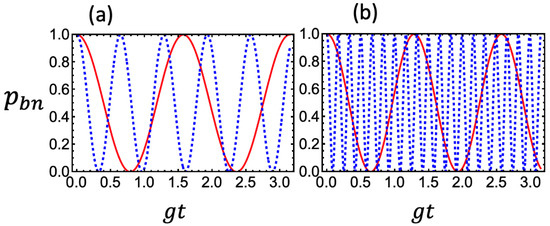
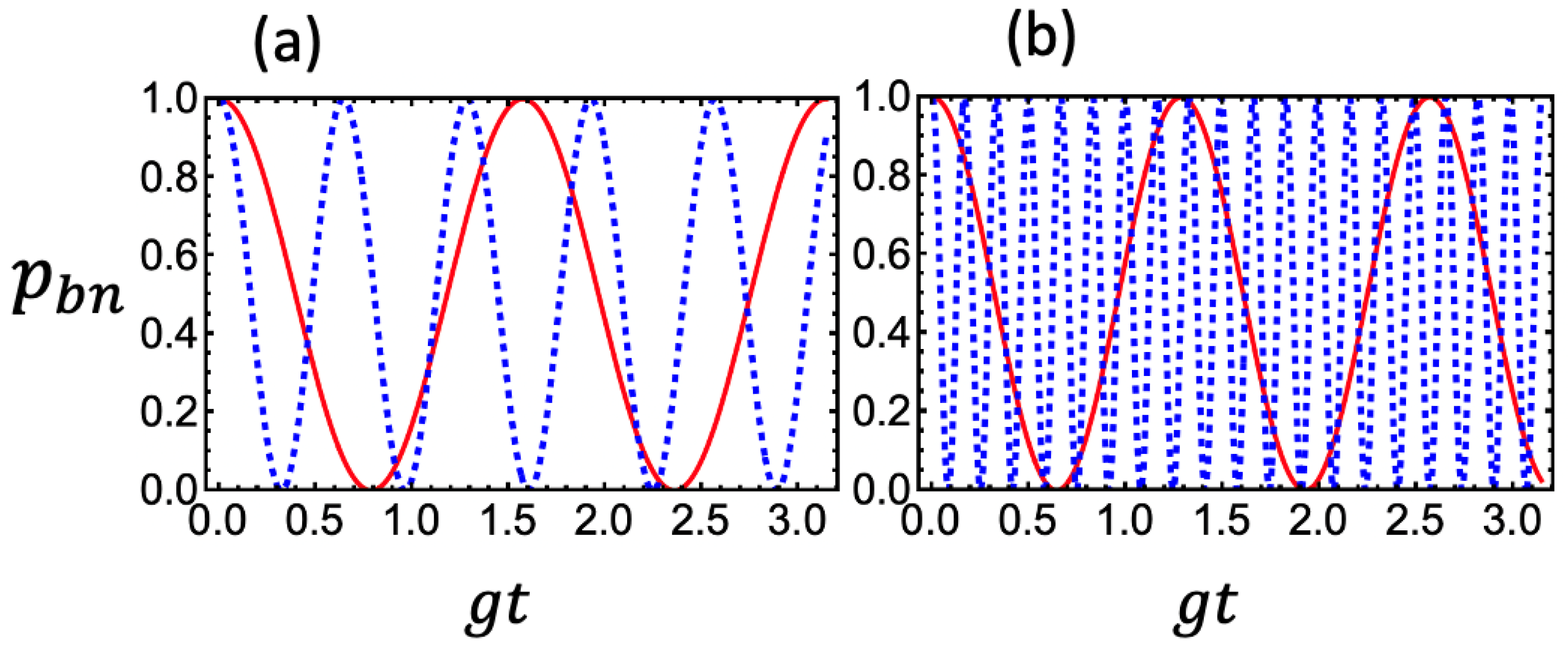
which is plotted in Figure 1. The oscillation frequency, and thus the resolution, is governed by the effective coupling factor , which increases with both photon number n and photon order m.
Figure 1.
Probability of finding the atom in the ground state for the initial condition with in (a) and in (b). The solid curves correspond to the single-photon process , while the dotted curves correspond to the four-photon process . The faster oscillations for larger m show that higher-order multiphoton coupling drives the system through distinguishable states more rapidly. This increased dynamical speed corresponds to a larger quantum Fisher information for time estimation and therefore supports the improved time-resolution scaling .
In Figure 1a, we consider the case . The solid (red) curve corresponds to , yielding , while the dotted (blue) curve corresponds to , with . As expected, the oscillation frequency for is approximately 2.5 times higher than that for over the same time interval. In Figure 1b, we examine the case , again comparing and , which correspond to and , respectively.
These results clearly illustrate that even a modest increase in the photon number n leads to a substantial enhancement in the resolution of nonlinear Rabi oscillations. This behavior underscores the potential of such dynamics to function as a super-resolving quantum clock, with time resolution scaling as . Furthermore, when employing R independent atoms, the precision can be improved in accordance with the quantum Cramér–Rao bound, yielding
Using for , this equation yields the explicit bound
This expression shows that the time resolution improves polynomially with photon number with power , and gains the usual enhancement from R independent repetitions.
4. Generation of the ON State
The simple configuration described in Equation (25) can lead to an interesting scenario. For , the system evolves into a specific entangled state between the atom and the field,
If the atom is subsequently measured in the superposition state , the field collapses into a superposition of two Fock states, and , given by
As a particular case, when , the resulting field state becomes a superposition of the vacuum and the n-photon Fock state, written as
This state serves as the single-mode analog of the NOON state and we refer to here as the ON state.
We now examine the metrological performance of the ON state. A phase shift can be imprinted on the state via the unitary operator , yielding
To estimate the phase , we introduce the observable that is used for the extraction of the phase information.
Therefore, the expectation value of this observable with respect to the state is
and its standard deviation is given by . Using the error propagation formula, the phase uncertainty is obtained as
Since the average photon number in the state is , this result corresponds to the Heisenberg limit of phase precision. What is particularly noteworthy here is that this scaling is often associated with the NOON state, where it arises due to entanglement between two modes. However, the ON state achieves the same Heisenberg-limited sensitivity without requiring any mode entanglement. This demonstrates that single-mode superpositions can also attain optimal precision in quantum metrology.
Interestingly, this state has been discussed previously in the literature (see Ref. [47]), where it was noted that such a superposition can in principle achieve Heisenberg-limited scaling, although no clear method for its realization was introduced. The formalism developed here provides a concrete mechanism for generating this state and may serve as a basis for experimentally demonstrating Heisenberg-limited scaling without the need for entanglement, using the ON state.
5. From Quantum Speed Limit to Ultimate Metrological Scaling
To gain a deeper understanding of the sensitivity of Rabi oscillations, it is instructive to analyze the system from the perspective of QFI. For a pure state , the QFI with respect to time is given by Equation (12). Applying this expression to the state in Equation (25) yields . This directly implies that the error in time estimation scales as , or equivalently,
which asymptotically approaches the scaling for large n. Using the expression for the instantaneous speed of quantum evolution in the Bures geometry, we find
This indicates that the speed of evolution increases with both the photon number n and the nonlinearity order m.
More generally, the QFI for an arbitrary mixed state is bounded by
where is the standard deviation (energy uncertainty) of the system Hamiltonian .
The first formulation of the QSL was introduced by Mandelstam and Tamm, who demonstrated that the minimum time required for a quantum system to evolve between two orthogonal states is bounded from below by [59]
This bound was later generalized to arbitrary (nonorthogonal) quantum states and through the introduction of the Bures angle , leading to [60]
In the limit of infinitesimal time evolution, where evolves continuously to , the Bures angle reduces to . This yields the inequality
This bound establishes a fundamental connection between operator variance and the concept of QSL [40].
Therefore, the minimum resolvable time interval is given by
This relation demonstrates that the QSL imposes a fundamental constraint on the attainable precision of quantum metrological protocols, directly linking the energy fluctuations of the probe to its ultimate estimation capability.
The Heisenberg limit associated with the NOON state is widely recognized as the optimal scaling for quantum metrology [61]. However, as demonstrated above, the precision scaling with n photons at the input can instead follow , enabling sensitivities that surpass the conventional scaling of the NOON state, as illustrated in Figure 1. At first glance, this appears to challenge the notion that the NOON state achieves the ultimate metrological precision. Such observations are not confined to the present work. For example, Beltrán and Luis showed that phase estimation in systems with classical optical nonlinearities can exhibit an error scaling of [35], a result that was later confirmed experimentally by Napolitano et al. [36]. Even stronger scalings of the form , where q is a positive integer, have been reported by Boixo et al. [37]. These findings suggest that, under certain nonlinear or interaction-based strategies, one can achieve precision beyond the traditional Heisenberg limit. This effect is often referred to as “super-Heisenberg” scaling [36,38]. Consequently, the conventional Heisenberg limit cannot be regarded as a universally valid bound on metrological precision. This raises a fundamental question: what is the true quantum-mechanical limit that dictates the ultimate scaling of parameter estimation?
To resolve the apparent paradox surrounding the optimal scaling of precision, it is essential to adopt a consistent and physically meaningful definition of resource counting. As previously discussed, the QFI is bounded by the variance (uncertainty) of the system Hamiltonian, linking metrological precision to the Mandelstam–Tamm bound. In certain specific scenarios, this variance leads to a number-phase uncertainty relation, which underpins the conventional usage of the term Heisenberg limit [42,47]. This connection suggests that the metrological resource should be identified with the generator of the parameter shift, typically the system Hamiltonian. However, using the Hamiltonian variance as a universal measure of resource consumption is problematic. In particular, it does not always provide a well-defined or finite quantity. For example, in certain physically relevant systems, the variance of the Hamiltonian may diverge. A prominent case is the class of systems characterized by a Breit-Wigner energy spectrum [62,63], where the energy uncertainty becomes ill defined. This highlights the need for a more robust and universally applicable framework for defining resources in quantum metrology.
It turns out that framing the problem within the context of the QSL provides an alternative way to bound the achievable precision in estimating a phase shift (or equivalently, time). An important result in this regard is the bound introduced by Margolus and Levitin, which states that the minimum time required for a quantum system to evolve into an orthogonal state is [64,65], where denotes the average energy of the system, whereas denotes only the average number of photons in the field. These two quantities coincide only for simple linear phase shifts generated by . In nonlinear or multiphoton protocols, however, the generator can depend nonlinearly on photon number, for example through , so the relevant resource is not simply , but rather the expectation value of the generator, such as .
When represents a physical Hamiltonian, the absolute energy origin carries no operational meaning; adding a constant leaves the dynamics unchanged but shifts . We therefore fix the reference by assigning zero energy to the ground state (minimum energy state). This can be done by using the shift
where is the smallest eigenvalue and I is the identity. Resource measures and precision bounds that depend on the mean energy should be expressed in terms of , the average energy measured from the ground state. This quantity is invariant under energy shifts and aligns with the form required by Margolus–Levitin bounds.
Similar to the Mandelstam–Tamm bound, this result has been generalized to arbitrary (nonorthogonal) quantum states using the Bures angle , leading to the inequality [66]
From this relation, one sees that the Margolus–Levitin bound implies a fundamental constraint on estimation precision, . Therefore, any quantum metrological strategy must respect this bound in addition to the one set by the energy variance. Crucially, unlike the variance, the average energy is always positive and finite, making it a well-defined and operationally meaningful measure of the resource. Intuitively, increasing the average energy allocated to the system enables higher precision, while implies no informational gain, as no physical resource is available to encode or extract information.
Therefore, for the nonlinear interaction Hamiltonian in Equation (15), the appropriate definition of the resource is given by , reflecting the m-photon nature of the coupling. As a result, the resource count is characterized by the average value . Strategies based on classical pulses typically yield a precision scaling of , which corresponds to . The Rabi oscillation protocol developed here surpasses the conventional scaling, highlighting its potential as a practically relevant approach for achieving super-Heisenberg precision in quantum metrology.
Therefore, when the phase-generating operator is defined as , its application to a NOON state enables phase estimation under nonlinear dynamics. The phase shift is imprinted on the state as
To extract the phase information, we introduce the observable . The expectation value of this observable with respect to the evolved state is
This gives , from which the phase uncertainty can be derived using error propagation
This result saturates the fundamental scaling limit imposed by the Margolus–Levitin bound. In the case of , this reduces to the well-known Heisenberg scaling , confirming that the NOON state achieves optimal precision under both linear and nonlinear phase shift generators.
As a result, the apparent paradox in precision scaling can be resolved by identifying as the true resource of the system, leading to a Heisenberg-limit precision that scales as , rather than . Consequently, the Heisenberg limit should be understood in the context of the Margolus–Levitin bound rather than the traditional Heisenberg uncertainty relation. The latter is instead associated with the Mandelstam–Tamm bound, which relates the attainable precision to the variance of the Hamiltonian . As demonstrated above, our parameter estimation framework simultaneously satisfies both bounds. Therefore, it becomes evident that many of the so-called super-Heisenberg scaling protocols, which appear to surpass the conventional Heisenberg limit, in fact do not reach the ultimate quantum bound on precision.
It is important to note that the scaling laws derived above correspond to an ideal coherent evolution. In realistic implementations, decoherence, photon loss, imperfect state preparation, finite detection efficiency, and fluctuations in the effective coupling strength can reduce the achievable Fisher information [67,68,69]. These effects are especially relevant for higher-order multiphoton processes, where the effective coupling is typically weaker and the required coherence time may become more demanding. Therefore, the condition for observing the predicted scaling is not only that the effective m-photon Hamiltonian is valid, but also that the coherent Rabi dynamics occurs on a timescale shorter than the relevant decoherence and loss times.
For the ON-state protocol, losses and dephasing are also important because the metrological advantage depends on preserving coherence between the vacuum and the n-photon component. Photon loss can partially reveal which-number information and suppress the off-diagonal coherence responsible for the phase-dependent signal . Similarly, detector inefficiency and imperfect projection measurements reduce the visibility of the measured oscillations and therefore lower the attainable precision [70]. Thus, although the ON state shows that scaling does not by itself certify mode entanglement as the enabling resource, its practical realization still requires high-fidelity state preparation, low-loss evolution, and efficient readout.
These considerations do not change the resource-counting argument of the present work. Rather, they clarify that the results should be interpreted as ideal quantum speed-limit and Fisher-information bounds. In experiments, decoherence and imperfections will generally reduce the prefactor and may limit the range over which the asymptotic scaling can be observed. Nevertheless, platforms with strong light–matter coupling, long coherence times, and controlled multiphoton interactions provide a realistic route for testing the predicted dynamics and for exploring the resource-consistent interpretation of apparent super-Heisenberg scaling.
6. Conclusions
We presented a resource-consistent framework that ties metrological precision directly to quantum dynamical speed, clarifying when and how super-Heisenberg-like scalings arise. By analyzing multiphoton Rabi dynamics, we showed that the time (or phase) uncertainty can scale as with average photon number n and nonlinearity order m, and we identified the correct resource for such protocols as the generator’s expectation rather than photon number alone. Framing precision through quantum speed limits reconciles these scalings with fundamental bounds: the Mandelstam–Tamm relation links precision to energy variance, while the Margolus–Levitin bound shows that the ultimate Heisenberg regime is . Within this unified view, seemingly paradoxical beyond- behaviors reflect different generators and resource accounting, not a violation of Heisenberg scalings. In other words, the Heisenberg limit should be understood in the context of the Margolus–Levitin type speed limit bounds rather than the traditional Heisenberg uncertainty relation. Moreover, we revisited the common attribution of the NOON state’s scaling to entanglement. We considered a setting showing that the scaling alone does not certify entanglement as the enabling resource in this setting. We explicitly construct the feasible single-mode ON state probe that achieves the same sensitivity without mode entanglement.
These findings illuminate the ultimate scaling of quantum sensors and clarify the proper interpretation of the so-called Heisenberg scalings. These results shed light on the connection between quantum metrology and quantum speed limits, and show that demonstrating genuine quantum advantages requires careful, system-specific quantification of the operative resources.
Funding
This research received no external funding.
Data Availability Statement
No datasets were generated or analyzed during the current study.
Acknowledgments
I would like to thank Marlan O. Scully and M. Suhail Zubairy for insightful discussions.
Conflicts of Interest
The author declares no conflicts of interest.
References
- Tse, M.; Yu, H.; Kijbunchoo, N.; Fernandez-Galiana, A.; Dupej, P.; Barsotti, L.; Blair, C.; Brown, D.; Dwyer, S.; Effler, A.; et al. Quantum-enhanced advanced LIGO detectors in the era of gravitational-wave astronomy. Phys. Rev. Lett. 2019, 123, 231107. [Google Scholar] [CrossRef] [Scilit] [PubMed]
- Jia, W.; Xu, V.; Kuns, K.; Nakano, M.; Barsotti, L.; Evans, M.; Mavalvala, N.; Collaboration, L.S.; Abbott, R.; Abouelfettouh, I.; et al. Squeezing the quantum noise of a gravitational-wave detector below the standard quantum limit. Science 2024, 385, 1318. [Google Scholar] [CrossRef] [Scilit] [PubMed]
- Taylor, M.A.; Bowen, W.P. Quantum metrology and its application in biology. Phys. Rep. 2016, 615, 1–59. [Google Scholar] [CrossRef] [Scilit]
- Khashami, F. Fundamentals of NMR and MRI: From Quantum Principles to Medical Applications; Springer Nature: Berlin/Heidelberg, Germany, 2024. [Google Scholar]
- Couteau, C.; Barz, S.; Durt, T.; Gerrits, T.; Huwer, J.; Prevedel, R.; Rarity, J.; Shields, A.; Weihs, G. Applications of single photons in quantum metrology, biology and the foundations of quantum physics. Nat. Rev. Phys. 2023, 5, 354. [Google Scholar] [CrossRef] [Scilit]
- Giovannetti, V.; Lloyd, S.; Maccone, L. Advances in quantum metrology. Nat. Photonics 2011, 5, 222. [Google Scholar] [CrossRef] [Scilit]
- Maleki, Y.; Zubairy, M.S. Distributed phase estimation and networked quantum sensors with W-type quantum probes. Phys. Rev. A 2022, 105, 032428. [Google Scholar] [CrossRef] [Scilit]
- Helstrom, C.W. Minimum mean-squared error of estimates in quantum statistics. Phys. Lett. A 1967, 25, 101. [Google Scholar] [CrossRef] [Scilit]
- Caves, C.M. Quantum-mechanical noise in an interferometer. Phys. Rev. D 1981, 23, 1693. [Google Scholar] [CrossRef] [Scilit]
- Yu, C.-J.; von Kugelgen, S.; Laorenza, D.W.; Freedman, D.E. A molecular approach to quantum sensing. ACS Cent. Sci. 2021, 7, 712. [Google Scholar] [CrossRef] [Scilit] [PubMed]
- Aslam, N.; Zhou, H.; Urbach, E.K.; Turner, M.J.; Walsworth, R.L.; Lukin, M.D.; Park, H. Quantum sensors for biomedical applications. Nat. Rev. Phys. 2023, 5, 157. [Google Scholar] [CrossRef] [Scilit] [PubMed]
- Khashami, F.; Glöggler, S. Quantum entanglement control in two-spin-1/2 NMR systems through magnetic fields and temperature. Phys. Chem. Chem. Phys. 2025, 27, 16996. [Google Scholar] [CrossRef] [Scilit] [PubMed]
- Degen, C.L.; Reinhard, F.; Cappellaro, P. Quantum sensing. Rev. Mod. Phys. 2017, 89, 035002. [Google Scholar] [CrossRef] [Scilit]
- Pirandola, S.; Bardhan, B.R.; Gehring, T.; Weedbrook, C.; Lloyd, S. Advances in photonic quantum sensing. Nat. Photonics 2018, 12, 724. [Google Scholar] [CrossRef] [Scilit]
- Braun, D.; Adesso, G.; Benatti, F.; Floreanini, R.; Marzolino, U.; Mitchell, M.W.; Pirandola, S. Quantum-enhanced measurements without entanglement. Rev. Mod. Phys. 2018, 90, 035006. [Google Scholar] [CrossRef] [Scilit]
- Demkowicz-Dobrzański, R.; Górecki, W.; Guţă, M. Multiparameter estimation beyond quantum Fisher information. J. Phys. A Math. Theor. 2020, 53, 363001. [Google Scholar] [CrossRef] [Scilit]
- Albarelli, F.; Barbieri, M.; Genoni, M.G.; Gianani, I. A perspective on multiparameter quantum metrology: From theoretical tools to applications in quantum imaging. Phys. Lett. A 2020, 384, 126311. [Google Scholar] [CrossRef] [Scilit]
- Liu, J.; Yuan, H.; Lu, X.-M.; Wang, X. Quantum Fisher information matrix and multiparameter estimation. J. Phys. A Math. Theor. 2020, 53, 023001. [Google Scholar]
- Sidhu, J.S.; Kok, P. Geometric perspective on quantum parameter estimation. AVS Quantum Sci. 2020, 2, 014701. [Google Scholar] [CrossRef] [Scilit]
- Huang, J.; Zhuang, M.; Lee, C. Entanglement-enhanced quantum metrology: From standard quantum limit to Heisenberg limit. Appl. Phys. Rev. 2024, 11, 031302. [Google Scholar] [CrossRef] [Scilit]
- Montenegro, V.; Mukhopadhyay, C.; Yousefjani, R.; Sarkar, S.; Mishra, U.; Paris, M.G.A.; Bayat, A. Quantum metrology and sensing with many-body systems. Phys. Rep. 2025, 1134, 1–62. [Google Scholar] [CrossRef] [Scilit]
- Fadel, M.; Roux, N.; Gessner, M. Quantum metrology with a continuous-variable system. Rep. Prog. Phys. 2025, 88, 106001. [Google Scholar] [CrossRef] [Scilit]
- Bass, S.D.; Doser, M. Quantum sensing for particle physics. Nat. Rev. Phys. 2024, 6, 329. [Google Scholar] [CrossRef] [Scilit]
- Meyer, J.J. Fisher information in noisy intermediate-scale quantum applications. Quantum 2021, 5, 539. [Google Scholar] [CrossRef] [Scilit]
- Feng, W.; Jiang, K.; Lollie, M.L.-J.; Zubairy, M.S.; Dowling, J.P. Super-resolving single-photon number-path-entangled state and its generation. Phys. Rev. A 2014, 89, 043824. [Google Scholar] [CrossRef] [Scilit]
- Maleki, Y. Quantum phase estimations with spin coherent states superposition. Eur. Phys. J. Plus 2021, 136, 1028. [Google Scholar] [CrossRef] [Scilit]
- Xiang, G.-Y.; Higgins, B.L.; Berry, D.; Wiseman, H.M.; Pryde, G. Entanglement-enhanced measurement of a completely unknown optical phase. Nat. Photonics 2011, 5, 43. [Google Scholar]
- Zhou, S.; Zhang, M.; Preskill, J.; Jiang, L. Achieving the Heisenberg limit in quantum metrology using quantum error correction. Nat. Commun. 2018, 9, 78. [Google Scholar] [CrossRef] [Scilit]
- Boto, A.N.; Kok, P.; Abrams, D.S.; Braunstein, S.L.; Williams, C.P.; Dowling, J.P. Quantum interferometric optical lithography: Exploiting entanglement to beat the diffraction limit. Phys. Rev. Lett. 2000, 85, 2733. [Google Scholar] [CrossRef] [Scilit] [PubMed]
- Maleki, Y.; Zheltikov, A.M. Generating maximally path-entangled number states in two spin ensembles coupled to a superconducting flux qubit. Phys. Rev. A 2018, 97, 012312. [Google Scholar] [CrossRef] [Scilit]
- Pezze, L.; Smerzi, A.; Oberthaler, M.K.; Schmied, R.; Treutlein, P. Quantum metrology with nonclassical states of atomic ensembles. Rev. Mod. Phys. 2018, 90, 035005. [Google Scholar] [CrossRef] [Scilit]
- Hemmer, P.R.; Muthukrishnan, A.; Scully, M.O.; Zubairy, M.S. Quantum lithography with classical light. Phys. Rev. Lett. 2006, 96, 163603. [Google Scholar] [CrossRef] [Scilit] [PubMed]
- Liao, Z.; Al-Amri, M.; Zubairy, M.S. Quantum lithography beyond the diffraction limit via Rabi oscillations. Phys. Rev. Lett. 2010, 105, 183601. [Google Scholar] [CrossRef] [Scilit] [PubMed]
- Wölk, S.; Ge, W.; Zubairy, M.S. Phase measurement with classical light. Phys. Rev. A 2012, 86, 053833. [Google Scholar] [CrossRef] [Scilit]
- Beltrán, J.; Luis, A. Breaking the Heisenberg limit with inefficient detectors. Phys. Rev. A 2005, 72, 045801. [Google Scholar] [CrossRef] [Scilit]
- Napolitano, M.; Koschorreck, M.; Dubost, B.; Behbood, N.; Sewell, R.; Mitchell, M.W. Interaction-based quantum metrology showing scaling beyond the Heisenberg limit. Nature 2011, 471, 486. [Google Scholar] [CrossRef] [Scilit] [PubMed]
- Boixo, S.; Flammia, S.T.; Caves, C.M.; Geremia, J.M. Generalized limits for single-parameter quantum estimation. Phys. Rev. Lett. 2007, 98, 090401. [Google Scholar] [CrossRef] [Scilit] [PubMed]
- Rams, M.M.; Sierant, P.; Dutta, O.; Horodecki, P.; Zakrzewski, J. At the limits of criticality-based quantum metrology: Apparent super-Heisenberg scaling revisited. Phys. Rev. X 2018, 8, 021022. [Google Scholar] [CrossRef] [Scilit]
- Taddei, M.M.; Escher, B.M.; Davidovich, L.; de Matos Filho, R.L. Quantum speed limit for physical processes. Phys. Rev. Lett. 2013, 110, 050402. [Google Scholar] [CrossRef] [Scilit] [PubMed]
- Maleki, Y.; Ahansaz, B.; Maleki, A. Speed limit of quantum metrology. Sci. Rep. 2023, 13, 12031. [Google Scholar] [CrossRef] [Scilit] [PubMed]
- Carrasco, S.C.; Goerz, M.H.; Li, Z.; Colombo, S.; Vuletić, V.; Schleich, W.P.; Malinovsky, V.S. Time-reversal interferometry using cat states with scalable entangling resources. arXiv 2026, arXiv:2602.06308. [Google Scholar]
- Holland, M.J.; Burnett, K. Interferometric detection of optical phase shifts at the Heisenberg limit. Phys. Rev. Lett. 1993, 71, 1355. [Google Scholar] [CrossRef] [Scilit] [PubMed]
- Maleki, Y.; Zheltikov, A.M. Recovery of maximally entangled quantum states by weak-measurement reversal. Laser Phys. Lett. 2018, 15, 056201. [Google Scholar] [CrossRef] [Scilit]
- Ness, G.; Lam, M.R.; Alt, W.; Meschede, D.; Sagi, Y.; Alberti, A. Observing crossover between quantum speed limits. Sci. Adv. 2021, 7, eabj9119. [Google Scholar] [CrossRef] [Scilit] [PubMed]
- Chen, C.-F.; Lucas, A.; Yin, C. Speed limits and locality in many-body quantum dynamics. Rep. Prog. Phys. 2023, 86, 116001. [Google Scholar] [CrossRef] [Scilit]
- Maleki, Y.; Maleki, A. Speed limit of quantum dynamics near the event horizon of black holes. Phys. Lett. B 2020, 810, 135700. [Google Scholar] [CrossRef] [Scilit]
- Zwierz, M.; Pérez-Delgado, C.A.; Kok, P. General optimality of the Heisenberg limit for quantum metrology. Phys. Rev. Lett. 2010, 105, 180402. [Google Scholar] [CrossRef] [Scilit] [PubMed]
- Scully, M.O.; Zubairy, M.S. Quantum Optics; Cambridge University Press: Cambridge, UK, 1997. [Google Scholar]
- Maleki, Y.; Scully, M.O.; Zheltikov, A.M. Quantum metrology with superposition spin coherent states: Insights from Fisher information. Phys. Rev. A 2021, 104, 053712. [Google Scholar] [CrossRef] [Scilit]
- Bures, D. An extension of Kakutani’s theorem on infinite product measures to the tensor product of semifinite W-algebras. Trans. Am. Math. Soc. 1969, 135, 199. [Google Scholar] [CrossRef] [Scilit]
- Uhlmann, A. The transition probability in the state space of a-algebra. Rep. Math. Phys. 1976, 9, 273. [Google Scholar] [CrossRef] [Scilit]
- Jozsa, R. Fidelity for mixed quantum states. J. Mod. Opt. 1994, 41, 2315. [Google Scholar] [CrossRef] [Scilit]
- Maleki, Y.; Zubairy, M.S. Universal criteria for entanglement-assisted dynamical speed enhancement. Phys. Rev. A 2024, 110, 052415. [Google Scholar] [CrossRef] [Scilit]
- Deffner, S.; Lutz, E. Quantum speed limit for non-Markovian dynamics. Phys. Rev. Lett. 2013, 111, 010402. [Google Scholar] [CrossRef] [Scilit] [PubMed]
- Villas-Boas, C.J.; Rossatto, D.Z. Multiphoton Jaynes-Cummings model: Arbitrary rotations in Fock space and quantum filters. Phys. Rev. Lett. 2019, 122, 123604. [Google Scholar] [CrossRef] [Scilit] [PubMed]
- Felicetti, S.; Rossatto, D.; Rico, E.; Solano, E.; Forn-Díaz, P. Two-photon quantum Rabi model with superconducting circuits. Phys. Rev. A 2018, 97, 013851. [Google Scholar] [CrossRef] [Scilit]
- Zou, F.; Zhang, X.-Y.; Xu, X.-W.; Huang, J.-F.; Liao, J.-Q. Multiphoton blockade in the two-photon Jaynes-Cummings model. Phys. Rev. A 2020, 102, 053710. [Google Scholar] [CrossRef] [Scilit]
- Toor, A.; Zubairy, M. Validity of the effective Hamiltonian in the two-photon atom-field interaction. Phys. Rev. A 1992, 45, 4951. [Google Scholar] [CrossRef] [Scilit] [PubMed]
- Mandelstam, L.; Tamm, I. The uncertainty relation between energy and time in non-relativistic quantum mechanics. In Selected Papers; Springer: Berlin/Heidelberg, Germany, 1991; pp. 115–123. [Google Scholar]
- Deffner, S.; Campbell, S. Quantum speed limits: From Heisenberg’s uncertainty principle to optimal quantum control. J. Phys. A Math. Theor. 2017, 50, 453001. [Google Scholar] [CrossRef] [Scilit]
- Kim, D.-H.; Hong, S.; Kim, Y.-S.; Oh, K.; Lee, S.-Y.; Lee, C.; Lim, H.-T. Distributed quantum sensing with multimode N00N states. Phys. Rev. Lett. 2025, 135, 050802. [Google Scholar] [CrossRef] [Scilit] [PubMed]
- Breit, G.; Wigner, E. Capture of slow neutrons. Phys. Rev. 1936, 49, 519. [Google Scholar] [CrossRef] [Scilit]
- Uffink, J.B. The rate of evolution of a quantum state. Am. J. Phys. 1993, 61, 935. [Google Scholar] [CrossRef] [Scilit]
- Margolus, N.; Levitin, L.B. The maximum speed of dynamical evolution. Phys. D Nonlinear Phenom. 1998, 120, 188. [Google Scholar] [CrossRef] [Scilit]
- Kominis, I.K. Quantum thermodynamic derivation of the energy resolution limit in magnetometry. Phys. Rev. Lett. 2024, 133, 263201. [Google Scholar] [CrossRef] [Scilit] [PubMed]
- Campaioli, F.; Pollock, F.A.; Binder, F.C.; Modi, K. Tightening quantum speed limits for almost all states. Phys. Rev. Lett. 2018, 120, 060409. [Google Scholar] [CrossRef] [Scilit] [PubMed]
- Chin, A.W.; Huelga, S.F.; Plenio, M.B. Quantum metrology in non-Markovian environments. Phys. Rev. Lett. 2012, 109, 233601. [Google Scholar] [CrossRef] [Scilit] [PubMed]
- Shaji, A.; Caves, C.M. Qubit metrology and decoherence. Phys. Rev. A 2007, 76, 032111. [Google Scholar] [CrossRef] [Scilit]
- Zhou, C.; Maleki, Y.; Liao, Z.; Zubairy, M.S. Emission of an atom inside a one-dimensional atomic cavity. Phys. Rev. A 2023, 108, 013708. [Google Scholar] [CrossRef] [Scilit]
- Datta, A.; Zhang, L.; Thomas-Peter, N.; Dorner, U.; Smith, B.J.; Walmsley, I.A. Quantum metrology with imperfect states and detectors. Phys. Rev. A 2011, 83, 063836. [Google Scholar] [CrossRef] [Scilit]
Disclaimer/Publisher’s Note: The statements, opinions and data contained in all publications are solely those of the individual author(s) and contributor(s) and not of MDPI and/or the editor(s). MDPI and/or the editor(s) disclaim responsibility for any injury to people or property resulting from any ideas, methods, instructions or products referred to in the content. |
© 2026 by the author. Licensee MDPI, Basel, Switzerland. This article is an open access article distributed under the terms and conditions of the Creative Commons Attribution (CC BY) license.