


Abstract
We investigate majority-vote opinion dynamics on Geometric Inhomogeneous Random Graphs (GIRGs), a powerful model for spatial complex networks. In contrast to classic coarsening dynamics, where a single opinion typically achieves global consensus, our simulations reveal that sufficiently large, localized opinion domains do not disappear. Instead, they stabilize, leading to a persistent coexistence of competing opinions. To understand the mechanism behind this arrested coarsening, we develop and analyze a tractable mean-field model of the interface between two opinion domains. Our main theoretical result rigorously establishes the existence of a stable, non-trivial limiting distribution for the interface profile in a mean-field analysis. This demonstrates that the boundary between opinions is stationary, providing a mathematical explanation for how complex network geometry can support robust opinion diversity in social systems.
1. Introduction
Emergence of Stable Boundaries in Spatial Opinion Dynamics. The diffusion of ideas, the adoption of innovations, and the formation of political consensus are all driven by social influence within populations structured by complex networks. A growing body of evidence suggests that many real-world networks, from online social platforms to offline communities, can be modelled by assuming a latent geometric space where proximity increases the connection probability [1,2,3,4,5,6]. This underlying geometry gives rise to many properties observed in real social networks, including high clustering and stronger communities than the degree distribution would predict [2,4,7,8]. Naturally, those structural properties shape the dynamics of social processes in the network.
A fundamental social mechanism is conformism: Individuals tend to adopt the opinions held by the majority of their peers [9]. This principle is captured by the simple and intuitive majority-vote dynamics, a process where agents iteratively update their state to match their local environment [10,11,12] and maintain their state in case of a tie. This work begins with a simple yet foundational question: In a world divided into two competing opinions, what determines the fate of a localized enclave of one opinion surrounded by the other? To investigate this, we performed simulations of a sequential majority process on Geometric Inhomogeneous Random Graphs (GIRGs), a state-of-the-art model for spatial complex networks [2]. The simulations then lead to a hypothesis that we rigorously verify in a mean-field approximation of the process and the graph models.
Our simulations reveal a dichotomy that forms the central puzzle of this paper. When an initial, localized domain of one opinion—say, “blue”—is small, it is quickly eroded by the surrounding “red” majority and vanishes, leading to global consensus. This outcome aligns with the classical expectation of coarsening dynamics [13]. However, if the initial blue domain is sufficiently large, the dynamics are markedly different. The domain initially shrinks and its boundaries become smoother, but the process halts. The system settles into a stable configuration where a persistent, ball-like cluster of the blue opinion coexists indefinitely with the red majority. This phenomenon of arrested coarsening suggests that interfaces between opinion domains in these complex networks can be remarkably stable, which is well compatible with the polarisation that real networks can express [14]. The central question of this paper is therefore: What is the underlying mechanism that governs this stability?
Context: From Coarsening Physics to Complex Networks. The evolution of boundaries between competing phases is a classic topic in statistical physics [13]. In models such as the Voter Model on a two-dimensional regular Euclidean lattice, where vertices randomly adopt the state of one of their neighbours, the system typically evolves to minimise the length of the interface separating domains, a process known as coarsening [15]. On any finite, connected graph, this process will continue until one domain is completely eliminated, resulting in a global consensus in which all agents share the same state. In many graphs, such convergence happens very quickly [16,17,18]. For the majority dynamics studied in this paper, by contrast, consensus is not guaranteed, and the long-term behaviour depends much more strongly on the underlying graph: Both rapid convergence to unanimity and persistent disagreement have been established in other settings [19,20,21]. Related majority-type phenomena have also been studied in probabilistic cellular automata and mean-field approximations [22]. Our results identify a specific mechanism for coexistence in a spatial complex network setting: on GIRGs, sufficiently large, localized opinion domains can remain stable because the interface between the two opinions becomes stationary.
The network in our study is the Geometric Inhomogeneous Random Graph (GIRG) model [2]. GIRGs have emerged as a powerful and realistic framework for modelling complex networks [3,4,6,8,23]. They rely on two ingredients. First, they are embedded in a geometric space, with connection probability decaying with distance. Second, vertices are endowed with heterogeneous weights, drawn from a power-law distribution, which gives rise to a scale-free degree distribution and the existence of highly connected “hub” vertices. The combination of those two features gives rise to many other emerging properties of real-world networks: They have clustering and communities [2], ultra-small distances [24], they are navigable [25] and compressible [2]. They show a remarkably rich phase diagram for infection processes [6] and rumour spreading [26], and the performance of several graph algorithms on GIRGs has been shown to match closely that on real-world networks [3,27]. They also include the popular model of Hyperbolic Random Graphs [28] as a special case [2]. While many spreading processes like infection models [6,23], rumour spreading [26], first-passage percolation [29], and bootstrap percolation [30] have been analysed for GIRGs, to the best of our knowledge, this is the first paper studying a competitive dynamics between two opinions.
Mathematical Contribution: A Tractable Mean-Field Model of the Interface. It is not hard to understand why a too-small ball of diverging opinion disappears. We give a brief heuristic argument in Section 3.1 that a boundary is unstable when its curvature becomes too large. This also explains the experimentally observed phenomenon that a large box of blue opinion will slightly shrink into a ball before stabilising. However, the mathematically more challenging part is to understand why a sufficiently large ball stabilises.
To gain mathematical traction on this question, we analyse the process in a simplified, continuous setting. Since stability of the interface is only achieved for sufficiently large balls, we first consider the macroscopic limit of an infinitely large ball of one opinion. In this limit, the curvature of the interface approaches zero, and the boundary converges to a straight line separating two half-spaces, one initially all-red and the other all-blue. This approach of studying a planar interface is a powerful technique in the statistical mechanics of phase separation and allows a detailed analysis of the interface profile and its dynamics. In a second step, we then show how the results for this macroscopic limit transfer to the case of balls with large but finite radius.
We model the state of this idealised system by a function , which represents the probability that a vertex located at a signed distance z from the interface holds the blue opinion. The evolution of over time is governed by an operator derived from the majority dynamics. In each step of our mean-field process, a vertex’s neighbourhood is effectively resampled from a hypothetical population whose red-/blue-assignment follows the probability distribution of the previous step. The number of red and blue neighbours of a vertex is then an independent Poisson random variable, redrawn in each round. This is a common and effective approximation for sparse random graphs in which edge presence is largely independent, but it is a substantial simplification for spatial models. The expectation of the two Poisson random variables is then obtained by integrating the current opinion profile f against the connection kernel of the GIRG model. This “mean-field assumption”, formally stated in Definition 4 of our technical analysis, decouples local spatial correlations. While this ignores the fact that neighbours of a red vertex are themselves more likely to be red, it makes the system analytically tractable. The evolution of the system is then described by an update operator derived from the dynamics.
Our Results. Our main theoretical result is concerned with the limiting distribution obtained by applying the operator repeatedly. In principle, a mean-field dynamics as described above could lead to two types of limiting distributions: The constant function is a fixed point of , so that would be a candidate for , which would then indicate that the phase boundary is not stable. However, we show that this is not the case in the macroscopic limit and that the limiting distribution is of a different type. Our main theoretical result, presented in Theorem 2, demonstrates that the limiting distribution between halfspaces is bounded away from for sufficiently large z. In other words, the initially red region maintains a red majority forever, and likewise for the blue region. The existence of this stable, non-constant solution provides a rigorous mathematical explanation (in a simplified setting) for the persistence of the interface observed in our simulations.
Our proof proceeds by constructing a class of “valid” functions that satisfy certain structural properties (monotonicity and symmetry) and that are subsolutions of , i.e., the operator maps them pointwise into more extreme functions, meaning that the absolute distance from increases pointwise. We then show that any valid subsolution of is a pointwise lower bound for the distance from of the true solution . Finally, for sufficiently large average degree in the underlying GIRG we show the existence of a non-trivial valid subsolution of by an explicit construction, thereby guaranteeing that both opinions survive in their respective majority regions.
In a second step, we transfer the results to the case of balls of finite, but growing radius r, which is more subtle. Due to the finite curvature, we can not expect the ball to persist indefinitely, as we formally show in Theorem 4. However, we show that the speed at which the ball erodes shrinks with the size of the ball. Note that the speed here is measured additively, i.e., if we start with a ball of radius , then even after time the local opinion will still dominate in a ball of radius . This means that the speed of erosion approaches zero as . In the discussion, we argue that this also explains arrested coarsening in the discrete setting of actual graphs. A vertex in a GIRG has a typical geometric distance of from all other vertices. Hence, in the discrete graph setting a ball of local opinion cannot shrink with arbitrarily small speed, and speed in the mean field approximation naturally corresponds to speed zero in the discrete setting, meaning stability.
Summary. In summary, this paper provides the first analytical evidence for the stability of opinion domains in the majority dynamics model on Geometric Inhomogeneous Random Graphs. By combining direct simulation with a rigorous mean-field analysis, we show that opinion formation in complex networks may deviate from the classic picture of opinion coarsening, with a robust coexistence limit rather than global consensus. Our results shed light on the mechanisms that can support opinion diversity and the formation of stable ideological clusters in spatially-embedded social systems. Furthermore, they provide a new analytical framework for studying interface phenomena on complex networks, bridging concepts from statistical physics with the modern theory of random graphs.
A summary of the results has been presented at the 14th International Conference on Complex Networks and their Applications in Binghampton, NY, USA [31]. The associated proceedings paper contains an outline of the results, but without proofs. Moreover, it only contains results for the macroscopic limit where both opinions form halfspaces, whereas we now also show how those results extend to balls of finite size. To extend the proof to this domain, we have switched the norm of the underlying geometric space from the maximum norm to the Euclidean norm because this makes the space rotationally invariant.
2. Network Model and Opinion Spreading
We start with the definition of Geometric Inhomogeneous Random Graphs (GIRG) and state a few basic properties that will be useful in our analysis.
Definition 1
(GIRG [2]). Let , and depending on the previous k be fixed constants and let be a d-dimensional cube of volume with torus topology centred at the origin. Distances are measured with respect to the norm on this torus. A Geometric Inhomogeneous Random Graph on n vertices is obtained by the following three-step procedure.
- (a)
- Each vertex independently draws a weight from the power-law distribution on with density for .
- (b)
- Each vertex draws independently a uniform random position .
- (c)
- A vertex pair forms an edge if and only if .
Compared to [2], we restrict to the zero-temperature case (In general, a temperature parameter makes edges appear with probability . At zero temperature (), this becomes a deterministic threshold rule, which is analytically more tractable while still preserving the essential geometric and heterogeneous structure of GIRGs), and we explicitly model the density parameter k that was hidden in -notation. Equivalently to our use of k, we could also increase the density of vertices from 1 to k.
The ball of influence is the region in which a vertex connects to all other vertices independently of their weights. It is a region that the vertex v dominates.
Definition 2
(Ball of Influence). Let be a GIRG on n vertices. The ball of influence of a vertex v is the -ball around of radius . Any vertex u in is a neighbour of v regardless of .
Beyond the ball of influence, vertices may still connect if their weight is sufficiently large. We call neighbours from the ball of influence near-neighbours or for short, and other neighbours far-neighbours or for short.
The following theorem gives the expected degree of a vertex of a given weight. It is one of the fundamental properties of the model and will later serve as a key ingredient in our mean-field approximation. The following refines a result from Bringmann et al. [2].
Theorem 1.
Let be a GIRG on n vertices and . Condition on the event that v has weight . Then
where the first term is contributed by the near-neighbours and the second from the far-neighbours.
We split the proof into two lemmas, corresponding to the two contributions to the degree: Near neighbours and far neighbours.
Lemma 1.
Let be a GIRG on n vertices and . Condition on the event that v has weight , the expected number of neighbours of v from the ball of influence is
Proof.
With respect to , the ball of influence is a d-dimensional ball of radius . The volume of such a hypersphere is
where represents Euler’s gamma function. By definition of all vertices inside , regardless of their weight, connect to v. Since distributes n vertices in a space of volume n, the density of the expected number of vertices per volume is one. Thus, the ball of influence will contain one vertex for each volume of space contained in . Thus
concluding the proof. □
Lemma 2.
Let be a GIRG on n vertices and . Condition on the event that v has weight , the expected number of far neighbours of v is
Proof.
Let u be a far neighbour of v with . Recall that u is a neighbour of v if and only if . Thus the probability that a random vertex u at distance r from v is a (far) neighbour of v is
By definition, is drawn from a power-law distribution with known density. Thus,
For each fixed r, the space at distance exactly r from v forms the surface of a d-ball. Applying its volume definition and the same volume argument from Lemma 1,
the number of far neighbours can be expressed in terms of the probability . The exponent is negative, since , and the integral evaluated at ∞ will therefore vanish. Plugging in yields
concluding the proof. □
On GIRGs we will consider the following sequential majority dynamics.
Definition 3
(Opinion Spreading). Let be an undirected graph. An opinion configuration at time is a function , where denotes the opinion of vertex at time t. For a given initial configuration , the Opinion Spreading process evolves as follows: At each time step , a vertex is chosen uniformly at random. This vertex then converts to the majority opinion of its neighbourhood at time step . The opinion of all other vertices remains unchanged. That is,
where denotes the set of neighbours of v in G. In particular, in the case of a tie, the opinion of v remains unchanged.
It is known that the Opinion-Spreading process always reaches a stable configuration in expected time at most , see [21].
3. Results
3.1. Experimental Observations
To motivate the subsequent theoretical analysis, we conducted simulations of the Opinion Spreading process on GIRGs generated with the libgirgs-all library [32]. The experiments used n = 10,000 vertices in dimensions, that is a torus of side length 100, and an average degree of 20, while varying the degree exponent . This parameter strongly influences the network structure. For small values of , the graph tends to contain many high-weight vertices with long-range connections, whereas larger yields more localised networks with fewer hubs and fewer long edges.
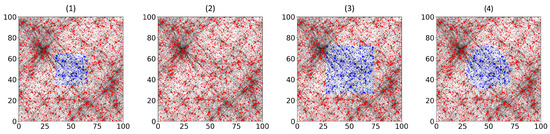
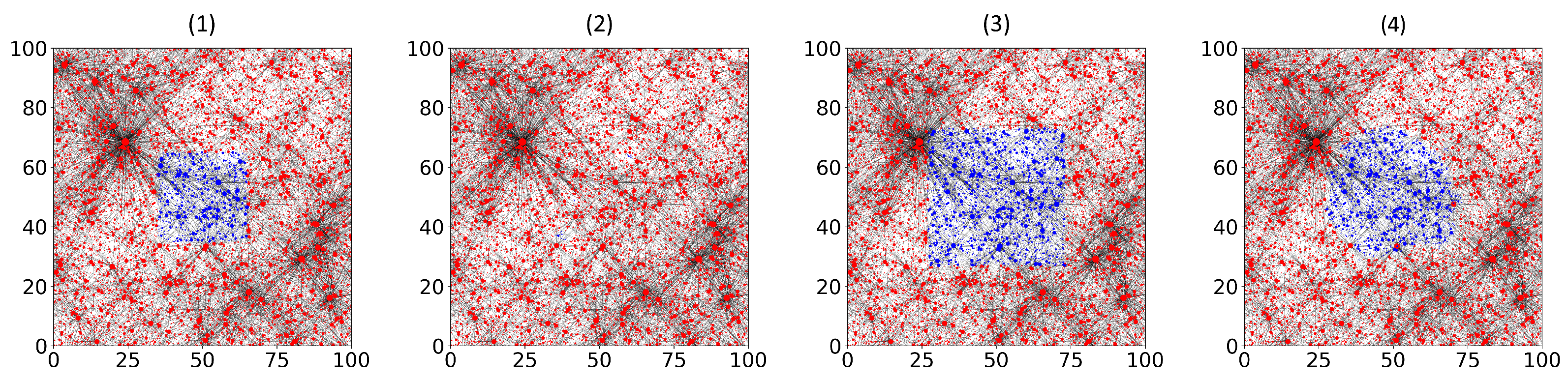
The initial opinion configuration was chosen to contain a region of blue vertices () in the shape of an axis-aligned square of side length s, centred at the origin, with all remaining vertices red (). When s was small, the region of blue vertices did not survive. The red opinion expanded inward until the stable configuration assigned value to all but a few small isolated components, which can never flip once formed. This effect was especially pronounced in networks with many high-weight vertices. The left two images of Figure 1 illustrate such a run: The blue region visible at (left) has completely disappeared in the final configuration (right).
Figure 1.
Opinion spreading with . Panels (1,2): Small square initial configuration ( (left), final configuration (right)), only red survives with minor exceptions. Panels (3,4): Large square initial configuration ( (left), (right)), both opinions survive.
For sufficiently large s, the blue region contracted during the early stages of the process, but the system then reached a stable configuration in which both opinions survived. The boundary of the blue region changed shape during this evolution. Vertices located at corners, surrounded by red neighbours in three quadrants, were highly unstable and flipped early, while vertices along flat edges with a more balanced neighbourhood were more likely to remain blue. The result after convergence was a rounded, approximately ball-shaped region of blue vertices. The left two images of Figure 1 show such an outcome, with the initially square set (left) evolving into a rounded persistent region in (right).
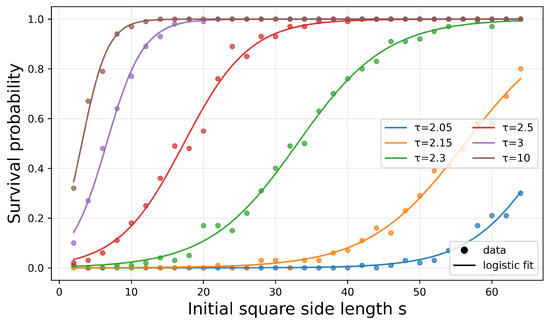
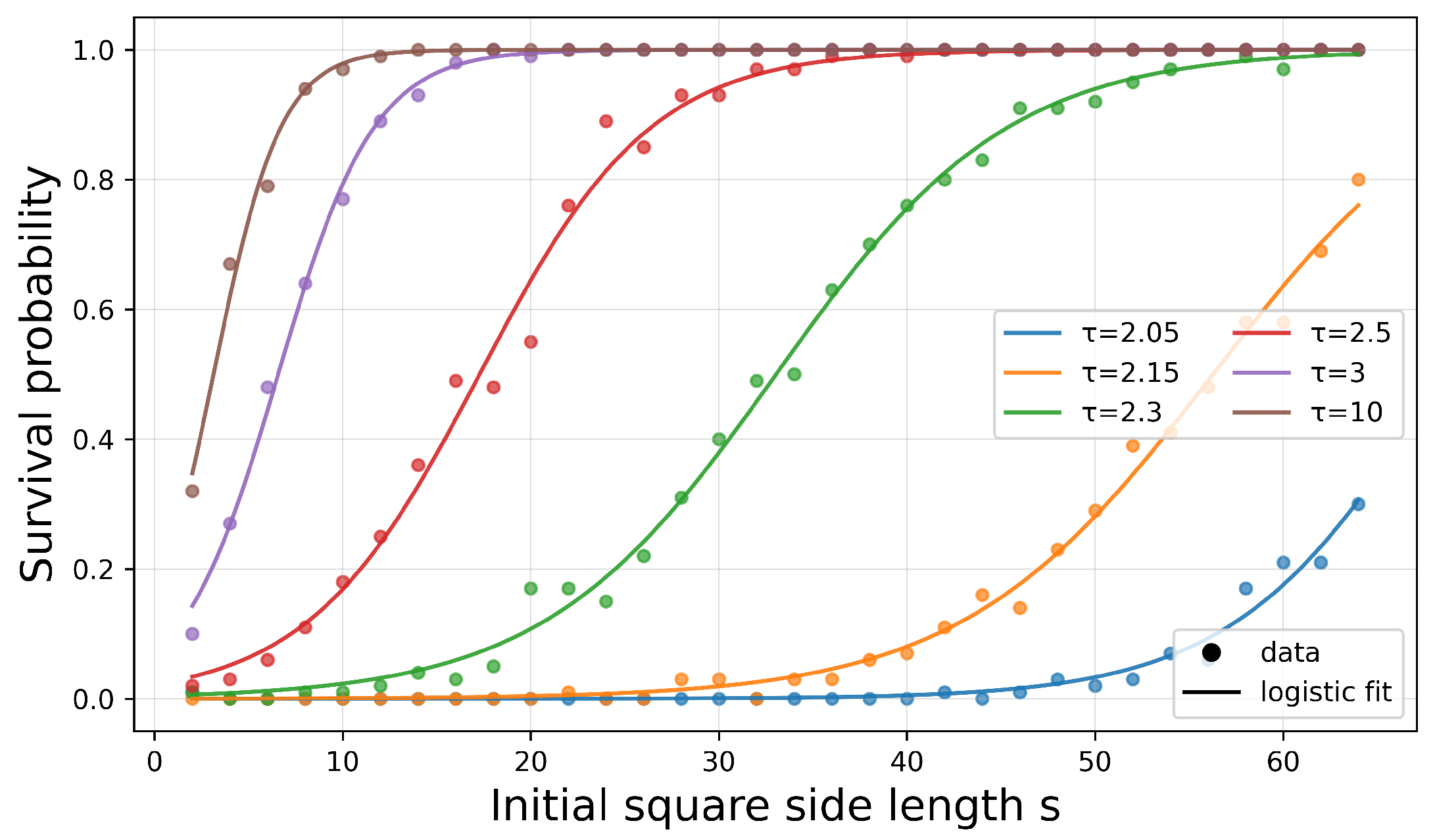
Systematic variation of showed a clear effect on the critical size needed for survival. As increased, survival became possible at smaller scales. Figure 2 illustrates this behaviour: For each value of , the survival probability of a square initial configuration rises sharply from near zero to near one as the side length s grows, with the transition point shifting to smaller s for larger . In all cases, surviving regions gradually evolved towards rounded shapes. Heuristically, this is consistent with the idea that the boundaries of high-curvature regions tend to shrink: small balls disappear, while larger infected regions can contract into shapes whose boundaries have lower curvature throughout. This intuition is reflected in our main theoretical result, which shows in a simplified mean-field setting that the process stabilises in the limit of vanishing curvature. Importantly, the theoretical results establish stability for arbitrary fixed dimension d, whereas the simulations reported here are restricted to the two-dimensional case only.
Figure 2.
Survival probability of a square initial configuration as a function of its side length s, for various values of . Dots show simulation results (100 runs per data point), and solid curves show logistic fits. The critical size decreases with .
3.2. The Mean-Field Approximation
Framework
To analyse the Opinion Spreading process on GIRGs, we employ a mean-field approximation [33]. The key idea is to replace the random, but fixed, neighbourhood of each vertex with an independent sample from the same distribution, redrawn each round. This leads to a deterministic update operator acting on functions f that describe the probability of holding opinion .
Definition 4
(Mean-Field Assumption). Let be a GIRG on n vertices and with a large enough density parameter k. Each vertex has a weight and a position . The Mean-Field Assumption posits that, conditioned on the type of a vertex v, the opinions of its neighbours are independent. Each neighbour holds opinion with probability , where is a function describing the current distribution of opinions. Moreover, the number and type of neighbours are redrawn for each update.
This assumption neglects local spatial dependencies induced by geometry, but retains heterogeneity in vertex types and spatially varying connection densities.
This assumption induces a natural one-step evolution rule: Given the current distribution f, we can compute the updated distribution of opinions in the next round by evaluating the probability that a vertex adopts opinion under the mean-field model. Recall that we will study the case for sufficiently large average degree, which is controlled by the parameter k.
Definition 5
(Mean-Field Update Operator). Let be a function and let denote the indicator of the event that vertices of types and are adjacent. For a vertex v of type define
where η denotes the density of existence of a vertex of type . Note that is simply the expected number of neighbours and does not depend on f or x.
Under the mean-field assumption, the numbers of neighbours with opinions are independent Poisson random variables with these means. We define the mean-field update operator by
where we adopt the convention that ties count as ; this differs from the sequential rule, but the exact tie event has vanishing probability for large degrees and can thus be ignored. Moreover, for sufficiently large k, we can use a Gaussian approximation of the above Skellam distribution via the central limit theorem,
where Φ denotes the standard normal distribution function.
In the following, we will work with the operator instead of , meaning that our results assume sufficiently large k.
Definition 6
(Advantage). For a vertex v of type and a function f, the quantity defined in Definition 5 is called the advantage of v under f. It measures the expected difference between the numbers of neighbours of v holding opinions and . We use the notation to denote the advantage of v in the region .
Next we define what it means for an opinion to survive under the mean-field assumption.
Definition 7
(Survival in the Mean-Field). Let be some initial configuration. Define and . We say that both opinions t-survive in the mean-field if there exist a constant ε, such that for all , there are positions , that satisfy
If this holds for , we will drop the t in t-survival and simply say that both opinions survive.
Although vertices in a GIRG are embedded in the full cube , our analysis will, for the most part, only depend on their signed distance from the boundary of a half-space. We therefore write for the first coordinate of , and restrict attention to functions of the form .
To estimate the advantage, we will often have to compare different regions of the neighbourhood of a vertex. The following definition will be useful for that.
Definition 8
(Complement). Let be a position with coordinates . We define its complement as the reflection of x across the hyperplane . Formally, and for all .
The next definition will be at the heart of the proof. We will show later that any valid subsolution of is a bound for the limiting survival function on half-spaces.
Definition 9
(Valid Function). A function is called valid if it satisfies Conditions 1–3 below, and we call f a valid subsolution of if additionally Condition 4 holds.
- 1.
- Symmetry: for all ; in particular .
- 2.
- Monotonicity in z: For each fixed w, the map is monotone increasing.
- 3.
- Monotonicity in w: For each fixed , the map is monotone increasing on .
- 4.
- Subsolution: for all with .
Note that symmetry Condition 1 together with the subsolution Condition 4 implies the reverse inequality for negative , as the update operator on f is also symmetric.
3.3. The Survival Theorem for Half-Spaces
Looking at half-spaces is motivated by our experimental observation. Areas of high local curvature tend to flatten over time, either vanishing fully or reaching stability once the curvature becomes negligible. In the limit, all shapes of negligible curvature locally look identical to half-spaces, which makes them a well-suited proxy for more complicated shapes.
We call the initialisation , corresponding to the opinion configuration that assigns to all vertices to the left of the half-space and to the vertices on the right, the half-space initialisation. Our main result of this section is to prove its mean-field survival.
Theorem 2
(Survival Theorem). For the half-space initialisation , both opinions survive in the mean-field.
To prove Theorem 2, we first collect some easy facts regarding .
Lemma 3
(Continuity of ). Let and fix . Then the map
is continuous.
Proof.
Since is continuous and does not depend on x, it is enough to show that
is continuous. Let . By definition,
For fixed w and y, the two indicators converge pointwise as , except possibly on the boundary
For each fixed w, this boundary is a sphere in . The integrand thus converges almost everywhere. Moreover, since , the integrand is bounded in absolute value by
for all sufficiently large n. This is integrable, because
where the last inequality uses . By dominated convergence,
Applying continuity of yields
Hence, is continuous. □
Lemma 4
(Symmetry Preservation of ). If is symmetric, then also is.
Proof.
By symmetry of
Since f is symmetric, also is. Thus,
which proves the statement. □
Lemma 5
(Monotonicity of ). Define , then these two monotonicity statements hold for :
- i.
- If f and g are symmetric and satisfy for all w and then for all w and .
- ii.
- If f and g satisfy everywhere, then also everywhere.
Proof.
We prove the two claims separately. By definition of , it suffices to show that for all w and . We write
By symmetry,
Since , for all with , so in particular,
for all w. Therefore,
This proves claim i. Claim ii, follows immediately from the definition
since everywhere. □
Applying the symmetry and monotonicity recursively, we obtain the following result.
Theorem 3
(Comparison Principle for ). Let be the half-space initialisation and . Furthermore let f be a valid subsolution of with on . Then for all t, w and . By symmetry also .
Proof.
By Condition 1, . By Lemmas 5 and 4,
With these facts, the aim of the remaining proof is to construct a valid subsolution f of . The most crucial step in this construction will be obtaining a pointwise lower bound on the advantage of a vertex v under f. This bound will then allow us to define f via the right-hand side of the defining equation of the update Operator (1).
3.3.1. Geometric Advantage Partitioning
We partition the ambient space into two regions and compute the contribution to the advantage from each separately.
Definition 10
(Partitioning). Let and let denote its complement (Definition 8). Let
and let
Then and form a partition of . A visualization of this partition can be found in Figure 3.
Figure 3.
The two-dimensional space partitioned into the two regions and .
We start by bounding the advantage of the red region.
Lemma 6.
The advantage of the red region is non-negative for any valid function f and any vertex v with .
Proof.
By symmetry of across the hyperplane, must also be. Unfolding the advantage definition
Since , for all x with , so in particular
for all w. Therefore,
Next we bound the advantage of the blue region.
Lemma 7.
The advantage of the blue region is lower bounded by
for any valid function f and any vertex v with , where
Proof.
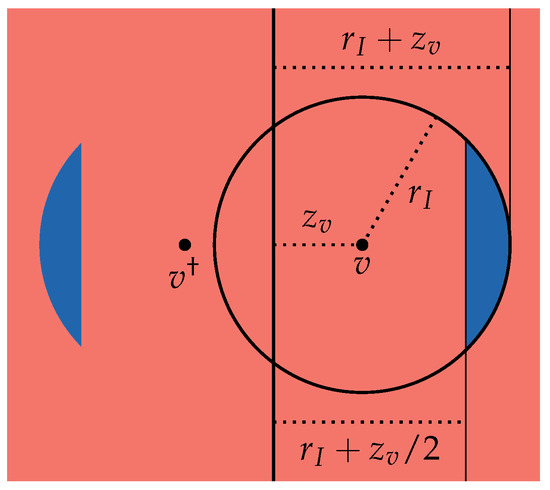
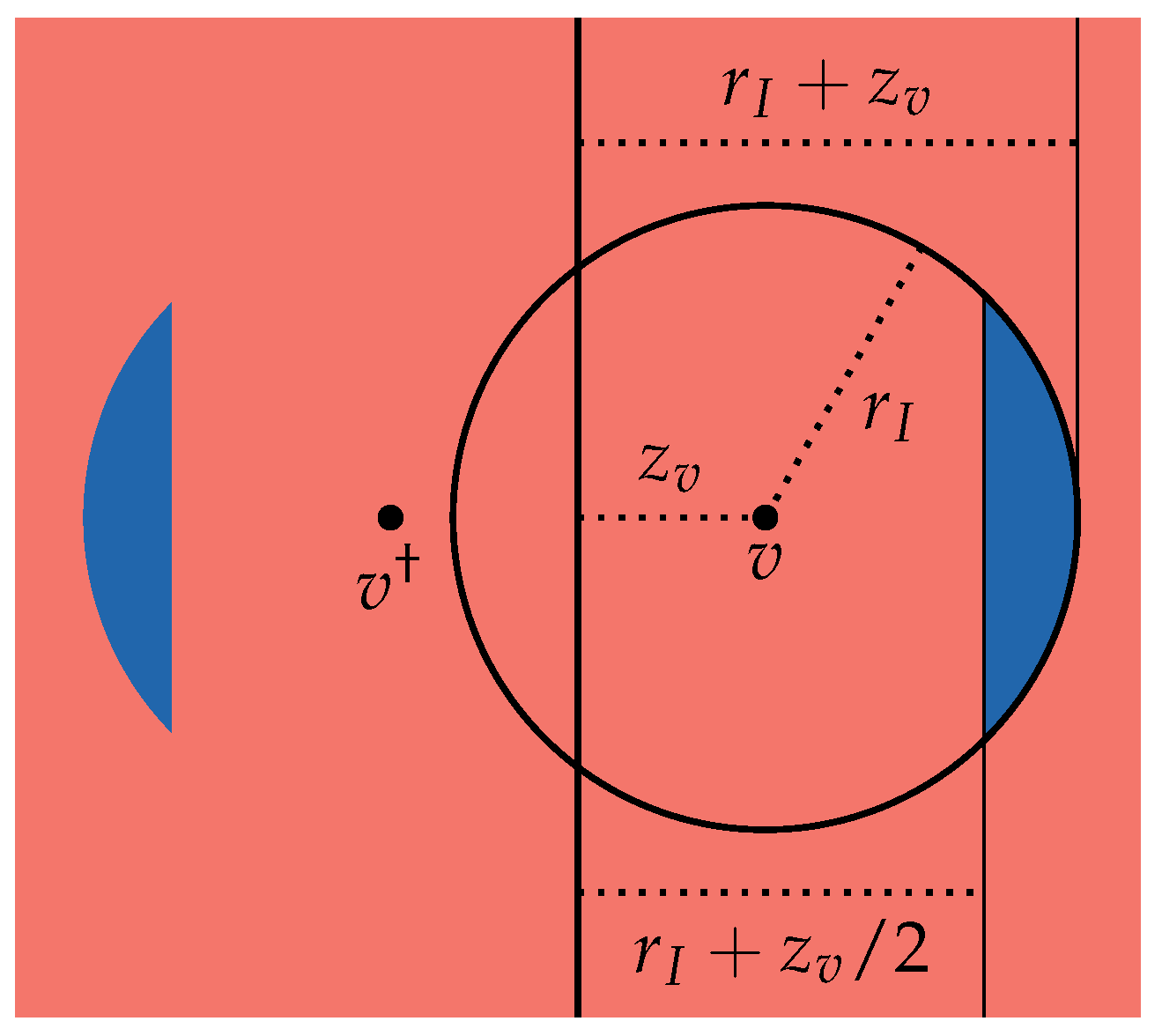
Write for brevity. The volume of the blue space on the right side of the hyperplane is a cut ball. The intersection of a hyperplane and a ball is either empty or again a ball, but of diminished dimension. Thus, by construction, is a -dimensional ball. Applying the Pythagorean theorem, the radius r of this ball can be bounded by
where the last step exploits the assumption . Using this, we can lower bound the volume of the region , by the volume of the d-cone with base and height . Applying the volume definitions for the cone and the ball
where is the Gamma function, a function which extends the factorial operator to the reels.
Now that we have gotten a handle for the volume of the blue region, we can shift our attention to the advantage. Unfolding the advantage definition, splitting the region into its reflexive halves and applying symmetry (Condition 1).
Any vertex in is adjacent to v, since . Furthermore, all vertices have distance at least from v. This lets us solve for in the GIRG edge criterion, which gives the necessary condition for all neighbours of v in . Using this observation, we can lower bound by
By construction of , all vertices have a z-component of at least . By monotonicity in z (Condition 2), this lets us pointwise lower bounds over the integration range of the outer integral
By monotonicity of in w on (Condition 3), f can be pointwise lower bounded over the integration range of the inner integral
Notice that the integrand of the outer interval is independent of x, this lets us bound the expression by applying the previously derived bound for the volume of :
Finally solving the inner integral
we conclude the proof by defining to be the right-hand side. □
3.3.2. A Valid Subsolution
Before finally defining a valid subsolution of , we need one more lemma about solutions to the standard normal distribution function that appears in the definition of (1).
Lemma 8.
For fixed , the equation
admits a solution for some .
Proof.
Set
Since is smooth, g is continuous on and differentiable on . A direct computation gives
Hence
which is positive whenever . Thus, there exists such that . On the other hand
because for every finite t. By the intermediate value theorem, there exists
with , i.e.,
as required. □
This leads us to a function that is a valid subsolution of .
Lemma 9.
There exists a value for some such that the function
is a valid subsolution of for some .
Proof.
We start by selecting as the solution to the equation
Such a solution exists by Lemma 8 whenever
where the hides constants in d and . Rearranging yields that this condition is satisfied whenever k is a large enough constant in d and .
Next, we go one by one through the Conditions of Definition 9. The first Condition 1 follows from the construction of f for all . For , and the expression thus reduces to .
The second Condition 2, follows immediately from and being monotone increasing in . Note that by choice of , for vertices v with and ,
monotonicity at this point is also guaranteed. By symmetry, monotonicity for follows immediately.
For the third Condition 3, we can exploit the monotonicity of , to focus solely on and . The restriction implies that , then
which is clearly monotone increasing in . Note again that by choice of , monotonicity at is also guaranteed.
Since Conditions 1–3 hold, f is valid. We can show Condition 4 by applying Lemmas 6 and 7:
Thus f is a valid subsolution of . □
We are now ready to prove Theorem 2.
Proof of Theorem 2.
Take f, as defined in Lemma 9. Choose k large enough such that both its requirement in Definition 4 and its requirement in Lemma 9 are satisfied. Clearly on . Then by Theorem 3, for all t, w and . Define . It is easily verifiable that for all , where
By symmetry also
Taking the limit yields the same bounds for . Thus, both opinions survive in the mean-field. □
3.4. From Half-Spaces to Balls
In this section, we will convert our results from the previous section to large Euclidean balls. We will prove that a generalised version of Theorem 2 is unobtainable in the limit due to the lacking symmetry of the initial condition. However, t-survival can still be guaranteed for an unbounded number of mean-field updates. In other words, in the mean-field model the boundary of the ball shrinks by in any constant time as the radius of the ball grows.
3.4.1. Localization
Recall our motivation to study the behaviour of the dynamics for the half-space interface: Locally, the boundary of a large ball has negligible curvature and thus looks identical to a half-space.
Let us start, by aligning the machinery we have developed for half-spaces to the new problem of Euclidean balls. Thus again, let v be some vertex of type and let be a large ball of radius r. Previously represented the signed distance from to the half-space boundary. The equivalent concept in this setting, the signed distance of to the boundary of , could have contributions from all different dimensions of . But conveniently we can rotate the space in such a way that v lies on the z-axis and that the ball has the half-space as tangent in direction of z.
Lemma 10
(Local Coordinates). Let v be some vertex of type and let be a ball of radius r. Denote by p the point on the boundary of closest to and as the hyperplane tangential to at p. Then there exists a distance preserving transformation of , such that and is to the right of .
Proof.
We define as the combination of rotations and translations. Since is rotationally invariant, A will be guaranteed to be distance preserving.
Define to be the translation matrix that maps p to the origin. Let be the normalized normal vector of towards , then by the transitivity of the rotation group on the sphere , there exists a rotation with . Then for any ,
Thus . □
3.4.2. Non-Stability of Balls Under the Mean-Field Assumption
We define the natural ball initialisation
its evolution under the mean-field and its limiting distribution . As for the half-space initialisation, we are interested in the behaviour of its limiting distribution. Unfortunately, is, under some mild assumption, much less interesting than .
Theorem 4.
Fix and a sufficiently large weight cut-off . Consider the mean-field model, in which is truncated at W. Then everywhere.
The only additional assumption needed for Theorem 4 is the imposition of a global weight cut-off W onto the mean-field model. This is motivated by the underlying finite GIRG. Indeed, in a GIRG on n vertices with weight tail exponent , the maximum weight is of order
with high probability. In this event, truncating the weight distribution at W does not remove any vertex, hence it does not change the realised graph (when keeping the positions fixed) and therefore does not change the dynamics. Consequently, the truncated mean-field model can be viewed as the natural mean-field analogue of the finite GIRG on the high-probability event that no vertex exceeds weight W. In the limit of , such a weight cut-off does not significantly change the results established in Section 2. It also does not falsify any results established in Section 3.2, as these rely only on the properties of vertices with small weight.
Proof of Theorem 4.
Let be the set of all positions that violate the statement of the lemma at time t. We will show that the set is empty.
We start by showing that for all t, all points in must have come from the original ball . Let and let H be a separating hyperplane that is tangential to at the point that is closest to x. Transform this into local coordinates using Lemma 10 such that ends up on the right side of the hyperplane. Then by construction everywhere, for the half-space initialisation on these local coordinates. By Lemma 5.ii, for all t, so in particular, . Let in local coordinates. Since H separated x from , . By Lemma 9, is upper bounded in this regime by a value strictly below 1/2. Thus .
We have shown that the series cannot outgrow ; next, we show that it shrinks. Define to be the set of tangential half-spaces of . As before, each induces a half-space initialisation in local coordinates, where sits on the right side. Notice that each H induces the same sequence of functions just over different local coordinates. To keep things simple, we will assume that each is always evaluated over its local coordinate system, and g over the global coordinate system. Whenever we relate the two, you may assume that , where is the system induced by H. Naturally
and by Lemma 5.ii
for all . Next, we show that each additional mean-field update introduces an additional error into g. Specifically, we show that
for all and an error E uniform in w and z. We show this proposition by induction on . Consider any point x in global coordinates and let y be the point on the boundary of farthest away from x. Consider the ball of radius centred at y; at least half B of this ball lies on the left of the half-space going through y. The volume of that half is ; furthermore, all vertices in it are at most away from x (this is a global constraint in a d-dimensional cube of volume n) and thus all vertices of weight at least
connect to all other vertices in the space. We now compare how much the space of B contributes to the advantage of x in and , where is the half-space going through the antipodal point of y. In , B is treated as just to the left of the half-space, and thus by Lemma 9, in the full domain. In , the region is treated as if and thus bounded by Theorem 2 strictly away from in the opposite direction. We define the error as the contribution difference to the advantage of B for the two perspectives
By the induction hypothesis is upper bounded by a shifted version of all functions for , so in particular upper bounded by the minimum of and
Remembering the region B, this can be upper bounded by
By choice of , , is the half-space where the localised distance to the boundary z is minimised. Naturally is the minimiser over all H. Thus,
Plugging in the definition of the advantage
Differentiating ,
as is upper bounded by . Shifting z by some offset h only translates the ball of influence of radius , hence the change in is bounded by the volume of the symmetric difference of two radius-R balls shifted by h, which is at most . Dividing by and integrating over gives
since for . Therefore , and using yields
with constants independent of t. Then for all , is Lipschitz for . Thus, there exists a function uniform in and t such that
Plugging this back into the bound for
which completes the induction.
We can now prove the result. Let and let z be the distance from x to the boundary of . Then for ,
and thus . By the same argument x never again enters the set for any . Since this holds for all , must be empty. □
The result from Theorem 4 shows that the missing symmetry of the ball initialisation erodes any chances of a mean-field fix point , in which both opinions survive. This result does not however rule out survival for an unbounded number of steps. In fact, as we will see in the next sections, such a result is achievable.
3.4.3. Bounding Local Curvature
From this point forward, we will only use the local coordinate system of v. It is thus convenient to define the new position of all previously defined objects in this new coordinate system. Let be any previously defined object, by abuse of notation, define , where is the transformation from Lemma 10. This in particular redefines and .
In the new coordinate system, p is still the closest point to on the boundary of as preserves distances. As is orthogonal to , it holds that . In particular, if then . We can now formalise the intuition from before: From the perspective of v, the local boundary of looks identical to .
Lemma 11.
Let be a ball of radius , let and let be the corresponding half-space as defined above. Let be some point with
for some . Let be the closest point on the boundary of to x and let be the closest point on to x. Then
for .
Proof.
Let be the closest point on from . We prove the statement by case distinction. Assume , then by choice of and the triangle inequality over the point ,
For the second case, assume . Then by triangle inequality over the point and choice of
Define and note that . By assumption, , so in particular also and . This lets us construct the right triangle consisting of the points p, and the centre of . By definition, the distance from the centre of to p is r, the distance from p to is at most and the line from the centre to goes through . This gives the following inequality from the Pythagorean theorem
Solving for and applying the definition of ,
Then applying the generic bound for ,
for and . □
The result from Lemma 11 implies that the local geometry experienced by v and all its not to far away neighbours match approximatively the geometry of a half-space, given that r is large enough. The choice of in Lemma 11 naturally lends itself to a definition of a weight , defined in such a way that for all all neighbours of v with weight at most are at most away from v. We define by the largest weight that satisfies this property. Solving for in the edge criterion yields
Lemma 12.
Let be the ball initialisation on and let be the half-space initialisation, and cut off the weights at maximum . Then for all and t
where z is the sign distance of x to the boundary of and Δ is the curvature parameter from Lemma 11.
Proof.
We prove this statement by induction on t. Clearly for all and z being the signed distance from x to the boundary of .
Thus, fix some and some vertex v of type . Let be the signed distance of to the boundary of , then consider the neighbours of v. By assumption, all weights are at most , and thus all neighbours of v are inside a ball around . For any , let z be its signed distance from the boundary and let be its coordinate in the local coordinate system of x, by Lemma 11,
Plugging this inequality into the pointwise lower bound of the induction hypothesis, for all neighbours of v,
Importantly, this bounds the probability for each not by their own local coordinate system, but by that of v. We can thus lower bound the advantage :
Shifting the ambient space by
Lastly, plugging this advantage bound into the definition of
which concludes the induction and the proof. □
Our main result in this section follows immediately from this lemma, that for growing r in any constant time t, the ball of minority opinion shrinks only by an additive .
Theorem 5.
Let be a ball of radius and let be the curvature parameter from Lemma 11. Cut off the weights at as given in Lemma 12. Then for every , all points x in the ball of radius concentric with and all satisfy
Proof.
Consider any point x in the ball of radius concentric to , and let z be the sign distance of x to the boundary of . Then, . Hence, by Lemma 12, and by Theorem 2. □
4. Discussion
In this work, we have investigated the majority-vote opinion dynamics on Geometric Inhomogeneous Random Graphs (GIRGs) to understand how the interplay of latent geometry and degree heterogeneity shapes social influence processes [2,9]. Our findings represent a significant departure from the classical understanding of coarsening dynamics observed in standard statistical physics models [13,15]. While traditional models on regular Euclidean lattices or non-spatial random graphs typically evolve toward a global consensus where one domain is completely eliminated [16,17,18,20,21], we have demonstrated that spatial complex networks can support the long-term coexistence of competing opinions through the formation of stable boundaries. This mirrors the persistence of ideological clusters seen in real-world societies.
Our mathematical contribution provides a rigorous explanation for this arrested coarsening [12,13] through a tractable mean-field model of the interface. By analysing the macroscopic limit of a planar interface, we established the existence of a stable, non-trivial limiting distribution for the interface profile. Our results show that when the average degree is sufficiently large, the update operator reinforces the existing majority on either side of the boundary.
Furthermore, we extend the results to finite balls by bounding the effect of local curvature. Here, the results are more subtle. We show that any finite ball of minority opinion with radius will erode eventually, but that the speed of erosion is . However, when we return from the mean-field model to the original graph setting, then an erosion speed of is not possible. Recall that in the GIRG model, the n vertices draw their position uniformly at random in a cube of volume n. Hence, for any fixed point on the boundary, the closest vertex has expected distance . Therefore, while in the mean-field model, erosion of speed can occur, in the graph setting, the boundary of the ball can only withdraw in discrete steps of order . This holds regardless of the size of the ball, even for balls of growing radius . Hence, a speed of (or sufficiently low constant speed) in the mean-field model naturally translates into speed zero for the corresponding graphs. Thus our results for finite balls under the mean-field assumption are compatible with the experimental results showing that coarsening comes to a halt for graphs.
Note that due to monotonicity of the process, our result extends to every region that merely contains a sufficiently large ball. Such a region may shrink and coarsen its boundaries, but will maintain a stable core which shrinks with speed that preserves the local opinion.
For the analysis of finite balls, we need to include a truncation of weights both for our positive and negative results. Note that such a truncation is natural since a ball of radius r in the GIRG model does not contain vertices of arbitrary weights. However, while the truncation in Theorem 4 is so large that with high probability it does not exclude any vertices of the GIRG model, the truncation in Lemma 12 and Theorem 5 is of order . While it is still true that locally (at any fixed boundary point) with high probability there are no vertices of higher weight, this is not generally true globally. The largest weight of a vertex in a ball of radius r is of order roughly , and this is only smaller than the cut-off if . It remains an open problem to strengthen our result to a cut-off of the weight that globally does not exclude any vertices in the initial ball.
The arrested coarsening that we show in this paper is a consequence of two aspects of the considered process. Firstly, we model conformity by the majority update rule where nodes adopt the majority opinion among their neighbours. This is a model of complex contagion [34], where more than one neighbour is involved in the update. A classical alternative model is the Voter Model, where a node updates its opinion to that of a random neighbour. The Voter Model is closely connected to the theory of coalescing random walks and generally does not lead to stable phase boundaries [16,17,18]. As our results show, the majority update as an example of a rule can allow opinions to coexist. However, this is not sufficient, as previous work has also shown that coexistence does not happen in many other graph models even under the majority dynamics [20,21]. Thus, the second crucial ingredient is the choice of the underlying graph model. In this work, we choose GIRGs as an established model for social networks [2,4]. This model combines a heavy-tailed degree distribution with an underlying geometry that induces many properties also observed in real social networks. Those include, in particular, clustering, communities, and small separators [2,35,36]. These are typical for real social networks [37,38,39]. It is natural that those properties foster coexistence of competing opinions [40,41], since an isolated cluster of one opinion can only be stable if every vertex has at least as many edges inside of the cluster as outside, a condition closely connected to the concepts of communities and of small edge separators.
However, our simulations show that not all regions of minority survive: While small localised domains of a “blue” opinion are quickly eroded by the surrounding “red” majority, domains that exceed a critical size do not disappear. Instead, they settle into stable, rounded configurations where the interface between opinions becomes stationary. This transition point is highly sensitive to the power-law exponent ; as increases and the network becomes more localized with fewer long-range hubs, survival becomes possible at smaller scales.
Future Research Directions
While our current analysis focuses on the zero-temperature case to maintain analytical tractability, several avenues for future research remain:
- Non-Zero Temperature: Our current analysis focuses on the zero-temperature case of the GIRG model. It would be very interesting to extend the analysis to include a temperature parameter , which would allow for long-range edges (“weak ties”) that are not directly mandated by the geometry [2]. This would help determine if thermal noise eventually overcomes the geometric stability of the interface, as it does in simpler graph models [42].
- Alternative Dynamics: We have already mentioned that the classical Voter Model does not lead to stable phase boundaries (on grids and finite connected graphs), while our results shows the opposite for the Majority Vote Model. However, there are other models which interpolate between both variants. An example is the 3-Majority Dynamics, where a node updates with the majority opinion of three uniformly sampled neighbours, and the 2-Choice Dynamics, where one of the three Opinions of the 3-Majority Model is replaced by the node’s own opinion. As the Majority Vote Model, coexistence quickly vanishes in some graphs [43,44,45], but may be stable in social network models like GIRGs. The related process of bootstrap percolation has been studied for GIRGs, but only in the context of a single opinion spreading through the graph [30]. Note that for a sufficiently connected graph, such processes degenerate eventually, so coexistence in this context means survival of both opinions for a super-polynomial time.
- Navigation and Spreading: Given that GIRGs are known to be navigable and efficient for rumour spreading [25,26], exploring the competition between a “fast” spreading rumour and a “stable” majority-vote opinion could provide insights into how misinformation persists alongside established consensus. A similar process has been analysed in [46] for Hyperbolic Random Graphs, which is a special case of the GIRG model [2]. Alternatively, one could study two competing spreading processes, such as Competing First-Passage Percolation [47].
Author Contributions
Conceptualisation, M.B. and J.L.; methodology, M.B. and J.L.; software, M.B.; formal analysis, M.B. and J.L.; data curation, M.B.; writing—original draft preparation, M.B.; writing—review and editing, M.B. and J.L.; visualisation, M.B.; supervision, J.L.; funding acquisition, J.L. All authors have read and agreed to the published version of the manuscript.
Funding
This research was funded by the Swiss National Science Foundation, grant number 200021-232060. The first author was supported by the German Academic Scholarship Foundation.
Data Availability Statement
A link to the source code used to produce the experimental data can be found in this repository (https://doi.org/10.5281/zenodo.18800883).
Acknowledgments
We thank Konstantinos Lakis for his insightful feedback on this manuscript.
Conflicts of Interest
The authors declare no conflicts of interest.
Abbreviations
The following abbreviations are used in this manuscript:
| GIRG | Geometric Inhomogeneous Random Graph |
References
- Boguná, M.; Papadopoulos, F.; Krioukov, D. Sustaining the internet with hyperbolic mapping. Nat. Commun. 2010, 1, 62. [Google Scholar] [CrossRef] [Scilit]
- Bringmann, K.; Keusch, R.; Lengler, J. Geometric inhomogeneous random graphs. Theor. Comput. Sci. 2019, 760, 35–54. [Google Scholar] [CrossRef] [Scilit]
- Bläsius, T.; Fischbeck, P. On the external validity of average-case analyses of graph algorithms. ACM Trans. Algorithms 2024, 20, 1–42. [Google Scholar] [CrossRef] [Scilit]
- Bläsius, T.; Cohen, S.; Fischbeck, P.; Friedrich, T.; Krejca, M.S. Robust Parameter Fitting to Realistic Network Models via Iterative Stochastic Approximation. arXiv 2024, arXiv:2402.05534. [Google Scholar] [CrossRef] [Scilit]
- Dayan, B.; Kaufmann, M.; Schaller, U. Expressivity of geometric inhomogeneous random graphs—Metric and non-metric. In Proceedings of the International Conference on Complex Networks; Springer: Cham, Switzerland, 2024; pp. 85–100. [Google Scholar]
- Komjáthy, J.; Lapinskas, J.; Lengler, J.; Schaller, U. Four universal growth regimes in degree-dependent first passage percolation on spatial random graphs I. arXiv 2023, arXiv:2309.11840. [Google Scholar] [CrossRef] [Scilit]
- Kaufmann, M.; Ravi, R.R.; Schaller, U. Sublinear cuts are the exception in bdf-girgs. In Proceedings of the International Conference on Complex Networks and Their Applications; Springer: Cham, Switzerland, 2024; pp. 366–377. [Google Scholar]
- Kaufmann, M.; Schaller, U.; Bläsius, T.; Lengler, J. Assortativity in geometric and scale-free networks. arXiv 2025, arXiv:2508.04608. [Google Scholar] [CrossRef] [Scilit]
- Flache, A.; Mäs, M.; Feliciani, T.; Chattoe-Brown, E.; Deffuant, G.; Huet, S.; Lorenz, J. Models of Social Influence: Towards the Next Frontiers. J. Artif. Soc. Soc. Simul. 2017, 20, 2. [Google Scholar] [CrossRef] [Scilit]
- Galam, S. Minority opinion spreading in random geometry. Eur. Phys. J. B 2002, 25, 403–406. [Google Scholar] [CrossRef] [Scilit]
- Krapivsky, P.L.; Redner, S. Dynamics of Majority Rule in Two-State Interacting Spin Systems. Phys. Rev. Lett. 2003, 90, 238701. [Google Scholar] [CrossRef] [Scilit] [PubMed]
- Castellano, C.; Fortunato, S.; Loreto, V. Statistical physics of social dynamics. Rev. Mod. Phys. 2009, 81, 591–646. [Google Scholar] [CrossRef] [Scilit]
- Bray, A.J. Theory of phase-ordering kinetics. Adv. Phys. 2002, 51, 481–587. [Google Scholar] [CrossRef] [Scilit]
- Cinelli, M.; De Francisci Morales, G.; Galeazzi, A.; Quattrociocchi, W.; Starnini, M. The echo chamber effect on social media. Proc. Natl. Acad. Sci. USA 2021, 118, e2023301118. [Google Scholar] [CrossRef] [Scilit]
- Dornic, I.; Chaté, H.; Chave, J.; Hinrichsen, H. Critical Coarsening without Surface Tension: The Universality Class of the Voter Model. Phys. Rev. Lett. 2001, 87, 045701. [Google Scholar] [CrossRef] [Scilit]
- Cooper, C.; Frieze, A.; Radzik, T. Multiple random walks in random regular graphs. SIAM J. Discret. Math. 2010, 23, 1738–1761. [Google Scholar] [CrossRef] [Scilit]
- Lyons, R.; Peres, Y. Probability on Trees and Networks; Cambridge University Press: Cambridge, UK, 2017; Volume 42. [Google Scholar]
- Cox, J.T. Coalescing random walks and voter model consensus times on the torus in Zd. Ann. Probab. 1989, 17, 1333–1366. [Google Scholar] [CrossRef] [Scilit]
- Benjamini, I.; Chan, S.O.; O’Donnell, R.; Tamuz, O.; Tan, L.Y. Convergence, unanimity and disagreement in majority dynamics on unimodular graphs and random graphs. Stoch. Process. Their Appl. 2016, 126, 2719–2733. [Google Scholar] [CrossRef] [Scilit]
- Gärtner, B.; Zehmakan, A.N. Majority model on random regular graphs. In Proceedings of the Latin American Symposium on Theoretical Informatics; Springer: Cham, Switzerland, 2018; pp. 572–583. [Google Scholar]
- Mossel, E.; Neeman, J.; Tamuz, O. Majority dynamics and aggregation of information in social networks. Auton. Agents Multi-Agent Syst. 2014, 28, 408–429. [Google Scholar] [CrossRef] [Scilit]
- Bricmont, J.; Van Den Bosch, H. Intermediate Model Between Majority Voter PCA and Its Mean Field Model. J. Stat. Phys. 2015, 158, 1090–1099. [Google Scholar] [CrossRef] [Scilit]
- Jorritsma, J.; Hulshof, T.; Komjáthy, J. Not all interventions are equal for the height of the second peak. Chaos Solitons Fractals 2020, 139, 109965. [Google Scholar] [CrossRef] [Scilit]
- Bringmann, K.; Keusch, R.; Lengler, J. Average distance in a general class of scale-free networks. Adv. Appl. Probab. 2025, 57, 371–406. [Google Scholar] [CrossRef] [Scilit]
- Bringmann, K.; Keusch, R.; Lengler, J.; Maus, Y.; Molla, A.R. Greedy routing and the algorithmic small-world phenomenon. In Proceedings of the ACM Symposium on Principles of Distributed Computing, Washington, DC, USA, 25–27 July 2017; pp. 371–380. [Google Scholar]
- Kaufmann, M.; Lakis, K.; Lengler, J.; Ravi, R.R.; Schaller, U.; Sturm, K. Rumour spreading depends on the latent geometry and degree distribution in social network models. In Proceedings of the 2026 Annual ACM-SIAM Symposium on Discrete Algorithms (SODA); SIAM: Philadelphia, PA, USA, 2026; pp. 6264–6307. [Google Scholar]
- Cerf, S.; Dayan, B.; De Ambroggio, U.; Kaufmann, M.; Lengler, J.; Schaller, U. Balanced Bidirectional Breadth-First Search on Scale-Free Networks. arXiv 2024, arXiv:2410.22186. [Google Scholar]
- Krioukov, D.; Papadopoulos, F.; Kitsak, M.; Vahdat, A.; Boguñá, M. Hyperbolic geometry of complex networks. Phys. Rev. E 2010, 82, 036106. [Google Scholar] [CrossRef] [Scilit]
- Komjáthy, J.; Lodewijks, B. Explosion in weighted hyperbolic random graphs and geometric inhomogeneous random graphs. Stoch. Process. Their Appl. 2020, 130, 1309–1367. [Google Scholar] [CrossRef] [Scilit]
- Koch, C.; Lengler, J. Bootstrap percolation on geometric inhomogeneous random graphs. Internet Math. 2021, 1. [Google Scholar]
- Bierwirth, M.; Lengler, J. Stable Boundaries of Opinion Dynamics in Heterogeneous Spatial Complex Networks. In Proceedings of the International Conference on Complex Networks and Their Applications; Springer: Cham, Switzerland, 2025. [Google Scholar]
- Bläsius, T.; Friedrich, T.; Katzmann, M.; Meyer, U.; Penschuck, M.; Weyand, C. Efficiently generating geometric inhomogeneous and hyperbolic random graphs. Netw. Sci. 2022, 10, 361–380. [Google Scholar] [CrossRef] [Scilit]
- Gleeson, J.P. Binary-state dynamics on complex networks: Pair approximation and beyond. Phys. Rev. X 2013, 3, 021004. [Google Scholar] [CrossRef] [Scilit]
- Törnberg, P. Echo chambers and viral misinformation: Modeling fake news as complex contagion. PLoS ONE 2018, 13, e0203958. [Google Scholar] [CrossRef] [Scilit]
- Lengler, J.; Todorovic, L. Existence of small separators depends on geometry for geometric inhomogeneous random graphs. arXiv 2017, arXiv:1711.03814. [Google Scholar] [CrossRef] [Scilit]
- Kaufmann, M.; Lengler, J.; Schaller, U.; Sturm, K. Expanders in Models of Social Networks. In Proceedings of the International Workshop on Graph-Theoretic Concepts in Computer Science; Springer: Cham, Switzerland, 2025; pp. 302–315. [Google Scholar]
- Newman, M.E. Analysis of weighted networks. Phys. Rev. E—Stat. Nonlinear Soft Matter Phys. 2004, 70, 056131. [Google Scholar] [CrossRef] [Scilit]
- Fortunato, S. Community detection in graphs. Phys. Rep. 2010, 486, 75–174. [Google Scholar] [CrossRef] [Scilit]
- Frenkel, S.; Carmesin, J. How Local Separators Shape Community Structure in Large Networks. arXiv 2025, arXiv:2504.14501. [Google Scholar] [CrossRef] [Scilit]
- Del Vicario, M.; Vivaldo, G.; Bessi, A.; Zollo, F.; Scala, A.; Caldarelli, G.; Quattrociocchi, W. Echo chambers: Emotional contagion and group polarization on facebook. Sci. Rep. 2016, 6, 37825. [Google Scholar] [CrossRef] [Scilit] [PubMed]
- Cota, W.; Ferreira, S.C.; Pastor-Satorras, R.; Starnini, M. Quantifying echo chamber effects in information spreading over political communication networks. EPJ Data Sci. 2019, 8, 35. [Google Scholar] [CrossRef] [Scilit]
- Carro, A.; Toral, R.; San Miguel, M. The noisy voter model on complex networks. Sci. Rep. 2016, 6, 24775. [Google Scholar] [CrossRef] [Scilit]
- Berenbrink, P.; Clementi, A.; Elsässer, R.; Kling, P.; Mallmann-Trenn, F.; Natale, E. Ignore or comply? On breaking symmetry in consensus. In Proceedings of the ACM Symposium on Principles of Distributed Computing, Washington, DC, USA, 25–27 July 2017; pp. 335–344. [Google Scholar]
- Shimizu, N.; Shiraga, T. 3-majority and 2-choices with many opinions. In Proceedings of the ACM Symposium on Principles of Distributed Computing, Hotel Las Brisas Huatulco Huatulco, Mexico, 16–20 June 2025; pp. 207–217. [Google Scholar]
- Becchetti, L.; Clementi, A.; Natale, E. Consensus dynamics: An overview. ACM SIGACT News 2020, 51, 58–104. [Google Scholar] [CrossRef] [Scilit]
- Candellero, E.; Stauffer, A. Coexistence of competing first passage percolation on hyperbolic graphs. Ann. L’Inst. Henri Poincare (B) Probab. Stat. 2021, 57, 2128–2164. [Google Scholar] [CrossRef] [Scilit]
- Antunović, T.; Dekel, Y.; Mossel, E.; Peres, Y. Competing first passage percolation on random regular graphs. Random Struct. Algorithms 2017, 50, 534–583. [Google Scholar] [CrossRef] [Scilit]
Disclaimer/Publisher’s Note: The statements, opinions and data contained in all publications are solely those of the individual author(s) and contributor(s) and not of MDPI and/or the editor(s). MDPI and/or the editor(s) disclaim responsibility for any injury to people or property resulting from any ideas, methods, instructions or products referred to in the content. |
© 2026 by the authors. Licensee MDPI, Basel, Switzerland. This article is an open access article distributed under the terms and conditions of the Creative Commons Attribution (CC BY) license.