


Abstract
The present work is devoted to the investigation of oscillatory solutions of even-order neutral differential equations with distributed deviating arguments. By developing sharper iterative inequalities, we derive a comparison framework that reduces the oscillation problem to the study of a related discrete-delay equation. The proposed approach establishes oscillation criteria for a broad range of argument configurations, including delayed, advanced, and mixed cases, while also accommodating different monotonicity assumptions with respect to the distributed argument. These features allow the analysis to be carried out within a single unified framework and substantially extend the applicability of many existing results. The effectiveness of the obtained criteria is further illustrated through applications to Euler-type differential equations, where the proposed conditions remain applicable in situations for which several related results fail to provide a conclusion.
Keywords:
differential equations; distributed deviating arguments; oscillatory behavior; neutral delay equations; sharpened oscillation criteria MSC:
34C10; 34K11
1. Introduction
1.1. Background and Problem Formulation
Neutral differential equations (NDEs) constitute a prominent class of functional differential equations, characterized by the presence of the highest-order derivative in both delayed and nondelayed terms. Their significance stems not only from their wide range of applications in engineering and the physical sciences but also from the mathematical challenges arising in the analysis of their qualitative behavior. In particular, the study of oscillatory properties of NDEs becomes considerably more involved when delayed and advanced arguments are incorporated into the equation. Nonlinear NDE models arise naturally in a variety of applications, including population dynamics, automatic control systems, fluid mixing processes, and coupled flexible-structure mechanical systems (see Hale [1]). Furthermore, second-order NDEs play an important role in the mathematical modeling of bipedal robotic systems and human postural balance mechanisms [2].
The present study develops optimized inequalities and applies them to examine the oscillation of a class of functional differential equations (FDEs) with a neutral term and distributed deviating arguments, expressed in the form
where , is an even number, and . We proceed under the following assumptions:
- (A1)
- a and b are nonnegative real numbers with ;
- (A2)
- g, , is nondecreasing in u and monotonic in ;
- (A3)
- and .
1.2. Related Literature
A substantial body of literature has been devoted to the oscillatory behavior of neutral differential equations using a wide range of analytical techniques. From the viewpoint most relevant to the present work, the existing studies may be grouped into three categories.
The first category consists of studies on higher-order neutral differential equations whose neutral terms do not involve distributed delays; see, for example, Zafer [3], Zhang and Yan [4] and Karpuz et al. [5], Zhang et al. [6], Baculíkováẽt al. [7], Xing et al. [8], Agarwal et al. [9], Moaaz et al. [10], Alatwi et al. [11], and Salah et al. [12]. The present results may be viewed as a natural extension of this line of research to a more general class of neutral equations with distributed-delay operators. Moreover, as will be demonstrated through the comparisons presented later, the obtained criteria provide, in several cases, sharper conclusions than those available in the existing literature.
The second category concerns neutral differential equations involving distributed deviating arguments; see, for example, Zhang and Meng [13], Moaaz et al. [14,15], and El-Gaber and El-Sheikh [16]. While these studies share the general framework of distributed arguments with the present work, our results differ from them in several respects. First, the derived oscillation criteria are based on refined solution-neutral function estimates, leading to more effective oscillation tests. Second, the proposed approach provides a unified treatment that simultaneously covers both advanced and delayed arguments in the functions h and g, as well as both monotonicity cases of the partial derivative of g with respect to its second argument. To the best of our knowledge, such a unified framework has not been considered in the above studies.
The third category deals with second-order neutral differential equations having a structure similar to that considered in the present paper; see, for example, Bohner et al. [17] and Moaaz et al. [18]. The results obtained here extend this line of research to higher even-order equations. Such an extension is not straightforward, since higher even-order equations allow more possible classes of eventually positive solutions and require a more detailed analysis of derivative sign properties.
Motivated by these observations, this paper establishes new oscillation criteria for higher even-order neutral differential equations with distributed deviating arguments by combining refined solution-neutral function estimates with the analysis of distributed-delay neutral operators. The class of equations considered in this work arises naturally in the qualitative analysis of nonlinear dynamical systems with memory and distributed interactions. Consequently, the obtained oscillation criteria contribute to a deeper understanding of the long-term behavior of such systems, which constitute an important topic within the study of complex dynamical processes.
The following review highlights relevant results from the literature, including foundational contributions that established oscillation criteria and analytical methodologies for even-order differential equations, studies that developed oscillation conditions for differential equations with distributed deviating arguments, and works that enhanced the relationship between solutions and their associated functions in neutral differential equations.
In 1998, Zafer [3] studied the oscillatory behavior of solutions to the nonlinear neutral differential equation
Using Kiguradze’s lemma to obtain lower bounds for z, the work established practical conditions that extend classical oscillation results from non-neutral delay equations to the neutral case. These criteria apply to both linear and sublinear nonlinearities and provide explicit integral bounds ensuring oscillation.
Zhang and Yan [4] and Karpuz et al. [5] examined the asymptotic behavior of Equation (2) in the special case , relying on a similar comparison approach that reduces the oscillation of the higher-order neutral equation to that of a first-order delay equation. While Zhang and Yan focused on even-order equations with variable coefficients and derived explicit integral criteria ensuring oscillation, the study of Karpuz et al. considered a broader range of cases, including both even and odd orders, and established asymptotic conditions that guarantee oscillation or almost-oscillation for all solutions. Later, Zhang et al. [6] extended the results in [4] to the nonlinear case of Equation (1) when .
Baculíkováẽt al. [7] studied the oscillation of even-order quasilinear NDE
where is a ratio of odd positive integers. Their framework covers cases with and , but remains restricted by the condition .
Xing et al. [8] and Agarwal et al. [9] examined the oscillatory behavior of the NDE
By constructing first-order differential inequalities, Ref. [8] obtained new oscillation criteria applicable to both even and odd orders n. Their results also broadened earlier findings by allowing neutral coefficients with and admitting non-bounded functions .
Studies [10,11,12] examined the oscillatory behavior of solutions of Equation (3) through various analytical methodologies. In comparing the methodologies adopted in these studies, the work of Moaaz et al. [10] established oscillation criteria for (3) based on Riccati-type transformations and without introducing auxiliary functions. Building upon this framework, Alatwi et al. [11] developed additional monotonic properties and iterative arguments for positive solutions, which led to strengthened oscillation conditions for quasi-linear equations. Subsequently, Salah et al. [12] extended these ideas further by employing a sequence of iterative estimates together with Kneser-type arguments to derive new oscillation criteria. Although all three studies share a common analytical foundation, the later contributions broaden the applicability of the approach and yield sharper oscillation results under more general settings.
Concerning oscillation criteria for differential equations with deviating arguments, Ref. [13] investigated the even-order neutral differential equation with distributed deviating arguments
where . Employing generalized Riccati transformations together with the Philos technique and an appropriate class of kernel functions, the authors obtained oscillation criteria that extended and improved several existing results.
For fourth-order equations, Ref. [14] studied the oscillatory behavior of solutions of
By combining Riccati-type substitutions with comparison arguments, oscillation criteria were established for this equation and some related subclasses. For a more general even-order problem,
where , Ref. [15] derived oscillation conditions by combining Riccati transformation methods with comparison principles involving first-order delay equations.
Recently, Ref. [16] examined the fourth-order half-linear equation
where
Using generalized Riccati transformations together with Kamenev-type and Philos-type techniques, the authors established oscillation criteria in both the canonical and noncanonical cases.
Recently, considerable research attention has been devoted to establishing sharper oscillation criteria for differential equations of second order and higher. Broadly speaking, the methodologies developed in this direction can be classified into two main approaches. The first aims to derive stronger oscillation results through successive improvements of the monotonic properties of positive solutions. Within this framework, Studies [19,20] established oscillation criteria for second-order nonneutral differential equations in the canonical case, whereas Studies [21,22,23] focused on the noncanonical setting. For third-order equations, Ref. [24] developed improved oscillation conditions based on iterative techniques. These ideas were subsequently extended to fourth-order differential equations in [25], leading to further refinements of the existing oscillation theory.
The second approach is based on strengthening the relationship between a solution and its associated function in order to obtain more effective oscillation criteria. In this direction, Studies [17,18] investigated this issue for second-order and higher-order differential equations under various assumptions and scenarios, yielding a number of significant improvements and extensions to the available results in the literature.
1.3. Main Contributions
The present work aims to establish new oscillation criteria for a class of even-order differential equations involving distributed deviating arguments. The main idea is to employ comparison techniques to relate Equation (1) to an associated nonneutral differential equation and thereby take advantage of the significant recent developments in the oscillation theory of nonneutral equations. In addition, we derive refined relations between solutions and their corresponding neutral functions and investigate the impact of these refinements on the resulting oscillation criteria.
Unlike many existing studies, the obtained results cover both delayed and advanced cases of the functions h and g, while also accommodating both monotonicity assumptions of g with respect to its second argument. To further clarify the relationship between the present work and the existing literature on differential equations with distributed deviating arguments, Table 1 provides a concise comparison of the assumptions and analytical approaches adopted in the most closely related studies. This comparison highlights the scope of the present work and helps identify the main features that distinguish it from previous contributions.
Table 1.
Comparison of assumptions and techniques in studies on neutral differential equations with distributed deviating arguments.
To evaluate the effectiveness of the proposed results in comparison with related studies that do not involve distributed delays, we applied the obtained criteria to an Euler-type equation, which is frequently used as a benchmark example in this area; see, for instance, Example 1 in [10,12], and Example 2 in [11]. The resulting oscillation conditions were then compared with those reported in the literature through graphical illustrations. The comparison indicates that, for the considered example, the proposed criteria remain applicable over a wider range of parameter values and yield oscillation conclusions in situations where the cited results are inconclusive.
The remainder of this paper is organized as follows. In the next section, we present the necessary definitions, notation, and some known results that are used throughout the paper. The main results are divided into two parts corresponding to the delay and advanced cases. In each part, sufficient conditions ensuring the oscillation of all solutions of Equation (1) are established. Furthermore, each part includes illustrative applications together with detailed comparisons with related results from the literature. Finally, the main findings of the study are summarized in the concluding section.
1.4. Preliminaries and Notations
A function , with , is regarded as a solution of (1) if and x satisfies (1) for . We consider only those solutions x for which holds for all . A solution x is said to be oscillatory when it fails to be eventually positive or eventually negative; otherwise, it is regarded as nonoscillatory.
Throughout the paper, we shall make use of the following assumptions:
- (H1)
- , , and there is a constant such that .
- (H2)
- g and h are either delay or advance arguments, and there is a constant such that, for all ,
Moreover, we define as
To investigate the oscillatory behavior of Equation (1) in the case of delayed arguments, we assume that condition (H1) holds and introduce the following notation:
for and
For the oscillation analysis of Equation (1) under condition (H2), we assume that condition (H2) holds and employ the following notation:
for and
We note that, when , the quantity coincides with the delayed-case coefficient (with replaced by ), and therefore it depends on the parameter ℓ. In contrast, when , the quantity reduces to , whose definition is independent of ℓ. Consequently, the index ℓ appears in the notation only through the delayed-case component ().
Here, k denotes an arbitrary but fixed positive integer. The quantities , , , , , , and are defined with respect to this choice of k.
Let denote the set of solutions to (1) that are eventually positive. Furthermore, we denote by the solutions whose corresponding function z satisfies
Using the classical lemma of Kiguradze [26], we have that
Lemma 1
([27], Lemma 1 and 2). Suppose that and there is a positive integer such that
Then,
for all and . Moreover, if with , then
for all .
Lemma 2
([22], Lemma 3.2). Suppose that . Then, for ,
Lemma 3
([28], Lemma 2.2.3). Suppose that F, is of fixed sign,
and . Then, eventually,
2. Main Results
2.1. Delay Case
In this section, we study the oscillatory behavior of Equation (1) in the case of delayed arguments.
Theorem 1.
Proof.
Assume, to the contrary, that . We observe that z is positive and increasing, and therefore . It follows from (1) that
Since inequality (7) admits a positive solution z that does not approach zero (z is increasing), Corollary 1 in [29] guarantees that Equation (6) also has a positive solution, leading to a contradiction.
The proof is thus complete. □
In the case , and based on the results in [25], we are able to establish a sharp oscillation criterion for the solutions of Equation (1), as stated in the following corollary:
Corollary 1.
Example 1.
Remark 1.
In what follows, we apply the known results in the literature to Equation (8) in order to obtain oscillation criteria and subsequently compare them:
- 1 .
- Theorem 2 in [3]:
- 2 .
- Corollary 1 in [4,5,6]:
- 3 .
- Corollary 2.8 in [7] and Corollary 2.14 in [8]:
- 4 .
- Theorem 2.1 in [9]:
- 5 .
- Theorem 5 in [10]:
- 6 .
- Theorem 1 in [11]:where and
- 7 .
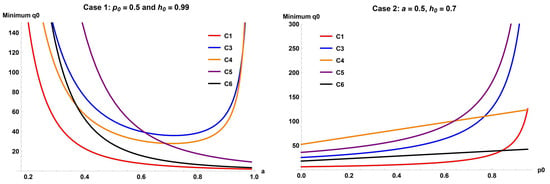
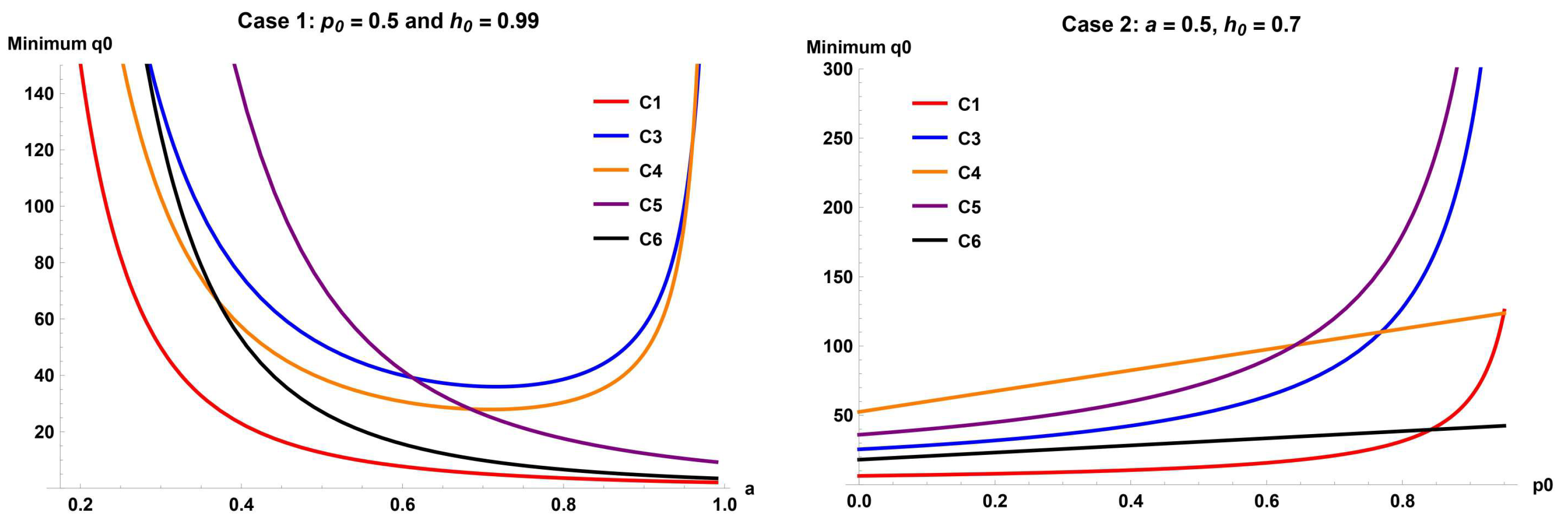
- By applying Theorem 1 in [12], we obtain (C1) when .Figure 1 illustrates the minimal values of for conditions (C1), (C3), … (C6) for two different cases. It is worth noting that the curve corresponding to condition (C2) exhibits rapid asymptotic growth and takes significantly larger values, which places it outside the comparative range of the sharper criteria (C1), (C3), … (C6) depicted in the figure.Figure 1. Comparison of the lower bounds of in Criteria (C1), (C3), … (C6) in two different cases.It is evident from this figure that criterion (C1) is, on the whole, sharper than the other criteria.For comparison with condition (C7), consider the case and , for which (8) reduces toIn this setting, (C1) is satisfied whenever , whereas (C7) requires . Consequently, choosing, for example, , condition holds while condition fails. Therefore, condition (C1) covers some cases that cannot be detected by condition (C7), which demonstrates the broader applicability of (C1).
The following theorem sharpens the relation linking the solution x to its corresponding function z, resulting in an improved oscillation criterion.
Theorem 2.
Suppose that (H1) holds. If, for some and for any fixed , the equation
is oscillatory, then Equation (1) is also oscillatory.
Proof.
Assume, to the contrary, that . Then, , for one of . Since , it follows from Lemma 1 that
for all . Thus, from Lemma 2, we arrive at
which with (1) yields
Proceeding exactly as in Theorem 1, we obtain the desired result.
The proof is thus complete. □
Corollary 2.
Suppose that , and that (H1) holds. If, for some and for any fixed ,
then Equation (1) is oscillatory, where and are defined as in Corollary 1.
Example 2.
Remark 2.
Since
it follows that condition (C8) is stronger than condition (C1). We note that when , , , and , Corollary 1 reduces to Theorem 1 in [12]. Furthermore, Corollary 2 is derived using a refined relation between the solution and the corresponding neutral function, leading to a stronger oscillation criterion than that provided by Corollary 1. Consequently, Corollary 2 may be viewed as a refinement of Theorem 1 in [12].
2.2. Advanced Case
In this section, we examine the oscillatory behavior of Equation (1) in the advanced case. The following lemma extends Lemma 2 in [27] to the advanced case.
Lemma 4.
Proof.
Using Taylor’s theorem, there is such that
Since and , we have that , and so
It follows from Lemma 1 that
The proof is thus complete. □
Theorem 3.
Suppose that (H2) holds. If, for any fixed , the equation
is oscillatory, for some when and for some when , then Equation (1) is also oscillatory.
Proof.
Assume, to the contrary, that . Then, , for one of .
Suppose first that . Proceeding as in the proof of Theorem 2, we obtain that (11) holds.
On the other hand, when , Lemma 4 implies that
for all . Hence, it follows from Lemma 2 that
for all .
Now, combining (11) and (13) yields
This transforms Equation (1) into the form
for , and so
So, Equation (15) admits a positive solution z that does not approach zero (z is increasing).
It is readily noticeable that , as , and (15) in the canonical case. Consequently, according to Corollary 1 in [29], the corresponding Equation (12) also admits a positive solution satisfying , which is a contradiction.
The proof is thus complete. □
Using Theorem 2.1 in [30], one can obtain a criterion that guarantees the oscillation of all solutions of Equation (12); hence, the oscillation of Equation (1) follows.
Corollary 3.
Suppose that , and that (H2) holds. If, for any fixed ,
for some when and for some when , then Equation (1) is oscillatory.
Example 3.
Consider the NDE
where
We note that
for some and , and so
Since for and for , it follows that
Using Corollary 3, Equation (16) is oscillatory if
or
where
Since , the sequence is increasing with respect to k. Moreover, for every . Therefore, . Consequently, the threshold obtained from is the limiting value of the thresholds generated by the finite iterations . Since the oscillation threshold
converges monotonically to
every strict inequality involving remains valid for all sufficiently large finite values of k. Therefore, Corollary 3 can be applied with a sufficiently large finite value of k.
Remark 3.
It should be emphasized that the available oscillation results for NDEs with distributed deviating arguments, including those reported in [13,14,15,16], rely on the assumptions that h and g are delay functions and that g is nondecreasing with respect to its second variable. The results established in the present work are not limited to this particular setting; rather, they also cover several other classes of the functions h and g. Therefore, our findings not only broaden the range of admissible deviating arguments but also substantially extend the applicability of the existing theory.
3. Conclusions
In this paper, we studied the oscillatory behavior of a class of even-order neutral differential equations involving distributed deviating arguments. By employing comparison techniques, the oscillation problem was reduced to the study of associated differential equations with discrete deviating arguments, which enabled the derivation of new oscillation criteria. The obtained results cover both delayed and advanced cases of the functions h and g, as well as different monotonicity assumptions with respect to the distributed variable.
To illustrate the applicability of the developed criteria, several Euler-type examples were examined and compared with related results available in the literature. These comparisons show that the proposed approach extends the applicability of existing criteria and, in some cases, leads to sharper oscillation conditions. Further research may focus on extending the present analysis to noncanonical neutral differential equations and related classes of functional differential equations (see [31,32]).
Author Contributions
Conceptualization, A.A.-J. and O.M.; methodology, A.A.-J. and O.M.; investigation, A.A.-J. and O.M.; writing—original draft preparation, A.A.-J. and O.M.; writing—review and editing, A.A.-J. and O.M. All authors have read and agreed to the published version of the manuscript.
Funding
Princess Nourah bint Abdulrahman University Researchers Supporting Project number (PNURSP2026R406), Princess Nourah bint Abdulrahman University, Riyadh, Saudi Arabia.
Data Availability Statement
The original contributions presented in this study are included in the article. Further inquiries can be directed to the corresponding author.
Acknowledgments
The authors would like to thank Princess Nourah bint Abdulrahman University Researchers Supporting Project number (PNURSP2026R406), Princess Nourah bint Abdulrahman University, Riyadh, Saudi Arabia.
Conflicts of Interest
The authors declare no conflicts of interest.
References
- Hale, J.K. Functional Differential Equations; Springer: New York, NY, USA; Heidelberg, Germany, 1971. [Google Scholar]
- MacDonald, N. Biological Delay Systems: Linear Stability Theory; Cambridge University Press: Cambridge, UK, 1989. [Google Scholar]
- Zafer, A. Oscillation criteria for even order neutral differential equations. Appl. Math. Lett. 1998, 11, 21–25. [Google Scholar] [CrossRef] [Scilit]
- Zhang, Q.; Yan, J. Oscillation behavior of even order neutral differential equations with variable coefficients. Appl. Math. Lett. 2006, 19, 1202–1206. [Google Scholar] [CrossRef] [Scilit]
- Karpuz, B.; Öcalan, Ö.; Öztürk, S. Comparison theorems on the oscillation and asymptotic behavior of higher-order neutral differential equations. Glasg. Math. J. 2010, 52, 107–114. [Google Scholar] [CrossRef] [Scilit]
- Zhang, Q.; Yan, J.; Gao, L. Oscillation behavior of even-order nonlinear neutral differential equations with variable coefficients. Comput. Math. Appl. 2010, 59, 426–430. [Google Scholar] [CrossRef] [Scilit]
- Baculíková, B.; Džurina, J.; Li, T. Oscillation results for even-order quasilinear neutral functional differential equations. Electron. J. Differ. Equ. 2011, 2011, 1–9. [Google Scholar]
- Xing, G.; Li, T.; Zhang, C. Oscillation of higher-order quasi-linear neutral differential equations. Adv. Differ. Equ. 2011, 2011, 45. [Google Scholar] [CrossRef] [Scilit]
- Agarwal, R.P.; Bohner, M.; Li, T.; Zhang, C. A new approach in the study of oscillatory behavior of even-order neutral delay differential equations. Appl. Math. Comput. 2013, 225, 787–794. [Google Scholar] [CrossRef] [Scilit]
- Moaaz, O.; El-Nabulsi, R.A.; Muhib, A.; Elagan, S.K.; Zakarya, M. New Improved Results for Oscillation of Fourth-Order Neutral Differential Equations. Mathematics 2021, 9, 2388. [Google Scholar] [CrossRef] [Scilit]
- Alatwi, M.; Moaaz, O.; Askar, S.S.; Alshamrani, A.M.; Elabbasy, E.M. Fourth-Order Emden–Fowler Neutral Differential Equations: Investigating Some Qualitative Properties of Solutions. Symmetry 2023, 15, 1446. [Google Scholar] [CrossRef] [Scilit]
- Salah, H.; Moaaz, O.; Askar, S.S.; Alshamrani, A.M.; Elabbasy, E.M. Optimizing the Monotonic Properties of Fourth-Order Neutral Differential Equations and Their Applications. Symmetry 2023, 15, 1744. [Google Scholar] [CrossRef] [Scilit]
- Zhang, S.; Meng, F. Oscillation Criteria for Even Order Neutral Equations with Distributed Deviating Argument. Int. J. Differ. Equ. 2010, 2010, 308357. [Google Scholar] [CrossRef] [Scilit]
- Moaaz, O.; Elabbasy, E.M.; Muhib, A. Oscillation Criteria for Even-Order Neutral Differential Equations with Distributed Deviating Arguments. Adv. Differ. Equ. 2019, 2019, 412. [Google Scholar] [CrossRef] [Scilit]
- Bazighifan, O.; Minhos, F.; Moaaz, O. Sufficient Conditions for Oscillation of Fourth-Order Neutral Differential Equations with Distributed Deviating Arguments. Axioms 2020, 9, 39. [Google Scholar] [CrossRef] [Scilit]
- El-Gaber, A.A.; El-Sheikh, M.M.A. Oscillation of Fourth-Order Neutral Differential Equations with Distributed Deviating Arguments. J. Math. Comput. Sci. 2022, 28, 60–71. [Google Scholar] [CrossRef] [Scilit]
- Bohner, M.; Grace, S.R.; Jadlovská, I. Sharp Results for Oscillation of Second-Order Neutral Delay Differential Equations. Electron. J. Qual. Theory Differ. Equ. 2023, 2023, 1–23. [Google Scholar] [CrossRef] [Scilit]
- Moaaz, O.; Cesarano, C.; Almarri, B. An Improved Relationship between the Solution and Its Corresponding Function in Fourth-Order Neutral Differential Equations and Its Applications. Mathematics 2023, 11, 1708. [Google Scholar] [CrossRef] [Scilit]
- Jadlovská, I.; Džurina, J. Kneser-Type Oscillation Criteria for Second-Order Half-Linear Delay Differential Equations. Appl. Math. Comput. 2020, 380, 125289. [Google Scholar] [CrossRef] [Scilit]
- Jadlovská, I. New Criteria for Sharp Oscillation of Second-Order Neutral Delay Differential Equations. Mathematics 2021, 9, 2089. [Google Scholar] [CrossRef] [Scilit]
- Džurina, J.; Jadlovská, I. A Sharp Oscillation Result for Second-Order Half-Linear Noncanonical Delay Differential Equations. Electron. J. Qual. Theory Differ. Equ. 2020, 2020, 1–14. [Google Scholar] [CrossRef] [Scilit]
- Bohner, M.; Grace, S.R.; Jadlovská, I. Sharp Oscillation Criteria for Second-Order Neutral Delay Differential Equations. Math. Methods Appl. Sci. 2020, 43, 10041–10053. [Google Scholar] [CrossRef] [Scilit]
- Chatzarakis, G.E.; Grace, S.R.; Jadlovská, I. A Sharp Oscillation Criterion for Second-Order Half-Linear Advanced Differential Equations. Acta Math. Hung. 2021, 163, 552–562. [Google Scholar] [CrossRef] [Scilit]
- Jadlovská, I.; Chatzarakis, G.E.; Džurina, J.; Grace, S.R. On Sharp Oscillation Criteria for General Third-Order Delay Differential Equations. Mathematics 2021, 9, 1675. [Google Scholar] [CrossRef] [Scilit]
- Jadlovská, I.; Džurina, J.; Graef, J.R.; Grace, S.R. Sharp Oscillation Theorem for Fourth-Order Linear Delay Differential Equations. J. Inequal. Appl. 2022, 2022, 98. [Google Scholar] [CrossRef] [Scilit]
- Kiguradze, I.T. On the oscillation of solutions of the equation + a(u)|u|n sign u = 0. Mat. Sb. 1964, 65, 172–187. (In Russian) [Google Scholar]
- Baculíková, B.; Džurina, J. On Certain Inequalities and Their Applications in the Oscillation Theory. Adv. Differ. Equ. 2013, 2013, 165. [Google Scholar] [CrossRef] [Scilit]
- Agarwal, R.P.; Grace, S.R.; O’Regan, D. Oscillation Theory for Difference and Functional Differential Equations; Kluwer Academic: Dordrecht, The Netherlands, 2000. [Google Scholar]
- Kusano, T.; Naito, M. Comparison Theorems for Functional-Differential Equations with Deviating Arguments. J. Math. Soc. Jpn. 1981, 33, 509–532. [Google Scholar] [CrossRef] [Scilit]
- Graef, J.R. Oscillation of Higher Order Functional Differential Equations with an Advanced Argument. Appl. Math. Lett. 2020, 111, 106685. [Google Scholar] [CrossRef] [Scilit]
- Alsharidi, A.K.; Muhib, A. Functional Differential Equations in the Non-Canonical Case: New Conditions for Oscillation. AIMS Math. 2025, 10, 7256–7268. [Google Scholar] [CrossRef] [Scilit]
- Alsharidi, A.K.; Muhib, A. Oscillatory Behavior for Higher-Order Nonlinear Differential Equations in the Canonical Case. J. Inequal. Appl. 2026, 2026, 18. [Google Scholar] [CrossRef] [Scilit]

Disclaimer/Publisher’s Note: The statements, opinions and data contained in all publications are solely those of the individual author(s) and contributor(s) and not of MDPI and/or the editor(s). MDPI and/or the editor(s) disclaim responsibility for any injury to people or property resulting from any ideas, methods, instructions or products referred to in the content. |
© 2026 by the authors. Licensee MDPI, Basel, Switzerland. This article is an open access article distributed under the terms and conditions of the Creative Commons Attribution (CC BY) license.