


Abstract
Cascade is known as the transfer of conserved quantities across scales through nonlinear mode coupling. Originally studied in classical fluids, it has recently been realized in quantum systems. However, whether a stable cascade can emerge in a strongly interacting quantum system during the driving process remains an open question, where heating competes with the cascade. In this work, we investigate the far-from-equilibrium dynamics of a one-dimensional Bose–Hubbard system at half-filling, driven periodically by a spatially modulated chemical potential that injects energy at a single intermediate wavevector. By performing large-scale simulations, we uncover that the momentum distribution follows a quasi-steady power-law scaling in the region . Notably, this particle cascade in momentum space is stable only under weak driving in the weakly interacting regime against thermalization, while it persists up to substantially larger amplitudes in the strongly interacting regime. Our results reveal an interacting many-body quantum counterpart of periodically driven turbulent wave cascades and indicate a mechanism by which interactions stabilize universal distributions under far-from-equilibrium conditions.
1. Introduction
The notion of energy and particle cascades is one of the universal phenomena in physics. Following Richardson’s picture of a direct cascade, the invariant power-law scaling is the hallmark of turbulent steady states [1,2,3]. Cascades are central to hydrodynamic turbulence and have been predicted in contexts ranging from gravitational waves in the early universe to magnetized plasmas [4,5]. Beyond these theoretical predictions, inverse cascades, i.e., the transport of conserved quantities from small to large lengthscales, have also been observed in classical turbulence experiments [6,7]. Ultracold quantum gases provide a clean and highly controllable platform in which to realize and probe this physical process [8,9,10,11,12,13,14,15]. Recently, the inverse cascade was observed experimentally in a homogeneous Bose gas driven isotropically on a lengthscale much smaller than its size [16,17]. Starting from an equilibrium condensate, continuous injection of energy at a large wavevector produced a steady power-law momentum distribution with predicted by weak wave turbulence [18]. At lower wavevectors, the analogous distribution is associated with non-thermal fixed-point theory [19,20,21,22]. These experiments established a clean realization of a driven particle cascade and raised the question of whether analogous stable power-law scaling can emerge in strongly interacting lattice systems. Closely related questions on the classical-to-quantum crossover in far-from-equilibrium low-dimensional systems are actively studied in active matter and matter-aggregating systems [23,24].
The one-dimensional Bose–Hubbard model is an experimentally accessible setting to address this question. Its interaction strength, , is continuously tunable: at unit filling the one-dimensional chain is a superfluid at weak interaction and becomes a Mott insulator only above a critical coupling through a Berezinskii–Kosterlitz–Thouless transition [25,26,27,28], and in the hard-core limit it maps onto free fermions [28], offering a well-controlled platform in which to explore how interactions shape the cascade. In addition, periodically driven many-body systems generically absorb energy and heat towards a featureless infinite-temperature state [29,30,31,32]. This heating is strongly suppressed by strong interactions: the existence of long-lived prethermal states can slow the absorption of energy exponentially [33,34,35,36]. This suggests the possibility that strong interactions, far from destroying a turbulent cascade, may instead stabilize it against heating.
In this work, we address these questions by simulating the driven one-dimensional Bose–Hubbard system using the time-dependent matrix product state method. We consider a chain at half-filling initialized in its ground state, and drive the chemical potential periodically with a spatial modulation at wavevector , so that energy is injected continuously at a single intermediate wavevector scale. We find that the system relaxes to a quasi-steady state whose momentum distribution exhibits a universal power-law scaling, , over the wavevector window . Most strikingly, at strong coupling, the power-law scaling survives up to substantially larger driving amplitudes, suggesting that strong interactions protect the cascade against heating. Our results identify a candidate one-dimensional interacting system counterpart of driven turbulent wave cascades and indicate a mechanism by which interactions stabilize far-from-equilibrium universal distributions.
This paper is organized as follows. Section 2 introduces the one-dimensional Bose–Hubbard model, the driving protocol, and the numerical method. Section 3 presents our main results: the emergence of the power law, its robustness with respect to the driving amplitude, and its dependence on the interaction strength. We conclude in Section 4 with a summary and outlook.
2. Theoretical Framework and Numerical Methods
2.1. Model, Driving Protocol, and Momentum Distribution
We consider a uniform one-dimensional Bose–Hubbard system with size L under open boundary conditions, described by the Hamiltonian
where () creates (annihilates) a boson on site i, is the occupation number, J is the hopping amplitude, and U is the onsite interaction strength. We work at half-filling (). Throughout, we set and measure all energies in units of J.
We drive the system by adding a time-dependent and spatially modulated chemical potential of the form
so that the total Hamiltonian is . The spatial profile has wavevector for a period of four lattice sites. Throughout, we use the drive frequency . This protocol is the lattice analog of the modulated driving used in the two-dimensional experiment of Ref. [16]. Here, the injected energy redistributes the conserved particle number in momentum space, producing a cascade from towards lower and higher momenta.
Our central observable is the single-particle momentum distribution
where is the particle number. Within weak wave turbulence theory, is the wave action spectrum from which the fluxes across k are constructed [9]. A cascade is a local flux of a conserved quantity in momentum space, and its scale-invariant steady state is signaled by a power law, , in direct analogy with Kolmogorov–Zakharov wave turbulence [37,38]. The momentum distribution is likewise the central object of non-thermal fixed-point theory, whose universal far-from-equilibrium states are self-similarly scaled [19,20]. In addition, is the quantity directly accessible in ultracold-atom experiments through time-of-flight imaging, so it serves both as a theoretical diagnostic and as an experimentally measurable signature of the particle cascade.
2.2. Numerical Method: DMRG and TDVP
To circumvent the exponential growth of the Hilbert-space dimension, we restrict the simulation to the manifold of matrix product states (MPSs) that reproduces the physics of one-dimensional systems at a cost scaling only polynomially with the system size.
A generic state is written as an MPS,
where labels the local boson occupation and each is a tensor carrying one physical index and two auxiliary indices of bond dimension . The singular value decomposition (SVD) underpins the compression of such states. Cutting the chain between sites i and and factorizing the two halves yields the Schmidt decomposition, whose singular values, , quantify the entanglement across the cut. Keeping only the largest of them produces a controlled truncation whose error is fixed by the discarded weight, . The number of variational parameters is thereby reduced from to a quantity polynomial in L, D, and , so that the accuracy of the representation is governed entirely by .
The ground state that initializes the dynamics is obtained with the density matrix renormalization group (DMRG) [39,40], the standard variational algorithm for one-dimensional systems. DMRG minimizes over the MPS manifold by sweeping along the chain and optimizing the local tensors two sites at a time. At each step, the two active sites are contracted with the rest of the chain so that the energy minimization reduces to an eigenvalue problem in a small effective Hilbert space. The resulting tensors are then re-factorized by an SVD and truncated back to the target bond dimension . In practice we initialize the state as a small MPS and sweep until the energy has converged to a fixed tolerance, monitoring both the change in energy per sweep and the discarded weight. For each value of , the ground state is prepared in this way before the drive is switched on, so that the initial state entering the time evolution is a variational optimum controlled by alone.
For the real-time evolution, we use the time-dependent variational principle (TDVP) [41]. Rather than integrating the Schrödinger equation in the full Hilbert space, the TDVP method projects it onto the tangent space of the MPS manifold at the instantaneous state,
where is the projector onto the tangent space, so that the evolved state is constrained to remain an MPS and follows the optimal tangent direction at every instant. Because the projection is assembled from the local Hamiltonian terms, TDVP applies directly to arbitrary local operators, especially for the time-dependent drive, , in contrast to the time-evolving block decimation (TEBD), which accumulates a finite time-step error.
The two integration schemes differ in their treatment of the bond dimension [42]. The one-site scheme keeps fixed and integrates the projected equations without further truncation, while the fixed bond dimension entails a permanent projection error. The two-site scheme lets grow before each SVD truncation, which lowers the projection error at the cost of relaxing strict energy conservation. Both are ultimately limited by entanglement growth. Under continuous driving, the entanglement entropy rises and must grow to keep the state faithful, but once the bond dimension reaches its preset ceiling the state can no longer accommodate the further growth of entanglement and truncation errors begin to accumulate. This saturation of determines the longest time we can reliably access. We mention that both algorithms are implemented in the ITensors.jl and ITensorTDVP.jl packages [43]. In practice, we adopt the standard hybrid strategy, starting with the two-site update while the bond dimension is still below its target and switching to the one-site update once the target is reached. Throughout this work, we use a chain of sites at half-filling, a maximum bond dimension , and a fixed time-step .
3. Results and Discussions
3.1. Emergence of the Power-Law Scaling
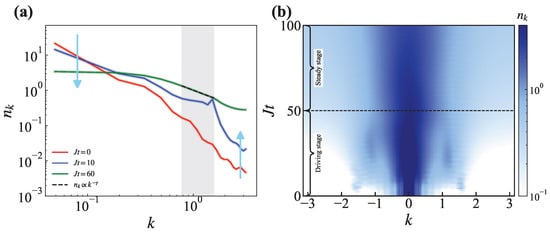
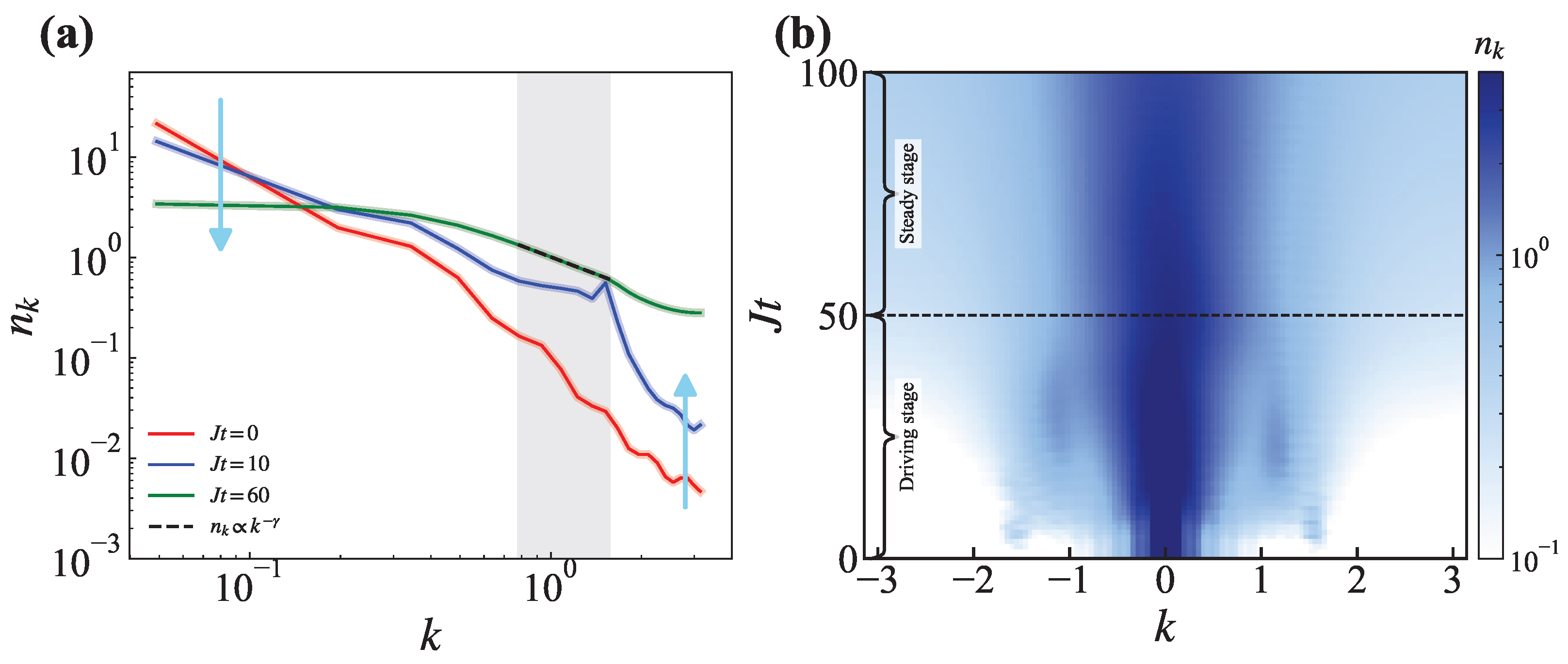
The resulting dynamics is schematically illustrated in Figure 1. At short drive times, the momentum distribution departs from the initial ground-state distribution as energy is injected at ; at sufficiently long times, becomes essentially time-independent, signaling the formation of a far-from-equilibrium quasi-steady state in which is well described by a power-law scaling over the window below the injection scale, marked by the black-dashed line and gray region in Figure 1a. Figure 1b shows the full time evolution of over the Brillouin zone as a heat map, with the horizontal dashed line at separating the driving stage from the quasi-stationary stage reached after the initial transient. Because the drive injects energy only at the single wavevector , the appearance of a scale-free interval below is suggestive of a scale-local flux, and the scale invariance of is therefore the momentum-space signature of a possible stationary cascade in which the particle number is transported through k at a scale-independent rate.
Figure 1.
Schematic illustration of the driving dynamics and emergent steady state. (a) Momentum distribution, , at the times (red), (blue), and (green). The gray shaded region marks the cascade window, , and the dashed line is the fitted power law that develops in the steady state. (b) Heat map of versus time over the Brillouin zone . The horizontal dashed line at separates the driving stage from the steady stage. The blue arrows in (a) indicate the temporal change of : decreases at low momenta and increases at high momenta.
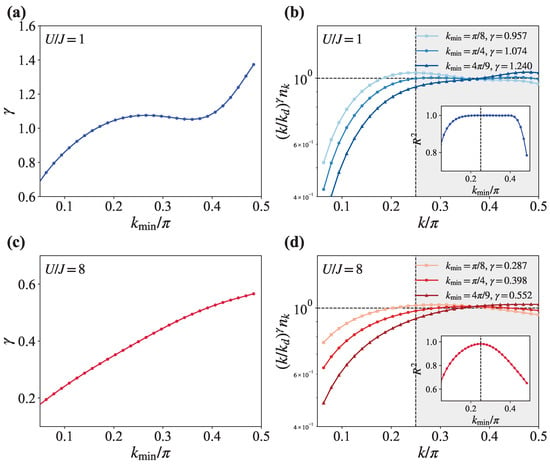
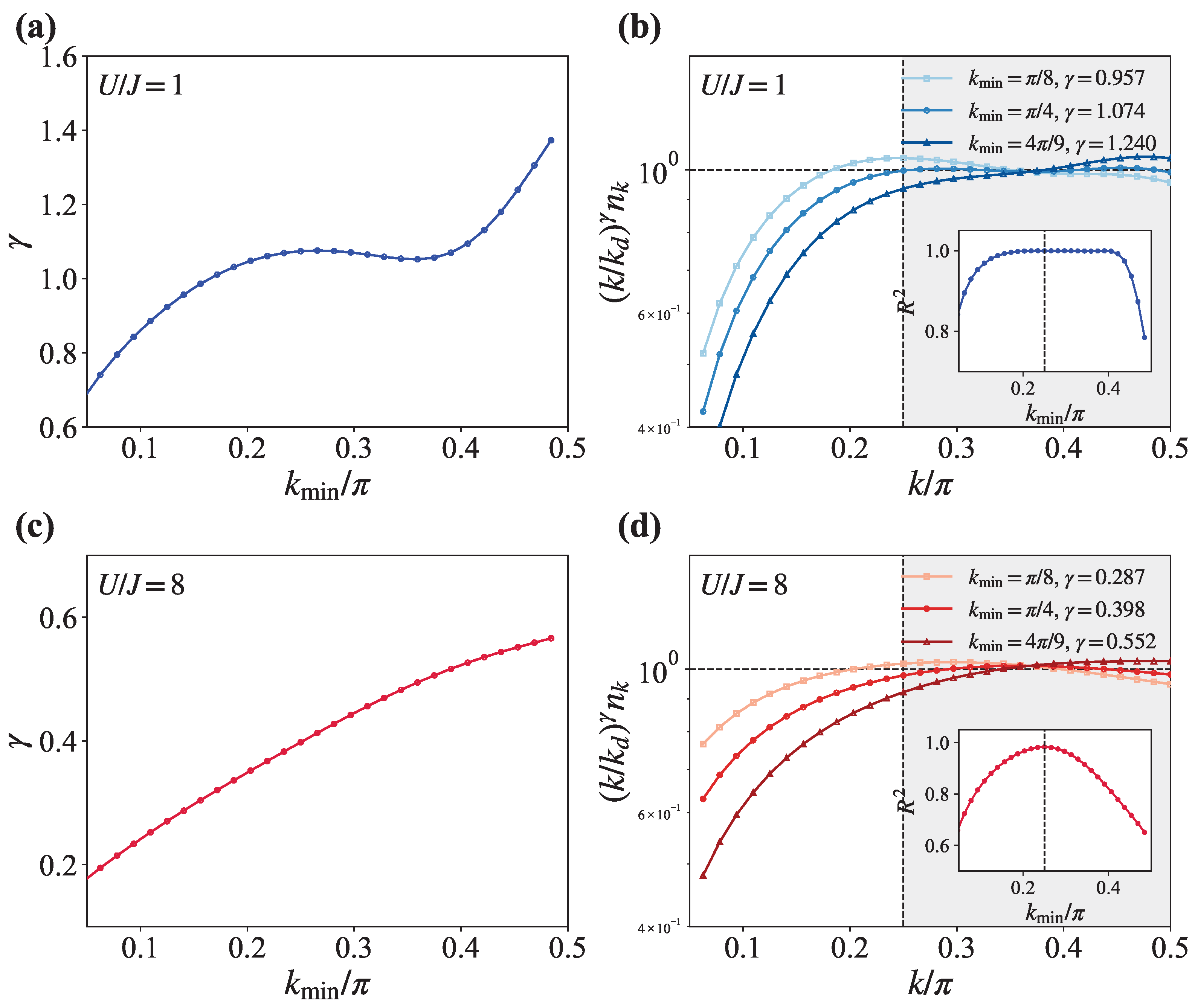
The endpoints of this window follow from the physics of the cascade rather than from the fitting procedure. The upper endpoint, , is the injection scale, below which the inverse cascade lives by definition, and the lower endpoint is set at half the injection scale, . Panels (a) and (c) of Figure 2 show the exponent obtained by fitting over as a function of the lower cutoff . For , stays near over the plateau around , but drops to at and to as once the fit extends below . The drop traces to the downward bending of the compensated spectrum below , which, normalized to unity within the window, falls to ≈0.42 for [panel (b) of Figure 2]. Panels (b) and (d) of Figure 2 compare the compensated spectra obtained from three lower cutoffs, , , and , each refitted on and normalized to unity over . The spectrum is flattest within the window for , fluctuating by only ≈1.7% for and ≈3.5% for , whereas the other cutoffs visibly distort it. The insets show the corresponding goodness of fit , computed by refitting on and evaluating on the fixed window ; it is maximized at and drops as moves away. Toward , only a few grid points remain and the fitted slope becomes statistically unstable, so that, for , the exponent drifts from ≈1.07 to ≈1.4, a lever-arm artifact rather than a physical trend. The maximum at therefore confirms this as the natural lower bound, and the insensitivity of to across the surrounding plateau makes the result robust to this choice. We emphasize that this power-law scaling is stable in two respects: it does not drift appreciably in time, and it is insensitive to the precise details of the initial state within the same phase.
Figure 2.
Justification of the fitting window , shown as the gray shaded region. Panels (a,c) show the fitted exponent as a function of the lower cutoff for the weakly interacting case with and , and the strongly interacting case with and . Panels (b,d) show the compensated spectra for the three lower cutoffs , , and , each refitted on and normalized to unity over . The insets show the goodness of fit , which is maximized at and drops as moves away. The vertical dashed line marks , the lower edge of the fitting window, and the horizontal dashed line marks unity; in the insets, the vertical dashed line indicates , where is maximal.
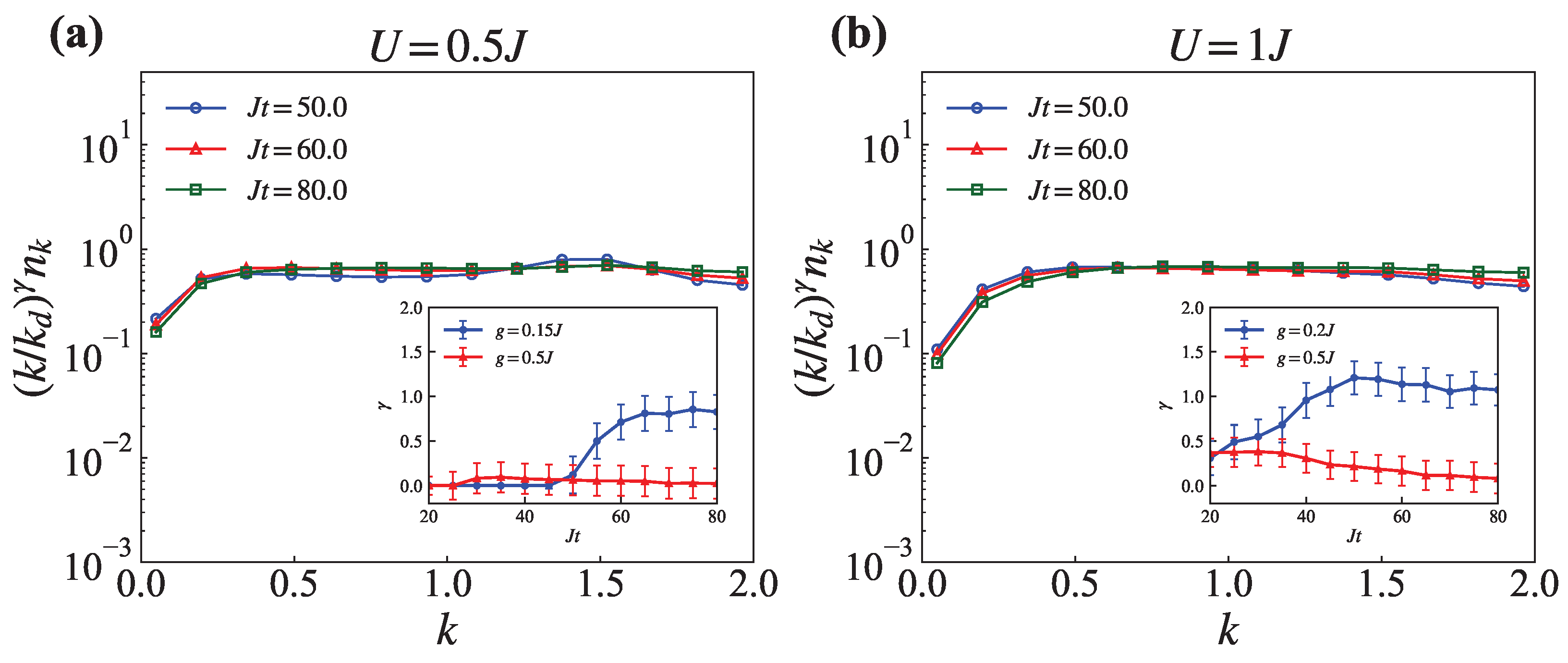
We further show the emergence of the stable power-law scaling at different interactions. For and a weak driving amplitude , the momentum distribution develops precisely this stable power law. As shown in Figure 3a, the scaled momentum distribution, , becomes approximately k-independent over for , confirming that has settled onto the form . The time evolution of the fitted exponent is presented in the inset of Figure 3a, where relaxes to a steady value and remains constant over the accessible time scale. A closely analogous behavior is observed at in Figure 3b for a driving amplitude, .
Figure 3.
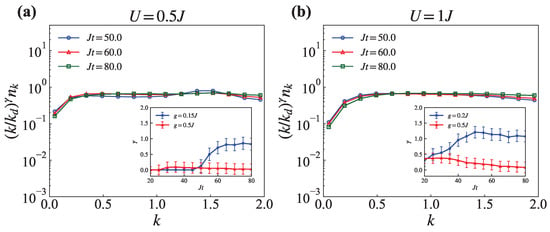
The cascade in the weakly interacting regime. (a) and (b) . In each panel, the main plot shows the scaled momentum distribution, , versus k at the driving amplitude that sustains a cascade ( and , respectively), with different colors denoting different times. The inset shows the extracted exponent, , versus time. At the stronger amplitude, the exponent collapses towards zero, signaling rapid thermalization that destroys the cascade.
However, when the driving amplitude is increased to at the same interaction strength, the behavior changes qualitatively. Under this stronger driving, the system rapidly thermalizes, and the stable power-law distribution is destroyed. As illustrated in the inset of Figure 3a, the fitted exponent collapses towards zero as time progresses, consistent with the absence of any scale-free interval in . Thus, the steady state, , becomes flat over essentially the entire Brillouin zone, indicating that the injected energy heats the system to a featureless thermal-like distribution rather than sustaining a directed momentum-space flux. The contrast between and shows that, in the weakly interacting superfluid, the cascade survives only within a limited range of driving amplitudes.
3.2. Robustness Against the Driving Amplitude in the Strongly Interacting System
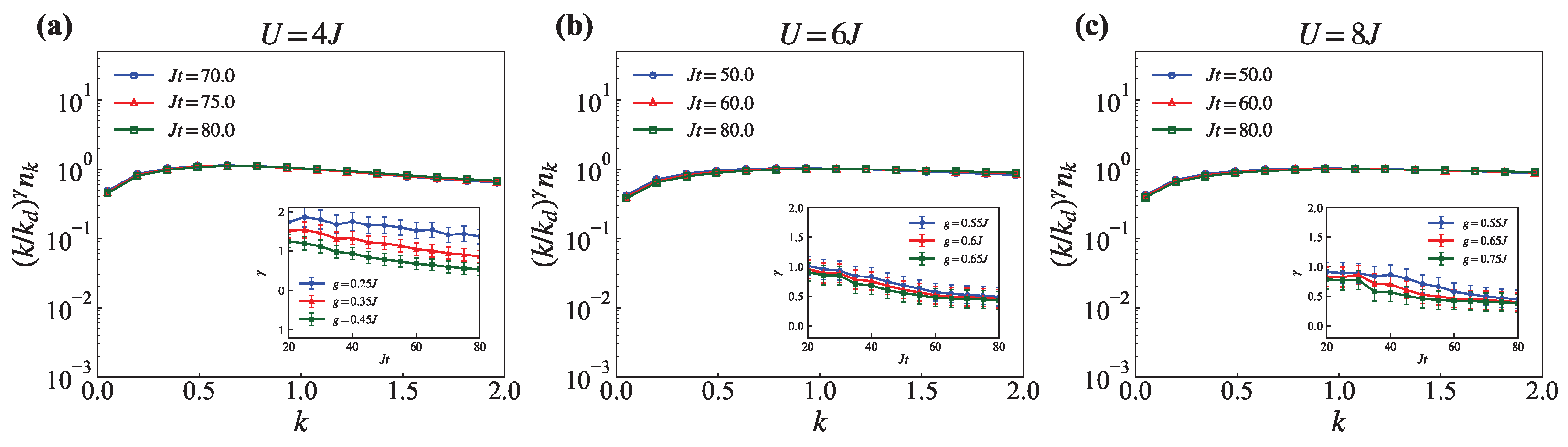
Having established the emergence of a stable power-law scaling in the weakly interacting superfluid state, we next ask whether this phenomenon survives into the strongly interacting regime. We examine the cases , 6, and 8, summarized in Figure 4. Figure 4 shows that the emergent quasi-steady state again exhibits a stable power-law distribution over a momentum window below the injection scale. The corresponding time evolution of the extracted exponents is presented in the inset of each panel, where each exponent gradually converges to a steady value over time.
Figure 4.
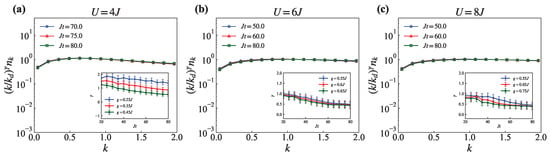
The cascade in the strongly interacting regime. (a) , (b) , and (c) . In each panel, the main plots show the scaled momentum distribution, , versus k at the driving amplitude that sustains a cascade (, , and , respectively), with different colors denoting different times. The inset shows the extracted exponent versus time for a sweep of driving amplitudes. The power-law scaling survives up to substantially larger driving amplitudes than in the weakly interacting regime, showing that strong interactions protect the cascade against heating.
At and 8, the power law survives driving amplitudes of and , far larger than the that already destroys the cascade in the weakly interacting superfluid, and a stable power law is likewise obtained at with . The fitted exponents in the three cases differ only slightly, so strong interactions protect the candidate particle cascade against heating. We attribute this protection to the emergence of a long-lived prethermal regime of a strongly interacting Floquet system, which suppresses the rate of energy absorption and thereby extends the lifetime of the quasi-stable state.
3.3. Interaction Dependence of the Cascade Exponent
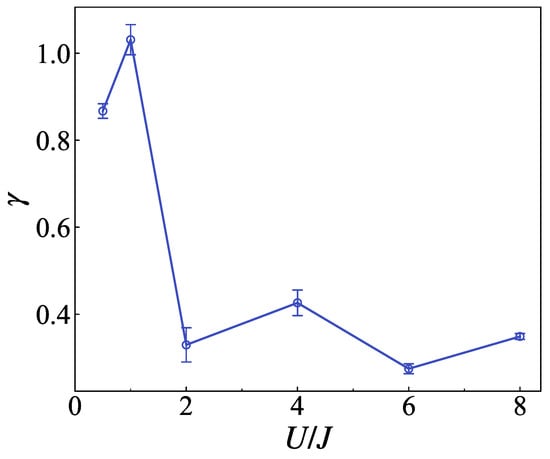
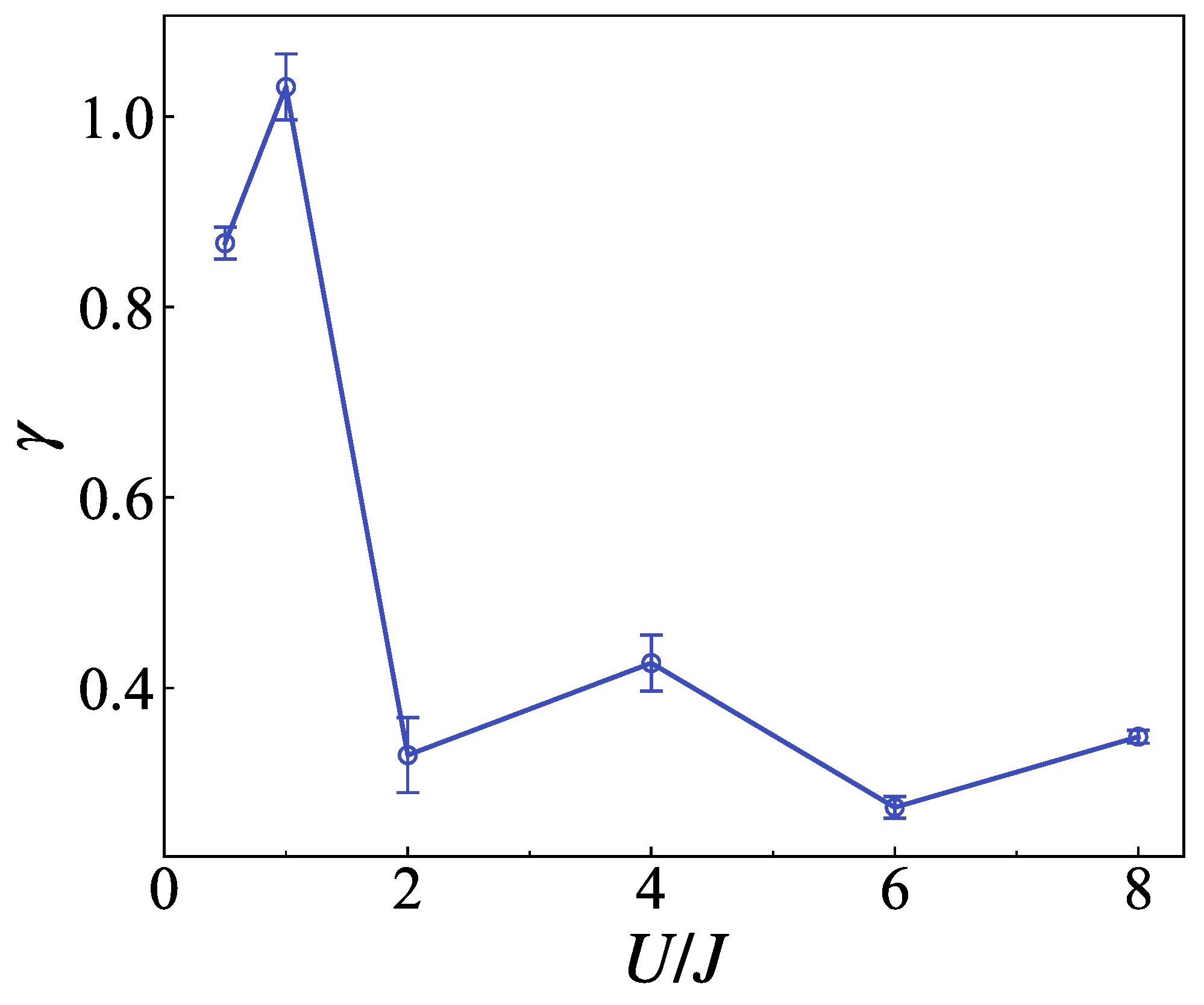
To quantify the dependence of the cascade on the interaction strength, we collect the asymptotic exponent, , as a function of in Figure 5, choosing for each interaction strength the driving amplitude that sustains a stable power-law scaling. Across the strongly interacting regime the exponent varies only slightly with , in marked contrast to its strong sensitivity to the driving amplitude in the weakly interacting superfluid. This near-constancy of corroborates the protective role of strong interactions and shows that the cascade mechanism is robust to the detailed value of the interaction. The fitted exponent is far from the classical hydrodynamic values. The asymptotic exponent is – in the weakly interacting regime at and 1, and drops to – in the strongly interacting regime at , 6, and 8, with the transition already occurring near . Both lie well below the Kolmogorov–Richardson exponent of the isotropic energy cascade [1,2]. This is expected because is the wave-action, particle-number spectrum rather than the energy spectrum, and the present cascade is a one-dimensional particle-number cascade rather than a two- or three-dimensional energy cascade. The exponent is also not universal: it changes from ∼1 to ∼0.4 upon entering the strongly interacting regime and thereafter depends only weakly on , in sharp contrast to the interaction-independent of the Kolmogorov energy cascade. This interaction dependence places the observed scaling in the class of non-thermal fixed-point and weak-wave-turbulence spectra [19,37,38].
Figure 5.
Dependence of the asymptotic power-law exponent, , on the interaction strength, . For each , the exponent is extracted from the quasi-steady state at the driving amplitude that supports a stable cascade. Error bars denote the standard deviation of over the final portion of the time evolution. The small variation in across the strongly interacting regime underscores the robustness of the cascade.
Extracting the precise values of the exponent and connecting it to the weak wave turbulence or non-thermal fixed point prediction remains an important task for future work.
3.4. Numerical Convergence
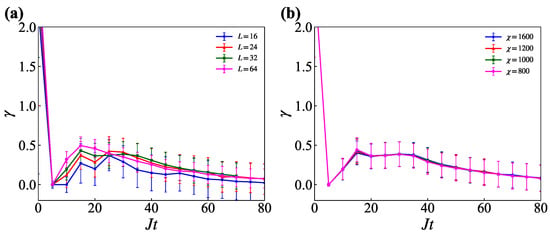
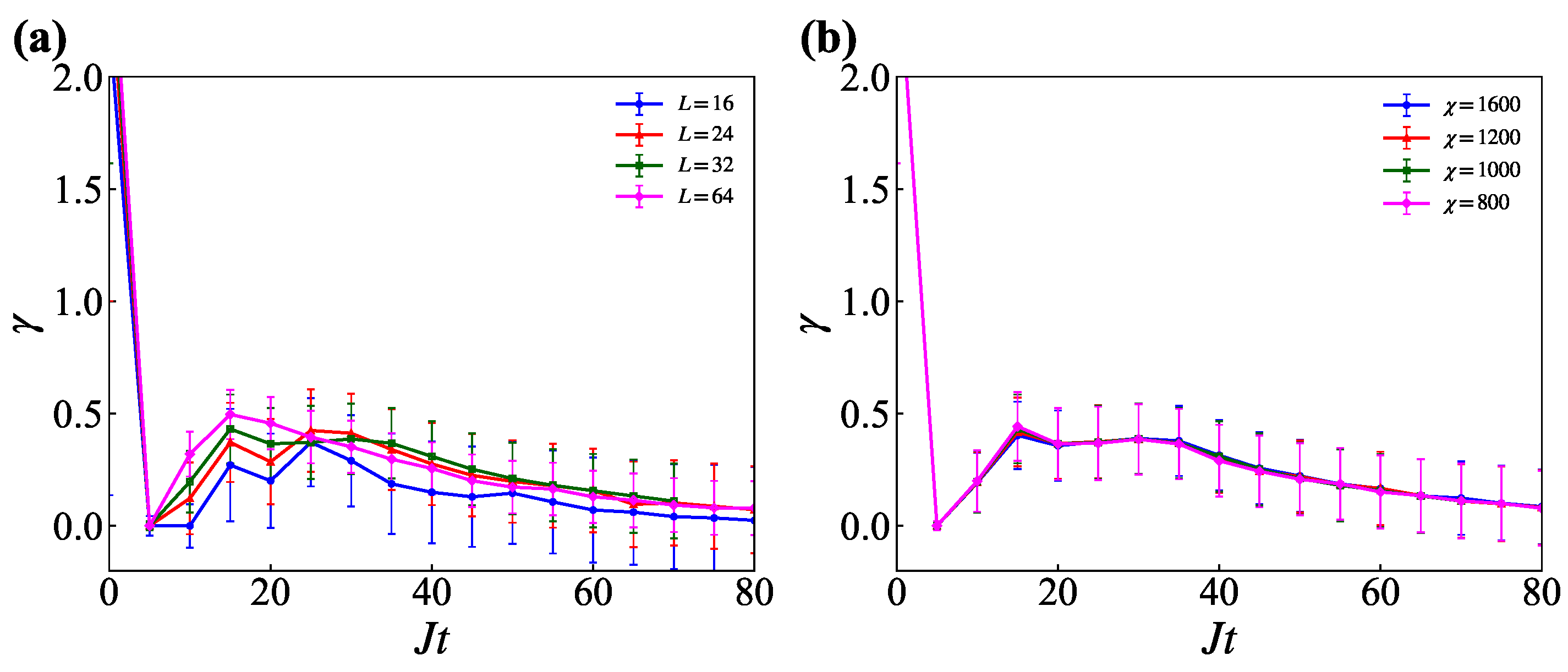
Figure 6 shows the time-dependent exponent, , at and , representative of the weakly interacting regime in which the cascade is well developed. Panel (a) compares four system sizes, , 24, 32, and 64, while panel (b) compares four bond dimensions, , 1000, 1200, and 1600, at a fixed size . In all cases, the curves agree within the fit uncertainty over the entire time window and settle onto the same quasi-steady value, confirming that the exponent reported in this work is not an artifact of the finite chain length or of the matrix–product–state truncation.
Figure 6.
Convergence of the fitted power-law exponent, , at and . (a) four system sizes , 24, 32, and 64. (b) four bond dimensions –1600 at fixed size . The collapse of the curves confirms that the exponent is insensitive to finite-size and truncation effects.
4. Conclusions
We have investigated the far-from-equilibrium dynamics of a half-filled one-dimensional Bose–Hubbard system driven by a spatially modulated chemical potential that injects energy at a single wavevector, , using DMRG to prepare the ground state and TDVP to propagate the dynamics. The momentum distribution then relaxes to a quasi-steady power law over the window below the injection scale, a scale-free interval suggestive of a particle cascade analogous to the Kolmogorov–Zakharov spectra of wave turbulence. Strikingly, whereas in the weakly interacting superfluid this cascade forms only under weak driving, at strong coupling, it survives up to much larger driving amplitudes. We attribute this protection to the long-lived prethermal regime of a strongly interacting Floquet system, which suppresses energy absorption and thereby extends the lifetime of the quasi-steady state.
Our results provide a candidate one-dimensional lattice counterpart of driven turbulent wave cascades, and suggest that strong interactions can stabilize far-from-equilibrium power-law distributions in periodically driven quantum many-body systems. Several directions remain open. First, connecting the observed exponents to analytical weak wave turbulence or non-thermal fixed point predictions and to the self-similar evolution expected from wave turbulence theory [44] would clarify whether the candidate cascade belongs to a universality class. Second, the models and driving protocols are directly realizable in cold-atom experiments through lattice depth combined with time-of-flight imaging, opening the prospect of observing the cascade directly. Finally, extensions to inhomogeneous, disordered, or higher-dimensional geometries would test the robustness of the phenomenon beyond the idealized one-dimensional setting.
Author Contributions
Conceptualization, J.L.; methodology, J.L. and Y.L.; software, Z.Z.; formal analysis, Z.Z.; investigation, Z.Z.; writing—original draft preparation, Z.Z.; writing—review and editing, J.L. and Y.L. All authors have read and agreed to the published version of the manuscript.
Funding
Y.L. acknowledges the support provided by the National Natural Science Foundation of China (Grants No. 12074431, No. 12374252 and No. 12674337), and the Science and Technology Innovation Program of Hunan Province under Grant No. 2024RC1046. J.L. acknowledges the support provided by the National Natural Science Foundation of China (Grants No. 12404332).
Data Availability Statement
The original contributions presented in this study are included in the article. Further inquiries can be directed to the corresponding author.
Conflicts of Interest
The authors declare no conflicts of interest.
References
- Richardson, L.F. Weather Prediction by Numerical Process; Cambridge University Press: Cambridge, UK, 1922. [Google Scholar]
- Kolmogorov, A.N. The local structure of turbulence in incompressible viscous fluid for very large Reynolds numbers. Dokl. Akad. Nauk SSSR 1941, 30, 299–303. [Google Scholar]
- Kraichnan, R.H. Inertial ranges in two-dimensional turbulence. Phys. Fluids 1967, 10, 1417–1423. [Google Scholar] [CrossRef] [Scilit]
- Galtier, S.; Nazarenko, S.V. Turbulence of weak gravitational waves in the early universe. Phys. Rev. Lett. 2017, 119, 221101. [Google Scholar] [CrossRef] [Scilit] [PubMed]
- Biskamp, D.; Schwarz, E.; Drake, J.F. Two-dimensional electron magnetohydrodynamic turbulence. Phys. Rev. Lett. 1996, 76, 1264–1267. [Google Scholar] [CrossRef] [Scilit] [PubMed]
- Laurie, J.; Bortolozzo, U.; Nazarenko, S.; Residori, S. One-dimensional optical wave turbulence: Experiment and theory. Phys. Rep. 2012, 514, 121–175. [Google Scholar] [CrossRef] [Scilit]
- Falcon, E.; Michel, G.; Prabhudesai, G.; Cazaubiel, A.; Berhanu, M.; Mordant, N.; Aumaître, S.; Bonnefoy, F. Saturation of the Inverse Cascade in Surface Gravity-Wave Turbulence. Phys. Rev. Lett. 2020, 125, 134501. [Google Scholar] [CrossRef] [Scilit] [PubMed]
- Navon, N.; Smith, R.P.; Hadzibabic, Z. Quantum gases in optical boxes. Nat. Phys. 2021, 17, 1334–1341. [Google Scholar] [CrossRef] [Scilit]
- Navon, N.; Eigen, C.; Zhang, J.; Lopes, R.; Gaunt, A.L.; Fujimoto, K.; Tsubota, M.; Smith, R.P.; Hadzibabic, Z. Synthetic dissipation and cascade fluxes in a turbulent quantum gas. Science 2019, 366, 382–385. [Google Scholar] [CrossRef] [Scilit] [PubMed]
- Madeira, L.; García-Orozco, A.D.; Alves dos Santos, F.E.; Bagnato, V.S. Entropy of a Turbulent Bose-Einstein Condensate. Entropy 2020, 22, 956. [Google Scholar] [CrossRef] [Scilit] [PubMed]
- Navon, N.; Gaunt, A.L.; Smith, R.P.; Hadzibabic, Z. Emergence of a turbulent cascade in a quantum gas. Nature 2016, 539, 72–75. [Google Scholar] [CrossRef] [Scilit] [PubMed]
- Tsatsos, M.C.; Tavares, P.E.S.; Cidrim, A.; Fritsch, A.R.; Caracanhas, M.A.; dos Santos, F.E.A.; Barenghi, C.F.; Bagnato, V.S. Quantum turbulence in trapped atomic Bose-Einstein condensates. Phys. Rep. 2016, 622, 1–52. [Google Scholar] [CrossRef] [Scilit]
- Henn, E.A.L.; Seman, J.A.; Roati, G.; Magalhães, K.M.F.; Bagnato, V.S. Emergence of turbulence in an oscillating Bose-Einstein condensate. Phys. Rev. Lett. 2009, 103, 045301. [Google Scholar] [CrossRef] [Scilit] [PubMed]
- Proment, D.; Nazarenko, S.; Onorato, M. Quantum turbulence cascades in the Gross-Pitaevskii model. Phys. Rev. A 2009, 80, 051603. [Google Scholar] [CrossRef] [Scilit]
- Zhu, Y.; Semisalov, B.; Krstulovic, G.; Nazarenko, S. Direct and inverse cascades in turbulent Bose-Einstein condensates. Phys. Rev. Lett. 2023, 130, 133001. [Google Scholar] [CrossRef] [Scilit] [PubMed]
- Karailiev, A.; Gazo, M.; Gałka, M.; Eigen, C.; Satoor, T.; Hadzibabic, Z. Observation of an inverse turbulent-wave cascade in a driven quantum gas. Phys. Rev. Lett. 2024, 133, 243402. [Google Scholar] [CrossRef] [Scilit] [PubMed]
- Gazo, M.; Karailiev, A.; Satoor, T.; Eigen, C.; Gałka, M.; Hadzibabic, Z. Universal coarsening in a homogeneous two-dimensional Bose gas. Science 2025, 389, 802–805. [Google Scholar] [CrossRef] [Scilit] [PubMed]
- Dyachenko, S.; Newell, A.C.; Pushkarev, A.; Zakharov, V.E. Optical turbulence: Weak turbulence, condensates and collapsing filaments in the nonlinear Schrödinger equation. Phys. D 1992, 57, 96–160. [Google Scholar] [CrossRef] [Scilit]
- Berges, J.; Rothkopf, A.; Schmidt, J. Nonthermal fixed points: Effective weak coupling for strongly correlated systems far from equilibrium. Phys. Rev. Lett. 2008, 101, 041603. [Google Scholar] [CrossRef] [Scilit] [PubMed]
- Chantesana, I.; Piñeiro Orioli, A.; Gasenzer, T. Kinetic theory of nonthermal fixed points in a Bose gas. Phys. Rev. A 2019, 99, 043620. [Google Scholar] [CrossRef] [Scilit]
- Nowak, B.; Sexty, D.; Gasenzer, T. Superfluid turbulence: Nonthermal fixed point in an ultracold Bose gas. Phys. Rev. B 2011, 84, 020506. [Google Scholar] [CrossRef] [Scilit]
- Piñeiro Orioli, A.; Boguslavski, K.; Berges, J. Universal self-similar dynamics of relativistic and nonrelativistic field theories near nonthermal fixed points. Phys. Rev. D 2015, 92, 025041. [Google Scholar] [CrossRef] [Scilit]
- Löffler, R.J.G.; Gorecki, J. Dynamics of Aggregation in Systems of Self-Propelled Rods. Entropy 2024, 26, 980. [Google Scholar] [CrossRef] [Scilit] [PubMed]
- Gadomski, A.; Kruszewska, N. Matter-Aggregating Systems at a Classical vs. Quantum Interface. Entropy 2025, 27, 273. [Google Scholar] [CrossRef] [Scilit] [PubMed]
- Greiner, M.; Mandel, O.; Esslinger, T.; Hänsch, T.W.; Bloch, I. Quantum phase transition from a superfluid to a Mott insulator in a gas of ultracold atoms. Nature 2002, 415, 39–44. [Google Scholar] [CrossRef] [Scilit] [PubMed]
- Fisher, M.P.A.; Weichman, P.B.; Grinstein, G.; Fisher, D.S. Boson localization and the superfluid-insulator transition. Phys. Rev. B 1989, 40, 546–570. [Google Scholar] [CrossRef] [Scilit] [PubMed]
- Bloch, I.; Dalibard, J.; Zwerger, W. Many-body physics with ultracold gases. Rev. Mod. Phys. 2008, 80, 885–964. [Google Scholar] [CrossRef] [Scilit]
- Cazalilla, M.A.; Citro, R.; Giamarchi, T.; Orignac, E.; Rigol, M. One dimensional bosons: From condensed matter systems to ultracold gases. Rev. Mod. Phys. 2011, 83, 1405–1466. [Google Scholar] [CrossRef] [Scilit]
- D’Alessio, L.; Rigol, M. Long-time behavior of isolated periodically driven interacting lattice systems. Phys. Rev. X 2014, 4, 041048. [Google Scholar] [CrossRef] [Scilit]
- Bukov, M.; D’Alessio, L.; Polkovnikov, A. Universal high-frequency behavior of periodically driven systems: From dynamical stabilization to Floquet engineering. Adv. Phys. 2015, 64, 139–226. [Google Scholar] [CrossRef] [Scilit]
- Eckardt, A. Colloquium: Atomic quantum gases in periodically driven optical lattices. Rev. Mod. Phys. 2017, 89, 011004. [Google Scholar] [CrossRef] [Scilit]
- Rigol, M.; Dunjko, V.; Olshanii, M. Thermalization and its mechanism for generic isolated quantum systems. Nature 2008, 452, 854–858, Correction in Nature 2012, 481, 224. https://doi.org/10.1038/nature10773. [Google Scholar] [CrossRef] [Scilit] [PubMed]
- Abanin, D.A.; De Roeck, W.; Ho, W.W.; Huveneers, F. Effective Hamiltonians, prethermalization, and slow energy absorption in periodically driven many-body systems. Phys. Rev. B 2017, 95, 014112. [Google Scholar] [CrossRef] [Scilit]
- Messer, M.; Sandholzer, K.; Görg, F.; Minguzzi, J.; Desbuquois, R.; Esslinger, T. Floquet dynamics in driven Fermi-Hubbard systems. Phys. Rev. Lett. 2018, 121, 233603. [Google Scholar] [CrossRef] [Scilit] [PubMed]
- Kuwahara, T.; Mori, T.; Saito, K. Floquet-Magnus theory and generic transient dynamics in periodically driven many-body quantum systems. Ann. Phys. 2016, 367, 96–124. [Google Scholar] [CrossRef] [Scilit]
- Mori, T.; Ikeda, T.N.; Kaminishi, E.; Ueda, M. Thermalization and prethermalization in isolated quantum systems: A theoretical overview. J. Phys. B At. Mol. Opt. Phys. 2018, 51, 112001. [Google Scholar] [CrossRef] [Scilit]
- Zakharov, V.E.; L’vov, V.S.; Falkovich, G. Kolmogorov Spectra of Turbulence I: Wave Turbulence; Springer: Berlin, Germany, 1992. [Google Scholar]
- Nazarenko, S. Wave Turbulence; Springer: Berlin, Germany, 2011. [Google Scholar]
- White, S.R. Density matrix formulation for quantum renormalization groups. Phys. Rev. Lett. 1992, 69, 2863–2866. [Google Scholar] [CrossRef] [Scilit] [PubMed]
- Schollwöck, U. The density-matrix renormalization group in the age of matrix product states. Ann. Phys. 2011, 326, 96–192. [Google Scholar] [CrossRef] [Scilit]
- Haegeman, J.; Cirac, J.I.; Osborne, T.J.; Pižorn, I.; Verschelde, H.; Verstraete, F. Time-Dependent Variational Principle for Quantum Lattices. Phys. Rev. Lett. 2011, 107, 070601. [Google Scholar] [CrossRef] [Scilit] [PubMed]
- Haegeman, J.; Lubich, C.; Oseledets, I.; Vandereycken, B.; Verstraete, F. Unifying time evolution and optimization with matrix product states. Phys. Rev. B 2016, 94, 165116. [Google Scholar] [CrossRef] [Scilit]
- Fishman, M.; White, S.R.; Stoudenmire, E.M. The ITensor Software Library for Tensor Network Calculations. SciPost Phys. Codebases 2022, 4. [Google Scholar] [CrossRef] [Scilit]
- Zhu, Y.; Semisalov, B.; Krstulovic, G.; Nazarenko, S. Self-similar evolution of wave turbulence in Gross-Pitaevskii system. Phys. Rev. E 2023, 108, 064207. [Google Scholar] [CrossRef] [Scilit] [PubMed]
Disclaimer/Publisher’s Note: The statements, opinions and data contained in all publications are solely those of the individual author(s) and contributor(s) and not of MDPI and/or the editor(s). MDPI and/or the editor(s) disclaim responsibility for any injury to people or property resulting from any ideas, methods, instructions or products referred to in the content. |
© 2026 by the authors. Licensee MDPI, Basel, Switzerland. This article is an open access article distributed under the terms and conditions of the Creative Commons Attribution (CC BY) license.