


Abstract
Two-dimensional optical orthogonal codes have important applications in optical code division multiple access networks. In this paper, a generic construction of two-dimensional optical orthogonal codes with at most one pulse per wavelength (AM-OPPW 2D OOCs) is proposed. As a result, some optimal AM-OPPW 2D OOCs with new parameters can be yielded. The new AM-OPPW 2D OOC may support more subscribers and heavier asynchronous traffic compared with known constructions.
1. Introduction
With the advantage of combining the large transmission bandwidth of fiber-optic media and the flexibility of code division multiple access (CDMA) techniques, the optical code division access system (OCDMA) has been extensively studied since the 1980s. In this system, unipolar optical orthogonal codes (OOCs [1]) are employed as spreading codes. However, this multiple-access scheme has a drawback in that the effect of multiple-access interference (MAI) cannot be completely eliminated as in directly spreading CDMA systems. Thus, one of the key points for the OCDMA system is to design OOCs with low cross-correlation and off-peak autocorrelation. In the meantime, to enlarge the discrimination between the correct codeword and interfering codewords, we also need a large peak autocorrelation value, i.e., the weight of the OOCs. Finally, since the number of users in the system is less than or equal to the code size of OOCs, it is beneficial to design OOCs with large code sizes. However, as the volume of codewords or the weight of the code increases rapidly, the code length increases rapidly. Thus, optimal solutions, i.e., optimal OOCs, were proposed with respect to the tradeoff of those parameters (see, e.g., [2,3,4,5,6,7,8,9,10]).
In the meantime, two-dimensional optical orthogonal codes (2D OOCs) that spread in both time and wavelength were introduced for the OCDMA system to overcome this drawback. Similarly, to minimize multiple-access interference, we have to minimize the cross-correlation and off-peak autocorrelation of 2D OOCs; to support a large number of users, we need a large set of 2D OOCs. Moreover, to simplify the practical implementations, restrictions, such as at most one pulse per wavelength (AM-OPPW) and at most one pulse per time slot (AM-OPPTS), are often imposed on 2D OOCs [11]. However, these parameters are not independent of each other. They suffer some theoretic bounds, for instance, the Johnson bound [4] and the bound for 2D OOCs with the AM-OPPW restriction [11]. So far, various works have addressed optimal 2D OOCs with respect to these bounds [11,12,13,14,15,16,17,18,19,20,21,22,23,24,25,26,27].
The main idea of this paper is to generate new optimal AM-OPPW 2D OOCs based on known OOCs and 2D OOCs. In [16,17,19], OOCs were used to construct 2D OOCs by spreading them in the time domain, i.e., the OOCs form rows of 2D OOCs. In our construction, the OOCs are utilized to determine which rows of 2D OOCs are not all-zero vectors. In this way, new AM-OPPW 2D OOCs can be yielded with large sizes, some of which are optimal with respect to the theoretic bound proposed in [11]. Further, we also analyze the performances of the new 2D OOCs under the chip-synchronous and chip-asynchronous assumptions, respectively.
The remainder of this paper is organized as follows. Section 2 reviews some necessary preliminaries. Section 3 introduces the new construction of AM-OPPW 2D OOCs. Section 4 conducts the performances of the new AM-OPPW 2D OOCs under the chip-synchronous and chip-asynchronous assumptions, respectively. Section 5 concludes this paper.
2. Preliminaries
Let , T, w, and be positive integers, and be the least non-negative residue of a modulo b for positive integers a and b. A two-dimensional optical orthogonal code (2D OOC) is a family of arrays of order with constant weight w satisfying the following two properties:
- (1)
- The autocorrelation property
- (2)
- The cross-correlation property
where , and .
If is the smallest integer such that (1) and (2) hold, then we say that is the maximum collision parameter (MCP) of . If , then is exactly an optical orthogonal code (OOC) [1].
The following restrictions on the placement of pulse within an array are often proposed for 2D OOCs to simplify the practical implementations [11]:
- Arrays with one pulse per wavelength (OPPW): For any array X in , the element 1 appears exactly once in each row of X.
- Arrays with at most one pulse per wavelength (AM-OPPW): For any array X in , the element 1 appears at most once in each row of X.
- Arrays with one pulse per time slot (OPPTS): For any array X in , the element 1 appears exactly once in each column of X.
- Arrays with at most one pulse per time slot (AM-OPPTS): For any array X in , the element 1 appears at most once in each column of X.
Obviously, OPPW (OPPTS resp.) is a special case of AM-OPPW (AM-OPPTS resp.).
In the following, we briefly review the theoretic bounds on the code size of OOCs and 2D OOCs with AM-OPPW.
Lemma 1
([4]). The maximum possible size of an OOC with parameters is bounded by
Lemma 2
([11]). The maximum possible size of a 2D OOC with AM-OPPW is bounded by
In particular, for the 2D OOC with OPPW,
An OOC (a 2D OOC with AM-OPPW resp.) is called optimal if the number of codewords achieves the theoretic bound in Lemma 1 (Lemma 2 resp.).
3. Optimal AM-OPPW 2D OOCs via Known AM-OPPW 2D OOCs and OOCs
In this section we introduce a general construction of AM-OPPW 2D OOCs based on known OOCs and AM-OPPW 2D OOCs.
Let be an AM-OPPW 2D OOC with parameters , . For , is defined by
where ⊤ is the transpose operation, and the T-dimensional vector is the -th row of the array , . Let be an OOC with parameters , where for .
With the above preparation, we can construct an AM-OPPW 2D OOC as follows.
Construction A: For each three-tuple , , run the following Algorithm 1 to generate a new array :
| Algorithm 1 Generate the new array |
| Input: , , j. Initiate: , ; while do if then ; ; else // 0 is the all-zero T-dimensional vector end if ; end while return |
Theorem 1.
The 2D OOC generated by Construction A is an AM-OPPW 2D OOC with parameters , code size , and .
Proof.
We first show that the MCP of is less than or equal to . By (1) and (2), it is sufficient to investigate
which is divided into two cases according to the values of i, r, and j.
Case I: . By Algorithm 1, the rows and if and only if and , where . Note that both and contain at most one element 1. Thus, the cross-correlation value is less than or equal to the correlation of and at time shift , i.e., ≤.
Case II: . By Algorithm 1, and are rows of and , respectively. Hence, the correlation value is less than or equal to the correlation of and at time shift . Then, the nontrivial correlation value , i.e., or ( and ), is less than or equal to .
In addition, it is easy to check that . Therefore, the AM-OPPW 2D OOC has parameters and size , where □
In what follows, we present some results obtained by Construction A for specific cases of Firstly, for , we have the following result:
Corollary 1.
If is an optimal OPPW 2D OOC with parameters and is an optimal OOC with parameters , then the AM-OPPW 2D OOC generated by Construction A with parameters is optimal for and .
Proof.
Because of the optimality of both the OOC and the OPPW 2D OOC , the code size of and are, respectively, and by Lemmas 1 and 2. Thus, applying Theorem 1, we obtain that is an AM-OPPW 2D OOC with parameters , and the code size . On the one hand, the fact implies that , i.e., the code size of is . On the other hand, it follows from Lemma 2 that
where the last equality holds for . Thus, is optimal with respect to the bound in Lemma 2. This finishes the proof. □
In Table 1, we list some known optimal OOCs with parameters satisfying , where p is a prime and q is a prime power.
Table 1.
Some known optimal OOCs with .
As an application of Corollary 1, in Table 2, we provide some optimal AM-OPPW 2D OOCs by means of the optimal OPPW 2D OOCs in [19] and optimal OOCs in Table 1.
Table 2.
Some new optimal AM-OPPW 2D OOCs from Corollary 1.
Next, for , we have the following corollary.
Corollary 2.
Let be an optimal OPPW 2D OOC with parameters and be an optimal OOC with parameters . Then, the AM-OPPW 2D OOC generated by Construction A with parameters is optimal if or and .
Proof.
The proof is similar to that of Corollary 1. □
It was shown in [30] that there exist optimal OOCs with parameters for . Note that or and for . Associated with the optimal OPPW 2D OOC of parameters in [11], where p is a prime and , the following result can be directly obtained from Corollary 2.
Corollary 3.
Let be the optimal OPPW 2D OOC with parameters and be the optimal OOC with parameters where is a prime and . Then, AM-OPPW 2D OOC generated from Construction A is optimal with parameters .
Remark 1.
Compared with 2D OOCs, the AM-OPPW 2D OOC may have a lower code rate because the AM-OPPW condition is indeed a constraint from the perspective of code construction. The reader may refer to [12] for a more detailed comparison.
4. Performance Analysis of the New Optimal AM-OPPW 2D OOCs
Let be the optimal AM-OPPW 2D OOC with parameters and code size generated from Corollary 1 based on a known AM-OPPW 2D OOC with parameters and code size M together with a known OOC with parameters and code size N. From now on, we examine its performances under the chip-synchronous and chip-asynchronous assumptions, respectively.
In an OCDMA using on–off keying (OOK), “1” and “0” are sent with equal probability but only bit “1” is encoded by the 2D OOC. Following the simple protocol in [1], we analyze the performance of the OCMDA in an ideal case where performance deterioration is only due to multiple-access interference (MAI) so that the effects of physical noises, such as thermal noise, shot noise, and beat noise are ignored [31]. That is, a decision error occurs only when the accumulative MAI reaches over a decision threshold and a data bit zero is transmitted. In addition, before correlation is performed, a hard-limiter is often placed at the front end of a receiver for reducing the effects of MAI [32]. Thus, throughout this section we discuss the performances of the new 2D OOC in the ideal case with a hard-limiter.
4.1. Performance Analysis under the Chip-Synchronous Assumption
Without loss of generality, let be the desired codeword. Let be the probability of l hits in a time slot when it cross-correlates with all the other codewords , where , , , , and .
For the chip-synchronous case, the hard-limiting error probability of the new AM-OPPW 2D OOCs with parameters in on–off keying (OOK) data modulation is [33]
where K denotes the number of simultaneous users and is the decision threshold. Hence, for the case , to derive the error probability of the new AM-OPPW 2D OOCs we only need to calculate the probabilities and .
Firstly, we count the number of the hits between arrays and to compute . Recall from Algorithm 1 that their k-th rows and if and only if
When , one hit occurs exactly once as running through all the possible time delays, i.e., , since the two rows and contain exactly one element 1, respectively. Note that the OOCs and have weight . According to the proof of Theorem 1, the following are true:
- When , (4) happens exactly times as ranges from 0 to . Then, there are hits since and , respectively, have M and possible choices;
- When and , (4) happens exactly times as ranges from 1 to . Then, there are hits since has M possible choices;
- When and , (4) happens exactly times. Then, there are hits since has possible choices.
Therefore, there are hits in total. Then, we have
where the factor comes from the assumptions that the error occurs only if a data bit zero is transmitted and the element 0 is sent with probability . denotes the number of codewords except for , and T is the number of all the time slots. Secondly, the fact implies
In the sequel, we present some simulation results acquired by MATLAB r2023b as an example.
Example 1.
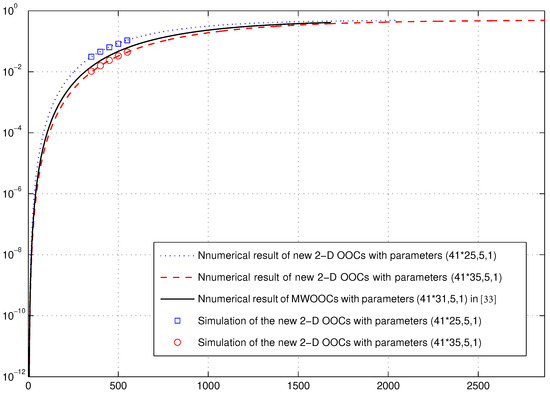
Let be the optimal OPPW 2D OOC with parameters and code size [19] and be the optimal OOC with parameters and code size [5]. Then, we can construct a new optimal AM-OPPW 2D OOC with parameters and code size using Construction A. In this case, using (5) and (6) we obtain and . Then, we can calculate the hard-limited chip-synchronous error probability by means of (3), which is plotted against K simultaneous users with threshold in Figure 1. Similarly, based on the OPPW 2D OOC with parameters [19], an optimal AM-OPPW 2D OOC with parameters , and code size can also be yielded by Construction A.
Figure 1.
Error probabilities versus the numbers of simultaneous users under the chip-synchronous assumptions [33].
In [34], the multi-wavelength optical orthogonal codes (MWOOCs) with parameters , and code size 1681 can be generated. As a comparison, we plot the hard-limited chip-synchronous error probability of the MWOOCs with parameters , and our new 2D OOCs with parameters and together in Figure 1.
Further, simulation for the new 2D OOCs with parameters ( resp.) is performed by choosing K codewords for K simultaneous users randomly from the 2050 (2870 resp.) codewords. Particularly, the transmission time delay of each codeword is chosen from a random integer in [0,25) to simulate the chip-synchronous condition. In order to attain the error probability, the simulation is iterated times for .
As shown in Figure 1, the new 2D OOC with parameters has better performance than the MWOOC with parameters , while the MWOOC performs better than the new 2D OOC parameters . However, the code size of the new 2D OOCs, even for the case with parameters , are larger than that of the MWOOCs. This is desirable. On the one hand, the larger the code size, the more the users in the OCDMA systems. On the other hand, new 2D OOCs with large size may support multicode keying in OCDMA systems [35].
4.2. Performance Analysis under the Chip-Asynchronous Assumption
It is known that the chip-synchronous assumption provides pessimistic upper bounds on the performance of the system, whereas the chip-asynchronous assumption assures a more accurate performance [32]. In this subsection, we study the hard-limiting performance of the new AM-OPPW 2D OOCs under the chip-asynchronous assumption.
For the chip-asynchronous case, the hard-limiting error probability of the new AM-OPPW 2D OOCs with parameters in on–off keying (OOK) data modulation is [17,33]
where K denotes the number of simultaneous users, denotes the probability of the cross-correlation value in the preceding time slot equal to (the present time slot , respectively), and is the decision threshold. In particular, for the new AM-OPPW 2D OOCs with parameters , we then have
That is, it is sufficient to determine , for computing .
According to [36], the 2D OOCs with satisfy that
To derive , we need to count the total number of two consecutive hits, i.e., two hits occurring firstly at the preceding time slot and subsequently the present time slot, when the desired code array correlates with all the other arrays in the code set. Without loss of generality, assume that is the desired array.
Firstly, we discuss the arrays from the set . Assume that there exists a hit at the time slot , i.e., . Note that for or , there exists at most one integer k, , such that since their non-trivial correlation value is no more than 1. Then, by Algorithm 1, for any and any , both and occur at most once for all the integers , which indicates that and have at most one hit for all the time slots. This is to say, no other hits happen except for the one at time slot .
Secondly, we investigate the arrays based on the same OOC and , i.e., . Suppose that there is a hit at the time slot , i.e., . In the OOC , there are elements where . If , the rows and contain exactly one element 1 otherwise they are all-zero vectors according to Algorithm 1. Then, there are possible time slots such that and times such that when varies over for a given . Thus, in total, hits happen as C ranging over the set . This to say, there are consecutive hits on average.
Based on the above analysis, we have
where the factor comes from the assumptions that the error occurs only if a data bit zero is transmitted and the element 0 is sent with probability , is the number of codewords except , and T is the number of all the time slots.
Finally, we present some simulation results obtained using MATLAB as an example.
Example 2.
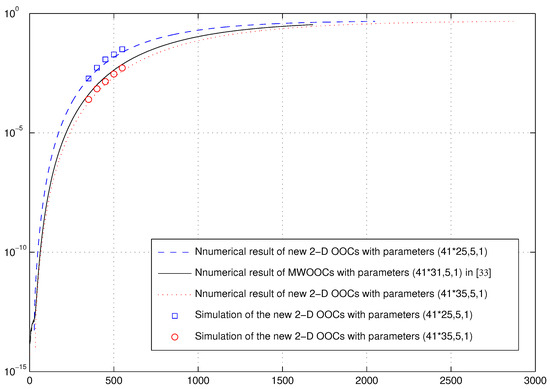
Analyzing the new 2D OOCs with parameters and generated in Example 1, using (11), (13), and (12), we can calculate that , and (, and resp.). Substituting them into (7), we derive the hard-limited chip-asynchronous error probability, which is plotted against K simultaneous users in Figure 2, where . As a comparison, we also plot the hard-limited chip-asynchronous error probability of the MWOOCs with parameters together with our new 2D OOCs with parameters and in Figure 2.
Figure 2.
Error probabilities versus the numbers of simultaneous users under chip-asynchronous assumptions [33].
Simulations are conducted by choosing K codewords for K simultaneous users randomly from 2050 (2870 resp.) codewords. Specifically, the transmission time of each codeword is chosen from a random real number between 0 and 25 to simulate the chip asynchronous condition. In order to acquire an error probability, the simulations are iterated times for . As shown in Figure 2, the simulation result is very close to the chip-asynchronous curves given by (7).
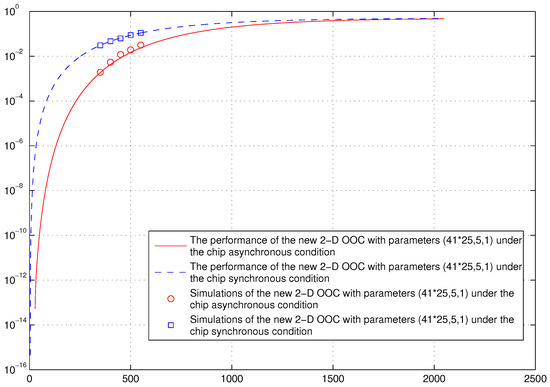
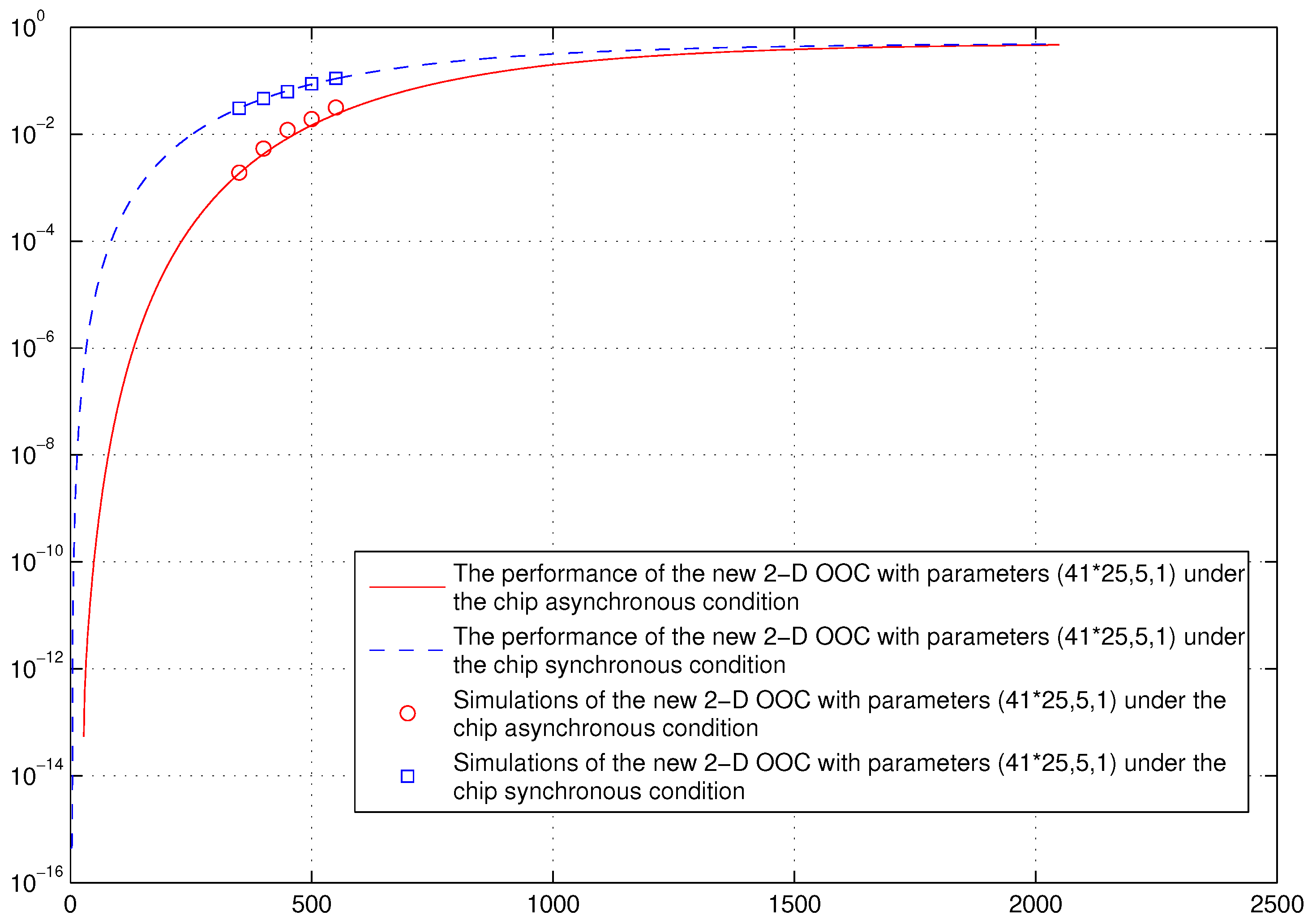
In addition, we compare the performance of the new optimal AM-OPPW 2D OOC with parameters under the hard-limited chip asynchronous and hard-limited chip synchronous conditions in Figure 3. It is seen that the performance of the hard-limited chip asynchronous is better than the hard-limited chip synchronous case, which is consistent with the result in [32].
Figure 3.
Error probabilities of the new optimal AM-OPPW 2D OOC under hard-limited chip-asynchronous and hard-limited chip synchronous conditions.
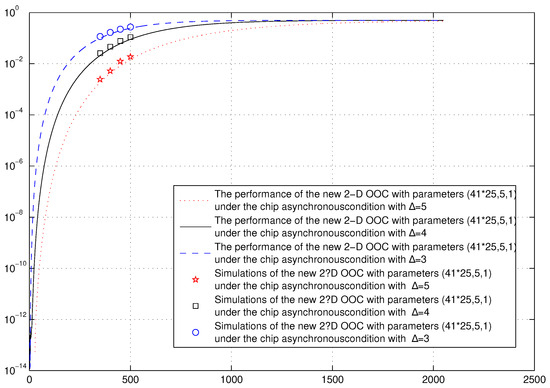
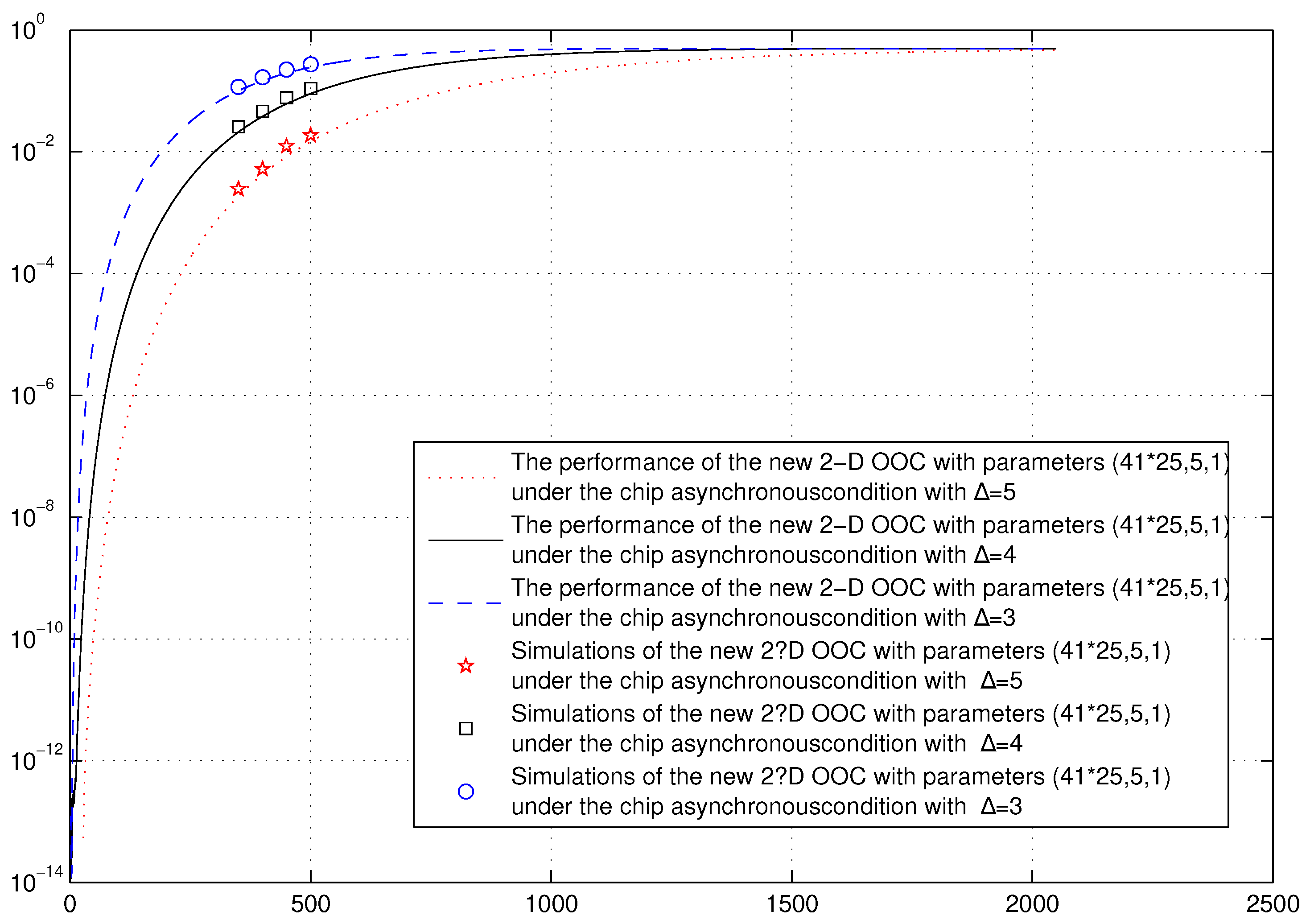
In Figure 4, we plot the performance of the new 2D OOC with parameters under hard-limited chip-asynchronous conditions for the decision threshold Δ with the value varying from 3 to 5. It was firstly pointed out in [32] that the higher the threshold level, the better system performance since multiple users will become less probable to occupy a particular chip above the level of the threshold. Clearly, our simulation result reveals this fact.
Figure 4.
Error probabilities of the new optimal AM-OPPW 2D OOC under the hard-limited chip asynchronous with different decision threshold .
5. Conclusions
In this paper, a new generic construction of AM-OPPW 2D OOCs was proposed. By restricting the OOCs and OPPW 2D OOCs to optimal ones, optimal AM-OPPW 2D OOCs and asymptotically optimal 2D OOCs with new parameters were obtained. Additionally, the performance of the new AM-OPPW 2D OOCs was demonstrated under both chip-synchronous and chip-asynchronous assumptions.
However, in general, the known parameters of AM-OPPW 2D OOCs are quite limited, and the performance of AM-OPPW 2D OOCs in real-world scenarios remains an open question.
Author Contributions
Investigation, M.S.; Writing—original draft, M.S.; Writing—review & editing, X.N. All authors have read and agreed to the published version of the manuscript.
Funding
This research was funded by Sichuan Provincial Natural Science Foundation Innovative Research Group under Grant 2024NSFTD0008.
Institutional Review Board Statement
Not applicable.
Data Availability Statement
The original contributions presented in the study are included in the article, further inquiries can be directed to the corresponding author.
Conflicts of Interest
The authors declare no conflict of interest.
References
- Salehi, J.A. Code division multiple-access techniques in optical fiber networks-part I: Fundamental principles. IEEE Trans. Commun. 1989, 37, 824–833. [Google Scholar] [CrossRef]
- Chang, Y.; Fuji-Hara, R.; Miao, Y. Combinatorial construcions of optimal optical orthogonal codes with weight 4. IEEE Trans. Inf. Theory 2003, 49, 1283–1292. [Google Scholar] [CrossRef]
- Chu, W.; Golomb, S.W. A new recursive construction for optical orthogonal codes. IEEE Trans. Inf. Theory 2003, 49, 3072–3076. [Google Scholar]
- Chung, F.R.K.; Salehi, J.A.; Wei, V.K. Optical orthogonal codes: Design, analysis, and applications. IEEE Trans. Inf. Theory 1989, 35, 595–604. [Google Scholar] [CrossRef] [Scilit]
- Chung, J.-H.; Yang, K. Asymptotically optimal optical orthogonal codes with new parameters. IEEE Trans. Inf. Theory 2013, 59, 3999–4005. [Google Scholar] [CrossRef] [Scilit]
- Ding, C.; Xing, C. Cyclotomic optical orthogonal codes of composite lengths. IEEE Trans. Commun. 2004, 52, 263–268. [Google Scholar] [CrossRef]
- Ge, G.; Yin, J. Constructions for optimal (v, 4, 1) optical orthogonal codes. IEEE Trans. Inf. Theory 2001, 47, 2998–3004. [Google Scholar] [CrossRef]
- Fuji-Hara, R.; Miao, Y. Optical orthogonal codes: Their bounds and new optimal constructions. IEEE Trans. Inf. Theory 2000, 46, 2396–2406. [Google Scholar]
- Moreno, O.; Omrani, R.; Kumar, P.V.; Lu, H. A generalized Bose-Chowla family of optical orthogonal codes and distinct differnece sets. IEEE Trans. Inf. Theory 2007, 53, 1907–1910. [Google Scholar] [CrossRef] [Scilit]
- Yin, J. Some combinatorial constructions for optical orthogonal codes. Discr. Math. 1998, 185, 201–219. [Google Scholar] [CrossRef] [Scilit]
- Omrani, R.; Garg, G.; Kumar, P.V.; Elia, P.; Bhambhani, P. Large families of asymptotically optimal two-dimensional optical orthogonal codes. IEEE Trans. Inf. Theory 2012, 58, 1163–1185. [Google Scholar] [CrossRef]
- Cai, H.; Liang, H.B.; Tang, X.H. Constructions of optimal 2-D optical orthogonal codes via generalized cyclotomic classes. IEEE Trans. Inf. Theory 2015, 61, 688–695. [Google Scholar] [CrossRef] [Scilit]
- Cao, H.; Wei, R. Combinatorial constructions for optimal two-dimensional optical orthogonal codes. IEEE Trans. Inf. Theory 2009, 55, 1387–1394. [Google Scholar] [CrossRef] [Scilit]
- Feng, T.; Chang, Y. Combinatorial constructions for optimal two-dimensional optical orthogonal codes with λ = 2. IEEE Trans. Inf. Theory 2011, 57, 6796–6819. [Google Scholar] [CrossRef] [Scilit]
- Shivaleela, E.S.; Sivarajan, K.N.; Selvarajan, A. Design of a new family of two-dimensional codes for fiber-optic CDMA networks. J. Lightw. Technol. 1998, 16, 501–508. [Google Scholar] [CrossRef] [Scilit]
- Sun, S.; Yin, H.; Wang, Z.; Xu, A. A new family of 2-D optical orthogonal codes and analysis of its performance in optical CDMA access networks. J. Lightw. Technol. 2006, 24, 1646–1653. [Google Scholar]
- Wang, T.-C.; Yang, G.-C.; Chang, C.Y.; Kwong, W.C. A new family of 2-D codes for fiber-optic CDMA systems with and without the chip-synchronous assumption. J. Lightw. Technol. 2009, 27, 2612–2620. [Google Scholar] [CrossRef] [Scilit]
- Wang, J.; Yin, J. Two-dimensional optical orthogonal codes and semicyclic group divisible designs. IEEE Trans. Inf. Theory 2010, 56, 2177–2187. [Google Scholar] [CrossRef] [Scilit]
- Yang, G.-C.; Kwong, W.C. Performance comparison of multiwavelength CDMA and WDMA+ CDMA for fiber-optic networks. IEEE Trans. Commun. 1997, 45, 1426–1434. [Google Scholar] [CrossRef] [Scilit]
- Yang, Y.; Tang, X.H.; Udaya, P.; Peng, D.Y. New bound on frequency hopping sequence sets and its optimal constructions. IEEE Trans. Inf. Theory 2011, 57, 7605–7613. [Google Scholar] [CrossRef] [Scilit]
- Alderson, T.L.; Mellinger, K.E. Optical orthogonal codes from singer groups. In Coding Theory and Cryptology; World Scientific: Hackensack, NJ, USA, 2007; Volume 3, pp. 51–70. [Google Scholar]
- Cai, H.; Zhou, Z.C.; Yang, Y.; Tang, X.H. A new construction of frequency-hopping sequences with optimal partial hamming correlation. IEEE Trans. Inf. Theory 2014, 60, 1139–1141. [Google Scholar]
- Chen, J.-J.; Yang, G.-C. CDMA fiber-optic systems with optical hard limiters. J. Lightw. Technol. 2001, 19, 950–958. [Google Scholar] [CrossRef]
- Gu, F.R.; Wu, J. Construction of two-dimensional wavelength/time optical orthogonal codes using difference family. J. Lightw. Technol. 2005, 23, 3642–3652. [Google Scholar] [CrossRef] [Scilit]
- Shivaleela, E.S.; Selvarajan, A.; Srinivas, T. Two-dimensional optical orthogonal codes for fiber-optic CDMA networks. J. Lightw. Technol. 2005, 23, 647–654. [Google Scholar] [CrossRef] [Scilit]
- Wang, X.; Chang, Y.; Feng, T. Optimal 2-D (n × m, 3, 2, 1)-optical Orthogonal Codes. IEEE Trans. Inf. Theory 2013, 59, 710–725. [Google Scholar] [CrossRef] [Scilit]
- Yin, J. A general construction for optimal cyclic packing designs. J. Combin. Theory Ser. A 2002, 97, 272–284. [Google Scholar] [CrossRef] [Scilit]
- Lee, S.; Seo, S. New construction of multiwavelength optical orthogonal codes. IEEE Trans. Commun. 2002, 50, 2003–2008. [Google Scholar]
- Chung, H.; Kumar, P.V. Optical orthogonal codes-new bounds and an optimal construction. IEEE Trans. Inf. Theory 1990, 36, 866–873. [Google Scholar] [CrossRef]
- Feng, T.; Chang, Y.; Ji, L. Constructions for strictly cyclic 3-designs and applications to optimal OOCs with λ = 2. J. Combin. Theory Ser. A 2008, 115, 1527–1551. [Google Scholar] [CrossRef] [Scilit]
- Tancevski, L.; Rusch, L.A. Impart of the beat noise on the performance of 2-D optimal CDMA systems. IEEE Commun. Lett. 2000, 4, 264–266. [Google Scholar] [CrossRef] [Scilit]
- Salehi, J.A.; Brackett, C.A. Code division multiple-access techniques in optical fiber networks-part II: Systems performance analysis. IEEE Trans. Commun. 1989, 37, 834–850. [Google Scholar] [CrossRef] [Scilit]
- Hus, C.-C.; Chang, Y.-C.; Yang, G.-C.; Chang, C.-L.; Kwong, W.C. Performance analysis of 2-D O-CDMA codes without the chip-synchronous assumption. IEEE J. Sel. Areas Commun. 2007, 25, 135–143. [Google Scholar]
- Kwong, W.C.; Yang, G.-C.; Baby, V.; Brés, C.-S.; Prucnal, P.R. Multiple-wavelength optical orthogonal codes under prime-sequence permutations for optical CDMA. IEEE Trans. Commun. 2005, 53, 117–123. [Google Scholar] [CrossRef]
- Narimanov, E.; Kwong, W.C.; Yang, G.-C.; Prucnal, P.R. Shifted carrier-hopping prime codes for multicode keying in wavelength-time O-CDMA. IEEE Trans. Commun. 2005, 53, 2150–2156. [Google Scholar] [CrossRef]
- Hsu, C.-H.; Yang, G.-C.; Kwong, W.C. Hard-limiting performance analysis of 2-D optical codes under the chip-asynchronous assumption. IEEE Trans. Commun. 2008, 56, 762–768. [Google Scholar] [CrossRef]

Disclaimer/Publisher’s Note: The statements, opinions and data contained in all publications are solely those of the individual author(s) and contributor(s) and not of MDPI and/or the editor(s). MDPI and/or the editor(s) disclaim responsibility for any injury to people or property resulting from any ideas, methods, instructions or products referred to in the content. |
© 2024 by the authors. Licensee MDPI, Basel, Switzerland. This article is an open access article distributed under the terms and conditions of the Creative Commons Attribution (CC BY) license (https://creativecommons.org/licenses/by/4.0/).