


Abstract
Despite the considerable attention given to virtual streamers, their effectiveness in live streaming warrants further investigation. Drawing on the stimulus-organism-response (SOR) framework, social role theory and social cognitive theory, this study examines the influence mechanism of virtual streamer roles on consumers’ virtual place attachment. An online scenario experiment employing a 2 (assistant-role virtual streamers vs. friend-role virtual streamers) and 2 (search products vs. experience products) between-subjects design (N = 328) was conducted to verify research hypotheses. The results demonstrate that, compared with the assistant-role virtual streamer, the friend-role virtual streamer elicits a higher level of virtual place attachment among consumers. This effect is mediated through three distinct pathways: the positive mediation of social self-efficacy, the negative mediation of task self-efficacy, and the positive serial mediation involving both. Moreover, product type exerts a significant moderation effect on the association between social self-efficacy and task self-efficacy. Specifically, this relationship is stronger under search (vs. experience) product conditions. Such a moderation effect, however, is conditional upon consumer expertise and is only significant for consumers with low expertise. Additionally, consumer expertise moderates the influence of task self-efficacy on virtual place attachment, and this influence is stronger for high-expertise consumers than for low-expertise consumers. These findings shed empirical light on the functioning and influence of virtual streamers in e-commerce live streaming and extend the theoretical literature on virtual place attachment. They also offer practical insights for companies to optimize virtual streamer design, implement differentiated interaction strategies, and configure personalized features.
1. Introduction
With the iterative advancement of artificial intelligence (AI), virtual streamers have emerged as a significant force in e-commerce live streaming due to their cost-effectiveness and 24/7 availability [1,2,3]. However, despite significant improvements in visual realism and interaction naturalness, virtual streamers’ performance remains inferior to human streamers in terms of interaction depth and adaptive capability, which constrains user dwell time and conversion rates (see: https://www.chinairn.com/news/20260424/160457772.shtml (accessed on 23 July 2026)). In light of this challenge, virtual place attachment, as a key psychological construct linking individuals to virtual environments [4], provides an important theoretical perspective. By establishing positive connections and bonds between users and virtual spaces, it reveals the underlying psychological mechanism of why users are willing to prolong their stay in virtual live streaming [5].
In this context, the live streaming room is not merely a channel for information transmission, but a meaningful space co-constructed by streamers and audiences [6]. When users develop place attachment to a specific virtual live streaming room, they tend to exhibit higher level of place trust, subsequently leading to higher purchase intentions [7]. Furthermore, this attachment is a proven key factor in predicting users’ continuance intention [5], as well as in enhancing user engagement and stickiness [8,9,10]. Therefore, exploring how to cultivate consumer place attachment toward virtual live streaming rooms holds significant practical implications for addressing the “retention dilemma” associated with virtual streamers.
The formation of virtual place attachment is fundamentally rooted in the interactive experiences between individuals and places [11,12]. In e-commerce live streaming, streamers function as both facilitators for transaction completion and social partners for emotional exchange [13]. Existing literature suggests that the emotional ties established between consumers and streamers can be effectively transformed into attachment toward the live streaming platform or space [8]. Consequently, as a core personified medium connecting consumers to the virtual live streaming rooms, the virtual streamers’ role performance acts as a crucial driver of virtual place attachment. Furthermore, Tian et al. (2026) [7] demonstrated that the social dimension of the anthropomorphism of virtual streamers enhances virtual place attachment by fulfilling users’ relatedness needs. Given that the social role of a virtual streamer presents a primary manifestation of social anthropomorphism [14], the research by Tian et al. (2026) [7] provides the theoretical foundation for the current study to explore the impact of virtual streamer roles on virtual place attachment.
However, prior studies exhibit several shortcomings. First, while Gong et al. (2024) [15] confirmed the interaction effect between virtual streamer roles and product types on purchase intention, the underlying psychological mechanisms through which different social roles drive virtual place attachment remain unclear. Second, the social support provided by virtual streamers creates favorable conditions for enhancing self-efficacy [16,17]. However, as an important factor affecting place attachment [18], the differentiated mediating roles of the two-dimensional division of self-efficacy in the “social role → virtual place attachment” pathway have yet to be investigated. Third, existing research in virtual live streaming often emphasizes external contextual factors like product type [1], while overlooking the boundary effects of consumer expertise—a critical internal individual factor.
Based on these gaps, this study aims to explore the influence mechanisms and boundary conditions governing the impact of virtual streamers’ social roles on virtual place attachment. Specifically, this research intends to: (1) examine the direct effect of virtual streamer roles (assistant-role vs. friend-role) on virtual place attachment; (2) utilize task self-efficacy and social self-efficacy as mediating variables to verify the differential psychological pathways involved; and (3) incorporate product type and consumer expertise to analyze their moderating effects on the “social self-efficacy → task self-efficacy” path, as well as the moderating role of consumer expertise on the “task self-efficacy → virtual place attachment” path.
To validate these objectives, we conducted a 2 (virtual streamer role: assistant-role vs. friend-role) × 2 (product type: search vs. experience) online scenario-based experiment. The results indicate that the friend role elicits stronger virtual place attachment than the assistant role. Social and task self-efficacy respectively mediate this relationship, and they also serve as serial mediators. Furthermore, product type moderates the relationship between social and task self-efficacy, a process further contingent upon consumer expertise (i.e., moderated moderation). Additionally, consumer expertise moderates the impact of task self-efficacy on virtual place attachment.
The contributions of this study are fourfold. First, starting from the core manifestation of social anthropomorphism—namely, “social roles”—this study refines the effects of assistant and friend roles on virtual place attachment, addressing the scarcity of research on this topic. Second, by introducing the two-dimensional division of self-efficacy as core mediators, this study clarifies the underlying mechanism through which virtual streamer roles influence virtual place attachment. Third, this study reveals the moderating effect of product type and moderated moderation effect of consumer expertise on the “social self-efficacy → task self-efficacy” pathway, deepening our understanding of the boundaries of the internal transformation process of self-efficacy. Fourth, this study confirms the moderating role of consumer expertise on the “task self-efficacy → virtual place attachment” pathway, offering a new perspective for understanding the formation mechanism of virtual place attachment.
2. Literature Review
2.1. Stimulus–Organism–Response Framework
The Stimulus–Organism–Response (SOR) model is a classic framework in environmental psychology for elucidating “person–environment” relationships, systematically explaining how external environmental stimuli (S) influence an individual’s internal psychological states (O), which subsequently drive their responses (R) [19]. In recent years, this framework has been widely applied in the context of e-commerce live streaming to reveal how environmental factors influence consumer psychology and behavior [20]. As virtual streamers have become a pivotal component of live streaming, scholars have increasingly treated them as core stimulus elements of the live streaming environment and have verified the applicability of the SOR model in this setting. For instance, Gao et al. (2023) [21], Wen & Li (2025) [22], and Tian et al. (2026) [7] utilized this framework to uncover the pathways through which virtual streamer characteristics influence consumer purchase intentions. Similarly, Zhong et al. (2024) [23] validated the mechanisms by which virtual streamer anthropomorphism influences consumer citizenship behavior with the same framework.
Furthermore, the SOR framework has been proven effective in explaining the formation mechanism of individual attachment. For example, Xu et al. (2025) [24] identified cultural motivation and involvement in local festivals as stimuli (S) and authenticity as the organism (O), confirming their driving effect on place attachment (R). Likewise, Liu et al. (2026) [25] showed that the perceived anthropomorphism and personalization of AI robots influence users’ emotional attachment through perceived control and trust. Building on this logic, this study adopts the SOR model as the foundational research framework. Specifically, social roles of virtual streamers are conceptualized as external environmental stimuli (S), two types of self-efficacy as organismic cognitive states (O), and virtual place attachment toward the live streaming room as an approach response (R).
2.2. Virtual Place Attachment
Place attachment denotes the enduring positive connection (both cognitive and emotional) linking people to specific places [4]. As noted by Milligan (1998) [11] and Goel et al. (2011) [12], its essence lies in the interactive experiences between an individual and a place, rather than in the place’s physical or virtual nature. Consequently, virtual place attachment shares parallel psychological and social foundations with attachment to physical places. Currently, scholarship has extended this concept to various virtual environments, including mobile websites [26,27,28,29,30], online platforms [31,32], online communities [33], the metaverse [4,34,35,36,37,38,39], and digital technologies [10,40,41]. Collectively, these investigations advance knowledge of human–environment interaction within virtual settings. Live streaming, a real-time interactive activity led by streamers on online platforms, inherently constructs a virtual interactive space [6]. The sustained exchanges linking streamers and viewers, alongside viewer-to-viewer communications, endow this space with unique place meaning, thereby potentially fostering virtual place attachment [5,12]. Empirical evidence suggests that such attachment act as a crucial determinant of user stickiness [8,9]. Given this established link, an in-depth investigation into virtual place attachment specifically within AI-driven live streaming environments is of considerable importance.
Specifically, few scholars turn their attention to this attachment in e-commerce live streaming. Li et al. (2021) [8] investigated how social (interaction and identification) and technological (synchronicity and vicarious experience) dimensions shape users’ attachment to streamers and the platform, ultimately impacting user stickiness. Applying complexity theory, Yu et al. (2023) [6] explored how perceived value and virtual place attachment synergistically drive buying intentions in travel live streaming contexts. Despite these valuable contributions, the specific antecedents and underlying mechanisms driving virtual place attachment in the virtual streamer context remain insufficiently investigated. Therefore, this study centers on virtual streamers to examine how they shape consumers’ virtual place attachment toward the live streaming room.
2.3. Virtual Streamer Anthropomorphism
In virtual streamer research, anthropomorphism is considered a key factor in enhancing consumers’ acceptance and driving marketing efficacy [1,42]. Anthropomorphism refers to the attribution of human traits, qualities, behaviors, and mental states to non-human objects [43,44,45], including brands [46], virtual agents [14,47], and advertisements [48]. Tailored to the characteristics of e-commerce live streaming, this study defines virtual streamer anthropomorphism as the degree of similarity between virtual streamers and human streamers across visual appearance, auditory voice, speech style, cognitive thinking, emotional experience, and behavioral interaction. This definition underscores the realism of virtual streamers [49] and reflects their humanlike attributes as non-human entities in live streaming [45].
As a focal point in the literature, virtual streamer anthropomorphism has been extensively discussed. It has been shown to enhance purchase intentions [7,42,49,50,51,52,53], patronage intentions [54], and human–machine value co-creation [55], while also facilitating impulse buying [56,57] and citizenship behavior [23]. Moreover, highly anthropomorphic virtual streamers are perceived as more competent and warmer [7,49,53,58,59,60,61,62], which helps foster consumer trust and emotional attachment toward virtual streamers [42,49,50,51,57,59,63,64]. To better evaluate the efficacy of this construct, many scholars have advocated adopting a multidimensional perspective [51,58]. Drawing on the classification of AI robot anthropomorphism by Zhu et al. (2025) [14], this study synthesized the relevant literature on virtual streamers. As shown in Table 1, although existing studies have confirmed the significant impact of anthropomorphism on consumer psychology and behavior, the focus has been disproportionately placed on external aspects such as appearance and language, relatively neglecting the critical role of social anthropomorphism.
Social anthropomorphism refers to the projection of human societal roles, behavioral norms, and personality traits onto virtual streamers, enabling them to establish better social connections with users [14,65]. Such anthropomorphism effectively enhances the social competence of these agents [66], shortens the psychological distance with consumers [64], and increases the likelihood of emotional resonance [2]. More importantly, social anthropomorphism helps mitigate the uncanny valley effect induced by external anthropomorphism [14]. Specifically, relying solely on visual realism tends to trigger users’ self-oriented mentalization [14], leading to feelings of eeriness and negative attitudes [61,67], thereby ultimately compromising commercial outcomes [68]. In contrast, social roles, as the core form of social anthropomorphism, can effectively cultivate other-oriented mentalization, thereby helping to circumvent these adverse effects [14].
A review of the literature on virtual streamers reveals that previous studies have utilized social roles as experimental materials for studying socialness [66] or examined their interactive effects with product types on purchase intentions [15]. However, how virtual streamer roles drive virtual place attachment through differentiated psychological pathways remains underexplored.
Table 1.
Research on virtual streamer anthropomorphism.
2.4. Social Role Theory and Virtual Streamer Roles
Previous research has underscored the significance of distinguishing AI roles. Youn and Jin (2021) [76] observed that assistant-role robots, compared to those in friend roles, are more effective at eliciting perceptions of competence regarding brand personality, thereby influencing customer relationship management. In contrast, friend-role robots better enhance parasocial interaction, thereby strengthening perceptions of brand sincerity. Similarly, Kim et al. (2021) [77] found that AI agents assuming an assistant role induce higher levels of perceived usefulness than those in friend roles, which in turn fosters positive evaluations of the AI. Furthermore, Zhang and Rau (2023) [78] demonstrated that mentor-role agents are more effective than servant-role agents in enhancing users’ emotional attachment and satisfaction. Collectively, these studies indicate that different AI roles trigger differentiated psychological and behavioral responses in users—a phenomenon robustly explained by social role theory.
In social role theory, social roles refer to the expected patterns of behavior associated with a specific social position [79]. The theory posits that diverse social roles activate distinct psychological schemas, thereby shaping varying expectations and behavioral responses among consumers [80]. The efficacy of this theory has been well-established in the AI domain. For instance, Zhu et al. (2025) [14] validated how the social roles of AI robots influence customer acceptance, while Desveaud & Pavone (2025) [81] demonstrated the differential effects of various AI interface roles on users’ sense of power deprivation in autonomous vehicles.
Existing research indicates that virtual streamers can assume either an assistant role or a friend role [15,82]. As an assistant, a virtual streamer exhibits greater professional competence and faster responsiveness [15], focusing on providing informational support to help consumers complete shopping tasks efficiently and reliably [82,83]. In contrast, a virtual streamer in a friend role is perceived as more attractive and empathetic [15,76,84], emphasizing emotional support to foster emotional connection and social companionship [82,83]. However, how these two roles influence consumers’ psychology and behavior in virtual live streaming remains underexplored. Therefore, this study employs social role theory to investigate the differential pathways through which virtual streamer social roles affect virtual place attachment.
2.5. Self-Efficacy
Self-efficacy is a core concept of social cognitive theory (SCT), referring to an individual’s belief and expectation regarding their ability to perform specific tasks and achieve particular goals [68,85,86]. This concept emphasizes the cognitive evaluation process—that is, the judgment of one’s own behavioral capacity in a given situation [68,87]. In e-commerce live streaming, consumers’ core behavioral activities can be summarized as completing shopping tasks and engaging in social interaction [88]. Accordingly, this study identifies two key dimensions of self-efficacy in this context—task self-efficacy and social self-efficacy—corresponding to consumers’ competence beliefs in successfully completing shopping tasks and effectively engaging in social interaction, respectively.
According to SCT, external environmental stimuli influence subsequent affective and behavioral responses by altering individuals’ internal cognitive states [89]. In this study, the social role of the virtual streamer serves as a critical external environmental stimulus that influences consumers’ self-efficacy by providing informational and emotional support [16,17]. Prior research has indicated that self-efficacy promotes place attachment [18]. Specifically, individuals with high self-efficacy are more likely to satisfy their basic psychological needs, thereby strengthening their connection with a place and facilitating the formation of place attachment [18,90]. Based on the above analysis, this study adopts task self-efficacy and social self-efficacy as mediating variables through which virtual streamer roles influence virtual place attachment.
3. Research Hypotheses
3.1. Virtual Streamer Role and Virtual Place Attachment
Based on the Computers Are Social Actors (CASA) theory, consumers unconsciously treat AI agents with social attributes as social actors and automatically trigger social responses [78,83]. In AI-driven virtual environments, advanced technologies empower digital entities with real-time personalization and emotionally intelligent interaction capabilities, further reinforcing the CASA effect and prompting users to invest more emotion and generate empathy during interactions [91].
Within this theoretical framework, the social roles of virtual streamers elicit differentiated social responses. Compared to the assistant role, which focuses on task orientation and functional fulfillment, the friend role is perceived by consumers as an entity with more human-like social attributes and emotional depth. By providing richer social cues such as warmth, empathy, and emotional support, the friend-role virtual streamers stimulate higher parasocial interaction intentions [76,82,83,84,92]. This profound parasocial interaction significantly enhances consumers’ social presence [91,93], narrows psychological distance, and consequently fosters deeper intimacy and emotional attachment toward the friend role [78,91]. Furthermore, according to the affect transfer theory, virtual streamers serve as a bridge between consumers and the live streaming room, effectively facilitating the extension of emotional attachment from the “person” to the “place” [8,94], ultimately triggering and strengthening consumers’ virtual place attachment to the live streaming room. Therefore, we propose:
H1.
In e-commerce live streaming, friend-role virtual streamers (versus assistant-role) elicit stronger virtual place attachment toward the live streaming room.
3.2. The Mediating Roles of Social and Task Self-Efficacy
Based on consumers’ core behavioral activities in e-commerce live streaming, this study categorizes self-efficacy into two types: task self-efficacy and social self-efficacy. Task self-efficacy refers to consumers’ belief in their ability to complete shopping tasks and achieve intended purchasing goals within the live streaming room; social self-efficacy reflects the judgment and confidence regarding one’s ability to engage in friendly interactions and maintain positive social relationships in the same context [86,95]. Social cognitive theory posits that the influence of external environments on individuals’ affect and behaviors is mediated by internal cognitive states [96]. Building on this, social role theory further suggests that different roles activate distinct role expectations in individuals, thereby eliciting varied cognitive responses [80,97]. Accordingly, this study proposes that the assistant and friend roles of virtual streamers will enhance consumers’ task and social self-efficacy, respectively.
First, compared to the friend role, the assistant role is perceived as possessing higher professionalism and reliability, providing consumers with detailed product knowledge and operational guidance [14,15,82,84,97]. This high level of informational support effectively improves consumers’ cognitive understanding of products and reduces uncertainty regarding shopping tasks [82]. This enhances their sense of control over task completion [98], thereby strengthening their confidence in executing shopping tasks [99]. Therefore, the assistant role is more likely to enhance consumers’ task self-efficacy.
Second, in contrast, the friend role is perceived to have higher affinity and empathy, offering emotional exchange and social companionship [14,76,82,83,84,92,97]. This emotional support fosters an inclusive and secure social atmosphere [100], effectively alleviating negative emotions such as stress, anxiety, and loneliness in the virtual social environment [101]. According to social cognitive theory, emotional states are an important source of self-efficacy [85]. When social pressure is relieved and negative emotions are attenuated, consumers’ confidence in successfully participating in social interactions and maintaining positive relationships significantly increases. Thus, the friend role is more likely to boost consumers’ social self-efficacy.
Self-efficacy further facilitates the satisfaction of basic psychological needs, creating favorable conditions for the emergence of virtual place attachment [18]. Specifically, consumers with high task self-efficacy possess greater confidence and execution ability in completing shopping tasks [102]. The sense of control and competence experienced during this process facilitate the satisfaction of their need for competence [103], which is closely linked to individual growth [104]. When a live streaming room fulfills this need for competence, consumers are more likely to experience a sense of achievement and self-worth, subsequently developing place attachment [18]. Meanwhile, consumers with high social self-efficacy exhibit greater social confidence, enabling them to overcome social anxiety and actively integrate into groups [105]. This proactive willingness for social interaction increases the likelihood of gaining acceptance and recognition from the community [106], thereby satisfying the need for relatedness. The fulfillment of this need directly contributes to the development of place attachment [18]. Based on this, we posit:
H2.
In e-commerce live streaming, social self-efficacy mediates the effect of virtual streamer roles on virtual place attachment.
H3.
In e-commerce live streaming, task self-efficacy mediates the effect of virtual streamer roles on virtual place attachment.
Based on SCT, task and social self-efficacy are important cognitive factors for live streaming consumers that influence their affect. While extant research has examined the mediating roles of these two types of self-efficacy [86,95,107], little attention has been paid to how these two dimensions of self-efficacy relate to each other. This study proposes that social self-efficacy can enhance task self-efficacy.
Specifically, consumers with high social self-efficacy exhibit greater social confidence during live streaming interactions [105], enabling them to communicate more proactively with virtual streamers and other consumers. According to SCT, this active interaction not only facilitates information exchange but also provides consumers with essential verbal persuasion and vicarious experiences. On one hand, informational support effectively reduces uncertainty and perceived risk during the shopping decision-making process. On the other hand, authentic product evaluations or shopping suggestions from other consumers offer valuable references for success [108]. Together, these factors significantly bolster consumers’ confidence in successfully completing shopping tasks. Furthermore, when task self-efficacy is elevated, consumers’ needs for competence are more easily satisfied. This enables consumers to experience a greater sense of achievement and self-worth throughout the shopping journey, thereby deepening their emotional bond with the live streaming room and ultimately enhancing their virtual place attachment [18]. Therefore, social self-efficacy, influenced by the friend role, can further affect virtual place attachment through task self-efficacy. Building on this, we posit:
H4.
In e-commerce live streaming, social and task self-efficacy serially mediate the effect of virtual streamer roles on virtual place attachment.
3.3. The Moderating Role of Product Type
The categorization of products into search and experience types, introduced by Nelson (1970) [109], has been widely adopted in consumer research. Search products are those whose quality and key attributes are ascertained from pre-purchase information, whereas experience products require firsthand experience for assessment [110]. In the context of e-commerce live streaming, consumers with higher social self-efficacy are more inclined to participate in social interactions and obtain product information and peer feedback. However, the extent to which such informational support enhances task self-efficacy varies depending on product type. For search products, the core attributes are highly objective, which renders information provided by others highly diagnostic [111]. Therefore, when consumers with high social self-efficacy acquire information through social interaction, this external information can be directly translated into effective decision-making basis, strengthening their confidence in successfully completing shopping tasks and thereby enhancing task self-efficacy. In contrast, the core attributes of experience products are inherently subjective, and others’ subjective feelings cannot substitute for consumers’ own firsthand experience, resulting in lower diagnosticity of the information provided by others [111]. In this case, although consumers with high social self-efficacy can obtain informational support through interaction in an attempt to boost task self-efficacy, such evaluative information and recommendations from others can hardly serve as a valid decision-making basis, which consequently attenuates the facilitative effect of social self-efficacy on task self-efficacy. Hence, we hypothesize:
H5.
Product type serves as a moderator on the association between social self-efficacy and task self-efficacy. Specifically, this association is stronger under search (versus experience) product conditions.
3.4. The Moderating Role of Consumer Expertise
In consumer-related research, expertise is commonly defined as an individual’s mastery of product-related knowledge [112], which significantly explains differences in consumers’ abilities regarding information retrieval, processing, and decision-making [112,113]. Existing studies have widely confirmed that consumer expertise acts as a key moderator affecting consumer psychology and behavior across multiple domains [114,115]. However, research on live streaming has primarily focused on streamer expertise [116,117,118,119], with few studies examining the role of consumer expertise [120]. This study posits that consumer expertise moderates the moderating effect of product type on the relationship between social and task self-efficacy by altering individuals’ information reliance pathways.
For consumers with low expertise, the moderating effect of product type is significant. Due to insufficient product knowledge and undeveloped cognitive structures, these consumers rely heavily on external cues during information processing and decision-making [114,121]. Such reliance implies that their ability to translate information gained from social interaction into a decision-making basis largely depends on the diagnosticity of external cues. Product type, in turn, exerts its moderating effect by determining the validity of these cues. Specifically, the objective attributes of search products endow social information with high diagnosticity, enabling low-expertise consumers to smoothly translate it into a decision-making basis, thereby strengthening the positive effect of social self-efficacy on task self-efficacy. In contrast, the subjective nature of experience products reduces the diagnosticity of external information, thereby attenuating this positive effect.
Conversely, high-expertise consumers possess extensive product knowledge and a well-developed cognitive structure [122,123]. They rely primarily on their own knowledge and experience to process information and make decisions, whether evaluating search or experience products [114,124]. This self-reliance implies that the transfer from social to task self-efficacy occurs independently of external cues. Therefore, product type does not serve as a significant moderator of the effect among consumers with high expertise. Accordingly, we hypothesize:
H6.
Product type’s moderation effect (proposed in H5) is further moderated by consumer expertise. Specifically, this effect is significant only among consumers with low (versus high) expertise.
Furthermore, this study argues that consumer expertise moderates the relationship between task self-efficacy and virtual place attachment by altering individuals’ depth of information processing. High-expertise consumers possess stronger information processing capabilities [112,125,126], enabling them to interpret high-level, abstract information [126] and uncover the profound value and unique attributes of products [116]. Such deep cognitive involvement allows them to ground their task self-efficacy in a thorough understanding of the product. Consequently, they can more effectively transform the sense of achievement and self-worth derived from task completion into positive emotional bonds with the live streaming room, thereby strengthening their virtual place attachment. In contrast, low-expertise consumers, constrained by weaker information processing abilities, tend to focus on low-level, concrete, and surface-level information [126]. As a result, the confidence they develop during the shopping process often lacks a deep understanding of the live streaming room’s value, making it difficult for their task self-efficacy to be effectively converted into strong emotional attachment. Accordingly, the influence of task self-efficacy on virtual place attachment is relatively weaker for these consumers. Based on the foregoing analysis, we advance the following hypothesis:
H7.
Consumer expertise moderates the positive effect of task self-efficacy on virtual place attachment. Specifically, this positive effect is weaker among low-expertise consumers than among high-expertise consumers.
Constructed from the preceding theoretical analysis, Figure 1 presents the overarching conceptual model of this research.
Figure 1.
Theoretical model. Note: Straight arrows represent the hypothesized direct effect of the virtual streamer role on virtual place attachment (H1), and three indirect pathways: positive mediation via social self-efficacy (H2), negative mediation via task self-efficacy (H3), and serial mediation involving both (H4). Arrows pointing toward specific paths indicate hypothesized moderation effects: product type moderates the path from social self-efficacy to task self-efficacy (H5), with this moderation further conditioned by consumer expertise (H6). Additionally, consumer expertise moderates the effect of task self-efficacy on virtual place attachment (H7).
4. Methodology
4.1. Experimental Design
This study employed a 2 (virtual streamer role: assistant-role vs. friend-role) × 2 (product type: search vs. experience) between-subjects experimental design.
The experimental materials were scenario-based, combining text and images. The reasons are as follows. First, real-world live streaming involves numerous confounding factors (e.g., real-time comments, situational distractions) that could obscure the specific effects of key variables. By using controlled text and image stimuli, we aimed to isolate the core mechanism under investigation without such interference. Second, this approach is consistent with prior literature in human–computer interaction and online marketing [76,127]. Furthermore, this design has also been applied in recent investigations into virtual streamers [3,15,128]. In light of these considerations, utilizing experimental materials that combine text and images to manipulate virtual streamer roles and product types is an acceptable approach.
Following Gong et al. (2024) [15], four sets of experimental materials were designed, and participants were randomly allocated to four conditions: assistant-role–search, assistant-role–experience, friend-role–search, or friend-role–experience. All four materials included the same components: core textual introductions for each virtual streamer role, first-person live streaming scripts, and images. The textual introductions differentiated the main features of the assistant-role and friend-role virtual streamers. Based on the role features, first-person scripts simulated the scenarios in which the assistant-role and friend-role virtual streamers respectively introduced a search product (USB flash drive) and an experience product (body wash) and engaged in interactions. The experimental images were designed based on the virtual streamer live streaming interface in Taobao. To eliminate potential interference from contextual cues, we fictionalized the names of the live streaming room (RSRII) and the virtual streamer (Alice).
4.2. Pretest to Validate Manipulation Stimuli
A pretest was conducted via Credamo in China (N = 80; 51.2% female; 46.3% aged 18–25) to assess the validity of the virtual streamer role and product type manipulations. We recruited participants who met two criteria: prior live streaming shopping experience and having watched e-commerce live streaming within the past month. They were then randomly allocated to four conditions: assistant-role–search, assistant-role–experience, friend-role–search, or friend-role–experience.
After reading the manipulation materials, participants were presented with a comprehension check question to confirm their understanding of the key manipulation. Specifically, they were asked to identify which attribute was not characteristic of the virtual streamer described in the materials. Data from participants who failed this check were excluded from subsequent analysis. Subsequently, participants rated two items adapted from Youn & Jin (2021) [76] on a 7-point Likert scale (1 = strongly disagree, 7 = strongly agree). These items measured the extent to which they viewed the virtual streamer, respectively, as an assistant and a friend. Next, following an introduction to the distinction between search and experience products, participants rated the corresponding product from 1 (search product) to 7 (experience product). An additional attention-check question was included to verify careful responding.
Independent samples t-tests indicated the effectiveness of the manipulations for the virtual streamer role and product type. Specifically, for the virtual streamer role, significant differences emerged between the assistant-role and friend-role conditions on both manipulation check items (Item 1: Massistant-role = 5.900, Mfriend-role = 3.975, t = 6.196, p < 0.001; Item 2: Massistant-role = 3.475, Mfriend-role = 5.175, t = −4.430, p < 0.001). Likewise, the search and experience product conditions differed significantly on the manipulation check (Msearch = 2.500, Mexperience = 5.200, t = −6.194, p < 0.001). Thus, the manipulations for both the virtual streamer role and product type were successful, suggesting their suitability for the subsequent formal experiment. The specific experimental stimuli are provided in Appendix A.
4.3. Measures
To ensure validity among the Chinese consumer sample, the original English scales were localized. First, these scales underwent a translation-back-translation procedure. Then, they were contextually tailored to the live streaming scenario.
Following Chen et al. (2024) [95], social self-efficacy was evaluated through three items (“After viewing the above live streaming content, I feel more confident about my ability to communicate effectively with others in this live streaming room”; “After viewing the above live streaming content, I feel more confident in my social abilities during live streaming communication”; “After viewing the above live streaming content, I feel more confident in developing my social relationships in this live streaming room”).
Drawing on Wang & Netemeyer (2002) [129], task self-efficacy was assessed with three items (“After viewing the above live streaming content, I am more confident of my ability to complete shopping tasks well in this live streaming room”; “After viewing the above live streaming content, I feel I am more capable at the task of shopping in this live streaming room”; “After viewing the above live streaming content, I feel I have greater capabilities to successfully complete shopping tasks in this live streaming room”).
Integrating Yu et al. (2023) [6] and Prodanova et al. (2020) [29], we measured virtual place attachment using eight items. Sample items included: “If I do the same shopping activities, I will give priority to this live streaming room” and “This live streaming room is a part of me”. All items measuring the aforementioned constructs were rated on a 7-point Likert scale ranging from 1 (strongly disagree) to 7 (strongly agree).
Consumer expertise is commonly conceptualized as comprising subjective and objective expertise. Given that consumer behavior depends more on their subjective expertise than on objective expertise [124,130], this study employed the subjective expertise scale developed by Clarkson et al. (2013) [131] to measure consumer expertise. Moreover, subjective measures of expertise have been widely used to examine its role in consumer behavior [115,132,133]. Participants were asked four questions (e.g., “How knowledgeable do you think you are about the product?”) and rated their expertise on a scale of 1 (not knowledgeable at all/not much expertise at all/not much information at all/not much understanding at all) to 7 (very knowledgeable/a lot of expertise/a lot of information/a lot of understanding).
Additionally, considering that emotion may influence participants’ perceptions of attachment [127], we included emotion as a control variable in the model, using items adapted from Labroo & Rucker (2010) [134]. These items served to evaluate how they felt at that moment (1 for bad/unpleasant/negative, and 7 for good/pleasant/positive).
4.4. Formal Experimental Procedure
The formal experiment was carried out in the following steps. First, participants were briefed on this study concerning virtual streamers in e-commerce live streaming. Then they were requested to review the informed consent form. Upon providing consent, their current emotional state was measured to be controlled for in the subsequent analysis.
Next, participants were distributed across the four groups in a randomized manner. Prior to reading the experimental materials, we evaluated their consumer expertise. Subsequently, they were presented with the following scenario and imagined themselves in that situation: “Suppose you are planning to purchase a product (a USB flash drive or body wash). While browsing a live streaming platform, you come across a virtual streamer named Alice who is currently live streaming. You enter her live streaming room, and she happens to be selling that product.” Then, the participants read the corresponding experimental materials.
After that, participants answered a comprehension check question to verify their careful reading, as well as manipulation check items concerning the virtual streamer’s role and product type (identical to those used in the pretest). Subsequently, their actual feelings toward the three constructs (social self-efficacy, task self-efficacy, and virtual place attachment) were assessed. To ensure data quality, several attention-check questions instructing participants to choose a particular option were embedded throughout the questionnaire. Ultimately, the questionnaire ended with items reporting participants’ gender, age, and educational background.
4.5. Sample of the Formal Experiment
A sample for the formal experiment was acquired through the Credamo platform. To ensure sample suitability, participation was strictly limited to respondents who had prior live streaming shopping experience and had viewed e-commerce live streaming within the past month. Moreover, respondents were required to have a platform credit score above 90 and could complete the survey only on a computer to ensure sample quality. Eventually, collectively 328 usable questionnaires were retained for empirical examination after excluding those that failed the comprehension check or the attention checks. In gender representation, slightly over half (54.6%) were female. Age clustered in the 26–35 range (47.2%), with 35.1% aged 18–25 and 10.7% aged 36–45, and the remaining 7.0% were older than 45. Bachelor’s degree holders formed the majority (77.4%), while those with an associate degree or below (6.4%), a master’s degree (15.6%), and a doctoral degree (0.6%) constituted smaller proportions.
Given that this study involves multiple statistical methods, we conducted four a priori power analyses using G*Power 3.1. The results indicate that the actual sample size (N = 328) exceeds the maximum sample size requirement (N = 128) derived from the power analyses (see Appendix B).
5. Results
5.1. Assessment of Construct Reliability and Validity
We conducted reliability and validity analyses of data using SPSS 23.0 and AMOS 24.0. The results show that the Cronbach’s α values for each construct are greater than 0.75, and all composite reliability (CR) values exceed 0.75. In addition, the average variance extracted (AVE) values are all above 0.50 (recommended threshold). See Table 2 for specific values. These results indicate that all constructs exhibit good internal consistency, composite reliability, and convergent validity.
Table 2.
Results of reliability and convergent validity.
To further assess discriminant validity, we employed the heterotrait–monotrait ratio (HTMT) for analysis. As presented in Table 3, the HTMT values for all variables are below the recommended threshold of 0.85, supporting the model’s discriminant validity.
Table 3.
Results of HTMT discriminant validity.
Furthermore, a multicollinearity analysis reveals that the variance inflation factor (VIF) values for all variables are less than 5, indicating no severe multicollinearity concerns. These results are summarized in Table 2.
5.2. Common Method Bias
Given that the data came from an online scenario experiment, Harman’s single-factor analysis was conducted to evaluate common method bias (CMB). The results show that the first factor accounts for 46.87% of the variance, which falls below the critical threshold of 50%. Therefore, CMB may not threaten the validity of this study.
5.3. Manipulation Check
Independent samples t-tests confirmed the successful manipulation of both experimental factors. For the virtual streamer role, the assistant-role and friend-role conditions differ significantly across two manipulation check items (Item 1: Massistant-role = 5.98, Mfriend-role = 4.15, t = 12.116, p < 0.001; Item 2: Massistant-role = 3.13, Mfriend-role = 5.24, t = −12.618, p < 0.001). Similarity, the search-product and experience-product conditions are perceived as intended (Msearch = 2.66, Mexperience = 5.47, t = −14.947, p < 0.001). With the manipulations validated, we next tested the hypotheses using SPSS 23.0 and the PROCESS macro.
5.4. Hypothesis Testing
5.4.1. The Direct Effect of Virtual Streamer Role on Virtual Place Attachment
An analysis of covariance (ANCOVA) was conducted to test H1, controlling for initial emotion. Results show that emotion is a significant covariate (F (1, 325) = 153.413, p < 0.001). More importantly, the friend-role condition elicits greater virtual place attachment than the assistant-role condition (Massistant-role = 5.031, Mfriend-role = 5.185, F (1, 325) = 5.806, p < 0.05), supporting H1.
5.4.2. The Mediating Effects of Social and Task Self-Efficacy
A bootstrap mediation analysis using PROCESS Model 6 (5000 samples) was performed to test H2–H4 (see Table 4 and Figure 2). Controlling for participants’ emotion, the virtual streamer role positively predicted social self-efficacy (B = 0.378, SE = 0.112, p < 0.001), but negatively predicted task self-efficacy (B = −0.163, SE = 0.081, p < 0.05). All three indirect effects were significant: via social self-efficacy (B = 0.209, SE = 0.066, 95% CI [0.085, 0.340]), via task self-efficacy (B = −0.056, SE = 0.028, 95% CI [−0.118, −0.005]), and via the sequential path from social to task self-efficacy (B = 0.044, SE = 0.018, 95% CI [0.016, 0.084]). These results collectively support H2, H3, and H4.
Table 4.
Results of mediation analysis.
Figure 2.
Mediation model of the virtual streamer role on virtual place attachment. Note: 0 = assistant, 1 = friend. Emotion was included as a covariate. a1, a2, a3, b1, b2 and c1 in the figure represent unstandardized path coefficients. * p < 0.05, *** p < 0.001. Solid lines represent statistically significant paths; the dashed line represent a non-significant path.
5.4.3. The Moderating Effects of Product Type and Consumer Expertise
A hierarchical regression analysis was employed to test H5–H6, examining product type’s moderating role and whether consumer expertise further moderated that moderation (see Table 5). The analysis involved three models: Model 1 included the control variables (emotion and the virtual streamer role) and the independent variable (social self-efficacy); Model 2 added product type and its interaction term with social self-efficacy; Model 3 further introduced consumer expertise and all relevant interaction terms. All continuous variables were mean-centered prior to the analysis to mitigate multicollinearity, following Aiken & West (1991) [135].
Table 5.
The hierarchical regression analysis.
As shown in Model 2 of Table 5, the interaction term between social self-efficacy and product type negatively predicted task self-efficacy (B = −0.169, p < 0.05), indicating that product type moderated this relationship. Simple slope analysis (PROCESS Model 1, Figure 3) revealed that for search products, social self-efficacy more strongly enhanced task self-efficacy (B = 0.413, p < 0.001), whereas for experience products, this effect was weaker but still significant (B = 0.244, p < 0.001). Thus, H5 was supported.
Figure 3.
The association between social self-efficacy and task self-efficacy under different product conditions.
Model 3 (Table 5) further showed a significant three-way interaction between social self-efficacy, product type, and consumer expertise (B = 0.151, p < 0.05), indicating that consumer expertise moderated product type’s moderating role. Simple slope analysis (PROCESS Model 3, Figure 4) demonstrated that at low consumer expertise (−1 SD), product type significantly moderated the association between social and task self-efficacy (B = −0.275, p < 0.01), but at high consumer expertise (+1 SD), this moderation was not significant (B = 0.037, p > 0.05). Hence, H6 was supported.
Figure 4.
Moderated moderating effect of consumer expertise.
Finally, PROCESS Model 1 was used to test H7, examining whether consumer expertise moderated the effect of task self-efficacy on virtual place attachment. With virtual streamer role, emotion, and social self-efficacy as covariates, the task self-efficacy × consumer expertise interaction positively predicted virtual place attachment (B = 0.091, p < 0.05), demonstrating a significant moderating effect of consumer expertise (see Figure 5). Simple slopes analysis showed that task self-efficacy positively predicted virtual place attachment at both low (B = 0.281, p < 0.001) and high (B = 0.467, p < 0.001) consumer expertise, with the effect significantly stronger at high expertise. Thus, H7 was supported.
Figure 5.
Interaction effects of task self-efficacy and consumer expertise on virtual place attachment.
5.5. Robustness Test
To verify our findings’ stability, we applied a two-tailed winsorization at the 1st and 99th percentiles to all continuous variables (emotion, consumer expertise, social self-efficacy, task self-efficacy, and virtual place attachment), following Teoh et al. (1998) [136]. As shown in Table 6, the direction and significance of the key hypothesis-testing results remained largely unchanged, thereby supporting the robustness of the original findings.
Table 6.
Winsorizing results.
6. General Discussion
Drawing on the SOR framework, combined with social role and social cognitive theory, this study examined how virtual streamer roles influence virtual place attachment. The empirical findings are presented below.
First, virtual streamer role is shown to be a significant predictor of consumers’ virtual place attachment. Compared to the assistant role, the friend role more effectively promotes consumers’ parasocial interaction and evokes higher social presence, which in turn fosters deeper emotional attachment [78,91]. According to affect transfer theory, this attachment to the streamer subsequently translates into place attachment toward the virtual live streaming room. This finding aligns with prior research showing that the social anthropomorphism of virtual streamers positively influences virtual place attachment [7], and underscores the effectiveness of social anthropomorphism in virtual live streaming.
Second, social and task self-efficacy mediate the impact of virtual streamer roles on virtual place attachment. Specifically, assistant-role virtual streamers provide informational support through their professionalism and reliability, which significantly enhances consumers’ task self-efficacy and subsequently boosts virtual place attachment by satisfying their need for competence. In contrast, friend-role virtual streamers offer emotional support via high affinity and empathy, thereby bolstering social self-efficacy and fostering virtual place attachment through the fulfillment of the need for relatedness. Furthermore, a positive serial mediation path was identified: the high interaction willingness stimulated by social self-efficacy broadens information access channels, thereby elevating task self-efficacy, which ultimately jointly reinforces virtual place attachment. These findings suggest that social and task self-efficacy serve as key psychological mechanisms through which virtual streamer roles impact virtual place attachment.
Third, product type (search vs. experience) significantly moderates the pathway from social to task self-efficacy. This highlights the impact of product attribute differences on consumer decision-making: for search products, objective attributes endow external information with higher diagnosticity [111], enabling information acquired through interactions to be effectively transformed into decision-making guidance, thus strengthening task self-efficacy. Conversely, the subjective nature of experience products reduces information diagnosticity [111], attenuating the positive effect of social self-efficacy on task self-efficacy.
Fourth, this study identifies a dual moderating role of consumer expertise. First, the moderating effect of product type is itself moderated by expertise—being significant only for low-expertise consumers, who rely heavily on external cues whose diagnosticity is determined by product type. Second, expertise positively moderates the relationship between task self-efficacy and virtual place attachment. High-expertise consumers, capable of extracting deeper product value, more effectively convert task-derived achievement into deep emotional bonds with the live streaming room.
6.1. Theoretical Implications
This study offers three primary theoretical contributions. First, by examining the differential impacts of virtual streamer roles on virtual place attachment, it deepens the understanding of how virtual place attachment is formed in AI-driven live streaming. While existing literature has established a direct link between the virtual streamers’ anthropomorphism and virtual place attachment from a social perspective [7], this study further focuses specifically on social roles (assistant vs. friend), a core form of social anthropomorphism, and confirms the role of virtual streamer social roles in driving virtual place attachment. Furthermore, by introducing social and task self-efficacy as mediators, this research elucidates the internal mechanisms through which different social roles influence virtual place attachment via distinct psychological pathways. This not only enriches theories related to virtual streamers’ anthropomorphism but also offers a novel perspective on the “human–AI–place” emotional connection mechanism within AI live streaming contexts.
Second, this study provides new insights into consumer self-efficacy in the context of virtual streamers by investigating product type’s moderation and consumer expertise’s moderated moderation. Prior work has shown that product type influences consumer psychology and purchase behavior in virtual live streaming [1], yet how consumers’ self-efficacy in contexts such as virtual streamers is influenced by product type deserves more attention. The present study not only confirms that product type is a key situational moderator of the association between social and task self-efficacy but also reveals a key boundary condition of this moderation: its effectiveness depends on consumer expertise. Consequently, this work delineates the boundary conditions for self-efficacy in virtual streamer live streaming and extends theoretical knowledge of how situational (e.g., product type) and individual (e.g., consumer expertise) factors jointly shape self-efficacy in this setting.
Third, by demonstrating that consumer expertise moderates the link between task self-efficacy and virtual place attachment, this study reinforces individual characteristics’ important role in virtual streamer live streaming. Previous studies have explored how consumer characteristics such as mindset [56], impulsiveness [56], and novelty-seeking [137] moderate live streaming shopping behaviors. However, how individual characteristics such as consumer expertise moderate virtual place attachment has yet to be thoroughly explored. Furthermore, current discussions on expertise in e-commerce live streaming have largely centered on the streamer’s perspective [118], but the role of consumer expertise remains underexamined. Therefore, this study shifts the analytical lens to consumer expertise and reveals its moderation on the association between task self-efficacy and virtual place attachment. This not only extends the research context of consumer expertise into the domain of virtual streamers but also provides a key analytical perspective to elucidate the formation of virtual place attachment.
6.2. Practical Implications
First, given the facilitating effect of friend-role virtual streamers on consumers’ virtual place attachment, companies should enhance consumers’ viewing and shopping experiences by designing and optimizing the friend role of virtual streamers. To enable virtual streamers to more effectively play the role of a friend during interactions with consumers, companies should leverage technologies like big data analytics and machine learning to build an intelligent emotional interaction system capable of deep understanding, active empathy, and sustained engagement. On the one hand, by analyzing consumers’ long-term interaction histories, content preferences, and emotional response patterns within the live streaming room, companies can develop accurate consumer profiles and continuously track their relationship stages and evolving emotional needs. This allows the virtual streamer’s interaction strategy to be upgraded from “generic responses” to “personalized emotional adaptation,” thereby offering consumers a warmer and more immersive experience. On the other hand, companies can rely on technologies like emotional speech synthesis, natural language processing, and text sentiment analysis. These tools enable the real-time identification of consumers’ emotional states, allowing virtual streamers to provide an anthropomorphic, personalized voice and behavioral feedback. This capability directly enhances the streamers’ empathic and real-time interaction skills. In addition, companies can employ strategies like granting consumers exclusive digital identities and co-creating emotional memory points. These approaches help effectively bridge the psychological distance with consumers, allowing them to consistently experience intimacy and belonging during live streaming interactions, thereby strengthening their attachment to virtual streamers’ live streaming rooms.
Second, companies should recognize the double-edged sword effect of friend-role virtual streamers. While they foster virtual place attachment through social self-efficacy and a positive serial mediation (from social to task self-efficacy), they inherently fall short of assistant-role virtual streamers in building task self-efficacy, thereby exerting a suppressive effect on attachment. Therefore, companies should take steps to leverage their social advantages while compensating for the deficit in consumers’ task self-efficacy. For example, when consumers enter a live streaming room, clear and concise shopping guidance, key product features, or shopping lists can be displayed via fixed panels or in-stream overlays to help them quickly form a cognitive framework and a sense of control. Friend-role virtual streamers can also be trained to adopt an “objective information + subjective experience” expression strategy when sharing stories or opinions, ensuring that emotional engagement is consistently paired with useful information. Moreover, real-time text analysis can be applied to monitor comments for signals of decision hesitancy (e.g., “I’m so torn,” “I don’t get it,” or “What’s the difference?”). When such expressions reach a predefined threshold, the virtual streamer should temporarily set aside open-ended social topics and shift to focused, structured information delivery.
Third, companies need to account for the boundary roles of product type and consumer expertise. Our investigation reveals that social self-efficacy boosts task self-efficacy more strongly for search products (vs. experience products). Furthermore, this product-type-induced difference is primarily evident among consumers with low expertise. For high-expertise consumers, product type’s moderation is not significant; instead, their task self-efficacy exerts a stronger influence on virtual place attachment. Therefore, when attempting to strengthen consumers’ social and task self-efficacy in the live streaming room, as well as their virtual place attachment to the live streaming room, companies must dynamically adjust their strategies based on product types and consumers’ expertise levels.
Specifically, when a live streaming room attracts a large number of low-expertise consumers and the virtual streamer is promoting a search product, companies can introduce interactive segments, such as polls on the product attributes consumers care about most. The virtual streamer can then interpret the poll results alongside the product parameters, thereby helping low-expertise consumers effectively translate their social self-efficacy into task self-efficacy. Conversely, when the virtual streamer is promoting an experience product to a predominantly low-expertise audience, companies can design experiential, narrative-driven interactive segments to stimulate emotional engagement, helping consumers build confidence in their shopping tasks based on subjective feelings.
In contrast, when a live streaming room is dominated by high-expertise consumers, given that this group exhibits a higher conversion efficiency from task self-efficacy to virtual place attachment, companies should directly provide access to in-depth information (e.g., pop-up links for hardcore specifications) to satisfy their professional cognitive needs. Simultaneously, companies can introduce an “Expert User Q&A” section to centrally display objective reviews extracted from product forums and professional communities, along with high-value user experiences. To implement these dynamic strategies, companies can employ technologies like behavioral sequence analysis, natural language processing, and machine learning to build user profiles centered on “expertise levels.” This enables the rapid identification of consumers’ expertise, allowing for immediate adjustments to the virtual streamer’s interactive communication strategies and the live streaming room’s functional setup based on the product type.
6.3. Limitations and Future Research
First, this study has certain limitations regarding the ecological validity of its experimental design. We employed an online scenario-based experiment using text and images. While this approach maximally controlled for confounding factors and ensured high internal validity, it inevitably simplified the complex multimodal sensory cues (e.g., real-time danmaku, the voice and non-verbal behaviors of streamers) in real live streaming environments. Such experimental stimuli that rely heavily on text may not fully evoke participants’ authentic psychological responses as they would occur in actual live streaming environments. Consequently, the generalizability of our findings is limited to some extent. To address this issue, future research should consider conducting field experiments on actual live streaming platforms to validate the findings in more natural interactive contexts.
Second, although this study simultaneously tested the main effects, mediating effects, and moderating effects through a single comprehensive experiment, the reliance on a single experimental design leaves room for improvement in the rigor of causal inference. As Rohrer et al. (2022) [138] pointed out, statistical significance does not necessarily imply a true causal relationship between variables. To further consolidate the robustness of our findings, future research could adopt multiple experimental designs to test the main effects, mediating effects, and moderating effects sequentially, thereby ruling out potential confounding variables. Additionally, future studies may consider incorporating longitudinal data to verify the true causal relationships among the variables.
Third, this research restricts its attention to the effects of two virtual streamer roles (i.e., assistant and friend) on virtual place attachment. However, the roles that virtual streamers assume in e-commerce live streaming can be highly diverse and are not limited to these two. Subsequent studies could explore a broader typology of virtual streamer roles and investigate their positive emotional impacts on consumers, such as that of the teacher role [139].
Fourth, this study is also limited by its short-term experimental design, which captures only immediate perceptions and cannot reflect long-term behavioral outcomes. Consequently, this study fails to explain the potential dynamic changes in virtual place attachment over an extended period of time. Future research could employ a longitudinal design to track attachment levels across multiple interactions and examine their evolution over time.
Author Contributions
Conceptualization, M.P. and M.S.; methodology, M.P. and M.S.; formal analysis, M.P.; investigation, M.P.; writing—original draft preparation, M.P.; writing—review and editing, M.S. and M.P.; visualization, M.P.; supervision, M.S.; funding acquisition, M.S. All authors have read and agreed to the published version of the manuscript.
Funding
This work was supported by the MOE (Ministry of Education in China) Project of Humanities and Social Sciences (grant number: 17YJA630087).
Institutional Review Board Statement
The study was conducted in accordance with the Declaration of Helsinki, and approved by the Ethics Committee of Donghua University (protocol code: RLSSZYJ202512240099; date of approval: 24 December 2025).
Informed Consent Statement
Informed consent was obtained from all subjects involved in the study.
Data Availability Statement
The data presented in this study are available on request from the corresponding author.
Conflicts of Interest
The authors declare no conflicts of interest.
Appendix A. The Experimental Materials of the Four Scenarios
- The introduction for the assistant-role virtual streamer: “Virtual streamer Alice is your virtual assistant, known for having a thorough knowledge of product specifications. Through her introduction, you can quickly understand the product’s various basic features and usage scenarios. She is also well-versed in industry trends and can answer any questions you may have about the product.”
- The introduction for the friend-role virtual streamer: “Virtual streamer Alice is your virtual friend, known for her humor and ability to build a friendly rapport with you. She introduces products in a witty manner, occasionally shares stories or jokes, and can recommend products that better suit your needs based on the personal situation you have described.”
- The first-person script for the assistant-role virtual streamer–search product condition:
Hello everyone. I am your virtual assistant, Alice. Today, I am introducing a USB flash drive. It features a USB 3.2 Gen 2 interface and delivers ultra-high transfer speeds, with a read speed reaching 1040 MB/s and a write speed of up to 1000 MB/s, completing the transfer of a 1 GB file in just one second. It supports both USB-A and Type-C dual ports, making it compatible with various devices such as smartphones, computers, and tablets. Cross-device file transmission requires no adapters—it’s plug-and-play. It also comes in three capacity options: 256 GB, 512 GB, and 1 TB, easily handling daily files, HD videos, and large-scale data storage to meet your different needs. Furthermore, this flash drive aligns with the current industry trends of high efficiency, strong compatibility, and convenience. It is ideal for both mobile work and entertainment, and can also be used to expand your phone’s storage, delivering a smooth and efficient user experience. Regarding the question about water resistance I just saw in the live chat, this drive features IP55-rated waterproof performance. It is capable of withstanding water jets from any direction (immersion excluded) without causing damage to the device. If you still have questions about its performance or other aspects, please feel free to ask at any time. I am here to answer all your questions about the product.
- The first-person script for the assistant-role virtual streamer–experience product condition:
Hello everyone. I am your virtual assistant, Alice. Today, I am introducing a body wash. It adopts a mildly acidic formula with a pH between 4.5 and 5.5, paired with plant-derived surfactants. This combination effectively cleanses the skin, protects the skin barrier, and achieves a balance between cleansing power and gentleness. It is enriched with facial-grade essence ingredients such as aloe vera, centella asiatica, and almond oil, along with natural tea tree essential oil. These ingredients provide gentle nourishment, improve dryness, and leave the skin hydrated, radiant, and glowing. It also carries a light fragrance, which is a blend of eight scent notes: Sicilian citrus, white tea, mint, lily of the valley, freesia, green leaves, vetiver, and sandalwood. Furthermore, this body wash aligns with the current industry trends of natural, healthy, and personalized skincare. It is suitable for daily cleansing and can also provide a soothing experience after exercise, delivering a comfortable and pleasant washing and skincare experience. Regarding the question about acne I just saw in the live chat, its core ingredient, tea tree essential oil, possesses antibacterial and anti-inflammatory properties, which can effectively help improve mild acne-prone skin. If you still have questions about its efficacy or other aspects, please feel free to ask at any time. I am here to answer all your questions about the product.
- The first-person script for the friend-role virtual streamer–search product condition:
Hey ‘baobaos’! I’m your virtual friend, Alice! Today, I’m gonna recommend a super cool USB flash drive! It’s literally the Flash of the data transfer world—a 1 GB file transfers in a second, faster than your reaction to your morning alarm! Switching between your phone, computer, and tablet is as smooth and seamless as scrolling through short videos! Choosing a capacity is just like picking your milk tea—there’s always one that suits you! The 256 GB is like your everyday commuter bag, holding daily documents with ease; the 512 GB is basically Doraemon’s pocket, ready to be stuffed with all your movies and videos; and the 1 TB is your mobile warehouse, storing everything for both work and play! Speaking of which, this reminds me of a story a ‘baobao’ shared with me. Once, when she was out with zero internet, she survived entirely on episodes of ‘Empresses in the Palace’ stored right on her flash drive! In that moment, she said this drive felt way more reliable than her boyfriend—so real, right?! Oh, I see a ‘baobao’ in the live chat is asking: “Which capacity should I choose for storing design drafts?” Listen up, my design crew! The 512 GB is enough for your daily materials, but if your budget allows, just go straight for the 1 TB—it’ll give you so much more peace of mind! If you’re still struggling with picking a capacity or have other needs, don’t stress. Come find me anytime, and I’ll definitely recommend the absolute best fit for ‘baobaos’!
- The first-person script for the friend-role virtual streamer–experience product condition:
Hey ‘baobaos’! I’m your virtual friend, Alice! Today, I’m gonna recommend a super amazing body wash! It’s a total pro at cleansing your pores and pampering your skin! With this, you can easily say goodbye to dirt and oil. It even helps protect against external irritants, so sensitive-skin ‘baobaos’ can use it with peace of mind! Its nourishing power is fantastic, too—every time you shower with it, it feels like a spa treatment. After washing, your skin feels as if it’s literally drunk its fill of water—so incredibly moisturized, plump, and glowing. Dry-skin ‘baobaos’, lock this one in! The scent is also absolutely incredible! It’s a refreshing burst of Sicilian citrus, white tea, and mint, mixed with the florals of lily of the valley and freesia, all finishing with the deep base notes of green leaves, vetiver, and sandalwood. It’s like wrapping yourself in an entire garden—it smells so incredibly good! A ‘baobao’ told me that after using it, she can’t help but sniff her own arms from top to bottom—that image is just too adorable! Oh, I see a ‘baobao’ in the live chat is asking about a whitening body wash! The cherry blossom variant from this same line is super suitable for that, and many ‘baobaos’ say it really works! If you’re still wondering what suits your skin type or have other needs, don’t stress. Come find me anytime, and I’ll definitely recommend the absolute best fit for ‘baobaos’!
Note: ‘Baobaos’ is the plural of ‘baobao’, a term of endearment used by Chinese live streamers to address their viewers, fostering a sense of intimacy.
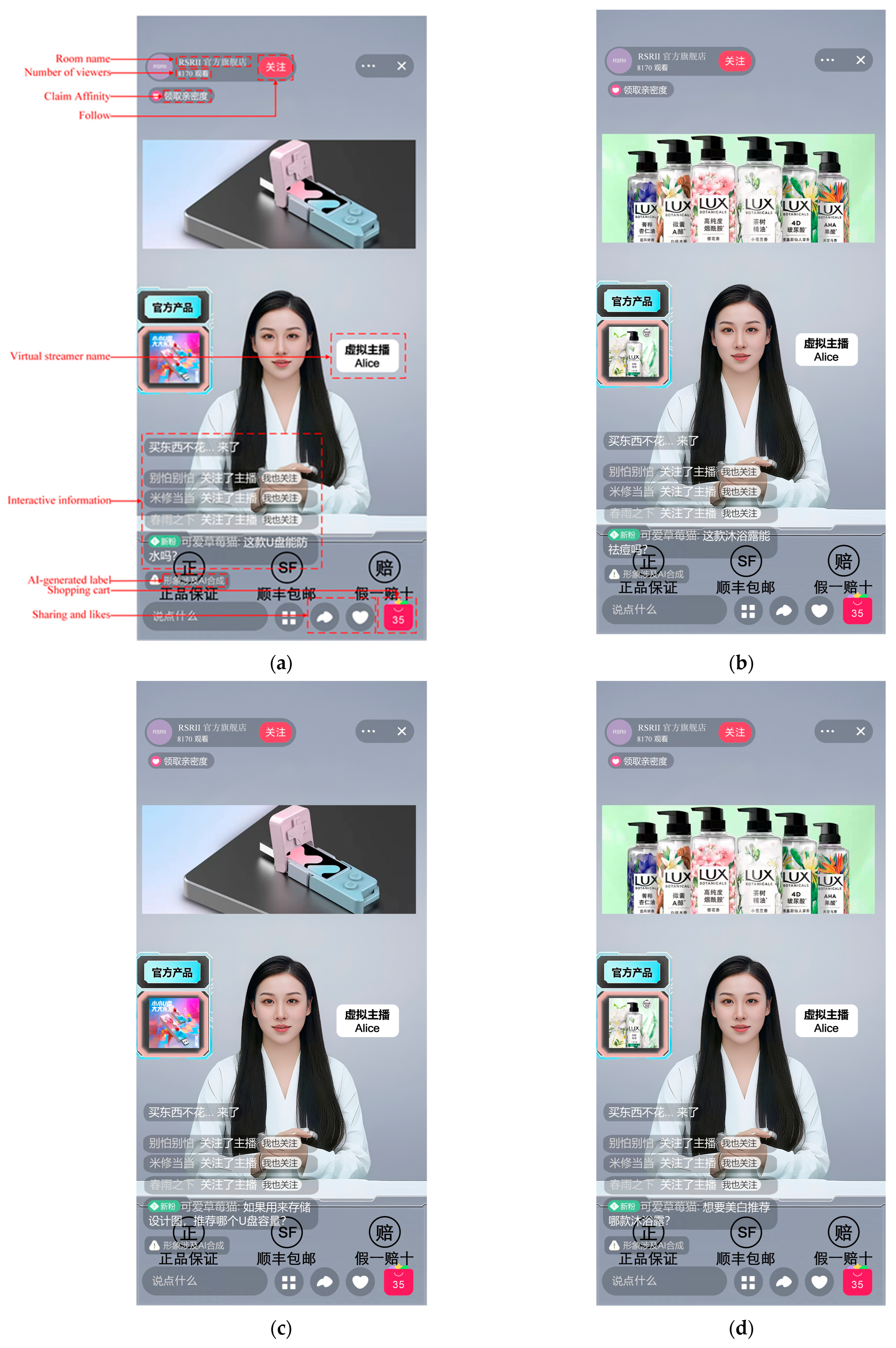
Figure A1.
Live streaming images of different experimental conditions: (a) assistant-role virtual streamer–search product; (b) assistant-role virtual streamer–experience product; (c) friend-role virtual streamer–search product; (d) friend-role virtual streamer–experience product.
Appendix B. Sample Size Estimation Based on the Priori Power Analysis
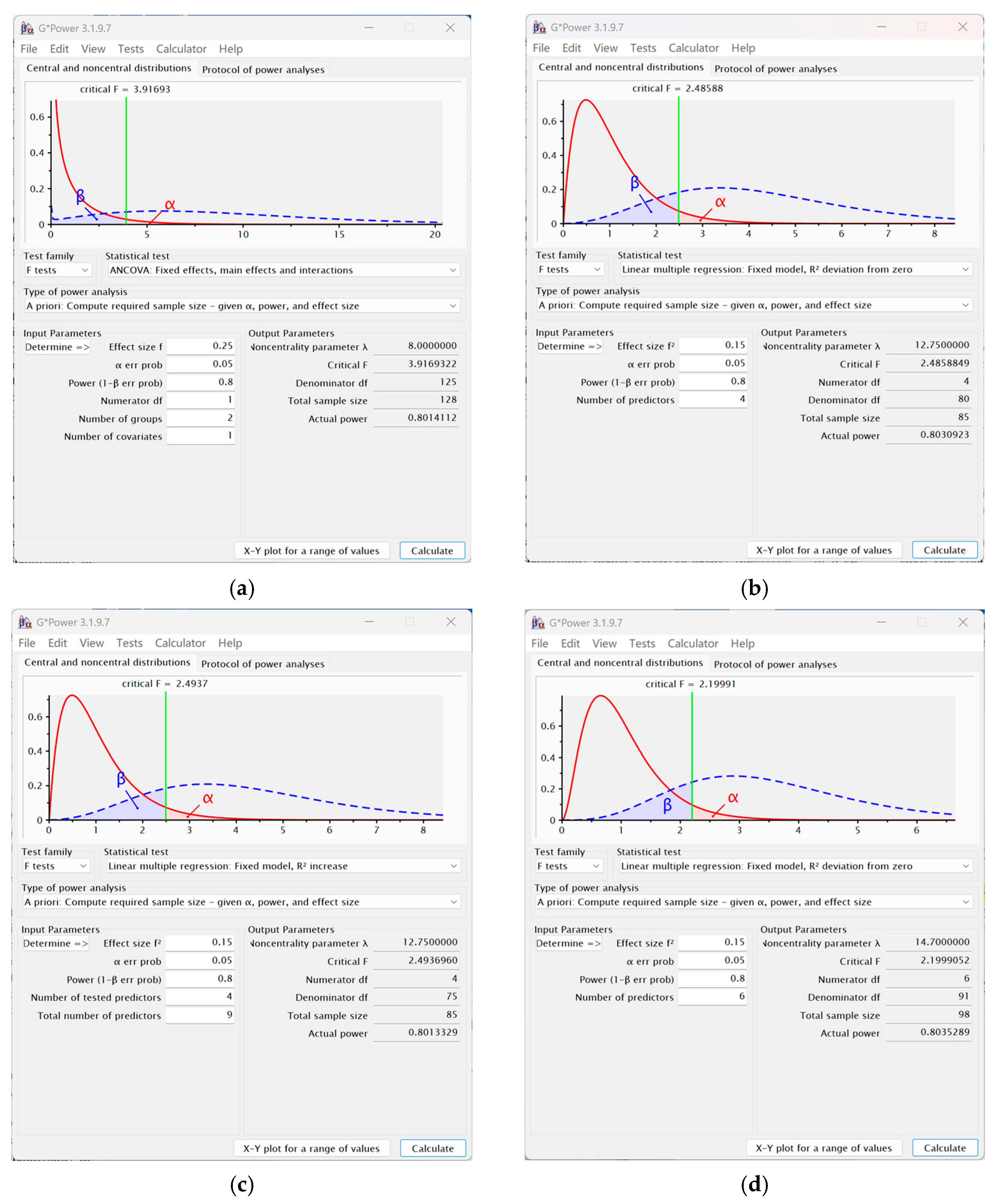
To ensure sufficient statistical power for this study, we conducted four separate priori power analyses for the primary analyses, including analysis of covariance (ANCOVA), mediation effect analysis, hierarchical regression analysis, and moderation effect analysis. Following the approach of Chen et al. (2024) [1] and Gong & Sun (2025) [2], we set the effect size for all analyses to a medium level (0.15~0.25), the alpha level to 0.05, and the statistical power (1−β) to 0.80. The power analysis results (see Figure A2) indicated that the minimum required sample size ranged from 85 to 128. The obtained sample of 328 participants exceeds this minimum requirement, thus confirming an adequate sample size.
Figure A2.
Live streaming images of different experimental conditions: (a) a power analysis of covariance (ANCOVA) (for H1); (b) a power analysis of mediation effect analysis (for H2~H4); (c) a power analysis of hierarchical regression analysis (for H5~H6); (d) a power analysis of moderation effect analysis (for H7). Note: The red solid curve, blue dash-dotted curve, and green vertical line represent the central F-distribution (null hypothesis), non-central F-distribution (alternative hypothesis), and critical F-value, respectively. The red shaded area under the red curve to the right of the green line indicates the significance level (α). The blue shaded area under the blue curve to the left of the green line indicates the Type II error probability (β).
References
- Chen, H.; Shao, B.; Yang, X.; Kang, W.; Fan, W. Avatars in live streaming commerce: The influence of anthropomorphism on consumers’ willingness to accept virtual live streamers. Comput. Hum. Behav. 2024, 156, 108216. [Google Scholar] [CrossRef] [Scilit]
- Gong, X.; Sun, P. Can virtual streamers express emotions? Understanding the language style of virtual streamers in livestreaming e-commerce. J. Retail. Consum. Serv. 2025, 82, 104148. [Google Scholar] [CrossRef] [Scilit]
- Xiong, S.; Wu, R.; Li, Y. The effect of e-commerce live streamer partner type on consumers’ approach intention: An empirical study based on live streaming studios. J. Consum. Behav. 2026, 25, 579–602. [Google Scholar] [CrossRef] [Scilit]
- Pal, D.; Arpnikanondt, C. The sweet escape to metaverse: Exploring escapism, anxiety, and virtual place attachment. Comput. Hum. Behav. 2024, 150, 107998. [Google Scholar] [CrossRef] [Scilit]
- Zhang, S.; Ji, T.; Liang, K.; Wei, L.; Pan, Y. Why do users stay? Emotional vs. functional attachment in pan-entertainment live streaming platforms. Front. Psychol. 2025, 16, 1623568. [Google Scholar] [CrossRef] [Scilit] [PubMed]
- Yu, J.; Xie, C.; Huang, S.; Guo, C. Configuring the value-versus-attachment combinations in determining consumer purchase intention in tourism e-commerce live streaming: A fsQCA approach. Curr. Issues Tour. 2023, 26, 3023–3039. [Google Scholar] [CrossRef] [Scilit]
- Tian, Z.; Chen, F.; Cui, D. The influence of e-commerce virtual streamer characteristics on consumers’ purchase intention: Based on a hybrid SEM-ANN approach. Acta Psychol. 2026, 266, 106758. [Google Scholar] [CrossRef] [Scilit] [PubMed]
- Li, Y.; Li, X.; Cai, J. How attachment affects user stickiness on live streaming platforms: A socio-technical approach perspective. J. Retail. Consum. Serv. 2021, 60, 102478. [Google Scholar] [CrossRef] [Scilit]
- Yue, X.; Yang, Y.; Gu, X.; Wang, Q. Research on the impact of perceived interaction on user Stickiness in the context of Tiktok e-commerce live broadcast--The mediating role based on emotional attachment. SHS Web Conf. 2023, 165, 02011. [Google Scholar] [CrossRef] [Scilit]
- Zou, Y.; Liao, J.; Jin, D. The effects of tourists’ digital attachment on behavioural intention in live-streaming tourism. Curr. Issues Tour. 2025, 28, 2803–2824. [Google Scholar] [CrossRef] [Scilit]
- Milligan, M.J. Interactional past and potential: The social construction of place attachment. Symb. Interact. 1998, 21, 1–33. [Google Scholar] [CrossRef] [Scilit]
- Goel, L.; Johnson, N.A.; Junglas, I.; Ives, B. From space to place: Predicting users’ intentions to return to virtual worlds. MIS Q. 2011, 35, 749–771. [Google Scholar] [CrossRef] [Scilit]
- Zhang, S.; Huang, C.; Li, X.; Ren, A. Characteristics and roles of streamers in e-commerce live streaming. Serv. Ind. J. 2022, 42, 1001–1029. [Google Scholar] [CrossRef] [Scilit]
- Zhu, Y.; Liang, J.; Zhao, Y. Expert or partner: The matching effect of AI chatbot roles in different service contexts. Electron. Commer. Res. Appl. 2025, 71, 101496. [Google Scholar] [CrossRef] [Scilit]
- Gong, X.; Jiang, X.; Yu, S. A study on the interaction effect of AI virtual streamer role and product type on consumers’ purchase intention. Chin. J. Manag. 2024, 21, 1373–1381. [Google Scholar] [CrossRef]
- Sarason, B.R.; Pierce, G.R.; Shearin, E.N.; Sarason, I.G.; Waltz, J.A.; Poppe, L. Perceived social support and working models of self and actual others. J. Pers. Soc. Psychol. 1991, 60, 273–287. [Google Scholar] [CrossRef]
- Iwanowicz-Palus, G.; Mróz, M.; Bień, A. Quality of life, social support and self-efficacy in women after a miscarriage. Health Qual. Life Outcomes 2021, 19, 16. [Google Scholar] [CrossRef] [Scilit] [PubMed]
- Ariccio, S.; Lema-Blanco, I.; Bonaiuto, M. Place attachment satisfies psychological needs in the context of environmental risk coping: Experimental evidence of a link between self-determination theory and person-place relationship effects. J. Environ. Psychol. 2021, 78, 101716. [Google Scholar] [CrossRef] [Scilit]
- Mehrabian, A.; Russell, J.A. An Approach to Environmental Psychology; The MIT Press: Cambridge, MA, USA, 1974. [Google Scholar]
- Shui, X.; Bian, S.; Zhang, P. How Can AI Virtual Streamers Gain Consumer Trust to Influence Purchase Intention in Live-Streaming E-Commerce? J. Theor. Appl. Electron. Commer. Res. 2025, 20, 325. [Google Scholar] [CrossRef] [Scilit]
- Gao, W.; Jiang, N.; Guo, Q. How do virtual streamers affect purchase intention in the live streaming context? A presence perspective. J. Retail. Consum. Serv. 2023, 73, 103356. [Google Scholar] [CrossRef] [Scilit]
- Wen, J.; Li, X. AI digital human responsiveness and consumer purchase intention: The mediating role of trust. J. Theor. Appl. Electron. Commer. Res. 2025, 20, 246. [Google Scholar] [CrossRef] [Scilit]
- Zhong, L.; Yang, Y.; Mei, Z.; Xie, Y.; Yu, A. Exploring consumer citizenship behavior by personification of e-commerce virtual anchors based on shopping value. IEEE Access 2024, 12, 76469–76477. [Google Scholar] [CrossRef] [Scilit]
- Xu, Y.; Xia, F.; Fu, X. The mechanism of stimulating resident tourists’ place attachment via festivals. J. China Tour. Res. 2025, 21, 214–235. [Google Scholar] [CrossRef] [Scilit]
- Liu, X.; Hu, Y.; Chen, X.; Zhang, M. “Cyber Lovers”: The impact of AI social chatbots on users’ emotional attachment. Curr. Psychol. 2026, 45, 293. [Google Scholar] [CrossRef] [Scilit]
- Dhar, S.; Bose, I. Corporate users’ attachment to social networking sites: Examining the role of social capital and perceived benefits. Inf. Syst. Front. 2023, 25, 1197–1217. [Google Scholar] [CrossRef] [Scilit] [PubMed]
- Kim, M.J.; Chung, N.; Lee, C.K.; Preis, M.W. Online group-buying of tourism products: Effects of value and trust on site attachment, altruism, and loyalty. J. Travel Tour. Mark. 2015, 32, 935–952. [Google Scholar] [CrossRef] [Scilit]
- Ooi, K.B.; Hew, J.J.; Lee, V.H. Could the mobile and social perspectives of mobile social learning platforms motivate learners to learn continuously? Comput. Educ. 2018, 120, 127–145. [Google Scholar] [CrossRef] [Scilit]
- Prodanova, J.; San-Martín, S.; Jiménez, N. Achieving customers’ repurchase intention through stimuli and site attachment. J. Organ. Comp. Electron. Commer. 2020, 30, 187–208. [Google Scholar] [CrossRef] [Scilit]
- Zhang, X.; Wu, Y.; Liu, S. Exploring short-form video application addiction: Socio-technical and attachment perspectives. Telemat. Inform. 2019, 42, 101243. [Google Scholar] [CrossRef] [Scilit]
- Li, J.; So, K.K.F.; Hudson, S. Customer responses to the Airbnb platform: The role of Airbnb experience and memorability. Int. J. Contemp. Hosp. Manag. 2023, 35, 1068–1086. [Google Scholar] [CrossRef] [Scilit]
- Lu, B.; Yan, L.; Chen, Z. Perceived values, platform attachment and repurchase intention in on-demand service platforms: A cognition-affection-conation perspective. J. Retail. Consum. Serv. 2022, 67, 103024. [Google Scholar] [CrossRef] [Scilit]
- Deng, X.; Guo, K. Understanding knowledge sharing in virtual communities: A network perspective. Libr. Hi Tech 2021, 39, 1174–1186. [Google Scholar] [CrossRef] [Scilit]
- Coulson, M.; Oskis, A.; Spencer, R.; Gould, R.L. Tourism, migration, and the exodus to virtual worlds: Place attachment in massively multiplayer online gamers. Psychol. Pop. Media 2020, 9, 525–532. [Google Scholar] [CrossRef] [Scilit]
- Farah, M.F.; Ramadan, Z. Toward an inclusive metaverse: Maneuvering between acceptance of disability and need for uniqueness. J. Res. Interact. Mark. 2024, 18, 741–758. [Google Scholar] [CrossRef] [Scilit]
- Oleksy, T.; Wnuk, A.; Lassota, I. Attachment to real-world places and willingness to migrate to metaverse virtual worlds. J. Environ. Psychol. 2023, 92, 102161. [Google Scholar] [CrossRef] [Scilit]
- Oleksy, T.; Wnuk, A.; Piskorska, M.; Toma, C.L. Migration to the metaverse and its predictors: Attachment to virtual places and metaverse-related threat. Comput. Hum. Behav. 2023, 141, 107642. [Google Scholar] [CrossRef] [Scilit]
- Pal, D.; Zhang, X.; Mukherjee, S.; Funilkul, S. Switching to metaverse? Perspectives from push–pull–mooring model. J. Comput. Educ. 2023, 12, 1–35. [Google Scholar] [CrossRef] [Scilit]
- Wang, S.S.; Hsieh, C.-T. Ubiquitous Pokémon Go: Human–environment relationships and the location-based augmented reality game. Environ. Behav. 2020, 52, 695–725. [Google Scholar] [CrossRef] [Scilit]
- Kim, M.J.; Lee, C.-K.; Jung, T. Exploring consumer behavior in virtual reality tourism using an extended stimulus-organism-response model. J. Travel Res. 2020, 59, 69–89. [Google Scholar] [CrossRef] [Scilit]
- Wu, H.-C.; Ai, C.-H.; Cheng, C.-C. Virtual reality experiences, attachment and experiential outcomes in tourism. Tour. Rev. 2020, 75, 481–495. [Google Scholar] [CrossRef] [Scilit]
- Bai, S.; Cao, L.; Zhou, J. Is the anthropomorphic virtual anchor its optimal form? An exploration of the impact of virtual anchors’ appearance on consumers’ emotions and purchase intention. J. Theor. Appl. Electron. Commer. Res. 2025, 20, 110. [Google Scholar] [CrossRef] [Scilit]
- Epley, N.; Waytz, A.; Cacioppo, J.T. On seeing Human: A three-factor theory of anthropomorphism. Psychol. Rev. 2007, 114, 864–886. [Google Scholar] [CrossRef] [Scilit] [PubMed]
- Wu, M.; Wang, N.; Yuen, K.F. Deep versus superficial anthropomorphism: Exploring their effects on human trust in shared autonomous vehicles. Comput. Hum. Behav. 2023, 141, 107614. [Google Scholar] [CrossRef] [Scilit]
- Zhu, Z.; Hall, C.M.; Tao, L.; Qin, Z.; Li, Y. When AI meets livestreaming: Exploring the impact of virtual anchor on tourist travel intention. J. Theor. Appl. Electron. Commer. Res. 2025, 20, 239. [Google Scholar] [CrossRef] [Scilit]
- Ma, J.; Tu, H.; Zhou, X.; Niu, W. Can brand anthropomorphism trigger emotional brand attachment? Serv. Ind. J. 2023, 43, 555–578. [Google Scholar] [CrossRef] [Scilit]
- Saad, S.B. Anthropomorphic virtual agents in luxury travel booking: Enhancing perceived anthropomorphism and social presence. J. Consum. Behav. 2025, 24, 3123–3151. [Google Scholar] [CrossRef] [Scilit]
- Wang, X.; Ming, M.; Zhang, Y. Are “people” or “animals” more attractive? Anthropomorphic images in green-product advertising. J. Clean. Prod. 2020, 276, 122719. [Google Scholar] [CrossRef] [Scilit]
- Jiang, L.; Li, M. Research on the impact path of virtual streamers characteristics on agricultural product consumers’ purchase intention. PLoS ONE 2025, 20, e0330021. [Google Scholar] [CrossRef] [Scilit] [PubMed]
- Tong, Y.; Diao, Y.; Liu, B. The effect of anthropomorphic features of virtual streamers on consumers’ purchase intention—The mediating role of sense of trust. In E-Business: New Challenges and Opportunities for Digital-Enabled Intelligent Future; Tu, Y.P., Chi, M., Eds.; Springer: Cham, Switzerland, 2024; Volume 515. [Google Scholar] [CrossRef] [Scilit]
- Li, C.; Huang, F. The impact of virtual streamer anthropomorphism on consumer purchase intention: Cognitive trust as a mediator. Behav. Sci. 2024, 14, 1228. [Google Scholar] [CrossRef] [Scilit] [PubMed]
- Sun, Y.; Zhong, Y.; Zhang, Z.; Wang, Y.; Zhu, M. How technical features of virtual live shopping platforms affect purchase intention: Based on the theory of interactive media effects. Decis. Support Syst. 2024, 180, 114189. [Google Scholar] [CrossRef] [Scilit]
- Liu, X.; Zhang, L. Virtual streamer anthropomorphism affects consumers’ purchase intention: The mediating role of social presence. Soc. Behav. Pers. 2025, 53, e14517. [Google Scholar] [CrossRef] [Scilit]
- Gu, Y.; Guo, Z.; Hao, J. Decoding virtual streamers: Exploring emotional and cognitive drivers of consumer patronage intentions in live-streaming commerce. Asia Pac. J. Mark. Logist. 2026, 38, 1061–1076. [Google Scholar] [CrossRef] [Scilit]
- Ye, Q.; Li, Y.; Luo, Y.; Pang, Z. The impact of AI anchor anthropomorphism on users’ willingness to co-create value in tourism live-streaming contexts: The mediating role of social presence and the moderating role of perceived control. Front. Psychol. 2026, 16, 1724176. [Google Scholar] [CrossRef] [Scilit] [PubMed]
- Zhang, X.; Shi, Y.; Li, T.; Guan, Y.; Cui, X. How do virtual AI streamers influence viewers’ livestream shopping behavior? The effects of persuasive factors and the mediating role of arousal. Inf. Syst. Front. 2024, 26, 1803–1834. [Google Scholar] [CrossRef] [Scilit]
- Zhou, T.; Li, S. Examining consumer impulsive purchase intention in virtual AI streaming: A S-O-R perspective. J. Theor. Appl. Electron. Commer. Res. 2025, 20, 204. [Google Scholar] [CrossRef] [Scilit]
- Xiao, Q.; Li, X.; Huang, W.; Zhang, X. Gimmick or genuineness? Exploring the antecedents of AI virtual streamers aversion in live-streaming commerce. Technol. Forecast. Soc. Change 2025, 212, 123981. [Google Scholar] [CrossRef] [Scilit]
- Li, J.; Li, Y.; Wang, X. The interaction effect of virtual streamer anthropomorphism and price expectation discrepancy on purchase intention: The mediating role of inferred intentions. J. Retail. Consum. Serv. 2026, 90, 104684. [Google Scholar] [CrossRef] [Scilit]
- Liao, M.; Fang, J.; Han, L.; Zhang, Y.; Liu, L. The power of facial allure: How AI streamer facial physical and emotional attractiveness drive consumer engagement. J. Bus. Res. 2026, 214, 116259. [Google Scholar] [CrossRef] [Scilit]
- Ji, M. Understanding consumer purchase intention in virtual live streaming: The moderating role of anthropomorphism. Behav. Sci. 2026, 16, 342. [Google Scholar] [CrossRef] [Scilit] [PubMed]
- Zhang, R.; Fang, J.; Han, L.; Liao, M. Is more human-like better? The impact of virtual streamer language naturalness on user engagement. Technol. Forecast. Soc. Change 2026, 222, 124392. [Google Scholar] [CrossRef] [Scilit]
- Yu, W.; Ji, S.; Liao, X. When destination meets cuteness: Effect of virtual streamers’ cute anthropomorphic appearance on viewers’ travel intention. Asia Pac. J. Mark. Logist. 2026, 38, 1061–1076. [Google Scholar] [CrossRef] [Scilit]
- Chen, Y.; Zhang, Y.; Fan, H.; Guo, Y. Can AI streamers drive purchases in food delivery e-commerce live streaming? Evidence from an O2O platform. J. Retail. Consum. Serv. 2026, 90, 104683. [Google Scholar] [CrossRef] [Scilit]
- Sun, Z.; Zang, G.; Wang, Z.; Zhao, H.; Liu, W. VCAs as partners or servants? The effects of information sensitivity and anthropomorphism roles on privacy concerns. Technol. Forecast. Soc. Change 2026, 192, 122560. [Google Scholar] [CrossRef] [Scilit]
- Wu, R.; Liu, J.; Chen, S.; Tong, X. The effect of e-commerce virtual live streamer socialness on consumers’ experiential value: An empirical study based on Chinese e-commerce live streaming studios. J. Res. Interact. Mark. 2023, 17, 714–733. [Google Scholar] [CrossRef] [Scilit]
- Tang, X.; Wang, Z. Anthropomorphic design of virtual streamers in live streaming: A double-edged sword effect on consumers’ acceptance intention. J. Consum. Behav. 2026, 25, 1–21. [Google Scholar] [CrossRef] [Scilit]
- Pan, S.; Qin, Z.; Zhang, Y. More realistic, more better? How anthropomorphic images of virtual influencers impact the purchase intentions of consumers. J. Theor. Appl. Electron. Commer. Res. 2024, 19, 3229–3252. [Google Scholar] [CrossRef] [Scilit]
- Zhang, Y.; Wang, X. The effect of virtual anchor appearance on purchase intention: A perceived warmth and competence perspective. J. Prod. Brand Manag. 2025, 34, 84–103. [Google Scholar] [CrossRef] [Scilit]
- Yao, R.; Qi, G.; Wu, Z.; Sun, H.; Sheng, D. Digital human calls you dear: How do customers respond to virtual streamers’ social-oriented language in e-commerce livestreaming? A stereotyping perspective. J. Retail. Consum. Serv. 2024, 79, 103872. [Google Scholar] [CrossRef] [Scilit]
- Liu, Y.; Wang, L.; Yang, S.; Wang, Y. Artificial intelligence-powered digital streamers in online retail: Empirical insights and design strategies from experiments. Inf. Syst. Res. 2026, 37, 824–841. [Google Scholar] [CrossRef] [Scilit]
- Hu, H.; Ma, F. Human-like bots are not humans: The weakness of sensory language for virtual streamers in livestream commerce. J. Retail. Consum. Serv. 2023, 75, 103541. [Google Scholar] [CrossRef] [Scilit]
- Zhang, Y.; Wang, X.; Zhao, X. Supervising or assisting? The influence of virtual anchor driven by AI–human collaboration on customer engagement in live streaming e-commerce. Electron. Commer. Res. 2025, 25, 3047–3070. [Google Scholar] [CrossRef] [Scilit]
- Chen, X.; Guo, S.; Han, S. The role of gender-identity congruity in cross-gender endorsement in the context of live streaming. J. Res. Interact. Mark. 2024, 18, 1001–1016. [Google Scholar] [CrossRef] [Scilit]
- Zhou, Z.; Wen, S.; Li, T.; Zhang, X.; Chi, M. Virtual streamer and destination visitation: An attractiveness transfer perspective. J. Destin. Mark. Manag. 2024, 33, 100922. [Google Scholar] [CrossRef] [Scilit]
- Youn, S.; Jin, S.V. “In AI we trust?” The effects of parasocial interaction and technopian versus luddite ideological views on chatbot-based customer relationship management in the emerging “feeling economy”. Comput. Hum. Behav. 2021, 119, 106721. [Google Scholar] [CrossRef] [Scilit]
- Kim, J.; Merrill, K., Jr.; Collins, C. AI as a friend or assistant: The mediating role of perceived usefulness in social AI vs. functional AI. Telemat. Inform. 2021, 64, 101694. [Google Scholar] [CrossRef] [Scilit]
- Zhang, A.; Rau, P.-L.P. Tools or peers? Impacts of anthropomorphism level and social role on emotional attachment and disclosure tendency towards intelligent agents. Comput. Hum. Behav. 2023, 138, 107415. [Google Scholar] [CrossRef] [Scilit]
- Biddle, B.J. Recent developments in role theory. Annu. Rev. Sociol. 1986, 12, 67–92. [Google Scholar] [CrossRef]
- Tu, Y.; Li, J.; Chen, J.; Li, C.-J.; He, W. When AI becomes my teammate: Unpacking how employees perceive and collaborate with gendered AI teammates. J. Organ. Behav. 2025, 1–25. [Google Scholar] [CrossRef] [Scilit]
- Desveaud, K.; Pavone, G. AI driver or assistant? The impact of gendered interfaces on disempowerment dynamics in fully autonomous vehicles. Technol. Forecast. Soc. 2025, 219, 124259. [Google Scholar] [CrossRef] [Scilit]
- Liu, R.; Li, L.; Ding, Z. Mentor or partner: Matching effect of para-social interaction and product type on purchase intention in live-streaming commerce. Electron. Commer. Res. Appl. 2024, 65, 101410. [Google Scholar] [CrossRef] [Scilit]
- Song, M.; Hong, Z.; Wang, Y.; Duan, Y. Friend or assistant? Matching effects between virtual influencer role types and well-being patterns based on construal level theory. J. Vacat. Mark. 2026, 32, 544–559. [Google Scholar] [CrossRef] [Scilit]
- Schweitzer, F.; Belk, R.; Jordan, W.; Ortner, M. Servant, friend or master? The relationships users build with voice-controlled smart devices. J. Mark. Manag. 2019, 35, 693–715. [Google Scholar] [CrossRef] [Scilit]
- Bandura, A. Self-efficacy: Toward a unifying theory of behavioral change. Psychol. Rev. 1977, 84, 191–215. [Google Scholar] [CrossRef] [PubMed]
- Zeng, F.; Wang, R.; Li, S.Y.; Qu, Z. Social media advertising through private messages and public feeds: A congruency effect between communication channels and advertising appeals. Inf. Manag. 2022, 59, 103646. [Google Scholar] [CrossRef] [Scilit]
- Dash, S.; Saji, K.B. The role of consumer self-efficacy and website social-presence in customers’ adoption of B2C online shopping: An empirical study in the Indian context. J. Int. Consum. Mark. 2008, 20, 33–48. [Google Scholar] [CrossRef] [Scilit]
- Li, M.; Hua, Y. Integrating social presence with social learning to promote purchase intention: Based on social cognitive theory. Front. Psychol. 2022, 12, 810181. [Google Scholar] [CrossRef] [Scilit] [PubMed]
- Bandura, A. Human agency in social cognitive theory. Am. Psychol. 1989, 44, 1175–1184. [Google Scholar] [CrossRef] [PubMed]
- Mura, A.L.; Insalata, L.A.; Bonaiuto, M. My home is my new office: The relationship between environmental comfort, workplace attachment, and psychological needs in the context of remote working. J. Environ. Psychol. 2024, 98, 102378. [Google Scholar] [CrossRef] [Scilit]
- Rehman, A.; Kumar, S.; Salam, M.A.; Virmani, N. How does AI-powered virtual influencer’s anthropomorphism impact trust and brand love? The moderating role of opinion leadership. Technol. Forecast. Soc. Change 2025, 219, 124198. [Google Scholar] [CrossRef] [Scilit]
- Qian, Y.; Wan, X. Influence of robot anthropomorphism on consumer attitudes toward restaurants and service providers. Int. J. Hosp. Manag. 2024, 123, 103939. [Google Scholar] [CrossRef] [Scilit]
- Xu, K.; Chen, X.; Huang, L. Deep mind in social responses to technologies: A new approach to explaining the Computers are Social Actors phenomena. Comput. Hum. Behav. 2022, 134, 107321. [Google Scholar] [CrossRef] [Scilit]
- Frasquet, M.; Ieva, M.; Mollá-Descals, A. Customer inspiration in retailing: The role of perceived novelty and customer loyalty across offline and online channels. J. Retail. Consum. Serv. 2024, 76, 103592. [Google Scholar] [CrossRef] [Scilit]
- Chen, Y.; Wang, H.; Hill, S.R.; Li, B. Consumer attitudes toward AI-generated ads: Appeal types, self-efficacy and AI’s social role. J. Bus. Res. 2024, 185, 114867. [Google Scholar] [CrossRef] [Scilit]
- Bandura, A.; Cervone, D. Differential engagement of self-reactive influences in cognitive motivation. Organ. Behav. Hum. Decis. Process. 1986, 38, 92–113. [Google Scholar] [CrossRef] [Scilit]
- Chen, S.; Duan, Y.; Zhao, Y. Expert or partner? How social roles of AI chatbots shape competence trust and privacy disclosure intention in fitness contexts. Int. J. Hum. Comput. Interact. 2026, 1–24. [Google Scholar] [CrossRef] [Scilit]
- Sankaran, S.; Kossowska, M.; von Hecker, U. When do they push the right buttons? Need for closure and the role of perceived control in situations of uncertainty. Pers. Individ. Diffr. 2023, 213, 112316. [Google Scholar] [CrossRef] [Scilit]
- Schwarzer, R.; Bäßler, J.; Kwiatek, P.; Schröder, K.; Zhang, J.X. The assessment of optimistic self-beliefs: Comparison of the German, Spanish, and Chinese versions of the general self-efficacy scale. Appl. Psychol. 1997, 46, 69–88. [Google Scholar] [CrossRef]
- O’Hare, A.; Powell, R.B.; Stern, M.J.; Bowers, E.P. Influence of educator’s emotional support behaviors on environmental education student outcomes. Environ. Educ. Res. 2020, 26, 1556–1577. [Google Scholar] [CrossRef] [Scilit]
- Zhang, Y.; Huang, H.; Tang, D.; Lu, X.; Fan, F.; Pan, J. Mechanism of online emotional support accompany group for stress: The role of social support. Front. Psychol. 2023, 13, 1047364. [Google Scholar] [CrossRef] [Scilit] [PubMed]
- Tajurahim, N.N.S.; Bakar, E.A.; Jusoh, Z.M.; Ahmad, S.; Arif, A.M.M. The effect of intensity of consumer education, self-efficacy, personality traits and social media on consumer empowerment. Int. J. Consum Stud. 2020, 44, 511–520. [Google Scholar] [CrossRef] [Scilit]
- Ryan, R.M.; Deci, E.L. Self-Determination Theory: Basic Psychological Needs in Motivation, Development, and Wellness; The Guilford Press: New York, NY, USA, 2017. [Google Scholar]
- Scannell, L.; Gifford, R. The experienced psychological benefits of place attachment. J. Environ. Psychol. 2017, 51, 256–269. [Google Scholar] [CrossRef] [Scilit]
- Kahai, S.S.; Lei, Y. Building social capital with Facebook: Type of network, availability of other media, and social self-efficacy matter. Int. J. Hum.-Comput. Stud. 2019, 130, 113–129. [Google Scholar] [CrossRef] [Scilit]
- Goolaup, S.; Nunkoo, R.; Cho, M. Food tourists social interactions: A social capital and social learning perspective. Tour. Manag. 2025, 108, 105128. [Google Scholar] [CrossRef] [Scilit]
- Howle, T.C.; Dimmock, J.A.; Ntoumanis, N.; Chatzisarantis, N.L.; Sparks, C.; Jackson, B. The impact of agentic and communal exercise messages on individuals’ exercise class attitudes, self-efficacy beliefs, and intention to attend. J. Sport Exerc. Psychol. 2017, 39, 397–411. [Google Scholar] [CrossRef] [Scilit] [PubMed]
- Hu, S.; Liu, H.; Gu, J. What Role Does Self-Efficacy Play in Developing Cultural Intelligence from Social Media Usage? Electron. Commer. Res. Appl. 2018, 28, 172–180. [Google Scholar] [CrossRef] [Scilit]
- Nelson, P. Information and consumer behavior. J. Polit. Econ. 1970, 78, 311–329. [Google Scholar] [CrossRef] [Scilit] [PubMed]
- Zhang, Y.; Zhang, T.; Yan, X. Understanding impulse buying in short video live e-commerce: The perspective of consumer vulnerability and product type. J. Retail. Consum. Serv. 2024, 79, 103853. [Google Scholar] [CrossRef] [Scilit]
- Feng, W.; Yang, L.; Han, T.; Xu, J. Why AI needs to “Speak with Data”: The impact mechanism of digitalized descriptions by virtual eWOM senders on eWOM effectiveness. J. Theor. Appl. Electron. Commer. Res. 2025, 20, 303. [Google Scholar] [CrossRef] [Scilit]
- Chinchanachokchai, S.; Thontirawong, P.; Chinchanachokchai, P. A tale of two recommender systems: The moderating role of consumer expertise on artificial intelligence based product recommendations. J. Retail. Consum. Serv. 2021, 61, 102528. [Google Scholar] [CrossRef] [Scilit]
- Carlson, J.P.; Vincent, L.H.; Hardesty, D.M.; Bearden, W.O. Objective and subjective knowledge relationships: A quantitative analysis of consumer research findings. J. Consum. Res. 2009, 35, 864–876. [Google Scholar] [CrossRef] [Scilit] [PubMed]
- Aljukhadar, M.; Senecal, S. The user multifaceted expertise: Divergent effects of the website versus e-commerce expertise. Int. J. Inf. Manag. 2016, 36, 322–332. [Google Scholar] [CrossRef] [Scilit]
- Yuan, C.; Wang, S.; Yu, X. The impact of food traceability system on consumer perceived value and purchase intention in China. Ind. Manag. Data Syst. 2020, 120, 810–824. [Google Scholar] [CrossRef] [Scilit]
- Wang, C.; Chen, B.; Li, M.; Li, J. Interaction orientation and impulse buying in live streaming: Moderated by streamer expertise and attractiveness. Curr. Psychol. 2025, 44, 14914–14931. [Google Scholar] [CrossRef] [Scilit]
- Li, P.; Lee, S.; Lee, K.Y.; Yang, S.-B.; Chang, Y. What makes viewers engage in live streaming shopping during and after the pandemic: An affordance perspective. Serv. Bus. 2023, 17, 963–1000. [Google Scholar] [CrossRef] [Scilit]
- Liao, J.; Chen, K.; Qi, J.; Li, J.; Yu, I.Y. Creating immersive and parasocial live shopping experience for viewers: The role of streamers’ interactional communication style. J. Res. Interact. Mark. 2023, 17, 140–155. [Google Scholar] [CrossRef] [Scilit]
- Liu, Q.; Xu, L.; Feng, W.; Zhou, J.; Li, Y. Is tourism live streaming a double-edged sword? The paradoxical impact of online flow experience on travel intentions. J. Travel Tour. Mark. 2023, 40, 744–763. [Google Scholar] [CrossRef] [Scilit]
- Zhang, D.; Fu, L.; Ma, J.; Chen, C. Social-oriented versus task-oriented streamer interaction styles on live streaming e-commerce: Empirical research in China. J. Consum. Behav. 2024, 23, 1995–2008. [Google Scholar] [CrossRef] [Scilit]
- Langner, T.; Krengel, M. The mere categorization effect for complex products: The moderating role of expertise and affect. J. Bus. Res. 2013, 66, 924–932. [Google Scholar] [CrossRef] [Scilit]
- Barrutia, J.M.; Paredes, M.R.; Echebarria, C. Value co-creation in e-commerce contexts: Does product type matter? Eur. J. Mark. 2016, 50, 442–463. [Google Scholar] [CrossRef] [Scilit]
- Zheng, X.; Wang, Y.-C.; Wei, W.; Zhang, L.; Huo, D. The impact of service robots on consumer response: Examining the roles of consumers’ service expertise and technology expertise. Psychol. Mark. 2023, 40, 2341–2354. [Google Scholar] [CrossRef] [Scilit]
- Wagner, J.A.; Klein, N.M.; Keith, J.E. Buyer–seller relationships and selling effectiveness: The moderating influence of buyer expertise and product competitive position. J. Bus. Res. 2003, 56, 295–302. [Google Scholar] [CrossRef] [Scilit]
- Zhao, K.; Stylianou, A.C.; Zheng, Y. Sources and impacts of social influence from online anonymous user reviews. Inf. Manag. 2018, 55, 16–30. [Google Scholar] [CrossRef] [Scilit]
- Nam, M.; Wang, J.; Lee, A.Y. The difference between differences: How expertise affects diagnosticity of attribute alignability. J. Consum. Res. 2012, 39, 736–750. [Google Scholar] [CrossRef] [Scilit]
- Yan, J.; Xia, S.; Jiang, A.; Lin, Z. The effect of different types of virtual influencers on consumers’ emotional attachment. J. Bus. Res. 2024, 177, 114646. [Google Scholar] [CrossRef] [Scilit]
- Sun, L.; Tang, Y. Avatar effect of AI-enabled virtual streamers on consumer purchase intention in e-commerce livestreaming. J. Consum. Behav. 2024, 23, 2999–3010. [Google Scholar] [CrossRef] [Scilit]
- Wang, G.; Netemeyer, R.G. The effects of job autonomy, customer demandingness, and trait competitiveness on salesperson learning, self-efficacy, and performance. J. Acad. Mark. Sci. 2002, 30, 217–228. [Google Scholar] [CrossRef] [Scilit]
- Wang, J.; Cole, C.A. The effects of age and expertise on product evaluations: Does the type of information matter? Manag. Sci. 2016, 62, 2039–2053. [Google Scholar] [CrossRef] [Scilit]
- Clarkson, J.J.; Janiszewski, C.; Cinelli, M.D. The desire for consumption knowledge. J. Consum. Res. 2013, 39, 1313–1329. [Google Scholar] [CrossRef] [Scilit]
- Schweitzer, F.; Van den Hende, E.A. Drivers and consequences of narrative transportation: Understanding the role of stories and domain—Specific skills in improving radically new products. J. Prod. Innov. Manag. 2017, 34, 101–118. [Google Scholar] [CrossRef] [Scilit]
- Sierra, J.J.; Hyman, M.R. Outlet mall shoppers’ intentions to purchase apparel: A dual-process perspective. J. Retail. Consum. Serv. 2011, 18, 341–347. [Google Scholar] [CrossRef] [Scilit]
- Labroo, A.A.; Rucker, D.D. The orientation-matching hypothesis: An emotion-specificity approach to affect regulation. J. Mark. Res. 2010, 47, 955–966. [Google Scholar] [CrossRef] [Scilit]
- Aiken, L.S.; West, S.G. Multiple Regression: Testing and Interpreting Interactions; SAGE Publications: Newbury Park, CA, USA, 1991. [Google Scholar]
- Teoh, S.H.; Welch, I.; Wong, T.J. Earnings management and the underperformance of seasoned equity offerings. J. Financ. Econ. 1998, 50, 63–99. [Google Scholar] [CrossRef] [Scilit]
- Gao, J.; Zhao, X.; Zhai, M.; Zhang, D.; Li, G. AI or human? The effect of streamer types on consumer purchase intention in live streaming. Int. J. Hum.–Comput. Interact. 2025, 41, 305–317. [Google Scholar] [CrossRef] [Scilit]
- Rohrer, J.M.; Hünermund, P.; Arslan, R.C.; Elson, M. That’s a lot to process! Pitfalls of popular path models. Adv. Methods Pract. Psychol. Sci. 2022, 5, 25152459221095827. [Google Scholar] [CrossRef] [Scilit]
- Sarigul, B.; Schneider, F.M.; Utz, S. Believe it or not? Investigating the credibility of voice assistants in the context of social roles and relationship types. Int. J. Hum.–Comput. Interact. 2025, 41, 6253–6265. [Google Scholar] [CrossRef] [Scilit]
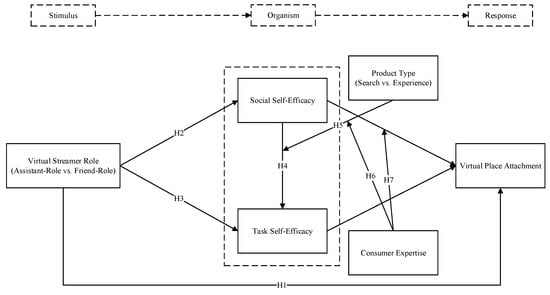
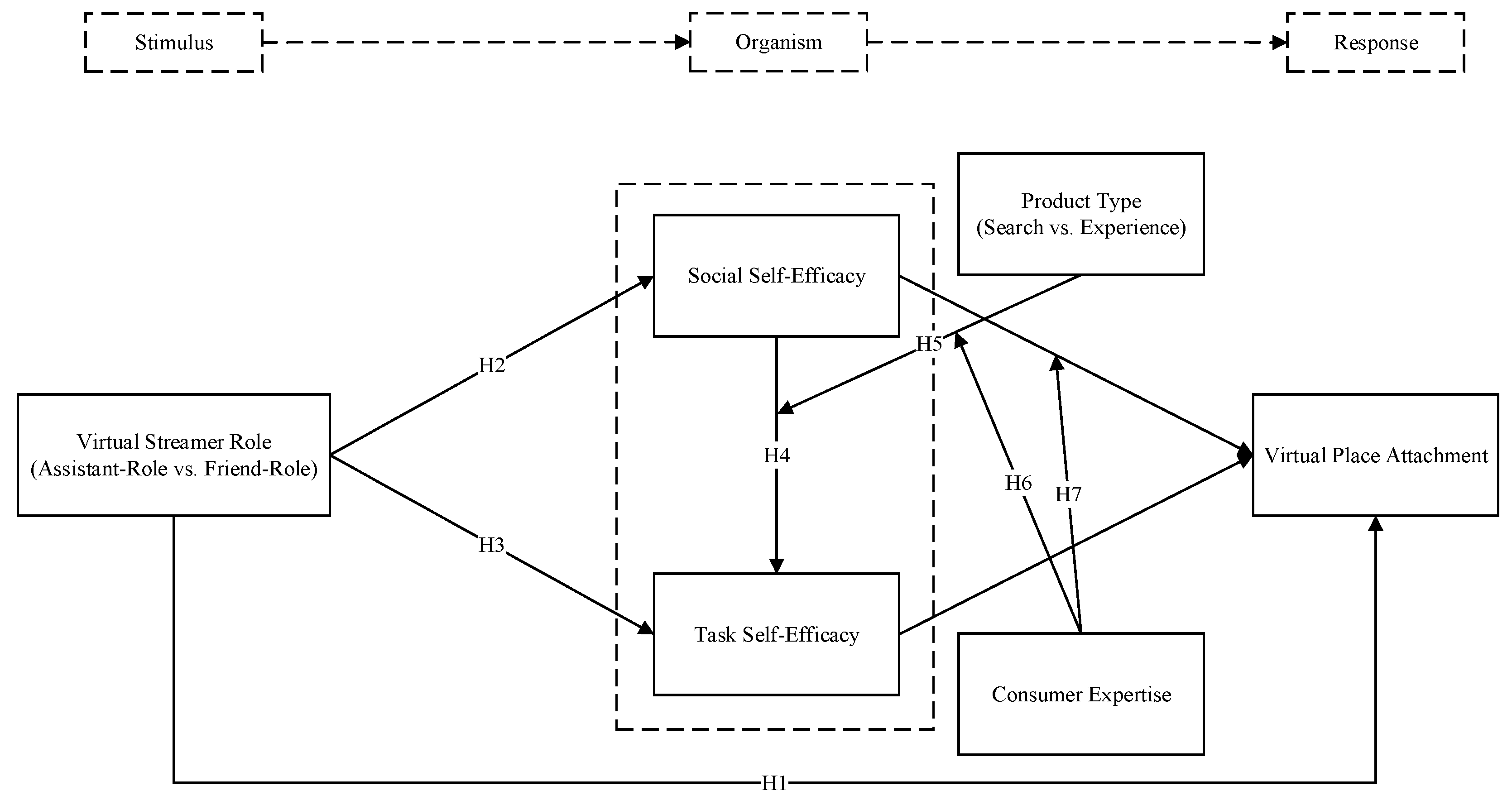
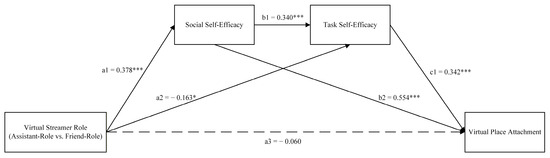
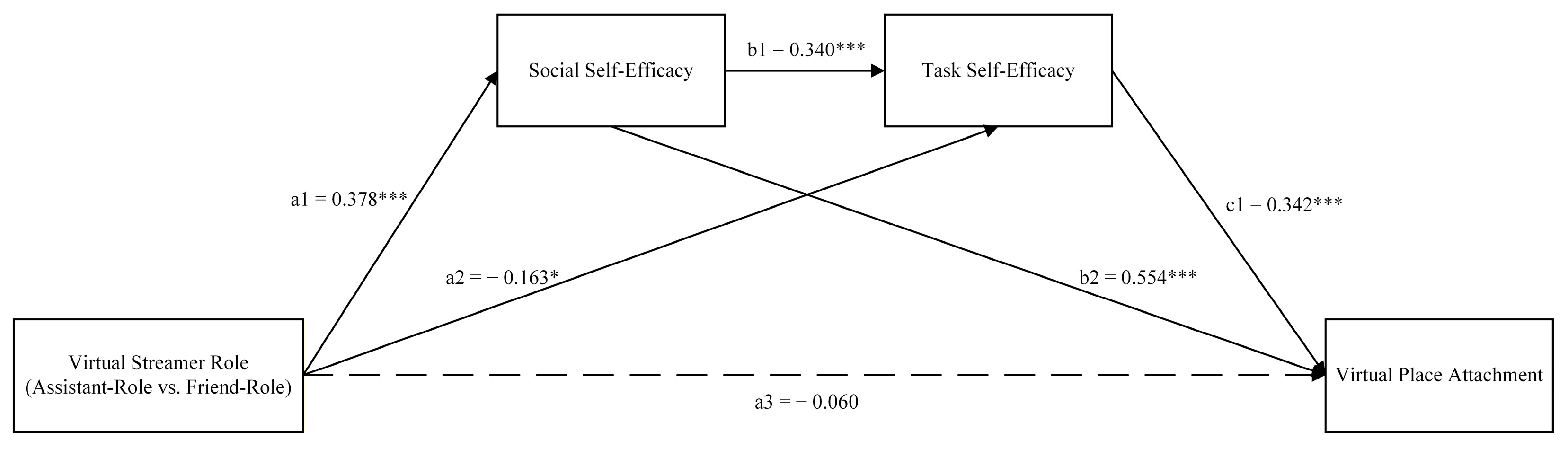
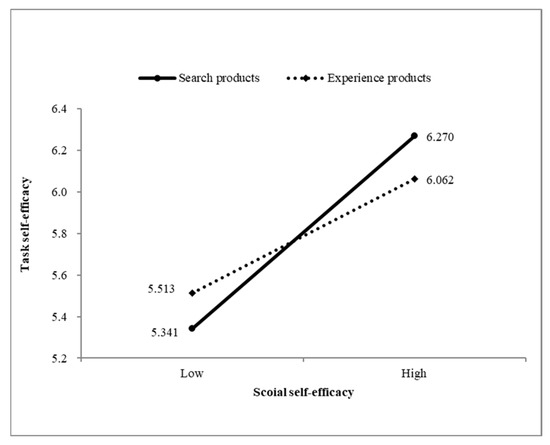
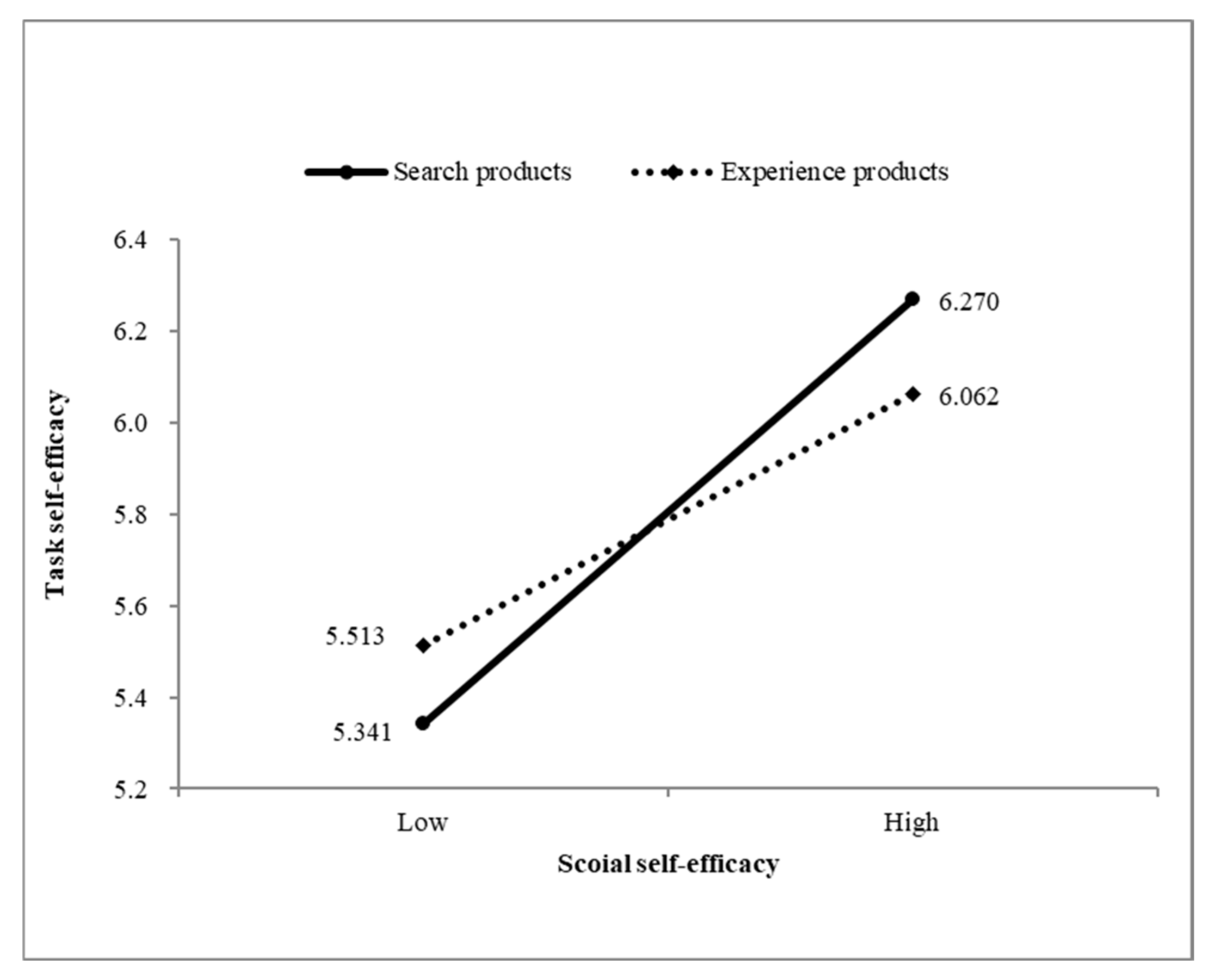
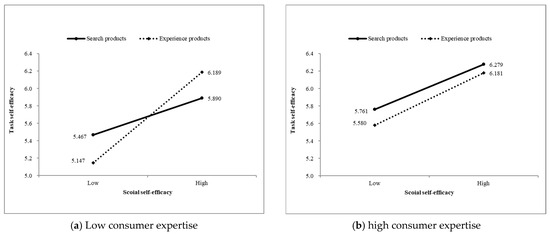
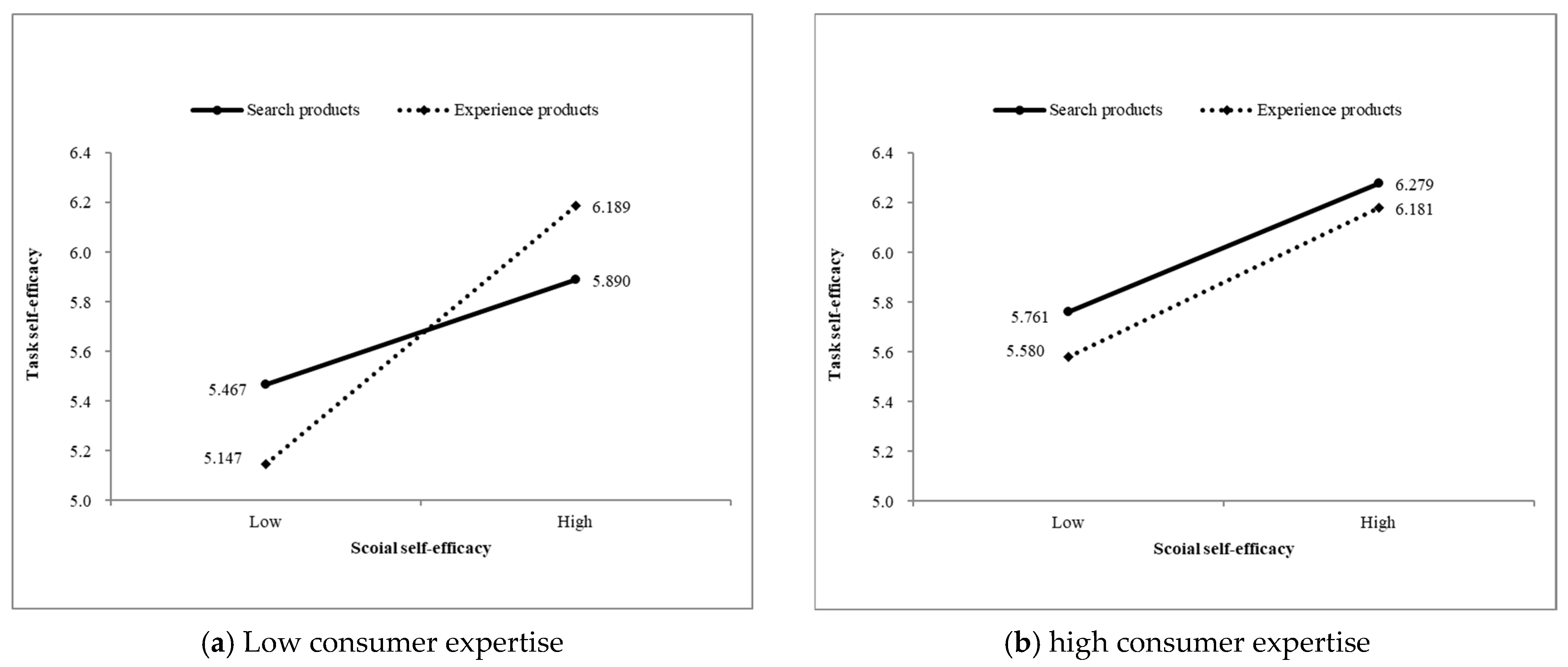
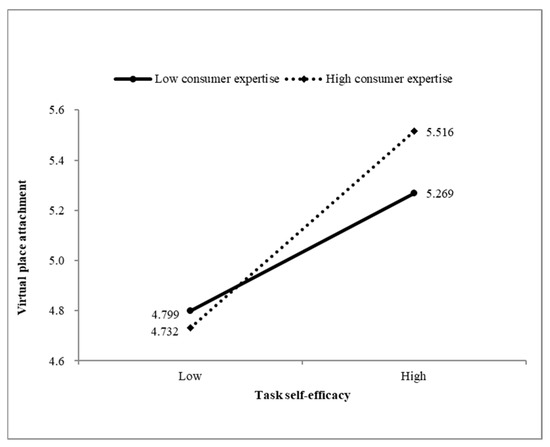
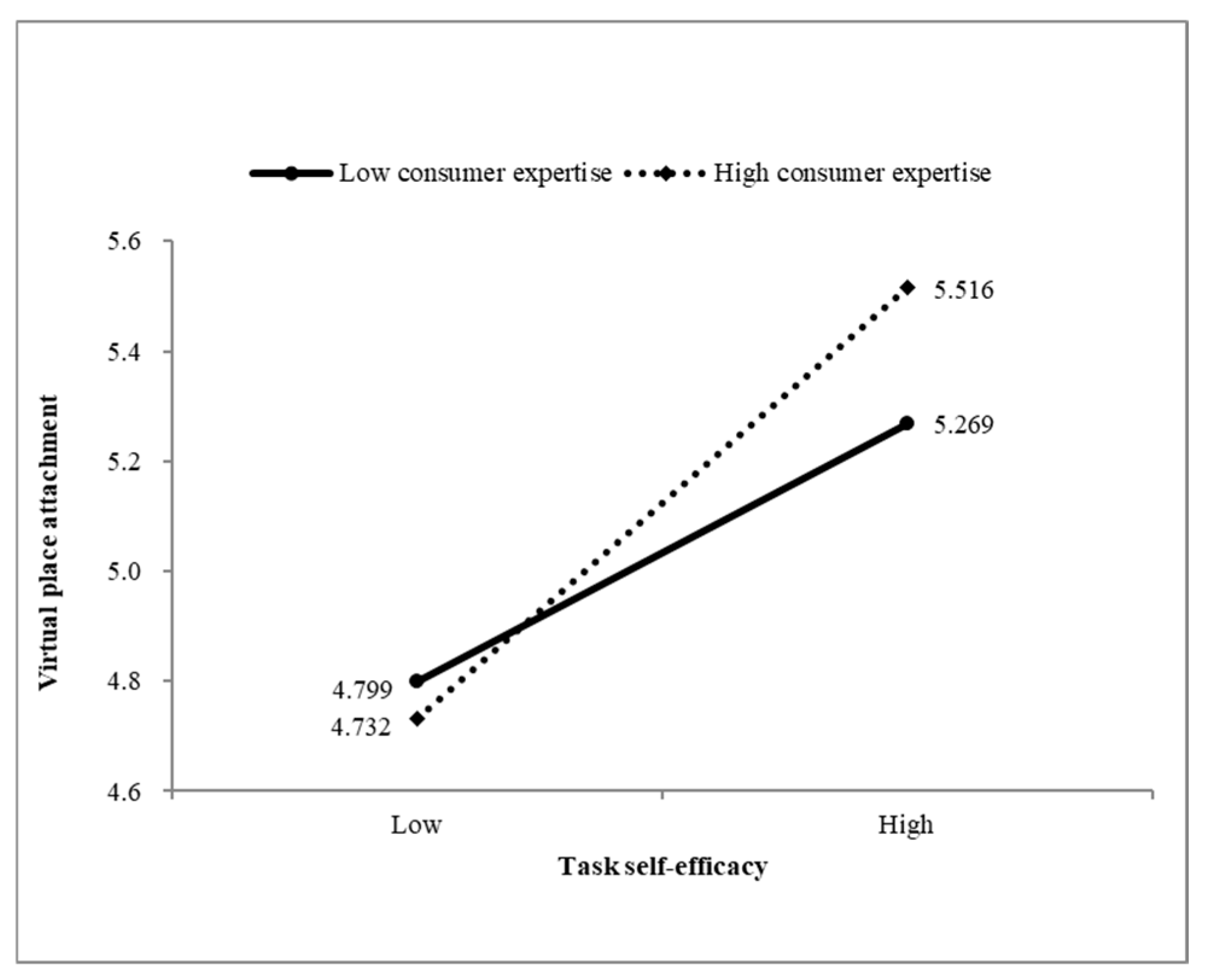

Disclaimer/Publisher’s Note: The statements, opinions and data contained in all publications are solely those of the individual author(s) and contributor(s) and not of MDPI and/or the editor(s). MDPI and/or the editor(s) disclaim responsibility for any injury to people or property resulting from any ideas, methods, instructions or products referred to in the content. |
© 2026 by the authors. Licensee MDPI, Basel, Switzerland. This article is an open access article distributed under the terms and conditions of the Creative Commons Attribution (CC BY) license.