


Abstract
Although social media influencers (SMIs) play a pivotal role in destination marketing, the underlying factors through which they shape tourists’ interest and travel intentions remain underexplored. Based on the modified attention interest desire action (AIDA) model, this study addresses this gap by investigating how the characteristics of SMIs influence travel intentions through destination perceived trust and destination perceived attractiveness. A total of 416 valid questionnaires were analyzed using partial least squares structural equation modeling (PLS-SEM) and an artificial neural network (ANN). The results revealed that SMIs’ similarity, expertise, physical attractiveness, social attractiveness, sincerity, and visibility enhanced tourists’ destination perceived trust and destination perceived attractiveness, thereby influencing travel intentions. Additionally, the ANN analysis complements the PLS-SEM results by comparing predictive performance and identifying the relative importance of SMI characteristics. These findings provide several suggestions for destination management organizations to improve influencer marketing.
1. Introduction
In the digital age, social media provides a new channel for promoting products and services, improving the effectiveness of information exchange, and enriching the quality of user-generated content for tourists [1,2,3]. Social media influencers (SMIs), as important contributors to digital tourism communication, have become increasingly prominent in destination marketing and are widely regarded as influential third-party endorsers [4,5,6]. More importantly, as a marketing approach with wide audiences, influencer marketing can generate positive word-of-mouth and high engagement, leading plenty of tourists to destinations [7,8,9]. For example, Chongqing and Chengdu (China) became internet-famous tourism destinations because of SMIs [10,11].
Current studies indicate that SMIs provide opportunities for tourists to establish connections with a destination [9,12,13]. Specifically, SMIs cultivate specific images through strategies involving interaction styles, content, and personal interests, thereby fostering trust and popularity among tourists [8,14,15,16]. For example, similarity and authenticity constitute the foundation of the relationship between influencers and targeted tourists, subsequently enhancing tourists’ trust [14,17,18]. Moreover, drawing on traditional celebrity research, the characteristics of SMIs (i.e., expertise and attractiveness) may affect followers’ attitudes and purchase intentions [19,20]. Yet Choi, Zhang and Sung [15] argued that different characteristics should be targeted toward specific consumer segments, as attractive celebrities may be more suited to endorse beauty products than experts. Although previous studies have confirmed the significant influence of SMIs on tourists’ travel intentions, limited attention has been paid to identifying which specific influencer characteristics are most effective in destination marketing contexts. Hence, the characteristics of these influencers should be further explored in tourism research to provide an empirical reference for destination management organizations (DMOs).
In influencer marketing, the favorable image of influencers shows a positive correlation with tourists’ trust [15,21,22]. Recommendations from trusted SMIs influence tourists’ metacognitive processes, thereby strengthening the credibility of the destination [6]. Furthermore, tourists frequently rely on credible information sources to mitigate uncertainty during the destination decision-making process. SMIs serve as informal information intermediaries by disseminating personal travel experiences, practical recommendations, and authentic evaluations that facilitate tourists’ destination assessments. For instance, SMIs share travel diaries about local B&Bs (Bed and Breakfasts) and integrate tourism experiences into trending topics to improve reputations for destinations [5,10]. Nevertheless, Pop, Săplăcan, Dabija and Alt [9] investigated the impact of influencers on tourists’ decisions, finding that while trust is a crucial factor, it alone does not fully account for tourists’ emotional responses. In the para-social relationship between SMIs and their followers, the attractiveness of the influencers serves as a fundamental basis for the relationship [21,23,24]. According to the meaning transfer model, the characteristics of influencers can be transferred to endorsed services or products [16]. In influencer marketing, visually rich content, personal storytelling, and experiential descriptions can enhance tourists’ interest in a destination’s scenery, culture, atmosphere, and experiential value. Destination perceived attractiveness is a key predictor of potential tourists’ travel intentions [25], yet previous studies have not explored the relationship between influencers’ characteristics and destination perceived attractiveness. For this reason, incorporating destination perceived attractiveness as an indicator of tourists’ emotional responses provides a more holistic understanding of tourist decision-making.
The attention interest desire action (AIDA) model is widely employed to measure the effectiveness of advertising and to predict the behaviors of potential tourists [26,27]. However, the existing literature rarely explains the effectiveness of influencer marketing through the AIDA model. As such, this study uses the AIDA model as a guiding theoretical framework to explain how tourism social media influencers shape tourists’ psychological responses and travel intentions. Specifically, SMI characteristics are conceptualized as attention-eliciting stimuli rather than direct indicators of attention, whereas destination perceived trust and destination perceived attractiveness are modeled as evaluative of the destination after interest is generated, with travel intention representing the per-action motivational outcome. Furthermore, to address the limitations of traditional statistical methods in tourism marketing, this study adopts a two-stage PLS-ANN design for complementary explanatory and predictive purposes. A hybrid PLS-SEM–ANN approach was employed to complement the explanatory capabilities of PLS-SEM with the predictive capabilities of ANNs, thereby providing a more comprehensive evaluation of the proposed model. Specifically, this research has the following purposes: (1) to validate the effectiveness of SMIs’ characteristics in tourism activities through the modified AIDA model; (2) to assess how tourists’ destination perceived trust and attractiveness affect travel intentions within influencer marketing; (3) to complement the explanatory findings of PLS-SEM with the predictive assessment and predictor importance ranking provided by ANNs using a hybrid PLS-SEM–ANN approach, thereby offering a more comprehensive evaluation of the proposed model. The results of this study shed light on the role of influencers’ characteristics on tourists’ emotional responses and potential travel intentions, thereby providing theoretical support for destination promotion. In practice, this study could guide DMOs in formulating appropriate marketing strategies to shape the e-WOM and predict travel intention.
2. Literature Review and Hypothesis Development
2.1. Attention Interest Desire Action (AIDA) Model
As a major theory in advertising and marketing, the AIDA model is mainly employed to evaluate the effectiveness of advertisements and to predict potential consumer behavior [8,26,28]. The model suggests that consumers generally progress through four sequential stages before purchasing: (1) attraction of attention; (2) fostering of interest in the product; (3) generation of a positive desire to buy through enhanced understanding; (4) ultimate purchasing behavior.
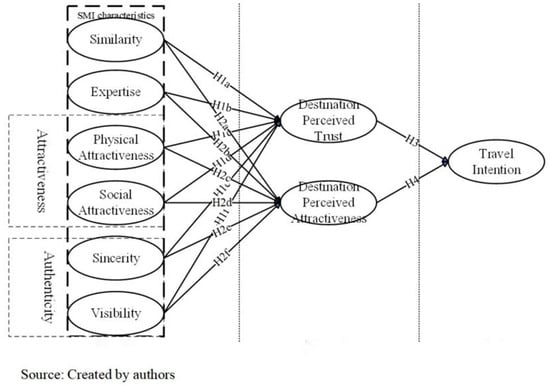
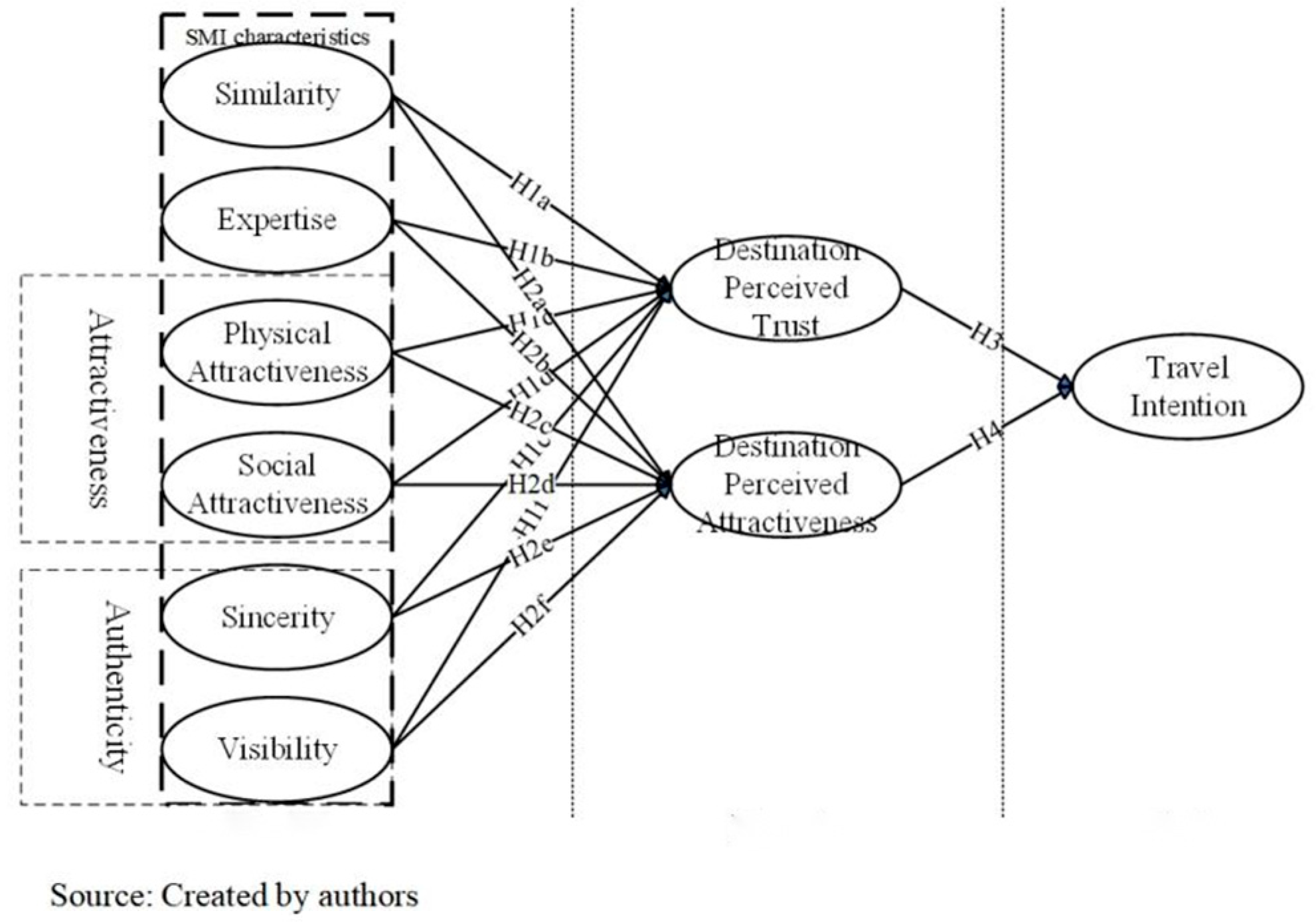
To date, the AIDA model has been widely applied in tourism marketing [26,27]. For example, Wei, Liu, Xu, Li and Cao [8] combined the AIDA model and the information adoption model to examine the effect of sensory stimulation on travel intentions. The current literature examining how SMIs affect travel intentions through the lens of the AIDA model remains limited, despite the model’s demonstrated effectiveness. In SMI marketing, their characteristics are key factors in attracting tourists’ attention. According to the meaning transfer model, the characteristics of influencers can be transferred to endorsed services or products. In other words, the characteristics of influencers can increase tourists’ attention and interest in the endorsed destinations. At the same time, an effective way to increase tourists’ interest and travel intention is to provide accurate destination information and attractiveness. For example, SMIs act as informal information intermediaries by sharing tourism experiences, practical recommendations, and authentic destination reviews, thereby facilitating tourists’ decision-making. Additionally, it should be highlighted that actual travel actions often occur much later than intention formation due to habits, norms, and other factors in tourism activities [28]. This study focuses on the pre-action stage of travel decision-making. Therefore, this study constructs a theoretical framework based on the modified AIDA model to describe a series of psychological processes of tourists in influencer marketing, thereby gaining a deeper understanding of the decision-making process (Figure 1).
Figure 1.
The theoretical framework. Notes: the six characteristics of social media influencers are represented by dark dashed lines; the light dashed lines represent the two dimensions of attractiveness and authenticity.
2.2. Social Media Influencers
SMIs are defined as individuals who have followers on social media. Generally, the higher the popularity of influencers, the larger the audience for their opinions [14,29]. With the development of social media, influencers have become a part of our daily lives and have had a great impact on tourism marketing [4,30,31]. A variety of high-quality information [32] and e-WOM [6] associated with SMIs have become important for the evaluation of options before traveling and increase trust in destinations [1,33]. Once trust is established between influencers and tourists, there is a significant increase in tourists’ desire to visit destinations they recommend [14,34], especially among Millennials and Gen Zers [35,36]. However, the effectiveness of SMIs is not guaranteed. It may damage the destination’s reputation if SMIs’ authenticity and reliability are questioned by tourists [17,37]. Nevertheless, SMIs are playing an increasingly important role in tourism activities.
2.3. The Characteristics of SMIs
Prior studies have demonstrated that tourists’ attitudes toward a destination are not directly shaped by an influencer’s popularity, but instead by the influencer’s image [10,23]. Therefore, it is important to recognize and understand the effectiveness of influencers’ characteristics in destination marketing. Specifically, similarity is a key characteristic in getting travelers’ attention and creating positive attitudes [13,38]. The similarity between SMIs and followers in terms of objective life environment and internal pursuits will cause community identity and enhance self-image congruity as well as self-brand congruity [18,39]. Additionally, expertise usually refers to SMIs’ ability to deal with complex information and the depth of their knowledge about a destination. Influencers with expertise are more likely to be trusted [15,40].
Attractiveness is often described as charismatic or physical attractiveness. SMIs with physical attractiveness could have a greater effect on consumers’ attitudes and behaviors [24,41], especially in the field of beauty and popular culture [15]. However, recent research indicated that social attractiveness is also a crucial element [30,40]. For example, the facial expressions and communication techniques used by SMIs in tourism videos are believed to give positive emotional feedback to tourists [21,40]. Authenticity, as a multidimensional concept, is often applied to describe the tourism experience [42]. In influencer marketing, authenticity implies sincerity, originality, visibility, and so on [32,37]. Hence, this study classifies authenticity into sincerity and visibility [43]. SMIs with sincerity are more likely to be preferred by tourists, thereby boosting a destination’s reputation [44]. On the other hand, visibility refers to the transparency of information provided by SMIs, including both positive and negative content [37,45,46]. Based on the above literature, this study examines six operational dimensions of SMI characteristics: similarity, expertise, physical attractiveness, social attractiveness, sincerity, and visibility. Conceptually, physical and social attractiveness are treated as two subdimensions of attractiveness, while sincerity and visibility are treated as two subdimensions of authenticity.
2.4. Destination Perceived Trust
Destination perceived trust is considered a crucial element in establishing and maintaining relationships with tourists [2,9], and it may have a significant impact on the behaviors of potential tourists [47,48]. In influencer marketing, the characteristics of influencers affect tourists’ overall cognitions before participating in tourism activities and are positively related to tourists’ trust [13,15,49]. Specifically, individuals are more likely to engage with those who share similar values and social status [18]. For example, Yang, Zhang, Liu, Hua and Li [12] and Szymkowiak, Gaczek and Padma [6] found that the perception of similarity between influencers and tourists led to the development of a sense of trust and understanding, which reduced the perceived risk associated with destinations. Expertise is equally significant in influencing tourists’ attitudes and desires and has been validated in different scenarios [14,45]. According to Chen, Hyun and Lee [23], SMIs with expertise may provide more useful information and services, and the destinations they recommend are more likely to be trusted by tourists.
Attractiveness, as one of the core characteristics of SMIs, could bring positive reputations and emotional responses for endorsed products and even influence consumers’ purchase intentions [21,24,50]. Attractive influencers are considered to have greater affinity and may establish stable relationships with tourists, which is especially important for females [45]. Prior studies showed that authentic information is a critical foundation for building consumer trust. As an effective marketing strategy, authenticity may improve brand reputation and brand loyalty significantly [27]. In other words, influencers without image management are more trusted in destination marketing [16,49,50]. Accordingly, this study proposes the following hypotheses:
H1.
SMIs’ (a) similarity, (b) expertise, (c) physical attractiveness, (d) social attractiveness, (e) sincerity, and (f) visibility will positively influence destination perceived trust.
2.5. Destination Perceived Attractiveness
Destination perceived attractiveness represents tourists’ assessment of the extent to which a destination is able to satisfy their tourism requirements (i.e., historical, social, and infrastructural factors) [51]. In destination marketing, attractive products or services have been considered the determining factor in persuading tourists [24,39]. For instance, tourists may react positively when they recognize an influencer as they view destination videos [38]. Dewantara, Jin and Gardiner [30] discovered that the similarity between video bloggers and viewers may contribute to parasocial relationships, thereby increasing awareness of a destination. These studies indicated that similarity may affect tourists’ destination perceived attractiveness. Likewise, if a blogger with expertise in a specific field is perceived as more attractive, consumers will develop positive desires and attitudes toward the products they promote [18,52].
In influencer marketing, attractive influencers may engage with tourists and promote products effectively. For example, the attractiveness of SMIs serves as an important visual experience for consumers in the fields of beauty and popular culture [15,41]. More importantly, SMIs with attractiveness usually have a large number of followers and their references and reviews are more likely to be adopted by tourists [7,30]. Additionally, SMIs will develop intimacy with followers through sincere interactions [17]. Woodroof, Howie, Syrdal and VanMeter [32] found that such intimate relationship leads to more positive evaluations of SMIs by tourists. Therefore, the following hypothesis are proposed:
H2.
SMIs’ (a) similarity, (b) expertise, (c) physical attractiveness, (d) social attractiveness, (e) sincerity, and (f) visibility will positively influence the destination perceived attractiveness.
2.6. Travel Intention
Travel intention refers to a traveler’s attitude toward a destination’s services or products and is often considered a core predictor of actual action [8,53]. In this study, it specifically refers to tourists’ travel intentions after viewing destination short videos. It has been confirmed that destination perceived trust is an important factor influencing travelers’ travel intentions and destination loyalty [54]. For instance, a study of hotels revealed that positive online reviews can improve a sense of trust in a destination among tourists, leading to higher occupancy rates [55]. Additionally, the characteristics of influencers may enhance destination perceived trust, leading tourists to maintain interest in a destination and generate travel intentions [33,56]. Therefore, the following hypothesis is proposed:
H3.
Destination perceived trust has a positive influence on travel intention.
Destination perceived attractiveness is not only a significant evaluation standard for tourism experiences but also an important factor influencing tourists’ travel intentions [25]. Prior studies found that when destinations meet tourists’ needs, they become more attractive and improve travel intentions significantly [39]. Specifically, the characteristics of SMIs in tourism videos may increase destination attractiveness, which in turn influences travel intentions [12]. Hence, this study proposes the following hypothesis:
H4.
Destination perceived attractiveness has a positive influence on travel intention.
3. Methodology
3.1. Study Site
Recently, partnering with influencers to promote destinations has gained popularity in China. For example, through a local tourism director (SMI), Ganzi has become one of the most clicked destinations on social media and repeatedly ranked first in the new media communication index and seventh among 16,000 destinations nationwide. Additionally, Ganzi deals with tourists’ complaints actively to shape electronic word of mouth (e-WOM). Therefore, this study uses Ganzi and the local tourism director as a study case.
3.2. Measurement
Based on the prior literature, the questionnaire of this study included 7 constructs and 4 parts. All constructs were assessed on a 5-point Likert scale (1 = strongly disagree, 5 = strongly agree). The first part concerns the characteristics of SMIs, including similarity (four items) [19,57,58], expertise (four items) [20], social attractiveness (four items), physical attractiveness (four items) [59], sincerity (four items), and visibility (four items) [17]. The second part utilizes research from Abubakar and Ilkan [53] and Delgado-Ballester [60] to measure destination perceived trust (four items). Destination perceived attractiveness was adapted from Li, et al. [61] and Yin, et al. [62]. Thirdly, to assess travel intentions, three items were drawn from Lee, et al. [63] and Weng, Huang and Bao [26]. Finally, demographic indicators consisted of gender, age, marital status, education level, occupation, and monthly income.
Initially, the questionnaire items were crafted in English and subsequently translated into Chinese by experts. Two professors majoring in tourism were invited to assess the content validity of the questionnaire. Additionally, this study collected 50 questionnaires through a pretest on December 10th, 2022, and further revised the questionnaire based on the results of the pretest. After that, the revised questionnaire was used in this survey.
3.3. Data Collection
Since the respondents were the group who have viewed the short videos of the Ganzi tourism director, online surveys were deemed to have higher credibility and convenience. Wenjuanxing, the most popular online survey company in China with a market share of over 60%, was hired to collect the sample for the study. The data was collected using an online questionnaire from December 2022 to January 2023. Finally, 433 self-administered questionnaires were returned, and 17 samples were deleted due to the same answers having been given or answers having been given too quickly. Thus, 416 valid samples were retained, with a valid response rate of 96.1%. The sample size met the requirement of 10 times the number of items (i = 416), such that the samples were considered for further analysis [64].
3.4. Data Analysis
Based on prior research, this study applied a hybrid PLS-ANN approach to analyze the data. In the first stage, partial least squares structural equation modeling (PLS-SEM) was employed to evaluate the measurement and structural models for the following reasons [64]: (1) PLS-SEM is appropriate suitable for small sample sizes; (2) PLS-SEM is an ideal analytical method for exploring conceptual models that have not yet been widely validated; (3) PLS-SEM can handle data with a non-normal distribution. In this study, the normalization coefficient of Mardia calculated by SPSS 26.0 is 113.75 > 3. This indicates that the data is not normally distributed. In the second stage, this study employed artificial neural networks (ANNs) to complement the PLS-SEM analysis by enhancing predictive assessment and examining the relative importance of predictors. ANNs were adopted because their flexible modeling framework can accommodate complex relationships that may not be fully captured by conventional linear approaches, recognizing that multiple influencer cues may exert non-additive and compensatory effects on tourists’ decision-making. According to Leong, et al. [65], the benefits of ANNs lie in their ability to capture both linear and nonlinear relationships among variables, compare predictive performance, identify shifts in the relative importance of predictors, and reveal complex combinatorial patterns that conventional linear models may overlook. Accordingly, ANNs were used to compare predictive performance and relative importance rankings with the linear PLS-SEM results.
In addition, a Harman one-factor test and variance inflation factor (VIF) were required to confirm the presence of common methodological biases in the resultant dataset before analyzing the data [66,67]. The results showed that the first factor is 33.36% of the total variance (<40%) of the total variance, and the VIF values of the internal model range from 1.291 to 1.621 (<3). Therefore, the data results do not present a common method bias.
4. Results
4.1. Demographic Profiles
As shown in Table 1, more than half of the 416 valid respondents were female (56.5%). The most common age group was 20–29 (49.8%), followed by 30–39 (24%). This suggests that most of the targets of influencer marketing are concentrated between 20 and 39, which is in line with the distribution of TikTok audience groups [40]. In terms of education, the majority of respondents had graduated from junior college (50.7%) or university (26.2%). In addition, more than half of the respondents earned less than ¥4500 monthly (66.6%). The most common occupations among respondents were students (36.5%) and national institutions and enterprises (13.5%), and about 20% of respondents chose “other” due to privacy concerns. Regarding marital status, about 41.6% of the respondents were married and 52.6% were not married.
Table 1.
Demographic profiles of respondents (N = 416).
4.2. Measurement Model
Assessment of measurement models requires testing the reliability and validity of the constructs. As presented in Table 2, the factor loadings of each construct were more than 0.7 (0.758~0.891), indicating that the questionnaire items were reliable [68]. The Cronbach’s alpha and composite reliability levels exceeded 0.7, indicating that all constructs were reliable [69]. Next, the average variance extracted (AVE) was >0.5, which proved that the convergent validity was acceptable [64,67]. Fornell and Larcker [70] argued that the square roots of AVE should exceed the correlations with any other constructs. Furthermore, all values of the HTMT ratio fell below the recommended threshold of 0.85 [64]. As shown in Table 3, data results ensured the discriminant validity.
Table 2.
Results of measurement model.
Table 3.
Discriminant validity. Fornell–Larcker criterion (below the main diagonal) and heterotrait–monotrait ratio (HTMT) (above the main diagonal).
4.3. Structural Model
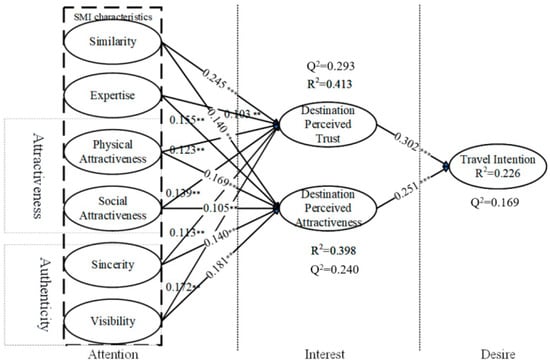
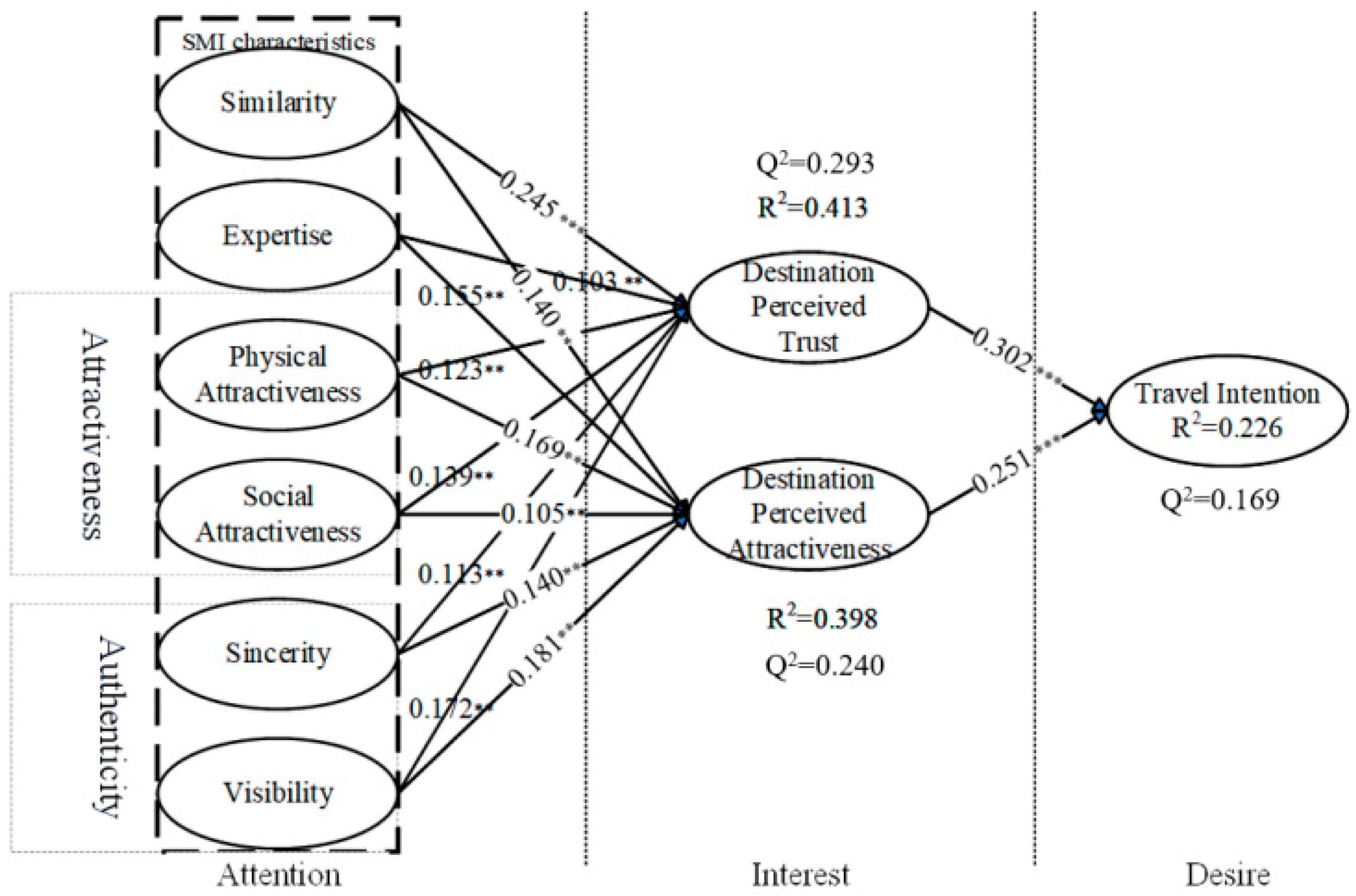
To examine the structural model and hypotheses, this study conducted 5000 bootstrapping procedures to ensure statistical significance. Hair, Risher, Sarstedt and Ringle [64] stated that Q2 can be used to evaluate the predictive relevance of a model. The Q2 values for destination perceived trust, destination perceived attractiveness, and travel intention were 0.293, 0.240, and 0.169 (>0), which proved that the model has predictive validity. Additionally, SMIs’ characteristics explained 41.3% and 39.8% of tourists’ destination perceived trust and attractiveness, respectively. The explanatory power of destination perceived trust and attractiveness with respect to travel intention is 22.6% (Figure 2). The f2 values depicted an exogenous effect size (Table 4). For example, SM (f2 = 0.037) and PA (f2 = 0.032) had effects on DPA, while DPA (f2 = 0.063) had a large effect on TI.
Figure 2.
Path coefficient of the conceptual framework. Notes: ** p < 0.01, *** p < 0.001; The six characteristics of social media influencers are represented by dark dashed lines.
Table 4.
Hypothesis testing results.
Additionally, all 14 hypotheses were supported. Specifically, Hypothesis 1 indicated that SMI characteristics significantly affected destination perceived trust, including similarity (H1a: β = 0.245, p < 0.001), expertise (H1b: β = 0.103, p < 0.05), physical attractiveness (H1c: β = 0.123, p < 0.05), social attractiveness (H1d: β = 0.139, p < 0.05), sincerity (H1e: β = 0.113, p < 0.05), and visibility (H1f: β = 0.172, p < 0.05). Likewise, SMIs’ similarity (H2a: β = 0.140, p < 0.05), expertise (H2b: β = 0.155, p < 0.05), physical attractiveness (H2c: β = 0.169, p < 0.05), social attractiveness (H2d: β = 0.105, p < 0.05), sincerity (H2e: β = 0.140, p < 0.05), and visibility (H2f: β = 0.181, p < 0.05) were positively related to destination perceived attractiveness. The destination perceived trust (H3: β = 0.302, p < 0.001) and destination perceived attractiveness (H4: β = 0.251, p < 0.001) had significant influence on travel intention.
4.4. Artificial Neural Network (ANN) Analysis
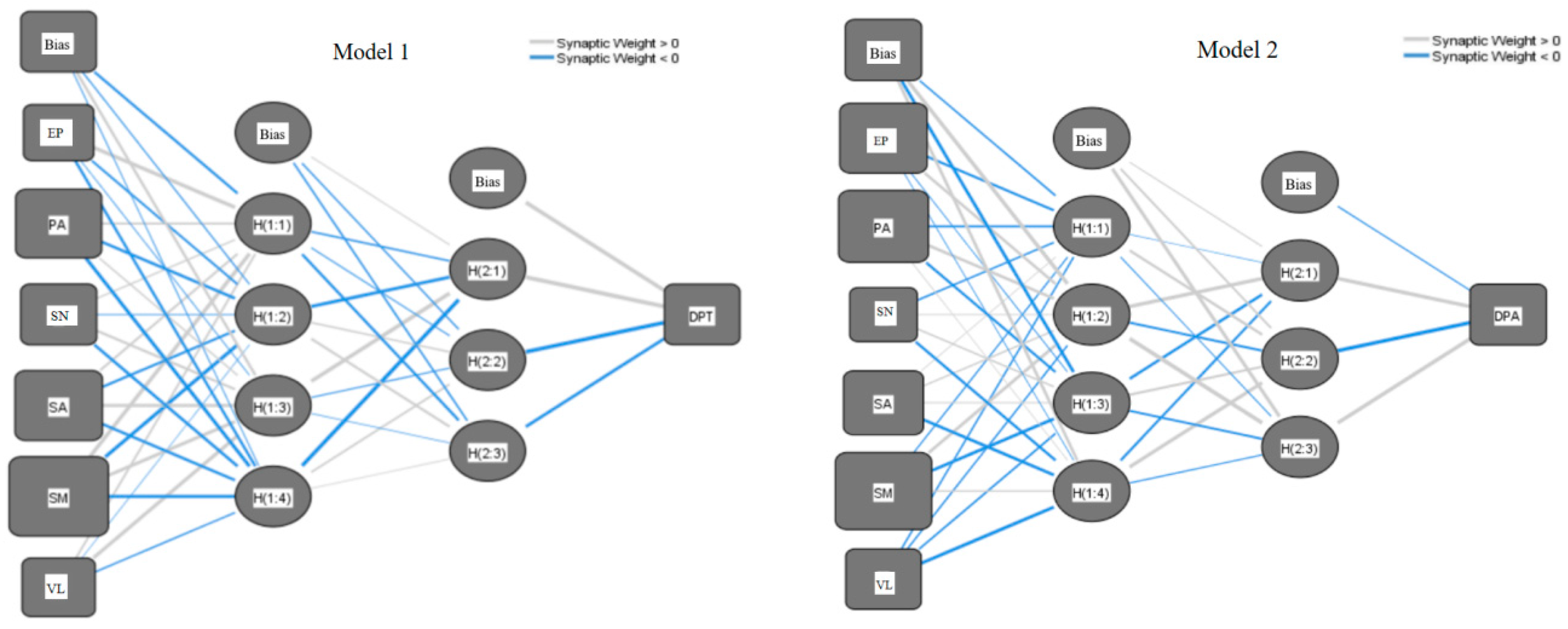
The ANN serves as a predictive complement to PLS-SEM by comparing predictor importance across methods and assessing predictive performance [13]. Therefore, this study employed SPSS 26.0 to conduct an ANN analysis. Using the multi-layer perceptron (MLP) training method, a neural network model was constructed comprising input, hidden (two), and output layers [65]. To enhance the learning efficiency of neuronal nodes, we decomposed the model into two sub-models: Model 1 (Output-DPA) has six input neurons, labeled SM, EP, PA, SA, SN, and VL. Model 2 (Output-DPT) has six input neurons, labeled SM, EP, PA, SA, SN, and VL (Figure 3). According to Liébana-Cabanillas, et al. [71], this study applied ten-fold cross-validation, dividing the data into training and testing sets at a 9:1 ratio, and utilized the sigmoid function as the activation function.
Figure 3.
Artificial neural network structure applied for Models 1 and 2. Source: Created by authors. Note: DPA = Destination Perceived Attractiveness; DPT = Destination Perceived Trust; EP = Expertise; PA = Physical Attractiveness; SN = Sincerity; SA = Social Attractiveness; SM = Similarity; VL = Visibility.
To assess the accurate predictions of Model 1 and Model 2, this study computed the root mean square error (RMSE) values across 10 neural networks. As shown in Table 5, the average RMSE values for the training and testing datasets of Model 1 are 0.113 and 0.113, respectively, whereas those for Model 2 are 0.124 and 0.115. Given the negligible differences in RMSE values and standard deviations between the training and testing datasets, the results confirmed the reliability of the neural network model [13].
Table 5.
RMSE values.
Secondly, the findings from the neural network sensitivity analysis (Table 6 and Figure 3) reveal that SM (100%) serves as the most important predictor in Model 1, followed by PA (95.38%), SA (75.11%), EP (74.48%), VL (63.27%), and SN (40.22%). In Model 2, SA emerges as the main predictor, with the remaining variables serving as secondary predictors. Additionally, a comparative analysis of the predictive outcomes derived from the PLS-SEM and ANN was conducted, identifying discrepancies in the ranking of predictors between the two methods (Table 7). For instance, VL and PA emerged as the strongest predictors in the PLS-SEM, while the ANN analysis identified SM as the variable with the greatest relative importance in Model 1.
Table 6.
Results of sensitivity analysis.
Table 7.
Comparison between PLS-SEM and ANN results.
Finally, it is necessary to evaluate the percentage variance explained for the ANN using the formula , where [65]. According to Table 8, compared with the R2 values for PLS-SEM, all the models of the ANN showed a higher predictive accuracy.
Table 8.
Structural Model quality.
5. Discussion and Conclusions
In the digital age, traditional spokespeople are losing influence in destination marketing, while influencers are becoming increasingly popular among tourists. Consequently, this study develops a theoretical framework based on the modified AIDA model to explore the relationships among the characteristics of SMIs (similarity, expertise, physical attractiveness, social attractiveness, sincerity, and visibility), destination perceived trust, destination perceived attractiveness, and travel intentions. The research model was evaluated using a hybrid PLS-ANN approach. The findings enrich the extant literature on SMIs and offer practical insights for DMOs.
5.1. Findings
First, among influencers’ characteristics, expertise significantly affected destination perceived attractiveness [45,52]. However, the relationship between expertise and destination perceived trust was weak in this study. This finding diverges from the conclusion of Choi, Zhang and Sung [15] that influencers with expertise are more likely to be trusted. We propose that the decline in tourists’ trust toward destinations may stem from an influencer’s being a local tourism director rather than a professional tour guide. Additionally, similarity has a positive influence on destination perceived trust and attractiveness. This reinforces the positive role of similarity in the emotional connections between endorsers and consumers [19].
Second, this study explored the role of SMIs’ attractiveness in destination marketing. Specifically, physical attractiveness predicted destination perceived attractiveness significantly, while social attractiveness had a little effect [41]. Moreover, this study suggested that the social attractiveness of influencers in short videos played a crucial role in influencing destination perceived trust. It also supports the findings of Kim and Park [59] and Sokolova and Kefi [40], namely, that SMI’s facial expressions and affectionate tones may improve the intimacy relationship with tourists. Additionally, the research demonstrated that tourists have strongly emotional responses to the authenticity of SMIs. Specifically, destination perceived trust and attractiveness were significantly affected by SMIs with sincerity (intrinsically authenticity) in short videos [27,37]. Moreover, SMIs who disclose authentic information are perceived as more trustworthy, which in turn shapes tourists’ emotional reactions and travel intentions. These findings are consistent with Djafarova and Rushworth [45].
Thirdly, destination perceived trust and destination perceived attractiveness exert positive influences on tourists’ travel intentions. These conclusions were revealed in previous research by Lee, et al. [72] and Sharma, et al. [73]. This implies that destination perceived trust and attractiveness are effective means of removing perceptions of uncertainties and risks and offers new ideas for improving the effect of destination marketing [47,48,55]. The relatively limited explanatory power for travel intention (R2 = 0.226) suggests that additional determinants may contribute to the complexity of the decision-making process. Future research could incorporate additional psychological, social, and contextual factors to enhance the explanatory power of travel intention and develop a more comprehensive understanding of the mechanisms through which social media influencer characteristics influence tourists’ destination-related behavioral intentions.
Finally, by integrating PLS-SEM with ANNs, this study offers complementary explanatory and predictive evidence regarding the influence of SMI characteristics on tourists’ destination evaluations. This integrated approach not only determines whether specific SMI characteristics exert significant effects on destination perceived trust and perceived attractiveness but also identifies their relative predictive importance under nonlinear modeling conditions.
5.2. Theoretical Implications
Overall, the theoretical contributions of the study are as follows. Initially, this study integrates the AIDA model and the meaning transfer theory as a theoretical framework to examine how the characteristics of SMIs affect tourists’ travel intentions, and advances the existing body of knowledge on tourism [16]. Specifically, though the AIDA model is commonly employed to explain tourists’ pre-travel psychological processes, limited research has evaluated the effectiveness of SMIs in destination marketing [8,26]. Therefore, this paper empirically validated that the characteristics of SMIs play a pivotal role in destination marketing. This broadens the application of the AIDA model and provides theoretical support for tourists’ shift from paying attention to influencers to interest in destinations.
Secondly, the existing literature on SMIs is focused on expertise, attractiveness, trustworthiness, and other factors [27,45,73]. However, this study identified similarity as an important characteristic of SMIs which serves as a foundation for influencers to cultivate close relationships with tourists. Individuals with similar values or hobbies are more likely to have a sense of community identification [18]. Additionally, attractiveness (physical and social) and authenticity (sincerity and visibility) were validated as critical factors in enhancing perceived trust and destination attractiveness. By synthesizing these research findings, this study provides a comprehensive understanding for evaluating the characteristics of SMIs and tourists’ psychological emotions, delivering theoretical support for DMOs to promote destination marketing.
Thirdly, this study explored how tourists’ emotional responses to destinations were affected by SMIs. Specifically, the image characteristics of SMIs facilitate destination perceived trust and destination perceived attractiveness, thereby improving tourists’ travel intentions [72,73]. The study contributes a novel lens for understanding the influencer– tourist–destination relationship in destination marketing.
Finally, this study employed a hybrid PLS-ANN approach to combine the explanatory strengths of PLS-SEM with the predictive strengths of ANN. By comparing the results derived from the two analytical methods, the study strengthened the robustness of the overall investigation and identified differences in the relative importance rankings of SMI characteristics. Additionally, this methodology provides robust theoretical support and constitutes a valuable methodological reference for the ongoing paradigm shift in consumer behavior research from explanatory modeling toward predictive analytics.
5.3. Practical Implications
Social media influencers had a great impact on the field of tourism. In particular, we observed that more than half the individuals were inspired by SMIs to visit specific destinations [9,49]. Therefore, this study explored the impact of SMIs’ characteristics on tourists’ travel intentions and provided practical insights for DMOs to boost destination marketing efficacy.
Firstly, we argued that the similarity and physical attractiveness of SMIs were the first elements in getting the attentions of tourists. For example, SMIs with higher physical attractiveness have a significant impact on consumers in beauty and popular culture [15]. In this study, the Ganzi tourism director, Ganzi, known as “the most handsome tourism director” because of physical attractiveness, attracted numerous tourists to visit the destination. Consequently, DMOs should focus on presenting the external characteristics of SMIs to capture the attentions of tourists and increase destination popularity, for example, refined appearance, ideal body shape, fashionable dressing, etc. On the other hand, SMIs with similarity may reduce tourists’ risk awareness and enhance their connection with the destination [18]. Accordingly, in terms of opinion leader selection, destination managers should move beyond follower counts and prioritize influencers whose personal image, lifestyle, values, and audience profile are consistent with the destination’s positioning. Destination agencies can establish an evaluation system that considers indicators such as audience relevance, engagement quality, content credibility, past collaboration performance, and reputation risk.
Secondly, in destination marketing, endorsers are usually people who have recently been trending on a topic. Yet marketers have ignored the fact that influencers with expertise are equally important in destination promotion. Hence, it would be beneficial for influencers to learn the geographical knowledge and cultural background of a destination, meticulously plan an itinerary and budget, and learn about risk assessment and emergency responses. Influencers with expertise may create a closer emotional connection with tourists and ensure that these positive feelings are associated with the destination. Social attractiveness is a crucial factor in establishing trust with tourists, although it has less impact on destination perceived attractiveness. This means that influencers may enhance tourists’ willingness to visit a destination by maintaining social attractiveness. Specifically, influencers can engage deeply with tourists by actively commenting and interacting privately on social media. On the other hand, SMI’s facial expressions, tone of voice, and other communication skills in short videos may have a positive effect on tourists.
Thirdly, influencers should possess not just tourism knowledge but also provide accurate and authentic tourism information to tourists [54]. As a result, in destination promotions, influencers should clearly label sponsored content in their videos or photos and evaluate the destination’s elements from multiple perspectives, such as landscape, hotels, transport, etc. When authenticity is recognized, tourists tend to have a great intention to travel [43]. Furthermore, platforms can establish a credibility profiling system and dynamic evaluation mechanism for social media influencers by linking the authenticity of shared information to the allocation of platform resources, such as traffic promotion and commission incentives, thereby fostering the healthy and sustainable development of influencer marketing.
In the end, apart from destination perceived trust, influencers could amplify destination perceived attractiveness to boost tourists’ travel intentions. Specifically, during destination promotion, SMIs should demonstrate the attractions of a destination and recommend appropriate products and services for various types of visitors. For example, adding gaming elements into a destination product would greatly appeal to youth, different hiking routes and camping equipment could be recommended to outdoor adventure tourists, and daily life in destinations could be shown to leisure groups [73]. In this way, the interest of tourists is activated and the popularity of a destination is significantly increased.
5.4. Limitations and Future Research
Although this study provides theoretical and practical contributions to the application of SMIs in destination marketing, there are still some limitations. First of all, the SMI of this study is a local tourism director. Therefore, it is necessary to further examine the effectiveness of other types of influencers in destination marketing (e.g., virtual influencers and non-local influencers). Secondly, this study further expanded and examined the effectiveness of SMIs’ characteristics (i.e., similarity, expertise, attractiveness, and authenticity). Among them, the dimensions of authenticity in this study were confirmed, but they are still not applied widely [17]. Thus, it is necessary to obtain further verification in future studies. Apart from these things, other characteristics of influencers (e.g., uniqueness and originality) may be added as control variables to research in the future. Thirdly, future research may apply the influencer’s popularity and the match with the destination to understand potential tourists’ behaviors. Finally, self-administered questionnaires may cause subjective bias among respondents. Therefore, refining the questionnaire with counter-directional questions and extending the data collection period could be effective strategies for future research.
Author Contributions
Conceptualization, Y.L. and K.-S.P.; methodology, Y.L. and H.L.; software, Y.L.; validation, Y.L. and H.L.; formal analysis, Y.L.; investigation, Y.L.; resources, K.-S.P.; data curation, Y.L. and H.L.; writing—original draft preparation, Y.L. and H.L.; writing—review and editing, K.-S.P.; visualization, Y.L.; supervision, K.-S.P.; project administration, K.-S.P.; funding acquisition, K.-S.P. All authors have read and agreed to the published version of the manuscript.
Funding
This work was supported by the research grant of Pai Chai University in 2026.
Institutional Review Board Statement
Ethical review and approval were waived by the Ethics Review Board of the Department of Leisure Service & Sports, Pai Chai University (Approval No. PCU-LS-2022-11-001; 25 November 2022) because the study involved an anonymous online questionnaire survey presenting no more than minimal risk to participants. The study did not collect personally identifiable information and complied with the ethical principles outlined in the Declaration of Helsinki.
Informed Consent Statement
Informed consent was obtained from all subjects involved in the study. Prior to participation, respondents were informed about the purpose of the study, the voluntary nature of participation, and the anonymity of their responses. Completion of the online questionnaire was considered to constitute informed consent.
Data Availability Statement
The data presented in this study are available on request from the corresponding author. The data are not publicly available due to privacy and ethical considerations related to the protection of participant confidentiality.
Conflicts of Interest
The authors declare no conflicts of interest.
References
- Kim, D.Y.; Kim, H.-Y. Influencer advertising on social media: The multiple inference model on influencer-product congruence and sponsorship disclosure. J. Bus. Res. 2021, 130, 405–415. [Google Scholar] [CrossRef] [Scilit]
- Yang, X. Social capital and consumer co-creation behaviors on tourism social media: The mediating role of psychological ownership. Tour. Rev. 2025, 80, 1141–1155. [Google Scholar] [CrossRef] [Scilit]
- Leung, X.Y.; Sun, J.; Bai, B. Thematic framework of social media research: State of the art. Tour. Rev. 2019, 74, 517–531. [Google Scholar] [CrossRef] [Scilit]
- Hernández-Méndez, J.; Baute-Díaz, N. Influencer marketing in the promotion of tourist destinations: Mega, macro and micro-influencers. Curr. Issues Tour. 2023, 27, 1332–1342. [Google Scholar] [CrossRef] [Scilit]
- Xu, X.; Pratt, S. Social media influencers as endorsers to promote travel destinations: An application of self-congruence theory to the Chinese Generation Y. J. Travel Tour. Mark. 2018, 35, 958–972. [Google Scholar] [CrossRef] [Scilit]
- Szymkowiak, A.; Gaczek, P.; Padma, P. Impulse buying in hospitality: The role of content posted by social media influencers. J. Vacat. Mark. 2021, 27, 385–399. [Google Scholar] [CrossRef] [Scilit]
- Fong, S.F.; Ong, Y.X.; Ating, R.; Besa, M.S. Exploring the intermediary effects of TikTok on Generation Z’s visit intention. J. Vacat. Mark. 2024, 31, 736–752. [Google Scholar] [CrossRef] [Scilit]
- Wei, M.; Liu, M.; Xu, J.; Li, S.; Cao, J. Understanding the influence of sensory advertising of tourism destinations on visit intention with a modified AIDA model. Asia Pac. J. Tour. Res. 2022, 27, 259–273. [Google Scholar] [CrossRef] [Scilit]
- Pop, R.-A.; Săplăcan, Z.; Dabija, D.-C.; Alt, M.-A. The impact of social media influencers on travel decisions: The role of trust in consumer decision journey. Curr. Issues Tour. 2021, 25, 823–843. [Google Scholar] [CrossRef] [Scilit]
- Wei, M.; Li, Y.; Zhang, T.; Liu, X. How values are co-created by tourists and TikTok that are conducive to destination promotion: Evidence from Chongqing. J. Vacat. Mark. 2023, 31, 457–478. [Google Scholar] [CrossRef] [Scilit]
- Tang, W.; Tosun, C.; Mohamed, A.E.; Uslu, S. The influence of social media usage and perceived government market orientation on travel intention to an internet celebrity city: Exploring the mediating effects of place attachment and perceived value. Behav. Sci. 2024, 14, 694. [Google Scholar] [CrossRef] [Scilit] [PubMed]
- Yang, J.; Zhang, D.; Liu, X.; Hua, C.; Li, Z. Destination endorsers raising on short-form travel videos: Self-image construction and endorsement effect measurement. J. Hosp. Tour. Manag. 2022, 52, 101–112. [Google Scholar] [CrossRef] [Scilit]
- Chan, S.H.G.; Tang, B.M.; Lin, Z.; Gao, K.Y.C. Micro-celebrity marketing-induced travels: A psychological ownership perspective. Tour. Rev. 2025, 80, 1242–1260. [Google Scholar] [CrossRef] [Scilit]
- Hudders, L.; De Jans, S.; De Veirman, M. The commercialization of social media stars: A literature review and conceptual framework on the strategic use of social media influencers. Int. J. Advert. 2021, 40, 327–375. [Google Scholar] [CrossRef] [Scilit]
- Choi, Y.K.; Zhang, R.; Sung, C. Attractiveness or expertise? Which is more effective in beauty product endorsement? Moderating role of social distance. Int. J. Advert. 2023, 42, 1201–1225. [Google Scholar] [CrossRef] [Scilit]
- McCracken, G. Who is the celebrity endorser? Cultural foundations of the endorsement process. J. Consum. Res. 1989, 16, 310–321. [Google Scholar] [CrossRef] [Scilit] [PubMed]
- Lee, J.A.; Eastin, M.S. Perceived authenticity of social media influencers: Scale development and validation. J. Res. Interact. Mark. 2021, 15, 822–841. [Google Scholar] [CrossRef] [Scilit]
- Ladhari, R.; Massa, E.; Skandrani, H. YouTube vloggers’ popularity and influence: The roles of homophily, emotional attachment, and expertise. J. Retail. Consum. Serv. 2020, 54, 102027. [Google Scholar] [CrossRef] [Scilit]
- Munnukka, J.; Uusitalo, O.; Toivonen, H. Credibility of a peer endorser and advertising effectiveness. J. Consum. Mark. 2016, 33, 182–192. [Google Scholar] [CrossRef] [Scilit]
- Ohanian, R. Construction and validation of a scale to measure celebrity endorsers’ perceived expertise, trustworthiness, and attractiveness. J. Advert. 1990, 19, 39–52. [Google Scholar] [CrossRef] [Scilit]
- Alamäki, A.; Rhee, C.; Suomala, J.; Kaski, T.; Kauttonen, J. Creating effective visuals for destination marketing videos: Scenery vs people. J. Vacat. Mark. 2023, 29, 141–157. [Google Scholar] [CrossRef] [Scilit]
- Leite, F.P.; Pontes, N.; Schivinski, B. Influencer marketing effectiveness: Giving competence, receiving credibility. J. Travel Tour. Mark. 2024, 41, 307–321. [Google Scholar] [CrossRef] [Scilit]
- Chen, X.; Hyun, S.S.; Lee, T.J. The effects of parasocial interaction, authenticity, and self-congruity on the formation of consumer trust in online travel agencies. Int. J. Tour. Res. 2022, 24, 563–576. [Google Scholar] [CrossRef] [Scilit]
- Lou, C.; Yuan, S. Influencer Marketing: How Message Value and Credibility Affect Consumer Trust of Branded Content on Social Media. J. Interact. Advert. 2019, 19, 58–73. [Google Scholar] [CrossRef] [Scilit]
- Um, S.; Chon, K.; Ro, Y. Antecedents of revisit intention. Ann. Tour. Res. 2006, 33, 1141–1158. [Google Scholar] [CrossRef] [Scilit]
- Weng, L.; Huang, Z.; Bao, J. A model of tourism advertising effects. Tour. Manag. 2021, 85, 104278. [Google Scholar] [CrossRef] [Scilit]
- Wu, X.; Lai, I.K.W. How the creativity and authenticity of destination short videos influence audiences’ attitudes toward videos and destinations: The mediating role of emotions and the moderating role of parasocial interaction with Internet celebrities. Curr. Issues Tour. 2023, 27, 2428–2447. [Google Scholar] [CrossRef] [Scilit]
- Barry, T.E.; Howard, D.J. A review and critique of the hierarchy of effects in advertising. Int. J. Advert. 1990, 9, 121–135. [Google Scholar] [CrossRef] [Scilit]
- Sarkis, N.; Jabbour Al Maalouf, N.; Abou Jaoude, E.; Azzi, T. Building Brand Trust Through Influencers: The Mediating Role of Consumer Engagement. J. Theor. Appl. Electron. Commer. Res. 2026, 21, 114. [Google Scholar] [CrossRef] [Scilit]
- Dewantara, M.H.; Jin, X.; Gardiner, S. What makes a travel vlog attractive? Parasocial interactions between travel vloggers and viewers. J. Vacat. Mark. 2023, 31, 113–129. [Google Scholar] [CrossRef] [Scilit]
- Zhu, C.; Fong, L.H.N.; Liu, C.Y.N.; Song, H. When social media meets destination marketing: The mediating role of attachment to social media influencer. J. Hosp. Tour. Technol. 2023, 14, 643–657. [Google Scholar] [CrossRef] [Scilit]
- Woodroof, P.J.; Howie, K.M.; Syrdal, H.A.; VanMeter, R. What’s done in the dark will be brought to the light: Effects of influencer transparency on product efficacy and purchase intentions. J. Prod. Brand Manag. 2020, 29, 675–688. [Google Scholar] [CrossRef] [Scilit]
- Su, L.; Yang, Q.; Swanson, S.R.; Chen, N.C. The impact of online reviews on destination trust and travel intention: The moderating role of online review trustworthiness. J. Vacat. Mark. 2022, 28, 406–423. [Google Scholar] [CrossRef] [Scilit]
- Wang, L.; Li, Y.-Q.; Ruan, W.-Q.; Zhang, S.-N. The congruence effect in tourism activity marketing: The difference between virtual influencers and human influencers. Curr. Issues Tour. 2024, 28, 3522–3540. [Google Scholar] [CrossRef] [Scilit]
- Lin, S.; Ren, Y.; Ye, S.; Ma, S.; Hu, X. How interactive videos shape travel intentions of Generation Z: An extension of presence theory. J. Hosp. Tour. Technol. 2025, 1–28. [Google Scholar] [CrossRef] [Scilit]
- Zhang, C.; Li, J.; Hao, Y. Why Do “Digital Hamsters” Hoard but Never Consume? Configurational Pathways and Influencing Mechanisms of Digital Hoarding Behaviour Among Chinese Generation Z. Behav. Sci. 2025, 15, 1575. [Google Scholar] [CrossRef] [Scilit] [PubMed]
- Audrezet, A.; De Kerviler, G.; Moulard, J.G. Authenticity under threat: When social media influencers need to go beyond self-presentation. J. Bus. Res. 2020, 117, 557–569. [Google Scholar] [CrossRef] [Scilit]
- Lee, S.; Joo, D.; Lee, C.-K.; Woosnam, K.M. Korean DMZ tourists’ perceived similarity and shared beliefs in predicting place attachment and support for tourism development. J. Destin. Mark. Manag. 2020, 18, 100467. [Google Scholar] [CrossRef] [Scilit]
- Yoon, D.; Kim, Y.-K. Effects of Self-Congruity and Source Credibility on Consumer Responses to Coffeehouse Advertising. J. Hosp. Mark. Manag. 2015, 25, 167–196. [Google Scholar] [CrossRef] [Scilit]
- Sokolova, K.; Kefi, H. Instagram and YouTube bloggers promote it, why should I buy? How credibility and parasocial interaction influence purchase intentions. J. Retail. Consum. Serv. 2020, 53, 101742. [Google Scholar] [CrossRef] [Scilit]
- Yin, J.; Li, T.; Ni, Y.; Cui, Y. The power of appeal: Do good looks and talents of vloggers in tourism short videos matter online customer citizenship behavior? Asia Pac. J. Tour. Res. 2024, 29, 1555–1572. [Google Scholar] [CrossRef] [Scilit]
- Wang, N. Rethinking authenticity in tourism experience. Ann. Tour. Res. 1999, 26, 349–370. [Google Scholar] [CrossRef] [Scilit]
- Lee, J.A.; Eastin, M.S. I Like What She’s #Endorsing: The Impact of Female Social Media Influencers’ Perceived Sincerity, Consumer Envy, and Product Type. J. Interact. Advert. 2020, 20, 76–91. [Google Scholar] [CrossRef] [Scilit]
- Abu-Alhaija, A.S.; Elsawy, M.M. Impact of Social Media Influencer Capability on Brand Loyalty in Saudi Arabia: The Mediating Role of Brand Trust and Moderating Effect of Authentic Leadership. J. Theor. Appl. Electron. Commer. Res. 2026, 21, 105. [Google Scholar] [CrossRef] [Scilit]
- Djafarova, E.; Rushworth, C. Exploring the credibility of online celebrities’ Instagram profiles in influencing the purchase decisions of young female users. Comput. Hum. Behav. 2017, 68, 1–7. [Google Scholar] [CrossRef] [Scilit]
- Sheng, Y.; Zhao, J.; Jung, E. Technology Empowers Emotions: How AR Technology Triggers Consumers’ Purchase and Spread Behavior Towards Intangible Cultural Heritage Brands. Behav. Sci. 2026, 16, 134. [Google Scholar] [CrossRef] [Scilit] [PubMed]
- Ekinci, Y.; Hosany, S. Destination personality: An application of brand personality to tourism destinations. J. Travel Res. 2006, 45, 127–139. [Google Scholar] [CrossRef] [Scilit]
- Han, H.; Hyun, S.S. Image congruence and relationship quality in predicting switching intention: Conspicuousness of product use as a moderator variable. J. Hosp. Tour. Res. 2013, 37, 303–329. [Google Scholar] [CrossRef] [Scilit]
- Hernández-Méndez, J.; Baute-Díaz, N.; Gutiérrez-Taño, D. The effectiveness of virtual versus human influencer marketing for tourism destinations. J. Vacat. Mark. 2024, 32, 13567667241276212. [Google Scholar] [CrossRef] [Scilit]
- Zou, J.; Fu, X. Understanding the purchase intention in live streaming from the perspective of social image. Humanit. Soc. Sci. Commun. 2024, 11, 1500. [Google Scholar] [CrossRef] [Scilit]
- Hu, Y.; Ritchie, J.B. Measuring destination attractiveness: A contextual approach. J. Travel Res. 1993, 32, 25–34. [Google Scholar] [CrossRef] [Scilit]
- Munnukka, J.; Maity, D.; Reinikainen, H.; Luoma-aho, V. “Thanks for watching”. The effectiveness of YouTube vlogendorsements. Comput. Hum. Behav. 2019, 93, 226–234. [Google Scholar] [CrossRef] [Scilit]
- Abubakar, A.M.; Ilkan, M. Impact of online WOM on destination trust and intention to travel: A medical tourism perspective. J. Destin. Mark. Manag. 2016, 5, 192–201. [Google Scholar] [CrossRef] [Scilit]
- Abubakar, A.M.; Ilkan, M.; Meshall Al-Tal, R.; Eluwole, K.K. eWOM, revisit intention, destination trust and gender. J. Hosp. Tour. Manag. 2017, 31, 220–227. [Google Scholar] [CrossRef] [Scilit]
- Duverger, P. Curvilinear effects of user-generated content on hotels’ market share: A dynamic panel-data analysis. J. Travel Res. 2013, 52, 465–478. [Google Scholar] [CrossRef] [Scilit]
- Lin, L.Y.; Lu, C.Y. The influence of corporate image, relationship marketing, and trust on purchase intention: The moderating effects of word-of-mouth. Tour. Rev. 2010, 65, 16–34. [Google Scholar] [CrossRef] [Scilit]
- Bower, A.B.; Landreth, S. Is beauty best? Highly versus normally attractive models in advertising. J. Advert. 2001, 30, 1–12. [Google Scholar] [CrossRef] [Scilit]
- Taillon, B.J.; Mueller, S.M.; Kowalczyk, C.M.; Jones, D.N. Understanding the relationships between social media influencers and their followers: The moderating role of closeness. J. Prod. Brand Manag. 2020, 29, 767–782. [Google Scholar] [CrossRef] [Scilit]
- Kim, H.; Park, M. Virtual influencers’ attractiveness effect on purchase intention: A moderated mediation model of the Product–Endorser fit with the brand. Comput. Hum. Behav. 2023, 143, 107703. [Google Scholar] [CrossRef] [Scilit]
- Delgado-Ballester, E. Applicability of a brand trust scale across product categories: A multigroup invariance analysis. Eur. J. Mark. 2004, 38, 573–592. [Google Scholar] [CrossRef] [Scilit]
- Li, L.; Zhang, J.; Nian, S.; Zhang, H. Tourists’ perceptions of crowding, attractiveness, and satisfaction: A second-order structural model. Asia Pac. J. Tour. Res. 2017, 22, 1250–1260. [Google Scholar] [CrossRef] [Scilit]
- Yin, J.; Cheng, Y.; Bi, Y.; Ni, Y. Tourists perceived crowding and destination attractiveness: The moderating effects of perceived risk and experience quality. J. Destin. Mark. Manag. 2020, 18, 675–688. [Google Scholar] [CrossRef] [Scilit]
- Lee, S.; Song, H.; Lee, C.-K.; Petrick, J.F. An integrated model of pop culture fans’ travel decision-making processes. J. Travel Res. 2018, 57, 687–701. [Google Scholar] [CrossRef] [Scilit]
- Hair, J.F.; Risher, J.J.; Sarstedt, M.; Ringle, C.M. When to use and how to report the results of PLS-SEM. Eur. Bus. Rev. 2019, 31, 2–24. [Google Scholar] [CrossRef] [Scilit]
- Leong, L.-Y.; Hew, T.-S.; Ooi, K.-B.; Tan, G.W.-H.; Koohang, A. An SEM-ANN approach-guidelines in information systems research. J. Comput. Inf. Syst. 2025, 65, 706–737. [Google Scholar] [CrossRef] [Scilit]
- Podsakoff, P.M.; Organ, D.W. Self-reports in organizational research: Problems and prospects. J. Manag. 1986, 12, 531–544. [Google Scholar] [CrossRef] [Scilit]
- Hair, J.F.; Sarstedt, M.; Ringle, C.M.; Mena, J.A. An assessment of the use of partial least squares structural equation modeling in marketing research. J. Acad. Mark. Sci. 2012, 40, 414–433. [Google Scholar] [CrossRef] [Scilit]
- Hulland, J. Use of partial least squares (PLS) in strategic management research: A review of four recent studies. Strateg. Manag. J. 1999, 20, 195–204. [Google Scholar] [CrossRef]
- Sarstedt, M.; Ringle, C.M.; Hair, J.F. Partial least squares structural equation modeling. In Handbook of Market Research; Springer International Publishing: Cham, Switzerland, 2021; pp. 587–632. [Google Scholar]
- Fornell, C.; Larcker, D.F. Evaluating structural equation models with unobservable variables and measurement error. J. Mark. Res. 1981, 18, 39–50. [Google Scholar] [CrossRef] [Scilit]
- Liébana-Cabanillas, F.; Marinković, V.; Kalinić, Z. A SEM-neural network approach for predicting antecedents of m-commerce acceptance. Int. J. Inf. Manag. 2017, 37, 14–24. [Google Scholar] [CrossRef] [Scilit]
- Lee, H.; Lee, J.; Chung, N.; Koo, C. Tourists’ happiness: Are there smart tourism technology effects? Asia Pac. J. Tour. Res. 2018, 23, 486–501. [Google Scholar] [CrossRef] [Scilit]
- Sharma, S.; Stylidis, D.; Woosnam, K.M. From virtual to actual destinations: Do interactions with others, emotional solidarity, and destination image in online games influence willingness to travel? Curr. Issues Tour. 2022, 26, 1427–1445. [Google Scholar] [CrossRef] [Scilit]

Disclaimer/Publisher’s Note: The statements, opinions and data contained in all publications are solely those of the individual author(s) and contributor(s) and not of MDPI and/or the editor(s). MDPI and/or the editor(s) disclaim responsibility for any injury to people or property resulting from any ideas, methods, instructions or products referred to in the content. |
© 2026 by the authors. Licensee MDPI, Basel, Switzerland. This article is an open access article distributed under the terms and conditions of the Creative Commons Attribution (CC BY) license.