


Abstract
Live streaming e-commerce has emerged as a dominant force in electronic commerce. Although extensive research has examined service failures and recovery in conventional e-commerce environments, there is limited understanding of how buyers interpret and respond to service recovery information provided by streamers in live streaming contexts, where streamers fulfill dual roles as both idols and sellers. This study, grounded in signaling theory, investigates the relationships among buyers’ observation, interpretation, and feedback of service recovery information. Specifically, it aims to assess how buyers’ perceived justice regarding service recovery information affects their repeat purchase intentions following live streaming e-commerce failures. Meanwhile, this study elucidates the mediating role of trust in the streamer (idol role and seller role) and verifies whether responsibility attribution and product involvement have moderating effects on the effect of perceived justice. Employing PLS-SEM analysis, the study analyzes data from 401 buyers who have experienced service failures in live streaming e-commerce. The findings reveal that perceived justice positively influences repeat purchase intentions to a certain extent. Trust in the streamer mediates the link between perceived justice and repeat purchase intentions. The inhibiting moderation effect of responsibility attribution and product involvement is generally significant. This study contributes to the theoretical understanding of signaling theory by expanding the signaling model to encompass service recovery information in live streaming e-commerce. Furthermore, it provides practical guidance for live streaming e-commerce practitioners on managing service recovery information, including recommendations for the sequence of sending such information, enhancing its transmission, and improving its overall effectiveness.
1. Introduction
In recent years, live streaming channels on platforms such as Taobao, Douyin, YouTube, and Facebook have drawn billions of users, establishing live streaming as a global phenomenon [1]. Companies and individuals have begun using these channels to sell products, forming an emerging business model known as live streaming e-commerce. Live streaming e-commerce is a combination of live streaming and electronic commerce, where streamers play a key role in marketing operations [2]. They present product information vividly and engage with buyers, thereby increasing online traffic and encouraging purchases. The market size for live streaming e-commerce in China is projected to soar to 1.13 trillion USD by 2026, making the conversion of viewers into repeat buyers a primary focus for streamers [3].
Due to inadequate regulatory protection, live streaming e-commerce often faces resistance as streamers may exaggerate promotions and sell counterfeit products, leading to service failures [4]. Similar to traditional service failures, those instigated by streamers can also cause buyer losses. As a result, buyers lose trust in streamers and are unwilling to purchase products recommended during live sessions, causing significant declines in both sales and reputation for streamers [5]. Live streaming e-commerce is a form of “fan economy” in which initial trust (trust in the idol role of the streamer and trust in the seller role of the streamer) exists between streamers and buyers. In practice, buyers distinguish between these two forms of trust because each serves distinct evaluative functions. Idol-role trust is affect-based, founded on parasocial attachment and emotional resonance with the streamer’s persona. It is activated when buyers seek entertainment, a sense of belonging, or emotional support [6]. Conversely, seller-role trust is cognition-based, established on the streamer’s perceived competence, honesty, and reliability in conducting transactions. This form of trust is invoked when buyers assess product information, suggestions, and opinions [7]. Yet, existing literature largely neglects the context of buyer trust in streamers’ roles [8]. Thus, understanding and reconstructing the complex mechanisms of trust buyers have in streamers during live streaming e-commerce service failures has become a critical issue.
Service recovery refers to the actions businesses undertake after buyers complain about product or service failures. Its effectiveness is commonly evaluated through a justice framework from the buyer’s perspective [9]. Specifically, perceived justice refers to the positive observation result of buyers regarding the service recovery information provided by businesses. In the unique context of live streaming e-commerce, buyers will further interpret service recovery information from streamers following service failures, enabling them to make purchasing decisions that favor their interests. The existing literature on service recovery suggests that perceived justice significantly influences both buyer satisfaction with the recovery process and their intention to revisit [10]. Liu et al. assert that perceived justice affects buyer loyalty by shaping both emotional and cognitive trust [11]. Consequently, in the service recovery of live streaming e-commerce, a unique signal transmission path may exist, involving buyers’ perceived justice of service recovery information (signal observation), their dual role trust in the streamer (signal interpretation), and their repeat purchase intention (signal feedback).
Signaling theory analyzes how decision-makers evaluate the quality of choices based on received signals. Over time, a comprehensive signaling model has evolved, encompassing elements such as the signal sender, the receiver, signal observation, signal interpretation, signal feedback, and the signaling environment [12]. This study applies signaling theory to examine the connections between buyers’ observation, interpretation, and feedback on service recovery information sent by streamers. In service recovery scenarios, current research typically addresses information asymmetry from the sender’s perspective, aiming to swiftly foster consumer forgiveness and enhance willingness for word-of-mouth communication [13,14]. However, substantial changes in the business environment are increasing uncertainty and altering buyer demands for service recovery information provided by streamers. The diversity and accessibility of information acquisition channels may also cause this service recovery information to shift from asymmetry to redundancy and overload. Therefore, exploring signal behaviors related to service recovery information from the receiver’s perspective can significantly enhance its effective transmission.
Furthermore, existing studies indicate that responsibility attribution and product involvement are critical factors influencing consumer perceptions of service failures. When service failures occur, irrespective of whether responsibility is clear or ambiguous, the majority of consumers hold the business accountable [15]. Additionally, the product’s value can shape consumer attitudes and cognitive strategies toward the business [16]. Consequently, it is necessary to explore how consumer responsibility attribution and product involvement impact the influence effect brought by perceived justice, according to the viewpoint proposed by signal theory that environmental factors of signal transmission significantly affect the signal transmission process [17].
In summary, this paper proposes the following research objectives:
- Identify how buyers’ positive observations of service recovery information sent by streamers affect their subsequent behavioral responses.
- Identify how buyers interpret the service recovery information sent by streamers.
- Determine how responsibility attribution and product involvement, as signaling environment factors, moderate the transmission process of service recovery information.
By addressing these research objectives, this study makes several significant contributions to the literature on service recovery in live streaming e-commerce through the lens of signaling theory. Firstly, the study establishes that buyers’ perceived justice (signal observation) regarding service recovery information influences their repeat purchase intention. Secondly, it elucidates the intricate signaling interpretation pathway involving dual-role trust in streamers within the service recovery information signaling model. Thirdly, the study highlights the moderating effects of responsibility attribution and product involvement, viewed as signaling environmental factors, on service recovery information transmission. Lastly, it provides specific practical guidance for managing service recovery information based on the relationships among buyers’ signal behaviors.
The structure of the paper is as follows: Section 2 provides a literature review and theoretical framework, focusing on signaling theory, buyer trust in the streamers, and the conceptual framework. Section 3 formulates the research hypotheses and presents the research model. Section 4 outlines the methodology, detailing the sample, data collection, and measurement process. Section 5 presents the results of the PLS-SEM analysis. Section 6 discusses the findings, along with their theoretical and managerial implications, limitations, and suggestions for future research. Finally, Section 7 offers the conclusion.
2. Literature Review and Theoretical Foundation
2.1. Signaling Theory
Signaling theory, introduced by American economist Michael Spence (1943-) in 1974, addresses the fundamental challenge for decision-makers: utilizing signals to mitigate uncertainty and improve decision-making [18]. Signaling theory provides a framework for understanding information exchange between two parties—whether individuals or organizations—that have unequal access to information. To mitigate this asymmetry, the more informed party (the sender) can send signals to the less-informed party (the receiver). In live streaming e-commerce, signaling theory primarily examines how informed streamers convey product signals, enabling uninformed buyers to infer product quality and facilitating successful transactions. For instance, streamers send signals by providing buyers with positive product information to reduce distrust resulting from information asymmetry. The successful transmission of these signals hinges on the streamer’s credibility and reputation, as well as buyers’ ability to accurately interpret and respond to them [19]. However, inaccuracies in product presentations by streamers can lead to live-stream failures and reputational damage, resulting in a loss of buyer trust and impaired signal transmission. Previous studies indicate that following service failures, viewers may struggle to promptly evaluate the quality and reliability of service recovery information provided by streamers, hindering effective viewer recovery [4].
In the context of service recovery, signaling theory illustrates how signals, such as service recovery information, can mitigate information asymmetry between streamers and buyers. Concurrently, justice theory clarifies which characteristics of these signals enhance their effectiveness from the receiver’s perspective. Specifically, when streamers provide service recovery information after a service failure, this information serves as a signal. However, signals vary in credibility and persuasiveness. Justice theory posits that buyers assess the fairness of recovery information through three dimensions: distributive justice, interactional justice, and procedural justice [20]. These perceived dimensions of justice are based on the quality and reliability of signals as observed by buyers. Thus, justice theory operationalizes the critical signal observation process integral to signaling theory. By integrating these two theories, we not only discern whether streamers send recovery signals but also understand the reasons and mechanisms behind the success of specific signals in rebuilding trust and encouraging repeat purchase intentions.
2.2. Buyer Trust in the Streamer
Trust is an individual’s subjective assessment of the reliability, authenticity, consistency, and competence of a person or organization [21]. Trust is vital in shaping buyers’ attitudes and intentions towards e-commerce and online social networks. In e-commerce, buyer hesitation to transact often arises from uncertainty about merchant conduct [22], a concern mirrored in live streaming e-commerce. In the live streaming e-commerce context, buyers attracted by a streamer’s charisma or fame may develop idol-role trust—an affect-based form of trust rooted in parasocial relationships, emotional attachment, and admiration for the streamer’s personal qualities [23]. Furthermore, live interaction, a unique feature of live streaming e-commerce, enables streamers to display their expertise, thereby fostering seller-role trust—a cognition-based form of trust grounded in the streamer’s perceived competence, product knowledge, and transactional reliability [7]. Consequently, we propose that buyers exhibit dual-role trust in streamers.
Although previous studies have acknowledged the importance of trust in streamers [24], they have largely focused on initial trust formation before or during the purchase. However, they rarely differentiate between idol-role and seller-role trust, and even fewer have investigated how these dual trusts are restored after a service failure—a critical scenario for retaining buyers. In a post-failure service recovery situation, the two roles become conceptually distinct because buyers hold different expectations: from the idol role they expect empathy, respect, and emotional support; from the seller role they expect fair compensation, efficient problem-solving, and consistent procedures. Consequently, perceived justice dimensions should influence the two types of trust differently. This differential prediction is consistent with the affect-based vs. cognition-based trust literature [9,11].
Signaling theory suggests that receivers interpret identical signals diversely, with signal interpretation defined as converting signals into deeper meanings [25]. Therefore, based on the dual-role attributes of buyers’ trust in the streamers, this paper constructs a complex interpretation mechanism of service recovery information. Our study introduces a novel integration of signaling theory and justice theory to explain post-failure trust repair, explicitly distinguishing between the two trust roles and hypothesizing their distinct antecedents (perceived justice) and consequences (repeat purchase intention). This approach extends the current understanding of live streaming e-commerce from initial trust formation to trust recovery and from a unitary trust concept to a dual-role trust framework.
2.3. Conceptual Framework
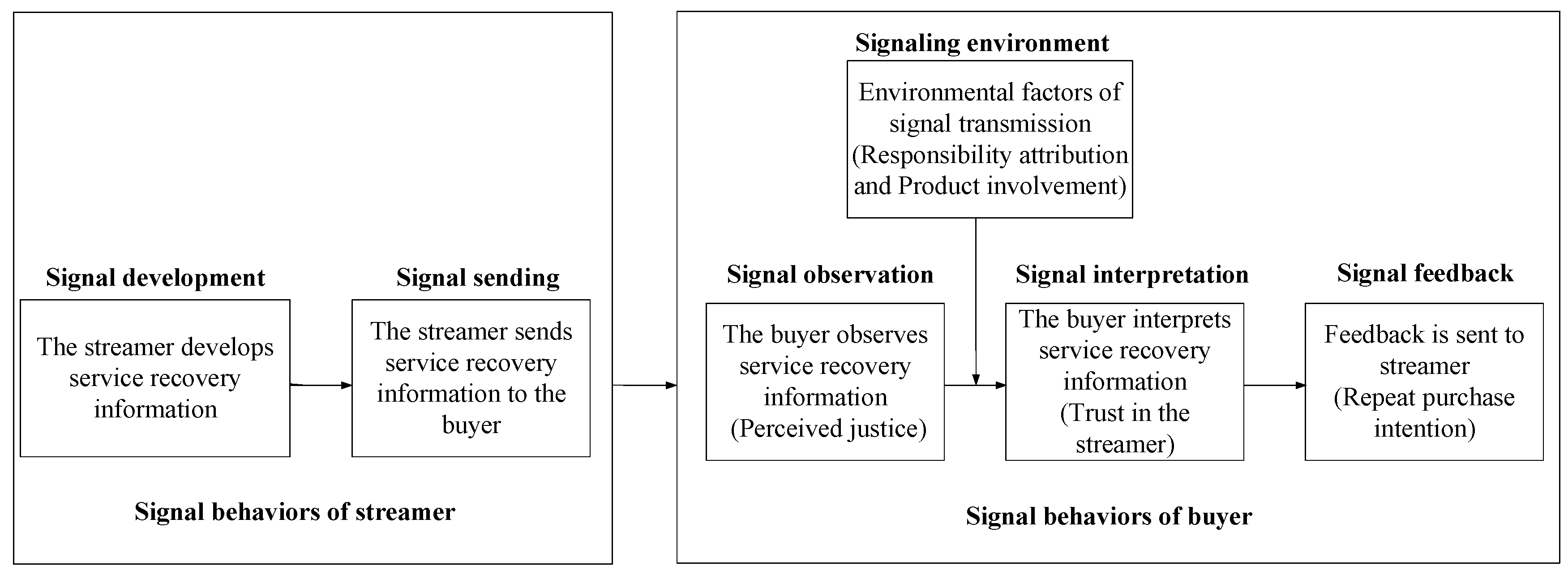
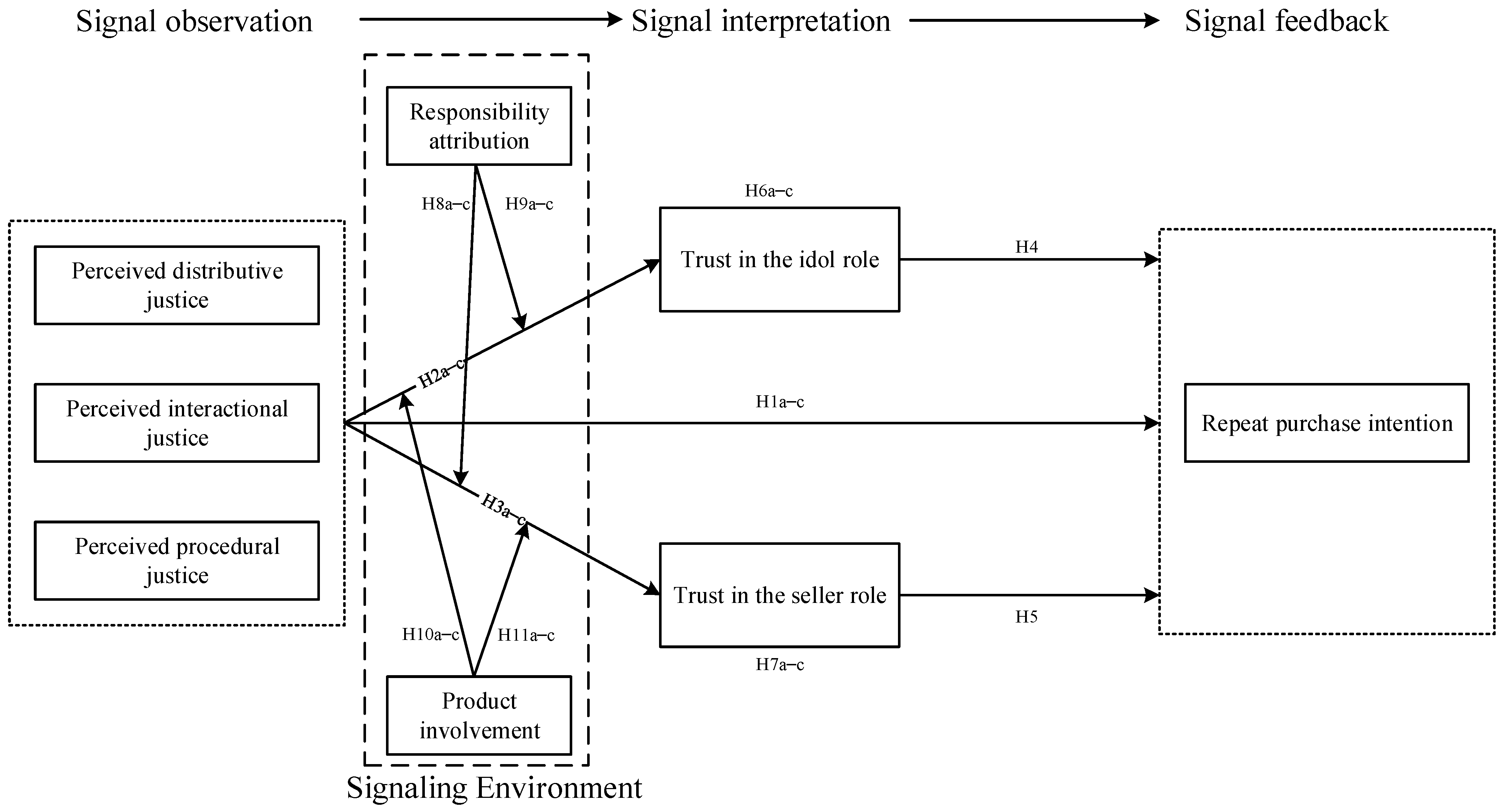
Thus, this study integrates signaling theory with buyers’ perceived justice in service recovery information, trust in the streamers, and repeat purchase intentions to investigate recovery strategies in live streaming e-commerce. As depicted in Figure 1, from the perspective of buyer signal behavior, the study constructs a conceptual framework illustrating how perceived justice (signal observation) influences buyers’ dual-role trust in the streamers (signal interpretation) and leads to repeat purchase intentions (signal feedback). Additionally, based on the distinctive attributes of live streaming e-commerce and existing research, responsibility attribution and product involvement are included as moderating factors (signaling environment) within the model.
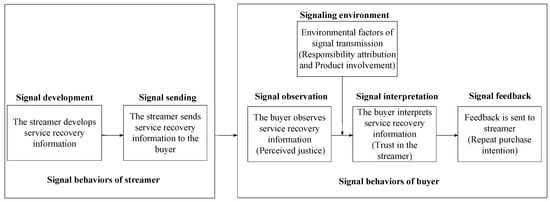
Figure 1.
A conceptual framework for the signaling model of service recovery information.
3. Research Model and Hypotheses
3.1. Perceived Justice and Repeat Purchase Intention
Signaling theory posits that individuals make decisions based on signals emitted by others. For example, buyers choose products or services that are necessary based on observed signals [26]. Perceived distributive justice involves the fair evaluation of tangible outcomes received in response to service failures or complaints. Perceived interactional justice pertains to buyers’ fairness perceptions formed through apologies and respect during service recovery, while perceived procedural justice focuses on how companies address product failures, including rapid response to crises, expressed concern, and flexibility to meet recovery needs [9]. Repeat purchase intention reflects a buyer’s willingness and inclination to buy merchants’ recommended products or services in the future [27]. Justice theory indicates that buyers’ repeat purchase intentions depend on their belief in the fairness of the service provider’s treatment. Effective buyer complaint management after service failures can enhance this repeat purchase intention [28]. Thus, this study posits the following hypotheses:
H1a.
Perceived distributive justice positively influences repeat purchase intention.
H1b.
Perceived interactional justice positively influences repeat purchase intention.
H1c.
Perceived procedural justice positively influences repeat purchase intention.
3.2. Perceived Justice and Trust in the Streamer
Trust in the idol role of the streamer refers to buyers’ recognition of streamers’ personal qualities and attractiveness, alongside their confidence in the streamers’ ability to fulfill commitments [23]. Trust in the seller role of the streamer indicates buyers’ perception of streamers, when acting as sellers, as having trustworthy information-providing capabilities and as offering quality service without exploiting buyers [24]. Following service failures, buyers are likely to encounter service recovery information from merchants, at which point fair treatment can lead them to believe that merchants will meet their psychological expectations and provide a positive consumption experience [29]. Research suggests that buyers equate perceived justice treatment with a mutual trust contract maintained by merchants [30]. Thus, this study posits the following hypotheses:
H2a.
Perceived distributive justice positively influences trust in the idol role of the streamer.
H2b.
Perceived interactional justice positively influences trust in the idol role of the streamer.
H2c.
Perceived procedural justice positively influences trust in the idol role of the streamer.
H3a.
Perceived distributive justice positively influences trust in the seller role of the streamer.
H3b.
Perceived interactional justice positively influences trust in the seller role of the streamer.
H3c.
Perceived procedural justice positively influences trust in the seller role of the streamer.
3.3. Trust in the Streamer and Repeat Purchase Intention
Role theory suggests that the trust placed in individual roles within social contexts significantly influences decision-making processes [31]. From a buyers’ perspective, trust in the idol role of the streamer provides an efficient and cost-effective method to engage in commercial activities. Furthermore, studies in social e-commerce reveal that trust in the celebrity persona of social media users enhances buyer willingness to participate in social commerce [32]. Within the realm of live-stream shopping, buyers depend on various commercial clues to bolster their trust in the seller role of the streamer. When buyers believe they can obtain valuable insights and guidance from streamers, they feel obligated to engage actively in live-stream shopping. Previous research has verified the positive influence of trust on repeat purchase intentions, while a lack of trust in sellers reduces the motivation for continued transactions [33]. Thus, this study posits the following hypotheses:
H4.
Trust in the idol role of the streamer positively influences repeat purchase intention.
H5.
Trust in the seller role of the streamer positively influences repeat purchase intention.
3.4. The Mediating Role of Trust in the Streamer
According to justice theory, when buyers perceive and trust the justice of sellers within an exchange relationship, they are more inclined to sustain this justice- and trust-based relationship [34]. During instances of service failure, if sellers exhibit high levels of integrity and responsibility during recovery efforts, buyers are likely to develop trust in them [35]. This trust extends beyond mere confidence in the transactional relationship, encompassing an appreciation of the seller’s charisma, expertise, and ethical standards, all of which can enhance customer loyalty [36]. Moreover, trust reduces buyers’ perceived risk associated with purchasing, increasing their willingness to buy products recommended by reliable merchants. Studies on live streaming e-commerce failures indicate that buyer trust in the streamers acts as a mediator between the streamer’s coping strategies and buyers’ subsequent behavioral intentions [4]. Thus, this study posits the following hypotheses:
H6a.
Trust in the idol role of the streamer mediates the relationship between perceived distributive justice and repeat purchase intention.
H6b.
Trust in the idol role of the streamer mediates the relationship between perceived interactional justice and repeat purchase intention.
H6c.
Trust in the idol role of the streamer mediates the relationship between perceived procedural justice and repeat purchase intention.
H7a.
Trust in the seller role of the streamer mediates the relationship between perceived distributive justice and repeat purchase intention.
H7b.
Trust in the seller role of the streamer mediates the relationship between perceived interactional justice and repeat purchase intention.
H7c.
Trust in the seller role of the streamer mediates the relationship between perceived procedural justice and repeat purchase intention.
3.5. The Moderating Role of Responsibility Attribution
Responsibility attribution refers to the degree to which buyers believe merchants are accountable for service failures [37]. It typically constitutes a subjective judgment based on buyers’ reflection and inference regarding negative events or outcomes. Research in service recovery suggests that responsibility attribution plays a crucial role in interpreting actions as justice or injustice, and that the effectiveness of service recovery is affected by how buyers attribute responsibility [38]. When buyers perceive that a service failure arises from a merchant’s controllable actions, they tend to exhibit stronger anger and a desire to retaliate against the merchant, resulting in negative reactions [39]. In the context of live streaming e-commerce failures, if buyers perceive the streamer as significantly responsible for the live streaming e-commerce failure, they often experience strong negative emotions. Despite the streamer’s efforts to accept responsibility and offer reasonable compensation, buyers may continue to question the streamer’s character and sincerity. Thus, this study posits the following hypotheses:
H8a.
Buyers’ responsibility attribution to the streamer will inhibit the influence of perceived distributive justice on trust in the seller role.
H8b.
Buyers’ responsibility attribution to the streamer will inhibit the influence of perceived interactional justice on trust in the seller role.
H8c.
Buyers’ responsibility attribution to the streamer will inhibit the influence of perceived procedural justice on trust in the seller role.
H9a.
Buyers’ responsibility attribution to the streamer will inhibit the influence of perceived distributive justice on trust in the idol role.
H9b.
Buyers’ responsibility attribution to the streamer will inhibit the influence of perceived interactional justice on trust in the idol role.
H9c.
Buyers’ responsibility attribution to the streamer will inhibit the influence of perceived procedural justice on trust in the idol role.
3.6. The Moderating Role of Product Involvement
Product involvement refers to the extent of buyer attention toward a product and its significance and impact on their lives [40]. As product involvement increases, buyers employ more varied criteria during the purchasing decision process to ensure product quality, subsequently influencing their attitudes towards product outcomes [41]. Given the elevated expectations associated with high-involvement products, live streaming e-commerce failures resulting in unmet expectations provoke significant disappointment and dissatisfaction among buyers. Despite the streamer’s efforts in service recovery, the gap between expectations and reality tends to erode buyer trust in the streamer. Prior research reveals that buyers with heightened expectations are more prone to make self-impacting behavioral decisions due to unsatisfactory product outcomes [42]. Thus, this study posits the following hypotheses:
H10a.
Buyers’ product involvement will inhibit the influence of perceived distributive justice on trust in the idol role.
H10b.
Buyers’ product involvement will inhibit the influence of perceived interactional justice on trust in the idol role.
H10c.
Buyers’ product involvement will inhibit the influence of perceived procedural justice on trust in the idol role.
H11a.
Buyers’ product involvement will inhibit the influence of perceived distributive justice on trust in the seller role.
H11b.
Buyers’ product involvement will inhibit the influence of perceived interactional justice on trust in the seller role.
H11c.
Buyers’ product involvement will inhibit the influence of perceived procedural justice on trust in the seller role.
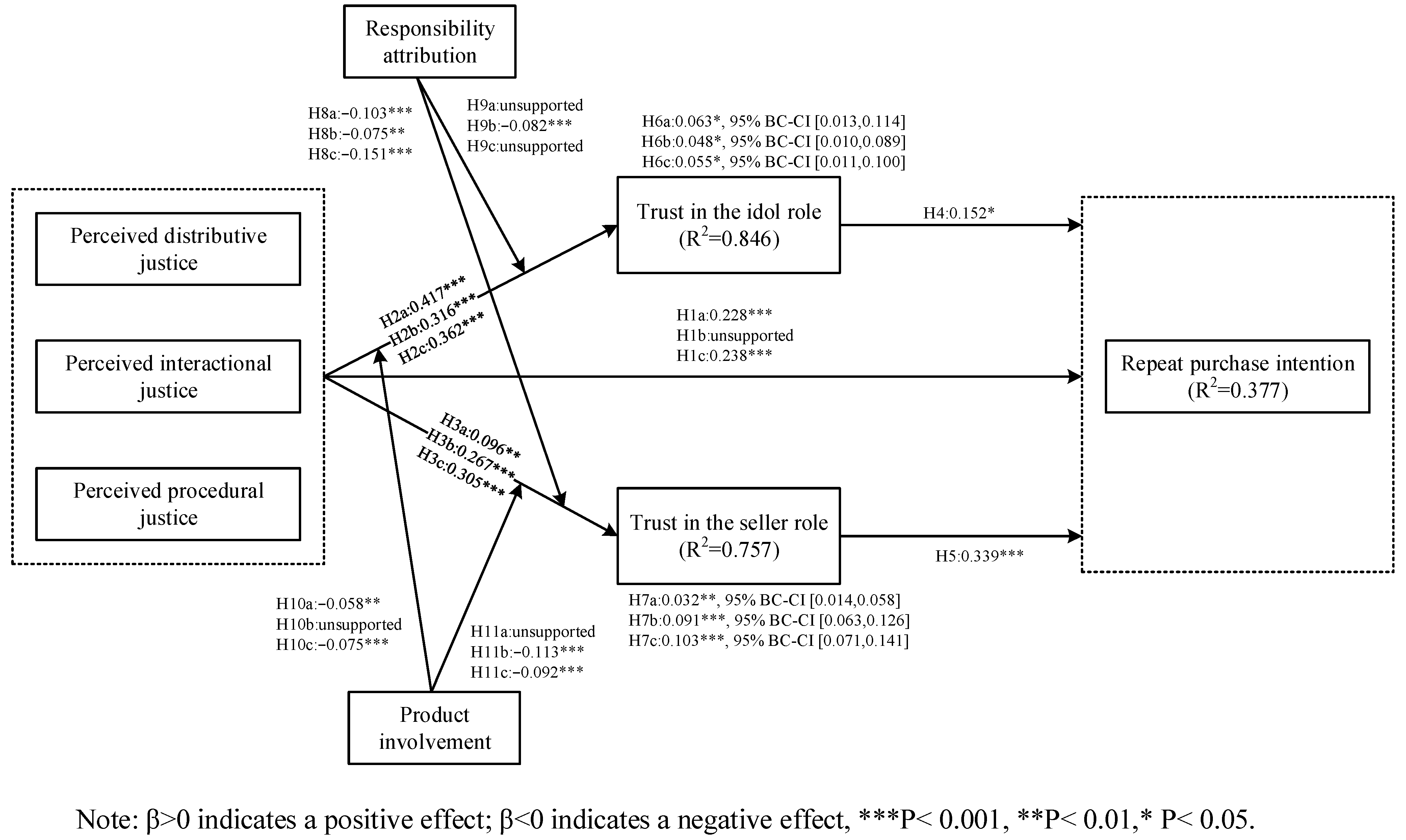
Therefore, the research model of this study is shown in Figure 2.
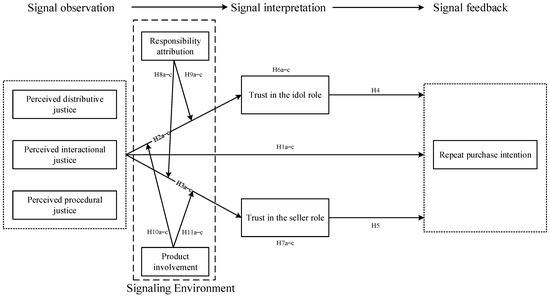
Figure 2.
Research model.
4. Methodology
4.1. Sample and Data Collection
The data were collected from Chinese buyers who had experienced service recovery efforts conducted by streamers on live streaming e-commerce platforms. Due to the requirement that participants must have encountered a specific service incident, a non-probability sampling method was employed, combining purposive and convenience sampling. The purposive approach involved a screening question to verify relevant experience, while the convenience approach involved recruiting participants through Credamo, a professional online survey platform that enables broad outreach but does not ensure a fully random sample of the general population. Data were collected via the professional online survey platform Credamo, which facilitated the questionnaire distribution to its panel members. To ensure participants had relevant experience with service recovery after live streaming e-commerce failures, the survey began with a crucial screening question: “Have you experienced service recovery on any live streaming e-commerce platform? (Yes/No).” Only respondents who answered “Yes” were eligible to continue with the full survey. To enhance participant understanding of the core concept, examples of typical ‘service recovery information’ communicated by streamers were provided at the beginning of the relevant survey section. A total of 443 initial responses were collected. Of these, 42 respondents were excluded for indicating that they had not paid attention to the service recovery information provided by streamers, rendering their responses invalid for analyzing perceptions of such information. The final valid sample comprised 401 respondents.
Regarding sample representativeness, it is important to note that, although the sample is not statistically representative of the entire Chinese live streaming e-commerce buyer population, it remains appropriate and informative for the theoretical objectives of this study. The sample captures the perceptions and behaviors of the targeted segment—buyers who actively engage with live streaming platforms and have experienced a service failure followed by a recovery attempt. The demographic profile of our sample (see Table 1) broadly aligns with that of active digital buyers in China, who tend to be relatively young, educated, and urban. For example, the majority of respondents are aged between 26 and 35 years (62.1%), hold a college degree or higher (76.8%), and have a monthly income exceeding 2000 RMB (71.3%). This profile is consistent with reports on the core user base of major Chinese live streaming e-commerce platforms. While the general population includes older and less digitally engaged segments, they are less likely to be the primary focus of this research. Consequently, the sample provides a valid basis for testing the proposed theoretical relationships within the relevant buyer segment. This study employed G*Power 3.1 to perform an a priori power analysis, determining the minimum sample size needed to test the proposed model. The analysis indicated that at least 123 participants were required to achieve adequate statistical power. With a final sample of 401 participants, the study exceeds this threshold, providing sufficient power to detect the hypothesized effects. Demographic information—including gender, education level, age, and monthly income—is summarized in Table 1.

Table 1.
Demographic information.
4.2. Measurements
All measurement items were derived from existing research and refined in accordance with this study’s research framework definitions and context. Specifically, perceived distributive justice (three items) and perceived interactional justice (three items) were adapted from Fu et al. [43]. Perceived procedural justice (four items) was based on Ali et al. [20]. Trust in the idol role (five items) was adapted from Su et al. [32] and Ohanian [44]. Trust in the seller role (four items) was adapted from Wongkitrungrueng and Assarut [45] and Kim and Park [46]. Repeat purchase intention (three items) was adapted from Hsu et al. [47]. Product involvement (five items) was adapted from Zhang et al. [40]. Responsibility attribution (three items) was informed by Chen et al. [30] and Grégoire and Fisher [48]. All items were assessed using a 7-point Likert scale. The measurement items are presented in Table 2.
Table 2.
Measurement items.
5. Results and Analysis
This study utilizes the PLS-SEM method. PLS-SEM was selected for this study due to several compelling reasons: (a) the research is primarily oriented towards prediction, necessitating hypothesis testing involving mediation and moderation, (b) the structural model features complex mediation chains and multiple moderators, which PLS-SEM handles effectively, and (c) the data do not meet the multivariate normality assumption required for CB-SEM. Consequently, PLS-SEM is particularly suitable for our study. PLS-SEM is applied in two stages: measurement model testing and structural model testing. The former deals with the reliability and validity of the structure, while the latter measures the correlation between variables.
5.1. Measurement Model
The study employed Smart PLS 3.0 software to evaluate the reliability and validity of the measurement model. As shown in Table 3, the variable loadings ranged from 0.809 to 0.937, exceeding the standard threshold of 0.7. The Cronbach’s α values ranged from 0.754 to 0.946, while the composite reliability (CR) values ranged from 0.859 to 0.959. These values surpass the recommended benchmark of 0.7, indicating robust model reliability. Additionally, all average variance extracted (AVE) values exceeded 0.60, fulfilling the requirements for convergent validity. Discriminant validity was further examined using the heterotrait–monotrait (HTMT) ratio and the Fornell–Larcker criterion, as recommended by Henseler et al. [49]. As indicated in Table 4, the square roots of AVE values were greater than the corresponding correlation coefficients, and all HTMT values remained below the 0.90 threshold, confirming sufficient discriminant validity [50].
Table 3.
Constructs, items, and reliability.
Table 4.
The correlation matrix of variables and the HTMT discriminant validity test.
Moreover, common method bias was tested using Harman’s single-factor test, showing that the maximum variance explained by a single factor was 30.53%, with a cumulative variance explanation rate of 75.06%. Because the first factor’s variance explanation did not account for half of the cumulative variance [51], no significant common method bias was detected. Finally, multicollinearity among indicators was assessed. All full collinearity VIF values ranged from 1.077 to 2.138, remaining well below the critical threshold of 3.33, which confirms the absence of significant multicollinearity issues [52].
5.2. Structural Model
This study evaluated the proposed model. As illustrated in Figure 3, the R2 for the entire model concerning repeat purchase intention (RPI) is 0.377. In comparison, the R2 values for the other explained variables, namely trust in the idol role (TIR) and trust in the seller role (TSR), are 0.846 and 0.757, respectively, suggesting that the model possesses strong explanatory power [53]. These high R2 values suggest that the three perceived justice dimensions collectively account for a significant portion of the variance in TIR and TSR. This finding is theoretically plausible, as the fairness of service recovery directly influences both affective and cognitive-based trust. Additionally, the Q2 values for RPI, TIR, and TSR are 0.248, 0.836, and 0.741, indicating substantial predictive relevance of the endogenous constructs [54]. We further assessed out-of-sample predictive power using PLSpredict (10 folds, 10 repetitions) [55]. The PLS-SEM prediction errors (RMSE/MAE) were: RPI-0.872/0.729, TIR-0.407/0.316, TSR-0.512/0.394. For all three endogenous constructs, the PLS-SEM prediction errors (RMSE) were consistently lower than the linear model (LM) benchmark for the majority of indicators, confirming moderate predictive power. The SRMR for the model is 0.045, which is below the recommended threshold of 0.08, indicating a good global model fit.
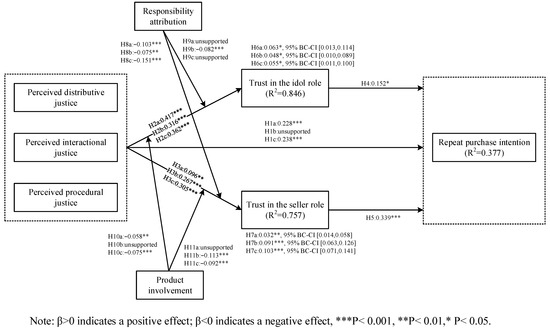
Figure 3.
Results of path analysis.
Furthermore, to examine the influence of relationships among variables, the study employed the bootstrapping resampling procedure in SmartPLS 3.0 for path analysis, with 5000 iterations. The results are presented in Table 5 and Figure 3. It was found that H1b, H9a, H9c, H10b and H11a (β = 0.009, p = 0.823, f2 = 0.000; β = −0.028, p = 0.142, f2 = 0.005; β = −0.018, p= 0.411, f2 = 0.002; β = −0.030, p = 0.113, f2 = 0.005; β = 0.000, p = 0.985, f2 = 0.000) are unsupported; all other hypotheses are supported. To further examine the role of TIR and TSR in the relationship between buyer perceived justice and repeat purchase intention, the results shown in Table 6 indicate that all indirect effects exclude zero in the 95% bias-corrected confidence interval, thus supporting Hypotheses H6a, H6b, H6c, H7a, H7b, and H7c.
Table 5.
Results of hypothesis testing.
Table 6.
Results of mediation effect test.
6. Discussion
6.1. Discussion of the Findings
This study yields several key findings. Firstly, buyers’ positive perceptions of specific justice dimensions regarding service recovery information from streamers can lead to positive feedback to some extent. Consistent with expectations, perceived distributive justice and procedural justice positively influenced repeat purchase intention. However, perceived interactional justice did not have a significant direct effect (H1b unsupported). This non-finding refines the signaling model by suggesting that interactional justice—while valuable for building relational trust—may not directly translate into repurchase behavior in the live streaming service recovery context. Buyers may perceive polite and respectful communication as a minimum expectation rather than a signal that reduces uncertainty about future transactions [56]; instead, material compensation and efficient procedures serve as stronger direct signals of streamer reliability [57,58]. Thus, H1b’s lack of support indicates that the signaling effectiveness of interactional justice is indirect, rather than directly influencing behavioral intention.
Secondly, trust in the role of the streamer is an important signal transmission path in the signaling model as a result of the signal interpretation of service recovery information. Perceived justice positively influenced both idol-role trust and seller-role trust, and both types of trust positively affected repeat purchase intention. Importantly, perceived justice had a stronger impact on idol-role trust than on seller-role trust, whereas seller-role trust had a stronger impact on repeat purchase intention than idol-role trust. This asymmetry reveals a two-stage signaling process: service recovery signals first satisfy buyers’ emotional needs (idol trust), but final repurchase decisions rely more heavily on transactional confidence (seller trust) [59]. This extends signaling theory by showing that the same signal can trigger distinct interpretation pathways that differentially influence ultimate outcomes.
Finally, the environmental factors of signal transmission significantly moderate the impact of signal receivers’ observation of service recovery information on information interpretation. Responsibility attribution and product involvement generally inhibited the positive effect of perceived justice on trust, but with notable exceptions: H9a, H9c, H10b, and H11a were not supported. These unsupported hypotheses do not invalidate the signaling model; rather, they refine its boundary conditions. The reason why H9a and H9c are not supported is that, when buyers attribute high responsibility to the streamer, they may still maintain idol-role trust if they receive substantial compensation (distributive justice) or observe fair procedures (procedural justice), because emotional dependence on the streamer’s persona can override blame attribution [60]. This suggests that for affect-based trust, material signals can sometimes bypass attribution effects—a nuance not anticipated in our original model. The lack of support for H10b indicates that high product involvement did not inhibit the effect of interactional justice on idol-role trust. On the contrary, highly involved buyers may scrutinize the streamer’s interactional sincerity more closely, making interactional justice a stronger signal for idol trust. This challenges our initial assumption that involvement uniformly weakens justice effects; instead, involvement may amplify certain justice dimensions. The lack of support for H11a reveals that distributive justice (compensation) remained positively influential on seller-role trust even under high product involvement. This indicates that distributive justice is a fundamental transactional obligation; regardless of product importance, buyers expect fair compensation, and involvement does not moderate this baseline requirement [61].
6.2. Theoretical Implications
This study enhances the theoretical understanding of service recovery following failures in live streaming e-commerce by broadening signaling theory beyond the conventional justice–trust–intention framework. Specifically, signaling theory offers three distinct insights that a pure justice model cannot provide: it directly addresses the issue of information asymmetry between streamers and buyers, elucidating how service recovery information reduces uncertainty regarding future behavior and therefore clarifies the mechanism by which perceived justice is transformed into trust and subsequent repurchase; it differentiates between signal observation and signal interpretation, enabling the theorization that the same observed signal may be interpreted differently based on the receiver’s role-based trust in streamers (as idol or seller), an analytical step missing in traditional justice models; it conceptualizes moderators as characteristics of the signaling environment that impact the signal transmission process, thereby refining boundary conditions that a pure justice framework would find challenging to establish. Specifically, the details are as follows:
Firstly, previous research has predominantly addressed the issue of information asymmetry concerning products prior to purchase in the realm of live streaming e-commerce [62,63], with limited emphasis on the post-purchase phase. This study integrates the theoretical perspectives of signaling theory with service recovery information pertinent to failures in live streaming e-commerce, providing a novel viewpoint for examining the influence of service recovery information on buyers’ behavior following such failures. Specifically, this research extends the application of signaling theory in the context of live streaming e-commerce failures by elucidating how buyers’ perceived justice (signal observation) of service recovery information affects their trust in the role of the streamer (signal interpretation) and repeat purchase intentions (signal feedback). Furthermore, the signaling model of service recovery information constructed in this study provides a theoretical framework for guiding research on buyer behavior following service failures, which largely mitigates the phenomenon of increased uncertainty resulting from live streaming e-commerce failures.
Secondly, this study constructs a complex interpretation pathway for buyer responses to service recovery information. Specifically, it considers buyer trust in the dual roles of the streamer as the result of information interpretation and distinguishes the functional differences in these two types of role trust in the service recovery of live streaming e-commerce. Prior research primarily emphasizes buyers’ trust in the streamer’s singular seller role [45]. In contrast, this study differentiates buyers’ trust in the streamer along emotional and competence dimensions, aligning with the features of live streaming e-commerce. Additionally, the mediating role of dual-role trust offers profound insights into the complex trust mechanisms and information interpretation pathways within live streaming e-commerce environments.
Finally, although prior research has examined the role of responsibility attribution and product involvement in service recovery efforts [64,65], this study investigates these elements as environmental factors in the transmission of service recovery information. We explore how these factors moderate the relationship between buyers’ positive observations of service recovery information and signal interpretation following failures in live streaming e-commerce, thereby enhancing the signaling model within this context. Moreover, the significant influence of environmental factors (responsibility attribution and product involvement) on the relationship between perceived justice and trust in the role of the streamer aids in understanding the boundary conditions under which buyers’ perceived justice operates, particularly from the perspectives of attribution and product-related factors.
6.3. Managerial Implications
To prevent redundancy and overload in service recovery information and enhance its effectiveness and quality, based on our empirical findings, this study provides three sets of actionable management recommendations for service recovery information targeting practitioners in the live streaming e-commerce industry.
First, we provide recommendations regarding the sequence of sending service recovery information. Our results show that distributive justice and procedural justice have significant direct positive effects on repeat purchase intention, whereas interactional justice does not. Therefore, after a service failure, streamers should prioritize sending clear information about what compensation will be offered (e.g., refunds, coupons, exchanges) and how the recovery process will be handled (e.g., clear return steps, timely updates). Only then should they add interactional elements (apologies, respectful language) as a supplement—never as a substitute. This sequence ensures buyers receive the most effective uncertainty-reducing signals first.
Second, we provide recommendations for enhancing the transmission of service recovery information. Our mediation analysis reveals that perceived justice influences repurchase intention through two distinct trust pathways—idol-role trust and seller-role trust—with seller-role trust having a stronger impact. Streamers should therefore design two parallel communication tracks: for seller-role trust, emphasize transactional fairness (compensation policies, product guarantees, after-sale procedures) using professional language and evidence; for idol-role trust, use interactive formats (live chat, Q&A, personal apologies) to restore emotional bonds, but always pair them with substantive distributive/procedural actions, because idol-role trust alone is less effective at converting repurchase intentions.
Finally, we provide recommendations for improving the effectiveness of service recovery information. Our moderation results show that responsibility attribution and product involvement generally weaken the effect of perceived justice on trust, but with important exceptions. When buyers highly blame the streamer, streamers should still offer substantial compensation and fair procedures—these signals can preserve idol-role trust even under blame (H9a, H9c unsupported). When product involvement is high, do not reduce interactional justice; highly involved buyers remain sensitive to sincere communication (H10b unsupported). Streamers should standardize compensation rules (e.g., “three-fold compensation for fakes”) regardless of product price and upgrade communication professionalism. For low-involvement products, efficiency and speed of recovery may outweigh personalized interaction. Because distributive justice is a fundamental transactional obligation (H11a unsupported), streamers must never compromise on fair compensation, irrespective of product value or buyer involvement level.
6.4. Limitations and Future Research
While this study offers notable contributions, it also has certain limitations. Firstly, data collection was conducted via an online survey to gauge buyer perceptions of service recovery information for live streaming failures, which may be subject to retrospective memory bias. Future research should consider employing more robust methods, such as experimental approaches including VR simulations of failure scenarios, or real-time diary studies, to more accurately assess buyer perceptions. Our structural model explained a substantial proportion of variance in trust in the idol role (R2 = 0.846) and trust in the seller role (R2 = 0.757). While we have offered theoretical justification, we recognize that conceptual overlap between perceived justice dimensions and trust constructs may partially inflate these high R2 values. Therefore, future research should aim to replicate our model using different operationalizations that more distinctly differentiate justice from trust. For instance, experimental vignettes with objective fairness manipulations or measurement items designed to reduce semantic overlap can be employed. These approaches would help ascertain whether the high R2 values reflect genuinely strong relationships or merely shared method variance.
Secondly, the cross-cultural generalizability of our findings is limited as all data were collected from Chinese buyers within a specific live streaming e-commerce environment. While China is one of the largest and most developed live streaming e-commerce markets, its cultural characteristics, such as collectivism and the distinctive “fan economy,” may influence how buyers perceive service recovery signals and establish dual-role trust. Additionally, the distinction between idol-role trust and seller-role trust may be more pronounced in East Asian contexts where celebrity endorsements and parasocial relationships are particularly strong. Therefore, our findings may not be directly applicable to Western or other non-Asian markets. Future research should aim to replicate our model in diverse cultural settings and, if possible, conduct cross-cultural comparisons using multi-group analysis or measurement invariance tests. Such studies would help determine whether the signaling mechanisms we identified are universal or context-dependent.
Thirdly, although the sample size is deemed adequate, it is demographically narrow, with a predominance of young buyers. Future studies should incorporate a more diverse range of participants, including middle-aged, elderly, and low-income rural buyers, to encompass a wider array of user experiences with live streaming e-commerce failures. Our study focused exclusively on service recovery information sent directly by streamers as the primary signal. However, in live streaming e-commerce, buyers also evaluate streamers based on other customers’ reviews. These social signals may interact with or even override the streamer’s own recovery signals, especially when inconsistencies exist. Future research could incorporate other customers’ reviews as an additional signaling mechanism or as a moderator of perceived justice effects. Excluding this dimension limits the comprehensiveness of our signaling model.
Fourthly, our screening procedure only ensured that respondents had encountered a service failure and subsequent recovery on live streaming platforms. However, we did not control for critical characteristics of the failure event, such as the failure type (e.g., product defect, delivery delay, poor service attitude), severity (e.g., minor inconvenience versus major loss), timing (e.g., recency of the failure within a three-month window), or the perceived outcome of the recovery (e.g., full compensation versus partial apology). These factors likely influence perceived justice, trust in the streamer, and repeat purchase intention. For example, minor failures may be more easily repaired by interactional justice, whereas severe failures likely require strong distributive and procedural justice to rebuild trust. Failure timing might moderate the dual-role trust mechanisms, and recovery outcome might further mediate or moderate the justice–trust link. Future research should systematically measure and control these variables or employ experimental designs that manipulate failure and recovery scenarios to isolate causal effects.
7. Conclusions
This study, grounded in signaling theory, elucidates the relationship between buyers’ signal behaviors concerning service recovery information provided by streamers in the aftermath of live streaming e-commerce service failures. Specifically, perceived justice (signal observation) influences buyers’ repeat purchase intentions (signal feedback) through their trust in the dual roles of the streamers (signal interpretation). The research indicates that the responsibility attribution and product involvement, as environmental factors in signal transmission, can moderate the relationship between perceived justice and trust in the streamer. Additionally, the signaling model for service recovery information developed in this study broadens the application of signal theory to live streaming e-commerce, offering a novel perspective for trust research within this domain by emphasizing buyers’ trust in the streamers’ dual roles (idol role and seller role). Furthermore, based on empirical analysis, this study provides several essential service recovery information management recommendations for practitioners in the live streaming e-commerce sector. Based on the research framework proposed in this study, future research can examine differences in information across diverse e-commerce sales scenarios and the interactions between other potential consumer signal behaviors.
Author Contributions
Conceptualization, M.Q. and Z.J.; Funding acquisition, M.Q.; Methodology, Z.J., Supervision, Z.J. and Z.P.; Writing—original draft, Z.J. and Z.P.; Writing—review & editing, M.Q. and Z.J. All authors have read and agreed to the published version of the manuscript.
Funding
This work was supported by the National Natural Science Foundation of China (Grant No. 72362025).
Institutional Review Board Statement
The study was conducted in accordance with the Declaration of Helsinki, and approved by Ethics Committee of Research Center of Management Science and Engineering, Jiangxi Normal University (protocol code 20240301 and date of approval 1 March 2024).
Informed Consent Statement
Informed consent was obtained from all subjects involved in the study.
Data Availability Statement
The data presented in this study are available on request from the corresponding author.
Conflicts of Interest
The authors declare no conflict of interest.
References
- Huang, L.; Ma, L. A protective buffer or a double-edged sword? Investigating the effect of “parasocial guanxi” on consumers’ complaint intention in live streaming commerce. Comput. Hum. Behav. 2024, 151, 108022. [Google Scholar] [CrossRef]
- Xiong, J.; Li, F. How do live-streamers attract their consumers: Insights from a multi-group analysis. Asia Pac. J. Mark. Logist. 2024, 36, 3353–3370. [Google Scholar] [CrossRef]
- Wang, Q.; Yao, X.; Li, X.; Yan, X.; Li, R. When peripheral route meets central route: An elaboration likelihood model of sales performance in live commerce. J. Retail. Consum. Serv. 2025, 84, 104218. [Google Scholar] [CrossRef]
- Chen, J.; Gong, X.; Ren, R. Active or avoidance coping? Influencing mechanisms of streamers’ coping strategies on viewers’ word of mouth after livestreaming e-commerce failures. J. Retail. Consum. Serv. 2023, 72, 103278. [Google Scholar] [CrossRef]
- Lu, P.; Fang, L.; Chen, Q.; Ma, X. Failed products, successful influencers: The moderating effect of the stealing thunder strategy on purchase intentions in live-streaming e-commerce failures. Asia Pac. J. Mark. Logist. 2024, 37, 2075–2089. [Google Scholar] [CrossRef]
- Liu, F.; Wang, Y.; Dong, X.; Zhao, H. Marketing by live streaming: How to interact with consumers to increase their purchase intentions. Front. Psychol. 2022, 13, 933633. [Google Scholar] [CrossRef] [PubMed]
- Zhang, M.; Liu, Y.; Wang, Y.; Zhao, L. How to retain customers: Understanding the role of trust in live streaming commerce with a socio-technical perspective. Comput. Hum. Behav. 2022, 127, 107052. [Google Scholar] [CrossRef]
- Yang, C.Y.; Koh, B.X.; Chew, K.W. How live streaming influences trust in social commerce: A parasocial relationship perspective. Telemat. Inform. 2025, 99, 102274. [Google Scholar] [CrossRef]
- Blodgett, J.G.; Granbois, D.H.; Walters, R.G. The effects of perceived justice on complainants’ negative word-of-mouth behavior and repatronage intentions. J. Retail. 1993, 69, 399–428. [Google Scholar] [CrossRef]
- Su, Z.; Ha, H.Y. Longitudinal impact of perceived fairness after service failures: Evidence from online travel agencies. Int. J. Hosp. Manag. 2025, 128, 104177. [Google Scholar] [CrossRef]
- Liu, Y.; Cheng, P.; Ouyang, Z. How trust mediate the effects of perceived justice on loyalty: A study in the context of automotive recall in China. J. Retail. Consum. Serv. 2021, 58, 102322. [Google Scholar] [CrossRef]
- Bergh, D.D.; Connelly, B.L.; Ketchen, D.J., Jr.; Shannon, L.M. Signalling theory and equilibrium in strategic management research: An assessment and a research agenda. J. Manag. Stud. 2014, 51, 1334–1360. [Google Scholar] [CrossRef]
- Kharouf, H.; Lund, D.J.; Krallman, A.; Pullig, C. A signaling theory approach to relationship recovery. Eur. J. Mark. 2020, 54, 2139–2170. [Google Scholar] [CrossRef]
- Jones, C.L.E.; Hancock, T.; Kazandjian, B.; Voorhees, C.M. Engaging the Avatar: The effects of authenticity signals during chat-based service recoveries. J. Bus. Res. 2022, 144, 703–716. [Google Scholar] [CrossRef]
- Nikbin, D.; Marimuthu, M.; Hyun, S.S.; Ismail, I. Relationships of perceived justice to service recovery, service failure attributions, recovery satisfaction, and loyalty in the context of airline travelers. Asia Pac. J. Tour. Res. 2015, 20, 239–262. [Google Scholar] [CrossRef]
- Rhee, C.E.; Choi, J. Effects of personalization and social role in voice shopping: An experimental study on product recommendation by a conversational voice agent. Comput. Hum. Behav. 2020, 109, 106359. [Google Scholar] [CrossRef]
- Connelly, B.L.; Certo, S.T.; Reutzel, C.R.; DesJardine, M.R.; Zhou, Y.S. Signaling theory: State of the theory and its future. J. Manag. 2025, 51, 24–61. [Google Scholar] [CrossRef]
- Spence, M. Competitive and optimal responses to signals: An analysis of efficiency and distribution. J. Econ. Theory 1974, 7, 296–332. [Google Scholar] [CrossRef]
- Lyu, J.; Liang, Y.D.; Vellore Nagarajan, D. Optimizing live streaming engagement through store atmospheric cues: Exploring prosocial behavior and social comparison—Insights from streamers and viewers. Internet Res. 2025, 35, 882–911. [Google Scholar] [CrossRef]
- Ali, F.; El-Manstrly, D.; Abbasi, G.A. Would you forgive me? From perceived justice and complaint handling to customer forgiveness and brand credibility-symmetrical and asymmetrical perspectives. J. Bus. Res. 2023, 166, 114138. [Google Scholar] [CrossRef]
- Alalwan, A.A.; Dwivedi, Y.K.; Rana, N.P. Factors influencing adoption of mobile banking by Jordanian bank customers: Extending UTAUT2 with trust. Int. J. Inf. Manag. 2017, 37, 99–110. [Google Scholar] [CrossRef]
- McKnight, D.H.; Choudhury, V.; Kacmar, C. Developing and validating trust measures for e-commerce: An integrative typology. Inf. Syst. Res. 2002, 13, 334–359. [Google Scholar] [CrossRef]
- Meng, L.M.; Duan, S.; Zhao, Y.; Lü, K.; Chen, S. The impact of online celebrity in livestreaming E-commerce on purchase intention from the perspective of emotional contagion. J. Retail. Consum. Serv. 2021, 63, 102733. [Google Scholar] [CrossRef]
- Zhai, M.; Chen, Y. How do relational bonds affect user engagement in e-commerce livestreaming? The mediating role of trust. J. Retail. Consum. Serv. 2023, 71, 103239. [Google Scholar] [CrossRef]
- Connelly, B.L.; Certo, S.T.; Ireland, R.D.; Reutzel, C.R. Signaling theory: A review and assessment. J. Manag. 2011, 37, 39–67. [Google Scholar] [CrossRef]
- Rosillo-Díaz, E.; Muñoz-Rosas, J.F.; Blanco-Encomienda, F.J. Impact of heuristic-systematic cues on the purchase intention of the electronic commerce consumer through the perception of product quality. J. Retail. Consum. Serv. 2024, 81, 103980. [Google Scholar] [CrossRef]
- Phan Tan, L.; Le, T.H. The influence of perceived price and quality of delivery on online repeat purchase intention: The evidence from Vietnamese purchasers. Cogent Bus. Manag. 2023, 10, 2173838. [Google Scholar] [CrossRef]
- Schoefer, K.; Diamantopoulos, A. The role of emotions in translating perceptions of (in) justice into postcomplaint behavioral responses. J. Serv. Res. 2008, 11, 91–103. [Google Scholar] [CrossRef]
- Ortiz, J.; Chiu, T.S.; Wen-Hai, C.; Hsu, C.W. Perceived justice, emotions, and behavioral intentions in the Taiwanese food and beverage industry. Int. J. Confl. Manag. 2017, 28, 437–463. [Google Scholar] [CrossRef]
- Chen, H.; Li, X.; Chiu, T.S.; Chen, F. The impact of perceived justice on behavioral intentions of Cantonese Yum Cha consumers: The mediation role of psychological contract violation. J. Hosp. Tour. Manag. 2021, 49, 178–188. [Google Scholar] [CrossRef]
- Martinsons, M.G. Relationship-based e-commerce: Theory and evidence from China. Inf. Syst. J. 2008, 18, 331–356. [Google Scholar] [CrossRef]
- Su, C.; Min, Q.; Scornavacca, E.; Liu, Z. A dual-role trust model for social commerce: A guanxi perspective. Inf. Manag. 2021, 58, 103512. [Google Scholar] [CrossRef]
- Raza-Ullah, T. When does (not) a coopetitive relationship matter to performance? An empirical investigation of the role of multidimensional trust and distrust. Ind. Mark. Manag. 2021, 96, 86–99. [Google Scholar] [CrossRef]
- Cohen, R.L. Distributive justice: Theory and research. Soc. Justice Res. 1987, 1, 19–40. [Google Scholar] [CrossRef]
- Hess, R.L., Jr.; Ganesan, S.; Klein, N.M. Service failure and recovery: The impact of relationship factors on customer satisfaction. J. Acad. Mark. Sci. 2003, 31, 127–145. [Google Scholar] [CrossRef]
- Li, Y.; Li, X.; Cai, J. How attachment affects user stickiness on live streaming platforms: A socio-technical approach perspective. J. Retail. Consum. Serv. 2021, 60, 102478. [Google Scholar] [CrossRef]
- Hamilton, V.L. Who is responsible? Toward a social psychology of responsibility attribution. Soc. Psychol. 1978, 41, 316–328. [Google Scholar] [CrossRef]
- Akarsu, T.N.; Marvi, R.; Foroudi, P. Service failure research in the hospitality and tourism industry: A synopsis of past, present and future dynamics from 2001 to 2020. Int. J. Contemp. Hosp. Manag. 2023, 35, 186–217. [Google Scholar] [CrossRef]
- Choi, S.; Mattila, A.S. Perceived controllability and service expectations: Influences on customer reactions following service failure. J. Bus. Res. 2008, 61, 24–30. [Google Scholar] [CrossRef]
- Zhang, Q.; Peng, Z.; Guo, X.; Vogel, D. Product involvement and routine use of a niche product from a well-known company: The moderating effect of gender. Inf. Manag. 2023, 60, 103758. [Google Scholar] [CrossRef]
- Das, M.; Ramalingam, M. What drives product involvement and satisfaction with OFDs amid COVID-19? J. Retail. Consum. Serv. 2022, 68, 103063. [Google Scholar] [CrossRef]
- Traylor, M.B.; Joseph, W.B. Measuring consumer involvement in products: Developing a general scale. Psychol. Mark. 1984, 1, 65–77. [Google Scholar] [CrossRef]
- Fu, J.R.; Ju, P.H.; Hsu, C.W. Understanding why consumers engage in electronic word-of-mouth communication: Perspectives from theory of planned behavior and justice theory. Electron. Commer. Res. Appl. 2015, 14, 616–630. [Google Scholar] [CrossRef]
- Ohanian, R. Construction and validation of a scale to measure celebrity endorsers’ perceived expertise, trustworthiness, and attractiveness. J. Advert. 1990, 19, 39–52. [Google Scholar] [CrossRef]
- Wongkitrungrueng, A.; Assarut, N. The role of live streaming in building consumer trust and engagement with social commerce sellers. J. Bus. Res. 2020, 117, 543–556. [Google Scholar] [CrossRef]
- Kim, S.; Park, H. Effects of various characteristics of social commerce (s-commerce) on consumers’ trust and trust performance. Int. J. Inf. Manag. 2013, 33, 318–332. [Google Scholar] [CrossRef]
- Hsu, M.H.; Chang, C.M.; Chuang, L.W. Understanding the determinants of online repeat purchase intention and moderating role of habit: The case of online group-buying in Taiwan. Int. J. Inf. Manag. 2015, 35, 45–56. [Google Scholar] [CrossRef]
- Grégoire, Y.; Fisher, R.J. Customer betrayal and retaliation: When your best customers become your worst enemies. J. Acad. Mark. Sci. 2008, 36, 247–261. [Google Scholar] [CrossRef]
- Henseler, J.; Ringle, C.M.; Sarstedt, M. A new criterion for assessing discriminant validity in variance-based structural equation modeling. J. Acad. Mark. Sci. 2015, 43, 115–135. [Google Scholar] [CrossRef]
- Hair, J.F., Jr.; Howard, M.C.; Nitzl, C. Assessing measurement model quality in PLS-SEM using confirmatory composite analysis. J. Bus. Res. 2020, 109, 101–110. [Google Scholar] [CrossRef]
- Podsakoff, P.M.; Organ, D.W. Self-reports in organizational research: Problems and prospects. J. Manag. 1986, 12, 531–544. [Google Scholar] [CrossRef]
- Cenfetelli, R.T.; Bassellier, G. Interpretation of formative measurement in information systems research. MIS Q. 2009, 33, 689–707. [Google Scholar] [CrossRef]
- Hair, J.F.; Hult, G.T.M.; Ringle, C.M.; Sarstedt, M.; Thiele, K.O. Mirror, mirror on the wall: A comparative evaluation of composite-based structural equation modeling methods. J. Acad. Mark. Sci. 2017, 45, 616–632. [Google Scholar] [CrossRef]
- Choshin, M.; Ghaffari, A. An investigation of the impact of effective factors on the success of e-commerce in small-and medium-sized companies. Comput. Hum. Behav. 2017, 66, 67–74. [Google Scholar] [CrossRef]
- Almamy, A.S.; Habib, S.; Nasser, L.K.; Hamadneh, N.N. Effect of Explainable AI Features on User Satisfaction and Purchase Intention in Saudi Mobile Shopping Apps. J. Theor. Appl. Electron. Commer. Res. 2026, 21, 120. [Google Scholar] [CrossRef]
- Chen, J.; Du, P. Under the dark side of online trust: How and when livestreamers’ online expressive coping strategy impacts the livestreaming e-commerce failure recovery process. Internet Res. 2025, 35, 1–19. [Google Scholar] [CrossRef]
- Fang, L.; Lu, B.; Zhang, M. When live-streaming fails: Influencer coping strategies, improvisational responses, and consumer purchase intention. J. Retail. Consum. Serv. 2026, 89, 104648. [Google Scholar] [CrossRef]
- Kuo, Y.F.; Wu, C.M. Satisfaction and post-purchase intentions with service recovery of online shopping websites: Perspectives on perceived justice and emotions. Int. J. Inf. Manag. 2012, 32, 127–138. [Google Scholar] [CrossRef]
- Hong, I.B.; Kim, M. Understanding the influence of a host’s guest perceptions on sharing intention on the Airbnb platform: A signaling theory perspective. Telemat. Inform. 2024, 87, 102096. [Google Scholar] [CrossRef]
- Simmons, C.; Krasich, K.; Chitre, A.; Sinnott-Armstrong, W. Does conscious perception render agents more responsible? A study of lay judgments. J. Exp. Soc. Psychol. 2025, 119, 104757. [Google Scholar] [CrossRef]
- Su, L.; Huang, S.S.; Nejati, M. Perceived justice, community support, community identity and residents’ quality of life: Testing an integrative model. J. Hosp. Tour. Manag. 2019, 41, 1–11. [Google Scholar] [CrossRef]
- Hu, M.; Zhang, M.; Wang, Y. Why do audiences choose to keep watching on live video streaming platforms? An explanation of dual identification framework. Comput. Hum. Behav. 2017, 75, 594–606. [Google Scholar] [CrossRef]
- Lin, Y.; Yao, D.; Chen, X. Happiness begets money: Emotion and engagement in live streaming. J. Mark. Res. 2021, 58, 417–438. [Google Scholar] [CrossRef]
- Fayyaz, M.S.; Abbasi, A.Z.; Kumar, S.; Qureshi, A.; Hussain, K.; Muhammad, L. Integrating digital influencer persuasion model and theory of planned behavior: The mediating role of consumer involvement in endorsed brands. J. Retail. Consum. Serv. 2025, 85, 104309. [Google Scholar] [CrossRef]
- Laufer, D.; Coombs, W.T. How should a company respond to a product harm crisis? The role of corporate reputation and consumer-based cues. Bus. Horiz. 2006, 49, 379–385. [Google Scholar] [CrossRef]
Disclaimer/Publisher’s Note: The statements, opinions and data contained in all publications are solely those of the individual author(s) and contributor(s) and not of MDPI and/or the editor(s). MDPI and/or the editor(s) disclaim responsibility for any injury to people or property resulting from any ideas, methods, instructions or products referred to in the content. |
© 2026 by the authors. Licensee MDPI, Basel, Switzerland. This article is an open access article distributed under the terms and conditions of the Creative Commons Attribution (CC BY) license.