
Skip to Content
  • Article
  • Open Access

28 May 2026

Please Don’t Refuse Me: The Impact of Recycled Product Anthropomorphism on Consumer Advertising Avoidance

and
Department of X-Cultural Studies, Kookmin University, Seoul 02727, Republic of Korea
*
Author to whom correspondence should be addressed.

Abstract

Recycled products have evolved from environmental substitutes to an important development direction in the future consumer market. However, consumers’ active avoidance of recycled product advertisements is still prevalent, which restricts their market acceptance and promotion. This study aims to systematically explore the relationship between recycled product anthropomorphism and consumer advertising avoidance, and reveal the mediating role of perceived risk, as well as the moderating effects of technology readiness and time orientation. A mixed exploratory method combining Smart PLS and fsQCA was adopted to conduct an in-depth analysis of 728 questionnaires. The results show that recycled product anthropomorphism has a significant negative impact on consumer advertising avoidance, and this effect is partially realized through the mediating mechanism of perceived risk, which is regulated by technology readiness and time orientation. The research results not only enrich the application of anthropomorphism theory in the field of sustainable consumption but also provide empirical evidence and practical guidance for companies to formulate effective recycled product advertising strategies and reduce consumer advertising avoidance.

1. Introduction

Recycled products are environmentally friendly products processed from waste materials. Due to their contributions to resource recycling and carbon emission reduction, they have attracted much attention in the global sustainable development strategy in recent years. Taking recycled plastics as an example, the global recycled plastic market size was 60.19 billion US dollars in 2025, and it is expected to grow from 65.34 billion US dollars in 2026 to 126.3 billion US dollars in 2034, showing a rapid development trend [1]. Moreover, more and more companies have incorporated recycled products into their core product systems, taking the practice of green development concepts as an important measure to enhance their brand’s sustainable competitiveness. They hope to launch them into the market through diversified design and advertising and marketing methods, so as to find a balance between environmental protection concepts and commercial value. For example, Adidas launched an online short film with the theme of the circular economy, showing the complete process from waste recycling resource treatment to new product formation through continuous narrative; at the same time, it carried out in-depth dialogues with environmental protection opinion leaders and sneaker bloggers on social platforms such as TikTok, thereby strengthening the credibility of the brand’s sustainable concepts (https://wearesocial.com/uk/case-study/adidas-made-to-be-remade/, accessed on 24 February 2026).
However, despite the clear environmental value of recycled products, consumers’ market acceptance of recycled products has not met expectations, with severe practical barriers limiting market conversion and consumer adoption [2]. According to current market feedback, nearly half of consumers will have concerns about the quality and hygiene of recycled products when purchasing them [3], and also have certain worries about the use experience of recycled products. This makes many potential consumers still tend to choose traditional products when making choices, and even have advertising avoidance behaviors. Against this backdrop, mitigating consumer resistance toward recycled products and improving their market acceptance has become an urgent practical issue in the field of sustainable marketing.
From a marketing practice perspective, anthropomorphism serves as a classic consumer engagement strategy widely adopted in e-commerce contexts. By endowing products with human characteristics, emotional attributes, and social identities, anthropomorphism enhances product affinity and emotional bonding, thereby reshaping consumer cognition, attitudes, and behavioral intentions [4]. Prior studies have validated the marketing effectiveness of anthropomorphic strategies across contexts such as defective products and virtual media [5,6]. Within livestream marketing, moderate anthropomorphism of virtual streamers stimulates positive consumer emotions, mitigates information resistance, and improves receptivity toward brand and advertising messages [7,8].
Existing anthropomorphism research suffers from notable limitations regarding research contexts and subjects. Most studies focus on low-risk product categories such as conventional goods and virtual media [9,10], while few conduct in-depth research on recycled products, a special category with both environmental value and perceived risks. Compared with conventional products, recycled products are inherently associated with quality and safety risks, which fundamentally changes how anthropomorphic strategies work [11]. More importantly, current studies have not clarified the internal transmission paths through which recycled product anthropomorphism affects consumer advertising avoidance, nor systematically analyzed the boundary conditions of this process. Addressing these theoretical gaps, this study dissects the internal mechanisms through which recycled product anthropomorphism shapes consumer advertising avoidance. Its findings not only extend the applicability of anthropomorphism theory to sustainable consumption and refine the antecedent framework of risk-driven advertising avoidance but also provide empirical guidance for companies to optimize recycled product promotion strategies, reduce audience information resistance, enhance marketing communication effectiveness, and facilitate the sustainable market diffusion of recycled products.
It is worth noting that in the actual digital marketing scenario of recycled products, consumers’ attitudes towards advertisements are also affected by their personal factors. For example, divergent time orientations lead consumers to hold significantly different attitudes toward recycled products in the context of advertising exposure [12]. Moreover, different from recyclable products, the digital marketing of recycled products not only requires the use of recycled materials, but also emphasizes that the design and production process from the source should be beneficial to the natural environment. Technology readiness reflects consumers’ personal acceptance of technology and may further shape their attitudes toward recycled product advertisements [13]. Therefore, incorporating technology readiness and time orientation into the moderating variables and testing the boundary role of the heterogeneity of the target consumer group is helpful to reveal the influence mechanism in more detail, thereby providing a more targeted decision-making basis for the scenario-based marketing of recycled products.
This study aims to systematically analyze the influence mechanism of recycled product anthropomorphism on consumers’ purchase intention. It divides recycled product anthropomorphism into three dimensions, including visual anthropomorphism, moral virtue anthropomorphism, and identity anthropomorphism, constructs a theoretical model based on perceived risk theory, and analyzes its mechanism through PLS-SEM and fsQCA. Existing studies mostly focus on the positive impact of anthropomorphism on product attitudes [14]; few investigations have explored the inhibitory effect of recycled product anthropomorphism on advertising avoidance, nor have they systematically analyzed the configurational effects of multi-dimensional anthropomorphism and boundary conditions of individual heterogeneity. Therefore, the innovation of this study is mainly reflected in starting from the perspective of a multimodal combination of product anthropomorphism, weakening consumers’ stereotype that recycled products are converted from waste by simulating human interaction, providing a more comprehensive empirical basis for understanding the complex causes of consumer advertising avoidance, and enriching the application boundary of anthropomorphism theory in green marketing scenarios. This study mainly explores the following questions:
  • RQ1: How do combined strategies of visual anthropomorphism, moral virtue anthropomorphism, and identity anthropomorphism for recycled products influence consumer advertising avoidance behaviors toward recycled product advertisements?
  • RQ2: Does perceived risk mediate the relationship between recycled product anthropomorphism and consumer advertising avoidance?
  • RQ3: Do technological readiness and temporal orientation moderate the above-mentioned relationships regarding consumer advertising avoidance behaviors?

2. Literature Review

2.1. Perceived Risk Theory

Perceived risk theory reflects that consumers will face the perception of potential negative consequences due to uncertain outcomes during the purchase decision-making process, and this perception will directly affect their purchase attitudes and behaviors [15,16]. Moreover, according to different product categories and consumption scenarios, perceived risk is refined into six specific dimensions, such as quality risk and functional risk [17,18]. It is worth noting that consumer psychological resistance to recycled products is not universal [19]; instead, it is highly contingent on product-specific characteristics reflected in three core dimensions, including raw material sources, functional recovery levels, and cognitive heterogeneity among consumers. This forms the fundamental premise for examining perceived risks of recycled products in this study.
Specifically, in terms of raw material sources, recycled products differ substantially in their waste material origins. Some products rely on standardized recycling channels with traceable raw materials and rigorous screening criteria, whereas others use mixed-source raw materials. Consumers worry that inadequately treated recycled feedstocks may contain residual harmful substances and pose potential health risks [20], triggering strong skepticism and resistance. Furthermore, whether recycled products perform functionally as well as conventional non-recycled alternatives constitutes a key criterion for consumer risk assessment [21]. When evaluating functional performance, consumers instinctively take conventional virgin material products as the primary benchmark and form inherent expectations regarding overall quality. They particularly focus on durability, structural stability, and long-term safety reliability to judge whether recycled products meet standard quality requirements. Such quality perceptions and functional expectations derived from conventional products significantly shape consumers’ subjective risk perceptions. When consumers are uncertain about the actual performance, usage stability, and functional durability of reprocessed recycled products, they worry that recycled items cannot match conventional virgin material products in usage experience, core functionality, and long-term performance [22]. Consequently, they perceive recycled products as unable to satisfy core daily needs, further intensifying functional-related concerns.
More importantly, consumers exhibit considerable individual differences in their knowledge of and willingness to accept recycled products. Consumers with high environmental awareness tend to better understand production processes and quality control measures of recycled products, resulting in lower risk perceptions. In contrast, consumers lacking relevant knowledge may equate recycled products with low quality or unsafe goods, leading to higher overall perceived risks. Multiple perceived risks stemming from raw material sources, functional recovery levels, and cross-consumer cognitive differences intertwine to form psychological barriers to consumer adoption of recycled products. This also provides an important theoretical foundation for this study to investigate the risk-mitigating effect of anthropomorphic strategies.

2.2. Recycled Product Anthropomorphism

Since the origin of human beings, anthropomorphism has served as a vital cognitive and expressive approach [23]. Through anthropomorphism, humans can project their own emotions, intentions and experiences onto the external world [24], transforming unfamiliar, abstract and uncontrollable natural phenomena and objective things into more understandable objects, thereby reducing cognitive load. While anthropomorphic strategies for ordinary products mainly aim to enhance product affinity and narrow interpersonal psychological distance, recycled products achieve functional upgrading by reprocessing waste raw materials, with their core value inherently tied to waste material origins [25]. Accordingly, consumers tend to associate recycled products with stigma regarding quality and hygiene risks. For this reason, anthropomorphism for recycled products needs to balance environmental value and functional practicality. Multi-dimensional personified expressions can reshape consumer perceptions and eliminate negative stereotypes.
Xie et al. [26] classified anthropomorphism into four dimensions, including visual and auditory anthropomorphism, when examining satisfaction in human artificial intelligence interactions. Drawing on the research framework of Dabiran et al. [27], this study takes into account the dual characteristics of recycled products, namely waste material origins and environmental attributes, and incorporates moral virtue anthropomorphism as a core dimension. It finally establishes a three-dimensional recycled product anthropomorphism system consisting of visual anthropomorphism, moral virtue anthropomorphism, and identity anthropomorphism. Rather than existing independently, these three dimensions follow a synergistic logic of cognitive progression and value empowerment, jointly shaping consumers’ cognitive reconstruction and emotional connection with recycled products. Specifically, visual anthropomorphism builds a fundamental cognitive bridge; moral virtue anthropomorphism deepens value recognition; and identity anthropomorphism facilitates partnership bonding. Together, they shift consumer perceptions of recycled products from waste-related stigma toward anthropomorphic partnership.
Visual anthropomorphism refers to endowing products with human physical features via visual design [28]. Focusing primarily on visual presentation, it translates abstract environmental attributes into concrete visual symbols by incorporating human facial features, body postures or dynamic expressions into recycled product designs. Moral virtue anthropomorphism projects positive moral traits such as environmental responsibility and resource conservation onto recycled products, granting them personified moral orientations of proactively promoting resource circulation and undertaking ecological duties. Through anthropomorphic narratives, waste material attributes are transformed into moral agents committed to resource recycling and ecological protection, embedding social virtues of low-carbon development and sustainable coexistence into product carriers [29]. By strengthening the link between recycled products and sustainable values, consumers develop emotional resonance with environmental responsibility while perceiving product functions, which continuously arouses public environmental awareness in consumption and usage contexts [30].
Furthermore, identity anthropomorphism assigns specific social roles or identity labels to recycled products, positioning them as companions for consumers pursuing sustainable lifestyles. Qin et al. [31] indicated that identity anthropomorphism strengthens the social value of products and enhances consumers’ social identity when making purchase choices. In recycled product purchasing contexts, consumers regard such products as partners with moral personalities. Under the synergistic effect of the three dimensions, visual anthropomorphism alleviates consumers’ initial cognitive biases at the visual level; moral virtue anthropomorphism deepens value recognition by endowing products with ecological moral attributes; and identity anthropomorphism further grants products the social role of sustainable living companions to achieve profound emotional bonding. Synthetically, the three dimensions cover consumers’ cognitive, emotional, and behavioral domains, and specifically facilitate the shift of consumer perceptions from functional tools to anthropomorphic partners, fundamentally mitigating multiple perceived risks.
In summary, this study endows recycled products with visual, moral virtue, and identity-based anthropomorphic features, and further explores the synergistic impacts of multi-dimensional anthropomorphic combinations on consumer attitudes and behaviors, enriching the application scenarios and effect boundaries of anthropomorphic strategies for recycled products.

3. Research Hypotheses

3.1. The Impact of Recycled Product Anthropomorphism on Consumer Advertising Avoidance

Advertising avoidance refers to consumers’ active behavior of reducing exposure to advertising information through cognitive filtering, emotional resistance, or behavioral escape when encountering such information [32]. It is also one of the key negative outcomes that need attention in recycled product advertising and marketing. The causes of consumer advertising avoidance are complex. In addition to the reasons analyzed earlier, it is partially related to the tedious content of recycled product advertisements. Particularly when presenting reproduction processes such as research and development technologies and production procedures, these contents are inherently abstract and require consumers to invest significant cognitive resources to understand them [33]. Traditional rational expression methods are likely to cause consumer confusion and resistance, trigger cognitive fatigue, and lead to advertising avoidance [34].
However, anthropomorphism can effectively reduce consumers’ cognitive burden and enhance the comprehensibility and attractiveness of advertising information by transforming abstract technical processes and product characteristics into concrete humanized expressions. Chen et al. [35] found that when products are endowed with human characteristics, consumers tend to perceive them as entities with thoughts, emotions, and intentions. This triggers emotional responses similar to interpersonal communication and strengthens consumers’ emotional engagement by activating social cognition and empathy pathways [36]. Thus, product anthropomorphism promotes the attractiveness of advertisements and consumers’ participation to a certain extent.
As an extension of product anthropomorphism in marketing, recycled product anthropomorphism shares many similarities in core logic with product anthropomorphism, while emphasizing the transparency and emotionality of the reproduction process [37]. Based on this, this study proposes the following hypothesis:
H1: 
Recycled product anthropomorphism has a significant negative impact on consumer advertising avoidance.

3.2. The Mediating Role of Perceived Risk

The value of anthropomorphism lies in stimulating consumers’ emotional resonance and transforming the relationship between products and consumers from a transactional relationship to an interpersonal, interactive relationship. When products are endowed with human characteristics, consumers tend to regard them as interactive objects with social attributes, thereby establishing a sense of trust similar to interpersonal relationships [38]. This cognitive shift can promote consumers to develop stronger trust and familiarity with products, making them more tolerant and understanding toward products [39]. Even if products have minor flaws, it reduces the risk of negative evaluations.
Baek and Morimoto [40] found that perceived risk is often accompanied by negative emotions such as anxiety and worry. In other words, to avoid or alleviate these unpleasant experiences, consumers may choose to avoid advertisements that trigger such emotions to prevent further worry [41]. Conversely, a lower level of perceived risk toward recycled products can reduce consumers’ sense of intrusion, uncertainty, and negative emotional responses triggered by relevant advertisements.
In the process of recycled product anthropomorphism affecting consumer advertising avoidance, recycled product anthropomorphism reduces consumers’ perceived risk, thereby reducing their tendency to avoid advertisements. Specifically, by endowing recycled products with personalized characteristics, anthropomorphism shortens the psychological distance between consumers and products. When consumers’ risk concerns about recycled products are alleviated, their resistance to the product information conveyed by advertisements also weakens. They no longer deliberately adopt avoidance behaviors such as skipping, ignoring, or rejecting advertisements; instead, they are more willing to actively pay attention to and understand the content conveyed by anthropomorphic recycled product advertisements. Based on the above analysis, this study proposes the following hypotheses:
H2: 
Recycled product anthropomorphism has a significant negative impact on perceived risk.
H3: 
Perceived risk has a significant positive impact on consumer advertising avoidance.
H4: 
Perceived risk plays a mediating role between recycled product anthropomorphism and consumer advertising avoidance.

3.3. The Moderating Role of Technology Readiness

Consumers’ technology readiness affects their cognition and expectations of technology applications. Consumers with higher technology readiness usually form a more positive cognition of the practical value of technology [42]. They are more likely to believe that advanced technologies adopted in the production of recycled products can effectively solve potential problems in quality and functionality, and also hold a more positive attitude toward new technologies [43].
Therefore, when facing recycled product anthropomorphism strategies, consumers with high technology readiness are more likely to align the technical advantages implied in anthropomorphic expressions with their positive cognition of technology. In contrast, consumers with low technology readiness have a weak foundation of trust in recycling technologies. Even when exposed to anthropomorphic recycled product information, they may struggle to effectively alleviate their cognitive concerns about product risks through anthropomorphic expressions, weakening the negative impact of anthropomorphism on perceived risk.
In addition, Basarir et al. [44] found that consumers with high technology readiness usually have high optimism and innovativeness. In this case, when recycled products are promoted through anthropomorphic advertising, consumers are more likely to accept the technologies and environmental concepts behind the products, interpret them as positive signals, and endow anthropomorphic recycled products with a more intelligent and environmentally friendly image [45]. This further enhances their interest in advertisements and reduces advertising avoidance behaviors. In contrast, consumers with low technology readiness hold a cautious attitude toward new technologies [46]. When recycled products are promoted through anthropomorphic advertising, they may even think that anthropomorphism is used to cover up potential quality defects or technical deficiencies of recycled products, and question the authenticity of the advertising information. Based on this, this study proposes the following hypotheses:
H5: 
Technology readiness plays a moderating role between recycled product anthropomorphism and perceived risk.
H6: 
Technology readiness plays a moderating role between recycled product anthropomorphism and consumer advertising avoidance.

3.4. The Moderating Role of Time Orientation

Time orientation refers to an individual’s tendency and attention preference toward different time dimensions in the decision-making process, which directly determines whether an individual focuses more on immediate current outcomes or potential future outcomes. Consumers with different time orientations differ in how they process risk information. Compared with present-oriented consumers, future-oriented consumers pay more attention to the realization of long-term value [47].
Even if they perceive certain quality or hygiene risks in recycled products, they may reduce their avoidance of advertisements due to recognizing the environmental benefits and resource circulation value carried by recycled products. In contrast, present-oriented consumers focus more on immediate product use experience and short-term interests. When they perceive risks in recycled products, they are more likely to avoid advertisements to avoid potential immediate losses, making the positive impact of perceived risk on advertising avoidance stronger. Therefore, compared with present-oriented consumers, the positive impact of perceived risk on advertising avoidance is weaker for future-oriented consumers. Based on the above analysis, this study proposes the following hypothesis:
H7: 
Time orientation plays a moderating role between perceived risk and consumer advertising avoidance.
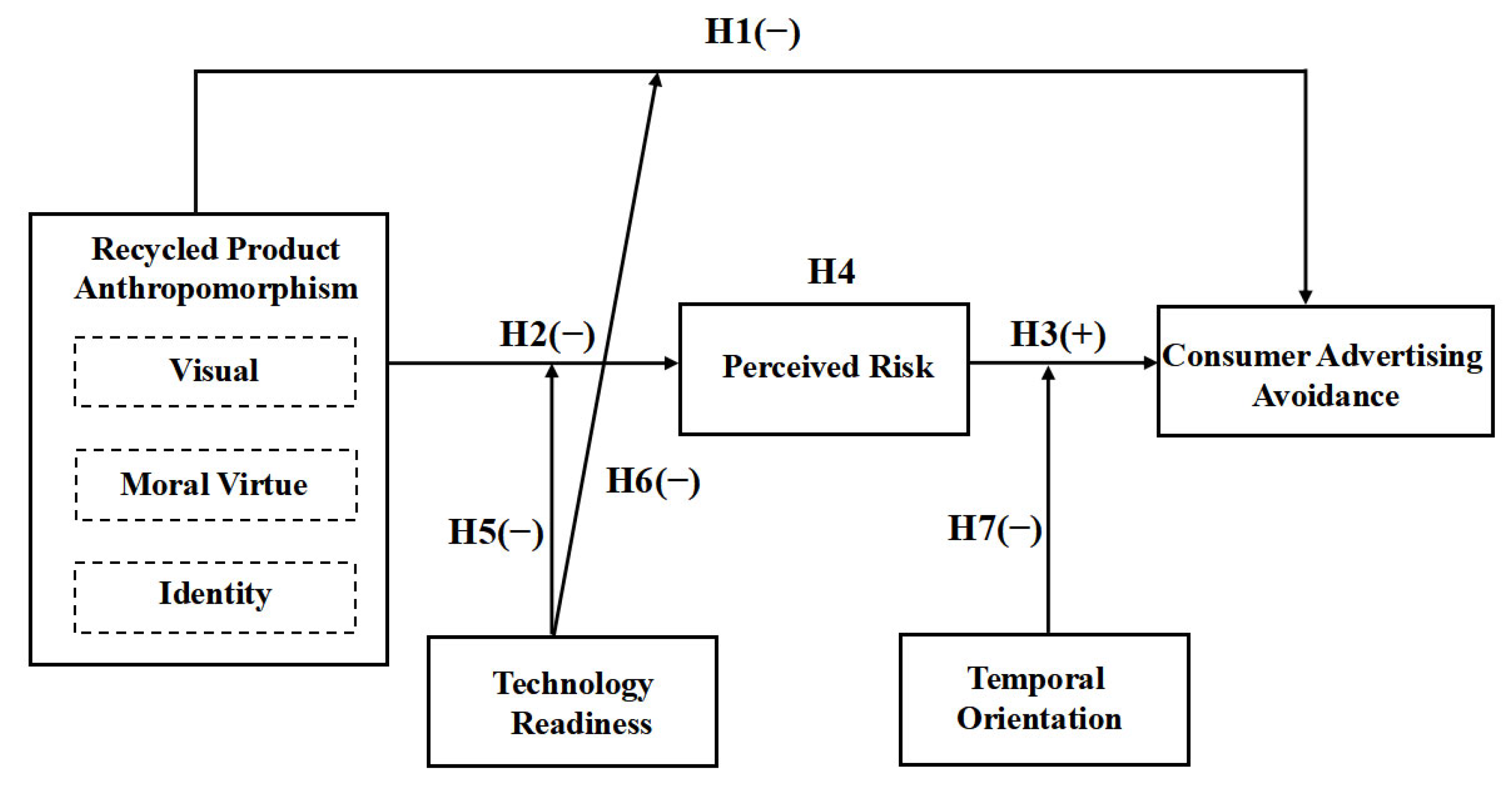
Based on the above assumptions and considering the characteristics of recycled product anthropomorphism, this study proposes the following model (see Figure 1).
Figure 1. Research framework.

4. Data Measurement and Collection

4.1. Measurement Instruments

To comprehensively measure consumer advertising avoidance behavior toward recycled product advertisements, this study adopted established scales from the previous literature. Although the measurement items were derived from different research contexts, such as tourism and food health, all the items were carefully adjusted according to the research theme of recycled product advertisements. All variables were measured using a 7-point Likert scale (1 = Strongly Disagree, 7 = Strongly Agree). Among the constituent dimensions of recycled product anthropomorphism, visual anthropomorphism was adapted based on the items from Nowak and Rauh [48] and Dabiran et al. [27] to form the final measurement items; moral virtue anthropomorphism and identity anthropomorphism were adapted from the measurement items of Xu et al. [49] and Xie et al. [26], respectively.
The measurement items of perceived risk were based on the studies of Suh and Chang [50] and Kang [51], with partial adaptations made according to the characteristics of risk perception in the context of recycled product consumption. For the measurement items of advertising avoidance, this study drew on the advertising avoidance behavior on social media from Pahari et al. [52], and revised and optimized the items from two dimensions (emotional avoidance and behavioral avoidance), in combination with the communication forms and content characteristics of recycled and environmental advertisements, to ensure the pertinence and effectiveness of the measurement. Technology readiness was measured using Parasuraman and Colby’s [53] classic TR scale, retaining the original dimensional framework while adapting item wording to the recycled product context. For the measurement items of time orientation, present-time orientation was mainly revised and abridged based on the research designs of Rojas-Méndez and Davies [54] and Wang et al. [55]; future orientation was based on the scale of Joireman et al. [56], with adaptive revisions and sentence optimization combined with the research context of recycled product advertisements and the characteristics of green consumption decisions, ultimately forming the formal measurement items suitable for this study (Appendix A, Table A1).
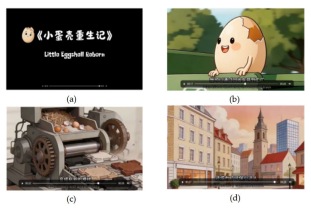
In addition, existing recycled product advertisements may, in practice, induce prior familiarity among consumers, which can interfere with subjective evaluations, bias research data, and reduce the authenticity and accuracy of measurement results. Based on real-world green marketing scenarios and industrial practice cases, this study developed standardized questionnaire stimuli independently. Three exclusive advertising materials were created for scenario-based tests, including print advertisement, motion poster, and video advertisement (Table 1). Print advertisement and motion poster correspond to traditional static and semi-dynamic advertising forms, while video advertisement conforms to the mainstream trend of video-oriented marketing. The three types of advertisements fully reconstruct real-world communication scenarios for recycled product promotion and prevent systematic biases derived from single-format advertising. Before participants took part in the survey, they were provided with unified explanations of recycled products, including their definition, raw material sources, and complete production processes, to ensure a full understanding of the advertising context. Participants were required to view all advertising materials before completing the questionnaire.
Table 1. Advertising type images.
By applying two visual styles of realistic physical presentation and cartoon virtual imagery, this study designed differentiated advertisements with diverse anthropomorphic expressions. All advertisements contained elements of visual anthropomorphism, moral virtue anthropomorphism, and identity anthropomorphism, ensuring consistency in core variable manipulation, value delivery, and narrative logic across the three formats. Visual anthropomorphism is realized mainly by embedding anthropomorphic visual elements, such as eyes, into recycled product advertisements; moral virtue anthropomorphism conveys corresponding moral value connotations through advertising copy and slogans. Specifically, print advertisement featured recycled plastic clothing as the theme with realistic physical visuals; motion poster focused on recycled coffee ground stationery pen holders while maintaining realistic visual styles; and video advertisement was originally generated using Midjourney Video V1. Using recycled eggshell-based eco-friendly construction bricks as the creative carrier, this advertisement delivered anthropomorphic narratives through cartoon virtual images. The specific video is available at (https://www.bilibili.com/video/BV1e49kBVEcJ/?spm_id_from=333.1387.list.card_archive.click&vd_source=868bf4bd6bc50c4dfcb0e046bcf8b47f, accessed on 28 April 2026).

4.2. Pretest

Before the formal survey, a pretest was conducted to verify the clarity and effectiveness of the revised measurement items. Pretest data were collected offline at a CR Vanguard in Tianjin. The offline setting allowed direct observation of participants’ expressions and reactions when completing the questionnaire, helping to evaluate the reasonability and understandability of items and providing intuitive feedback for further revision. A total of 80 questionnaires were distributed to consumers across different age groups. No participants suggested revisions to the questionnaire during the pretest, and no misunderstandings or ambiguous expressions were detected. Pretest results were not included in the subsequent formal empirical analysis.

4.3. Data Collection and Sample

This study recruited 786 respondents to complete the questionnaire survey via the Credamo online platform (https://www.credamo.com). The average completion time was approximately 19 min. After excluding invalid responses such as those with a completion time of less than 90 s and straight-lined answers, 728 valid questionnaires were retained, with a valid response rate of 92.62%. Each valid respondent received a monetary reward of 2 RMB.
Among the valid sample (Table 2), respondents aged 16–35 accounted for the largest proportion (36.54%). Most respondents were college students (38.74%) and enterprise employees (29.12%). The age structure of the sample is generally consistent with the finding reported by China Economic Network (https://www.ceweekly.cn/xiaofeitouzi/2025/1229/486762.html, accessed on 14 January 2026) that young people aged 25–39 have become the core consumer group of the circular economy. Therefore, although the sample cannot represent consumers of all age groups and occupations in China, its composition demonstrates strong relevance and sufficient reference value for this research.
Table 2. Demographics of the sample (N = 728).
This study developed 7-point Likert scale items for three dimensions, namely visual anthropomorphism, moral virtue anthropomorphism, and identity anthropomorphism, to measure participants’ perceived levels of each anthropomorphic dimension. Paired samples t-test results revealed significant differences in participants’ perceptions of the three anthropomorphic dimensions within advertisements (p < 0.001). Specifically, visual anthropomorphism yielded the highest perceived score (M = 5.46, SD = 0.91), followed by identity anthropomorphism (M = 4.19, SD = 0.85), while moral virtue anthropomorphism received the lowest score (M = 3.82, SD = 0.96). These findings verify that participants can clearly distinguish among the three anthropomorphic dimensions, confirming the validity of variable manipulation for the experimental stimuli.

5. Data Analysis and Results

5.1. Measurement Model Analysis

This study employed Smart PLS 4.0 to examine the reliability and convergent validity of the measurement scale. Cronbach’s α coefficient was adopted to assess the internal consistency of each construct, with 0.70 set as the cutoff criterion [57]. As presented in Table 3, Cronbach’s α values for identity anthropomorphism (IA), perceived risk (PR), and technology readiness (TR) all exceeded 0.70, while the coefficients of the remaining variables were all above 0.80, indicating satisfactory overall scale reliability. Meanwhile, the composite reliability (CR, rho_c) values of all the constructs ranged from 0.859 to 0.915, further confirming the strong internal consistency of the scale.
Table 3. Confirmatory factor analysis.
In terms of convergent validity, this study evaluated construct validity via item factor loadings and the average variance extracted (AVE). The results in Table 4 demonstrated that the factor loading of each item on its corresponding construct was greater than 0.70, and the AVE value of every construct exceeded 0.50. These findings indicate that all items effectively reflect the traits of their respective latent variables, thereby confirming adequate convergent validity of the overall measurement scale.
Table 4. Factor loadings of all constructs.

5.1.1. Discriminant Validity Analysis

Discriminant validity analysis aims to verify whether the correlation between two distinct constructs is statistically distinguishable. Following the Fornell and Larcker criterion [58], this study assessed the discriminant validity of both first-order and second-order constructs. In the correlation matrix, the diagonal values represent the square roots of the average variance extracted (AVE) for each construct, while the off-diagonal values denote the standardized correlation coefficients between constructs. As shown in Table 5 (first-order constructs) and Table 6 (second-order constructs), all diagonal AVE square root values are greater than the inter-construct correlation coefficients in the off-diagonal positions. This result indicates no excessive conceptual overlap among the research variables, thereby confirming satisfactory discriminant validity.
Table 5. First-order construct discriminant validity.
Table 6. Second-order construct discriminant validity.

5.1.2. HTMT Analysis

Furthermore, as presented in Table 7, the HTMT values between all pairs of first-order latent variables range from 0.030 to 0.661. Similarly, Table 8 shows that the HTMT values among second-order latent variables are all lower than 0.85. These findings further confirm that all constructs in this study achieve satisfactory discriminant validity [59].
Table 7. HTMT discriminant validity of first-order constructs.
Table 8. HTMT discriminant validity of second-order constructs.

5.2. Structural Model Analysis

5.2.1. R2 and Q2 Analysis

This study adopts PLS-SEM to calculate the R2 and adjusted R2 values for perceived risk and advertising avoidance. The R2 value of perceived risk is 0.232, indicating that the independent variables included in the model explain 23.2% of the variance in perceived risk and demonstrate an acceptable explanatory power. For consumer advertising avoidance, the R2 value is 0.345 with an adjusted R2 of 0.340. Falling within the moderate range of 0.33–0.67, these values suggest the model explains 34.5% of the variance in advertising avoidance, reflecting a satisfactory explanatory level.
In terms of the predictive relevance indicator Q2, the blindfolding procedure was employed to compute Q2 values. The results show that the Q2 values of perceived risk and consumer advertising avoidance are 0.224 and 0.236, respectively. All Q2 values are greater than zero, verifying the robust predictive relevance of the research model.
In terms of observed variables, the variance inflation factor (VIF) values of all measurement indicators ranged from 1.576 to 2.189, all well below the critical threshold of 3, indicating no severe multicollinearity among the items (Table 9). Further examinations of latent variables, main effects, and interaction paths showed that the VIF values for all the structural paths ranged from 1.002 to 1.511 (Table 10) and were below 3.3. This confirms the absence of common method bias in the model.
Table 9. Multicollinearity test of observed variables (VIF values).
Table 10. Multicollinearity test of latent variables and structural paths (VIF values).

5.2.2. Testing for Direct Effects

Path coefficients and their significance levels are adopted to evaluate the relationships between research hypotheses. After standardization, path coefficients range from −1 to 1. In this study, the bootstrapping method was applied to calculate path coefficients and t-values, with the number of bootstrap cases set to 5000.
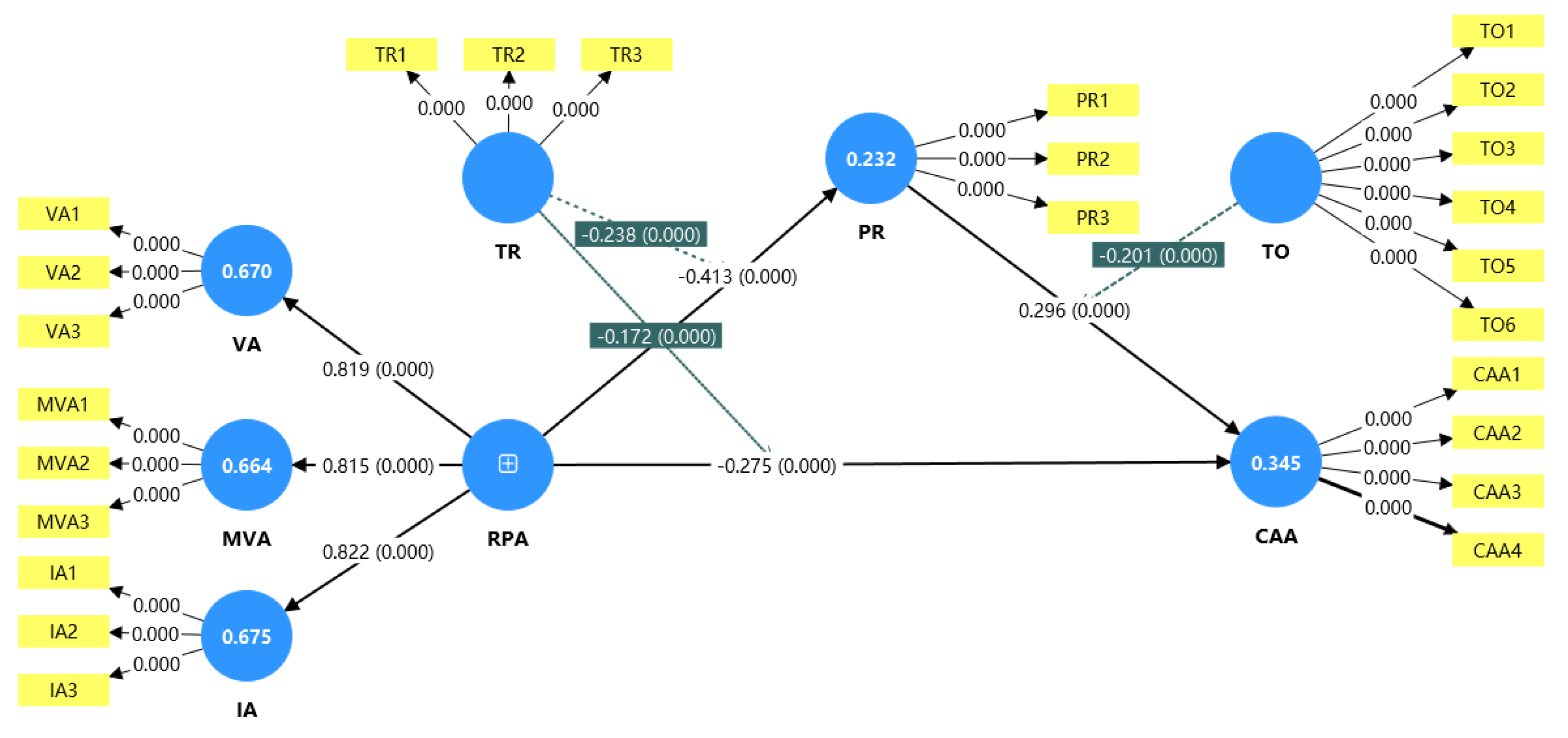
This study first examined the direct effects. As shown in Table 11, recycled product anthropomorphism exerted a significantly negative effect on consumer advertising avoidance (β = −0.275, p < 0.001), supporting H1. Recycled product anthropomorphism also negatively and significantly influenced perceived risk (β = −0.413, p < 0.001), which validated H2. Moreover, perceived risk had a significant positive impact on consumer advertising avoidance (β = 0.296, p < 0.001), lending support to H3. In terms of the magnitude of path coefficients, recycled product anthropomorphism showed the strongest influence on perceived risk (β = −0.413, p < 0.001), followed by the positive effect of perceived risk on advertising avoidance (β = 0.296, p < 0.001). The direct effect of recycled product anthropomorphism on advertising avoidance was relatively weaker (β = −0.275, p < 0.001). These findings reveal that recycled product anthropomorphism can not only directly inhibit consumer advertising avoidance but can also indirectly reduce consumer resistance to advertisements by lowering their perceived risk (Figure 2).
Table 11. Hypothesis results.
Figure 2. The result of the structural model.

5.2.3. Mediation Effect Test

To further examine the mediating effect of perceived risk, this study conducted empirical analysis using Smart PLS 4.0. As presented in Table 11, under the mediating condition of perceived risk, the indirect effect of recycled product anthropomorphism on consumer advertising avoidance was β = −0.122 (p < 0.001, 95% bias-corrected confidence interval = [−0.160, −0.091]), while the total effect was β = −0.398 (p < 0.001, 95% bias-corrected confidence interval = [−0.457, −0.336]). The results confirm the existence of the mediating effect of perceived risk, indicating that perceived risk plays a vital partial mediating role in the relationship between recycled product anthropomorphism and advertising avoidance. Furthermore, the findings demonstrate that consumer perceived risk serves as one of the critical psychological mechanisms shaping advertising attitudes and behaviors in the context of recycled product promotion. Reducing perceived risk through anthropomorphism strategies can effectively enhance advertising communication effectiveness and mitigate consumers’ defensive advertising avoidance.

5.2.4. Moderation Effect Test

The moderation analysis results reveal that the interaction term between technology readiness and recycled product anthropomorphism exerted a significantly negative influence on perceived risk (β = −0.172, p < 0.001), which supports H5. This suggests that for consumers with higher technology readiness, anthropomorphism strategies generate a stronger mitigating effect on perceived risk. Individuals with high technology readiness are more capable of understanding the technical logic of recycled products and the rationality of anthropomorphic design, thereby reducing concerns regarding product quality, safety, and other attributes.
Consistent with H6, the interaction term also negatively and significantly predicted advertising avoidance (β = −0.238, p < 0.001). Consumers with high technology readiness show greater acceptance of anthropomorphic advertisements. They are more likely to establish emotional bonds triggered by anthropomorphic portrayals, thereby weakening their avoidance tendency. In contrast, consumers with low technology readiness lack comprehension of the technical logic behind anthropomorphic design. Instead, anthropomorphic information may amplify their doubts about the quality and safety of recycled products, weakening the risk-reduction effect of anthropomorphism and limiting its ability to alleviate advertising avoidance.
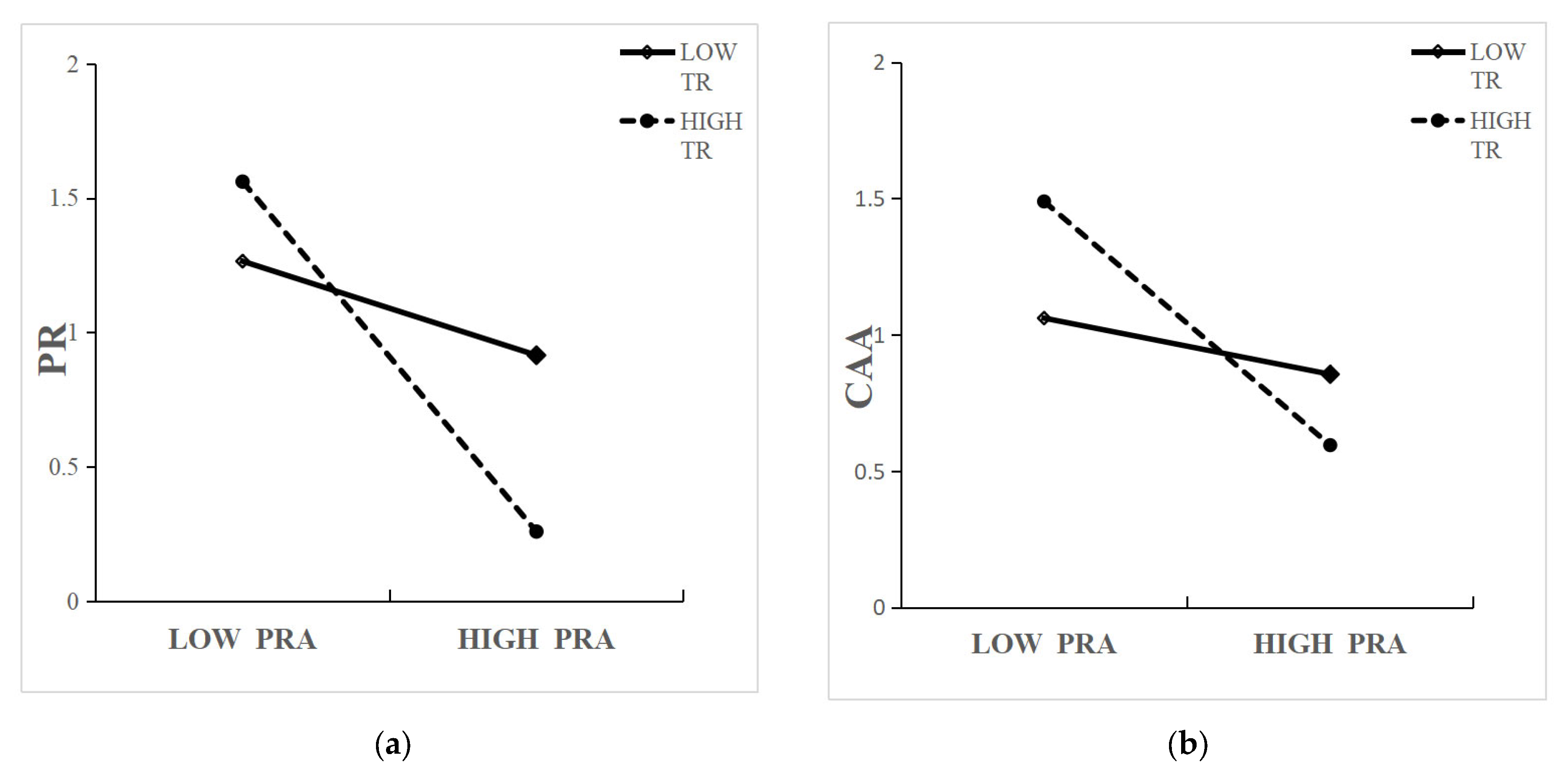
This study further examined the dual moderating effect of technology readiness and time orientation. As shown in Table 12, the results validate their joint moderating role, providing additional support for H5 and H7. Based on the mean plus or minus one standard deviation (M ± 1SD), technology readiness was divided into high and low subgroups, and simple slope plots were constructed to illustrate the moderating influence of technology readiness on the relationships among recycled product anthropomorphism, perceived risk, and advertising avoidance. Figure 3 indicates that technology readiness significantly moderates the above relationships. In the high technology readiness group, perceived risk and advertising avoidance declined sharply as the level of recycled product anthropomorphism increased. By comparison, the decreasing trend was relatively gentle in the low technology readiness group.
Table 12. Results of the moderation effect test.
Figure 3. The moderating effect of TR: (a) Interaction effect of recycled product anthropomorphism (PRA) and technology readiness (TR) on perceived risk (PR); (b) Interaction effect of recycled product anthropomorphism (PRA) and technology readiness (TR) on consumer advertising avoidance (CAA). (Note: PRA = Recycled products anthropomorphism, PR = Perceived risk, TR = Technology readiness, CAA = Consumer advertising avoidance).
Following Wang et al. [55], this study took present orientation as the baseline and regarded future orientation and neutral orientation as reference categories. In terms of the moderating effect of time orientation, the interaction between time orientation and perceived risk significantly negatively predicted consumer advertising avoidance (β = −0.201, p < 0.001), supporting H7. Specifically, future-oriented consumers attach greater importance to the long-term environmental value and sustainable attributes of recycled products. When perceived risk is alleviated, they tend to transform such risk relief into positive attitudes toward advertisements, thereby substantially reducing advertising avoidance. By contrast, present-oriented consumers rely heavily on the usage experience of traditional products. Even with decreased perceived risk, their inherent resistance to recycled product advertisements remains difficult to change.
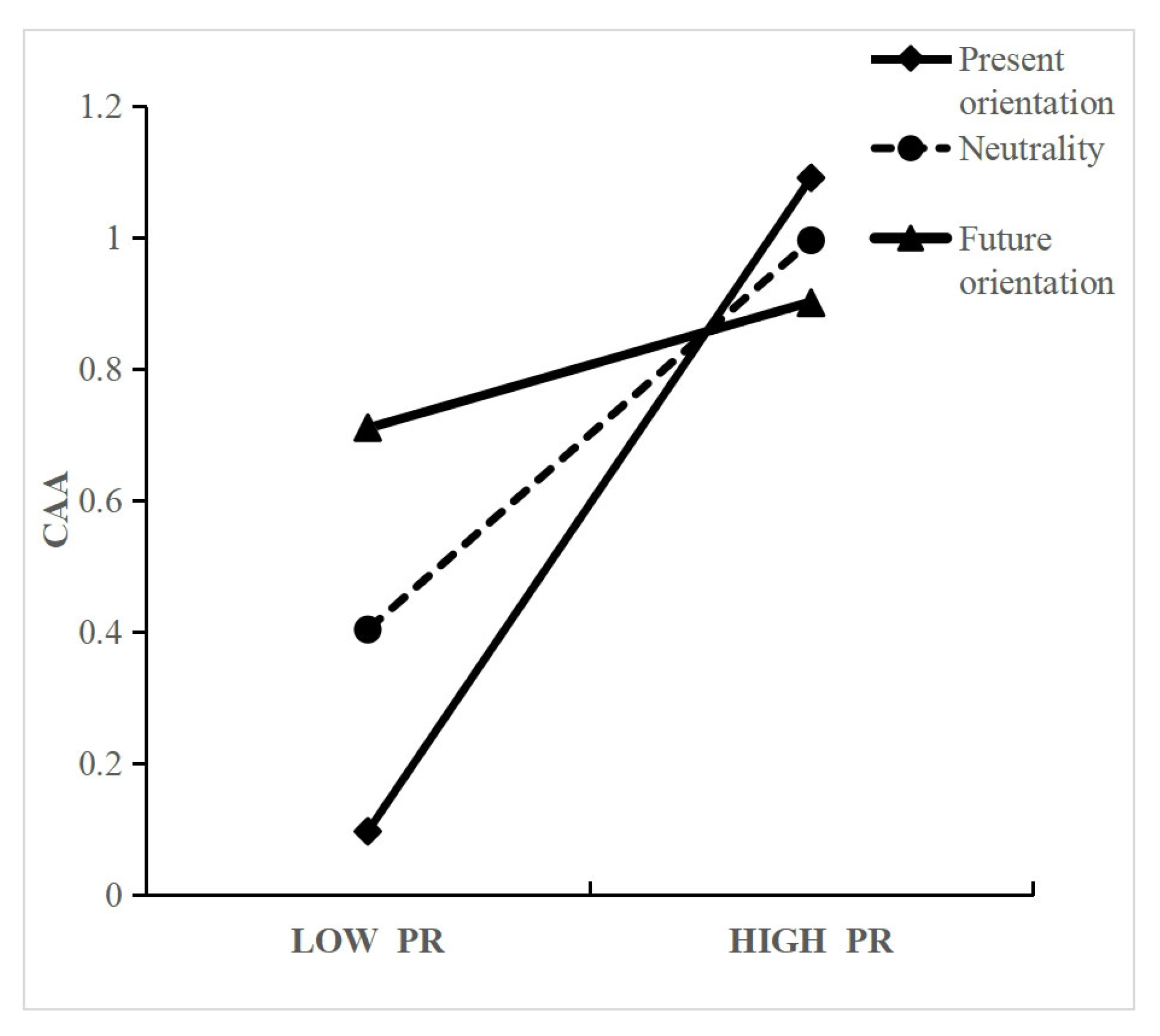
To intuitively demonstrate the moderating effect of time orientation, simple slope plots were generated for perceived risk and advertising avoidance across three time-orientation groups (Figure 4). The results show that the promotional effect of perceived risk on advertising avoidance is stronger for present-oriented consumers than for future-oriented consumers, with neutral-oriented consumers situated in the middle. These findings confirm that time orientation acts as a crucial boundary condition in the influence of perceived risk on advertising avoidance. When implementing anthropomorphism strategies for recycled product promotion, companies should conduct targeted communication tailored to consumers’ time orientation characteristics.
Figure 4. The moderating effect of To. (Note: PR = Perceived risk, TO = Temporal orientation, CAA = Consumer advertising avoidance).

5.2.5. Effect Size

To further evaluate the substantive effect strength of each structural path, this study employed the f2 effect size for analysis. As shown in Table 13, the effect size of recycled product anthropomorphism on perceived risk was f2 = 0.222, reaching a medium effect level. This indicates that anthropomorphism possesses strong substantive explanatory power in reducing consumers’ perceived risk of recycled products. The effect size of perceived risk on consumer advertising avoidance was f2 = 0.103, while the direct effect size of recycled product anthropomorphism on advertising avoidance was f2 = 0.094. Both values fall within the small effect range, demonstrating that perceived risk and anthropomorphism each exert a stable substantive contribution to advertising avoidance.
Table 13. Effect size assessment (f2).
Furthermore, the f2 results of the moderating effects show that the interaction term between technology readiness and recycled product anthropomorphism (TR x PRA) yielded an effect size of f2 = 0.071 on perceived risk (PR) and f2 = 0.041 on consumer advertising avoidance (CAA). The interaction term between time orientation and perceived risk (TO x PR) had an effect size of f2 = 0.061 on consumer advertising avoidance (CAA). All moderating f2 values exceed 0.02, reaching the small effect threshold.
These findings confirm that the moderating roles of technology readiness and time orientation are not only statistically significant but also substantively meaningful. There is no issue of merely statistical significance with a negligible practical effect in this study.

6. FsQCA Test

6.1. Variable Selection and Data Calibration

PLS-SEM is based on unidirectional linear relationships for causal prediction, while fsQCA combines the advantages of quantitative and qualitative methods, enabling in-depth analysis of multiple concurrent causal relationships between variables [60]. As shown in Table 14, this study adopted the direct calibration method, setting the 95%, 50%, and 5% percentiles of the sample as the thresholds for full membership, crossover point, and full non-membership, respectively [61].
Table 14. Calibration anchors for variable data.

6.2. Necessary Conditions Analysis

When conducting the necessity check for each antecedent variable, our research team took consumer advertising avoidance (CI = 1) as the outcome variable. As shown in Table 15, none of the necessary conditions, including visual anthropomorphism, moral virtue anthropomorphism, and identity anthropomorphism (the three dimensions of recycled product anthropomorphism), perceived risk, technology readiness, and time orientation, met the 0.9 threshold standard.
Table 15. Necessary conditions analysis results.

6.3. Conditional Configuration Analysis

This study divided configuration types into high and low groups. As shown in Table 16, in the high-configuration results group, the consistency of the four configurations ranged from 0.904 to 0.922, which was higher than the acceptable threshold of 0.80 for fsQCA analysis. This indicates that each configuration is a sufficient condition combination leading to high consumer advertising avoidance. The overall consistency of the solution was 0.490, and the overall coverage was 0.880, suggesting good overall explanatory power of the model. In addition, since time orientation in this study includes two sub-dimensions (present orientation and future orientation), the TO condition in the fsQCA analysis was constructed based on the average score of future-oriented items (TO4–TO6), representing individuals’ attention to long-term goals and delayed gratification.
Table 16. Results of high outcome configurations.
Configuration S1 shows that when perceived risk and technology readiness serve as core conditions, while both moral virtue anthropomorphism and identity anthropomorphism are absent, and visual anthropomorphism and future orientation do not act as core influencing factors, consumers are more likely to focus on rational evaluation of risks and technology. When consumers have high perceived risk regarding the authenticity of product safety, performance, and other aspects, even if they have strong technology readiness, it is difficult to offset the negative impact of risk perception on advertising attitudes.
In configuration S2, moral virtue anthropomorphism, identity anthropomorphism, visual anthropomorphism, and future orientation are all absent, and technology readiness does not serve as a core influencing factor. When recycled product advertisements lack a multimodal anthropomorphism communication strategy, and consumers have not formed a long-term future-oriented thinking, high perceived risk will directly translate into advertising avoidance behavior.
In configuration S3, both technology readiness and time orientation are present, while visual anthropomorphism, moral virtue anthropomorphism, and identity anthropomorphism are all absent, and perceived risk does not act as a core condition. Even if consumers have high technology acceptance and a long-term future orientation, enabling them to rationally recognize the technical feasibility and long-term value of recycled products, they will still generate advertising avoidance due to the lack of emotional resonance and identity when advertisements fail to establish emotional connections through anthropomorphism strategies. This result further verifies the mediating role of perceived risk.
In contrast, configuration S4 presents the coexistence of perceived risk, technological readiness, and temporal orientation, along with the absence of visual anthropomorphism and identity anthropomorphism. This path indicates that when recycled product advertisements do not adopt any anthropomorphism communication strategies to reduce psychological distance and value perception, consumers’ high perceived risk, high technology readiness, and long-term future orientation will form a synergistic effect, jointly promoting the occurrence of advertising avoidance behavior. All the above four paths re-verify that consumers’ avoidance of recycled product advertisements is not driven by a single factor, but by the configurational effect of ineffective anthropomorphism communication, perceived risk, technology readiness, and future orientation.
In the non-high configurations (Table 17), the overall solution consistency was 0.466, and the solution coverage was 0.898, indicating that the model has good explanatory power for scenarios of non-high advertising avoidance. Specifically, path NS1 takes the coexistence of moral virtue anthropomorphism and identity anthropomorphism as core conditions, with perceived risk and future orientation as absent core conditions. This suggests that when recycled products simultaneously present moral virtue and identity anthropomorphic characteristics, and consumers have low perceived risk and no prominent time orientation, a low level of advertising avoidance is more likely to be formed. This further indicates that in the context of low perceived risk and no prominent future orientation, the two dimensions of anthropomorphism strategies can effectively reduce consumers’ resistance.
Table 17. Results of low outcome configurations.
Path NS2 takes visual anthropomorphism, moral virtue anthropomorphism, identity anthropomorphism, and technology readiness as core conditions, with perceived risk as an absent core condition. Compared with path NS1, the presence of technology readiness in this path is the key difference. It shows that in anthropomorphic advertisements for recycled products, even if consumers have high technology readiness, as long as the perceived risk is low and anthropomorphic characteristics are fully presented, advertising avoidance behavior can still be effectively inhibited.

6.4. Robustness Analysis

To verify the robustness of the research results, this study conducted a robustness test on the antecedent configurations of consumer advertising avoidance. Firstly, the consistency threshold was increased from 0.8 to 0.85, and no changes in the configurations were found. Secondly, the case threshold was raised from 3 to 4, and the configurations remained unchanged. Finally, the PRI was increased from 0.7 to 0.75, resulting in configuration Q1, which was found to have a subset relationship with H1. Based on the above test results, the research results obtained through fsQCA analysis are fully confirmed to have high reliability and good robustness.

7. Discussion

Based on perceived risk theory, this study systematically explored the impact of recycled product anthropomorphism on consumer advertising avoidance. By combining PLS-SEM and fsQCA, we found that consumers’ avoidance behavior toward recycled product advertisements is not driven by a single variable independently, but by the joint effect of multiple dimensional factors, including perceived risk, technology readiness, time orientation, and anthropomorphism strategies.
From the results of PLS-SEM analysis, recycled product anthropomorphism affects consumer advertising avoidance through the mediating variable of perceived risk. Perceived risk exerts a significant positive direct effect on consumer advertising avoidance, which further confirms the views of Baek and Morimoto [40] and Chen and Zhou [41], while recycled product anthropomorphism has a significant negative impact on advertising avoidance. This result verifies that consumers’ risk perception of recycled products directly exacerbates their tendency to avoid advertisements, and anthropomorphism, as an emotional communication method, can effectively alleviate such risk anxiety.
FsQCA identified four configuration paths that can trigger consumer advertising avoidance and two configuration paths that can effectively inhibit advertising avoidance, providing a multi-configuration perspective to understand the complex formation mechanism of recycled product advertising avoidance. Specifically, the four configuration paths of high advertising avoidance all indicate that the absence of anthropomorphism strategies is one of the core incentives. Whether the absence of single-dimensional or multimodal anthropomorphism, it is likely to form a synergistic effect with factors such as perceived risk and technology readiness, promoting the occurrence of consumers’ avoidance behavior. In contrast, the two configuration paths of low advertising avoidance indicate that the combination of multimodal anthropomorphism and low perceived risk can effectively alleviate consumers’ resistance, even in the context of high technology readiness. This finding also provides new empirical support for anthropomorphism theory: anthropomorphism can not only enhance the emotional appeal of products, but it can also weaken the negative impact of perceived risk by reducing psychological distance, further verifying that anthropomorphism is an important marketing communication strategy to strengthen emotional connection and value resonance with consumers.
It should be noted that the survey sample of this study covered online consumers across different age groups. Restricted by the online research setting, young consumers accounted for a relatively larger proportion of the sample. As the primary audience for e-commerce advertisements, young consumers are more receptive to innovative anthropomorphic advertising formats and sustainable consumption concepts. This further explains why multimodal anthropomorphism exerted prominent effects in the context of this study, and offers a reasonable interpretation for the significant effectiveness of multimodal anthropomorphic strategies identified herein.

8. Conclusions

8.1. Theoretical Implications

Firstly, this study expands the application of anthropomorphism in the field of recycled product advertising. Although relevant research on anthropomorphism has undergone long-term development and has been extensively and in-depth discussed in previous literature, the interaction between anthropomorphism strategies and variables such as perceived risk and technology readiness in the special category of recycled products has not been fully revealed. By adopting a mixed analysis method of PLS-SEM and fsQCA, this study confirms that consumers’ avoidance behavior toward recycled product advertisements results from the interaction of multi-variable configurations rather than a single factor, which breaks the focus on the impact of a single variable and whether to adopt anthropomorphism in traditional research. This study also provides a new configurational perspective for perceived risk theory, indicating that anthropomorphism is not a simple communication strategy, and its absence may become one of the key triggering conditions for advertising avoidance.
Secondly, previous research perspectives have mainly focused on consumers’ perceived risk of recycled products, mostly treating it as an independent antecedent variable to explore its direct impact on purchase intention. In this study, we found that recycled product anthropomorphism affects consumer advertising avoidance through the mediating variable of perceived risk. This finding breaks the traditional cognition of perceived risk as a single factor and provides a more contextualized explanatory framework for the application of perceived risk theory in the field of recycled product advertising.
From the research results, advertising avoidance is not triggered in all contexts; only when recycled product advertisements lack anthropomorphic communication does high perceived risk jointly promote advertising avoidance behavior with other variables. When advertisements adopt multimodal anthropomorphism strategies, even if consumers have a certain degree of perceived risk, advertising avoidance can be effectively reduced. This helps to reveal the internal mechanism by which recycled product anthropomorphism acts on consumers’ behavior.

8.2. Practical Implications

Against the backdrop of the rapid development of green e-commerce marketing, precisely reducing consumer advertising avoidance of recycled products and mitigating resistance stemming from waste-related stigma has become a core challenge for companies in the digital promotion of recycled products. At present, most companies merely display the recycling of raw materials and the production processes of recycled products in a simplistic manner, yet fail to achieve expected outcomes. Based on the high and low advertising avoidance configurational paths identified in this study, companies can develop differentiated and tailored anthropomorphic advertising strategies for various consumer groups.
Consumers in high avoidance configurations S1 to S4 exhibit distinct heterogeneous characteristics. For consumers in configuration S1 with high perceived risk and high technological readiness, companies should prioritize the combined application of moral virtue anthropomorphism and identity anthropomorphism. The establishment of brand personalities featured by ecological responsibility and sustainable partnerships can effectively mitigate consumers’ risk concerns. For consumers in configuration S2 with high perceived risk, insignificant technological readiness, and weak future orientation, the adoption of three-dimensional anthropomorphism is essential. This strategy strengthens emotional connections with consumers and alleviates advertising resistance induced by high perceived risk. For consumers in configurations S3 and S4 with high technological readiness and prominent future orientation, three-dimensional anthropomorphism can likewise enhance consumers’ emotional resonance and eliminate advertising avoidance behaviors resulting from insufficient anthropomorphic design.
For consumers in low avoidance configurations NS1 and NS2 with low perceived risk and insignificant temporal orientation, moral virtue anthropomorphism and identity anthropomorphism alone can effectively reduce advertising avoidance. For groups with high technological readiness and low perceived risk, the complete three-dimensional strategy of visual, moral virtue, and identity anthropomorphism is required to stabilize consumers’ positive attitudes toward advertisements.
Therefore, when designing anthropomorphic advertisements for recycled products, companies should flexibly formulate multi-dimensional anthropomorphic combination strategies according to consumers’ differentiated configurational characteristics of perceived risk, technological readiness, and temporal orientation. Precise alignment with diverse causal configurational paths can effectively improve the communication effectiveness of e-commerce advertisements for recycled products and support the steady development of the recycled consumption market.

8.3. Research Limitations and Future Studies

Although this study further expands the research and application of anthropomorphism strategies in the field of recycled products, it still has many limitations. Firstly, the survey was mainly conducted in China. The sample exhibits distinct regional cultural characteristics, and most respondents were young individuals aged under 35. This group generally holds stronger sustainable consumption values and environmental awareness, and shows higher acceptance of digital anthropomorphic advertisements, which may overestimate the actual effects of anthropomorphic strategies to a certain extent. Therefore, the generalizability of the findings to other age groups and cross-cultural contexts requires further verification. Future research can expand the age range of participants and conduct comparative analyses using samples from diverse cultural backgrounds. Secondly, cross-sectional data and questionnaire survey methods were adopted in the research method. Although consumers were asked to watch different types of advertisements in the case, only consumers’ perception at a single time point was captured, which may limit the research results in explaining causal relationships. In subsequent research, eye-tracking or other experimental methods can be used to further verify the causal relationship between recycled product anthropomorphism, perceived risk, and advertising avoidance. Finally, this study only examined two moderating variables—technology readiness and time orientation—and did not involve potential moderating factors such as consumers’ environmental attitudes, brand trust, and product types. Consumers’ responses to the anthropomorphism strategies of recycled products of different types and brand popularity may vary. In the future, further exploration of the moderating role of these variables can enrich the explanatory power of the theoretical model and provide a more detailed strategic basis for the anthropomorphic design of recycled product advertisements.

Author Contributions

Conceptualization, W.S. and D.S.; methodology, W.S.; software, W.S.; validation, D.S.; formal analysis, W.S.; investigation, W.S.; resources, W.S.; data curation, W.S.; writing—original draft preparation, W.S.; writing—review and editing, D.S.; visualization, W.S.; supervision, D.S.; project administration, D.S.; funding acquisition, D.S. All authors have read and agreed to the published version of the manuscript.

Funding

This research received no external funding.

Institutional Review Board Statement

This paper adopts questionnaire survey research, and the research does not involve human clinical trials, physical intervention, or vulnerable groups. All participants participated voluntarily and anonymously. Under Article 13 of the Enforcement Rule of the Bioethics and Safety Act (Republic of Korea), human-subjects studies that use publicly available information or do not collect/record personally identifiable information may be exempt from IRB review when they fall into specified minimal-risk categories. In accordance with Article 32 of China’s Measures for the Ethical Review of Human-Related Life Science and Medical Research (2023 Edition). Our study did not require further ethics committee approval as it did not involve animal or human clinical trials and was not unethical and all respondents in our survey are Chinese citizens.

Data Availability Statement

The raw data are available from the corresponding author upon reasonable request.

Acknowledgments

During the preparation of this study, the authors used [Midjourney, Video V1] for the purposes of generating AI advertising materials. The authors have reviewed and edited the output and take full responsibility for the content of this publication.

Conflicts of Interest

The authors declare no conflicts of interest.

Appendix A

Table A1. Measurement Items.

References

  1. Fortune Business Insights. Recycled Plastic Market Size, Share and Industry Analysis. Available online: https://www.fortunebusinessinsights.com/recycled-plastic-market-102568 (accessed on 13 April 2026).
  2. Rathore, P.; Saha, E. Does Indian consumers’ concern towards sustainable development goals enhance recycled product purchase behavior? An empirical investigation. J. Clean. Prod. 2025, 535, 147135. [Google Scholar] [CrossRef]
  3. BSI & CISL. The Tipping Point: Building Trust in the Circular Economy. British Standards Institution and Cambridge Institute for Sustainability Leadership. Available online: https://www.cisl.cam.ac.uk/files/the_tipping_point_building_trust_in_the_circular_economy_2025.pdf (accessed on 2 April 2026).
  4. Agrawal, S.; Khandelwal, U.; Bajpai, N. Anthropomorphism in advertising: The effect of media on audience attitude. J. Mark. Commun. 2020, 27, 799–815. [Google Scholar] [CrossRef]
  5. Kim, K.; Ryoo, Y.; Manika, D.; Yoon, N.; Yoon, S. From ugly to attractive: Leveraging anthropomorphism to increase demand for irregular-appearing produce. Psychol. Mark. 2024, 41, 2033–2056. [Google Scholar] [CrossRef]
  6. Chen, T.; Razzaq, A.; Qing, P.; Cao, B. Do you bear to reject them? The effect of anthropomorphism on empathy and consumer preference for unattractive produce. J. Retail. Consum. Serv. 2021, 61, 102556. [Google Scholar] [CrossRef]
  7. Bai, S.; Cao, L.; Zhou, J. Is the Anthropomorphic Virtual Anchor Its Optimal Form? An Exploration of the Impact of Virtual Anchors’ Appearance on Consumers’ Emotions and Purchase Intention. J. Theor. Appl. Electron. Commer. Res. 2025, 20, 110. [Google Scholar] [CrossRef]
  8. Chen, H.; Shao, B.; Yang, X.; Kang, W.; Fan, W. Avatars in live streaming commerce: The influence of anthropomorphism on consumers’ willingness to accept virtual live streamers. Comput. Hum. Behav. 2024, 156, 108216. [Google Scholar] [CrossRef]
  9. Liu, P.; Li, S.; Zhang, L.; Li, W. Avoiding harm to the product: How product anthropomorphism and buyer usage intent affect sellers’ pricing. Asia Pac. J. Mark. Logist. 2025, 37, 2758–2773. [Google Scholar] [CrossRef]
  10. Gulan, M.; Feng, Y.; Mvondo, G.F.N.; Niu, B. How Do Virtual Influencers Affect Consumer Brand Evangelism in the Metaverse? The Effects of Virtual Influencers’ Marketing Efforts, Perceived Coolness, and Anthropomorphism. J. Theor. Appl. Electron. Commer. Res. 2025, 20, 36. [Google Scholar] [CrossRef]
  11. Lingaitiene, O.; Burinskiene, A. Development of trade in recyclable raw materials: Transition to a circular economy. Economies 2024, 12, 48. [Google Scholar] [CrossRef]
  12. Kim, S.; Kim, Y.K. Regulatory framing in online hotel reviews: The moderating roles of temporal distance and temporal orientation. J. Hosp. Tour. Manag. 2022, 50, 139–147. [Google Scholar] [CrossRef]
  13. Blut, M.; Wang, C. Technology readiness: A meta-analysis of conceptualizations of the construct and its impact on technology usage. J. Acad. Mark. Sci. 2020, 48, 649–669. [Google Scholar] [CrossRef]
  14. Wu, A.Y.; Malter, M.S.; Johar, G.V. “Recycle me!” products anthropomorphism can increase recycling behavior. J. Assoc. Consum. Res. 2023, 8, 351–363. [Google Scholar] [CrossRef]
  15. Bauer, R.A. Consumer behavior as risk taking. In Dynamic Marketing for a Changing World; Hancock, R.S., Ed.; American Marketing Association: Chicago, IL, USA, 1960; pp. 389–398. [Google Scholar]
  16. Stone, R.N.; Grønhaug, K. Perceived Risk: Further Considerations for the Marketing Discipline. Eur. J. Mark. 1993, 27, 39–50. [Google Scholar] [CrossRef]
  17. Dowling, G.R. Perceived risk: The concept and its measurement. Psychol. Mark. 1986, 3, 193–210. [Google Scholar] [CrossRef]
  18. Campbell, M.C.; Goodstein, R.C. The moderating effect of perceived risk on consumers’ evaluations of products incongruity: Preference for the norm. J. Consum. Res. 2001, 28, 439–449. [Google Scholar] [CrossRef]
  19. Testa, F.; Gusmerotti, N.; Corsini, F.; Bartoletti, E. The role of consumer trade-offs in limiting the transition towards circular economy: The case of brand and plastic concern. Resour. Conserv. Recycl. 2022, 181, 106262. [Google Scholar] [CrossRef]
  20. Nguyen, H.T.T. Promoting sustainable consumption and circular economy: The intention of Vietnamese youth consumers to purchase products made from recycled plastics. Chin. J. Popul. Resour. Environ. 2024, 22, 194–203. [Google Scholar] [CrossRef]
  21. Kim, I.; Jung, H.J.; Lee, Y. Consumers’ Value and Risk Perceptions of Circular Fashion: Comparison between Secondhand, Upcycled, and Recycled Clothing. Sustainability 2021, 13, 1208. [Google Scholar] [CrossRef]
  22. Meng, M.D.; Leary, R.B. It might be ethical, but I won’t buy it: Perceived contamination of, and disgust towards, clothing made from recycled plastic bottles. Psychol. Mark. 2021, 38, 298–312. [Google Scholar] [CrossRef]
  23. Sun, W.; Kong, L.; Seong, D. The impact of exhibit anthropomorphism on visitors’ cultural identity when cultural relics tell past stories. npj Herit. Sci. 2026, 14, 221. [Google Scholar] [CrossRef]
  24. Epley, N.; Waytz, A.; Cacioppo, J.T. On seeing human: A three-factor theory of anthropomorphism. Psychol. Rev. 2007, 114, 864–886. [Google Scholar] [CrossRef]
  25. Polyportis, A.; Magnier, L.; Mugge, R. Guidelines to Foster Consumer Acceptance of products Made from Recycled Plastics. Circ. Econ. Sustain. 2022, 3, 939–952. [Google Scholar] [CrossRef]
  26. Xie, Y.; Zhu, K.; Zhou, P.; Liang, C. How does anthropomorphism improve human-AI interaction satisfaction: A dual-path model. Comput. Hum. Behav. 2023, 148, 107878. [Google Scholar] [CrossRef]
  27. Dabiran, E.; Farivar, S.; Wang, F.; Grant, G. Virtually human: Anthropomorphism in virtual influencer marketing. J. Retail. Consum. Serv. 2024, 79, 103797. [Google Scholar] [CrossRef]
  28. Waytz, A.; Heafner, J.; Epley, N. The mind in the machine: Anthropomorphism increases trust in an autonomous vehicle. J. Exp. Soc. Psychol. 2014, 52, 113–117. [Google Scholar] [CrossRef]
  29. Ishigaki, R.; Shreeves, M.; Madhabika, L.N. Creating a Circular Economy by Anthropomorphic products Design. IIM Kozhikode Soc. Manag. Rev. 2026, 15, 114–122. [Google Scholar] [CrossRef]
  30. Liu, P.; Li, S. So hard to say goodbye? A study on the impact of anthropomorphism on the retention of idle products. J. Retail. Consum. Serv. 2024, 81, 104019. [Google Scholar] [CrossRef]
  31. Qin, H.; Xie, Z.; Ding, C.; Wang, J.; Xu, Y. Healing or hesitation? The impact of anthropomorphism on consumers’ repair intentions for products. J. Retail. Consum. Serv. 2024, 79, 103805. [Google Scholar] [CrossRef]
  32. Speck, P.S.; Elliott, M.T. Predictors of advertising avoidance in print and broadcast media. J. Advert. 1997, 26, 61–76. [Google Scholar] [CrossRef]
  33. Yu, J.; Sun, X.; Huang, Y.; Jia, Y. Concrete or Abstract? The Impact of Green Advertising Appeals and Information Framing on Consumer Responses. J. Theor. Appl. Electron. Commer. Res. 2025, 20, 130. [Google Scholar] [CrossRef]
  34. Gutentag, J.; Russell, C.A. Selling sustainability: Making green advertising more concrete with circular economy message framing. Int. J. Advert. 2024, 44, 47–65. [Google Scholar] [CrossRef]
  35. Chen, F.; Sengupta, J.; Zheng, J.F. When products Come Alive: Interpersonal Communication Norms Induce Positive Word of Mouth for Anthropomorphized products. J. Consum. Res. 2022, 49, 1032–1052. [Google Scholar] [CrossRef]
  36. Barbosa Escobar, F.; Velasco, C.; Byrne, D.V.; Wang, Q.J. The influence of emotional cues and anthropomorphism on products temperature expectations. Food Qual. Prefer. 2025, 126, 105387. [Google Scholar] [CrossRef]
  37. Tanaka, D.; Dente, S.M.R.; Hashimoto, S. How Do Eco-Labels for Everyday products Made of Recycled Plastic Affect Consumer Behavior? Sustainability 2024, 16, 4878. [Google Scholar] [CrossRef]
  38. Mourey, J.A.; Olson, J.G.; Yoon, C. Products as Pals: Engaging with Anthropomorphic products Mitigates the Effects of Social Exclusion. J. Consum. Res. 2017, 44, 414–431. [Google Scholar] [CrossRef]
  39. Gong, X.; Zhang, H. You are being watched! Using anthropomorphism to curb customer misbehavior in access-based consumption. J. Retail. Consum. Serv. 2023, 70, 103164. [Google Scholar] [CrossRef]
  40. Baek, T.H.; Morimoto, M. Stay Away from Me. J. Advert. 2012, 41, 59–76. [Google Scholar] [CrossRef]
  41. Chen, Y.; Zhou, S. Avoiding pre-roll ads: Predictors of online video consumption. Comput. Hum. Behav. 2023, 142, 107652. [Google Scholar] [CrossRef]
  42. Sunny, S.; Lee, P.; Law, R. Impact of cultural values on technology acceptance and technology readiness. Int. J. Hosp. Manag. 2019, 77, 89–96. [Google Scholar] [CrossRef]
  43. Cruz-Cárdenas, J.; Guadalupe-Lanas, J.; Ramos-Galarza, C.; Palacio-Fierro, A. Drivers of technology readiness and motivations for consumption in explaining the tendency of consumers to use technology-based services. J. Bus. Res. 2021, 122, 217–225. [Google Scholar] [CrossRef]
  44. Basarir-Ozel, B.; Nasir, V.A.; Turker, H.B. Determinants of smart home adoption and differences across technology readiness segments. Technol. Forecast. Soc. Change 2023, 197, 122924. [Google Scholar] [CrossRef]
  45. Zhang, Z.; Zhou, Q.K.; Yan, D. It’s not mine: Anthropomorphism attenuates the effect of psychological ownership on products-to-self judgment. Psychol. Mark. 2023, 40, 1103–1114. [Google Scholar] [CrossRef]
  46. Chen, J.; Chang, Y.W. How smart technology empowers consumers in smart retail stores? The perspective of technology readiness and situational factors. Electron. Mark. 2023, 33, 1. [Google Scholar] [CrossRef]
  47. Xu, L.; Zhao, S.; Cotte, J.; Cui, N. Cyclical Time Is Greener: The Impact of Temporal Perspective on Pro-Environmental Behavior. J. Consum. Res. 2023, 50, 722–741. [Google Scholar] [CrossRef]
  48. Nowak, K.L.; Rauh, C. The influence of the avatar on online perceptions of anthropomorphism, androgyny, credibility, homophily, and attraction. J. Comput.-Mediat. Commun. 2005, 11, 153–178. [Google Scholar] [CrossRef]
  49. Xu, Y.W.; Chi, C.G.; Gursoy, D.; Cai, R.R. Rethinking AI anthropomorphism: A holistic conceptualization and scale across AI systems and service contexts. Technol. Soc. 2026, 85, 103189. [Google Scholar] [CrossRef]
  50. Suh, K.S.; Chang, S. User interfaces and consumer perceptions of online stores: The role of telepresence. Behav. Inf. Technol. 2006, 25, 99–113. [Google Scholar] [CrossRef]
  51. Kang, H. Impact of VR on impulsive desire for a destination. J. Hosp. Tour. Manag. 2020, 42, 244–255. [Google Scholar] [CrossRef]
  52. Pahari, S.; Bandyopadhyay, A.; Manna, A. Exploring the social media advertising avoidance behavior through the lens of avoidance motivation theory. Kybernetes 2025, 54, 7209–7225. [Google Scholar] [CrossRef]
  53. Parasuraman, A.; Colby, C.L. An updated and streamlined Technology Readiness Index: TRI 2.0. J. Serv. Res. 2015, 18, 59–74. [Google Scholar] [CrossRef]
  54. Rojas-Méndez, J.I.; Davies, G. Avoiding Television Advertising: Some Explanations from Time Allocation Theory. J. Advert. Res. 2005, 45, 34–48. [Google Scholar] [CrossRef]
  55. Wang, J.; Wu, Y.; Wang, Z. Effect of short video storytelling on festival attractiveness: The moderating role of temporal orientation and novelty. Curr. Issues Tour. 2025, 28, 1427–1444. [Google Scholar] [CrossRef]
  56. Joireman, J.; Shaffer, M.J.; Balliet, D.; Strathman, A. Promotion Orientation Explains Why Future-Oriented People Exercise and Eat Healthy: Evidence from the Two-Factor Consideration of Future Consequences-14 Scale. Pers. Soc. Psychol. Bull. 2012, 38, 1272–1287. [Google Scholar] [CrossRef]
  57. Hair, J.F.; Hult, G.T.M.; Ringle, C.M.; Sarstedt, M.; Danks, N.P.; Ray, S. Partial Least Squares Structural Equation Modeling (PLS-SEM) Using R: A Workbook; Springer Nature: Berlin/Heidelberg, Germany, 2021; p. 197. [Google Scholar]
  58. Fornell, C.; Larcker, D.F. Structural Equation Models with Unobservable Variables and Measurement Error: Algebra and Statistics. J. Mark. Res. 1981, 18, 382–388. [Google Scholar] [CrossRef]
  59. Henseler, J.; Ringle, C.M.; Sarstedt, M. A new criterion for assessing discriminant validity in variance-based structural equation modeling. J. Acad. Mark. Sci. 2015, 43, 115–135. [Google Scholar] [CrossRef]
  60. Wei, H.; Wang, Q.; Chen, J.; Liang, Z.; Wu, Y.; Luo, H. Social environment, health cognition, and health behavior: How individuals with non-fixed employment end up with adverse health outcomes in China under the era of VUCA?—Findings from PLS-SEM and fsQCA. Front. Public Health 2024, 12, 1341213. [Google Scholar] [CrossRef]
  61. Ragin, C.C. Redesigning Social Inquiry: Fuzzy Sets and Beyond; University of Chicago Press: Chicago, IL, USA, 2008. [Google Scholar]
Disclaimer/Publisher’s Note: The statements, opinions and data contained in all publications are solely those of the individual author(s) and contributor(s) and not of MDPI and/or the editor(s). MDPI and/or the editor(s) disclaim responsibility for any injury to people or property resulting from any ideas, methods, instructions or products referred to in the content.

Article Metrics

Citations

Article Access Statistics

Multiple requests from the same IP address are counted as one view.