


Abstract
This study examines how mandatory digital service environments, in which human-assisted alternatives are systematically withdrawn, shape older consumers’ avoidance of self-service technologies (SSTs). We conceptualize perceived coercion as consumers’ subjective awareness of structurally constrained choice. Drawing on cognitive appraisal theory and psychological reactance theory, we propose a dual-pathway framework in which perceived coercion activates both perceived loss of autonomy and negative affect. Survey data from 389 older consumers in South Korea were analyzed using structural equation modeling. The results support a parallel mediation model, showing that perceived coercion significantly increases both mediators, each of which independently predicts avoidance intention, with negative affect showing a relatively stronger association. By conceptualizing coercion as a structural condition rather than an individual disposition, this study extends research on mandatory SST use and technology-mediated service encounters. The findings highlight the importance of autonomy-preserving and emotionally inclusive digital service systems in aging societies.
1. Introduction
The rapid digital transformation of service delivery has fundamentally reshaped consumer–firm interactions, generating efficiency gains while simultaneously creating new forms of exclusion. Self-service technologies (SSTs)—such as kiosks, self-checkout systems, and automated ticketing—have moved from optional service enhancements to default access points across retail, hospitality, transportation, and public services. While prior research has highlighted operational benefits and adoption drivers, the substitutive expansion of SSTs—where technology replaces rather than supplements human-staffed channels—has raised persistent concerns regarding consumer autonomy, fairness, and service inclusion [1,2]. In such environments, service systems increasingly function as choice architectures that shift technology use from an option to a practical necessity, making access to routine services contingent on the structural absence of alternatives. This shift changes the meaning of SST use from voluntary adoption to constrained compliance.
This transformation is particularly pronounced in South Korea, where SST-dominant service configurations have rapidly expanded across everyday contexts, often limiting or eliminating human-assisted alternatives. Accelerated during the COVID-19 pandemic and subsequently institutionalized, these arrangements have normalized service environments in which technology use is effectively mandatory rather than optional [3]. Similar trends are emerging globally, as labor shortages and cost pressures continue to drive the routinization of automated service delivery across sectors [4,5]. Taken together, these developments suggest that mandatory digital service use is not a temporary disruption but an increasingly stable service condition.
These developments raise especially salient concerns for older consumers. From a transformative service and inclusive design perspective, vulnerability is not merely an individual attribute but emerges from the interaction between consumer characteristics and service structures [6]. In SST-dominant environments, aging-related changes in cognitive processing, lower digital familiarity, and stronger preferences for human interaction may heighten older adults’ sensitivity to constrained choice and reduced autonomy [7]. Consistent with this perspective, older consumers’ SST encounters are often accompanied by stronger emotional discomfort and behavioral reluctance in routine service contexts. Recent studies have also begun to document negative psychological consequences of forced SST use in technology-mediated service encounters [8]. For older consumers, the central issue is not merely whether SSTs are usable, but whether service design preserves meaningful choice.
Despite these developments, extant SST research has largely adopted a voluntarist lens, focusing on individual-level adoption determinants such as perceived usefulness, ease of use, and convenience [1,5,9]. This perspective implicitly assumes that consumers retain meaningful freedom to choose among service channels, attributing avoidance primarily to individual barriers such as technology anxiety or limited digital skills. However, such explanations are insufficient in service environments where human-assisted alternatives have been structurally withdrawn, rendering technology use effectively non-optional. As a result, existing adoption-based explanations do not fully capture consumer responses in mandatory service settings.
To address this limitation, the present study shifts the analytical focus from individual adoption decisions to coercive service design, defined as service configurations in which consumers are compelled to use SSTs due to the systematic removal of alternatives. Building on research on forced and mandated technology use [3,10,11], we distinguish between coercive service design as a structural condition and perceived coercion as consumers’ subjective experience of being compelled to use technology against their preference.
To explain how coercive service environments shape consumer responses, this study draws on cognitive appraisal theory [12] (pp. 23–40) and psychological reactance theory [13] (pp. 1–7). We propose that perceived coercion activates two co-occurring yet distinct psychological processes. First, it elicits a cognitive appraisal of diminished self-determination, conceptualized as perceived loss of autonomy [14]. Second, it triggers an affective–motivational response characterized by negative emotions such as frustration, anxiety, and stress, reflecting resistance to compelled technology use. These processes are conceptualized as parallel pathways rather than sequential stages. Accordingly, we develop a dual-pathway mediation model linking perceived coercion to older consumers’ avoidance intentions toward SSTs. In this framework, cognition and affect are analytically distinct but empirically related responses to the same coercive service condition.
Accordingly, this study examines how perceived coercion arising from coercive service design influences older consumers’ avoidance of SSTs through these dual cognitive and affective pathways. This study makes three contributions. First, it advances research on service inclusion and transformative service by demonstrating how system-level service design—rather than individual limitations—can generate exclusionary outcomes in digitally mediated environments [6,15]. Second, it extends SST and service design scholarship by shifting the analytical focus from voluntarist adoption to structurally imposed use. In doing so, it conceptualizes coercion as a structurally embedded condition within service systems, reframing technology use as an obligation rather than a choice [16], and repositioning avoidance as a rational response to constrained service environments. Third, by disentangling the parallel cognitive and affective mechanisms through which perceived coercion leads to avoidance, this study offers a more precise account of how “convenience” may be experienced as coercion, providing actionable insights for designing autonomy-preserving and emotionally inclusive self-service systems in rapidly aging societies.
2. Literature Review and Hypothesis Development
2.1. From Voluntary SST Adoption to Mandatory Digital Service Use
Research on SSTs has traditionally focused on understanding consumers’ voluntary adoption of technology-mediated service interfaces. Drawing on technology acceptance and service automation perspectives, prior studies have examined factors such as perceived usefulness, ease of use, convenience, and trust in explaining consumers’ willingness to engage with SST-based service channels [1,5,17]. More recently, however, emerging research has begun to examine situations in which SST use becomes effectively mandatory as digital interfaces replace human-assisted service channels [3,8,9]. These developments suggest that SST interactions increasingly occur within digital service environments where consumers’ ability to choose how they access services may be constrained.
Within this evolving landscape, the boundary between voluntary technology adoption and compelled use has become increasingly blurred. Classic adoption models assume that consumers actively choose technologies based on instrumental evaluations such as efficiency or convenience. However, when human-staffed alternatives are systematically withdrawn, technology use may no longer reflect preference but instead become effectively unavoidable. In such situations, consumers may comply behaviorally while simultaneously experiencing constrained choice, reduced control, or psychological discomfort—indicating that observed usage alone does not necessarily reflect genuine acceptance [18]. Accordingly, behavioral compliance should not be interpreted as equivalent to voluntary acceptance in mandatory service settings.
Prior research has addressed related phenomena using concepts such as forced use or forced adoption, particularly in organizational, public-service, and mandatory IT contexts. Studies consistently show that mandated technologies tend to generate surface compliance rather than genuine acceptance: users conform outwardly while minimizing reliance, seeking workarounds, or disengaging psychologically when autonomy is undermined [10,19,20]. In consumer-facing environments, similar dynamics have been documented. Forced channel migration and SST-only service configurations have been associated with heightened stress, lower satisfaction, and resistance behaviors, even when the underlying technologies operate efficiently [3,11,17]. Recent research in digital commerce contexts further indicates that mandatory technology-mediated transactions can generate psychological discomfort and perceived dehumanization when opportunities for human interaction are removed [8].
While this literature offers important insights into behavioral responses to imposed technologies, existing notions of forced adoption remain limited in their ability to capture the structural origins of coerced technology use. Much prior work—particularly in organizational and mandatory IT contexts—focuses on individual-level compliance, resistance, or post-adoption reactions, thereby emphasizing coping and continuance decisions after technology use has already been imposed [10,19]. As a result, the service conditions that render technology use unavoidable are often analytically conflated with the cognitive or emotional responses that follow, obscuring the role of service system design as the source of constraint.
Importantly, the notion of coercion itself is not new. In healthcare and public service research, coercion has long been used to describe situations in which service users experience constrained choice due to institutional arrangements, policy structures, or the systematic withdrawal of viable alternatives—even in the absence of overt force or authoritative control [21,22]. This stream of research conceptualizes coercion as a structurally produced experience rather than an individual deficit, and consistently demonstrates that perceived coercion undermines trust, engagement, and well-being. These insights suggest that coercive experiences can emerge from how service systems are organized rather than solely from individual responses.
Building on this broader conceptualization, the present study introduces the concept of coercive service design, which highlights how digital service architectures shape individual perceptions of coercion. In this study, coercive service design refers to a system-level configuration in which access to services is organized around SSTs by default through the systematic withdrawal of viable human-staffed alternatives, such as kiosk-only ordering, mandatory app-based check-ins, or the elimination of staffed counters [3,15]. In this context, coercion does not imply physical force or authoritative power. Rather, it denotes a service architecture that produces perceived choice unavailability, wherein consumers experience technology use as unavoidable because no meaningful alternative remains. This perspective aligns with innovation-decision research demonstrating that structural configurations can transform technology engagement into structurally obligatory consumption even in the absence of explicit enforcement [16].
Perceived coercion captures consumers’ subjective experience of this structural condition. It reflects an experiential awareness of constrained choice—having no real option but to comply—that arises prior to evaluative judgments about usability, fairness, or satisfaction and thus functions as an antecedent experiential condition rather than a reflective appraisal or emotional response [3,19]. Perceived coercion is not reducible to usability limitations or technological difficulty. Rather, it reflects a structurally induced restriction of choice, whereby consumers experience technology use as unavoidable regardless of their capability or preference. This conceptualization resonates with recent discussions on digital technology captivity, which describe situations in which digital systems become the mandatory gateway to service access, leaving consumers with limited or no viable alternatives [4]. By distinguishing coercive service design (objective structure) from perceived coercion (subjective experience), this framework clarifies semantic ambiguities and establishes perceived coercion as an antecedent experiential condition rather than a reflective appraisal. In other words, the structural condition precedes, but is conceptually distinct from, the consumer’s appraisal of being compelled.
The consequences of coercive service design may be particularly pronounced in consumer markets. Unlike employees, consumers are not institutionally bound to service systems and may respond to constrained choice through avoidance, disengagement, or exit. Empirical studies show that removing human alternatives heightens perceived threats to freedom, erodes relational value, and diminishes satisfaction and loyalty [23,24]. Research grounded in psychological reactance theory further demonstrates that when individuals perceive a threat to their behavioral freedom—such as the elimination of a preferred service channel—they experience a motivational state oriented toward restoring that freedom, often expressed through resistance or avoidance of the imposed option [13]. In SST-only environments, the withdrawal of human-staffed alternatives therefore constitutes a direct freedom threat rather than a neutral efficiency enhancement, a pattern repeatedly observed in public and transport service contexts [3].
Despite these advances, prior research has typically examined either cognitive outcomes (e.g., perceived control, satisfaction) or affective responses (e.g., anxiety, frustration) in isolation. The interplay between cognitive appraisals and emotional responses under conditions of coercive SST use remains underexplored, leaving a critical gap in understanding how structurally imposed digital environments shape consumer resistance.
2.2. SST Use and Digital Service Exclusion Among Older Consumers
Older consumers constitute one of the fastest-growing demographic groups globally, yet they remain disproportionately vulnerable in increasingly digitalized service and commerce environments. While classic technology acceptance models emphasize perceived usefulness and ease of use, research on older consumers consistently shows that SST engagement is shaped less by instrumental evaluations alone and more by contextual, relational, and design-related conditions—including perceived control, self-efficacy, and, critically, the continued availability of human-assisted alternatives [25,26].
From a transformative service research (TSR) and inclusive service design perspective, vulnerability among older consumers is not an inherent individual deficiency but a context-dependent outcome of service system design [6]. When service architectures embed assumptions of digital readiness into default access conditions, they can unintentionally marginalize consumers whose service participation depends on relational support, reassurance, and assisted interaction [15]. In this sense, exclusion emerges not from aging itself but from a misalignment between consumer capabilities and service design.
Early qualitative and ethnographic studies identified interface-level barriers faced by older adults—such as small fonts, complex navigation paths, and limited error-recovery options—that undermine confidence and perceived competence [27,28]. More recent research, however, emphasizes that these usability challenges are compounded when human support is structurally withdrawn. Studies show that many older adults are capable of adapting to kiosk-based services and may even report comfort or satisfaction when assistance is available or when alternative channels remain accessible [29]. These findings challenge deficit-based accounts of aging and technology use, suggesting that older consumers’ responses are driven less by incapacity than by situational autonomy and the preservation of meaningful choice.
Problems intensify when SSTs fully replace human service channels. Empirical studies of digital-only access demonstrate that the withdrawal of staffed counters, helplines, or assisted modes significantly heightens feelings of exclusion, pressure to comply, and perceived unfairness among older consumers [30,31]. In such contexts, service design functions not merely as a functional interface but as a gatekeeping mechanism that determines whether relational service encounters remain possible. Recent research further shows that older adults exposed to mandatory SST use experience heightened anxiety, stress, and frustration even when transactions are successfully completed, indicating that emotional and relational costs persist beyond functional task performance [8,32].
These dynamics are increasingly reflected in the SST resistance literature. Studies document that older consumers often engage in additional cognitive and emotional “shadow work” to cope with imposed technologies, expending effort to compensate for the absence of human assistance and to manage autonomy threats embedded in service design [33]. Such efforts exacerbate emotional exhaustion and reinforce avoidance tendencies, particularly in repeated or routine service encounters.
Taken together, the literature suggests that coercive service design is especially consequential for older consumers because it simultaneously undermines instrumental access and erodes valued relational pathways. For this group, kiosks may represent not merely unfamiliar or inconvenient technologies, but symbolic and practical barriers that sever opportunities for human connection, reassurance, and dignity in service encounters [6,34]. The loss of these relational options amplifies the psychological impact of constrained choice, rendering autonomy threats more salient and emotionally consequential in everyday consumption contexts.
Despite growing recognition of these issues, existing research has often examined cognitive and affective responses separately, leaving a limited understanding of how older consumers process coercive SST environments holistically. Addressing this gap requires an integrated framework explaining how perceived coercion simultaneously activates cognitive appraisals of diminished autonomy and affective distress, ultimately motivating avoidance behavior. This need motivates the dual-pathway model developed in the following section.
2.3. Research Model and Hypotheses
In light of population aging and the increasing prevalence of SST-only service configurations, this study examines perceived coercion—stemming from the structural withdrawal of non-digital alternatives—as the proximal trigger of consumer responses, distinct from usability difficulties or individual capability deficits [35,36,37]. Building on this premise, we propose a dual-pathway cognition–affect–behavior framework to explain avoidance intentions, in which perceived coercion functions as the experiential stimulus, and perceived loss of autonomy and negative affect operate as two distinct yet parallel mediating mechanisms.
This framework integrates insights from cognitive appraisal theory [12], which explains how individuals actively evaluate environmental constraints in relation to personal control, and psychological reactance theory [13], which emphasizes the immediate emotional consequences of threatened freedom. Cognitive appraisal theory posits that service system constraints—such as the removal of human-staffed options—prompt reflective evaluations of diminished self-determination and fairness. Psychological reactance theory, by contrast, predicts that such constraints elicit immediate affective responses aimed at restoring autonomy. By integrating these perspectives, the present model conceptualizes cognition and emotion as parallel rather than sequential pathways through which coercive service design shapes avoidance behavior.
Perceived coercion simultaneously activates these two distinct psychological processes. First, it elicits a cognitive appraisal of diminished control, whereby individuals evaluate the extent to which their autonomy is restricted [12]. Second, it triggers an immediate affective–motivational response, reflected in psychological reactance, as individuals experience a threat to their behavioral freedom [13,38].
This dual activation reflects the broader cognition–affect–behavior tradition, which recognizes that cognitive evaluations and emotional responses jointly shape behavioral outcomes [39]. While some interpretations of this tradition imply a sequential process, accumulating evidence suggests that cognition and affect are often co-activated and operate in parallel, particularly under conditions involving constraint or threat [40,41]. In coercive service environments, where both objective restrictions and perceived threats to freedom are present, these processes may operate concurrently to shape consumer responses.
2.4. Cognitive Pathway: Perceived Coercion to Perceived Loss of Autonomy
When human-staffed service channels are withdrawn or rendered inaccessible, consumers may experience coercion as a sense of being compelled to use SSTs against their preferences. From a cognitive appraisal perspective, such coercion constitutes a structural constraint that prompts evaluative judgments regarding perceived loss of autonomy, defined here as the cognitive appraisal of diminished self-determination, control, and procedural fairness in the service encounter [10,16].
This cognitive pathway aligns with self-determination theory, which identifies autonomy as a fundamental psychological need reflecting individuals’ desire to experience volition, self-governance, and choice in their actions [42]. When service environments restrict meaningful alternatives and impose externally structured action paths, consumers appraise this constraint as autonomy frustration. Unlike perceived coercion, which captures the immediate recognition of structural compulsion, perceived loss of autonomy reflects the subsequent evaluative judgment of reduced personal control. In this sense, coercive SST use elicits evaluative judgments regarding control, dignity, and procedural fairness [14,43].
For older consumers, these autonomy appraisals may be particularly salient, as service encounters often carry implications for social inclusion and personal dignity [30]. Empirical research shows that when older adults perceive reduced control over service interactions, satisfaction and engagement decline sharply, even when objective service performance remains adequate [44]. Accordingly, coercive SST use is expected to heighten perceptions of autonomy loss among older consumers.
H1.
Perceived coercion in SST use is positively associated with perceived loss of autonomy.
When autonomy is perceived as diminished, consumers are less likely to view continued SST engagement as desirable or legitimate. Prior research in service and consumer behavior demonstrates that weakened perceptions of control and fairness undermine satisfaction, trust, and commitment, leading to withdrawal or avoidance [24,45]. In SST contexts, evidence from cashierless and kiosk-based retail settings indicates that perceived autonomy loss reduces reuse intentions despite efficiency benefits [44]. For older consumers, such effects may be magnified due to heightened sensitivity to relational and dignity-related concerns in service encounters.
H2.
Perceived loss of autonomy is positively associated with avoidance intention.
2.5. Emotional Pathway: Perceived Coercion to Negative Affect
While cognitive appraisals involve reflective evaluations of control and fairness, psychological reactance theory emphasizes the immediate affective consequences of threatened freedom. According to this theory, when individuals perceive that their behavioral options are constrained, they experience an aversive motivational state accompanied by negative emotions—such as anxiety, frustration, irritation, or resentment—directed toward restoring freedom or resisting the imposed option [13,38]. In SST-only environments, perceived coercion constitutes precisely such a freedom threat, distinct from cognitive appraisals of autonomy loss.
Research on mandatory technology use consistently links imposed systems to heightened negative affect and resistance [19,23]. In consumer-facing SST contexts, empirical studies show that kiosk-only policies evoke frustration and anxiety, which in turn mediate avoidance and disengagement [11]. Recent work on SST resistance further demonstrates that consumers engage in additional emotional and cognitive “shadow work” to cope with imposed technologies, intensifying stress and emotional exhaustion [33]. Among older adults, these affective reactions may be amplified due to lower technology self-efficacy and greater emotional sensitivity to autonomy threats [32,46].
Taken together, this literature suggests that perceived coercion not only prompts cognitive appraisal but also elicits immediate negative affective responses that independently shape behavioral outcomes.
H3.
Perceived coercion in SST use is positively associated with negative affect.
Negative affect, in turn, plays a direct role in driving avoidance intentions. Emotional discomfort during SST interactions reduces willingness to re-engage, undermines perceived value, and accelerates withdrawal, particularly when emotional costs outweigh functional benefits [47]. For older consumers, affective distress often exerts a stronger influence on behavior than instrumental considerations, making negative affect a critical predictor of avoidance in coercive service environments. This tendency is consistent with geropsychology research suggesting that older adults prioritize emotional regulation and are more sensitive to negative affective experiences, leading to more immediate behavioral responses to emotionally aversive situations [48].
H4.
Negative affect is positively associated with avoidance intention.
2.6. Parallel Full Mediation Model
Although traditional models often assume sequential mediation (cognitive appraisal → affect → behavior), evidence from service research and affective neuroscience suggests that cognitive and emotional processes frequently operate concurrently under constraint conditions [40,41]. Empirical research on SST resistance similarly indicates that evaluative judgments and affective reactions jointly shape avoidance and disengagement [26,49].
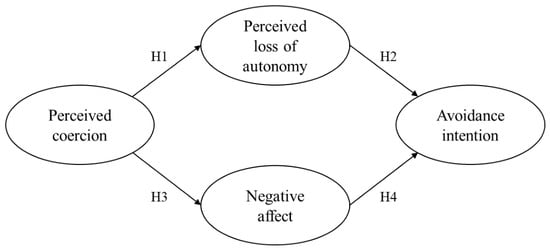
Accordingly, this study specifies a parallel full mediation model in which perceived coercion influences avoidance intention primarily through two independent mediators: (a) perceived loss of autonomy and (b) negative affect. No direct coercion–avoidance link is expected once these parallel mediators are accounted for.
H5a.
Perceived coercion is indirectly associated with avoidance intention via perceived loss of autonomy.
H5b.
Perceived coercion is indirectly associated with avoidance intention via negative affect.
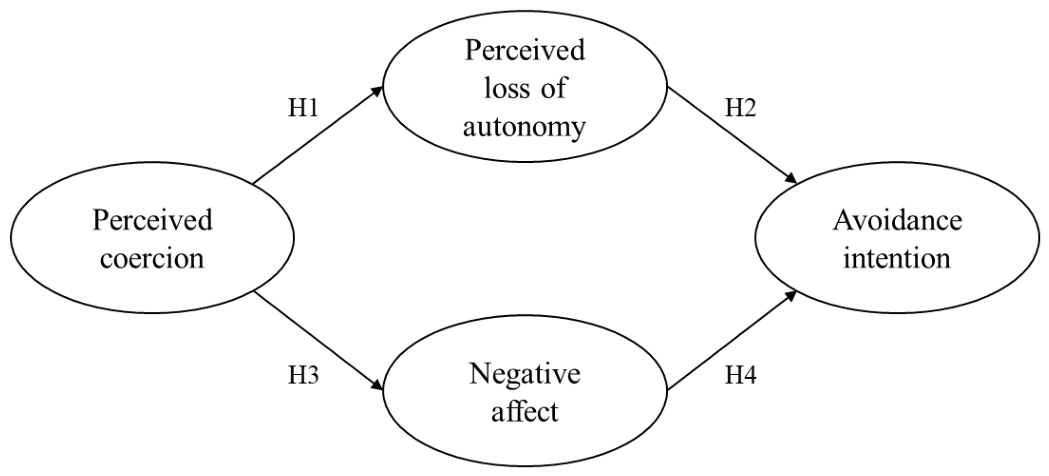
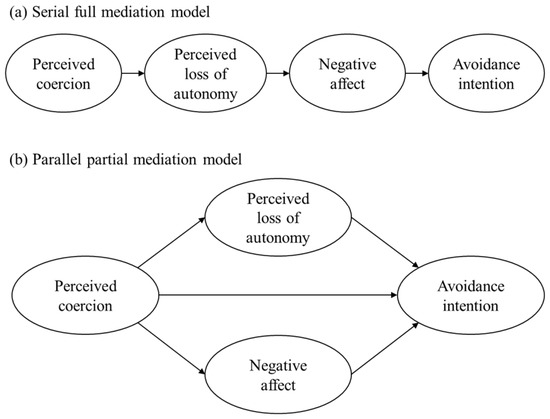
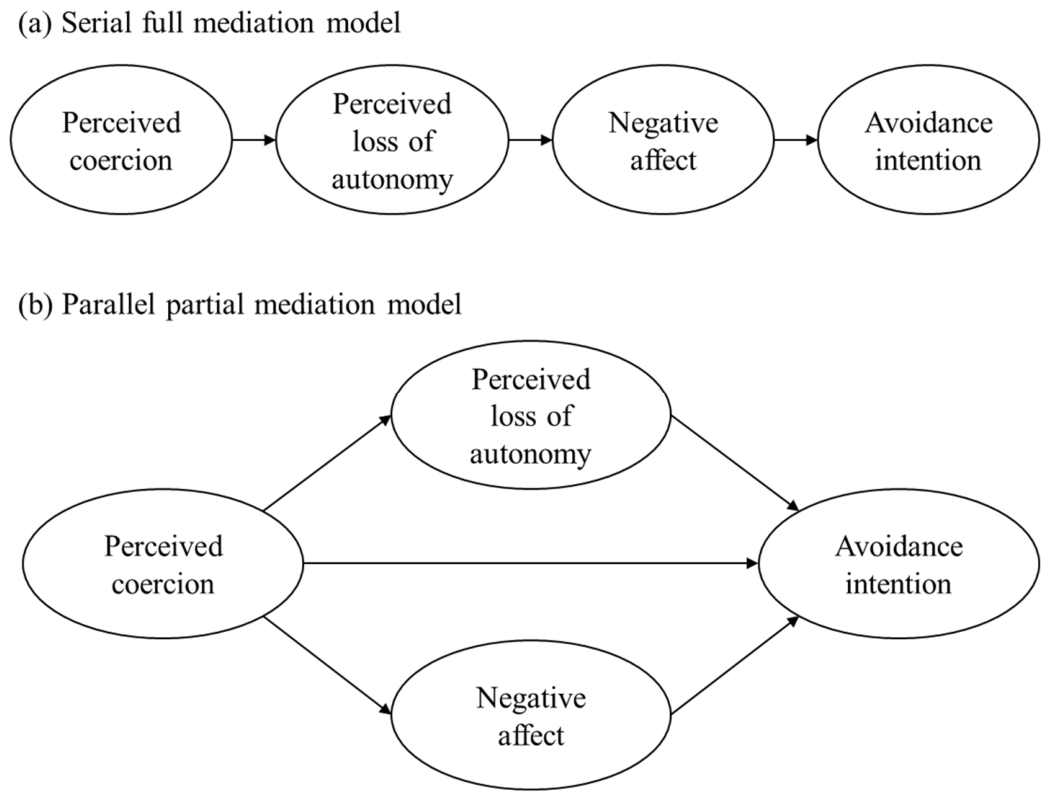
To examine the robustness and theoretical plausibility of the proposed framework, we contrast the parallel full mediation model (Figure 1) with two alternative model specifications—a serial full mediation model and a parallel partial mediation model (Figure 2)—that reflect different assumptions regarding the sequencing and independence of cognitive and affective mechanisms under coercive SST conditions.
Figure 1.
Proposed parallel full mediation model.
Figure 2.
Alternative models for comparison.
3. Materials and Methods
3.1. Measurements
Our research model incorporates four latent constructs: perceived coercion, perceived loss of autonomy, negative affect, and avoidance intention. All items were measured using five-point Likert scales ranging from 1 (strongly disagree) to 5 (strongly agree). Higher scores indicate stronger endorsement of each construct. The complete list of measurement items is presented in Table 1.
Because no established scale directly captures perceived coercion and perceived loss of autonomy in consumer-facing kiosk-only service environments, the measurement items were adapted and contextually refined from related literature on mandatory technology use, constrained choice, and autonomy [10,14,16,43].
Perceived coercion was conceptualized as the perceived presence of a structurally imposed obligation to use SSTs, reflecting consumers’ recognition that alternative service channels are unavailable. Importantly, perceived coercion captures the experiential awareness of constraint embedded in the service system, rather than an evaluative judgment regarding its fairness or consequences. Drawing on research on mandatory technology use and structurally imposed consumption [10,16], four items were developed to reflect feelings of being forced, pressured, or obliged to use kiosks under kiosk-only service configurations.
To preserve conceptual distinctiveness, these items were intentionally framed to exclude references to choice deprivation, control loss, or emotional reactions, positioning perceived coercion strictly as an antecedent experiential condition.
Perceived loss of autonomy was defined as a reflective cognitive appraisal that one’s freedom of choice and self-determination in service engagement has been diminished. Unlike perceived coercion—which reflects the immediate recognition of compulsion—loss of autonomy represents an evaluative judgment concerning reduced control over how services are accessed. Consistent with self-determination theory, autonomy reflects a fundamental psychological need for volition and self-governance [42]. Four items were adapted and contextually refined from autonomy and choice literature [14,43] to capture perceived deprivation of decision-making freedom, personal control, and self-determination in kiosk-only environments. Consistent with our theoretical framework, these items explicitly reference evaluative judgments, thereby distinguishing them from coercion items that capture the structural condition itself.
Negative affect captured the emotional distress experienced during kiosk interactions, including feelings of anxiety, irritation, and stress. Rather than modeling discrete emotions separately, this study conceptualizes negative affect as a broad affective response reflecting the overall emotional burden elicited by coercive service encounters. This approach aligns with our theoretical focus on affective resistance—the general emotional discomfort that motivates disengagement—rather than on fine-grained emotion-specific processes.
In high-pressure service environments characterized by autonomy threats, such emotions are known to co-occur and jointly shape behavioral avoidance [32,47]. Accordingly, three items were developed to capture the intensity of negative emotional experience during SST use, while deliberately excluding cognitive or evaluative language to maintain conceptual separation from perceived loss of autonomy.
Avoidance intention was defined as consumers’ behavioral tendency to disengage from or avoid kiosk use in future service encounters. Four items were adapted from prior studies on technology avoidance and switching intentions [24,47], with wording tailored to reflect avoidance behavior in kiosk-only service contexts.
The research instrument was developed from validated English-language scales and adapted for older Korean consumers using Brislin’s back-translation procedure [50]. Two bilingual Ph.D. candidates independently translated the items into Korean, followed by blind back-translation by a professional bilingual translator. Discrepancies were resolved through committee review [51].
Content validity was further established through expert review and a pilot test involving 30 older adults (aged 65 and above). Minor wording refinements were made to enhance clarity and flow. Pretest results indicated satisfactory internal consistency, supporting the clarity and coherence of the measurement items.
Table 1.
Measurement items.
3.2. Data Collection and Sample Description
This study focused on consumers aged 65 years and older to investigate perceptions of coercion in SST use. Stratified quota sampling was employed to ensure balanced gender representation, following best practices for minimizing sampling bias in aging research.
To ensure that all participants had prior exposure to SSTs and could meaningfully evaluate kiosk-only service environments, eligibility criteria required respondents to have used at least one kiosk-based service (e.g., restaurant ordering, supermarket self-checkout, or café kiosks) within the past six months. In this study, mandatory SST environments were operationalized through kiosk-only service scenarios, as kiosks represent one of the most prevalent and recognizable forms of SST in everyday service encounters for older consumers. Participants who reported no prior SST experience were excluded at the screening stage.
To establish a common experiential frame of reference and reduce heterogeneity in recalled service encounters, the survey began with visual prompts depicting typical kiosk-based service situations (e.g., restaurant ordering, supermarket self-checkout, and café kiosks) [53]. Participants were asked to recall similar experiences based on these images. By presenting kiosk-only environments without staffed alternatives, these visual cues helped standardize the perceived coercive service context across respondents prior to measurement.
The main survey was administered online through a professional research agency’s senior panel between 7 and 11 February 2025. Of the 400 responses collected, 389 valid cases were retained after excluding incomplete responses and those exhibiting straight-lining (long-string) response patterns. The study protocol received Institutional Review Board (IRB) approval, and all participants provided informed consent after being informed of the study’s purpose and procedures.
Although the use of an online panel may underrepresent older adults with extremely low digital access, the primary objective of this study was theory testing rather than population-level prevalence estimation. Consequently, the sample is appropriate for theory testing, although older adults with extremely low digital access are likely underrepresented.
Table 2 summarizes the sample characteristics. The mean age of participants was 68.5 years (SD = 3.21). Nearly half lived with a spouse, approximately 60% held a bachelor’s degree or higher, and the average monthly personal income was KRW 3.24 million.
Table 2.
Sample characteristics.
3.3. Data Analysis
Data analyses were conducted using SPSS 29.0 and AMOS 29.0. Descriptive statistics (means and standard deviations) and Pearson correlation coefficients were computed to summarize bivariate relationships among the variables.
Structural equation modeling (SEM) followed the two-step approach recommended by Anderson and Gerbing [54]. First, confirmatory factor analysis (CFA) was performed to evaluate the measurement model and establish convergent and discriminant validity. Model fit was assessed using multiple indices—χ2/df, Comparative Fit Index (CFI), Tucker–Lewis Index (TLI), Root Mean Square Error of Approximation (RMSEA), and Standardized Root Mean Square Residual (SRMR)—interpreted in accordance with established guidelines [55]. Convergent validity was verified through standardized factor loadings (preferably > 0.70; minimally > 0.50), average variance extracted (AVE ≥ 0.50), and composite reliability (CR ≥ 0.70) [56]. Discriminant validity was assessed using the Fornell–Larcker criterion, confirming that the square root of each construct’s AVE exceeded its inter-construct correlations.
Second, the hypothesized structural model was estimated using maximum likelihood estimation. Indirect effects were tested via bias-corrected bootstrapping with 5000 resamples to generate 95% confidence intervals [57]. To evaluate model parsimony, the proposed model was compared with two theoretically grounded alternatives: (1) a serial full mediation model (perceived coercion → perceived loss of autonomy → negative affect → avoidance intention), and (2) a parallel partial mediation model that included a direct path from perceived coercion to avoidance intention. Model comparisons were conducted using χ2 difference tests and information criteria (AIC, BIC), with lower values indicating superior model fit.
Finally, the phantom-variable approach [58] was applied to estimate and contrast the magnitudes of the cognitive and emotional indirect effects, allowing for a direct assessment of their relative contributions to avoidance intention.
4. Results
4.1. Measurement Model Testing
The CFA indicated good fit to the data (χ2 (69) = 186.780, CFI = 0.975, TLI = 0.967, SRMR = 0.045, RMSEA = 0.066), with the normed chi-square (χ2/df = 2.71) falling within the accepted threshold [59]. To probe common method bias, we also estimated a single-factor CFA; model fit indices were χ2 (75) = 850.862, CFI = 0.834, TLI = 0.798, RMSEA = 0.163, and SRMR = 0.071, indicating that a single common factor does not adequately account for the observed covariation among the indicators. Adding an unmeasured latent method factor did not meaningfully improve fit (ΔCFI < 0.01), suggesting that CMV is unlikely to materially bias the results.
As summarized in Table 3, all standardized factor loadings were statistically significant (p < 0.001) and exceeded the 0.50 threshold [55]. Convergent validity was adequately established, as all CR and AVE values surpassed the recommended minimums of 0.70 and 0.50, respectively [56].
Table 3.
Confirmatory factor analysis results.
Discriminant validity was initially assessed using the Fornell–Larcker criterion (Table 4), whereby the square root of each construct’s AVE exceeded its correlations with other constructs [56]. In addition, discriminant validity was further evaluated using the heterotrait–monotrait ratio (HTMT), which has been recommended as a complementary approach [60,61].
Table 4.
Means, correlations, and discriminant validity.
As shown in Table 5, all HTMT values ranged from 0.37 to 0.86, below the recommended threshold of 0.90 [60], providing additional support for discriminant validity. Notably, the statistical separation between perceived coercion and perceived loss of autonomy was confirmed, indicating that these conceptually related constructs are empirically distinct. All inter-construct correlations also remained below 0.85, further supporting the validity of the measurement model for subsequent structural analysis.
Table 5.
HTMT results.
To assess non-response bias, an early–late comparison was conducted by dividing respondents into the first and last 30% based on response order (n = 117 each). Independent samples t-tests revealed no significant differences across all key constructs (p > 0.05), suggesting that non-response bias is unlikely to affect the results.
4.2. Structural Model Testing
The structural model demonstrated a good fit (χ2 (71) = 187.170, CFI = 0.975, TLI = 0.968, SRMR = 0.043, RMSEA = 0.065), with a normed chi-square (2.64) well below the threshold of 3. As shown in Table 6, all hypothesized structural paths were statistically significant and in the predicted directions. Perceived coercion was positively associated with both perceived loss of autonomy (H1) and negative affect (H3). Subsequently, both mediators positively predicted avoidance intention (H2 and H4). The magnitude of the standardized coefficients and the explained variance indicate substantively meaningful effects.
Table 6.
Path analysis results of the proposed model.
4.3. Comparison with Alternative Models
To validate the theoretical superiority of the research model, we compared it against two plausible alternatives (see Table 7). The serial full mediation model—which assumes that cognitive appraisal precedes affective response—showed markedly poorer fit (χ2 (72) = 405.571; CFI = 0.929; RMSEA = 0.109) and higher AIC and BIC, indicating inferior performance relative to the research model. The parallel partial mediation model showed comparable fit (χ2 (70) = 186.877, CFI = 0.975, RMSEA = 0.066), but the chi-square difference was not significant (Δχ2 (1) = 0.293, p = 0.588), and the added direct path from perceived coercion to avoidance intention was not statistically significant at the conventional 0.05 level (β = 0.156, p = 0.075). Guided by the principle of parsimony [62] and the statistical superiority of the full mediation structure, the hypothesized parallel model was retained.
Table 7.
Model fit indices for hypothesized and alternative models.
4.4. Mediation Analysis
Mediation effects were examined using bias-corrected bootstrapping (5000 resamples) [57] and employed phantom variables to estimate pathway-specific effects [58] (see Table 8). The total indirect effect of perceived coercion on avoidance intention was statistically significant, indicating the presence of mediation through the proposed pathways.
Table 8.
Bootstrap results for total and specific indirect effects.
Pathway-specific analyses revealed significant indirect effects via both perceived loss of autonomy (H5a) and negative affect (H5b). A comparison of the indirect effects suggests that the pathway through negative affect was more pronounced than that through perceived loss of autonomy, implying that affective responses may play a more prominent role than cognitive appraisal in shaping avoidance intentions under coercive SST conditions.
5. Discussion and Conclusions
5.1. Discussion of Findings
This study examined the psychological mechanisms through which perceived coercion in SST contexts is linked to older consumers’ avoidance intentions. The results support a dual-pathway structure in which perceived coercion is related to both perceived loss of autonomy and negative affect, which in turn predict avoidance. This pattern suggests that avoidance is not merely a direct response to technology use itself, but is mediated by psychologically mediated responses to constrained service conditions. Such findings are consistent with prior research indicating that technology-related resistance is shaped not only by functional evaluations but also by affective and experiential responses in service interactions [4,6,15].
Three main insights emerge from the analysis.
First, the results suggest a relatively stronger role of affective responses. While both cognitive and emotional pathways significantly mediated the relationship between perceived coercion and avoidance, the effect of negative affect was more pronounced. This finding is consistent with prior research showing that emotionally driven responses can play a central role in SST resistance, particularly under conditions of uncertainty, time pressure, and reduced human support [32,33].
In contexts where consumers perceive limited controllability, immediate emotional reactions may become more salient than reflective evaluations, especially among older consumers who tend to rely more on affective and experiential cues [48]. This suggests that avoidance behavior in coercive service environments may be closely associated with feelings of discomfort or frustration rather than solely with deliberate evaluations of autonomy loss.
Second, the findings indicate that cognitive and emotional responses are co-activated but asymmetrical. This pattern aligns with emerging research that conceptualizes technology resistance as a multidimensional process integrating both evaluative judgments and affective responses [3,24,33,44]. The stronger influence of negative affect observed in this study suggests that emotional responses may play a particularly important role under conditions of perceived constraint, complementing prior work that has often examined cognitive and affective mechanisms separately.
Third, the findings suggest that responses to perceived coercion in consumer service contexts may differ from those observed in organizational settings. While prior research on mandatory technology use has often focused on compliance-oriented responses [10,20], the present results indicate that consumers may respond through disengagement when service designs are perceived as constraining.
This difference may reflect the presence of exit options in consumer markets, where individuals can avoid or discontinue service interactions. In this context, avoidance may not be purely functional but may also reflect perceived discomfort or reduced relational quality in technology-mediated encounters [11,32].
Taken together, the findings indicate that autonomy-threatening service designs are associated with both cognitive and affective responses, with affective reactions showing a relatively stronger association with avoidance. These results contribute to a growing body of research that views SST avoidance as a psychologically mediated response to perceived constraint, complementing adoption-based perspectives that emphasize voluntary decision-making.
5.2. Theoretical Implications
This study offers several theoretical implications for research on digital service environments and consumer behavior by situating perceived coercion within structurally constrained service contexts.
First, the findings suggest that perceived coercion can be understood as a consumer response associated with service environments in which meaningful alternatives are limited. Prior research on SST use has primarily focused on individual-level factors such as digital literacy or usability. The present results indicate that resistance may also be linked to how service systems are structured, particularly when human-assisted alternatives are reduced or removed. This perspective is consistent with emerging work that conceptualizes service systems as choice architectures shaping consumer experiences and access [6,15].
Second, the study provides empirical support for distinguishing perceived coercion from perceived loss of autonomy. While the two constructs are related, the results indicate that they function as distinct mechanisms within the model. Perceived coercion is associated with the experiential recognition of constrained choice, whereas perceived loss of autonomy reflects a more evaluative appraisal of reduced control. By demonstrating that these constructs exhibit discriminant validity and play different roles within the mediation structure, the study contributes to clarifying their conceptual boundaries. This distinction may be useful for future research examining how structural service conditions translate into different types of psychological responses.
Third, by incorporating both cognitive appraisal and affective response mechanisms within a single model, the study highlights the importance of considering multiple psychological pathways in understanding technology resistance. The findings suggest that emotional responses may play a particularly salient role under conditions of perceived constraint, complementing prior research that has emphasized cognitive evaluations. This perspective aligns with growing interest in integrating cognitive and affective processes in studies of technology use and resistance [33,40,41].
Overall, rather than proposing a fundamentally new framework, this study contributes by empirically illustrating how structurally constrained service conditions are associated with distinct cognitive and affective responses, which together shape avoidance behavior in SST contexts.
5.3. Practical Implications
The findings offer practical implications for the design, implementation, and governance of SSTs, particularly in consumer-facing settings such as restaurants, supermarkets, cafés, and public service facilities, where older and digitally vulnerable consumers increasingly encounter kiosk-based service formats.
Importantly, the moderate mean levels observed for key constructs suggest that respondents did not consistently perceive high levels of coercion or negative affect across all interactions. However, the results also indicate that even moderate levels of perceived constraint can be associated with avoidance intentions. This implies that coercive experiences, while not pervasive, may still exert meaningful behavioral influence when they occur. Accordingly, managerial attention should focus on specific interaction points where perceived constraint and emotional discomfort are more likely to arise, rather than relying solely on overall satisfaction indicators.
First, digital interface and interaction design should incorporate mechanisms that reduce emotional strain during SST interactions, rather than focusing exclusively on functional simplicity. Given that negative affect showed a relatively stronger association with avoidance, design efforts should pay particular attention to situations in which frustration or uncertainty is likely to emerge, such as order errors, payment failures, or time pressure in queues. Practical measures include clearly visible assistance options, supportive and humanized error messages, and multimodal guidance (e.g., visual or audio–visual cues) that can help users navigate the interaction more confidently. At the operational level, firms may benefit from monitoring inclusion-related indicators—such as help-request rates, task completion times, and abandonment rates—across different user segments to identify points where emotional strain is most pronounced [5].
Second, maintaining meaningful choice within service systems remains important. While SST deployment can improve efficiency, limiting or removing alternative service channels may increase perceptions of constraint. Ensuring that human assistance, assisted ordering options, or remote support remain visibly available may help preserve consumers’ sense of autonomy and reduce resistance. Prior research similarly emphasizes the importance of preserving perceived control and choice in technology-mediated service environments [1,24].
Third, hybrid human–technology service configurations may provide a balanced approach. Allocating routine transactions to SSTs while retaining human support for situations that require flexibility, reassurance, or problem resolution can help mitigate emotional strain without undermining efficiency. Such configurations may be particularly relevant for older consumers, whose technology use is often shaped by experiential and affective considerations [63,64]. In addition, participatory design approaches that involve older users may help ensure that service systems are not only accessible but also perceived as supportive.
Fourth, managing initial encounters with SSTs appears to be important. Negative first experiences may contribute to subsequent avoidance, particularly when accompanied by emotional discomfort. Providing onboarding support, guided interaction modes, or staff assistance during early use may help reduce negative affect and support more positive engagement trajectories [65].
Finally, policy and governance frameworks may need to consider coercive service design as an aspect of digital inclusion. For example, maintaining alternative access channels in essential services, conducting periodic accessibility assessments, and monitoring service completion or abandonment patterns may help identify unintended exclusion effects [15]. At the same time, policies aimed at improving digital literacy should complement—rather than replace—efforts to design less constraining service environments [66].
Taken together, these implications suggest that managing SST adoption is not solely a matter of improving usability, but also of addressing emotional and experiential dimensions of service interactions. By reducing perceived constraint and supporting more comfortable interaction experiences, organizations may enhance continued engagement among older consumers and digitally vulnerable segments.
5.4. Limitations and Future Research
This study also highlights several directions for future research that can further advance understanding of coercive service design in digital service environments.
First, future research should capture greater heterogeneity within older populations. Although the present study focused on consumers aged 65 and above, participants in their late 60s were more strongly represented than the “old-old” (e.g., 75+). Because functional, cognitive, and social constraints tend to intensify with age, studies employing finer age stratification could clarify how perceptions of coercion, autonomy loss, and emotional distress evolve across later-life stages. This is important because vulnerability is not a fixed trait but a dynamic condition shaped by the interaction between individual capabilities and service system design.
Second, measurement issues warrant further attention. Although this study employed context-adapted measures to capture perceived coercion and related psychological responses in mandatory SST environments, some constructs were operationalized by refining existing items rather than applying fully established scales developed specifically for this context. Future research should prioritize the development of standardized scales for technology-induced coercion and further validate these measures across diverse service settings to ensure comparability and robust construct validity.
Third, extending this framework beyond kiosk-based retail contexts represents an important avenue for research. Comparative studies across service domains—such as healthcare, transportation, and public administration—could determine whether the psychological mechanisms identified here generalize to settings where digital access carries higher stakes. Cross-national research may further clarify how cultural norms and regulatory environments shape responses to structurally imposed digital service systems.
Fourth, future studies may expand the model by incorporating contextual moderators such as trust in service providers, perceived legitimacy of automation, social norms, and prior service experiences. In particular, examining how the visibility or accessibility of human alternatives conditions perceived coercion would provide valuable insights for inclusive service system design.
Finally, longitudinal and experimental approaches could strengthen causal inference and illuminate process dynamics. Multi-method designs combining experiments, panel data, and qualitative inquiry would help trace how perceptions of coercion and resistance responses evolve across repeated service encounters.
Together, these directions position coercive service design as a promising framework for future research on digital inclusion, autonomy, and consumer well-being, supporting the development of digital service ecosystems that balance efficiency with dignity and emotional security.
Author Contributions
Conceptualization, methodology, and formal analysis, J.-M.L.; investigation and data curation, S.K. and J.-M.L.; writing—original draft preparation, J.-M.L. and S.K.; writing—review and editing, J.-M.L.; supervision, J.-M.L. All authors have read and agreed to the published version of the manuscript.
Funding
This work was supported by the Ministry of Education of the Republic of Korea and the National Research Foundation of Korea (NRF-2025S1A5A8005267).
Institutional Review Board Statement
The study was conducted in accordance with the Declaration of Helsinki and approved by the Institutional Review Board of Chungnam National University (IRB No. 202401-SB-005-01 and approval date 21 March 2024).
Informed Consent Statement
Informed consent was obtained from all subjects involved in the study.
Data Availability Statement
The data supporting the findings of this study are available from the corresponding author upon reasonable request.
Conflicts of Interest
The authors declare no conflicts of interest.
References
- Blut, M.; Wang, C.; Schoefer, K. Factors influencing the acceptance of self-service technologies: A meta-analysis. J. Serv. Res. 2016, 19, 396–416. [Google Scholar] [CrossRef] [Scilit]
- Pantano, E.; Viassone, M.; Boardman, R.; Dennis, C. Inclusive or exclusive? Investigating how retail technology can reduce old consumers’ barriers to shopping. J. Retail. Consum. Serv. 2022, 68, 103074. [Google Scholar] [CrossRef] [Scilit]
- Cserdi, Z.; Kenesei, Z. Attitudes to forced adoption of new technologies in public transportation services. Res. Transp. Bus. Manag. 2021, 41, 100611. [Google Scholar] [CrossRef] [Scilit]
- Wilson-Nash, C.; Angell, R.; Qiu, Y.; Pavlopoulou, I.; Kolyperas, D. No app, no entry: Conceptualizing digital technology captivity in service access. Psychol. Mark. 2026, 43, 974–985. [Google Scholar] [CrossRef] [Scilit]
- Wirtz, J.; Patterson, P.G.; Kunz, W.H.; Gruber, T.; Lu, V.N.; Paluch, S.; Martins, A. Brave new world: Service robots in the frontline. J. Serv. Manag. 2018, 29, 907–931. [Google Scholar] [CrossRef] [Scilit]
- Fisk, R.P.; Dean, A.M.; Alkire, L.; Joubert, A.; Previte, J.; Robertson, N.; Rosenbaum, M.S. Design for service inclusion: Creating inclusive service systems by 2050. J. Serv. Manag. 2018, 29, 834–858. [Google Scholar] [CrossRef] [Scilit]
- Lebrun, A.M.; Corbel, R.; Bouchet, P. Impacts of COVID-19 on travel intention for summer 2020: A trend in proximity tourism mediated by an attitude towards COVID-19. Serv. Bus. 2022, 16, 469–501. [Google Scholar] [CrossRef] [Scilit]
- Almokdad, E.; Mouloudj, K.; Lee, C.H. Rehumanizing AI-driven service: How employee presence shapes consumer perceptions in digital hospitality settings. J. Theor. Appl. Electron. Commer. Res. 2025, 20, 209. [Google Scholar] [CrossRef] [Scilit]
- Jun, J.Y.; Marjerison, R.K.; Kim, J.M. Drivers of kiosk adoption: An extended TAM perspective on digital readiness, trust, and barrier reduction. J. Theor. Appl. Electron. Commer. Res. 2025, 20, 261. [Google Scholar] [CrossRef] [Scilit]
- Brown, S.A.; Massey, A.P.; Montoya-Weiss, M.M.; Burkman, J.R. Do I really have to? User acceptance of mandated technology. Eur. J. Inf. Syst. 2002, 11, 283–295. [Google Scholar] [CrossRef] [Scilit]
- Feng, W.; Tu, R.; Lu, T.; Zhou, Z. Understanding forced adoption of self-service technology: The impacts of users’ psychological reactance. Behav. Inf. Technol. 2019, 38, 820–832. [Google Scholar] [CrossRef] [Scilit]
- Lazarus, R.S. Emotion and Adaptation; Oxford University Press: New York, NY, USA, 1991. [Google Scholar]
- Brehm, S.S.; Brehm, J.W. Psychological Reactance: A Theory of Freedom and Control; Academic Press: New York, NY, USA, 1981. [Google Scholar]
- Botti, S.; Iyengar, S.S. The dark side of choice: When choice impairs social welfare. J. Public Policy Mark. 2006, 25, 24–38. [Google Scholar] [CrossRef] [Scilit]
- Lu, F.C.; Sinha, J. Understanding retail exclusion and promoting an inclusive customer experience at transforming service encounters. J. Consum. Aff. 2023, 57, 1482–1522. [Google Scholar] [CrossRef] [Scilit]
- Heidenreich, S.; Talke, K. Consequences of mandated usage of innovations in organizations: Developing an innovation decision model of symbolic and forced adoption. AMS Rev. 2020, 10, 279–298. [Google Scholar] [CrossRef] [Scilit]
- Fernandes, T.; Pedroso, R. The effect of self-checkout quality on customer satisfaction and repatronage in a retail context. Serv. Bus. 2017, 11, 69–92. [Google Scholar] [CrossRef] [Scilit]
- Kokkinou, A.; Cranage, D.A. Why wait? Impact of waiting lines on self-service technology use. Int. J. Contemp. Hosp. Manag. 2015, 27, 1181–1197. [Google Scholar] [CrossRef] [Scilit]
- Bhattacherjee, A.; Davis, C.J.; Connolly, A.J.; Hikmet, N. User response to mandatory IT use: A coping theory perspective. Eur. J. Inf. Syst. 2018, 27, 395–414. [Google Scholar] [CrossRef] [Scilit]
- Hwang, Y.; Al-Arabiat, M.; Shin, D.H. Understanding technology acceptance in a mandatory environment: A literature review. Inf. Dev. 2016, 32, 1266–1283. [Google Scholar] [CrossRef] [Scilit]
- Brown, T.L. Coercion versus choice: Citizen evaluations of public service quality across methods of service delivery. Public Adm. Rev. 2007, 67, 559–572. [Google Scholar] [CrossRef] [Scilit]
- Stanhope, V.; Marcus, S.C.; Solomon, P. The impact of coercion on services from the perspective of mental health care consumers with co-occurring disorders. Psychiatr. Serv. 2009, 60, 183–188. [Google Scholar] [CrossRef] [PubMed]
- Liu, S. The impact of forced use of self-service technologies on consumer attitudes. Comput. Hum. Behav. 2012, 28, 464–472. [Google Scholar] [CrossRef] [Scilit]
- Reinders, M.J.; Dabholkar, P.A.; Frambach, R.T. Consequences of forcing consumers to use technology-based self-service. J. Serv. Res. 2008, 11, 107–123. [Google Scholar] [CrossRef] [Scilit]
- Franco, P. Older consumers and technology: A critical systematic literature review. AMS Rev. 2023, 13, 92–121. [Google Scholar] [CrossRef] [Scilit]
- Schroeder, T.; Dodds, L.; Georgiou, A.; Gewald, H.; Siette, J. Older adults and new technology: Mapping review of the factors associated with older adults’ intention to adopt digital technologies. JMIR Aging 2023, 6, e44564. [Google Scholar] [CrossRef] [Scilit]
- Mitzner, T.L.; Boron, J.B.; Fausset, C.B.; Adams, A.E.; Charness, N.; Czaja, S.J.; Dijkstra, K.; Fisk, A.D.; Rogers, W.A.; Sharit, J. Older adults talk technology: Technology usage and attitudes. Comput. Hum. Behav. 2010, 26, 1710–1721. [Google Scholar] [CrossRef] [Scilit]
- Sayago, S.; Blat, J. Telling the story of older people e-mailing: An ethnographical study. Int. J. Hum. Comput. Stud. 2010, 68, 105–120. [Google Scholar] [CrossRef] [Scilit]
- Guido, G.; Ugolini, M.M.; Sestino, A. Active ageing of elderly consumers: Insights and opportunities for future business strategies. SN Bus. Econ. 2022, 2, 8. [Google Scholar] [CrossRef] [Scilit] [PubMed]
- Lee, C.; Coughlin, J.F. Perspective: Older adults’ adoption of technology: An integrated approach to identifying determinants and barriers. J. Prod. Innov. Manag. 2015, 32, 747–759. [Google Scholar] [CrossRef] [Scilit]
- Sudbury-Riley, L.; Hunter-Jones, P.; Al-Abdin, A.; Haenlein, M. When the road is rocky: Investigating the role of vulnerability in consumer journeys. J. Acad. Mark. Sci. 2024, 52, 1045–1068. [Google Scholar] [CrossRef] [Scilit]
- Nam, J.; Kim, S.; Jung, Y. Elderly users’ emotional and behavioral responses to self-service technology in fast-food restaurants. Behav. Sci. 2023, 13, 284. [Google Scholar] [CrossRef] [Scilit]
- Kim, H.; Chung, C.; Chung, N. When customers resist self-service technology: A shadow work perspective. Int. J. Hum.-Comput. Interact. 2025, 41, 1–19. [Google Scholar] [CrossRef] [Scilit]
- Rosenbaum, M.S.; Seger-Guttmann, T.; Giraldo, M. Commentary: Vulnerable consumers in service settings. J. Serv. Mark. 2017, 31, 309–312. [Google Scholar] [CrossRef] [Scilit]
- Lee, S.M.; Lee, D. “Untact”: A new customer service strategy in the digital age. Serv. Bus. 2019, 13, 1–22. [Google Scholar] [CrossRef] [Scilit]
- Skare, M.; Ribeiro Soriano, D. Explaining COVID-19 shock wave mechanism in the European service industry using convergence clubs analysis. Serv. Bus. 2022, 16, 283–307. [Google Scholar] [CrossRef] [Scilit]
- Tai, Y.F.; Wang, Y.C.; Luo, C.C. Technology- or human-related service innovation? Enhancing customer satisfaction, delight, and loyalty in the hospitality industry. Serv. Bus. 2021, 15, 667–694. [Google Scholar] [CrossRef] [Scilit]
- Rains, S.A. The nature of psychological reactance revisited: A meta-analytic review. Hum. Commun. Res. 2013, 39, 47–73. [Google Scholar] [CrossRef] [Scilit]
- Dai, B.; Ali, A.; Wang, H. Exploring information avoidance intention of social media users: A cognition–affect–conation perspective. Int. J. Inf. Manag. (INTR) 2020, 30, 1455–1478. [Google Scholar] [CrossRef] [Scilit]
- Lindquist, K.A.; Wager, T.D.; Kober, H.; Bliss-Moreau, E.; Barrett, L.F. The brain basis of emotion: A meta-analytic review. Behav. Brain Sci. 2012, 35, 121–143. [Google Scholar] [CrossRef] [Scilit]
- Pessoa, L. A network model of the emotional brain. Trends Cogn. Sci. 2017, 21, 357–371. [Google Scholar] [CrossRef] [Scilit]
- Ryan, R.M.; Deci, E.L. Intrinsic and extrinsic motivations: Classic definitions and new directions. Contemp. Educ. Psychol. 2000, 25, 54–67. [Google Scholar] [CrossRef] [Scilit]
- Wertenbroch, K.; Schrift, R.Y.; Alba, J.W.; Barasch, A.; Bhattacharjee, A.; Giesler, M.; Knobe, J.; Lehmann, D.R.; Matz, S.; Nave, G.; et al. Autonomy in consumer choice. Mark. Lett. 2020, 31, 429–439. [Google Scholar] [CrossRef] [Scilit]
- Schultz, C.D.; Paetz, F. The way out—Customer benefits and self-service satisfaction in cashierless shopping systems. J. Retail. Consum. Serv. 2025, 85, 104280. [Google Scholar] [CrossRef] [Scilit]
- Fitzsimons, G.J. Consumer response to stockouts. J. Consum. Res. 2000, 27, 249–266. [Google Scholar] [CrossRef] [Scilit]
- Vaportzis, E.; Clausen, M.G.; Gow, A.J. Older adults’ perceptions of technology and barriers to interacting with tablet computers: A focus group study. Front. Psychol. 2017, 8, 1687. [Google Scholar] [CrossRef] [Scilit]
- Meuter, M.L.; Ostrom, A.L.; Roundtree, R.I.; Bitner, M.J. Self-service technologies: Understanding customer satisfaction with technology-based service encounters. J. Mark. 2000, 64, 50–64. [Google Scholar] [CrossRef] [Scilit]
- Carstensen, L.L.; Isaacowitz, D.M.; Charles, S.T. Taking time seriously: A theory of socioemotional selectivity. Am. Psychol. 1999, 54, 165–181. [Google Scholar] [CrossRef] [Scilit] [PubMed]
- Chiu, Y.T.H.; Nguyen, D.M.; Hofer, K.M. Self-recovery after self-service technology failures: Do motivations and self-efficacy matter? Int. J. Retail Distrib. Manag. 2023, 51, 1195–1212. [Google Scholar] [CrossRef] [Scilit]
- Brislin, R.W. Back-translation for cross-cultural research. J. Cross-Cult. Psychol. 1970, 1, 185–216. [Google Scholar] [CrossRef] [Scilit]
- Hinkin, T.R. A brief tutorial on the development of measures for use in survey questionnaires. Organ. Res. Methods 1998, 1, 104–121. [Google Scholar] [CrossRef] [Scilit]
- Chang, P.C.; Zhang, W.; Cai, Q.; Guo, H. Does AI-driven technostress promote or hinder employees’ artificial intelligence adoption intention? A moderated mediation model of affective reactions and technical self-efficacy. Psychol. Res. Behav. Manag. 2024, 17, 413–427. [Google Scholar] [CrossRef] [Scilit]
- Aguinis, H.; Bradley, K.J. Best practice recommendations for designing and implementing experimental vignette methodology studies. Organ. Res. Methods 2014, 17, 351–371. [Google Scholar] [CrossRef] [Scilit]
- Anderson, J.C.; Gerbing, D.W. Structural equation modeling in practice: A review and recommended two-step approach. Psychol. Bull. 1988, 103, 411–423. [Google Scholar] [CrossRef]
- Hair, J.F.; Black, W.C.; Babin, B.J.; Anderson, R.E. Multivariate Data Analysis, 8th ed.; Cengage: Mason, OH, USA, 2019. [Google Scholar]
- Fornell, C.; Larcker, D.F. Evaluating structural equation models with unobservable variables and measurement error. J. Mark. Res. 1981, 18, 39–50. [Google Scholar] [CrossRef] [Scilit]
- Preacher, K.J.; Hayes, A.F. Asymptotic and resampling strategies for assessing and comparing indirect effects in multiple mediator models. Behav. Res. Methods 2008, 40, 879–891. [Google Scholar] [CrossRef] [Scilit] [PubMed]
- Macho, S.; Ledermann, T. Estimating, testing, and comparing specific effects in structural equation models: The phantom model approach. Psychol. Methods 2011, 16, 34–43. [Google Scholar] [CrossRef] [Scilit]
- Hu, L.T.; Bentler, P.M. Cutoff criteria for fit indexes in covariance structure analysis: Conventional criteria versus new alternatives. Struct. Equ. Model. 1999, 6, 1–55. [Google Scholar] [CrossRef] [Scilit]
- Henseler, J.; Ringle, C.M.; Sarstedt, M. A new criterion for assessing discriminant validity in variance-based structural equation modeling. J. Acad. Mark. Sci. 2015, 43, 115–135. [Google Scholar] [CrossRef] [Scilit]
- Ab Hamid, M.R.; Sami, W.; Mohmad Sidek, M.H. Discriminant validity assessment: Use of Fornell & Larcker criterion versus HTMT criterion. J. Phys. Conf. Ser. 2017, 890, 012163. [Google Scholar] [CrossRef] [Scilit]
- MacCallum, R.C. Model specification: Procedures, strategies, and related issues. In Structural Equation Modeling: Concepts, Issues, and Applications; Hoyle, R.H., Ed.; Sage Publications: Thousand Oaks, CA, USA, 1995; pp. 16–36. [Google Scholar]
- Hsiao, C.H.; Tang, K.Y. Key factors in the continuance of self-service technology and its mobile app adoption: A case study of convenience stores in Taiwan. Appl. Sci. 2025, 15, 3804. [Google Scholar] [CrossRef] [Scilit]
- Saragih, H.S. Exploring the principle and competencies for phygital service inclusion. J. Serv. Mark. 2025, 39, 673–694. [Google Scholar] [CrossRef] [Scilit]
- Blake, H.T.; Davis, A.; Mellow, M.L.; Hull, M.; Robins, B.; Laver, K.; Dumuid, D.; Olds, T.; Keage, H.A.; Di Venuto, L.; et al. Co-design of a digital 24-hour time-use intervention with older adults and allied health professionals. Front. Digit. Health 2025, 7, 1544489. [Google Scholar] [CrossRef] [Scilit] [PubMed]
- Van Dijk, J.A.G.M. Digital divide research, achievements and shortcomings. Poetics 2006, 34, 221–235. [Google Scholar] [CrossRef] [Scilit]

Disclaimer/Publisher’s Note: The statements, opinions and data contained in all publications are solely those of the individual author(s) and contributor(s) and not of MDPI and/or the editor(s). MDPI and/or the editor(s) disclaim responsibility for any injury to people or property resulting from any ideas, methods, instructions or products referred to in the content. |
© 2026 by the authors. Licensee MDPI, Basel, Switzerland. This article is an open access article distributed under the terms and conditions of the Creative Commons Attribution (CC BY) license.