
Article

Consumer and Cultural Values Affecting Live Streaming Impulse Buying Behavior: A Cross-Cultural Study Between China and the United States


1
School of Digital Arts, Xi’an University of Posts and Telecommunications, 618 West Changan St., Xi’an 710121, China
2
Shaanxi Provincial Key Laboratory of Intelligent Media, Xi’an University of Posts and Telecommunications, 618 West Changan St., Xi’an 710121, China
3
School of Communication, Florida State University, 4100 University Center, Tallahassee, FL 32306, USA
4
School of Psychology, Shaanxi Normal University, 199 South Changan Road, Xi’an 710062, China
*
Author to whom correspondence should be addressed.
J. Theor. Appl. Electron. Commer. Res. 2026, 21(4), 109; https://doi.org/10.3390/jtaer21040109
Submission received: 24 January 2026 / Revised: 30 March 2026 / Accepted: 31 March 2026 / Published: 1 April 2026
(This article belongs to the Topic Livestreaming and Influencer Marketing)

Abstract

The rise of digital platforms has transformed marketing landscapes, with live-streaming emerging as a powerful tool for engaging audiences and shaping consumer behavior. While live-streaming e-commerce is rapidly expanding in Chinese and North American markets, empirical research comparing live-streaming impulse buying (LSIB) across cultural contexts remains limited. This study examined how atmospheric cues (ACs) are associated with LSIB in China and the United States through hedonic value (HV) and utilitarian value (UV), while also considering cultural value boundary conditions. Data were collected from 396 Chinese and 408 American consumers through online survey platforms. The measurement structure was first assessed using multi-group confirmatory factor analysis, and the main structural relationships were then tested using controlled multi-group latent structural equation modeling (SEM). Composite score path models were estimated as robustness checks, and moderation hypotheses were examined using interaction regressions on composite scores. In both countries, AC was positively associated with HV and UV, and HV was positively associated with LSIB. In the U.S. sample, UV was negatively associated with LSIB, whereas the corresponding association was not significant in China. Formal Wald tests did not indicate statistically significant cross-country differences in the focal structural paths. On the HV pathway, collectivism strengthened the relationship between AC and HV in China, and long-term orientation strengthened the relationship between AC and HV in the U.S. The findings suggested that the core stimulus–organism–response (S-O-R) mechanism replicated across two market contexts, while cultural orientations mainly condition the hedonic route. The study contributed to cross-context understanding of live-streaming consumption and provides evidence-based implications for digital marketing strategy.

1. Introduction

Over the past decade, live-streaming e-commerce has emerged as an important retail innovation that integrates real-time video, interactive communication, and online transactions within a single shopping process [1,2]. It can also be understood as an evolving form of social commerce, in which social interaction, support, and embedded commercial functions coexist within the same digital environment [3]. By blending entertainment, social engagement, and transaction capability, live-streaming created a more immersive form of digital consumption than conventional e-commerce browsing [4,5].
In Western markets, live-streaming shopping has increasingly been framed as a major emerging retail format capable of reshaping brand and consumer engagement [6]. According to Grand View Research [7,8], both the U.S. and European live-streaming markets were in a period of rapid expansion. During Black Friday 2025, consumers reportedly spent more than $75 million on Whatnot’s live shopping sessions, underscoring the rapid acceleration of live stream shopping adoption in the U.S. market [9]. The pattern suggested that live-streaming e-commerce is no longer a China-only phenomenon, but part of a broader transition toward interactive and socially embedded forms of retailing.
By contrast, live-streaming e-commerce in China is deeply integrated into mainstream retailing and digital platform ecosystems. Industry and official reports consistently showed that live stream shopping in China has achieved a high level of market maturity, infrastructural support, and consumer familiarity [10,11]. The broader scale of live-streaming usage in China also reflects the embeddedness of this shopping format in everyday digital life [12]. The strong integration between digital platforms, marketplace actors, and professional streamers made China a central example for understanding the large-scale evolution of live-streaming e-commerce.
At the same time, since live stream shopping is expanding internationally, the key theoretical question is no longer whether China is unique, but whether mechanisms identified in China are replicable across other contexts. More generally, recent systematic reviews of impulse buying suggested that the field benefits from more cross-context testing and stronger theoretical integration, which further motivated the present design [13,14]. A defining feature of live-streaming e-commerce is its potential to trigger impulse buying. Impulse buying refers to unplanned purchasing characterized by spontaneous decisions and limited deliberation [15]. A meta-analytic review has suggested that impulse buying is prevalent across retail contexts and can be intensified by technology-enabled shopping environments that heighten affective arousal and compress decision time [16]. Impulse buying has likewise been widely documented in digital commerce settings, including online and mobile contexts where browsing convenience and affective stimulation jointly encourage spontaneous purchases [17,18,19].
In live-streaming e-commerce specifically, real-time interaction, vivid product demonstrations, and platform-mediated recommendations can create urgency and emotional momentum that increase the likelihood of unplanned purchases [17,20,21]. Simultaneously, live-streaming shopping environments can reduce uncertainty by allowing consumers to access social cues, guidance shopping, and interactive explanations in real time [5,22]. However, the same environments may also induce decisional hesitation, as consumers are often required to rapidly assess seller credibility, product suitability, and the quality of interpersonal engagement under conditions of inherent uncertainty [23].
Prior research has suggested that live-streaming impulse buying can be shaped by consumers’ shopping values, including hedonic and utilitarian value [4,20]. However, a recent systematic review indicated that the empirical research base remains heavily China-centric and that cross-cultural boundary conditions are underexamined [14]. The limitation is particularly consequential since live-streaming e-commerce is developing under different market maturity levels and potentially different cultural value profiles in China and the United States. Building on the validated atmospheric cues scale for live-streaming e-commerce [24], the current study developed a stimulus–organism–response (S-O-R) model in which atmospheric cues represented the stimulus, hedonic and utilitarian shopping value represented dual organismic states, and live-streaming impulse buying represented the behavioral response [25]. This study further examined whether individual-level cultural values, collectivism and long-term orientation moderate the stimulus to organism links. Importantly, rather than relying solely on country-level cultural scores, the current study operationalized cultural values at the individual-level using CVSCALE measures [26], thereby allowing within-country heterogeneity while also comparing China and the United States as two distinct market contexts.

2. Theoretical Background and Hypothesis Development

2.1. Stimuli–Organism–Response (S-O-R) Framework

The conceptual framework of this study was established based on the S-O-R framework. The S-O-R framework posited that environmental stimuli (S) shape consumers’ internal organismic states (O), which subsequently drove behavioral responses (R) [25]. In retailing and digital commerce, S-O-R has been widely used to explain how atmospheric and platform cues influence consumers affective and cognitive evaluations (e.g., arousal, enjoyment, perceived value), thereby affecting approach behaviors and impulse buying [13,27]. The framework is particularly suitable for live-streaming e-commerce since this setting simultaneously presents task-relevant cues (e.g., information richness, navigation structure) and social or experiential cues (e.g., real-time interaction), both of which can activate affective and cognitive processing during shopping [21,24].
In this study, atmospheric cues in live-streaming shopping constituted the stimulus (S). Hedonic and utilitarian shopping value represent dual organismic states, capturing consumers affective enjoyment and task-oriented goal fulfillment during the shopping experience, thereby reflecting the organism (O) [28,29]. Live-streaming impulse buying behavior was the response (R), defined as unplanned purchases made during live-streaming sessions under emotional and situational influence [15]. Building on evidence that live-streaming impulse buying research remained geographically concentrated and that cross-cultural boundary conditions were underexplored [14], this study additionally examined individual-level collectivism and long-term orientation as moderators of the stimulus to organism relationships.

2.2. Live-Streaming Impulse Buying

Live-streaming e-commerce applied live-streaming technology to online platforms. It provided consumers with immersive product demonstrations, interactive information services, and real-time shopping assistance [30,31]. This business model transformed traditional online product presentations. Instead of static text and images, it introduced dynamic audio–visual content [32]. Such real-time interaction was more effective in fostering user engagement [6].
According to the 53rd Statistical Report on Internet Development in China released by the China Internet Network Information Center (CNNIC) in March 2024, China had 1.092 billion internet users as of December 2023. Among them, 816 million were live-streaming users, accounting for 74.7% of the total online population. Live-streaming e-commerce users reached 597 million, representing 54.7% of all netizens. As the user base grows, the market for live-streaming e-commerce continues to expand rapidly. Estimates from research institutions indicated that the market size reached 4.9 trillion yuan in 2023, marking a year-on-year increase of 35%.
Compared with traditional e-commerce, live-streaming e-commerce provided consumers with a rich shopping experience in personalization, interactivity, and social engagement [33]. It was also highly entertaining and interactive. These features evoked positive emotions in consumers [34,35]. As a result, shoppers often displayed strong emotional reactions that led to instant impulse purchases [36]. Consumers in live-streaming settings were thus more likely to engage in impulsive or unplanned buying [19,37,38,39]. According to iiMedia Research [40], 49.5% of live-streaming e-commerce viewers admitted that their purchase behavior was occasionally irrational and impulsive.
Impulse buying refers to unplanned purchasing with minimal deliberation. It was often triggered by external stimuli and emotional arousal [41,42]. Among all digital shopping formats, live-streaming e-commerce was particularly conducive to such behavior. Its interactive and immersive nature stimulated consumers’ impulses [20]. Real-time engagement, influencer endorsement, and gamified incentives created an exciting shopping atmosphere. These factors heightened psychological arousal and increased viewers’ impulsivity [2,21]. Moreover, the participatory experience of live-streaming strengthened this tendency further, making live-streaming a distinctive context for impulse-driven consumption [21].
Previous research suggested that the factors influencing impulse buying can be divided into two main categories: internal and external. Internal factors include demographic traits and individual characteristics. External factors, often called situational factors, refer to the shopping context, such as product features, environment, timing, and interaction [43]. However, empirical research on impulse buying within live-streaming e-commerce was still in its early stage [44,45,46]. Some studies have identified specific factors influencing online impulsive behavior. The specific factors include the social presence of streamers, viewers, and products [31]; website features such as navigability, price cues, trust, and consumer self-confidence [33]; and media affordances like visibility, meta voicing, and guided shopping [47]. However, few studies explored how internal and external factors jointly drove impulsive buying. Research on how multiple atmospheric cues in live-streaming environments affect such behavior remained sparse.

2.3. Cultural Differences Between China and the United States

A growing body of evidence examined the drivers of impulse buying in live-streaming e-commerce. However, cross-cultural comparisons remained limited [14]. This was a critical gap, since China and the United States differed not only in market maturity but also in prevailing cultural orientations that shaped how consumers interpreted and responded to shopping environments. At the national level, Hofstede’s cultural framework suggested that China tended to be more collectivistic and more long-term-oriented than the United States [48]. These broad tendencies implied greater emphases on social connectedness (collectivism) and future-oriented goal pursuit (long-term orientation) during consumption. Consequently, the same atmospheric cues in live-streaming environments might not have been interpreted in identical ways across the two market contexts. However, the present study measured collectivism and long-term orientation at the individual-level rather than assuming that all consumers within a country shared the same value profile. Cultural value orientations could have shaped how viewers emphasized utilitarian versus hedonic value when responding to design, interactivity, and information cues in live-streaming contexts. Importantly, cultural orientations also varied within countries.
Therefore, this study did not treat national culture scores as deterministic for every individual. Instead, it operationalized collectivism and long-term orientation at the individual-level using CVSCALE measures [26]. This approach allowed the researchers to test (a) whether the proposed S-O-R relationships replicated across the two market contexts and (b) whether individual-level cultural values systematically strengthened or weakened the influence of atmospheric cues on hedonic and utilitarian value within each country. Exploring these cross-cultural differences not only extended the external validity of existing S-O-R frameworks but also contributed to the refinement of the understanding of impulse buying behavior in live-streaming e-commerce among consumers from different cultures.

2.4. Atmospheric Cues in Live-Streaming

The concept of atmosphere was first defined by Kotler as “the shopping environment that is consciously designed to create a specific buyer effect, particularly one that evokes emotional responses and enhances purchase probability” [49] (p. 50). This definition highlighted the emotional and perceptual influence of environmental cues on consumer behavior. With the development of online shopping, researchers extended the notion of atmospherics to digital environments. In the context of online retailing, online store atmospheric cues typically refer to three dimensions: information quality, navigation quality, and visual design [27,50]. Information cues are mainly associated with product-related content, such as product descriptions, reviews, and visual displays, which significantly affected consumers’ purchase decisions [27]. Navigation cues involve the ease of browsing and usability of website functions, which influence users’ perceptions of control and satisfaction [27]. Design cues refer to esthetic layout, color, and visual presentation, collectively shaping the overall emotional experience in the online store [27].
As live-streaming e-commerce emerged, scholars began to reexamine atmospheric cues within this new interactive shopping context. Live-streaming e-commerce extended traditional online cues with additional sensory and social features. It allowed real-time interaction between streamers and viewers, creating an immersive and dynamic shopping experience [51]. In this context, interactive cues, including bullet screen comments, verbal communication, and viewer participation, constitute a key atmospheric element [24]. At the same time, background music and auditory design also functioned as vital atmospheric stimuli that shaped the streaming environment and influenced viewers’ emotional states [52]. When interactivity and music were optimally designed, they enhanced engagement, elevated consumers’ emotional arousal, and increased their likelihood of making impulsive purchases [24]. Thus, atmospheric cues in live-streaming environments comprised both traditional online elements, such as information, navigation, and design. Additionally, they included cues unique to live-streaming features, such as interaction. Previous studies demonstrated that atmospheric cues shaped consumers’ cognitive and affective evaluations of shopping experiences [5,27].
Before developing hypotheses, it is important to clarify the two focal shopping values. Hedonic value (HV) refers to the enjoyment, fun, and experiential pleasure derived from shopping, whereas utilitarian value (UV) reflects task-oriented goal fulfillment, such as efficiency, convenience, and effectiveness [28,29]. In live-streaming e-commerce, atmospheric cues represent the overall shopping environment created by platform features and stream design. The cues typically include task-relevant elements, such as information richness and navigation structure, and experiential or social elements, such as visual design and real-time interaction [7,24]. Task-relevant cues can enhance utilitarian value by reducing search costs, increasing perceived convenience, and facilitating decision making [53,54]. Experiential and interactive cues can enhance hedonic value by creating immersion, enjoyment, and a socially engaging shopping experience [17,24]. Accordingly, we hypothesize positive associations between atmospheric cues and both types of shopping value:
H1a: 
Atmospheric cues are positively associated with hedonic value among Chinese consumers.
H1b: 
Atmospheric cues are positively associated with hedonic value among U.S. consumers.
H2a: 
Atmospheric cues are positively associated with utilitarian value among Chinese consumers.
H2b: 
Atmospheric cues are positively associated with utilitarian value among U.S. consumers.

2.5. Hedonic and Utilitarian Value

Consumption provided consumers with two key types of value, hedonic value (HV) and utilitarian value (UV), which served as primary motivational forces guiding shopping behavior [28,55]. Two types of shopping value represented the affective vs. cognitive orientations that jointly shaped individuals’ responses to online shopping environments.
Hedonic value captures the experiential, emotional, and pleasure-oriented aspects of consumption. It refers to the enjoyment, fun, and excitement derived from the process of shopping rather than the completion of a functional task [56]. Consumers with stronger hedonic orientation pursued sensory gratification and emotional stimulation, finding shopping inherently enjoyable and entertaining [57]. In live-streaming e-commerce, interactive visual displays, lively host engagement, and real-time viewer comments create a rich emotional atmosphere, enhancing the viewers’ hedonic experience. When consumers encounter positive feedback from others or perceive a sense of community connection, their pleasure and desire to purchase are intensified [58,59]. Scarpi revealed that hedonic shoppers enjoyed browsing and watching product videos, gaining satisfaction from exploring diverse products and immersive media content [60]. Such consumers experience high emotional engagement that may reduce self-control, thus strengthening unplanned buying impulses [61]. Prior empirical evidence consistently indicated that hedonic value positively affects impulsive buying behaviors across online and mobile settings [62,63,64]. In the context of live-streaming e-commerce, the immediate gratification and social–emotional enjoyment offered by interactive cues reinforce viewers’ affective arousal, resulting in stronger impulsive buying intentions [57]. Accordingly, hedonic value is expected to enhance live-streaming impulse buying across cultural contexts.
In contrast, utilitarian value (UV) reflects a rational, goal-oriented evaluation of whether the shopping activity efficiently achieves its intended purpose [28,29]. Consumers emphasizing utilitarian motives tended to focus on performance, convenience, authenticity, and value for money. In live-streaming e-commerce, utilitarian value may increase when the environment offers clear information and smooth navigation. However, since impulse buying is typically unplanned and affect-driven, stronger utilitarian appraisal may inhibit spontaneous purchasing by shifting attention toward deliberation, practicality, and goal-consistent decision making [16,59]. Therefore, utilitarian value is expected to exert a negative association with live-streaming impulse buying.
In sum, hedonic value primarily drives impulsive purchases through heightened affective enjoyment, whereas utilitarian value is associated with rational deliberation that may restrain such spontaneous actions. Accordingly, the following hypotheses are proposed:
H3a:
Hedonic value is positively associated with live-streaming impulse buying among Chinese consumers.
H3b:
Hedonic value is positively associated with live-streaming impulse buying among U.S. consumers.
H4a:
Utilitarian value is negatively associated with live-streaming impulse buying among Chinese consumers.
H4b:
Utilitarian value is negatively associated with live-streaming impulse buying among U.S. consumers.

2.6. Moderating Roles

The Moderating Role of Cultural Values

Cultural values are one of the internal factors that predict consumer buying behaviors. In the context of live-streaming e-commerce, individual-level cultural orientations such as collectivism and long-term orientation can impact the way consumers perceive atmosphere cues, thereby altering their perceived utilitarian and hedonic values derived from the same stimuli. To answer the appeal of exploring cultural values in impulsive buying in live-streaming e-commerce from Li et al. [14], this study used Hofstede’s cultural values as moderators to explore the heterogeneous patterns from stimulus to organism. That is, it tested the moderating roles of collectivism and long-term orientation within the relationship between atmospheric cues and hedonic or utilitarian value.
According to Hofstede’s cultural framework, individualism is defined as the identity based on the individual’s self-reliant benefits [65,66], whereas collectivism (COL) highlights the group’s benefits as an interdependent self [66]. Collectivism emphasizes group welfare, social connectedness, and interdependence. In live-streaming e-commerce, atmospheric cues, especially interactive and community-like elements, can create a stronger sense of social engagement and shared experience. Collectivistic consumers may be more responsive to such social and experiential aspects, thereby deriving greater enjoyment and pleasure from the shopping environment. Thus, collectivism is expected to strengthen the positive effect of atmospheric cues on hedonic value. In contrast, since collectivistic consumers may prioritize relational reassurance over task efficiency, collectivism may weaken the extent to which atmospheric cues translate into utilitarian value.
Hence, the following hypothesis is presented:
H5a:
Collectivism positively moderates the relationship between atmospheric cues and hedonic value among Chinese consumers (i.e., the relationship is stronger at higher collectivism).
H5b:
Collectivism positively moderates the relationship between atmospheric cues and hedonic value among U.S. consumers.
H6a:
Collectivism negatively moderates the relationship between atmospheric cues and utilitarian value among Chinese consumers (i.e., the relationship is weaker at higher collectivism).
H6b:
Collectivism negatively moderates the relationship between atmospheric cues and utilitarian value among U.S. consumers.
In accordance with Hofstede’s [48,66] framework of cultural values, “long term orientation (LTO) stands for the fostering of virtues oriented towards future rewards, in particular perseverance and thrift” [48] (p. 359). LTO reflects persistence, long-term planning, and thrift [26,48]. LTO also indicates a positive, dynamic, and future-oriented culture [66]. The literature suggested that consumers with a long-term orientation, who focus on the future, may enhance their self-control to attain long-term goals. Long-term-oriented consumers are likely to place greater weight on functional, diagnostic cues that help them make effective decisions. Therefore, long-term orientation is expected to strengthen the positive effect of atmospheric cues on utilitarian value. By contrast, as long-term-oriented consumers prioritize long-term goals and self-control, they may be less susceptible to immediate experiential enjoyment, weakening the effect of atmospheric cues on hedonic value. Hence, the following hypotheses are presented:
H7a:
Long-term orientation negatively moderates the relationship between atmospheric cues and hedonic value among Chinese consumers (i.e., the relationship is weaker at higher long-term orientation).
H7b:
Long-term orientation negatively moderates the relationship between atmospheric cues and hedonic value among U.S. consumers.
H8a:
Long-term orientation positively moderates the relationship between atmospheric cues and utilitarian value among Chinese consumers (i.e., the relationship is stronger at higher long-term orientation).
H8b:
Long-term orientation positively moderates the relationship between atmospheric cues and utilitarian value among U.S. consumers.
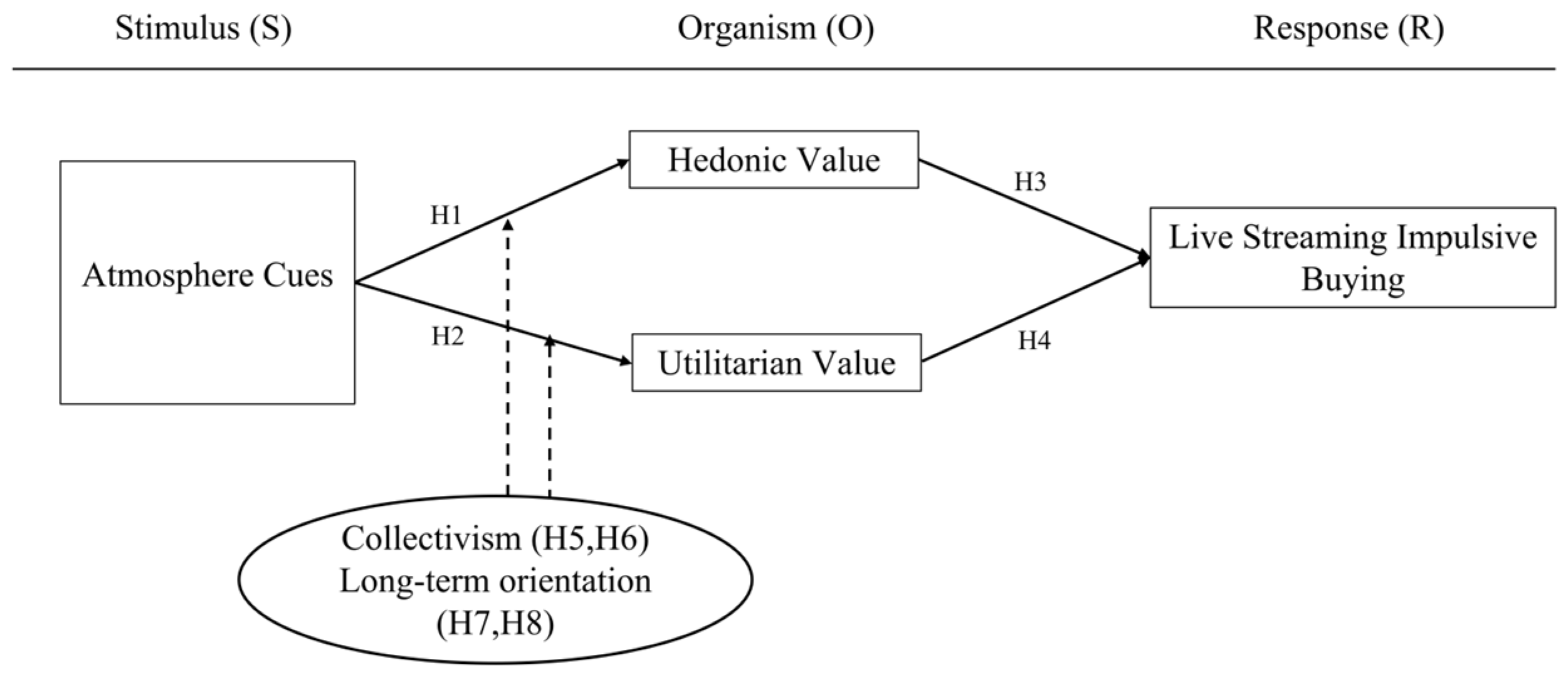
For the conceptual model, refer to Figure 1.

3. Methodology

3.1. Data Collection and Sample

The data for China and the United States were collected through two online survey panels, Credamo (https://www.credamo.com, accessed on 24 January 2026) in China and Prolific (https://www.prolific.com, accessed on 24 January 2026) in the US. Both are commercial online survey platforms. Participants received a small payment (about 1.5 USD) after completing the survey. Prior to the survey, each participant was required to read an informed consent form and the Institutional Review Board (IRB) approval memo. At the beginning of the questionnaire, two qualifier questions were set: “Have you ever used a shopping website that had a live stream?” and “Have you ever watched a live stream about a product before purchasing it?” Only participants who answered “yes” for both qualified. The qualifier question aims to ensure that the participant group with live-streaming shopping experience is included. All respondents provided informed consent before proceeding.
The data collection period took place in November through December 2025, which was a major shopping season in both countries. A total of 453 responses from China and 450 responses from the United States were initially obtained. After removing incomplete responses, attention check failures, and statistical outliers, a final sample of 396 valid Chinese cases and 408 valid U.S. cases was retained. A valid response rate was calculated as the number of valid cases divided by the initial submitted responses (China: 396/453 = 87.4%; U.S.: 408/450 = 90.6%). Both panel platforms provide respondent-level identifiers and within-study participation controls, which were used to reduce duplicate participation. Nevertheless, since the data were collected through online panels, self-selection and panel-specific bias cannot be fully ruled out. Prior methodological work suggested that carefully screened online panel data can still provide high-quality behavioral evidence, although they should not be treated as fully representative of the broader population [67,68].
Across the two country samples, both similarities and differences were observed between China and the United States. In China, most participants were female (62.1%), and the majority were young adults aged 18–35 (66.4%). In contrast, the U.S. sample had a higher proportion of male participants (54.7%), and the age distribution was more evenly spread across groups from 26 to 55 years old. Regarding education, both samples were generally well educated. In China, 77.1% of respondents held a university or postgraduate degree, while in the United States, 63.8% reached the same level. Overall, participants in both samples represented active and educated consumers engaged in live-streaming e-commerce. Detailed sample information is presented in Table 1.

3.2. Measurement

The measurement instrument comprised constructs that have been validated in previous research. Accordingly, the variables in the proposed conceptual model were adapted from existing scales and translated into Mandarin Chinese. The translated survey was then back-translated into English to ensure content equivalence. An expert panel was convened to assess the content validity of the Mandarin version. The panel included one associate professor specializing in communication and two assistant professors with international academic experience. All experts agreed that the Mandarin survey demonstrated high relevance and equivalence to the original English version in terms of clarity, content, and readability. Experts reviewed the translated items for conceptual equivalence and content relevance; feedback was incorporated to finalize the questionnaire.
All constructs were measured using established multi-item scales on a five-point Likert scale (1 = strongly disagree, 5 = strongly agree). Atmospheric cues (ACs) were measured using the 13-item atmospheric cue scale developed for live-streaming e-commerce by Shi et al. [24]. Hedonic value (HV) and utilitarian value (UV) were each assessed with a four-item scale used from Overby and Lee [69]. Impulse buying behavior in live-streaming shopping (LSIB) was measured with a three-item scale developed by Huo et al. [70]. Individual-level collectivism and long-term orientation were measured using CVSCALE items [26], consisting of six items for each construct.
During scale purification, one LTO item (LTO2: Going on resolutely in spite of opposition) showed a low and negatively corrected item total correlation in the China sample and was removed. To maintain cross-group comparability in the revised analyses, the same item was removed from both samples.

3.3. Measure Validation

The measurement model was re-evaluated at the item level using multi-group confirmatory factor analysis (CFA). The six factors’ multi-group CFA showed acceptable residual-based fit but only marginal incremental fit: robust χ2 (1024) = 2391.14, robust CFI = 0.876, robust TLI = 0.864, robust RMSEA = 0.062, and SRMR = 0.068. All factor loadings were positive and statistically significant (p < 0.001). Following common structural equation modeling (SEM) reporting conventions, these results support cautious rather than strong claims about model fit [71].
Internal consistency was satisfactory across both countries. Specifically, Cronbach’s alpha coefficients for all constructs exceeded the recommended threshold of 0.70 in both datasets [72]. In addition, McDonald’s Omega values exceeded 0.75 for all constructs [73]. The average variance extracted (AVE) exceeded 0.50 for HV, UV (China), LSIB, and COL. However, AVE was below 0.50 for AC and LTO in both countries and was marginal for UV in the U.S. sample. Since AC and LTO were broad, multifaceted constructs, the study retained them based on their adequate reliability and conservatively interpreted their convergent validity [74]. See Table 2.
Since this study compared China and the United States, cross-group measurement invariance was additionally tested. Configural invariance was supported at an acceptable level (CFI = 0.865, RMSEA = 0.065, SRMR = 0.068). Metric invariance was approximate rather than unequivocal (CFI = 0.853, RMSEA = 0.067, SRMR = 0.076), and full scalar invariance was not supported (CFI = 0.813, RMSEA = 0.075, SRMR = 0.081). Accordingly, latent mean differences were not interpreted, and cross-group structural comparisons were treated conservatively [75,76].
To assess common method variance (CMV), a one-factor CFA model was estimated. The one-factor solution showed poor fit (CFI = 0.528, TLI = 0.498, RMSEA = 0.121, SRMR = 0.112), indicating that a single common factor was unlikely to account for the covariance structure in the data [77].
Given the broad multidimensional nature of AC and the only approximate cross-group equivalence of the measurement model, a two-step analysis strategy was used. The core H1–H4 relationships were estimated with a controlled multi-group latent SEM, and composite-score path models were used as robustness checks. The moderation hypotheses (H5–H8) were estimated using controlled interaction regressions on composite scores, since latent interaction models were not sufficiently stable under the present measurement structure.

3.4. Hypothesis Testing

3.4.1. Main Effect and Mediating Effect

To test H1–H4, a controlled multi-group latent SEM was estimated in R (version 4.4.1) using the lavaan package. Atmospheric cues (ACs), hedonic value (HV), utilitarian value (UV), and live-streaming impulse buying (LSIB) were modeled as latent constructs. Age and gender were included as controls in all endogenous equations. Indirect effects were evaluated using bootstrap confidence intervals based on 5000 resamples.
Given that the revised measurement assessment indicated only marginal incremental fit and only approximate metric equivalence across groups, the same core structural relationships were further re-estimated with composite score path models to assess robustness. This strategy followed the logic that robustness analyses can be useful when broad multidimensional constructs were retained primarily on theoretical grounds; however, the item-level measurement model warrants conservative interpretation [75,76]. To avoid the reporting inconsistency in the earlier version, Table 3 reports unstandardized coefficients (b) with 95% confidence intervals, while standardized coefficients (β) are provided separately for interpretive convenience.
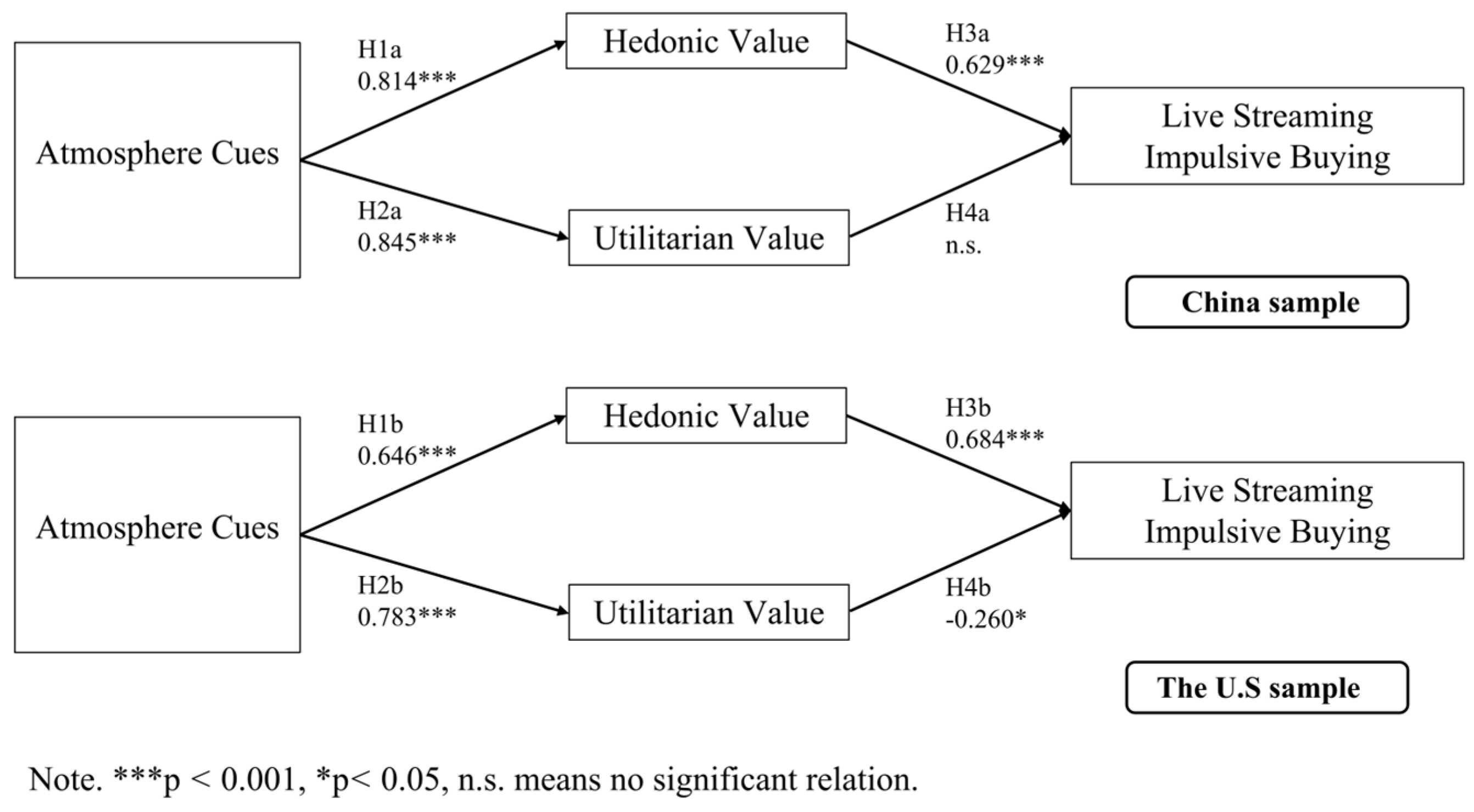
In the latent multi-group SEM, AC was positively associated with HV and UV in both countries. For the China sample, AC was positively associated with HV (β = 0.814, p < 0.001) and UV (β = 0.845, p < 0.001). HV was positively associated with LSIB (β = 0.629, p < 0.001), whereas UV was not significantly associated with LSIB (β = −0.127, p = 0.481). Therefore, H1a, H2a, and H3a were supported, whereas H4a was not supported. For the U.S. sample, AC was positively associated with HV (β = 0.646, p < 0.001) and UV (β = 0.783, p < 0.001). HV was positively associated with LSIB (β = 0.684, p < 0.001), whereas UV was negatively associated with LSIB (β = −0.260, p = 0.026). Thus, H1b, H2b, H3b, and H4b were supported; see Figure 2.
The indirect effect of AC on LSIB through HV was significant in both China (β = 0.511, p < 0.001) and the U.S. (β = 0.441, p < 0.001). The indirect effect through UV was not significant in China (β = −0.107, p = 0.487) but was significant and negative in the U.S. sample (β = −0.441, p = 0.032). Accordingly, HV represents the dominant indirect pathway in both countries, whereas the UV pathway is context-contingent.
To evaluate whether the main structural paths differed statistically across countries, formal multi-group Wald tests were conducted. None of the focal path differences reached statistical significance. The group-specific patterns were therefore interpreted as descriptive differences rather than statistically confirmed structural divergence.
As a robustness check, the same H1–H4 relationships were re-estimated using composite score path models. The composite score results showed the same qualitative pattern: AC was positively associated with HV and UV in both countries; HV was positively associated with LSIB in both countries; UV was non-significant in China but negative in the U.S. sample. This convergence reduced concerns that the substantive conclusions were an artifact of the latent measurement specification.

3.4.2. Moderating Effect

To test H5–H8, moderation effects were estimated using controlled interaction regressions on composite scores rather than latent interaction SEM. This choice was made since the revised item-level measurement model was only marginally fitting and since latent interaction estimation was not sufficiently stable for the present multidimensional structure. Atmospheric cues and moderator variables were mean-centered prior to constructing interaction terms, and age and gender were included as controls in all moderation models. For interpretive transparency, focal Johnson–Neyman analyses were computed using standardized moderator values.
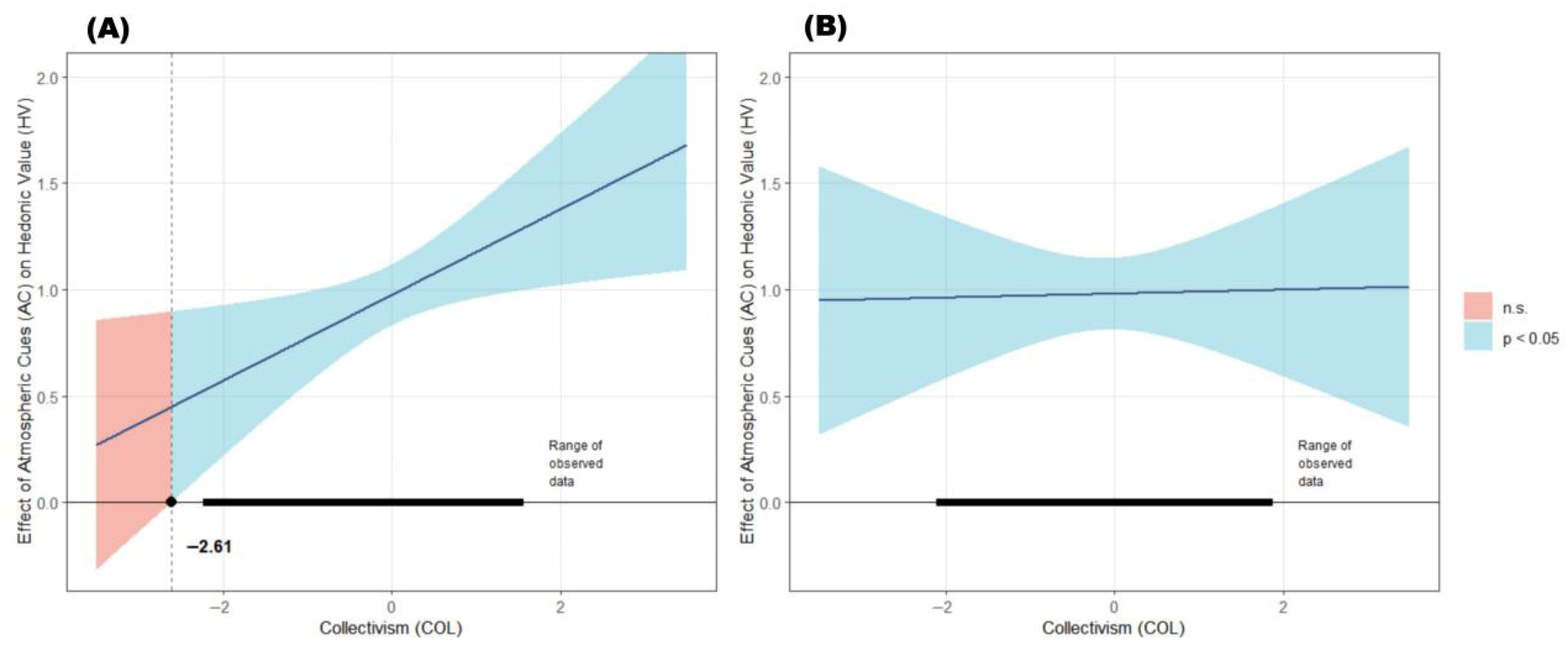
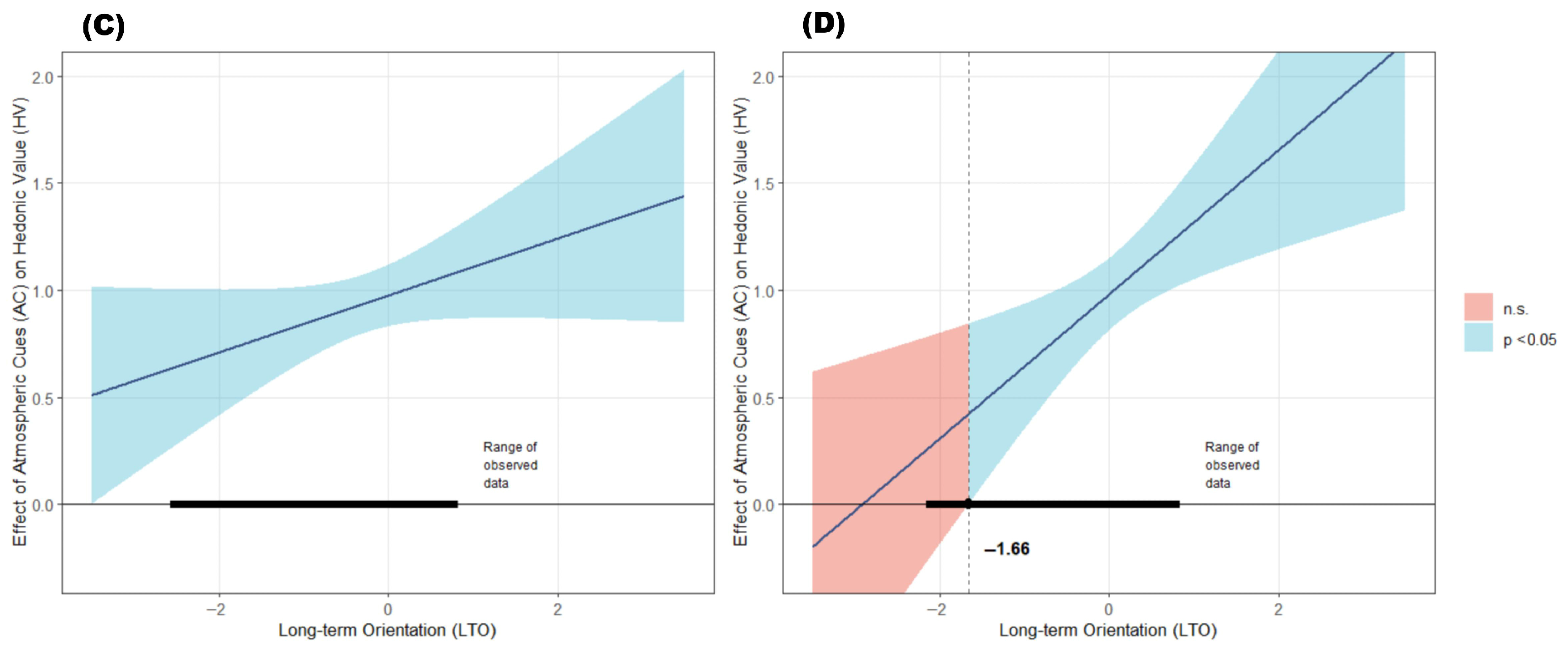
For the China sample, COL positively moderated the relationship between AC and HV (β = 0.096, p = 0.017), supporting H5a. Long-term orientation also positively moderated the relationship between AC and HV (β = 0.099, p = 0.016). However, since H7a predicted a negative moderation effect, H7a was not supported. Instead, the interaction emerged in the opposite direction to the hypothesis. By contrast, neither COL (β = 0.053, p = 0.157) nor LTO (β = 0.056, p = 0.145) significantly moderated the relationship between AC and UV. Therefore, H6a and H8a were not supported.
For the U.S. sample, COL did not significantly moderate the relationship between AC and HV (β = 0.041, p = 0.350), so H5b was not supported. Regarding the relationship between AC and UV, a small positive interaction between COL and AC was observed (β = 0.084, p = 0.041). Since H6b predicted a negative moderation effect, H6b was not supported. LTO positively moderated the relationship between AC and HV (β = 0.111, p = 0.008). Since H7b predicted a negative moderation effect, H7b was not supported. Instead, an opposite-direction positive interaction was observed. Given that this effect was small and close to the threshold of significance, we interpret it cautiously. LTO did not significantly moderate the relationship between AC and UV (β = 0.067, p = 0.091); thus, H8b was not supported. See Table 4.
In the focal Johnson–Neyman analyses, the lower significance bounds fell below the practical range of the observed moderator distributions. The interactions were therefore interpreted substantively as indicating that the positive association between AC and HV persisted across essentially the observed range of collectivism in China and across nearly the full observed range of LTO in the U.S., rather than warranting over-interpretation of the raw threshold values. See Figure 3.

4. Discussion and Conclusions

4.1. Discussions

This study, responding to the call from prior research to expand impulse buying research beyond the Chinese market and integrating consumer shopping values and Hofstede’s cultural dimensions [14], explores cross-cultural live-streaming impulse buying within the S-O-R framework. To specify, this study extended prior live-streaming impulse buying research by examining whether the mediating mechanism from atmospheric cues through shopping values to live-streaming impulse buying was replicated across two market contexts, rather than assuming that findings from one country generalize automatically to another. The revised analyses indicated that atmospheric cues were positively associated with hedonic value and utilitarian value in both China and the United States, and that hedonic value was positively associated with live-streaming impulse buying in both countries. In this sense, the strongest contribution of the study was evidence of cross-context replication of the core S-O-R mechanism.
At the same time, the results qualified overly strong cross-country claims. Although the U.S. sample showed a significant negative association between utilitarian value and live-streaming impulse buying and the China sample did not, formal Wald tests did not identify statistically significant between-country differences in the focal structural paths. Therefore, these group-specific patterns should be interpreted as descriptive rather than definitive evidence of structural divergence.

4.2. Theory Contributions

This study contributed to live-streaming e-commerce research in three ways. First, it extended prior China-centric evidence by testing whether the core mechanism through which atmospheric cues influenced value and, in turn, live-streaming impulse buying was replicated across two market contexts. Second, it integrated individual-level cultural values into the S-O-R framework and showed that cultural value boundary conditions arose primarily on the hedonic pathway rather than overturning the core structural mechanism. Third, it improved methodological transparency in the literature by adding item-level measurement assessment, cross-group invariance testing, formal Wald tests for path differences, and robustness checks using composite score models.
This research validated the cross-cultural applicability of the S-O-R framework in the context of live-streaming e-commerce. According to Li et al. [14], nearly two-thirds of studies on live-streaming impulse buying have employed the S-O-R framework as their theoretical foundation, yet most relied on single-culture data, predominantly from China. By introducing a comparative analysis between Chinese and American consumers, this study empirically confirmed that the S-O-R framework remains theoretically robust across distinct cultural environments. This evidence enhanced the external validity of the model and extends its theoretical boundary from a localized to a global digital commerce context.
Additionally, this research broadened the theoretical landscape of live-streaming e-commerce by comparing a mature and an emerging market. While prior scholarship has primarily focused on Chinese, well-established live-streaming e-commerce, this study expanded the inquiry to the United States, which is an emerging but rapidly developing live-streaming e-commerce market. This cross-market comparison could help us better understand how consumers situated in different stages of market maturity construct and evaluate live-streaming experiences. Through the integrated consideration of consumer shopping values (hedonic and utilitarian value) and cultural values (collectivism and long-term orientation), the study uncovered the psychological and cultural mechanisms that distinguish Chinese and American consumer responses. Theoretically, it helped scholars understand cultural influence on impulse buying in global live-streaming e-commerce.
Second, this study explored the mediating roles of hedonic value and utilitarian value in linking atmospheric cues to live-streaming impulse buying. The results revealed that in both cultural samples, the influence of atmospheric cues on LSIB occurred fully through hedonic value (indirect-only mediation), whereas the mediating path through utilitarian value was insignificant in China and even negative in the United States. This finding showed that hedonic value is one of the most essential factors to effect live-streaming impulse buying. Consumers’ hedonic responses played a decisive function in transforming live stream stimulation into impulsive buying behaviors. This aligned with the previous literature emphasizing that perceived enjoyment, as a hedonic response, increased the likelihood of live-streaming impulse buying by enhancing the emotional appeal of the shopping experience [78,79]. However, few studies have explicitly tested hedonic value as a formal mediator within the live-streaming context, which is an empirical gap that this study directly addresses.
The negative association between utilitarian value and live-streaming impulse buying in the U.S. sample deserved particular attention. One plausible interpretation is that utilitarian appraisal may activate deliberation, practicality assessment, and caution in a market where live-streaming shopping is less routinized than in China. Under such conditions, stronger utilitarian evaluation may suppress impulsive urges rather than amplify them, which is consistent with prior work suggesting that more deliberative processing can reduce impulse-oriented behavior [16,59]. However, since the formal cross-group Wald test for the association between UV and LSIB was not significant, this pattern should be interpreted as a within-country result rather than definitive evidence of U.S. and China structural divergence.
Third, this study advanced cross-cultural research on the S-O-R framework by incorporating Hofstede’s cultural value dimensions as moderating factors. Rather than treating culture merely as a contextual background, this study incorporated individual-level cultural values, such as collectivism and long-term orientation, to understand cross-cultural differences in consumer behavior. The findings showed that collectivism significantly moderated the relationship between atmospheric cues and hedonic value among Chinese consumers, whereas long-term orientation played a stronger moderating role in the U.S. context. To specify, Chinese consumers with higher collectivist tendencies experience stronger hedonic responses under rich atmospheric cues. This finding is consistent with prior studies emphasizing the social affective effects of collectivism in Chinese live-streaming e-commerce. Previous research has shown that collectivist values, such as “guanxi orientation” and relational interdependence, strengthen the emotional and hedonic dimensions of consumer responses in socially enriched online environments [80,81,82].
Additionally, long-term orientation significantly moderated the relationship between atmospheric cues and hedonic value among the U.S. sample. This finding is somewhat unexpected, as long-term orientation is more often associated with planning, restraint, and future-oriented evaluation than with heightened hedonic responses. This current result implied that the U.S. consumers with higher levels of long-term orientation generated stronger emotional reactions to the live stream stimuli, possibly since they evaluate live stream environments based on sustained trust and perceived stability rather than immediate enjoyment. Although previous studies have not directly addressed this interaction, existing evidence offered indirect support. Research suggested that even the U.S. consumers with a long-term planning orientation may display heightened hedonic motivations when exposed to stimulating marketing environments, and that long-term orientation can serve as a positive predictor of hedonic shopping value across cultural contexts [83,84]. At the same time, this interpretation should be treated cautiously, and the positive moderating effect of long-term orientation on the hedonic pathway should be tested further in other Western markets to determine whether it reflects a broader cultural pattern or a context-specific result. Notably, this opposite direction pattern was not limited to the U.S. sample, as long-term orientation also positively moderated the relationship between atmospheric cues and hedonic value in China. This suggested that the role of long-term orientation in live-streaming e-commerce may be more context-dependent than originally hypothesized, and may not operate solely through restraint or reduced hedonic responsiveness. In addition, the small positive interaction between collectivism and atmospheric cues on utilitarian value in the U.S. sample suggests that collectivistically oriented consumers may use socially embedded atmospheric cues as practical reassurance rather than as purely hedonic input in some contexts, although this finding should be interpreted conservatively.
This evidence demonstrated that cultural values may shape how consumers from different cultural backgrounds emotionally respond to the same environmental stimuli, thereby influencing downstream behavioral reactions. Theoretically, this approach enriched cross-cultural consumer behavior research by revealing that cultural values operate not only as national cultural background but also as individual-level value factors driving emotional and behavioral variability across cultures.

4.3. Managerial Implications

The managerial implications of the present study are framed at the level of hedonic versus utilitarian emphasis, rather than attributing effects too narrowly to any single atmospheric cue facet. The strongest and most stable result across both countries is that hedonic value is positively associated with live-streaming impulse buying. Therefore, marketers seeking immediate impulse conversion should prioritize stream experiences that enhance enjoyment, immersion, and emotional engagement.
At the same time, the findings highlight a practical trade-off. In the U.S. sample, stronger utilitarian appraisal was negatively associated with live-streaming impulse buying. This suggested that increasing informational clarity, technical detail, and evaluation support may improve consumer confidence and decision quality, but may also reduce spontaneous purchasing. Firms should therefore align stream design with campaign objectives: when the objective is immediate impulse conversion, stronger experiential engagement may be more effective; when the objective is trust-building and informed purchase, more utilitarian support may be preferable even if impulsive conversion declines.
Although the study did not model specific anchor characteristics directly, prior evidence suggested that streamer traits and emotional contagion could intensify consumers’ impulsive responses, which was relevant for designing hedonic enhancement strategies [36,85]. Since the exploratory facet-level models did not provide sufficiently strong fit for fine-grained inference, the researchers refrained from asserting that any particular atmospheric-cue dimension was the definitive driver of live-streaming impulse buying. Instead, the evidence supported a broader interpretation of atmospheric cues as a general hedonic enhancement mechanism rather than as distinct dimensions.

4.4. Limitations and Direction for Future Research

The limitations of this study suggested a few important directions for future research. First, this study employed a cross-sectional survey to test the S-O-R framework relationships, which limits the ability to draw causal conclusions between atmospheric cues, consumer shopping values, and impulse buying behavior. Although the findings suggest significant associations, the direction cannot be fully established. Future research could adopt longitudinal or experiential designs, for example by manipulating specific atmospheric cues (e.g., streaming interactivity or visual design) and tracking subsequent emotional and behavioral changes to examine causality more rigorously. Moreover, field experiments in real live-streaming e-commerce environments could further validate the temporal dynamics of impulse buying.
Second, all constructs in this study were assessed through self-reported questionnaires, which may be subject to social desirability bias and common method variance. In the context of impulsive buying, respondents may under-report their spontaneous tendencies. Although online panels are widely used in behavioral research, they may introduce self-selection and panel-specific biases. Screening questions and attention checks were implemented to enhance data quality; however, the sample may still not fully represent the general population of live-streaming shoppers [69,70]. Future research could enhance measurement validity and generalizability by integrating multi-method data collection, such as combining self-reports with behavioral indicators or psychophysiological measures, and by triangulating findings using alternative sampling approaches or behavioral platform data.
Third, the study focused on Hofstede’s two cultural dimensions, collectivism and long-term orientation, while other cultural factors that may influence consumer decision making (such as uncertainty avoidance or power distance) were not included. Since cultural values are multidimensional and interactive, relying solely on a subset may oversimplify the cultural influence mechanism. Future research could incorporate a broader set of cultural constructs or draw on alternative frameworks (e.g., Schwartz’s culture theory) to understand how cultural traits shape psychological responses in live-streaming e-commerce.
Additionally, the gender composition differed between the two national samples, with a higher proportion of male participants in the U.S. sample than in the Chinese sample. Such imbalance may influence impulse buying tendencies, as previous research has documented gender-specific differences in purchasing behaviors. However, this imbalance could still affect the observed cross-country differences in impulse buying patterns and may limit the comparability and generalizability of the findings. Future research could use stratified sampling or matched-sample designs to improve demographic comparability across countries.
Another limitation concerns measurement robustness. Although the current study included item-level CFA, reliability, AVE, and cross-group invariance testing, the measurement model showed only marginal incremental fit and metric invariance was only approximate, while full scalar invariance was not supported. Therefore, path coefficient comparisons between the China and U.S. samples should be considered preliminary and interpreted with caution. In addition, the AVE values for atmospheric cues and long-term orientation were below the conventional 0.50 threshold in both countries. Although these constructs were retained for theoretical reasons, their conceptual breadth may have reduced the precision with which the focal relationships were captured. Future research should refine the measurement structure further, especially for broader constructs such as atmospheric cues and long-term orientation.
In addition, the moderation hypotheses were tested using controlled interaction regressions on composite scores rather than latent interaction SEM. This choice improved estimation stability under the current multidimensional measurement structure, but it also means that moderation inferences should be interpreted as more conservative than if a fully satisfactory latent interaction model were available.
Finally, the current study treated live-streaming e-commerce as a homogeneous context, without distinguishing among different platforms (e.g., TikTok Live vs. Taobao Live) or product types (e.g., hedonic vs. utilitarian goods). Given that platform-specific features, such as different levels of interactivity, streamer viewer communication patterns, and interface design, as well as product involvement, may shape impulsive tendencies and value perceptions, this simplification may have influenced the observed S-O-R relationships and limited the generalizability of the findings. Future research could adopt a comparative design examining how different digital platforms and product categories moderate the S-O-R relationships.

Author Contributions

P.W. and Y.L. wrote the main manuscript text. Z.J. analyzed all the data and wrote the data report. S.C. wrote the conclusion part and prepared figures and tables. All authors have read and agreed to the published version of the manuscript.

Funding

This work was supported by the Scientific Research Program Funded by the Shaanxi Provincial Education Department (Program No. 24JK0221). The authors also gratefully acknowledge the funding support from Shaanxi Provincial Key Laboratory of Intelligent Media.

Institutional Review Board Statement

This study was approved by the Academic Committee of School of Digital Arts, Xi’an University of Posts and Telecommunications (protocol code Study202510101, 10 October 2025).

Informed Consent Statement

Informed consent was obtained from all subjects involved in the study.

Data Availability Statement

The data that support the findings of this study are available from the School of Digital Art at Xi’an University of Posts and Telecommunications, but restrictions apply to the availability of these data, which were used under license for the current study and so are not publicly available. The data are, however, available from the authors upon reasonable request and with the permission of the School of Digital Art at Xi’an University of Posts and Telecommunications.

Conflicts of Interest

The authors declare that they have no known competing interests or personal relationships that could have appeared to influence the work reported in this paper.

References

  1. Hu, M.; Chaudhry, S.S. Enhancing consumer engagement in e-commerce live streaming via relational bonds. Internet Res. 2020, 30, 1019–1041. [Google Scholar] [CrossRef]
  2. Xu, Y.; Kapitan, S.; Phillips, M. The commercial impact of live streaming: A systematic literature review and future research agenda. Int. J. Consum. Stud. 2023, 47, 2495–2527. [Google Scholar] [CrossRef]
  3. Liang, T.P.; Ho, Y.T.; Li, Y.W.; Turban, E. What drives social commerce: The role of social support and relationship quality. Int. J. Electron. Commer. 2011, 16, 69–90. [Google Scholar] [CrossRef]
  4. Lee, C.H.; Chen, C.W. Impulse buying behaviors in live streaming commerce based on the stimulus-organism-response framework. Information 2021, 12, 241. [Google Scholar] [CrossRef]
  5. Sun, Y.; Shao, X.; Li, X.; Guo, Y.; Nie, K. How live streaming influences purchase intentions in social commerce: An IT affordance perspective. Electron. Commer. Res. Appl. 2019, 37, 100886. [Google Scholar] [CrossRef]
  6. Robertson, T.S. Selling on TikTok and Taobao. Harv. Bus. Rev. 2022, 100, 54–58. [Google Scholar]
  7. Grand View Research: U.S. Live Streaming Market Size & Outlook, 2023–2030. Available online: https://www.grandviewresearch.com/horizon/outlook/live-streaming-market/united-states (accessed on 12 March 2026).
  8. Grand View Research: Europe Live Streaming Market Size & Outlook, 2023–2030. Available online: https://www.grandviewresearch.com/horizon/outlook/live-streaming-market/europe (accessed on 12 March 2026).
  9. EMARKETER: Black Friday Fuels Surge in Livestream Shopping. Available online: https://www.emarketer.com/content/black-friday-fuels-surge-livestream-shopping (accessed on 12 March 2026).
  10. China Netcasting Services Association: China Online Audiovisual Development Research Report. Available online: https://www.thepaper.cn/newsDetail_forward_30492943 (accessed on 12 March 2026).
  11. iiMedia Research. Analysis and Trend Research Report on the Operation of China’s Live e-Commerce Industr from 2025 to 2029. 2025. Available online: https://report.iimedia.cn/repo100-0/57811.html?acPlatCode=imw&acFrom=recomBar&iimediaId=106406 (accessed on 12 March 2026).
  12. China Internet Network Information Center: The 52nd Statistical Report on Internet Development in China. Available online: https://www.cnnic.org.cn/n4/2023/0828/c88-10829.html (accessed on 12 March 2026).
  13. Redine, A.; Deshpande, S.; Jebarajakirthy, C.; Surachartkumtonkun, J. Impulse buying: A systematic literature review and future research directions. Int. J. Consum. Stud. 2023, 47, 3–41. [Google Scholar] [CrossRef]
  14. Li, Y.; García-de-Frutos, N.; Ortega-Egea, J.M. Impulse buying in live streaming e-commerce: A systematic literature review and future research agenda. Comput. Hum. Behav. Rep. 2025, 19, 100676. [Google Scholar] [CrossRef]
  15. Rook, D.W.; Fisher, R.J. Normative influences on impulsive buying behavior. J. Consum. Res. 1995, 22, 305–313. [Google Scholar] [CrossRef]
  16. Iyer, G.R.; Blut, M.; Xiao, S.H.; Grewal, D. Impulse buying: A meta-analytic review. J. Acad. Mark. Sci. 2020, 48, 384–404. [Google Scholar] [CrossRef]
  17. Chan, T.K.H.; Cheung, C.M.K.; Lee, Z.W.Y. The state of online impulse-buying research: A literature analysis. Inf. Manag. 2017, 54, 204–217. [Google Scholar] [CrossRef]
  18. Nyrhinen, J.; Sirola, A.; Koskelainen, T.; Munnukka, J.; Wilska, T.-A. Online antecedents for young consumers’ impulse buying behavior. Comput. Hum. Behav. 2024, 153, 108129. [Google Scholar] [CrossRef]
  19. Zheng, X.; Men, J.; Yang, F.; Gong, X. Understanding impulse buying in mobile commerce: An investigation into hedonic and utilitarian browsing. Int. J. Inf. Manag. 2019, 48, 151–160. [Google Scholar] [CrossRef]
  20. Fu, J.R.; Hsu, C.W. Live-streaming shopping: The impacts of para-social interaction and local presence on impulse buying through shopping value. Ind. Manag. Data Syst. 2023, 123, 1861–1886. [Google Scholar] [CrossRef]
  21. Sun, B.; Zhang, Y.; Zheng, L. Relationship between time pressure and consumers’ impulsive buying-Role of perceived value and emotions. Heliyon 2023, 9, e23185. [Google Scholar] [CrossRef] [PubMed]
  22. Lu, B.; Chen, Z. Live streaming commerce and consumers’ purchase intention: An uncertainty reduction perspective. Inf. Manag. 2021, 58, 103509. [Google Scholar] [CrossRef]
  23. Ma, X.; Zou, X.; Lv, J. Why do consumers hesitate to purchase in live streaming? A perspective of interaction between participants. Electron. Commer. Res. Appl. 2022, 55, 101193. [Google Scholar] [CrossRef]
  24. Shi, W.; Li, F.; Hu, M. The influence of atmospheric cues and social presence on consumers’ impulse buying behaviors in e-commerce live streaming. Electron. Commer. Res. 2025, 25, 3325–3353. [Google Scholar] [CrossRef]
  25. Mehrabian, A.; Russell, J.A. An Approach to Environmental Psychology; MIT Press: Cambridge, MA, USA, 1974. [Google Scholar]
  26. Yoo, B.; Donthu, N.; Lenartowicz, T. Measuring Hofstede’s five dimensions of cultural values at the individual level: Development and validation of CVSCALE. J. Int. Consum. Mark. 2011, 23, 193–210. [Google Scholar] [CrossRef]
  27. Eroglu, S.A.; Machleit, K.A.; Davis, L.M. Atmospheric qualities of online retailing: A conceptual model and implications. J. Bus. Res. 2001, 54, 177–184. [Google Scholar] [CrossRef]
  28. Babin, B.J.; Darden, W.R.; Griffin, M. Work and/or fun: Measuring hedonic and utilitarian shopping value. J. Consum. Res. 1994, 20, 644–656. [Google Scholar] [CrossRef]
  29. Voss, K.E.; Spangenberg, E.R.; Grohmann, B. Measuring the hedonic and utilitarian dimensions of consumer attitude. J. Mark. Res. 2003, 40, 310–320. [Google Scholar] [CrossRef]
  30. Mao, Z.; Du, Z.; Yuan, R.; Miao, Q. Short-term or long-term cooperation between retailer and MCN? New launched products sales strategies in live streaming e-commerce. J. Retail. Consum. Serv. 2022, 67, 102996. [Google Scholar] [CrossRef]
  31. Zheng, R.; Li, Z.; Na, S. How customer engagement in the live-streaming affects purchase intention and customer acquisition, E-tailer’s perspective. J. Retail. Consum. Serv. 2022, 68, 103015. [Google Scholar] [CrossRef]
  32. Zhang, X.; Cheng, X.; Huang, X. “Oh, My God, Buy It!” Investigating impulse buying behavior in live streaming commerce. Int. J. Hum. Comput. Interact. 2023, 39, 2436–2449. [Google Scholar] [CrossRef]
  33. Lo, P.S.; Dwivedi, Y.K.; Tan, G.W.H.; Ooi, K.B.; Aw, E.C.X.; Metri, B. Why do consumers buy impulsively during live streaming? A deep learning-based dual-stage SEM-ANN analysis. J. Bus. Res. 2022, 147, 325–337. [Google Scholar] [CrossRef]
  34. Lim, J.S.; Choe, M.J.; Zhang, J.; Noh, G.Y. The role of wishful identification, emotional engagement, and parasocial relationships in repeated viewing of live-streaming games: A social cognitive theory perspective. Comput. Hum. Behav. 2020, 108, 106327. [Google Scholar] [CrossRef]
  35. Chen, C.C.; Lin, Y.C. What drives live-stream usage intention? The perspectives of flow, entertainment, social interaction, and endorsement. Telemat. Inform. 2018, 35, 293–303. [Google Scholar] [CrossRef]
  36. Li, L.; Chen, X.; Zhu, P. How do e-commerce anchors’ characteristics influence consumers’ impulse buying? An emotional contagion perspective. J. Retail. Consum. Serv. 2024, 76, 103587. [Google Scholar] [CrossRef]
  37. Feng, Y.F. Research on Live Streaming E-Commerce Based on Digital Marketing: TikTok E-Commerce Live Streaming as an Example. Highlights Bus. Econ. Manag. 2022, 2, 125–130. [Google Scholar] [CrossRef]
  38. Liu, L. The development path and content logic of direct broadcast with goods. Southeast Commun. 2020, 6, 89–91. [Google Scholar]
  39. Aulia Rahma, S.; Ridanasti, E. The Impact Of Marketing Strategy On Consumer’s Impulsive Buying Behavior on Tiktok Live. Int. J. Sci. Technol. Manag. 2023, 4, 439–455. [Google Scholar] [CrossRef]
  40. Iimedia Research: Live Streaming E-Commerce Industry Operation Big Data Analysisand Trend Research Report. Available online: https://www.iimedia.cn/c400/86233.html (accessed on 12 March 2026).
  41. Engel, J.F.; Blackwell, R.D.; Miniard, P.W. Consumer Behavior; Dryden Press: New York, NY, USA, 1995. [Google Scholar]
  42. Stern, H. The significance of impulse buying today. J. Mark. 1962, 26, 59–62. [Google Scholar] [CrossRef]
  43. Li, X.X.; Yu, Y.B.; Liu, Z.Z. Study on the relationship between price promotion and impulse purchase of customers. J. Northeast. Univ. (Soc. Sci. Ed.) 2018, 108, 33–39. [Google Scholar]
  44. Huang, Y.; Suo, L. Factors affecting Chinese consumers’ impulse buying decision of live streaming E-commerce. Asian Soc. Sci. 2021, 17, 16–32. [Google Scholar] [CrossRef]
  45. Sun, Y.; Bao, Z. Live streaming commerce: A compulsive buying perspective. Manag. Decis. 2023, 61, 3278–3294. [Google Scholar] [CrossRef]
  46. Cui, Y.; Liu, Y.; Gu, M. Investigating the key drivers of impulsive buying behavior in live streaming. J. Glob. Inf. Manag. 2022, 30, 1–18. [Google Scholar] [CrossRef]
  47. Yan, Y.; Chen, H.; Shao, B.; Lei, Y. How IT affordances influence customer engagement in live streaming commerce? A dual-stage analysis of PLS-SEM and fsQCA. J. Retail. Consum. Serv. 2023, 74, 103390. [Google Scholar] [CrossRef]
  48. Hofstede, G. Culture’s Consequences: Comparing Values, Behaviors, Institutions, and Organizations Across Nations, 2nd ed.; Sage: Thousand Oaks, CA, USA, 2001. [Google Scholar]
  49. Kotler, P. Atmospherics as a marketing tool. J. Retail. 1973, 49, 48–64. [Google Scholar]
  50. Floh, A.; Madlberger, M. The role of atmospheric cues in online impulse-buying behavior. Electron. Commer. Res. Appl. 2013, 12, 425–439. [Google Scholar] [CrossRef]
  51. Guo, W.; Sun, N. Unprofessional or admirable? Determinants of purchasing behavior in government officials’ livestreamed shopping. Int. J. Environ. Res. Public Health 2022, 19, 13073. [Google Scholar] [CrossRef] [PubMed]
  52. Ding, C.G.; Lin, C. How does background music tempo work for online shopping? Electron. Commer. Res. Appl. 2012, 11, 299–307. [Google Scholar] [CrossRef]
  53. Childers, T.L.; Carr, C.L.; Peck, J.; Carson, S. Hedonic and utilitarian motivations for online retail shopping behavior. J. Retail. 2001, 77, 511–535. [Google Scholar] [CrossRef]
  54. Eroglu, S.A.; Machleit, K.A.; Davis, L.M. Empirical testing of a model of online store atmospherics and shopper responses. Psychol. Mark. 2003, 20, 139–150. [Google Scholar] [CrossRef]
  55. Babin, B.J.; Darden, W.R. Consumer self-regulation in a retail environment. J. Retail. 1995, 71, 47–70. [Google Scholar] [CrossRef]
  56. Rani, V.Z.; Rofiq, A.; Juwita, H.A.J. The influence of intensity of TikTok use, utilitarian value, and hedonic value on impulsive buying mediated by urge to buy impulsively. Int. J. Res. Bus. Soc. Sci. 2023, 12, 86–97. [Google Scholar] [CrossRef]
  57. Wang, P.; Chapa, S.; Zhai, Y. Long-term orientation to impulsive buying behavior: A mediation model examining demographic factors differences. Curr. Psychol. 2023, 42, 28900–28910. [Google Scholar] [CrossRef]
  58. Cuandra, F. Impulsiveness in online era: The role of utilitarian and hedonic value on impulsiveness and impulse buying behavior of Batam Community. Inovbiz 2022, 10, 89–95. [Google Scholar] [CrossRef]
  59. Zhang, K.Z.K.; Xu, H.; Zhao, S.; Yu, Y. Online reviews and impulse buying behavior: The role of browsing and impulsiveness. Internet Res. 2018, 28, 522–543. [Google Scholar] [CrossRef]
  60. Scarpi, D. Work and fun on the Internet: The effects of utilitarianism and hedonism online. J. Interact. Mark. 2012, 26, 53–67. [Google Scholar] [CrossRef]
  61. Cahyono, K.E. Pengaruh Hedonic Value Dan Utilitarian Value Terhadap Impulse Buying Di Mediasi Oleh Shopping Life Style Pada Industri Kulit Sidoarjo. BALANCE Econ. Bus. Manag. Account. J. 2019, 16, 161–177. [Google Scholar] [CrossRef]
  62. Kim, S.; Eastin, M.S. Hedonic tendencies and the online consumer: An investigation of the online shopping process. J. Internet Commer. 2011, 10, 68–90. [Google Scholar] [CrossRef]
  63. Lee, C.H.; Wu, J.J. Consumer online flow experience: The relationship between utilitarian and hedonic value, satisfaction and unplanned purchase. Ind. Manag. Data Syst. 2017, 117, 2452–2467. [Google Scholar] [CrossRef]
  64. Yang, F.; Tang, J.; Men, J.; Zheng, X. Consumer perceived value and impulse buying behavior on mobile commerce: The moderating effect of social influence. J. Retail. Consum. Serv. 2021, 63, 102683. [Google Scholar] [CrossRef]
  65. Hofstede, G.; Bond, M.H. Hofstede’s culture dimensions: An independent validation using Rokeach’s value survey. J. Cross-Cult. Psychol. 1984, 15, 417–433. [Google Scholar] [CrossRef]
  66. Hofstede, G. Empirical models of cultural differences. In Contemporary Issues in Cross-Cultural Psychology; Bleichrodt, N., Drenth, P.J.D., Eds.; Swets & Zeitlinger Publishers: Leiden, The Netherlands, 1991; pp. 4–20. [Google Scholar]
  67. Palan, S.; Schitter, C. Prolific.ac—A subject pool for online experiments. J. Behav. Exp. Financ. 2018, 17, 22–27. [Google Scholar] [CrossRef]
  68. Peer, E.; Rothschild, D.; Gordon, A.; Evernden, Z.; Damer, E. Data quality of platforms and panels for online behavioral research. Behav. Res. Methods 2022, 54, 1643–1662. [Google Scholar] [CrossRef]
  69. Overby, J.W.; Lee, E.-J. The effects of utilitarian and hedonic online shopping value on consumer preference and intentions. J. Bus. Res. 2006, 59, 1160–1166. [Google Scholar] [CrossRef]
  70. Huo, C.; Wang, X.; Sadiq, M.W.; Pang, M. Exploring factors affecting consumer’s impulse buying behavior in live-streaming shopping: An interactive research based upon SOR model. SAGE Open 2023, 13, 21582440231172678. [Google Scholar] [CrossRef]
  71. Hu, L.T.; Bentler, P.M. Cutoff criteria for fit indexes in covariance structure analysis: Conventional criteria versus new alternatives. Struct. Equ. Model. A Multidiscip. J. 1999, 6, 1–55. [Google Scholar] [CrossRef]
  72. Nunnally, J.C.; Bernstein, I.H. Psychometric Theory; McGraw-Hill: New York, NY, USA, 1994. [Google Scholar]
  73. Hayes, A.F.; Coutts, J.J. Use omega rather than Cronbach’s alpha for estimating reliability. But…. Commun. Methods Meas. 2020, 14, 1–24. [Google Scholar] [CrossRef]
  74. Fornell, C.; Larcker, D.F. Evaluating structural equation models with unobservable variables and measurement error. J. Mark. Res. 1981, 18, 39–50. [Google Scholar] [CrossRef]
  75. Chen, F.F. Sensitivity of goodness of fit indexes to lack of measurement invariance. Struct. Equ. Model. A Multidiscip. J. 2007, 14, 464–504. [Google Scholar] [CrossRef]
  76. Vandenberg, R.J.; Lance, C.E. A review and synthesis of the measurement invariance literature: Suggestions, practices, and recommendations for organizational research. Organ. Res. Methods 2000, 3, 4–70. [Google Scholar] [CrossRef]
  77. Podsakoff, P.M.; MacKenzie, S.B.; Lee, J.-Y.; Podsakoff, N.P. Common method biases in behavioral research: A critical review of the literature and recommended remedies. J. Appl. Psychol. 2003, 88, 879–903. [Google Scholar] [CrossRef]
  78. Huang, Q.; Dastane, O.; Cham, T.H.; Cheah, J.H. Is ‘she’ more impulsive (to pleasure) than ‘him’ during livestream e-commerce shopping? J. Retail. Consum. Serv. 2024, 78, 03707. [Google Scholar] [CrossRef]
  79. Liu, R.; Abdul Hamid, A.B.; Ya’akub, N.I. Revisiting perceived gratification, consumer attitudes and purchase impulses in cross-border e-commerce live streaming: A direct and indirect effects model. J. Syst. Inf. Technol. 2024, 26, 51–70. [Google Scholar] [CrossRef]
  80. Luo, X.; Cheah, J.H.; Lim, X.J.; Ramayah, T.; Dwivedi, Y.K. Inducing shoppers’ impulsive buying tendency in live-streaming: Integrating signaling theory with social exchange theory. Internet Res. 2025, 35, 318–348. [Google Scholar] [CrossRef]
  81. Du, Y.; Xu, W.; Piao, Y.; Liu, Z. How Collectivism and Virtual Idol Characteristics Influence Purchase Intentions: A Dual-Mediation Model of Parasocial Interaction and Flow Experience. Behav. Sci. 2025, 15, 582. [Google Scholar] [CrossRef] [PubMed]
  82. Ni, S.; Ueichi, H. Factors influencing behavioral intentions in livestream shopping: A cross-cultural study. J. Retail. Consum. Serv. 2024, 76, 103596. [Google Scholar] [CrossRef]
  83. Wang, P.; Zhai, Y. The impact of long-term orientation on compulsive buying behavior: A cross-cultural study. Front. Psychol. 2022, 13, 979908. [Google Scholar] [CrossRef] [PubMed]
  84. Wang, P.; Chapa, S. A cross-cultural analysis of impulsive buying behaviour: Comparing the effect of longterm orientation and shopping values of Chinese and US consumers. J. Cult. Mark. Strategy 2023, 7, 174–186. [Google Scholar] [CrossRef]
  85. Zhu, L.; Li, H.; Nie, K.; Gu, C. How do anchors’ characteristics influence consumers’ behavioural intention in livestream shopping? A moderated chain-mediation explanatory model. Front. Psychol. 2021, 12, 730636. [Google Scholar] [CrossRef] [PubMed]
Figure 1. Conceptual model.
Jtaer 21 00109 g001
Figure 2. Path model.
Jtaer 21 00109 g002
Figure 3. Moderation effects of COL and LTO on the relationship between AC and HV. (A,B) present results for COL with China and U.S. samples, and (C,D) present results for LTO with China and U.S. samples. Note. The blue solid lines represent the estimated conditional effects of AC on HV. The dashed vertical lines indicate the Johnson–Neyman cutoff points. The black horizontal bars indicate the range of observed data for the moderator variables.
Jtaer 21 00109 g003aJtaer 21 00109 g003b
Table 1. Sample characteristics.
China SampleU.S. Sample
n%n%
Gender
  Male15037.922354.7
  Female24662.118144.4
  Others0040.9
Age
  18–2514837.4297.1
  26–3511529.013232.4
  36–454611.610926.7
  46–554511.410626
  56–654010.1204.9
  66 or older20.5122.9
Education
  High school or less4310.94310.5
  Some colleges or technical school4812.110525.7
  Bachelor’s or four-year degree22456.617943.9
  Postgraduate degree8120.58119.9
Employment status
  Employed full-time23459.129973.3
  Employed part-time112.85313
  Student912361.5
  Retired or not employed4711.94511
  Prefer not reply133.351.2
Table 2. Reliability and descriptive statistics of constructs.
China SampleThe U.S. Sample
ConstructαωAVEMSDαωAVEMSD
AC0.8940.8940.3963.9100.5120.8750.8750.3563.9440.475
HV0.8270.8320.5573.5190.7830.8420.8590.6143.3920.909
UV0.8230.8300.5523.6100.7210.7810.7880.4853.7510.664
LSIB0.7320.7470.5043.3730.8430.7930.7860.5513.1311.009
COL0.9050.9110.6753.4320.8530.9110.8940.6293.1160.847
LTO0.7570.7330.4144.1730.5290.7640.7970.4454.1560.528
Note: N—China sample = 396, N—U.S. sample = 408. α = Cronbach’s alpha; ω = McDonald’s Omega; AVE = average variance extracted. M = mean, SD = standard deviation. One item (LTO2) was removed due to low and negative item-to-scale correlation in the China sample.
Table 3. Main effect and mediating effect analysis results.
PathChina SampleThe US. Sample
b95% CIpβb95% CIpβ
AC → HV1.408[1.170, 1.708]<0.0010.8140.867[0.664, 1.129]<0.0010.646
AC → UV1.626[1.364, 1.963]<0.0010.8451.096[0.897, 1.363]<0.0010.783
HV → LSIB0.707[0.374, 1.089]<0.0010.6291.105[0.822, 1.437]<0.0010.684
UV → LSIB−0.128[−0.523, 0.182]0.481−0.127−0.403[−0.765, −0.051]0.026−0.260
AC → LSIB−0.225[−1.085, 0.601]0.605−0.1160.173[−0.351, 0.654]0.4960.080
AC → HV → LSIB0.996[0.515, 1.617]<0.0010.5110.959[0.690, 1.298]<0.0010.441
AC → UV → LSIB−0.208[−0.882, 0.293]0.487−0.107−0.441[−0.868, −0.054]0.032−0.203
Total indirect effect0.787[0.030, 1.581]<0.0490.4040.517[0.080, 0.987]0.0260.238
Total effect0.562[0.289, 0.827]<0.0010.2890.690[0.374, 0.975]<0.0010.318
Note. N—China sample = 396, N—U.S. sample = 408. b = unstandardized coefficient; β = standardized regression coefficient; CI = confidence interval; AC = atmospheric cues; HV = hedonic value; UV = utilitarian value; LSIB = live-streaming impulse buying.
Table 4. Moderation effect analysis results.
China SampleU.S Sample
Moderation Pathb95% CIpβb95% CIpβ
COL × AC → HV0.179[0.032, 0.326]0.0170.0960.079[−0.087, 0.245]0.3500.041
LTO × AC → HV0.240[0.046, 0.434]0.0160.0990.310[0.082, 0.537]0.0080.111
COL × AC → UV0.091[−0.035, 0.216]0.1570.0530.118[0.005, 0.231]0.0410.084
LTO × AC → UV0.124[−0.042, 0.290]0.1450.0560.135[−0.021, 0.292]0.0910.067
Note. N—China sample = 396, N—U.S. sample = 408. β = standardized regression coefficient; b = unstandardized interaction coefficient; CI = confidence interval; AC = atmospheric cues; HV = hedonic value; UV = utilitarian value; COL = collectivism; LTO = long-term orientation.
Disclaimer/Publisher’s Note: The statements, opinions and data contained in all publications are solely those of the individual author(s) and contributor(s) and not of MDPI and/or the editor(s). MDPI and/or the editor(s) disclaim responsibility for any injury to people or property resulting from any ideas, methods, instructions or products referred to in the content.