


Abstract
This study explores the effects of algorithmic governance on consumer responses, with a particular focus on the role of territorial psychological ownership (TPO) as a moderator. In increasingly automated digital environments, consumers interact with algorithms that govern content, services, and personalized experiences. This research demonstrates that TPO influences consumer reactions to algorithmic actions, such as the perceived intrusiveness of automated systems, which subsequently affects brand attitude and purchase intention. The findings highlight the importance of understanding how algorithmic governance can be designed to optimize consumer interactions while maintaining consumer satisfaction. By balancing the need for personalized experiences with respect for consumer autonomy, businesses can create more effective and efficient governance systems that avoid negative consumer perceptions. This study offers key insights for companies looking to navigate the delicate balance between providing personalized services and respecting consumer preferences, ultimately ensuring positive interactions with automated systems.
1. Introduction
Digital platforms increasingly depend on algorithmic systems to manage and structure user environments. Algorithmic processes curate content, organize stored information, regulate account activity, and maintain platform order with minimal human intervention. For example, platforms automatically remove stored items that violate internal policies, reorganize user-generated content based on relevance criteria, or suspend accounts through rule-based detection systems without direct human review. As these systems become embedded in everyday digital routines, users interact with platform environments that are continuously shaped by automated governance mechanisms. Prior research has conceptualized algorithmic governance as a form of system-based regulation that operates through data driven rules and automated decision making, often outside direct user visibility [1,2,3]. While such governance enhances efficiency and scalability, it also alters how users perceive autonomy, control, and stability within digital environments.
Recent studies in digital marketing, information systems, and human–computer interaction have begun to document how automated platform interventions influence users’ perceptions of control, fairness, and personal space [4,5,6,7]. Studies in information systems and digital marketing indicate that automated system actions can challenge user expectations regarding control over personal digital environments, thereby influencing trust, satisfaction, and downstream behavioral responses [4,8,9]. In particular, when platform systems modify, remove, or reorganize user associated content without salient awareness, users may interpret such actions as interference in a personal domain rather than as neutral system maintenance. This tension between invisible governance and perceived interference highlights the need to understand how users respond when algorithmic management becomes experientially salient.
Psychological ownership theory provides a useful lens for examining these reactions. Psychological ownership reflects a state in which individuals perceive a target as their own, leading to heightened sensitivity to external control or boundary violations [10,11]. Recent research extends this notion to digital contexts, showing that users can develop territorial ownership toward virtual spaces, accounts, and digital possessions, even in the absence of legal ownership [12,13]. Conceptualizing psychological ownership as territorial emphasizes perceived boundaries, expectations of control within those boundaries, and defensive reactions to perceived encroachment, thereby extending prior work that has primarily focused on attachment and responsibility toward owned targets. Such territorial feelings foster expectations of stability and self-governance within personal digital spaces. Consequently, external system-driven interventions may be experienced as encroachments, especially when users feel a strong sense of territorial control. In this study, territorial psychological ownership (TPO) refers to users’ perceived boundaries and control over their personal digital space.
Perceived intrusiveness serves as a central psychological mechanism linking external interventions to negative consumer responses. Intrusiveness research demonstrates that actions perceived as interruptions or invasions of personal domains trigger irritation, resistance, and unfavorable evaluations toward the responsible entity [14,15]. In digital environments, perceived intrusiveness has been shown to reduce brand evaluations, weaken trust, and lower behavioral intentions toward platform providers and associated brands [16,17]. Despite these insights, limited empirical work has examined how algorithmic governance of personal digital spaces activates perceived intrusiveness and how this process unfolds under varying levels of territorial psychological ownership.
Accordingly, this study addresses the following research question: How does algorithmic deletion within personal digital spaces, as a form of algorithmic governance, influence perceived intrusiveness and downstream consumer responses, and under what conditions does territorial psychological ownership intensify these effects? First, this study re-examines baseline effects of algorithmic governance on perceived intrusiveness and downstream brand responses within the context of personal digital space management. Second, this study identifies territorial psychological ownership as a boundary condition that strengthens the indirect effect of algorithmic governance through perceived intrusiveness. Two scenario-based experiments are conducted to test these mechanisms and establish the conditional nature of algorithmic governance outcomes. By integrating algorithmic governance research with psychological ownership and intrusiveness perspectives, this study advances understanding of consumer reactions to system driven management of personal digital environments and offers implications for digital platform design and governance strategies. Specifically, the novelty lies in extending intrusiveness research from personalization-focused interventions to governance-related algorithmic actions in personal digital spaces, while identifying territorial psychological ownership as a key boundary condition.
2. Theoretical Framework and Hypotheses Development
2.1. Algorithmic Governance of Digital Spaces and Baseline Effects
Algorithmic governance refers to system-based and data-driven mechanisms through which digital platforms organize, regulate, and maintain user environments [1,2]. Such governance structures operate through automated rules that manage content visibility, stored information, and account status with limited direct user involvement [1,2]. Existing scholarship emphasizes that algorithmic systems function not only as technical infrastructures but also as socio-technical actors that shape user experiences, expectations, and perceptions of control within digital platforms [3,18]. As platforms increasingly rely on automated decision systems to sustain scalable digital ecosystems, users inhabit environments that are continuously curated and governed by invisible system logic.
Algorithmic governance is typically implemented to improve platform efficiency, reduce human workload, and deliver seamless user experiences. However, the opacity of automated management means that system interventions often become salient only when unexpected modifications occur within personal digital spaces. Research on platform transparency and algorithmic accountability indicates that low visibility of system actions can heighten user uncertainty and challenge perceptions of procedural fairness [5,19]. When automated processes modify stored content, accounts, or digital assets without explicit awareness, users may perceive a loss of autonomy and stability in personal digital environments. This perception is especially relevant in contexts where users treat digital spaces as extensions of the self rather than as purely functional service environments.
Marketing and information systems research further suggests that system-initiated actions influence user evaluations of platform providers and affiliated brands. Studies on technology-mediated service encounters show that reduced user control in automated environments can undermine satisfaction and trust, thereby shaping downstream consumer responses [20,21]. Similarly, research on algorithmic personalization reveals that automated interventions can trigger negative reactions when users feel that system actions exceed acceptable boundaries of assistance or customization [22,23]. Despite these insights, empirical evidence remains limited regarding algorithmic governance targeting personal digital spaces where users store and manage self-relevant digital assets. Accordingly, the present research re-examines baseline relationships between algorithmic governance of personal digital spaces and consumer responses before introducing boundary conditions. Based on this reasoning, the following hypotheses are proposed.
H1a.
Algorithmic governance of a digital space has a negative effect on brand attitude.
H1b.
Algorithmic governance of a digital space has a negative effect on purchase intention.
Automated governance actions that alter personal digital environments may also activate perceptions of external interference. Literature on online privacy and digital control suggests that system actions perceived as unanticipated or non-transparent can evoke feelings of surveillance, interference, or encroachment into personal domains [24,25]. Extending this logic, algorithmic governance that produces unanticipated modifications to personal digital spaces is likely to heighten perceived intrusiveness, serving as a proximal psychological reaction to system intervention. Therefore, the following hypothesis is proposed.
H2.
Algorithmic governance of a digital space leads to higher perceived intrusiveness compared to a non-intervention condition.
2.2. Perceived Intrusiveness and Consumer Affective Cognitive Responses
Perceived intrusiveness represents a psychological state in which external actions are interpreted as invasive or disruptive to one’s personal domain. Intrusiveness theory posits that such perceptions elicit irritation, psychological reactance, and resistance toward the source of interference [14,15]. In digital contexts, intrusiveness has been examined as a key mechanism through which online interventions translate into negative emotional and evaluative outcomes [26,27]. When users perceive digital actions as intruding upon their personal environments, they are likely to form unfavorable attitudes and reduce engagement with the responsible platform or brand.
Recent research further shows that intrusiveness extends beyond advertising formats to encompass broader system-driven digital experiences. Studies on mobile notifications, push technologies, and algorithmic recommendations demonstrate that unsolicited or opaque system actions can trigger perceptions of interruption and invasion, thereby lowering brand trust and behavioral intentions [6,7,28]. In platform settings, perceived intrusiveness has been linked to reduced willingness to share data, avoidance behaviors, and negative brand evaluations [4,16]. These findings suggest that when algorithmic governance actions are interpreted as intrusions into personal digital spaces, users are likely to attribute responsibility to the platform or its affiliated brands, resulting in adverse affective and cognitive responses.
Attribution processes further strengthen this mechanism. When system-driven changes occur in personal digital environments, users tend to associate these experiences with the platform provider rather than with neutral technological maintenance. Research on service attribution indicates that negative experiences attributed to controllable external agents lead to stronger negative evaluations and reduced purchase intentions [29,30]. Thus, perceived intrusiveness serves as a mediating mechanism linking algorithmic governance of digital spaces to brand attitude and purchase intention. Based on this reasoning, the following hypotheses are proposed.
H3a.
Perceived intrusiveness mediates the effect of algorithmic governance of a digital space on brand attitude, such that algorithmic governance increases perceived intrusiveness, which in turn reduces brand attitude.
H3b.
Perceived intrusiveness mediates the effect of algorithmic governance of a digital space on purchase intention, such that algorithmic governance increases perceived intrusiveness, which in turn reduces purchase intention.
2.3. Territorial Psychological Ownership as a Boundary Condition
Psychological ownership theory posits that individuals can experience a target as mine even in the absence of legal ownership, leading to heightened sensitivity to external control and boundary violations [10,11]. In consumer research, psychological ownership has been shown to shape attachment, responsibility, and protective behaviors toward owned or self-associated objects [31,32]. In digital environments, users often develop territorial psychological ownership toward accounts, profiles, and stored digital assets, creating perceived personal territories within platform ecosystems [12,13].
Territorial psychological ownership establishes psychological boundaries that regulate acceptable external influence. Research on territoriality indicates that stronger ownership feelings intensify reactions to perceived encroachment and amplify defensive responses toward boundary violations [33,34]. In online environments, these effects extend to digital possessions and spaces, where users expect continuity, stability, and self-determination over stored content and personal configurations. When algorithmic governance alters elements within these spaces, users with high territorial psychological ownership are more likely to perceive such actions as illegitimate interference rather than as neutral system maintenance. Accordingly, territorial psychological ownership should condition how strongly algorithmic governance translates into perceived intrusiveness. Based on this reasoning, the following hypotheses are proposed.
H4.
Territorial psychological ownership of the digital space moderates the effect of algorithmic governance on perceived intrusiveness, such that the effect is stronger when territorial psychological ownership is high.
Building on this boundary condition, the indirect effects of algorithmic governance on consumer responses via perceived intrusiveness should vary across ownership levels. When territorial psychological ownership is strong, algorithmic intervention is more likely to be interpreted as a boundary violation, intensifying perceived intrusiveness and amplifying negative brand attitudes and reduced purchase intentions through stronger indirect pathways. Accordingly, the following hypotheses are proposed.
H5a.
The negative indirect effect of algorithmic governance of a digital space on brand attitude via perceived intrusiveness is stronger when territorial psychological ownership is high.
H5b.
The negative indirect effect of algorithmic governance of a digital space on purchase intention via perceived intrusiveness is stronger when territorial psychological ownership is high.
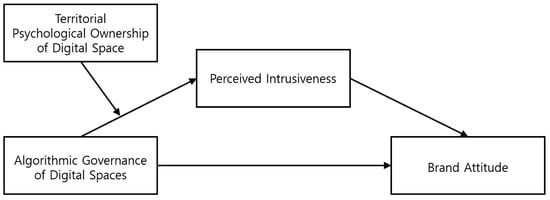
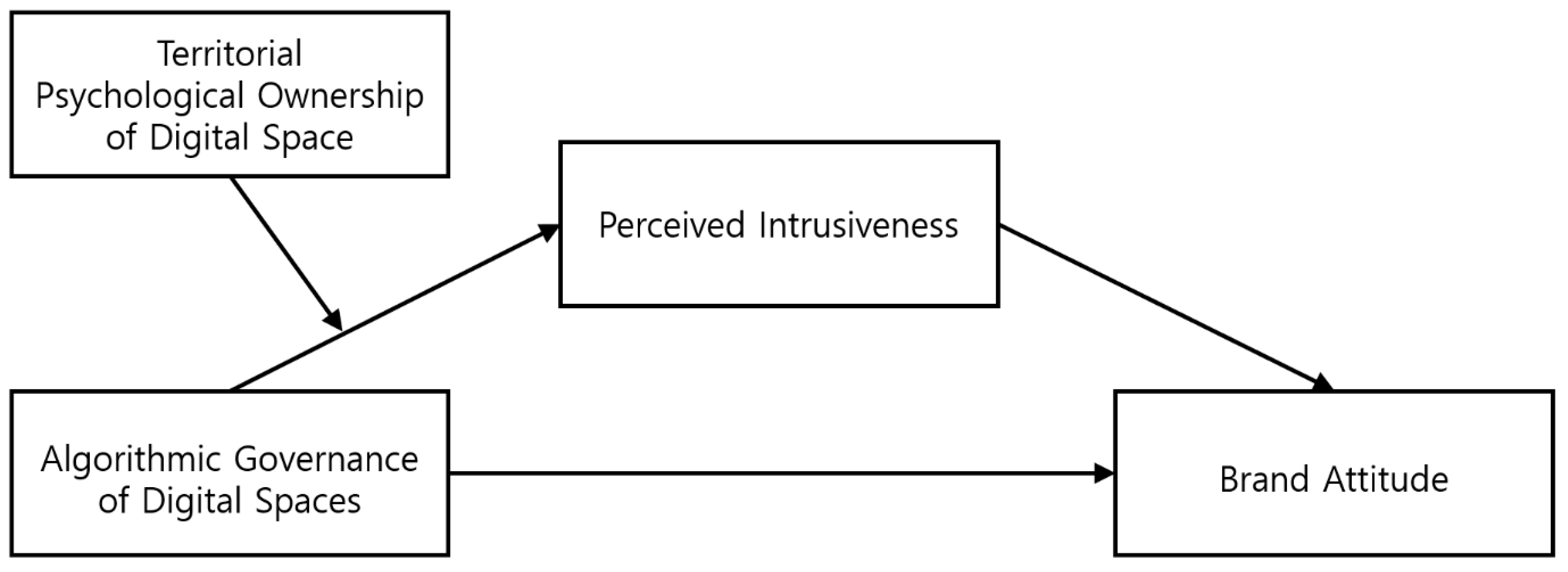
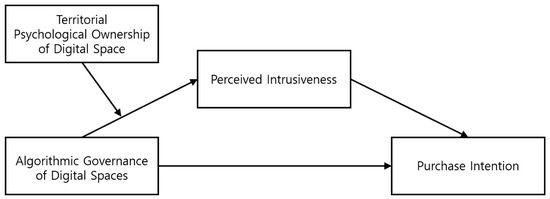
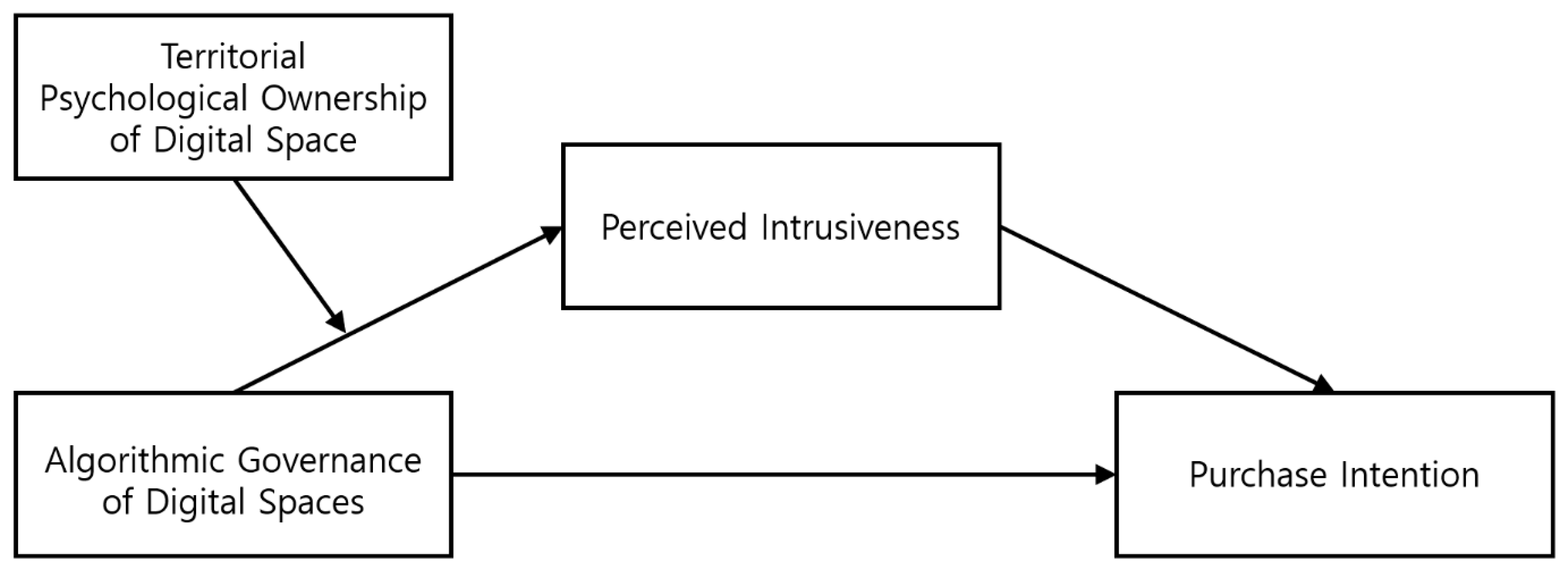
Figure 1 and Figure 2 present the conceptual models illustrating the proposed relationships among algorithmic governance of digital spaces, perceived intrusiveness, territorial psychological ownership, and consumer responses.
Figure 1.
Conceptual model for brand attitude.
Figure 2.
Conceptual model for purchase intention.
3. Study 1
3.1. Participants and Procedure
A total of 499 participants were recruited through Prolific. All participants received GBP 0.20 as compensation for completing the study. The study was intentionally designed to be brief and required approximately one to two minutes to complete, which aligns with Prolific compensation norms for very short tasks. As a precaution against automated responses, a reCAPTCHA-based bot detection procedure was applied. Following Qualtrics guidelines [35], responses with reCAPTCHA scores below 0.5 were to be excluded. No responses met this exclusion criterion, and thus all collected data were retained for analysis.
Participants were first presented with a scenario describing an online shopping website. They were asked to imagine that they had previously visited the website frequently and had saved products of interest to a wishlist for later comparison or purchase consideration. Participants were then randomly assigned to one of two experimental conditions. In the algorithmic governance condition, participants were informed that several wishlist items had been automatically deleted by the system according to platform policy and that such deletions could not be selected or reversed by users. This manipulation was designed to represent a policy-based algorithmic governance action rather than an accidental system error. In the non-intervention condition, participants were informed that wishlist items remained unchanged and that stored information was not automatically modified or deleted. Following the scenario, participants completed a manipulation check assessing whether items in the wishlist had been deleted. They then responded to measures of perceived intrusiveness, brand attitude, and purchase intention. In this study, brand attitude and purchase intention refer to evaluations toward the platform brand operating the website described in the scenario.
3.2. Measures
Perceived intrusiveness was measured with four items (α = 0.97): “The platform’s action felt intrusive,” “the platform’s action felt like an unwanted intervention,” “the platform interfered with my personal space,” and “the platform crossed a boundary” [14]. Brand attitude was measured with three items (α = 0.97): “I like this brand,” “I think this is a good brand,” and “overall, my impression of the brand is positive” [36]. Purchase intention was measured with three items (α = 0.98): “I will consider buying from this brand the next time I need something,” “I am likely to purchase from this brand the next time I need something,” and “I intend to purchase from this brand the next time I need something” [37]. All items were measured on Likert-type scales (1 = strongly disagree, 7 = strongly agree). Manipulation check was assessed with a single Likert-type item: “In this scenario, some items in the wishlist were deleted.”
3.3. Results
3.3.1. Manipulation Check
The manipulation check confirmed that the scenario successfully differentiated the two experimental conditions. Participants in the algorithmic governance condition strongly agreed that items in the wishlist had been deleted (M = 6.86; SD = 0.60), whereas participants in the non-intervention condition indicated that items had not been deleted (M = 1.14; SD = 0.67; F(1, 497) = 9981.72; p < 0.001; R2 = 0.953). This difference was highly significant, confirming that the manipulation was successful.
3.3.2. Main Effects on Brand Attitude and Purchase Intention
A one-way ANOVA revealed a significant effect of algorithmic governance on brand attitude. Participants in the algorithmic governance condition reported significantly lower brand attitude (M = 3.80; SD = 1.48) than those in the non-intervention condition (M = 5.35; SD = 1.05; F(1, 497) = 183.28; p < 0.001; R2 = 0.269). Thus, H1a was supported.
A similar pattern emerged for purchase intention. Participants in the algorithmic governance condition reported significantly lower purchase intention (M = 3.88; SD = 1.55) than those in the non-intervention condition (M = 5.37; SD = 1.07; F(1, 497) = 153.87; p < 0.001; R2 = 0.236). Thus, H1b was supported.
3.3.3. Effect of Algorithmic Governance on Perceived Intrusiveness
Algorithmic governance had a significant effect on perceived intrusiveness. Participants in the algorithmic governance condition reported substantially higher perceived intrusiveness (M = 4.86; SD = 1.71) than those in the non-intervention condition (M = 1.56; SD = 0.96; F(1, 497) = 704.34; p < 0.001; R2 = 0.586). Thus, H2 was supported.
3.3.4. Mediation Analyses
Mediation analyses were conducted using PROCESS Model 4 with 5000 bootstrap samples. For brand attitude, algorithmic governance significantly predicted perceived intrusiveness (b = 3.30, p < 0.001), and perceived intrusiveness significantly predicted brand attitude (b = −0.42, p < 0.001). The indirect effect of algorithmic governance on brand attitude via perceived intrusiveness was significant (indirect effect = −1.39, BootLLCI = −1.68, BootULCI = −1.11). Thus, H3a was supported.
A similar pattern emerged for purchase intention. Algorithmic governance significantly predicted perceived intrusiveness (b = 3.30, p < 0.001), and perceived intrusiveness significantly predicted purchase intention (b = −0.43, p < 0.001). The indirect effect of algorithmic governance on purchase intention via perceived intrusiveness was significant (indirect effect = −1.42, BootLLCI = −1.74, BootULCI = −1.12). Thus, H3b was supported.
3.4. Discussion
Study 1 provides initial evidence that algorithmic governance of personal digital spaces negatively shapes consumer responses. Algorithmic deletion of wishlist items increased perceived intrusiveness and reduced brand attitude and purchase intention. Moreover, perceived intrusiveness emerged as a key psychological mechanism linking algorithmic governance to these consumer responses. Having established these baseline effects, Study 2 investigates whether territorial psychological ownership of digital space functions as a boundary condition that intensifies perceived intrusiveness and its downstream effects.
4. Study 2
4.1. Participants and Procedure
A total of 903 participants were recruited through Prolific. All participants received GBP 0.20 as compensation. As in Study 1, the study was designed to be completed in approximately one to two minutes, making the compensation appropriate for task duration according to Prolific norms. Additionally, as in Study 1, a reCAPTCHA-based bot detection procedure was applied following Qualtrics (2024) guidelines [35], and responses with scores below 0.5 were removed. Ten responses met this criterion, resulting in a final sample of 893 participants.
The scenario and experimental manipulation were identical to Study 1, allowing Study 2 to isolate the moderating role of territorial psychological ownership in the proposed mechanism. Participants first read a scenario describing an online shopping website where they had previously saved products to a wishlist. Immediately after this initial scenario, participants reported their territorial psychological ownership of the wishlist, which served as the focal personal digital space in the study. They were then randomly assigned to either the algorithmic governance condition or the non-intervention condition, in which wishlist items were described as either automatically deleted by the system or remaining unchanged. As in Study 1, the algorithmic deletion was framed as a policy-based governance action rather than a system malfunction. Following the scenario, participants completed the same manipulation check and measures of perceived intrusiveness, brand attitude, and purchase intention used in Study 1. As in Study 1, brand-related measures referred to evaluations of the platform brand described in the scenario.
4.2. Measures
Territorial psychological ownership of the digital space was measured using three items adapted to the wishlist context, which functioned as a personal user-managed space for storing self-selected products: “I really feel like I own this wishlist on the website,” “I really feel like this wishlist belongs to me,” and “I really feel like this wishlist is mine” [32] (α = 0.94). All items were measured on Likert-type scales (1 = strongly disagree, 7 = strongly agree). Perceived intrusiveness, brand attitude, and purchase intention were measured using the same items as in Study 1. The manipulation check item was also identical to Study 1.
4.3. Results
4.3.1. Preliminary Analyses
The manipulation check again confirmed successful differentiation between experimental conditions. Baseline main and mediation patterns observed in Study 1 were replicated. We therefore focus on testing the proposed moderation and moderated mediation effects. Additionally, territorial psychological ownership did not differ significantly between the algorithmic governance condition (M = 5.26; SD = 1.51) and the non-intervention condition (M = 5.37; SD = 1.47; F(1, 891) = 1.215; p = 0.271), indicating no pre-existing group differences in ownership levels.
4.3.2. Moderation Analysis
To test H4, we conducted a moderation analysis using PROCESS Model 1 with perceived intrusiveness as the dependent variable, algorithmic governance as the independent variable, and territorial psychological ownership as the moderator.
Results revealed a significant interaction between algorithmic governance and territorial psychological ownership on perceived intrusiveness (b = 0.48, SE = 0.06, t = 8.12, p < 0.001). The interaction accounted for a significant increase in explained variance (ΔR2 = 0.0253, F(1, 889) = 65.87, p < 0.001). Conditional effects indicated that algorithmic governance had a stronger effect on perceived intrusiveness at higher levels of territorial psychological ownership (TPO; TPO = 4.00: b = 2.90, TPO = 5.67: b = 3.69, TPO = 7.00: b = 4.33). Thus, H4 was supported.
4.3.3. Moderated Mediation Analyses
To test H5a and H5b, moderated mediation analyses were conducted using PROCESS Model 7 with 5000 bootstrap samples.
For brand attitude, the index of moderated mediation was significant (Index = −0.17, BootLLCI = −0.22, BootULCI = −0.13). Conditional indirect effects of algorithmic governance on brand attitude via perceived intrusiveness increased as territorial psychological ownership (TPO) rose. Specifically, at TPO = 4.00, the effect was −1.05 (BootLLCI = −1.24, BootULCI = −0.88), at TPO = 5.67, the effect was −1.34 (BootLLCI = −1.56, BootULCI = −1.13), and at TPO = 7.00, the effect was −1.57 (BootLLCI = −1.83, BootULCI = −1.33). Thus, H5a was supported.
For purchase intention, the index of moderated mediation was also significant (Index = −0.18, BootLLCI = −0.24, BootULCI = −0.13). Conditional indirect effects similarly strengthened at higher levels of territorial psychological ownership. At TPO = 4.00, the effect was −1.11 (BootLLCI = −1.31, BootULCI = −0.92), at TPO = 5.67, the effect was −1.42 (BootLLCI = −1.64, BootULCI = −1.20), and at TPO = 7.00, the effect was −1.66 (BootLLCI = −1.93, BootULCI = −1.40). Thus, H5b was supported. A summary of the indirect effects across both studies is presented in Table 1.
Table 1.
Summary of mediation and moderated mediation results (Study 1 and Study 2).
4.4. Discussion
Study 2 extends the findings of Study 1 by identifying territorial psychological ownership as a boundary condition in the effects of algorithmic governance of digital spaces. When users felt stronger ownership over their digital space, algorithmic governance produced greater perceived intrusiveness, which in turn amplified negative brand attitudes and reduced purchase intention. Together, the results of Study 1 and 2 demonstrate that algorithmic governance of personal digital spaces influences consumer responses through perceived intrusiveness and that this mechanism is intensified by territorial psychological ownership.
5. General Discussion
This study explored the effects of algorithmic governance on consumer responses, focusing on the moderating role of territorial psychological ownership (TPO). More specifically, the findings are best understood in the context of policy-based algorithmic deletion within personal digital spaces, which represents one form of algorithmic governance. The results demonstrate that algorithmic governance significantly influences perceived intrusiveness, which subsequently impacts both brand attitude and purchase intention. TPO moderated these effects, with stronger reactions observed at higher levels of TPO. These findings contribute to understanding how users psychologically respond when automated systems intervene in personal digital spaces, while also offering practical implications for digital businesses, particularly in e-commerce settings where algorithmic systems govern user experiences.
By exploring the relationship between psychological ownership and consumer behavior, this study adds to the growing literature on consumer engagement in digital spaces [7,32]. The results underscore the importance of ownership perceptions in moderating the consumer’s response to algorithmic actions, especially in contexts involving automated decision-making systems.
5.1. Implications for Theory and Practice
The theoretical contribution of this study lies in its extension of psychological ownership theory into the realm of algorithmic governance. The findings emphasize that consumer reactions to algorithmic actions are shaped not only by privacy and trust but also by their psychological attachment to digital spaces. This has significant implications for understanding consumer responses in increasingly automated environments, where personalization and customization are becoming key drivers of consumer interaction with digital systems [5]. While personalization often involves companies tailoring content and experiences based on consumer data, it can raise privacy concerns as consumers may feel their data is being used without their full control [6]. In contrast, customization, where consumers have more control in designing their own experiences, offers an alternative by allowing users to take charge of how their interactions are shaped [38]. However, even customization may lead to consumer dissatisfaction if it feels too burdensome. Therefore, algorithmic governance in such automated environments must strike a balance between personalization and customization, ensuring that consumers feel both in control and engaged, rather than intruded upon. From a practical perspective, platform managers should clearly communicate when algorithmic actions affect user-managed spaces, provide options for user intervention or recovery when possible, and design governance policies that preserve users’ sense of territorial control over personal digital spaces.
5.2. Limitations and Future Research
This study, while providing important insights, is not without limitations. First, the use of a cross-sectional design prevents the establishment of causal relationships over time. Future research employing longitudinal methods could provide valuable insights into the causal relationships between algorithmic governance and psychological ownership, revealing how these factors influence consumer behavior over time. Understanding how perceptions of algorithmic governance, as part of algorithmic experience (AX), shape psychological ownership and vice versa would allow researchers to explore the long-term effects of algorithmic governance on consumer attitudes and behavioral intentions [39]. Building on this perspective, future research could examine long-term behavioral outcomes beyond self-reported intentions, for example through field experiments or by tracking actual platform usage behavior. Additionally, the role of fairness and transparency in algorithmic systems could be further investigated to understand their influence on how consumers evaluate and accept algorithmic decisions and how these evaluations evolve over time [5].
Additionally, this study focused on online shopping and e-commerce contexts, which may limit the generalizability of the findings to other digital environments, such as social media platforms, video or music streaming services, and online banking services. Since each of these contexts involves different types of consumer interactions and algorithmic applications, future research should explore the effects of algorithmic governance in these diverse contexts to determine whether similar patterns emerge across industries [40,41,42].
Moreover, while territorial psychological ownership was the primary moderator in this study, future research could explore other factors, such as AI literacy, attitudes towards AI, and anxiety toward AI, to provide a more comprehensive understanding of consumer responses to algorithmic governance [43,44,45]. Understanding how these individual differences influence consumer behavior in the face of algorithmic actions will be crucial for developing more consumer-friendly systems. Furthermore, examining how these factors interact with algorithmic transparency and consumer trust can offer deeper insights into the psychological mechanisms that drive consumer engagement with automated systems. Ultimately, a better understanding of these dynamics will help create more personalized and ethical algorithms that align with consumer preferences.
6. Conclusions
This study makes a significant contribution to understanding how algorithmic governance and territorial psychological ownership (TPO) influence consumer responses. By demonstrating that TPO moderates reactions to algorithmic actions, this research deepens existing theories of consumer engagement in digital spaces. It offers valuable practical insights for businesses seeking to optimize consumer interactions with automated systems, providing a foundation for designing more consumer-centric algorithms. While this research provides important theoretical and practical contributions, future research should continue to explore how consumer traits, algorithmic transparency, and cross-industry differences shape consumer behavior in the face of increasing automation and algorithmic governance. Exploring these dynamics will help refine models of consumer responses to automated systems and contribute to creating more personalized and ethical algorithms.
Funding
This research received no external funding.
Institutional Review Board Statement
The study was conducted in accordance with the Declaration of Helsinki, and approved by the HUFS IRB.
Informed Consent Statement
Informed consent was obtained from all subjects involved in the study.
Data Availability Statement
The data presented in this study are available on request from the corresponding author due to privacy and ethical restrictions.
Conflicts of Interest
The author declares no conflicts of interest.
References
- Kitchin, R. Thinking Critically about and Researching Algorithms. In The Social Power of Algorithms; Routledge: London, UK, 2019; pp. 14–29. [Google Scholar]
- Yeung, K. Algorithmic Regulation: A Critical Interrogation. Regul. Gov. 2018, 12, 505–523. [Google Scholar] [CrossRef] [Scilit]
- Gillespie, T.; Boczkowski, P.J.; Foot, K.A. Media Technologies: Essays on Communication, Materiality, and Society; MIT Press: Cambridge, MA, USA, 2014. [Google Scholar]
- Martin, K.D.; Murphy, P.E. The Role of Data Privacy in Marketing. J. Acad. Mark. Sci. 2017, 45, 135–155. [Google Scholar] [CrossRef] [Scilit]
- Shin, D. User Perceptions of Algorithmic Decisions in the Personalized AI System: Perceptual Evaluation of Fairness, Accountability, Transparency, and Explainability. J. Broadcast. Electron. Media 2020, 64, 541–565. [Google Scholar] [CrossRef] [Scilit]
- Sundar, S.S.; Marathe, S.S. Personalization versus Customization: The Importance of Agency, Privacy, and Power Usage. Hum. Commun. Res. 2010, 36, 298–322. [Google Scholar] [CrossRef] [Scilit]
- Wu, D.; Moody, G.D.; Zhang, J.; Lowry, P.B. Effects of the Design of Mobile Security Notifications and Mobile App Usability on Users’ Security Perceptions and Continued Use Intention. Inf. Manag. 2020, 57, 103235. [Google Scholar] [CrossRef] [Scilit]
- Culnan, M.J.; Armstrong, P.K. Information Privacy Concerns, Procedural Fairness, and Impersonal Trust: An Empirical Investigation. Organ. Sci. 1999, 10, 104–115. [Google Scholar] [CrossRef] [Scilit]
- Xu, H.; Teo, H.-H.; Tan, B.C.; Agarwal, R. The Role of Push-Pull Technology in Privacy Calculus: The Case of Location-Based Services. J. Manag. Inf. Syst. 2009, 26, 135–174. [Google Scholar] [CrossRef] [Scilit]
- Pierce, J.L.; Kostova, T.; Dirks, K.T. Toward a Theory of Psychological Ownership in Organizations. Acad. Manag. Rev. 2001, 26, 298–310. [Google Scholar] [CrossRef] [Scilit]
- Pierce, J.L.; Jussila, I. Psychological Ownership and the Organizational Context: Theory, Research Evidence, and Application. In Psychological Ownership and the Organizational Context; Edward Elgar Publishing: Glos, UK, 2011. [Google Scholar]
- Kirk, C.P.; Swain, S.D.; Gaskin, J.E. I’m Proud of It: Consumer Technology Appropriation and Psychological Ownership. J. Mark. Theory Pract. 2015, 23, 166–184. [Google Scholar] [CrossRef] [Scilit]
- Kirk, C.P.; Swain, S.D. Consumer Psychological Ownership of Digital Technology. In Psychological Ownership and Consumer Behavior; Springer International Publishing: Cham, Switzerland, 2018; pp. 69–90. [Google Scholar]
- Li, H.; Edwards, S.M.; Lee, J.-H. Measuring the Intrusiveness of Advertisements: Scale Development and Validation. J. Advert. 2002, 31, 37–47. [Google Scholar] [CrossRef] [Scilit]
- Edwards, S.M.; Li, H.; Lee, J.-H. Forced Exposure and Psychological Reactance: Antecedents and Consequences of the Perceived Intrusiveness of Pop-up Ads. J. Advert. 2002, 31, 83–95. [Google Scholar] [CrossRef] [Scilit]
- Aguirre, E.; Mahr, D.; Grewal, D.; De Ruyter, K.; Wetzels, M. Unraveling the Personalization Paradox: The Effect of Information Collection and Trust-Building Strategies on Online Advertisement Effectiveness. J. Retail. 2015, 91, 34–49. [Google Scholar] [CrossRef] [Scilit]
- Bleier, A.; Eisenbeiss, M. The Importance of Trust for Personalized Online Advertising. J. Retail. 2015, 91, 390–409. [Google Scholar] [CrossRef] [Scilit]
- Beer, D. The Social Power of Algorithms. In The Social Power of Algorithms; Routledge: London, UK, 2019; pp. 1–13. [Google Scholar]
- Ananny, M.; Crawford, K. Seeing without Knowing: Limitations of the Transparency Ideal and Its Application to Algorithmic Accountability. New Media Soc. 2018, 20, 973–989. [Google Scholar] [CrossRef] [Scilit]
- Parasuraman, A.; Colby, C.L. An Updated and Streamlined Technology Readiness Index: TRI 2.0. J. Serv. Res. 2015, 18, 59–74. [Google Scholar] [CrossRef] [Scilit]
- Meuter, M.L.; Ostrom, A.L.; Roundtree, R.I.; Bitner, M.J. Self-Service Technologies: Understanding Customer Satisfaction with Technology-Based Service Encounters. J. Mark. 2000, 64, 50–64. [Google Scholar] [CrossRef] [Scilit]
- White, T.B.; Zahay, D.L.; Thorbjørnsen, H.; Shavitt, S. Getting Too Personal: Reactance to Highly Personalized Email Solicitations. Mark. Lett. 2008, 19, 39–50. [Google Scholar] [CrossRef] [Scilit]
- Tucker, C.E. Social Networks, Personalized Advertising, and Privacy Controls. J. Mark. Res. 2014, 51, 546–562. [Google Scholar] [CrossRef] [Scilit]
- Malhotra, N.K.; Kim, S.S.; Agarwal, J. Internet Users’ Information Privacy Concerns (IUIPC): The Construct, the Scale, and a Causal Model. Inf. Syst. Res. 2004, 15, 336–355. [Google Scholar] [CrossRef] [Scilit]
- Acquisti, A.; Brandimarte, L.; Loewenstein, G. Privacy and Human Behavior in the Age of Information. Science 2015, 347, 509–514. [Google Scholar] [CrossRef] [Scilit]
- Ha, L.; McCann, K. An Integrated Model of Advertising Clutter in Offline and Online Media. Int. J. Advert. 2008, 27, 569–592. [Google Scholar] [CrossRef] [Scilit]
- Cho, C.-H.; University of Texas at Austin) is an as-. Why Do People Avoid Advertising on the Internet? J. Advert. 2004, 33, 89–97. [Google Scholar] [CrossRef] [Scilit]
- Moody, G.; Wu, D. Are You Annoyed? The Effects of Mobile Device User Interface and Intrusiveness of Security Notifications on User Security Perceptions. In SIGHCI 2013 Proceedings; Association for Information Systems: Atlanta, GA, USA, 2013. [Google Scholar]
- Weiner, B. Attributional Thoughts about Consumer Behavior. J. Consum. Res. 2000, 27, 382–387. [Google Scholar] [CrossRef] [Scilit]
- Folkes, V.S. Consumer Reactions to Product Failure: An Attributional Approach. J. Consum. Res. 1984, 10, 398–409. [Google Scholar] [CrossRef] [Scilit]
- Belk, R.W. Possessions and the Extended Self. J. Consum. Res. 1988, 15, 139–168. [Google Scholar] [CrossRef] [Scilit]
- Peck, J.; Shu, S.B. The Effect of Mere Touch on Perceived Ownership. J. Consum. Res. 2009, 36, 434–447. [Google Scholar] [CrossRef] [Scilit]
- Brown, G.; Lawrence, T.B.; Robinson, S.L. Territoriality in Organizations. Acad. Manag. Rev. 2005, 30, 577–594. [Google Scholar] [CrossRef] [Scilit]
- Baer, M.; Brown, G. Blind in One Eye: How Psychological Ownership of Ideas Affects the Types of Suggestions People Adopt. Organ. Behav. Hum. Decis. Process. 2012, 118, 60–71. [Google Scholar] [CrossRef] [Scilit]
- Response Quality. Available online: https://www.qualtrics.com/support/survey-platform/survey-module/survey-checker/response-quality/ (accessed on 26 February 2026).
- Bruner, G.C.; Kumar, A. Web Commercials and Advertising Hierarchy-of-Effects. J. Advert. Res. 2000, 40, 1–8. [Google Scholar] [CrossRef] [Scilit]
- Napoli, J.; Dickinson, S.J.; Beverland, M.B.; Farrelly, F. Measuring Consumer-Based Brand Authenticity. J. Bus. Res. 2014, 67, 1090–1098. [Google Scholar] [CrossRef] [Scilit]
- Yang, J.; Maeng, A.; Jung, S.-U. The Impact of AI-Powered Ad Customization: Exploring the Impact of Engagement, Psychological Ownership, Responsibility, and Attitude on Behavioral Intentions. J. Advert. 2025, 1–24. [Google Scholar] [CrossRef] [Scilit]
- Shin, D.; Zhong, B.; Biocca, F.A. Beyond User Experience: What Constitutes Algorithmic Experiences? Int. J. Inf. Manag. 2020, 52, 102061. [Google Scholar] [CrossRef] [Scilit]
- Tyler, T.; Katsaros, M.; Meares, T.; Venkatesh, S. Social Media Governance: Can Social Media Companies Motivate Voluntary Rule Following Behavior among Their Users? J. Exp. Criminol. 2021, 17, 109–127. [Google Scholar] [CrossRef] [Scilit]
- Wang, C.; Zheng, Y.; Jiang, J.; Ren, K. Toward Privacy-Preserving Personalized Recommendation Services. Engineering 2018, 4, 21–28. [Google Scholar] [CrossRef] [Scilit]
- Casaló, L.V.; Flavián, C.; Guinalíu, M. The Role of Security, Privacy, Usability and Reputation in the Development of Online Banking. Online Inf. Rev. 2007, 31, 583–603. [Google Scholar] [CrossRef] [Scilit]
- Schepman, A.; Rodway, P. The General Attitudes towards Artificial Intelligence Scale (GAAIS): Confirmatory Validation and Associations with Personality, Corporate Distrust, and General Trust. Int. J. Human–Computer Interact. 2023, 39, 2724–2741. [Google Scholar] [CrossRef] [Scilit]
- Ng, D.T.K.; Wu, W.; Leung, J.K.L.; Chiu, T.K.F.; Chu, S.K.W. Design and Validation of the AI Literacy Questionnaire: The Affective, Behavioural, Cognitive and Ethical Approach. Br. J. Educ. Technol. 2024, 55, 1082–1104. [Google Scholar] [CrossRef] [Scilit]
- Wang, Y.-Y.; Wang, Y.-S. Development and Validation of an Artificial Intelligence Anxiety Scale: An Initial Application in Predicting Motivated Learning Behavior. Interact. Learn. Environ. 2022, 30, 619–634. [Google Scholar] [CrossRef] [Scilit]

Disclaimer/Publisher’s Note: The statements, opinions and data contained in all publications are solely those of the individual author(s) and contributor(s) and not of MDPI and/or the editor(s). MDPI and/or the editor(s) disclaim responsibility for any injury to people or property resulting from any ideas, methods, instructions or products referred to in the content. |
© 2026 by the author. Licensee MDPI, Basel, Switzerland. This article is an open access article distributed under the terms and conditions of the Creative Commons Attribution (CC BY) license.