


Abstract
Online platforms often begin as intermediaries for third-party sellers but may later introduce private-label products. We develop a model in which a manufacturer sells through a platform that can introduce its own private label. Both firms procure from upstream suppliers through contracts that may be observable or unobservable. Under observable contracts, platform entry always reduces the manufacturer’s profit. Under unobservable contracts, however, entry can benefit both firms. A private wholesale-price deviation does not induce a direct pricing response from the rival chain, strengthening suppliers’ incentives to reduce wholesale prices. When the private label is sufficiently differentiated, procurement savings and demand adjustments can outweigh the competitive pressure from entry. We further endogenize transparency and show that the manufacturer prefers nondisclosure, whereas the platform may disclose its procurement cost when competition is sufficiently intense. Extensions and sensitivity analyses examine alternative sourcing structures, product preferences, beliefs, and market conditions, clarifying the robustness and boundaries of the manufacturer’s gain from platform entry.
1. Introduction
Digital platforms often begin as intermediaries. They connect third-party sellers with consumers, provide traffic, payment, and fulfillment services, and appear to stand outside direct product competition. Over time, however, many platforms move beyond pure intermediation and enter the market themselves through private labels. In traditional retail, Costco’s Kirkland Signature has been a flagship example of a retailer-owned brand since 1995. In e-commerce, Amazon launched AmazonBasics in 2009 as a new private-label line. In China, JD.com followed a similar path: JD’s private-label brand Jingzao was established in 2017, and JD later elevated its private-brand business into a more independent strategic unit. Across these cases, the platform is no longer merely matching buyers and sellers. It is also learning from marketplace transactions and then entering the product space itself through private-label expansion.
This tension has become even more salient in the latest developments around Temu. In March 2026, it was reported that Pinduoduo had set up a new entity, Xinpinmu, with an initial cash injection of CNY15 billion and a planned CNY100 billion investment over three years, explicitly combining Pinduoduo’s domestic supply chain with Temu’s overseas reach to develop self-operated brands for global markets [1]. Once a platform takes this step, the issue is not simply that one more seller has entered the market. Rather, the same firm that allocates traffic, sets marketplace rules, and observes market demand may also become a direct competitor to the merchants on its platform. This “referee-and-player” concern is hardly abstract: Reuters has documented prior tensions between Temu and its merchants [2], and also reported how Amazon’s private-brand operations in India used marketplace information and positioning in ways that intensified worries about unfair competition [3].
Motivated by these observations, we study how the observability of procurement contracts affects platform private-label entry and its consequences for an incumbent manufacturer. The platform earns commission revenue from the manufacturer’s sales and may also introduce its own product, while both firms procure through wholesale-price contracts. Existing research shows that contract unobservability can change downstream competition and upstream pricing incentives. However, these effects do not establish whether the manufacturer can benefit from facing a platform competitor rather than remaining the sole seller. Moreover, the platform’s combination of commission revenue and private-label profit creates disclosure incentives that differ from those of an ordinary competing seller. We therefore compare entry under observable and unobservable procurement contracts and then examine whether endogenous disclosure preserves the manufacturer’s potential gain from entry.
This framework allows us to ask three questions. First, when does a platform have an incentive to move from pure intermediation to private-label entry? Second, how does such entry affect the incumbent manufacturer’s profit when procurement contracts are observable versus unobservable? Third, if transparency is itself a strategic choice, which party has an incentive to disclose cost information, and does endogenous disclosure overturn the main implications of the model?
1.1. Main Findings
Our first finding is that contract observability fundamentally changes the effect of platform private-label entry on the incumbent manufacturer. Under observable contracts, the platform introduces a private label only when its product is sufficiently differentiated from the manufacturer’s product, and such entry always hurts the manufacturer. Under unobservable contracts, however, the result changes sharply. The platform still enters when substitutability is sufficiently low, but now there exists a region in which entry increases not only the platform’s profit but also the manufacturer’s profit. In other words, the same private-label entry that is harmful under transparency can become beneficial to the incumbent seller under nontransparency.
The result operates through a wholesale-leverage effect whose pricing foundations are related to the literature on contract observability and endogenous costs. Observable wholesale-price changes affect rival retail pricing, whereas a private deviation under passive beliefs does not induce a direct pricing response from the rival chain. This difference changes suppliers’ incentives and leads to lower equilibrium wholesale prices under unobservable contracts. Our additional finding concerns the comparison with no entry: when the private label is positioned sufficiently low relative to the manufacturer’s product, procurement savings and the associated demand adjustments can outweigh the competitive pressure created by entry. Thus, the manufacturer can earn more with platform competition than when it remains the sole seller.
Our second finding is that transparency itself is endogenous and asymmetric. Once we allow both firms to choose whether to disclose their contract terms, the manufacturer never discloses, whereas the platform may disclose when competition is sufficiently intense. The reason is that contract disclosure softens downstream competition, but it also induces the disclosing firm’s supplier to raise the wholesale price. For the manufacturer, the procurement-cost increase dominates, so nondisclosure is always optimal. For the platform, by contrast, disclosure can become attractive when the value of softer competition is large enough. Endogenizing transparency therefore changes the boundaries of the entry region and the manufacturer-benefit region, but it does not overturn the central message: private-label entry can still benefit the incumbent manufacturer provided that substitutability is sufficiently low.
Finally, our extensions and sensitivity analyses clarify the robustness and boundaries of the result. The mixed-belief analysis establishes that the gain does not require completely passive beliefs within the stated parameter region. The common-supplier analysis shows that joint upstream pricing eliminates the manufacturer’s gain from entry. Separately, the higher-preference extension shows that entry always hurts the manufacturer when the platform’s private label is more preferred than the manufacturer’s product. Further analyses characterize how commissions, supplier production costs, and entry-induced demand effects affect the gain, which can survive a sufficiently small adverse demand effect. These results identify conditions supporting mutually beneficial entry while highlighting the importance of product positioning and procurement arrangements.
1.2. Literature
Our study relates to research on platform entry and private labels, and to research on contract observability and endogenous cost disclosure.
The first stream examines how an intermediary’s entry into product markets affects incumbent firms. Studies of retailer private labels investigate the redistribution of category profits [4], changes in demand and pricing [5], and the interaction between product positioning and channel strategy [6,7]. Related research on supplier encroachment shows that the invaded retailer can sometimes benefit because entry changes wholesale pricing and alleviates double marginalization [8]. Information sharing and data analytics can further modify these effects [9,10,11,12]. These studies establish that entry can create indirect benefits through vertical relationships, making it important to identify the particular contractual and competitive conditions supporting such benefits.
In platform markets, research examines the choice between marketplace and reselling formats [13,14] and the consequences of the platform’s simultaneous roles as an intermediary and a seller. In particular, private-label entry interacts with sponsored advertising [15], product featuring [16], and search neutrality [17]. Related work on retailer-led marketplaces examines how retailers manage competition from third-party sellers through fees, consumer steering, and capacity allocation [18]. More closely related to our research, Qiu and Rao [19] show that merchants may benefit from platform entry when prices signal product quality, while Qi et al. [20] identify seller-benefit regions through dynamic effort incentives and value-enhancement spillovers. Our main result does not require quality uncertainty, endogenous effort, or a favorable demand spillover. Instead, we examine how the observability of endogenously determined procurement contracts changes the manufacturer’s profit relative to the no-entry benchmark. The sensitivity analysis further shows that the manufacturer’s gain can survive a sufficiently small adverse demand effect associated with entry.
The second stream studies the strategic consequences of private contracts. Foundational research examines whether unobservable contracts and delegation arrangements retain commitment value [21,22,23], while subsequent work considers the disclosure regime itself [24]. Related supply chain studies investigate the implications of visibility for strategic inventory [25], cost information in dual-channel distribution [26], and financial contracts [27]. Li et al. [28] examine cost-sharing agreements for purchase-order financing under asymmetric information. This literature establishes that contract visibility can alter behavior and performance, rather than serving merely as an informational detail.
Two studies are particularly close to ours. Li and Liu [29] analyze a manufacturer supplying two competing retailers through wholesale-price or two-part tariff contracts. They show that contract unobservability can reverse established rankings of contract forms and explain why wholesale-price contracts may be preferable. Our model holds the contract form fixed and examines a different comparison: whether an incumbent manufacturer benefits when its marketplace intermediary becomes a competing seller. This requires comparing endogenous procurement and retail outcomes across entry and no-entry market structures. Li [30] examines competing firms whose procurement costs are endogenously priced by upstream suppliers. His analysis establishes that disclosure changes both downstream competition and suppliers’ pricing incentives, and that firms competing on price prefer nondisclosure. We build on this connection between transparency and endogenous procurement costs. Our additional question is how these forces operate when one competitor also earns commission revenue from the other and chooses whether to enter its product market. In this asymmetric setting, the manufacturer continues to prefer nondisclosure, whereas the platform may disclose its procurement cost. We also examine how the resulting disclosure outcome affects the platform’s entry decision and the manufacturer’s comparison with the no-entry benchmark.
Our contribution is therefore twofold. First, we identify conditions under which procurement-contract unobservability reverses the effect of platform entry on the incumbent manufacturer: entry that is harmful under observable contracts can benefit the manufacturer under unobservable contracts, even without favorable demand spillovers. Second, we characterize asymmetric disclosure incentives when downstream competition is linked through marketplace commissions, and establish how endogenous transparency modifies the entry and manufacturer-benefit regions. The underlying effect of contract visibility on pricing incentives is related to existing research; our theoretical contribution concerns its implications for platform entry, incumbent profitability, and asymmetric disclosure.
2. Model Setup
2.1. Platform Marketplace
We consider a marketplace in which a platform intermediates transactions between a manufacturer (denoted as A) and a unit mass of consumers. The manufacturer sells a branded product through the platform (denoted as B), and the platform charges a commission at rate on the manufacturer’s sales revenue. The manufacturer sources the product from an upstream supplier (denoted as SA) through a wholesale-price contract. Let denote the manufacturer’s unit procurement cost. This wholesale-based procurement contract is very common and applied by most supply chains [31,32].
On the demand side, consumers are heterogeneous in their valuations for the manufacturer’s product. A consumer is indexed by v, where v is uniformly distributed on . The uniform distribution provides a tractable model in which changes in procurement costs and retail prices can be traced analytically. If the manufacturer is the only provider in the marketplace, a consumer who buys from the manufacturer obtains utility , where is the selling price. Therefore, if the platform does not introduce its own product, the manufacturer faces the standard monopoly demand
2.2. Private Label
A key feature of the marketplace is that the platform may introduce its own private-label product. Such private labels are common in platform selling: the platform initially serves as an intermediary for enrolled manufacturers, but may later enter the same product space with its own brand [33,34]. Once the platform introduces a private label, the market structure changes from monopoly to competition. To capture the fact that a private label is often perceived as a lower-tier or follower product relative to the incumbent branded product, we assume that a consumer’s valuation for the platform’s private label is discounted by a factor , where . If the platform sells its own product at price , the consumer’s utility from buying the private label is . The parameter captures the private label’s relative valuation. Changing affects both its vertical positioning and the competitive relationship between the products. The assumption therefore describes entry by a lower-positioned private label. Section 5.3 will examine the opposite positioning by allowing , while Section 5.4 will allow entry to generate an additional favorable or adverse demand effect for the manufacturer’s product.
Thus, when the platform enters, consumers choose among the manufacturer’s product, the platform’s private label, and the outside option, which is normalized to zero. The consumer who is indifferent between the manufacturer’s product and the platform’s product, denoted as , is given by , from which we have . The consumer who is indifferent between the platform’s product and the outside option, denoted as , is given by , which yields . It follows that the manufacturer’s demand is , whereas the platform’s demand is . Equivalently, we have
On the supply side, once the platform introduces its private label, it also procures from an upstream supplier (denoted as SB) through a wholesale-price contract. Let denote the platform’s unit procurement cost. In the main model, the manufacturer and the platform source from two independent suppliers, whose production costs are both normalized to zero. This benchmark reflects the common situation in which the platform’s private label and the manufacturer’s branded product rely on different supply relationships. An extension with a common supplier can be considered later in Section 5.2, which checks the robustness of our model.
2.3. Contract Observability
Wholesale terms between an upstream supplier and a downstream manufacturer are typically not directly observable by rival firms. As such, the competition is based on imperfect information and we should follow the concept of Bayesian equilibrium.
Let denote firm i’s belief about firm j’s procurement cost, where , , and the superscript e denotes a firm’s updated belief. These beliefs must be fulfilled on the equilibrium path. Following the literature on unobservable vertical contracts, we adopt passive beliefs off the equilibrium path [25,29,30]. That is, when firm i privately observes an unexpected contract offer from its own supplier, it does not revise its belief about the rival firm’s unobserved procurement contract, because that deviation is not observed by the rival firm or the rival supplier and therefore cannot affect their behavior. This restriction yields a natural equilibrium refinement in the present environment.
2.4. Game Sequence
The timing of the game is as follows (see Figure 1). In Stage 1, the platform decides whether to enter the retail market by introducing a private label. If the platform does not enter, then in Stage 2 the manufacturer’s supplier, SA, chooses the wholesale price , and in Stage 3 the manufacturer sets the retail price . Consumers then make their purchase decisions and payoffs are realized.
Figure 1.
Sequence of Events.
If the platform does enter, the game proceeds differently. In Stage 2, the two upstream suppliers, SA and SB, simultaneously choose wholesale prices and . The procurement cost of firm i is not observed by the rival firm. In Stage 3, the manufacturer and the platform simultaneously choose retail prices and . Finally, consumers decide whether to buy from the manufacturer, buy from the platform, or stay out of the market.
Several remarks on the above assumptions are in order. First, when contract terms are unobservable, it is natural to argue that a firm may voluntarily disclose or share its cost information so as to change the non-transparent environment. We will treat contract visibility as an endogenous strategic choice in Section 4, showing that the main results are not qualitatively changed. Second, we treat the commission rate as exogenous. This assumption is consistent with marketplace practice, where commission rates are usually category-specific and adjusted infrequently. For example, Amazon currently charges a referral fee of 8% for consumer electronics, 20% for gift cards, and 45% for Amazon device accessories. These category-based fees are posted as platform rules rather than determined transaction by transaction, which makes it natural to model as a pre-determined parameter. Third, in the benchmark model we assume , so that the platform’s private-label product is on average perceived as a lower-value alternative to the manufacturer’s branded product. This captures the common case in which a private label enters as a follower product and therefore faces a valuation discount. Nevertheless, this need not always be the case. In some settings, a platform’s own brand may be highly valued by consumers and may even dominate competing branded products in perceived attractiveness. In Section 5.3, we will consider the case of .
Our analysis proceeds by backward induction. We first characterize pricing decisions for given observable and unobservable procurement costs, then solve suppliers’ wholesale pricing decisions, and finally determine the equilibrium disclosure choices and the platform’s entry decision. All derivations are collected into Appendix A.
3. Main Analysis
Now, we proceed the main analysis. In Section 3.1, we first analyze the case in which the platform does not introduce a private label. In Section 3.2, we turn to the case in which the platform enters and competes with the manufacturer through its own brand, under the assumption that procurement contracts are observable. This corresponds to a full-information benchmark. In Section 3.3, we proceed with the case of private-label under unobservable contracts.
3.1. No Private Label
Suppose first that the platform remains a pure intermediary. Given the wholesale price , the manufacturer chooses the retail price to maximize its profit:
The first-order condition yields
where the superscript o refers to the equilibrium results of the no-entry benchmark.
Anticipating the manufacturer’s pricing decision, the upstream supplier chooses to maximize its own profit:
Solving backward gives
substituting which into the manufacturer’s and platform’s equilibrium profits, we have
In this no private label scenario, the manufacturer and the platform do not compete with each other. Thus, whether the manufacturer’s procurement cost is observed has no strategic effect on market outcomes.
3.2. Observable Contracts
Now suppose that the platform introduces a private label. In the benchmark with observable contracts, both and are observed before downstream pricing. For given wholesale prices, the manufacturer chooses to maximize its profit, while the platform chooses to maximize the sum of its private-label margin and commission revenue:
Solving the manufacturer’s and the platform’s maximization problems simultaneously yields
where the superscript f refers to the equilibrium outcomes under the case of platform entry with full information.
Anticipating downstream pricing, the two suppliers SA and SB simultaneously choose wholesale prices and , respectively, to maximize their own profits
The equilibrium wholesale prices are easily obtained as follows:
Substituting these expressions back into each firm’s profit functions, and by comparison, we have the following result, where the expression of the threshold is provided in Appendix A.
Proposition 1.
Under observable contracts, there exists a threshold , such that the platform introduces a private label if . Furthermore, private-label entry always reduces the manufacturer’s profit. Formally,
Proposition 1 shows that, even without any information friction, platform entry is not always desirable. The key trade-off for the platform is as follows. On the one hand, introducing a private label allows the platform to obtain an additional source of profit through direct retail margins. On the other hand, entry intensifies downstream competition and cannibalizes the manufacturer’s sales, which in turn reduces the platform’s commission revenue. When is small enough (), the platform’s private label is sufficiently differentiated from the manufacturer’s branded product. In this case, the platform can earn direct retail profit without triggering excessively intense price competition, so entry is profitable. By contrast, when is large enough (), the private label becomes a close substitute for the manufacturer’s product. Competition then becomes much fiercer, and the gain from selling the private label is outweighed by the loss in commission revenue. As a result, the platform prefers to remain a pure intermediary.
The proposition also shows that private-label entry always hurts the manufacturer. When , the platform chooses to introduce a private label and compete with the manufacturer. As a result, part of the manufacturer’s demand is diverted to the platform’s product, particularly in the lower-end segment, which reduces the manufacturer’s profit. Hence, compared with pure intermediation, platform entry always makes the manufacturer worse off.
3.3. Unobservable Contracts
Now, we proceed with the case of unobservable contracts. Under this case, if the platform does not enter the market, whether the manufacturer shares its cost information does not matter. We still have and . Once the platform chooses to enter with a private label, information structures are different from the benchmark.
In Stage 3, while the manufacturer chooses , it is unaware of . Similarly, when the platform chooses , it does not know as well. Under such an asymmetric-information case, both firms make decisions based on their beliefs regarding the rival’s cost. In particular, the manufacturer and the platform, respectively, aim to maximize
where is the manufacturer’s belief on the platform’s decision on , and is the platform’s belief on the manufacturer’s decision on . The manufacturer’s optimal choice on and the platform’s optimal choice on are easily solved to be, respectively,
Equation (14) implies that, as a rational firm, the manufacturer believes that is a function of and , where is a function of (the platform’s belief on ). Thus, the manufacturer’s choice on must be a function of , , and (the manufacturer’s beliefs on ). Similarly, the platform’s decision on should be a function of , , and . Given such belief structures, each firm infers how the rival would price under the corresponding cost realization. Therefore, equilibrium is determined by mutually consistent beliefs: each firm’s conjecture about the rival’s cost and pricing behavior must be fulfilled in equilibrium. Solving this belief-consistency condition yields the equilibrium pricing functions as follows (see details in Appendix A):
where the superscript u refers to equilibrium outcomes under unobservable contracts. Equation (15) serves as a unifying representations of downstream pricing under different information structures. For example, it is easy to check that when both beliefs are replaced by the realized costs (i.e., and ), and will collapse to the full-information pricing outcome, and .
In Stage 2, the two suppliers choose wholesale prices and simultaneously to maximize their profits, respectively given by
Since the rival chain’s procurement cost is not observed, each supplier evaluates downstream pricing responses based on its belief about that unobserved cost. In equilibrium, such beliefs must be self-fulfilling. This delivers the equilibrium wholesale prices as follows:
By substituting, we can obtain other equilibrium outcomes under unobservable contracts. The next lemma is obtained by comparing the case of observable and unobservable contracts.
Lemma 1.
Conditional on the platform’s private-label entry, unobservable contracts lead to lower wholesale and retail prices relative to observable contracts (i.e., , ).
Lemma 1 shows that unobservable contracts lead to lower equilibrium wholesale and retail prices. The pricing logic is related to existing research on endogenous cost disclosure [30]. Equations (9) and (15) imply
The derivatives under unobservable contracts hold beliefs fixed when a supplier privately deviates from its equilibrium wholesale price. Although procurement costs are correctly anticipated on the equilibrium path, an unobserved deviation does not change the rival downstream firm’s information or actual price.
When contracts are observable, a supplier’s wholesale-price reduction induces its downstream partner to lower its retail price, but also induces the rival firm to lower its price because retail prices are strategic complements. This rival response limits the demand expansion generated by the wholesale-price reduction. Under unobservable contracts and passive beliefs, the rival price does not respond to that private deviation, strengthening the supplier’s incentive to reduce its wholesale price. The equilibrium comparison in Lemma 1 establishes that both wholesale prices, and consequently retail prices, are lower under unobservable contracts.
Seeing that contract unobservability lowers prices and intensifies competition, one might naturally expect both the manufacturer and the platform to earn less profits than under observable contracts. The next two lemmas, however, show that the opposite may arise.
Lemma 2.
Conditional on the platform’s private-label entry, unobservable contracts increase the manufacturer’s demand, unit margin, and profit relative to observable contracts (i.e., , , ).
Counterintuitively, Lemma 2 shows that contract unobservability benefits the manufacturer along two dimensions. First, because unobservable contracts intensify downstream competition and lower the manufacturer’s retail price, the manufacturer attracts more demand (i.e., ). Second, unobservable contracts also increase the manufacturer’s unit margin, even though tougher competition tends to compress prices. The intuition can be understood from a unit-margin trade-off. On the one hand, stronger competition lowers the retail price, which tends to reduce the manufacturer’s unit margin. On the other hand, it also forces the upstream supplier to cut the wholesale price more aggressively, which tends to increase the manufacturer’s unit margin. The latter effect dominates.
To see why, note that , so the pass-through from wholesale cost to the manufacturer’s net revenue is incomplete: when changes by one unit, changes by only one half. Therefore, if the supplier wants the manufacturer to lower its retail price in a tougher competitive environment, it must reduce the wholesale price by more than the resulting decline in the manufacturer’s net revenue per unit. As a result, under unobservable contracts, the reduction in the wholesale price outweighs the reduction in the retail price, so the manufacturer earns a higher unit margin, that is, . Combined with the lower retail price and the resulting demand expansion, this explains why the manufacturer performs better under unobservable contracts (i.e., ; see Panel (a) of Figure 2).
Figure 2.
Profits under observable and unobservable contracts. .
Furthermore, unobservable contracts may also be beneficial to the platform under certain conditions, as shown in the next lemma (see Appendix A for the expression of ).
Lemma 3.
Conditional on the platform’s private-label entry, unobservable contracts make the platform better off than observable contracts (i.e., ) when .
The effect on the platform is more nuanced because the platform plays a dual role. On the one hand, it acts as a marketplace operator and earns commission revenue from the manufacturer’s sales. On the other hand, it acts as a seller through its private label and earns margin revenue from its own product. Under contract unobservability, the wholesale price tends to fall, which benefits the platform’s private-label business. At the same time, intensified competition lowers retail prices and , which hurts both the platform’s commission business and its private-label business. The overall effect therefore depends on whether the platform behaves more like a private-label seller or more like a marketplace operator.
When is small, the private label is substantially differentiated from the manufacturer’s product. The private label mainly serves lower-end consumers, whereas the manufacturer mainly serves higher-end consumers, so the two products overlap little and the private label steals only a limited amount of demand from the manufacturer. In this case, the negative effect of intensified competition is relatively small: the declines in and do not hurt the platform much, because its private-label business and commission business are not in strong conflict. By contrast, contract unobservability still induces a substantial reduction in , which significantly improves the profitability of the platform’s selling side. Thus, when is small, the platform behaves more like a private-label seller, and unobservable contracts make the platform better off.
When is large, by contrast, the private label and the manufacturer’s product both target relatively high-end consumers and become close substitutes. The expansion of the private label then comes mainly from stealing demand from the manufacturer, that is, from replacing commission revenue with private-label revenue. In this sense, the platform’s private-label growth increasingly comes at the expense of its marketplace business. Because the platform internalizes this cannibalization effect, its incentive to cut the private-label price aggressively becomes weaker. This in turn weakens the upstream supplier’s incentive to reduce . As a result, the wholesale-price reduction under unobservable contracts is no longer large enough to offset the loss caused by tougher competition. The platform’s private-label side may then exhibit both a lower unit margin and lower demand than under observable contracts, unlike the manufacturer.
These opposing forces generate the threshold . When , the conflict between the platform’s private-label business and its commission business is limited, so the gain from the lower wholesale price dominates and the platform benefits from contract unobservability. When , however, private-label gains come mainly from cannibalizing the manufacturer’s sales, so the negative effect of intensified competition dominates and the platform becomes worse off (see Panel (b) of Figure 2).
Taken the three lemmas above together, we have the following proposition (see Appendix A for the expressions of and ).
Proposition 2.
Under unobservable contracts, there exists a threshold , such that the platform introduces a private label if . Furthermore, there exists a threshold , such that private-label entry increases the manufacturer’s profit when . Formally,
Proposition 2 establishes a stronger comparison than the preceding lemmas. Lemma 1 compares prices across information regimes conditional on entry, while Lemma 2 compares the manufacturer’s performance under those regimes. By contrast, Proposition 2 compares entry with no entry under unobservable contracts. The manufacturer can benefit even though the no-entry benchmark gives it exclusive access to the marketplace. Figure 3 illustrates the entry outcome under unobservable contracts.
Figure 3.
Private Label Entry under Unobservable Contracts.
Relative to observable contracts, unobservable contracts make competition tougher and thus lower both wholesale and retail prices (Lemma 1). This more aggressive upstream price cut, however, improves the manufacturer’s unit margin, because the reduction in procurement cost outweighs the decline in its net revenue per unit (Lemma 2). When is sufficiently small, the private label is relatively differentiated from the manufacturer’s product, so the business-stealing effect is limited. In this case, the improvement in unit margin, together with the demand expansion induced by lower retail prices, dominates the competitive loss, so private-label entry increases the manufacturer’s profit. Thus, unlike in the observable-contract case, platform entry under contract unobservability can create a region in which the manufacturer benefits from the platform’s private-label encroachment.
Table 1 provides a simple numerical illustration of the mechanism behind Proposition 2 by putting and . When there is no private-label entry, the manufacturer earns a profit of 0.050. When the platform introduces a private label under observable contracts, the manufacturer’s profit falls to 0.046, consistent with Proposition 1. In this case, although entry expands the manufacturer’s sales from 0.250 to 0.308, it also reduces the manufacturer’s unit margin from 0.200 to 0.148, and the margin loss dominates.
Table 1.
Equilibrium Comparison under Different Cases. , .
By contrast, when the platform enters under unobservable contracts, the manufacturer’s profit rises to 0.052, which is even higher than in the no-entry benchmark. Relative to observable contracts, unobservable contracts further lower both the retail price and the wholesale price, from and to and . Importantly, the wholesale price falls more aggressively, so the manufacturer’s unit margin increases from 0.148 to 0.158. At the same time, the lower retail price further expands the manufacturer’s sales to 0.329. As a result, the gains from a higher unit margin and larger sales outweigh the competitive loss from private-label entry, so the manufacturer becomes better off.
4. Endogenous Transparency
To highlight how the manufacturer may benefit from the platform’s private-label entry, the main analysis compares two polar cases: a fully transparent market and a completely nontransparent market. In practice, however, contract visibility may itself be endogenous. Even when contracts are initially unobservable, both the manufacturer and the platform may voluntarily disclose their procurement costs through, for example, public announcements. This section therefore endogenizes contract visibility and examines firms’ strategic disclosure choices.
Specifically, when the platform does not introduce a private label, there is no downstream competitor, and disclosure of the manufacturer’s procurement cost has no strategic effect on market outcomes. By contrast, once the platform enters and competes with the manufacturer, the observability of procurement costs becomes strategically important. In that branch of the game, the manufacturer and the platform each decide whether to disclose their own procurement costs to the rival side.
Let denote firm i’s disclosure decision, where , represents disclosure, and represents nondisclosure. If firm i chooses , then its realized procurement cost becomes observable to the rival firm before retail prices are set. If firm i chooses , then remains private information observed only by firm i and its own supplier. The rival firm must then rely on its belief about that cost when making its pricing decision. We assume that disclosure, if chosen, is truthful and costless, so as to isolate the strategic role of contract visibility itself.
Regarding the timing of the game, disclosure is an ex ante policy commitment. After the platform’s entry decision (Stage 1), the manufacturer and the platform simultaneously choose publicly observed and binding disclosure policies (Stage 2). Suppliers observe these policies and simultaneously set wholesale prices (Stage 3). A firm committed to disclosure then reveals its realized wholesale price truthfully before simultaneous retail pricing (Stage 4). Thus, firms commit to whether they will disclose a subsequently determined procurement cost. This timing captures a relatively persistent transparency policy followed by more flexible procurement and retail decisions. In particular, suppliers anticipate whether their subsequent wholesale-price choices will become public. We do not allow firms to withdraw their disclosure commitments after receiving their contracts; disclosure chosen after contracting would constitute a different game.
When both parties disclose their cost information (), the subgame coincides with the full-information benchmark. Therefore, in addition to the unobservable-contract case analyzed above, there are two asymmetric-disclosure subgames to consider: only the manufacturer discloses (), or only the platform discloses (, ).
We apply the same belief specification consistently across the four disclosure subgames. A disclosed wholesale price is observed and used in the rival’s pricing decision, including when it differs from its equilibrium value. An undisclosed wholesale price remains subject to passive beliefs: an unexpected own contract or a change in the rival’s publicly disclosed contract does not change beliefs about that hidden price. In an asymmetric-disclosure subgame, both firms condition their strategies on the disclosed wholesale price, while forming consistent expectations about the hidden contract and the resulting pricing behavior. Retail prices are still chosen simultaneously; references to the rival’s price in the response equations represent an inferred price, not a price observed before choosing one’s own.
- Only the Manufacturer Discloses Cost.
Suppose the manufacturer discloses its cost while the platform does not. In this case, the downstream pricing responses are given by
where the platform observes and therefore updates its belief about , whereas the manufacturer does not observe and thus bases its pricing decision on the belief . Substituting into Equation (15) yields the equilibrium retail prices and . Anticipating these retail prices, supplier SA chooses to maximize , while supplier SB chooses to maximize . Solving the two suppliers’ problems under the belief-consistency requirement yields the equilibrium wholesale prices.
- Only the Platform Discloses Cost.
Next consider the case in which the platform discloses its cost while the manufacturer withholds its information. The downstream pricing responses are given by
where is publicly observed, whereas remains the manufacturer’s private information. Accordingly, the manufacturer’s pricing response depends directly on , whereas the platform must rely on its belief . Substituting into Equation (15) yields the equilibrium retail prices and . When the two suppliers maximize their profits, and , they form beliefs about the downstream pricing responses accordingly. Following the same logic as in the previous section, we can derive the equilibrium wholesale prices.
The derivations for these two asymmetric-disclosure subgames follow the same procedure as in Section 3.3 and are therefore relegated to Appendix A. Based on these subgames, we can characterize each firm’s equilibrium disclosure strategy, as summarized in the following proposition (see Appendix A for the threshold ).
Proposition 3.
Conditional on the platform’s private-label entry, the manufacturer never discloses its cost information, whereas the platform discloses its cost information when .
Proposition 3 shows that under the platform-selling mode, cost disclosure may arise as an equilibrium strategy, which helps explain why some platform-affiliated businesses voluntarily communicate cost information to the market. For example, Hema, Alibaba’s private label, has explicitly justified its lower offline prices by noting that online orders involve substantially higher delivery costs [35]. Similarly, JD-affiliated businesses such as Jingzao have publicly referred to operating costs and scale-based cost savings when explaining their pricing [36].
Proposition 3 further shows that the manufacturer never discloses its cost information. The logic is essentially the same as that in Lemma 2. Under competition, cost transparency allows the rival side to respond more effectively to a cost change, thereby softening downstream competition. However, most of this benefit is captured upstream in the form of a higher wholesale price. By contrast, the manufacturer has no additional channel through which it can recover the loss caused by a higher procurement cost. Therefore, regardless of whether the platform discloses its cost, disclosure is never attractive to the manufacturer. In this sense, nondisclosure is the manufacturer’s dominant strategy.
Once this is established, the platform’s disclosure decision can be analyzed conditional on the manufacturer withholding its cost information. The platform then faces a simple trade-off. On the one hand, disclosing makes its cost more transparent to the manufacturer side, which strengthens the cross-firm pricing response and helps soften downstream competition. On the other hand, such transparency also induces the platform’s supplier to raise the wholesale price, making disclosure costly on the procurement side. When competition is not sufficiently intense, the value of competition softening is limited, and the main effect of disclosure is simply to increase the platform’s procurement cost. In that case, the platform prefers nondisclosure. When competition becomes sufficiently intense, however, the gain from softer price competition becomes large enough to outweigh the procurement-cost increase, so the platform optimally chooses disclosure.
Proposition 3 also distinguishes our paper from related studies on voluntary cost disclosure. Li [30] shows that under symmetric price competition, firms never disclose endogenous cost information. Here, however, the competing parties are asymmetric, and the platform may disclose even though the manufacturer does not. The proposition is also different from Guo [37] and Li and Li [38], which explain voluntary cost disclosure through consumer fairness concerns. In contrast, our result is driven by strategic competition between the platform’s private-label business and the incumbent manufacturer.
Based on the endogenous-transparency outcome, we can immediately characterize the platform’s entry decision. When , neither firm discloses its cost information, and the entry outcome therefore coincides with Proposition 2. When , by contrast, the platform discloses its cost unilaterally after entry. In that case, we obtain the following proposition (see Appendix A for the thresholds and ).
Proposition 4.
When , there exists a threshold such that the platform introduces a private label if . Furthermore, there exists a threshold such that private-label entry increases the manufacturer’s profit if .
Figure 4 illustrates how the endogenous-disclosure outcome alters, but does not overturn, the main insights of the model. When , the equilibrium remains the same as in the nontransparent benchmark: neither firm discloses its cost, the platform enters when substitutability is sufficiently low, and the manufacturer may benefit from entry when substitutability is even lower. When , the platform discloses unilaterally, and the relevant thresholds shift to and . Thus, endogenizing transparency refines the boundary of the entry region and the manufacturer-benefit region, while preserving the central qualitative message: private-label entry is more likely when products are not too substitutable, and it can still benefit the manufacturer when substitutability is sufficiently low.
Figure 4.
Private-Label Entry under Endogenous Transparency.
The main implication of Proposition 4 is therefore not that endogenous transparency changes the story completely, but that disclosure and entry should be viewed as joint strategic choices. For platform managers, cost disclosure by a private-label business is not merely a communication policy; it can be part of the broader competitive design of platform entry. For manufacturers, this proposition suggests that a platform’s public discussion of costs should not be interpreted simply as a transparency gesture toward consumers. It may also be a strategic move accompanying private-label expansion. More broadly, the result helps explain why, in practice, platform-affiliated businesses may simultaneously communicate cost information to the market and continue expanding into categories served by third-party sellers. Endogenous transparency does not eliminate the possibility that entry benefits the incumbent manufacturer; rather, it determines more precisely when that possibility arises.
5. Extensions and Sensitivity Analysis
In this section, we examine the robustness and boundaries of our findings in four directions. Section 5.1 replaces passive beliefs with mixed beliefs. Section 5.2 and Section 5.3 consider a common supplier and a more preferred private label, respectively. Finally, Section 5.4 examines the commission rate, the platform supplier’s production cost, and an additional demand effect associated with entry, identifying how these factors affect the manufacturer’s gain.
5.1. Mixed Beliefs
The main model adopts passive beliefs: a firm receiving an unexpected wholesale price does not revise its belief about its rival’s procurement cost. An alternative approach allows an unexpected contract to affect such beliefs. For example, wary beliefs require a downstream firm to infer how a common supplier adjusts its other contract in its own interest [39]. Because our main model features independent suppliers, we instead draw on the symmetric and mixed beliefs studied by Pagnozzi and Piccolo [40] in competing vertical chains. Their approach allows a firm receiving an unexpected contract to assign a positive probability to its rival receiving a similar contract adjustment.
We retain the two independent suppliers and unobservable contracts. To accommodate the asymmetry between the manufacturer’s and the platform’s supply chains, we formulate similar adjustments in proportional terms. Let denote firm i’s equilibrium procurement cost under mixed beliefs, where and . Upon observing its own procurement cost , firm i believes that its rival faces with probability and with probability , where . Thus, recovers passive beliefs, whereas means that each firm interprets its own proportional cost adjustment as applying to its rival as well. These beliefs are fulfilled on the equilibrium path. This specification extends the mixed-belief approach to asymmetric supply chains rather than imposing identical wholesale prices on the two firms.
The following proposition establishes that our central result survives this alternative belief specification. The derivation is provided in Appendix A.
Proposition 5.
For any , there exists such that, for every and , the interior mixed-belief equilibrium has positive wholesale prices, the platform introduces its private label, and entry increases the manufacturer’s profit. Formally, and .
Proposition 5 shows that the manufacturer’s gain from platform entry does not require beliefs to be completely passive. Although an unexpected procurement cost now changes the recipient’s inference about its rival, the rival does not observe that cost and therefore does not directly adjust its price following the supplier’s unilateral deviation. Procurement-cost unobservability consequently continues to affect upstream pricing incentives. When the commission rate is below the stated sufficient bound and the private label is positioned sufficiently low relative to the manufacturer’s product, entry benefits both firms throughout the mixed-belief interval. The proposition establishes robustness in this parameter region; it does not imply that the entire manufacturer-benefit region is invariant to beliefs.
5.2. Common Supplier
The main model assumes that the manufacturer and the platform procure from different suppliers. In some markets, however, this assumption may be restrictive. In particular, a common upstream supplier or OEM may simultaneously serve both the manufacturer’s brand and the platform’s private label. It is therefore useful to examine whether our main insights continue to hold when the two downstream products are sourced from the same upstream firm.
To capture this possibility, we now consider the case in which, after private-label entry, both the manufacturer and the platform contract with a common supplier. The timing of the game remains unchanged, except that the single upstream supplier now chooses the two wholesale prices, and , jointly. All other elements of the model are kept the same. This extension allows us to assess whether our main results depend on the assumption of separate upstream suppliers, or whether they remain robust when upstream pricing decisions are centralized within a common supplier.
Our analysis shows that the qualitative results remain very similar to those in the main model. As illustrated in Appendix A, the platform still introduces a private label only when it is sufficiently differentiated from the manufacturer’s product. Moreover, under contract unobservability, private-label entry may still benefit the manufacturer when product substitutability is sufficiently low. In this sense, the main economic forces identified in the baseline model continue to operate even when the two products are supplied by the same upstream firm.
The intuition can be understood from the supplier’s perspective. Whether the manufacturer and the platform procure from separate suppliers or from a common supplier, contract unobservability still makes downstream price competition more aggressive. Anticipating this, the upstream side must lower wholesale prices more aggressively to accommodate the stronger downstream pricing pressure. A common supplier may internalize the linkage between and , but this does not change the basic fact that downstream competition becomes tougher under unobservable contracts. Hence, centralizing the two wholesale-pricing decisions at the supplier level affects the level of wholesale prices, but not the direction of the contract-unobservability effect. The wholesale-leverage effect therefore remains in place, which is why the qualitative results continue to resemble those in the main model.
5.3. Higher Preference for Private Label
The main model focuses on the case in which the manufacturer’s brand enjoys a stronger consumer preference than the platform’s private label. This assumption is natural when the manufacturer is an established brand and the private label acts as a follower product. In some markets, however, the opposite may arise. A platform-affiliated product may receive stronger consumer preference because of the platform’s traffic advantage, stronger in-house promotion, better fulfillment service, or greater consumer trust in the platform ecosystem. It is therefore useful to examine whether our main insights continue to hold when the private label is the more preferred product.
To capture this possibility, we now consider the case in which consumers have a higher intrinsic preference for the private label than for the manufacturer’s product, that is, . All other elements of the model remain unchanged. In particular, the platform still decides whether to introduce a private label, upstream suppliers choose wholesale prices, and the manufacturer and the platform then compete in the downstream market. This extension allows us to assess whether the economic forces identified in the main model depend on the private label being a weaker follower brand, or whether they remain robust when the platform enters with a more favored product.
In Appendix A, we show that the qualitative pattern of entry and disclosure remains broadly consistent with the main model. Even when the private label is more preferred by consumers, the platform introduces a private label only when its product is sufficiently differentiated from the manufacturer’s product. Moreover, the disclosure result is also qualitatively unchanged: the manufacturer never discloses its cost information, while the platform may voluntarily disclose in part of the entry region. Thus, allowing the private label to be more preferred does not overturn the basic logic governing entry and endogenous transparency.
The key difference from the main model lies in the manufacturer’s payoff. When , private-label entry always hurts the manufacturer. The reason is that, unlike in the baseline case, the platform now enters from the high end of the market. This makes the private label a much stronger rival to the manufacturer’s product and leads to substantial demand diversion away from the manufacturer. In the main model, by contrast, the private label enters from the low end, so its direct conflict with the manufacturer is limited. Since the manufacturer mainly serves higher-end consumers even without platform entry, the private label partly opens up a lower-end segment that would otherwise remain uncovered. As a result, the demand-stealing effect is relatively mild, leaving room for the wholesale-leverage effect under unobservable contracts to dominate and potentially make the manufacturer better off. This is precisely what generates the counterintuitive result in the baseline model. Once the private label becomes the more preferred product, however, this mechanism disappears. Entry now severely compresses the manufacturer’s market space and forces it to move downward toward a relatively lower-end segment. The resulting business-stealing effect is always strong enough to outweigh any benefit from the lower wholesale price induced by contract unobservability.
This extension identifies an important boundary of the manufacturer-benefit result. Contract unobservability does not make platform entry beneficial independently of product positioning: when the private label is more preferred than the manufacturer’s product, the manufacturer’s profit falls following entry. The positive result in the main model should therefore be interpreted as applying to lower-positioned private-label entry under the stated demand conditions. This positioning analysis complements the sensitivity analysis in Section 5.4, which shows that the baseline gain can survive a sufficiently small adverse demand effect associated with entry.
5.4. Sensitivity Analysis
We examine the sensitivity of our results to three dimensions. First, we vary the exogenous commission rate throughout . Second, we relax the zero-production-cost assumption by allowing supplier SB to incur a unit cost , while supplier SA’s cost remains zero. Third, we allow platform entry to generate an additional demand effect for the manufacturer’s product. Each analysis changes one dimension of the main model while retaining independent suppliers, passive beliefs, and unobservable procurement contracts. We compare the manufacturer’s profit following entry with its no-entry profit under the same parameter specification, and also check the platform’s incentive to enter. The derivations and parameter restrictions are provided in Appendix A.
First, the commission rate affects both the scope and magnitude of the manufacturer’s gain. The threshold increases with , so a higher commission expands the manufacturer-benefit region. Specifically, entry benefits the manufacturer for every when ; when , it does so if and only if , where . No commission rate generates a gain when . The platform also prefers entry throughout the manufacturer-benefit region. For each , the absolute gain is strictly concave in and reaches a positive maximum at a unique interior commission rate. Nevertheless, the manufacturer’s profit conditional on entry decreases with . Thus, a higher commission can make entry relatively more attractive without improving the manufacturer’s profit level.
Second, we allow supplier SB to incur a unit production cost , while supplier SA’s cost remains zero. Within the range where both products have positive demand, the manufacturer’s profit strictly increases with c. Entry benefits the manufacturer if and only if , where . Hence, the baseline manufacturer-benefit region survives a positive production cost for the platform’s supplier. Moreover, when , a sufficiently high but feasible c can turn entry from harmful to beneficial for the manufacturer. The platform also prefers entry whenever the manufacturer benefits. The result reflects the weaker competitive pressure from a more costly private label, and is restricted to costs below the level at which its demand vanishes.
Third, we allow platform entry to affect the manufacturer’s demand beyond price competition. If the platform does not enter, consumer utility remains , as in the main model. If the platform enters, utility from the manufacturer’s product becomes , whereas utility from the private label remains . Thus, arises only following entry. Positive captures a favorable demand effect associated with entry, whereas negative captures an adverse effect, such as that arising from unfavorable product positioning or traffic allocation. The no-entry equilibrium is therefore unchanged. Within the interior market configuration, the manufacturer’s profit increases with and exceeds its no-entry profit if and only if , where . Importantly, throughout the baseline manufacturer-benefit region. At any point strictly inside that region, a sufficiently small negative demand effect preserves both the platform’s incentive to enter and the manufacturer’s gain. The main result therefore tolerates some additional demand harm, although a sufficiently adverse effect overturns it.
6. Conclusions
This paper studies how contract observability influences the consequences of platform private-label entry. We develop a platform-selling model in which a platform initially operates as an intermediary for an incumbent manufacturer, charges a commission on the manufacturer’s sales, and may later introduce its own private label. The manufacturer and the platform procure from upstream suppliers through wholesale-price contracts, and the key friction is whether these procurement contracts are observable to the rival side.
Our analysis shows that under observable contracts, platform private-label entry occurs only when the private label is sufficiently differentiated from the manufacturer’s product, and such entry always hurts the manufacturer. Under unobservable contracts, however, a private wholesale-price deviation does not induce a direct pricing response from the rival chain, strengthening suppliers’ incentives to reduce wholesale prices. When the private label occupies a sufficiently low-end position, procurement savings and the associated demand adjustments can outweigh the competitive pressure from entry, benefiting both the platform and the manufacturer.
The extensions and sensitivity analyses clarify the scope of this result. Joint upstream pricing under a common supplier eliminates the manufacturer’s gain, while entry with a more preferred private label also hurts the manufacturer. By contrast, the gain survives mixed beliefs within the stated parameter region and can withstand a sufficiently small adverse demand effect associated with entry. The sensitivity analysis further shows that a higher commission expands the manufacturer-benefit region but reduces its profit conditional on entry, whereas a higher production cost for the platform’s supplier increases the manufacturer’s gain while both products remain active. These findings qualify the benefits of platform entry by identifying the procurement, product-positioning, and market conditions that support them.
These findings extend the literature in two specific respects. Existing research establishes that contract visibility affects competitive responses and endogenous procurement costs. We show how these effects can change the sign of an incumbent manufacturer’s profit response to platform entry, relative to a no-entry benchmark. We also show that the platform’s combination of commission revenue and private-label profit generates disclosure incentives that differ from those of the manufacturer. The mixed-belief and sensitivity analyses clarify the scope of these conclusions, rather than implying that contract unobservability makes platform entry beneficial under all market conditions.
Our demand assumptions also delimit the scope of the conclusions. The main model uses uniformly distributed valuations and a vertically differentiated private label. The higher-preference extension shows that the manufacturer’s gain disappears when the platform enters with the more preferred product, while the demand-effect analysis establishes robustness to a sufficiently small entry-induced valuation disadvantage. These analyses clarify the role of product positioning and additional demand effects, but do not establish robustness to arbitrary consumer-preference distributions or demand systems. Examining such alternatives while holding the mode of competition fixed is a useful direction for future research.
Author Contributions
Methodology, formal analysis, investigation, and writing—original draft preparation, Y.Z.; validation, supervision, and writing—review and editing, S.M.; funding acquisition and writing—review and editing, W.Z. All authors have read and agreed to the published version of the manuscript.
Funding
This research is supported by the National Key R&D Program of China (2023YFC3804901) and the National Natural Science Foundation of China (No. 72371069).
Institutional Review Board Statement
Not applicable.
Informed Consent Statement
Not applicable.
Data Availability Statement
No new data were created or analyzed in this study. Data sharing is not applicable to this article.
Conflicts of Interest
The authors declare no conflicts of interest.
Appendix A. Proofs and Additional Results
Appendix A.1. Proof of Proposition 1
Substituting and into the platform’s and the manufacturer’s profit functions and other response functions, we have the equilibrium outcomes under observable contracts in Table A1.
Table A1.
Equilibrium outcomes under observable contracts.
By algebra, easily have for all . We also have where is determined by the following implicit function:
Appendix A.2. Derivation for Equation (15)
The manufacturer’s choice on is a function of , , and , while the platform’s choice on is a function of , , and . Considering that firm i’s profit is a concave function with respect to , we conjecture that is linearly related to , , and , which will be confirmed. Suppose
The platform does not know , so its updated belief on is
substituting which into and solving the platform’s maximization problem, we have
The manufacturer does not know , so its updated belief on is
substituting which into and solving the manufacturer’s maximization problem, we have
Taken Equations (A4), (A6) and (A8) together, we have
Solving Equation (A9), we obtain the expressions of and , and hence have
Appendix A.3. Proof of Lemma 1–3
Substituting and into the platform’s and the manufacturer’s profit functions and other response functions, we have the equilibrium outcomes under observable contracts in Table A2.
Table A2.
Equilibrium outcomes under unobservable contracts.
By comparison, we easily have , , , and (Lemma 1). We also have , , and (Lemma 2). We also have
where is determined by the following implicit function (Lemma 3):
Appendix A.4. Proof of Proposition 2
By comparison, we easily have
where .
Appendix A.5. Derivation of the Subgame (Da, Db) = (1,0)
When the manufacturer discloses its information, all firms know . Substituting into Equation (15) and by algebra, we have
where we use the superscript to denote the equilibrium outcomes when .
Substituting and into suppliers SA’s and SB’s profit functions, and solving their maximization problems simultaneously, we obtain the equilibrium wholesale prices and (using ). Then, substituting and into each firm’s responses and decisions, we obtain the equilibrium outcome under this subgame, as shown in Table A3.
Table A3.
Equilibrium outcomes when only the manufacturer discloses cost.
Appendix A.6. Derivation of the Subgame (Da, Db) = (0,1)
When the platform discloses its information, all firms know . Substituting into Equation (15) and by algebra, we have
where we use the superscript to denote the equilibrium outcomes when .
Substituting and into suppliers SA’s and SB’s profit functions, and solving their maximization problems simultaneously, we obtain the equilibrium wholesale prices and (using ). Then, substituting and into each firm’s responses and decisions, we obtain the equilibrium outcome under this subgame, as shown in Table A4.
Table A4.
Equilibrium outcomes when only the platform discloses cost.
Appendix A.7. Proof of Proposition 3
We solve the continuation game separately for each publicly observed policy pair , allowing suppliers to reoptimize their wholesale prices under that pair and imposing belief consistency for undisclosed contracts. The resulting downstream profits in Table A1–Table A4 therefore constitute the payoffs of the Stage 2 disclosure game; a deviation in disclosure policy is evaluated using the newly induced continuation equilibrium.
Based on Table A1–Table A4, we can obtain the manufacturer’s and the platform’s disclosure decisions in Stage 2. First, we easily have and . Thus, no matter whether the platform discloses or does not disclose cost, nondisclosure is the manufacturer’s dominant strategy.
Second, given the manufacturer’s nondisclosure choice, the platform compares between and . By algebra,
where is determined by the following implicit function:
Thus, the platform will disclosure cost if and only if .
Appendix A.8. Proof of Proposition 4
Based on Proposition 3, we know that if the platform chooses entry in Stage 1, it will earn the profit when , and earn the profit when . If the platform does no enter in Stage 1, it will earn the profit . The entry decision and the corresponding thresholds ( and ) when have been analyzed in Proposition 2.
When , the platform enters the market if and only if . By algebra, we have
where is determined by the following implicit function:
Thus, when , the platform will enter the market in Stage 1 and disclose cost in Stage 2. In this case, we compare between , which yields
where is determined by the following implicit function:
Appendix A.9. Proof of Proposition 5
Let , , and . We focus on the interior market configuration used in the main analysis and construct affine pricing strategies and . Under the specified mixed beliefs, the manufacturer’s expected rival price is , and the platform’s expected rival price is . The downstream pricing conditions therefore imply and . Solving these conditions gives and .
A unilateral wholesale-price deviation is not observed by the rival chain. Thus, supplier SA’s deviation changes while leaving the platform’s actual price unchanged, and supplier SB’s deviation changes while leaving the manufacturer’s actual price unchanged. The suppliers’ first-order conditions are consequently and . Their second derivatives are and , respectively. On the equilibrium path, downstream pricing satisfies and . Combining these conditions with the demand functions yields
where . The retail prices are recovered from and . At the equilibrium wholesale prices, both possible realizations in each firm’s belief coincide with its rival’s actual procurement cost, so beliefs are fulfilled.
We first establish feasibility uniformly over when . At , , , and the bracket in the numerator of satisfies . Hence, by continuity and compactness of , both wholesale prices are strictly positive for all sufficiently small positive , uniformly over . Both demands are positive. Moreover, the proportion of consumers who do not purchase is , since . Therefore, the candidate lies in the interior market configuration for sufficiently small positive .
The manufacturer’s pricing condition implies , and hence . Without entry, . Extending the resulting profit expression continuously to , a Taylor expansion gives
where . This coefficient is strictly positive because .
For the platform, substitute the equilibrium quantities, wholesale prices, and retail prices into . Comparing this expression with gives , where .
For each fixed , both first-order coefficients are continuous and strictly positive on the compact interval , so their minima are strictly positive. The profit expressions are smooth in a common neighborhood of , making the Taylor remainders uniform over . Combining these observations with the feasibility argument, there exists such that, for every and , both and . The platform therefore enters and the manufacturer benefits from entry, completing the proof.
Appendix A.10. Extension: Common Supplier
When the manufacturer and the platform share a common supplier, S, their price responses are the same as those in the main model (see , , and ). When the supplier decides and , it maximizes the profit
Using the same method as in the main model (rational expectations on wholesale prices), we can obtain the equilibrium wholesale prices under each subgame. By substituting, we also obtain other equilibrium outcomes, as shown in Table A5.
Table A5.
Equilibrium outcomes given a common supplier.
From Table A5, we can compare the subgame equilibrium profits to obtain each firm’s disclosure decisions in Stage 2. First, we easily have and . As such, nondisclosure is the manufacturer’s dominant strategy. Second, anticipating that the manufacturer never discloses information, the platform chooses between disclosure and nondisclosure. We have
where the subscript c refers to the extension of a common supplier, and is determined by the following implicit function:
When , the equilibrium disclosure decisions are . In this case, we have
where the thresholds and are the same as those in the main model (see Equation (A12)).
When , the equilibrium disclosure decisions are . In this case, we have
where
Therefore, when , the platform does not disclose cost. It introduces its private label when , which makes the manufacturer better off when . When , the platform voluntarily discloses cost. It introduces its private label when , which makes the manufacturer better off when . These findings are consistent with the main model.
Appendix A.11. Extension: Higher Preference for Private Label
When , the cutoff points are determined by, respectively, and , from which we have and . In this case, the market demands are given by
Note that in this extension, the platform serves high-end consumers while the manufacturer sells products to the lower-end segment.
The profits of the manufacturer and the platform are, respectively,
Following the same method as in the main model, we can conjecture that
and will confirm this conjecture in the equilibrium.
The platform’s updated belief on is
substituting which into and solving the platform’s maximization problem, we have
The manufacturer’s updated belief on is
substituting which into and solving the manufacturer’s maximization problem, we have
Taken Equations (A29), (A31) and (A33) together, we have
Solving Equation (A34), we obtain the expressions of and , and hence have
Note that Equation (A35) is unifying response functions of the two firms. When neither firm discloses cost, is just . When both firms disclose cost, we substitute and into , and will obtain . When only the manufacturer discloses cost, we substitute into , and will obtain . When only the platform discloses cost, we substitute into , and will obtain .
The profits of the suppliers, SA and SB, are, respectively,
In each subgame, solving the suppliers’ maximization problems simultaneously, and using rational expectations (i.e., and ), we can obtain the equilibrium wholesale prices. Following this logic, we obtain the equilibrium outcomes of this extension in Table A6.
Table A6.
Equilibrium outcomes given .
From Table A6, we can compare the subgame equilibrium profits to obtain each firm’s disclosure decisions in Stage 2. First, we easily have and . As such, nondisclosure is the manufacturer’s dominant strategy. Second, anticipating that the manufacturer never discloses information, the platform chooses between disclosure and nondisclosure. We have
where the subscript h refers to the extension of higher preference for the private label, and is determined by the following implicit function:
When , the equilibrium disclosure decisions are . In this case, we have
where is determined by the following implicit function:
When , the equilibrium disclosure decisions are . In this case, we have
where is determined by the following implicit function:
Therefore, the platform’s entry and entry decisions are not qualitatively changed. When , the platform does not disclose cost. It introduces its private label when . When , the platform voluntarily discloses cost. It introduces its private label when . These findings are consistent with the main model.
We further have when the platform does not disclose cost and when the platform discloses cost. Thus, the manufacturer is always worse off when the platform enters the market with a private label.
Appendix A.12. Sensitivity Analysis
Let , , and . We first examine the commission rate in the baseline model. The manufacturer’s profits are and . Its benefit threshold satisfies and . The continuous endpoint values are and . For , solving yields . These observations establish the stated manufacturer-benefit regions. Moreover, letting , the entry threshold satisfies . Thus, the platform prefers entry whenever the manufacturer benefits.
For the magnitude of the gain, define . Differentiation gives and . Hence, is strictly concave in . Its endpoint derivatives are and for . Therefore, there is a unique interior maximizer . Since and the derivative at one is negative, its maximum is strictly positive. Finally, , establishing the distinction between the manufacturer’s profit level and its gain from entry.
To analyze the other two parameters, allow supplier SB’s unit cost to be c and the manufacturer’s utility following entry to be . We subsequently set for the cost analysis and for the demand-effect analysis. Demands are and . Under passive beliefs, a unilateral wholesale-price deviation leaves the rival’s actual retail price unchanged. The downstream price responses to own procurement costs have slopes and , respectively. Supplier SA’s first-order condition is therefore , whereas supplier SB’s is . The suppliers’ second derivatives are and , respectively. Combining these conditions with downstream pricing gives and . Substitution into demand yields
The manufacturer’s margin satisfies , so . Its no-entry profit remains , because neither modification affects the no-entry branch.
For the production-cost analysis, set . Both products have positive demand when , where . The manufacturer’s profit is , with derivative . Comparing this profit with gives if and only if . We have when and when . Moreover, is equivalent to , or . Thus, a feasible cost can generate a manufacturer gain beyond the baseline threshold precisely when .
To check the platform’s incentive, note that . This expression is affine in c and strictly positive at both endpoints of : it equals at zero and at . Hence, the platform’s private-label margin is positive throughout the feasible interval. Because , its commission revenue satisfies . Consequently, whenever the manufacturer benefits.
For the additional demand effect, set . The manufacturer’s profit becomes . Its derivative is whenever manufacturer demand is positive. Comparing with yields if and only if . In particular, if and only if .
The interior configuration requires positive quantities and retail prices. With , write . Then , , , and . All these quantities are strictly positive at , and ensures a positive outside-option share. They therefore remain valid for sufficiently small absolute values of . At any with , the baseline profit differences satisfy and . Continuity of the equilibrium prices, quantities, and profits then implies the existence of such that both profit differences remain strictly positive, and the market configuration remains interior, whenever . Thus, a sufficiently small adverse demand effect preserves the platform’s entry incentive and the manufacturer’s gain.
References
- Bao, Y. PDD Bets on In-House Brands in 100 Billion Yuan Expansion Plan. Caixin Global, 25 March 2026. Available online: https://www.caixinglobal.com/2026-03-25/pdd-bets-on-in-house-brands-in-100-billion-yuan-expansion-plan-102427400.html (accessed on 25 March 2026).
- Reuters. China’s Temu Vendors Protest over Penalty Policy. Reuters, 31 July 2024. Available online: https://www.reuters.com/business/retail-consumer/chinas-temu-vendors-protest-over-penalty-policy-2024-07-31/ (accessed on 31 July 2024).
- Kalra, A.; Stecklow, S. Amazon Copied Products and Rigged Search Results to Promote Its Own Brands, Documents Show. Reuters, 13 October 2021. Available online: https://www.reuters.com/investigates/special-report/amazon-india-rigging/ (accessed on 13 October 2021).
- Pauwels, K.; Srinivasan, S. Who benefits from store brand entry? Mark. Sci. 2004, 23, 364–390. [Google Scholar] [CrossRef] [Scilit]
- Chintagunta, P.K.; Bonfrer, A.; Song, I. Investigating the effects of store-brand introduction on retailer demand and pricing behavior. Manag. Sci. 2002, 48, 1242–1267. [Google Scholar] [CrossRef] [Scilit]
- Jin, Y.; Wu, X.; Hu, Q. Interaction between channel strategy and store brand decisions. Eur. J. Oper. Res. 2017, 256, 911–923. [Google Scholar] [CrossRef] [Scilit]
- Li, X.; Cai, X.; Chen, J. Quality and private label encroachment strategy. Prod. Oper. Manag. 2022, 31, 374–390. [Google Scholar] [CrossRef] [Scilit]
- Arya, A.; Mittendorf, B.; Sappington, D.E. The bright side of supplier encroachment. Mark. Sci. 2007, 26, 651–659. [Google Scholar] [CrossRef] [Scilit]
- Ha, A.Y.; Luo, H.; Shang, W. Supplier encroachment, information sharing, and channel structure in online retail platforms. Prod. Oper. Manag. 2022, 31, 1235–1251. [Google Scholar] [CrossRef] [Scilit]
- Guo, L.; Zhang, Y.; Zhao, Y.; Tong, L. Online versus offline encroachment? Channel selection and information sharing strategies in a multichannel supply chain considering consumer webrooming behavior. Int. Trans. Oper. Res. 2026, 33, 1883–1926. [Google Scholar] [CrossRef] [Scilit]
- Liu, M.; Dan, B.; Guan, Z.; Li, M. Information sharing in an e-tailing supply chain for fresh produce with supplier encroachment. Int. Trans. Oper. Res. 2024, 31, 3494–3530. [Google Scholar] [CrossRef] [Scilit]
- Chen, Y.; Ma, G.; He, Q.C.; Chen, Y.J.; Shen, Z.J.M. Strategic data analytics under supplier encroachment. Manuf. Serv. Oper. Manag. 2026, 28, 1324–1338. [Google Scholar] [CrossRef] [Scilit]
- Hagiu, A.; Wright, J. Marketplace or reseller? Manag. Sci. 2015, 61, 184–203. [Google Scholar] [CrossRef] [Scilit]
- Abhishek, V.; Jerath, K.; Zhang, Z.J. Agency selling or reselling? Channel structures in electronic retailing. Manag. Sci. 2016, 62, 2259–2280. [Google Scholar] [CrossRef] [Scilit]
- Long, F.; Amaldoss, W. Self-preferencing in e-commerce marketplaces: The role of sponsored advertising and private labels. Mark. Sci. 2024, 43, 925–952. [Google Scholar] [CrossRef] [Scilit]
- Wang, R.; Qiu, Y. Dual role and product featuring strategy of digital platform. Mark. Sci. 2024, 43, 1168–1187. [Google Scholar] [CrossRef] [Scilit]
- Zou, T.; Zhou, B. Self-preferencing and search neutrality in online retail platforms. Manag. Sci. 2025, 71, 4087–4107. [Google Scholar] [CrossRef] [Scilit]
- Hervas-Drane, A.; Shelegia, S. Retailer-led marketplaces. Manag. Sci. 2025, 71, 9650–9669. [Google Scholar] [CrossRef] [Scilit]
- Qiu, Y.; Rao, R.C. Can merchants benefit from entry by (Amazon-like) platform if multiagent prices signal quality? Mark. Sci. 2024, 43, 778–796. [Google Scholar] [CrossRef] [Scilit]
- Qi, L.; Song, H.; Xiao, W. Coopetition in platform-based retailing: On the platform’s entry. Manag. Sci. 2025, 71, 4013–4027. [Google Scholar] [CrossRef] [Scilit]
- Katz, M.L. Game-playing agents: Unobservable contracts as precommitments. RAND J. Econ. 1991, 22, 307–328. [Google Scholar] [CrossRef] [Scilit]
- Fershtman, C.; Kalai, E. Unobserved delegation. Int. Econ. Rev. 1997, 38, 763–774. [Google Scholar] [CrossRef] [Scilit]
- Koçkesen, L. Unobservable contracts as precommitments. Econ. Theory 2007, 31, 539–552. [Google Scholar] [CrossRef] [Scilit]
- Petrakis, E.; Skartados, P. Disclosure Regime of Contract Terms and Bargaining in Vertical Markets; UC3M Working Papers. Economics; Universidad Carlos III de Madrid: Getafe, Spain, 2022. [Google Scholar]
- Roy, A.; Gilbert, S.M.; Lai, G. The implications of visibility on the use of strategic inventory in a supply chain. Manag. Sci. 2019, 65, 1752–1767. [Google Scholar] [CrossRef] [Scilit]
- Gao, L.; Guo, L.; Orsdemir, A. Dual-channel distribution: The case for cost information asymmetry. Prod. Oper. Manag. 2021, 30, 494–521. [Google Scholar] [CrossRef] [Scilit]
- Huang, H.; Yi, Z.; Tan, Z.; Chan, H.K. Financial contract invisibility in a competing supply chain. Int. J. Prod. Res. 2025, 63, 8611–8631. [Google Scholar] [CrossRef] [Scilit]
- Li, A.; Sethi, S.P.; Wang, X.; Chang, S. Cost-sharing agreements for the financing of customized product purchase orders under asymmetric information. IEEE Trans. Eng. Manag. 2025, 72, 2611–2630. [Google Scholar] [CrossRef] [Scilit]
- Li, X.; Liu, Q. Contract unobservability and downstream competition. Manuf. Serv. Oper. Manag. 2021, 23, 1468–1482. [Google Scholar] [CrossRef] [Scilit]
- Li, X. Endogenous costs, market competition, and disclosure. Mark. Sci. 2025, 44, 374–389. [Google Scholar] [CrossRef] [Scilit]
- Lariviere, M.A.; Porteus, E.L. Selling to the newsvendor: An analysis of price-only contracts. Manuf. Serv. Oper. Manag. 2001, 3, 293–305. [Google Scholar] [CrossRef] [Scilit]
- Iyer, G.; Villas-Boas, J.M. A bargaining theory of distribution channels. J. Mark. Res. 2003, 40, 80–100. [Google Scholar] [CrossRef] [Scilit]
- Jiang, B.; Jerath, K.; Srinivasan, K. Firm strategies in the “mid tail” of platform-based retailing. Mark. Sci. 2011, 30, 757–775. [Google Scholar] [CrossRef] [Scilit]
- Madsen, E.; Vellodi, N. Insider imitation. J. Political Econ. 2025, 133, 652–709. [Google Scholar] [CrossRef] [Scilit]
- Tech Buzz China. The Transformation of Alibaba’s Hema (Freshippo). Tech Buzz China, 21 June 2024. Available online: https://techbuzzchina.substack.com/p/the-staggering-hippo-part-2-the-transformation (accessed on 21 June 2024).
- Liu, R. Providing One More Reliable Choice for Customers with Private Label Brands. JD.com Corporate Blog, 5 January 2021. Available online: https://jdcorporateblog.com/providing-one-more-reliable-choice-for-customers-with-private-label-brands/ (accessed on 5 January 2021).
- Guo, L. Inequity aversion and fair selling. J. Mark. Res. 2015, 52, 77–89. [Google Scholar] [CrossRef] [Scilit]
- Li, X.; Li, X. The bright side of inequity aversion. Manag. Sci. 2023, 69, 4210–4227. [Google Scholar] [CrossRef] [Scilit]
- Rey, P.; Vergé, T. Bilateral control with vertical contracts. RAND J. Econ. 2004, 35, 728–746. [Google Scholar] [CrossRef] [Scilit] [PubMed]
- Pagnozzi, M.; Piccolo, S. Vertical separation with private contracts. Econ. J. 2012, 122, 173–207. [Google Scholar] [CrossRef] [Scilit]
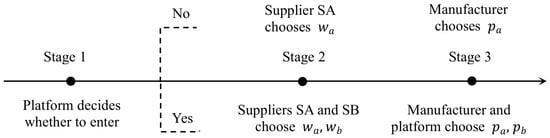
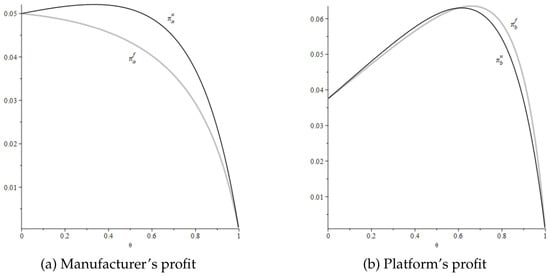
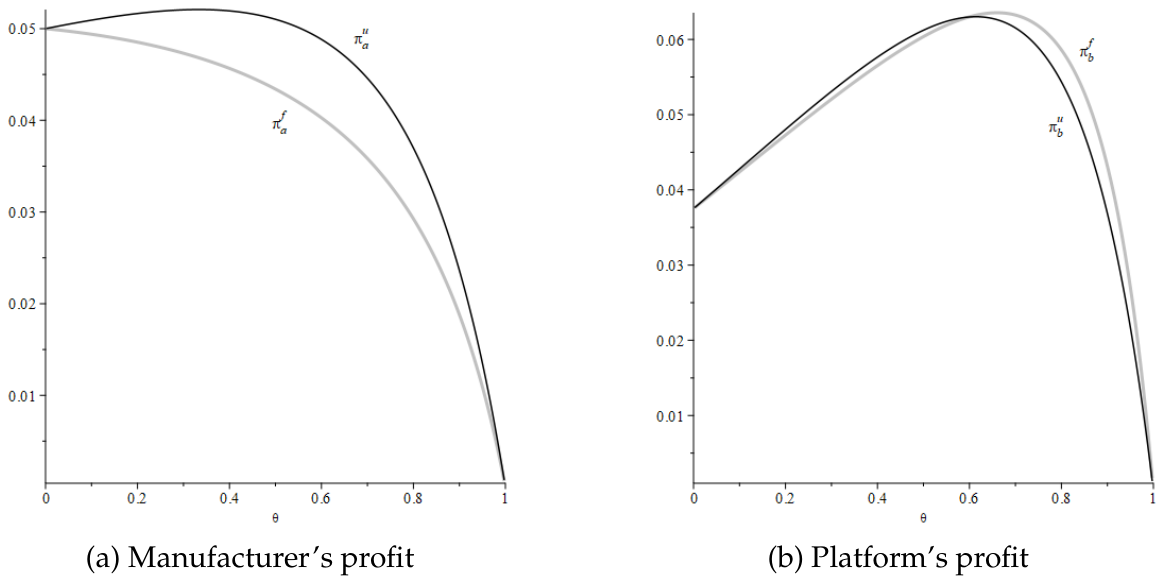
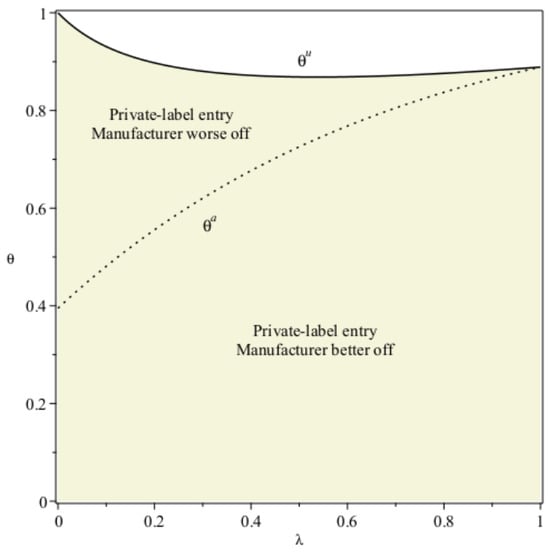
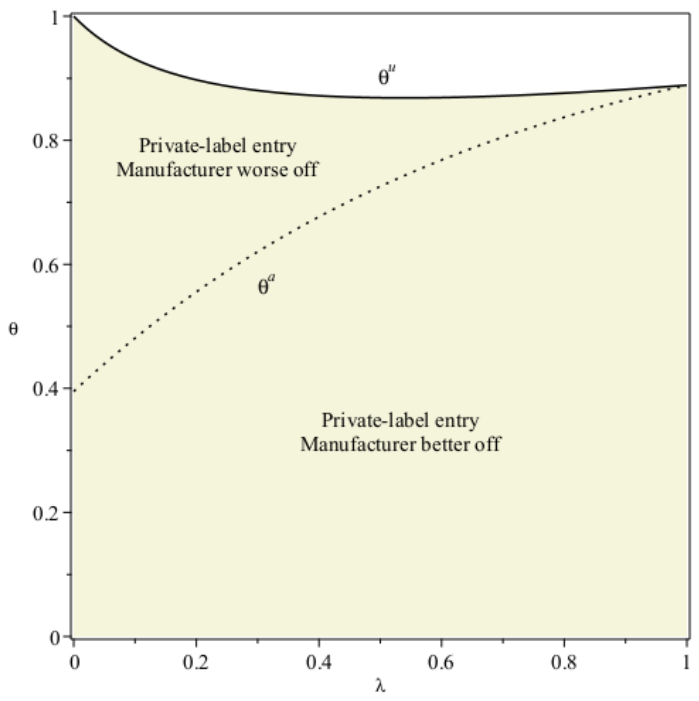
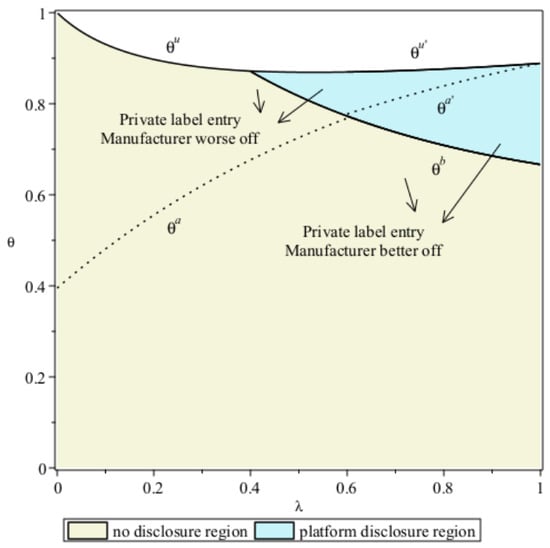
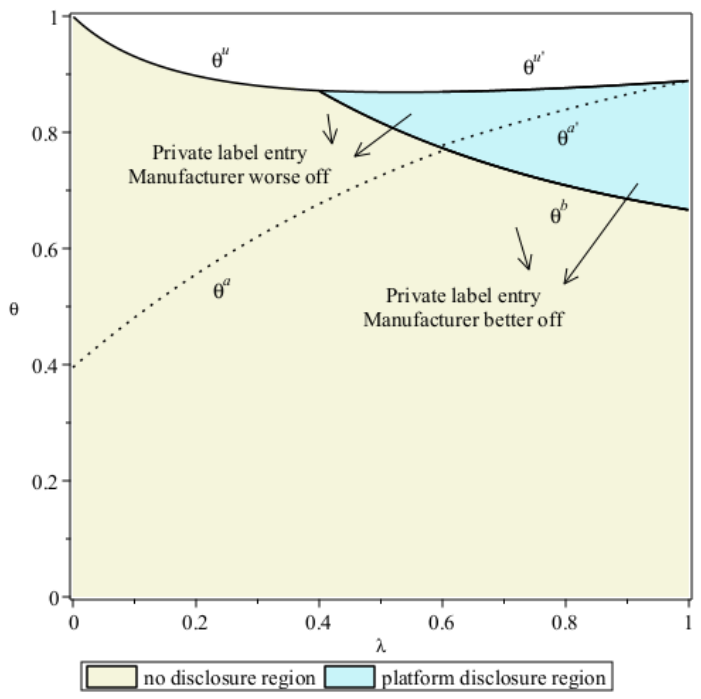

Disclaimer/Publisher’s Note: The statements, opinions and data contained in all publications are solely those of the individual author(s) and contributor(s) and not of MDPI and/or the editor(s). MDPI and/or the editor(s) disclaim responsibility for any injury to people or property resulting from any ideas, methods, instructions or products referred to in the content. |
© 2026 by the authors. Licensee MDPI, Basel, Switzerland. This article is an open access article distributed under the terms and conditions of the Creative Commons Attribution (CC BY) license.