


Abstract
Generative artificial intelligence (GenAI) shopping assistants can provide personalized shopping guidance while raising concerns about conversational data use. Drawing on privacy calculus, trust theory, and information systems success logic, this study examines a Trust-mediated benefit–risk model using cross-sectional survey data from 295 consumers in Riyadh, Saudi Arabia, with prior GenAI shopping-assistant experience. Partial least squares structural equation modeling indicates that perceived conversational quality is positively associated with Personalization Value (β = 0.563) and Privacy Concern (β = 0.235). Personalization Value is positively associated with Trust (β = 0.514), while Privacy Concern is negatively associated with Trust (β = −0.122). Trust is strongly associated with Purchase Intention (β = 0.731). The relationship between Privacy Concern and Trust is less negative at higher levels of self-assessed overall AI Literacy (interaction β = 0.144). Additional analyses indicate complementary partial mediation for Personalization Value and indirect-only mediation for Privacy Concern. The findings suggest that valued personalization and Privacy Concern can coexist during AI-assisted shopping, with Trust linking these appraisals to Purchase Intention. AI Literacy is interpreted as a global self-assessment rather than empirically separable competencies. Given the cross-sectional, non-experimental design, all findings reflect associations rather than causal effects.
1. Introduction
Generative AI-powered conversational assistants are becoming a distinct interface for electronic commerce because they can interpret natural-language requests, ask follow-up questions, compare alternatives, summarize product information, and generate context-sensitive recommendations. In contrast to static search, filters, and conventional rule-based chatbots, these systems can participate in an iterative decision-support encounter in which the consumer’s expressed needs shape subsequent responses. From a management-information-systems (MIS) perspective, this makes conversational quality-understanding needs, providing clear and useful information, and supporting the shopping task a consequential service-quality cue that can shape users’ evaluations of the digital encounter [1,2,3].
The same interaction can nevertheless be accompanied by a second, less favorable appraisal. Consumers may value recommendations that fit their needs while simultaneously becoming more attentive to the data, inferences, and conversational history that appear necessary to generate those recommendations. This tension is consistent with the personalization–privacy paradox: data-enabled relevance can be associated with greater perceived usefulness and convenience while also heightening concern about collection, control, transparency, and secondary use of personal information [4,5,6]. In GenAI-assisted shopping, the issue is especially salient because consumers can disclose preferences, budgets, constraints, and purchase goals conversationally rather than only through clicks or browsing traces.
The theoretical problem addressed in this study is therefore not simply whether GenAI shopping assistants are “useful” or “risky,” but how benefit- and risk-related appraisals are translated into a willingness to rely on the assistant. Classical privacy-calculus research treats privacy decisions as a balance among benefits, risks, and confidence or Trust-related considerations [7]. The present study uses privacy calculus as an appraisal lens rather than claiming to reproduce a complete direct benefit–risk-to-behavior calculus. Specifically, Perceived Personalization Value represents a benefit appraisal and Privacy Concern represents a risk appraisal; Trust in the AI Shopping Assistant is theorized as an important mechanism through which these appraisals are associated with Purchase Intention [8,9,10]. The competing mediation analysis further allows the study to determine whether these benefit- and risk-based appraisals operate exclusively through Trust or whether they also retain direct associations with Purchase Intention.
Consumers also differ in their capacity to interpret AI systems. AI Literacy encompasses awareness of AI, competence in using it, the ability to evaluate its outputs, and critical or ethical understanding of its implications [11,12]. This study therefore treats AI Literacy as a boundary condition on the Privacy Concern–Trust relationship. The argument is not that AI-literate consumers necessarily care less about privacy; rather, greater AI Literacy may help users distinguish a recognized privacy risk from a generalized judgment that the assistant is untrustworthy.
The problem statement emerges from three related gaps. First, much prior work examines chatbot-service quality, personalization, privacy, or Trust as separate issues, leaving the upstream role of the quality of a direct GenAI shopping conversation underdeveloped [2,3,13]. Second, the closest recent study, Nusir et al. [14], demonstrates that advertisements perceived to draw on prior GenAI conversations can simultaneously generate Personalization Value and Privacy Concern, which then shape algorithmic Trust and social-commerce Purchase Intention. That study concerns the downstream commercial reuse of prior conversational data in advertising. The present study instead focuses on consumers’ evaluations of the shopping-assistant interaction itself and asks whether perceived conversational quality functions as an upstream technological cue associated with both benefit and risk appraisals. Third, the role of AI Literacy as a boundary condition on whether Privacy Concern is translated into distrust remains insufficiently developed in GenAI-assisted shopping. Thus, the intended contribution is not the mere addition of familiar constructs but a refinement of the antecedent mechanism, the benefit–risk translation process, and the boundary conditions of Trust formation.
Saudi Arabia is used as an empirically informative setting rather than as an assumed cultural moderator of the proposed relationships. The context combines rapid e-commerce expansion, high national attention to AI, and a formal personal-data protection regime. Saudi Ministry of Commerce reporting indicates that e-commerce commercial registrations reached 43,854 in 2025, representing 9% annual growth, while national AI reporting indicates high public familiarity with AI and its applications [15,16]. The Personal Data Protection Law also makes transparency, lawful processing, and personal-data governance institutionally salient [17]. These features make Riyadh a relevant setting in which to examine GenAI-assisted shopping perceptions; however, the study does not claim that the observed path coefficients are uniquely Saudi or culturally caused.
Accordingly, the purpose of the study is to test a Trust-mediated benefit–risk model of GenAI shopping-assistant use in e-commerce. Four objectives guide the analysis: (1) to examine whether conversational quality is positively associated with Perceived Personalization Value and Privacy Concern; (2) to examine whether Personalization Value and Privacy Concern are, respectively, positively and negatively associated with Trust in the AI shopping assistant; (3) to examine how Perceived Personalization Value and Privacy Concern are associated with e-commerce Purchase Intention directly and indirectly through Trust; and (4) to examine whether the negative association between Privacy Concern and Trust is weaker at higher levels of AI Literacy. Because the data are cross-sectional, these objectives concern theoretically specified associations rather than temporal causation.
The study’s originality and value lie in four points. First, it positions conversational quality as an upstream encounter-level cue that can simultaneously generate benefit-based and risk-based consumer evaluations, rather than treating personalization itself as the focal stimulus. Second, it refines the use of privacy-calculus reasoning by showing that benefit- and risk-based evaluations do not translate into Purchase Intention symmetrically: Perceived Personalization Value operates through both direct and Trust-mediated routes, whereas Privacy Concern is associated with Purchase Intention primarily through its negative association with Trust. Third, it introduces AI Literacy as a theoretically targeted boundary condition on the Privacy Concern–Trust link rather than as a generic moderator of every relationship in the model. Fourth, it examines the robustness of the proposed benefit–risk–Trust mechanism among consumers with meaningful prior GenAI shopping-assistant experience and across the major e-commerce platforms represented in the sample. Table 1 summarizes how the present study differs from its closest recent comparator.
Table 1.
Positioning of the present study relative to the closest recent GenAI study.
2. Literature Review and Theoretical Background
2.1. GenAI Shopping Assistants in E-Commerce
Artificial intelligence has long been embedded in digital commerce through recommendation, ranking, customer-service automation, and personalization. GenAI shopping assistants extend these functions by allowing consumers to formulate goals in natural language, refine requests over multiple turns, compare products, and receive contextualized decision support. This integration of search, guidance, personalization, and conversation distinguishes GenAI assistants from conventional recommender systems and rule-based chatbots [18,19,20,21]. Research on online shopping assistants further shows that functional, social, relational, and security-related evaluations shape acceptance and that Trust can mediate the translation of those evaluations into behavioral intentions [13].
From a management-information-systems (MIS) perspective, the relevant issue is not only whether the system is technically capable but whether the interaction is experienced as understandable, responsive, relevant, and useful. Service-quality research on AI chatbots links these encounter characteristics to Trust, experience, satisfaction, and behavioral outcomes [2,3]. In the present study, conversational quality is therefore conceptualized as the quality of the interaction process, whereas Perceived Personalization Value is the consumer’s evaluation of the relevance, preference fit, usefulness, and convenience produced by that interaction. This process–outcome distinction is theoretically important because a good conversation is not identical to the value a consumer derives from personalized recommendations.
Consumer responses to AI-assisted commerce can nevertheless be ambivalent. Intelligent systems may reduce search costs and improve relevance while also reducing perceived control, making inference processes more visible, or creating uncertainty about how personal data are processed. Algorithmic aversion and AI-experience research similarly show that consumers may resist automated systems when decision logic is opaque or when data use feels inappropriate [21,22,23,24]. This coexistence of utility and concern motivates the benefit–risk appraisal structure developed below.
2.2. Privacy-Calculus Reasoning and Trust-Mediated Benefit–Risk Appraisal
Privacy-calculus theory explains why consumers may accept data-intensive digital services even when they experience Privacy Concern: they weigh valued outcomes against perceived privacy-related costs, risks, and confidence in the exchange [7]. Classical formulations commonly connect benefit- and risk-related beliefs to disclosure or transactional intentions. The present model draws on that reasoning but does not claim to be a complete direct test of the classical calculus at the behavioral-decision stage. Instead, it focuses on how benefit and risk appraisals are associated with Trust, while also examining whether these appraisals retain direct relationships with Purchase Intention.
This positioning is consistent with the personalization–privacy paradox. Consumers can value relevance, usefulness, and reduced search effort while remaining concerned about information collection, control, and transparency [4,5,6,25]. In GenAI-assisted shopping, conversational interaction can make personalization feel especially responsive because the system appears to infer needs from natural-language input. The same adaptive responsiveness may also make data inference more salient, although conversational clarity or usefulness alone does not necessarily imply more data collection. The mechanism proposed here is therefore one of perceived inference salience within an adaptive interaction, not a claim that every element of service quality inherently threatens privacy.
Recent GenAI research provides a close but distinct point of comparison. Nusir et al. [14] showed that advertising perceived to use information from prior AI conversations was associated with both higher Personalization Value and higher Privacy Concern; those evaluations were then associated with algorithmic Trust and social-commerce Purchase Intention. Their empirical referent was the reuse of conversational data for advertising. The present study shifts the focal referent upstream to consumers’ perceptions of the shopping-assistant interaction and asks whether perceived conversational quality is associated with the same two appraisals. The theoretical extension is therefore not simply a different country sample: it concerns the locus of the stimulus (shopping-assistant interaction quality rather than subsequent advertising personalization) and the inclusion of AI Literacy as a boundary condition on privacy-related Trust formation.
Within this framework, Perceived Personalization Value is treated as the benefit appraisal and Privacy Concern as the risk appraisal. Both are specified as antecedents of Trust in the AI Shopping Assistant. Trust is positioned as an important mechanism through which these appraisals are translated into Purchase Intention, but the revised analysis also tests whether Perceived Personalization Value and Privacy Concern have direct relationships with Purchase Intention. The competing mediation results show that Perceived Personalization Value is associated with Purchase Intention both directly and indirectly through Trust, indicating complementary partial mediation, whereas the direct effect of Privacy Concern on Purchase Intention is not statistically significant and Privacy Concern is associated with Purchase Intention primarily through Trust, indicating indirect-only mediation. Accordingly, the findings suggest that benefit- and risk-based appraisals do not operate symmetrically at the behavioral stage: Personalization Value retains an independent direct route to Purchase Intention, whereas privacy concern operates mainly by weakening Trust.
2.3. Trust Theory in AI-Assisted E-Commerce
Trust is central to e-commerce because transactions involve uncertainty, information asymmetry, and reliance on digital infrastructures that consumers cannot fully inspect. Trust reduces perceived vulnerability by supporting confidence that the focal digital actor or system is sufficiently competent, reliable, and oriented toward acceptable conduct [8,9,10,26].
In AI-assisted commerce, the consumer relies not only on the retailer or platform but also on an intelligent agent that interprets needs and generates recommendations. Trust in such an assistant can therefore reflect beliefs about competence or ability, dependability, integrity, and benevolent orientation toward the user’s goals, consistent with established e-commerce Trust frameworks [8]. Prior chatbot research further indicates that Trust can connect evaluations of AI-service encounters with satisfaction, continuance, loyalty, word of mouth, and purchase-related intentions [2,3,27].
The present study therefore positions Trust in the AI Shopping Assistant as an important proximal reliance judgment linking benefit- and risk-based appraisals to Purchase Intention. Personalization Value should support Trust because useful, preference-aligned recommendations signal capability and goal support; Privacy Concern should undermine Trust because uncertainty about collection, control, and data use is associated with greater perceived vulnerability. Trust is then expected to be positively associated with Purchase Intention. However, Trust is not assumed to constitute the only possible route through which these appraisals influence Purchase Intention. Consistent with the competing mediation specification, the study also examines whether Perceived Personalization Value and Privacy Concern retain direct associations with Purchase Intention. This allows the role of Trust to be interpreted more precisely as full, partial, or indirect-only mediation depending on the empirical pattern observed.
2.4. AI Literacy as a Boundary Condition
AI Literacy is commonly conceptualized as encompassing awareness, use, evaluation, and ethics [11,12]. The present study adapts items covering these domains but does not assume that the four competencies can be separately measured in this sample. Instead, their shared variance is interpreted as an overall self-assessed AI-Literacy orientation. This distinction is essential: self-ratings indicate perceived familiarity and confidence with AI-related tasks and issues, not externally tested proficiency. The empirical comparison of alternative measurement specifications, including the lack of discriminant validity between the four first-order dimensions, is reported in Section 5.4.
The boundary condition proposed here is deliberately narrower than a generic “AI Literacy moderates everything” argument. Privacy Concern is already a risk appraisal; the next judgment is whether that risk warrants distrust of the assistant. Consumers with greater AI Literacy may be better able to distinguish ordinary algorithmic data processing, model limitations, and explainable risks from evidence that the assistant itself is unreliable or untrustworthy. Thus, literacy is expected to attenuate the translation of Privacy Concern into distrust without implying that Privacy Concern disappears. The same rationale does not uniquely predict that literacy must alter the perceived quality of an answer or the value of a relevant recommendation, which is why the moderation hypothesis is focused on the Privacy Concern–Trust path. To assess whether this moderating role is sensitive to possible conceptual overlap with Privacy Concern and Trust, the study also examines the robustness of the interaction after excluding the AI-Literacy indicators that explicitly refer to privacy/data use and Trust-related judgments.
2.5. Integrative Theoretical Positioning and Contribution
The model integrates three theoretical roles rather than treating multiple theories as interchangeable labels. Information-systems-success logic motivates conversational quality as an encounter-level technological/service cue; privacy-calculus reasoning organizes the consumer’s benefit and privacy-risk appraisals; and trust theory explains why those appraisals are associated with a more proximal willingness to rely on the assistant. AI Literacy then specifies a cognitive boundary condition on the risk-appraisal-to-Trust link. This division of theoretical labor clarifies where each perspective enters the model and prevents privacy calculus from being overstated as a direct test of every possible benefit–risk-to-behavior pathway. Importantly, the revised competing mediation analysis further allows the model to distinguish between benefit- and risk-based appraisals that operate differently at the behavioral stage, rather than assuming that both are transmitted to Purchase Intention exclusively through Trust.
Relative to Nusir et al. [14], the present study partly replicates the broader observation that GenAI-related personalization can coexist with Privacy Concern, but it extends that logic in three ways. First, it locates the initiating cue in perceived conversational quality within the shopping-assistant context rather than in an advertisement perceived to reuse prior conversational data. Second, it shows that benefit- and risk-based appraisals are not behaviorally symmetric: Perceived Personalization Value retains both a direct and a Trust-mediated route to Purchase Intention, whereas Privacy Concern is associated with Purchase Intention primarily through its negative association with Trust. Third, it proposes AI Literacy as a boundary condition on whether a recognized Privacy Concern becomes distrust. The contribution therefore lies in refining the common-origin benefit–risk mechanism, clarifying the asymmetric routes through which these appraisals are associated with Purchase Intention, and identifying AI Literacy as a targeted boundary condition on privacy-related Trust formation. It does not claim that the coexistence of Personalization Value and Privacy Concern is itself novel.
3. Conceptual Framework and Development of Hypotheses
The conceptual model specifies a sequence from perceived conversational quality to two appraisals—Perceived Personalization Value and Privacy Concern—then to Trust in the AI Shopping Assistant and Purchase Intention. The model is privacy-calculus-informed because it represents a benefit appraisal and a risk appraisal, but it is more precisely characterized as a Trust-mediated benefit–risk model. AI Literacy is positioned as a boundary condition on the Privacy Concern–Trust relationship. In addition to the prespecified Trust-mediated pathways, the empirical analysis examines whether Perceived Personalization Value and Privacy Concern retain direct relationships with Purchase Intention, allowing the role of Trust to be distinguished more precisely. The following hypotheses distinguish the primary direct theoretical propositions (H1–H6) from derived indirect-effect tests (H7–H10), while the competing mediation specification is assessed as an additional analysis to determine whether the relevant indirect effects reflect partial or indirect-only mediation.
3.1. GenAI Shopping-Assistant Conversational Quality and Perceived Personalization Value
Conversational quality refers to the perceived quality of the interaction process: whether the assistant understands shopping needs, communicates clearly, provides useful product information, facilitates comparison, and supports decision making adaptively. These characteristics can reduce information overload and search effort. Importantly, conversational quality is conceptually distinct from Perceived Personalization Value: the former concerns how well the interaction performs, whereas the latter concerns the value the consumer derives from recommendation relevance, preference fit, usefulness, and convenience.
Information-systems-success research links system and service quality to favorable user evaluations, while chatbot-service research shows that responsiveness, usefulness, and reliability contribute to positive AI-service experiences [1,2,3]. Personalization research similarly indicates that consumers value systems that provide preference-matching information and reduce search costs [28,29]. Accordingly, a higher-quality GenAI shopping conversation should be associated with greater Perceived Personalization Value.
H1.
GenAI shopping-assistant conversational quality is positively associated with Perceived Personalization Value.
3.2. GenAI Shopping-Assistant Conversational Quality and Privacy Concerns
The privacy mechanism requires a more specific argument than the claim that “better conversation” automatically means greater data collection. Clarity and usefulness in isolation need not raise Privacy Concern. However, conversational quality in this study also includes adaptive need understanding and personalized guidance. When an assistant appears to infer preferences accurately across a dialogue, the interaction can make the underlying use of conversational inputs and inferred characteristics more salient to the user. This salience may prompt questions about what information is collected, retained, combined, or used to generate subsequent recommendations.
This mechanism is consistent with research on the personalization–privacy paradox, which shows that personalization can be valued while simultaneously increasing concern when information collection or inference becomes noticeable or insufficiently transparent [4,5,6]. It also aligns with GenAI research showing that conversation-derived personalization can make the use of sensitive or intention-revealing information salient [14]. The hypothesized association is therefore expected to be positive but need not be large, because many aspects of conversational quality are primarily value-enhancing rather than privacy-threatening.
H2.
GenAI shopping-assistant conversational quality is positively associated with Privacy Concern.
3.3. Perceived Personalization Value and Trust in AI Shopping Assistants
Perceived Personalization Value captures the consumer’s evaluation that the assistant’s recommendations are relevant, useful, convenient, and aligned with personal preferences. When the assistant helps the consumer locate suitable products, reduce search effort, and improve the decision process, the consumer receives evidence of the system’s capability and goal alignment. These judgments should support Trust in the assistant.
Personalization research shows that relevance and preference fit can enhance consumer evaluations of digital experiences [28,29]. Trust theory likewise suggests that perceived competence, dependability, and goal support encourage reliance on a digital actor [8]. Empirical chatbot studies report similar links between favorable AI-service evaluations and Trust [2,3].
H3.
Perceived Personalization Value is positively associated with Trust in the AI Shopping Assistant.
3.4. Privacy Concerns and Trust in AI Shopping Assistants
Privacy Concern should be negatively associated with Trust because uncertainty about how conversational information is collected, controlled, stored, or reused is associated with greater perceived vulnerability. A shopping dialog may reveal product preferences, budgets, lifestyle information, or decision constraints; if consumers are unsure how these data are governed, confidence in the assistant may decline even when its recommendations are useful.
Information-privacy research identifies collection, control, and awareness as core domains of Privacy Concern, while e-commerce studies show that privacy-related risk and uncertainty can undermine Trust and transactional willingness [7,9,10,30]. Recent personalization research similarly emphasizes that opacity or perceived overreach can make consumers feel vulnerable even when personalization is useful [6,14].
H4.
Privacy Concern is negatively associated with Trust in the AI Shopping Assistant.
3.5. Trust in AI Shopping Assistants and E-Commerce Purchase Intention
Trust in the AI Shopping Assistant is expected to be positively associated with e-commerce Purchase Intention. Online consumers make decisions under uncertainty about product quality, seller motives, recommendation accuracy, and data practices. Trust can reduce this uncertainty by supporting confidence that the assistant provides dependable decision support and does not behave in ways that make reliance unacceptable.
This proposition is consistent with Trust-based e-commerce models and empirical work linking Trust to adoption and purchase-related intentions [8,9,10,26]. AI-service studies similarly identify Trust as a key correlate of behavioral response [3,31].
H5.
Trust in the AI shopping assistant is positively associated with e-commerce Purchase Intention.
3.6. The Moderating Role of AI Literacy
AI Literacy is proposed as a moderator of the Privacy Concern–Trust association because this path requires consumers to translate a recognized privacy risk into a judgment about whether the AI assistant is worthy of reliance. Higher literacy can improve understanding of how AI systems use data, the limits of model outputs, and the difference between explainable data processing and evidence of system untrustworthiness. Accordingly, Privacy Concern may remain present while its negative association with Trust becomes weaker among more AI-literate consumers.
This moderation is deliberately path-specific. The theoretical rationale is strongest at the point where privacy-risk interpretation becomes a Trust judgment; it does not require the assumption that literacy changes the objective conversational features the user perceives, nor that it necessarily changes the usefulness of a relevant recommendation. Drawing on AI-Literacy frameworks that emphasize understanding, use, evaluation, and critical reflection [11,12], the study therefore tests a focused buffering hypothesis.
H6.
AI Literacy moderates the association between Privacy Concern and Trust in the AI Shopping Assistant, such that the negative association is weaker at higher levels of AI Literacy.
3.7. Derived Indirect-Effect Hypotheses
H7–H10 are treated as derived indirect-effect hypotheses rather than independent theoretical contributions. H1 and H3 jointly imply a positive indirect association from conversational quality to Trust through Personalization Value, whereas H2 and H4 jointly imply a negative indirect association through Privacy Concern. These two indirect routes operationalize the model’s benefit and risk appraisals at the Trust-formation stage.
H3–H5 and H4–H5 further imply indirect associations from Perceived Personalization Value and Privacy Concern to Purchase Intention through Trust. In addition to testing these prespecified indirect effects, the revised analysis estimates direct paths from Perceived Personalization Value and Privacy Concern to Purchase Intention in a competing mediation model. This supplementary specification allows the role of Trust to be distinguished more precisely as complementary partial mediation or indirect-only mediation, depending on whether the corresponding direct effect remains statistically significant. Accordingly, H9 and H10 continue to test whether the specified indirect effects through Trust are statistically different from zero, while the competing mediation analysis evaluates whether these indirect effects coexist with direct relationships to Purchase Intention [8,9,10].
H7.
Conversational quality has a positive indirect association with Trust in the AI Shopping Assistant through Perceived Personalization Value.
H8.
Conversational quality has a negative indirect association with Trust in the AI Shopping Assistant through Privacy Concern.
H9.
Perceived Personalization Value has a positive indirect association with e-commerce Purchase Intention through Trust in the AI Shopping Assistant.
H10.
Privacy Concern has a negative indirect association with e-commerce Purchase Intention through Trust in the AI Shopping Assistant.
Figure 1 summarizes the prespecified model. Solid paths represent the primary direct hypotheses, and the dashed path represents the AI-Literacy interaction. Although the prespecified conceptual model emphasizes Trust as the primary mediating mechanism, the revised empirical analysis additionally estimates direct PPV → Purchase Intention and Privacy Concern → Purchase Intention paths as a competing mediation specification. These additional paths are used to assess the form of mediation rather than to redefine the original H1–H10 hypothesis structure.
Figure 1.
Conceptual model of the study.
The next section explains the methodology adopted to test the proposed model and hypotheses empirically.
4. Methodology
4.1. Research Design and Context
This study used a quantitative cross-sectional survey design to examine associations among consumer perceptions of GenAI shopping assistants. A survey was appropriate for measuring latent perceptions such as conversational quality, Personalization Value, Privacy Concern, Trust, AI Literacy, and Purchase Intention, and PLS-SEM was used to evaluate the prespecified measurement and structural model. Because the observations were collected at one point in time and no experimental manipulation or temporal ordering was imposed, the design supports associational model testing rather than causal inference [9,10,32].
The empirical setting was Riyadh, Saudi Arabia. Riyadh was selected as a major urban e-commerce market within a national environment characterized by expanding e-commerce activity, high public attention to AI, and increasing institutional emphasis on data governance. Official reporting shows continued growth in Saudi e-commerce registrations and high public familiarity with AI, while the Personal Data Protection Law provides a formal privacy-governance backdrop [15,16,17]. These features make the context relevant for studying GenAI-assisted commerce. The study nevertheless treats Saudi Arabia as the sampling context rather than as a tested cultural or institutional moderator; no Saudi-specific causal mechanism is inferred from the single-country design.
4.2. Sample and Data Collection
Data were obtained through an anonymous self-administered survey of consumers residing in Riyadh with previous online-shopping experience. Participants were recruited using a non-probability sampling approach among adult e-commerce consumers residing in Riyadh, Saudi Arabia. Eligibility initially required residence in Riyadh and prior online-shopping experience. Before answering the focal items, respondents were given a standardized description of a GenAI shopping assistant as a tool that could answer product questions, compare alternatives, and provide personalized recommendations. The initial screening criterion was prior online-shopping experience, followed in the revised analytical strategy by an additional experience-based screening criterion concerning prior use of GenAI shopping assistants. Respondents who reported that they had never or rarely used GenAI shopping assistants were excluded from the primary analysis, whereas those reporting use sometimes, often, or very often were retained. Although respondents were not exposed to one standardized platform or named assistant, this additional criterion ensured that the primary analysis was based on consumers with meaningful prior experience using the focal technology.
A total of 390 completed questionnaires were initially obtained. Following the additional experience-based screening, 95 respondents who reported never or rarely using GenAI shopping assistants were excluded, resulting in a final primary analytical sample of 295 respondents. Data collection was completed by mid-July 2026. No missing values were observed in the retained analytical sample; therefore, no missing-data imputation or case deletion due to missing responses was required. Sample-size adequacy was assessed formally. Using the multiple-regression analog recommended for power analysis, with four predictors for the most heavily predicted endogenous construct, α = 0.05, desired power = 0.80, and a small minimum effect size of f2 = 0.05, the required sample is approximately 244; the retained sample of N = 295 therefore exceeds this requirement [33]. As a PLS-SEM-specific sensitivity check, the inverse square-root approach yields a minimum of approximately 275 observations when a standardized path of |β| = 0.15 is treated as the smallest substantively meaningful path at α = 0.05; the retained sample of 295 also exceeds this benchmark [34]. These calculations support adequacy for effects of meaningful magnitude while not implying that every statistically significant small effect is substantively important.
Participation was voluntary and anonymous. The survey described the research purpose, emphasized that there were no right or wrong answers, and informed participants of their right to discontinue. Directly identifying information was not requested. The original study documentation available for reporting does not provide a defensible denominator for all persons who encountered the survey invitation, so a response rate is not reconstructed post hoc. Likewise, recruitment-provider details, exact collection dates, incentives, and any attention-check protocol are not inferred where they were not documented. This reporting limitation is acknowledged explicitly rather than supplemented with unverifiable procedural claims.
4.3. Measurement Instrument
The questionnaire used measures adapted from the established literature and contextualized for GenAI-assisted shopping. The instrument was prepared in English and translated into Arabic, after which the Arabic wording was compared with the source meaning to preserve conceptual correspondence. The study documentation does not establish that an independent back-translation, bilingual expert committee, cognitive-interview stage, or formal translation pilot was conducted. Accordingly, the study does not claim a level of linguistic validation that cannot be verified, and translation equivalence is acknowledged as a limitation. This is especially relevant because recent Arabic validation work on AI-Literacy measures has used bilingual translation, expert review, and independent back-translation procedures [35].
Five items measured GenAI shopping-assistant conversational quality (GCQ), capturing need understanding, answer clarity, useful comparative information, shopping facilitation, and personalized guidance [2,3]. Four items measured Perceived Personalization Value (PPV) as the relevance, preference fit, usefulness, and convenience created by personalized assistance [28,29]. The constructs are therefore intended to represent interaction-process quality (GCQ) versus consumer-evaluated personalization outcomes (PPV). The wording of GCQ5 (“personalized guidance”) is acknowledged as conceptually adjacent to PPV, so discriminant-validity evidence is reported explicitly in Section 5.4 rather than assuming separation from item labels alone.
Privacy Concern was measured using four context-specific items adapted from concepts represented in the Internet Users’ Information-Privacy Concerns (IUIPC) framework. The original IUIPC framework conceptualizes Information-Privacy Concern as a multidimensional higher-order construct comprising collection, control, and awareness [30]. PC1 captures concern about the collection of personal information, PC2 concerns the use of conversational data, PC3 reflects perceived lack of control over personal data, and PC4 captures awareness and transparency concerns regarding how personal data are used for AI-based recommendations. These items were intended to capture a global situational privacy-concern orientation toward the GenAI shopping-assistant encounter rather than to reproduce the original multidimensional IUIPC measurement structure. Conceptually, the four items share a common situational referent—concern arising from how personal and conversational data are collected, used, controlled, and explained within the same AI-assisted shopping context—and were therefore specified as reflective indicators of an overall context-specific privacy-concern orientation. Because measurement-model specification should be based on the conceptual relationship between a construct and its indicators rather than on statistical criteria alone [36,37], this specification is treated as a context-specific adaptation rather than as a shortened or revalidated IUIPC scale. The reliability and convergent-validity statistics reported below therefore describe the empirical performance of the specified measure but are not interpreted as establishing its content validity [37]. Because several IUIPC domains are represented by only one or two adapted items, the measure provides relatively brief coverage of the broader information-privacy domain and should be interpreted accordingly. No additional expert content-validation exercise, cognitive pretest, or formal pilot specific to the adapted privacy-concern items is documented in the available study records. Accordingly, the present study does not claim independent content validation of the adapted four-item privacy-concern measure.
AI Literacy was assessed with 12 self-report items adapted from Wang et al. [12], whose conceptual framework covers awareness, use, evaluation, and ethics. The adapted items were evaluated as (1) one reflective overall factor, (2) four correlated first-order factors, and (3) a two-stage higher-order factor constructed from the four domain scores. The item-level single-factor model showed satisfactory reliability and convergent validity (α = 0.933, CR = 0.942, AVE = 0.574), whereas the four first-order factors lacked discriminant validity (HTMT = 1.010–1.040). The existing structural analysis was estimated with the higher-order score to retain the conceptual breadth of the item set; however, because its constituent domains were not empirically distinguishable, this score is interpreted solely as an index of overall self-assessed AI Literacy, not as evidence for separable dimensions or objectively demonstrated competencies. The 10-item single-factor sensitivity analysis excluding AIL11 and AIL12 further evaluates the stability of the interaction against content overlap with privacy and Trust. This choice is a pragmatic summary of the available self-report indicators, rather than validation of a four-dimensional measurement structure.
A theoretically unrelated marker variable was included as a sensitivity check for common-method variance. Three items measuring attitude toward the color blue were adapted from Miller and Simmering [38], following the marker-variable logic of Lindell and Whitney [39]. The marker was not part of the substantive theoretical model. Because its purpose was diagnostic rather than substantive, the marker comparison is interpreted conservatively: stability of focal paths after inclusion of the marker is evidence that the substantive conclusions are not highly sensitive to the modeled method factor, but it is not treated as proof that common-method variance is absent. Separate reliability estimates for the three marker items were not retained in the analytical output available for this revision. Accordingly, the marker analysis is treated only as a sensitivity check and not as independent psychometric validation of the marker scale.
All substantive constructs and the marker items were rated on a seven-point Likert scale from 1 = strongly disagree to 7 = strongly agree. The complete item wording, construct codes, and sources are provided in Appendix A. The use of a common response format improves consistency for respondents but also reinforces the importance of the procedural and statistical common-method checks described below.
4.4. Common-Method Bias Procedures
Because predictor and criterion perceptions were obtained from the same respondents in one self-administered survey, procedural steps were used to reduce common-method bias, including anonymity, neutral instructions, and a theoretically unrelated marker variable separated from the core construct blocks [40]. These procedures reduce but cannot eliminate method-related covariance.
Statistically, the marker-variable comparison was used as a supplementary common-method sensitivity analysis [38,39]. The VIF values reported in Section 5.2 are interpreted as structural collinearity diagnostics; they are not presented as a full-collinearity common-method test under Kock’s [41] 3.3 criterion because the required full-collinearity procedure was not separately documented. This distinction avoids conflating ordinary structural VIF assessment with a dedicated common-method test.
4.5. Data Analysis Approach
The hypothesized model was estimated using partial least squares structural equation modeling (PLS-SEM) in SmartPLS 4.1.1.7. The PLS-SEM algorithm was estimated using standardized results.
For the measurement model, indicator loadings, Cronbach’s alpha, composite reliability, average variance extracted (AVE), and heterotrait–monotrait (HTMT) ratios were evaluated. Loadings around or above 0.70, reliability coefficients above 0.70, and AVE above 0.50 were treated as evidence of adequate reliability and convergent validity, while HTMT values below 0.85 were used as a conservative discriminant-validity guideline [32,42]. These criteria are interpreted alongside the conceptual measurement concerns discussed above, because statistical discriminant validity does not by itself establish content validity.
Because AI Literacy has a multidimensional conceptual basis, alternative measurement specifications were evaluated before estimating the final structural model. The analysis compared: (1) a single-factor specification containing all 12 AI-Literacy indicators, (2) four correlated reflective first-order dimensions representing Awareness, Use, Evaluation, and Ethics, and (3) a higher-order AI-Literacy specification. The higher-order construct was estimated using the two-stage approach, consistent with recommendations for hierarchical component models in PLS-SEM [32]. In Stage 1, the four reflective first-order dimensions were estimated and their latent-variable scores obtained. In Stage 2, the scores for Awareness, Use, Evaluation, and Ethics were used as indicators of the higher-order AI-Literacy construct. The resulting higher-order construct was subsequently used in the structural model.
The moderation model included the constituent main effects of AI Literacy and Privacy Concern on Trust in the AI Shopping Assistant together with their interaction. The AI Literacy × Privacy Concern interaction was estimated using the two-stage moderation procedure based on standardized construct scores. Bootstrapping with 10,000 resamples was used for inference. The prespecified directional hypotheses were evaluated using one-tailed tests and 90% bias-corrected confidence intervals. In addition, two-tailed tests with 95% bias-corrected confidence intervals were reported for the moderation analysis and as a supplementary sensitivity assessment.
The structural model was assessed using standardized path coefficients, t-values, p-values, bias-corrected confidence intervals, R2, f2, and predictive assessment. Bootstrapping with 10,000 resamples was used for direct, indirect, and interaction effects. Effect sizes are reported alongside statistical significance so that detectable but substantively small paths are not overstated. PLS-Predict was used to compare indicator-level prediction errors against a linear-model benchmark [43]. The predictive results are interpreted at the indicator level rather than assigned an unqualified global label.
In addition to the primary PLS-SEM analysis, several supplementary analyses were conducted to assess the robustness of the findings with respect to respondent experience, mediation structure, construct specification, and platform heterogeneity. First, the structural results obtained from the revised primary sample of 295 respondents who reported using GenAI shopping assistants sometimes, often, or very often were compared with those obtained from the original full sample of 390 respondents. Second, a competing mediation model was estimated by adding direct paths from Perceived Personalization Value and Privacy Concern to E-Commerce Purchase Intention, allowing the mediating role of Trust in the AI Shopping Assistant to be assessed as complementary partial or indirect-only mediation. Third, the moderating effect of AI Literacy was re-estimated after removing AIL11 and AIL12 to examine whether the interaction remained robust when the privacy- and Trust-related indicators were excluded. Finally, platform heterogeneity was examined across Amazon.sa, Noon, and SHEIN using the measurement invariance of composite models (MICOM) procedure followed by permutation-based multigroup analysis [32,44].
5. Findings
5.1. Respondent Profile and Descriptive Statistics
A total of 295 respondents who reported using GenAI shopping assistants sometimes, often, or very often were retained for the revised primary analysis. All respondents resided in Riyadh, Saudi Arabia, in line with the empirical focus of the study. The sample was relatively balanced by gender, with 51.9% male and 48.1% female respondents. Regarding age, 44.1% were between 25 and 34 years old, followed by those aged 35–44 years (22.4%) and 18–24 years (21.7%). In terms of education, 54.2% held a bachelor’s degree, 19.0% held a postgraduate degree, and 16.3% held a diploma. Regarding employment status, 62.4% were employed, 14.9% were students, and 8.8% were self-employed.
The respondents also demonstrated regular engagement with online shopping. The largest proportion reported shopping online one to two times per month (36.9%), followed by three to five times per month (30.2%). The most frequently reported e-commerce platforms were Amazon.sa (30.8%), Noon (25.1%), and SHEIN (18.0%). Regarding prior interaction with GenAI shopping assistants, 54.6% reported using such tools sometimes, 32.9% often, and 12.5% very often. These characteristics confirm that the revised analytical sample consisted exclusively of respondents with prior experience using GenAI shopping assistants.
Descriptive statistics for the revised analytical sample are presented in Table 2. Mean values ranged from 4.062 to 4.369 on the seven-point scale, indicating moderately positive assessments across the study constructs. The highest mean was reported for AI Literacy (M = 4.369, SD = 0.825), followed by Perceived Personalization Value (M = 4.320, SD = 0.940), GenAI Shopping-Assistant Conversational Quality (M = 4.278, SD = 0.930), Trust in AI Shopping Assistant (M = 4.258, SD = 1.065), E-Commerce Purchase Intention (M = 4.253, SD = 1.178), and Privacy Concern (M = 4.062, SD = 0.870). As shown in Table 2, the skewness and excess kurtosis values remained within acceptable ranges, indicating no substantial distributional concerns.
Table 2.
Descriptive statistics (N = 295).
5.2. Multicollinearity Assessment
Structural collinearity was assessed using inner-model variance inflation factor (VIF) values from the retained higher-order structural model. According to Hair et al. [32,45], VIF values below 5.00 indicate that collinearity is unlikely to adversely affect the estimation of the structural model. All VIF values presented in Table 3 were below this threshold, ranging from 1.000 to 1.131. Overall, these results indicate that problematic collinearity was not evident among the structural predictors.
Table 3.
Structural collinearity assessment.
5.3. Common-Method Bias Assessment
Because all focal perceptions were self-reported by the same respondents, common-method variance was treated as a potential source of bias rather than assumed away. Procedural remedies included anonymity and neutral response instructions, and the marker-variable model provided a supplementary statistical sensitivity check [38,40].
The marker-variable analysis compared the baseline model with a model that included the theoretically unrelated color-attitude marker. As reported in Table 4, inclusion of the marker produced only small changes in the focal path coefficients, indirect effects, and R2 values. The marker comparison is therefore consistent with the substantive paths being relatively stable to this modeled method factor. Because marker-variable diagnostics cannot demonstrate the complete absence of common-method variance, the result is interpreted as a robustness check rather than a definitive test.
Table 4.
Marker-variable common-method sensitivity analysis.
For example, GCQ → PPV changed from β = 0.563 to β = 0.565; GCQ → Privacy Concern changed from β = 0.235 to β = 0.223; PPV → Trust remained β = 0.514; Privacy Concern → Trust changed from β = −0.122 to β = −0.126; AI Literacy → Trust changed from β = 0.243 to β = 0.242; Trust → Purchase Intention remained β = 0.731; and the AI Literacy × Privacy Concern interaction changed from β = 0.144 to β = 0.146. These differences were small relative to the baseline estimates.
The indirect effects were similarly stable: GCQ → PPV → Trust changed from β = 0.289 to β = 0.290, while GCQ → Privacy Concern → Trust changed from β = −0.029 to β = −0.028. The PPV → Trust → Purchase Intention indirect effect remained β = 0.376, whereas the Privacy Concern → Trust → Purchase Intention indirect effect changed from β = −0.090 to β = −0.092. R2 values also changed minimally. Taken together, the marker comparison provides no indication that the study’s main conclusions are driven by the modeled marker factor, while still leaving the general limitations of single-source cross-sectional measurement in place.
5.4. Measurement-Model Assessment
Measurement models were validated before examining structural relationships. All substantive constructs in the primary model were specified reflectively, and the reliability of the model was determined by the indicator loadings, Cronbach’s alpha, composite reliability, and average variance extracted (AVE). Based on recommendations, reliability and validity of reflective measures can be considered adequate when indicator loadings exceed 0.70, reliability values are greater than 0.70, and AVE is higher than 0.50 [32,45].
Table 5 presents the measurement results for the retained higher-order specification. All substantive first-order indicator loadings exceeded 0.70, ranging from 0.800 to 0.917. The four AI-Literacy dimension scores also loaded strongly on the higher-order construct, with loadings ranging from 0.912 to 0.917. AVE values for the retained constructs ranged from 0.683 to 0.838, while composite reliability values ranged from 0.896 to 0.954 and Cronbach’s alpha values ranged from 0.845 to 0.936. Thus, the retained measurement specification demonstrated satisfactory indicator reliability, internal consistency, and convergent validity.
Table 5.
Reliability and convergent validity of the retained higher-order measurement model. (A) Comparison of alternative AI-Literacy measurement specifications.
Because AI Literacy is conceptually multidimensional, comprising Awareness, Use, Evaluation, and Ethics [12], three alternative measurement specifications were examined. Under the single-factor specification, the 12 AI-Literacy indicators loaded satisfactorily on one reflective construct, with loadings ranging from 0.717 to 0.778, Cronbach’s alpha = 0.933, composite reliability = 0.942, and AVE = 0.574. The second specification modeled Awareness, Use, Evaluation, and Ethics as four correlated reflective first-order dimensions. Each dimension demonstrated satisfactory reliability and convergent validity, with Cronbach’s alpha ranging from 0.759 to 0.778, composite reliability from 0.861 to 0.871, and AVE from 0.673 to 0.692. However, discriminant validity among the four dimensions was not established, as HTMT values ranged from 1.010 to 1.040 and the corresponding bootstrap confidence intervals included 1.00. A higher-order AI-Literacy specification was therefore estimated using the two-stage approach, consistent with recommendations for hierarchical component models in PLS-SEM [32]. The first-order construct scores loaded strongly on the higher-order AI-Literacy construct: Awareness = 0.917, Use = 0.916, Evaluation = 0.912, and Ethics = 0.917. The higher-order construct demonstrated Cronbach’s alpha = 0.936, rho_A = 0.936, composite reliability = 0.954, and AVE = 0.838.
The higher-order index was retained as the overall AI-Literacy score for the already-estimated structural and moderation analyses because it summarizes the shared variation across the four content domains. However, specifying AI Literacy as a higher-order construct does not resolve the lack of discriminant validity among Awareness, Use, Evaluation, and Ethics; their HTMT ratios (1.010–1.040) fail discriminant-validity criteria. The acceptable 12-item single-factor results (α = 0.933, CR = 0.942, AVE = 0.574) provide independent support for a global self-report interpretation but do not demonstrate actual AI proficiency. Accordingly, all subsequent claims concerning AI Literacy refer to overall self-reported AI Literacy only, and no domain-specific effects are inferred.
Discriminant validity was assessed using the heterotrait–monotrait (HTMT) ratio (Table 6). All HTMT values for the retained measurement specification were below the conservative threshold of 0.85 [42]. Of particular relevance to potential construct overlap, the HTMT value between GenAI Shopping-Assistant Conversational Quality and Perceived Personalization Value was 0.635, indicating that these constructs remained empirically distinguishable despite the conceptual proximity of some item wording. The retained higher-order AI-Literacy construct also demonstrated satisfactory discriminant validity from the other substantive constructs, with HTMT values of 0.431 with GenAI Shopping-Assistant Conversational Quality, 0.130 with Privacy Concern, 0.347 with E-Commerce Purchase Intention, 0.308 with Perceived Personalization Value, and 0.422 with Trust in the AI Shopping Assistant. The highest HTMT value in the substantive model was observed between E-Commerce Purchase Intention and Trust in the AI Shopping Assistant (0.803), which remained below the 0.85 threshold. Thus, the overall AI-Literacy score was empirically distinguishable from the other substantive constructs; however, this does not resolve the lack of discriminant validity among Awareness, Use, Evaluation, and Ethics. This evidence should be distinguished from the alternative four-first-order-dimension AI-Literacy specification, in which HTMT values among Awareness, Use, Evaluation, and Ethics ranged from 1.010 to 1.040 and therefore did not support discriminant validity among those dimensions.
Table 6.
Discriminant validity (HTMT) for the retained higher-order measurement model.
5.5. Structural Model Assessment
The structural model was evaluated using standardized path estimates, bootstrapped confidence intervals, R2, f2, and predictive diagnostics. Statistical significance is interpreted together with effect magnitude because a path can be statistically detectable yet contribute little incremental explanatory power.
The model explained 31.7% of the variance in Perceived Personalization Value, 5.5% in Privacy Concern, 40.2% in Trust in the AI Shopping Assistant, and 53.4% in E-Commerce Purchase Intention. The comparatively low R2 for Privacy Concern indicates that conversational quality represents only one of several possible determinants of privacy-related evaluations. In contrast, the model provides substantially greater explanatory power for Trust and Purchase Intention.
5.5.1. Direct Effects
All prespecified direct hypotheses were statistically supported in the expected direction (Table 7), although their magnitudes differed considerably. GenAI Shopping-Assistant Conversational Quality was positively associated with Perceived Personalization Value (H1: β = 0.563, t = 13.992, p < 0.001, f2 = 0.465) and with Privacy Concern (H2: β = 0.235, t = 4.171, p < 0.001, f2 = 0.058). Thus, conversational quality was much more strongly related to Personalization Value than to Privacy Concern.
Table 7.
Results of hypothesis testing.
Perceived Personalization Value was positively associated with Trust in the AI Shopping Assistant (H3: β = 0.514, t = 11.706, p < 0.001, f2 = 0.390), whereas Privacy Concern was negatively associated with Trust (H4: β = −0.122, t = 2.550, p = 0.005, f2 = 0.024). Trust, in turn, had the strongest association with E-Commerce Purchase Intention (H5: β = 0.731, t = 28.515, p < 0.001, f2 = 1.148). These findings indicate that the personalization-value and Trust pathways dominate the model in substantive magnitude, whereas the privacy-concern effect on Trust, although statistically significant, is comparatively small.
5.5.2. Mediating Effects
The prespecified indirect effects were also statistically significant. GenAI Shopping-Assistant Conversational Quality had a positive indirect association with Trust in the AI Shopping Assistant through Perceived Personalization Value (H7: β = 0.289, t = 8.071, p < 0.001, 90% BCI [0.230, 0.348]). By contrast, the indirect association through Privacy Concern was negative and substantially smaller (H8: β = −0.029, t = 2.314, p = 0.010, 90% BCI [−0.053, −0.011]).
Perceived Personalization Value had a positive indirect association with E-Commerce Purchase Intention through Trust (H9: β = 0.376, t = 9.891, p < 0.001, 90% BCI [0.312, 0.438]), whereas Privacy Concern had a negative indirect association through Trust (H10: β = −0.090, t = 2.515, p = 0.006, 90% BCI [−0.148, −0.031]). These results establish the statistical significance of the prespecified indirect pathways. The form of mediation is examined separately in the competing mediation analysis reported in Section 5.7.2, where the direct PPV → PI and PC → PI paths are explicitly estimated.
Consistent with conventional PLS-SEM effect-size practice, Cohen’s f2 is not reported for these indirect effects; their magnitude and statistical precision are evaluated using the standardized indirect coefficients and bootstrap confidence intervals.
5.5.3. Moderating Effect
The moderation results are also evaluated using two-tailed bootstrap inference with 95% bias-corrected confidence intervals.
The moderation analysis used the retained higher-order AI-Literacy construct estimated through the two-stage approach. The model included the main effects of AI Literacy and Privacy Concern on Trust in the AI Shopping Assistant together with their interaction. AI Literacy was positively associated with Trust (β = 0.243, SE = 0.045, t = 5.407, p < 0.001, 95% BCI [0.150, 0.327], f2 = 0.089), whereas Privacy Concern was negatively associated with Trust (β = −0.122, SE = 0.048, t = 2.550, p = 0.011, 95% BCI [−0.214, −0.027], f2 = 0.024).
The AI Literacy × Privacy Concern interaction was positive and statistically significant (β = 0.144, SE = 0.046, t = 3.131, p = 0.002, 95% BCI [0.054, 0.236], f2 = 0.037), supporting H6. Because the Privacy Concern → Trust coefficient was negative, the positive interaction indicates that the negative association between Privacy Concern and Trust becomes weaker as AI Literacy increases. The interaction effect size was small, indicating that AI Literacy functions as a modest boundary condition rather than as a dominant determinant of Trust.
Simple-slope analysis further clarified this interaction (Figure 2). At one standard deviation below the mean of AI Literacy, Privacy Concern was negatively and significantly associated with Trust (β = −0.266, SE = 0.057, t = 4.690, p < 0.001, 95% BCI [−0.375, −0.153]). At the mean level of AI Literacy, the association remained negative and statistically significant (β = −0.122, SE = 0.048, t = 2.550, p = 0.011, 95% BCI [−0.214, −0.027]). At one standard deviation above the mean, the conditional relationship was close to zero and statistically nonsignificant (β = 0.021, SE = 0.075, t = 0.284, p = 0.776, 95% BCI [−0.126, 0.169]). Thus, higher AI Literacy attenuates the negative association between Privacy Concern and Trust. This result does not imply that AI Literacy reduces Privacy Concern itself or lowers objective privacy risk.
Figure 2.
Conditional effect of Privacy Concern on Trust in the AI Shopping Assistant at low (−1 SD), mean, and high (+1 SD) levels of AI Literacy.
5.6. Predictive Assessment
PLS-Predict was used as an indicator-level check of out-of-sample predictive relevance. Positive Q2predict values indicate that the model has predictive relevance relative to a naive benchmark, while comparison of PLS-SEM and linear-model RMSE values indicates whether PLS-SEM improves prediction for each indicator [43].
As shown in Table 8, all Q2predict values for the E-Commerce Purchase Intention indicators were positive, ranging from 0.126 to 0.149. The RMSE results further showed that the PLS-SEM model produced lower prediction errors than the linear-model benchmark for all three indicators. Specifically, the PLS-SEM RMSE was lower than the LM RMSE for PI1 (1.177 vs. 1.217), PI2 (1.281 vs. 1.301), and PI3 (1.176 vs. 1.203). The corresponding PLS–LM differences were −0.040, −0.020, and −0.027, respectively. Considering that all Q2predict values were positive and the PLS-SEM model yielded lower RMSE values than the linear-model benchmark across all three indicators, the results indicate satisfactory out-of-sample predictive performance for E-Commerce Purchase Intention. The estimated structural model, including the path coefficients and explained variance, is presented in Figure 3.
Table 8.
PLS-Predict.
Figure 3.
PLS-SEM results for the retained higher-order AI-Literacy structural model.
5.7. Robustness and Alternative-Specification Analyses
5.7.1. Full-Sample Versus Experienced-User Comparison
To assess the robustness of the findings to respondents’ prior experience with GenAI shopping assistants, the structural results obtained from the revised primary sample of 295 respondents who reported using such tools sometimes, often, or very often were compared with those obtained from the original full sample of 390 respondents. As shown in Table 9, the direction, magnitude, and statistical significance of the principal structural relationships remained highly consistent across the two samples.
Table 9.
Comparison of full-sample and experienced-user structural results.
Specifically, the effect of GenAI Shopping-Assistant Conversational Quality on Perceived Personalization Value changed only slightly from β = 0.585 in the full sample to β = 0.563 in the experienced-user sample, while its effect on Privacy Concern changed from β = 0.213 to β = 0.235. The effect of Perceived Personalization Value on Trust in the AI Shopping Assistant remained virtually unchanged, shifting from β = 0.515 to β = 0.514. Similarly, the effect of Privacy Concern on Trust changed only marginally from β = −0.119 to β = −0.122, while the effect of Trust on E-Commerce Purchase Intention changed from β = 0.740 to β = 0.731. The moderating effect of AI Literacy on the relationship between Privacy Concern and Trust also remained significant, changing from β = 0.163 to β = 0.144.
Overall, all principal relationships retained their original direction and statistical significance after respondents with little or no prior GenAI shopping-assistant experience were excluded. These findings indicate that the substantive conclusions of the study are robust to the stricter experience-based screening criterion and are not driven by respondents lacking meaningful prior exposure to GenAI shopping assistants.
5.7.2. Competing Mediation Model
To further examine the mediating role of Trust in the AI Shopping Assistant, a competing mediation model was estimated by adding direct paths from Perceived Personalization Value and Privacy Concern to E-Commerce Purchase Intention. This additional specification was used to determine the form of mediation through Trust by assessing whether the corresponding direct effects remained statistically significant (Table 10).
Table 10.
Competing mediation model results.
The direct effect of Perceived Personalization Value on E-Commerce Purchase Intention was positive and statistically significant (β = 0.230, t = 5.255, p < 0.001), while the indirect effect through Trust in the AI Shopping Assistant also remained positive and significant (β = 0.308, t = 9.647, p < 0.001). Because both the direct and indirect effects were significant and operated in the same direction, the relationship is characterized as complementary partial mediation.
In contrast, the direct effect of Privacy Concern on E-Commerce Purchase Intention was negative but not statistically significant (β = −0.056, t = 1.355, p = 0.088), whereas the indirect effect through Trust remained negative and significant (β = −0.074, t = 2.548, p = 0.005). This pattern indicates indirect-only mediation, suggesting that Privacy Concern is associated with Purchase Intention primarily through its negative association with Trust.
5.7.3. AI-Literacy Robustness Analysis
As an additional sensitivity analysis, the original 12-item single-factor AI-Literacy benchmark was re-estimated after removing AIL11 and AIL12 to assess whether the moderation result was sensitive to indicators with the greatest conceptual overlap with Privacy Concern and Trust in the AI Shopping Assistant. These two indicators refer specifically to privacy/data-use considerations and Trust-related judgments, respectively, and were therefore excluded in the sensitivity specification.
As shown in Table 11, the revised 10-item single-factor AI-Literacy specification retained satisfactory measurement properties. Indicator loadings ranged from 0.743 to 0.787, Cronbach’s alpha was 0.921, rho_A was 0.924, composite reliability was 0.934, and AVE was 0.585. The AI Literacy × Privacy Concern interaction remained positive and statistically significant in the 10-item sensitivity model (β = 0.141, t = 3.006, p = 0.001, 90% BCI [0.065, 0.220]), compared with β = 0.144 in the 12-item single-factor benchmark. These results indicate that the interaction observed in the single-factor benchmark is robust to the exclusion of AIL11 and AIL12 and is not driven solely by these two potentially overlapping indicators.
Table 11.
Comparison of the 12-item benchmark and 10-item sensitivity AI-Literacy specifications.
5.7.4. Platform Heterogeneity Analysis
To examine whether the structural relationships varied across the major e-commerce platforms represented in the sample, permutation-based multigroup analysis was conducted for the three largest platform groups: Amazon.sa (n = 91), Noon (n = 74), and SHEIN (n = 53). Pairwise comparisons were performed using 10,000 permutations, two-tailed tests, and a significance level of 0.05. Prior to comparing structural path coefficients, measurement invariance was assessed using the MICOM procedure [44].
For the Amazon.sa versus Noon comparison, compositional invariance was established for all constructs, and no significant differences were found in construct means or variances. Therefore, full measurement invariance was supported. The subsequent permutation MGA showed no statistically significant differences in the principal structural relationships.
For the Noon versus SHEIN comparison, compositional invariance was again established for all constructs, while equality of means and variances was also supported. Thus, full measurement invariance was established. Consistent with the first comparison, none of the structural path differences were statistically significant.
For the Amazon.sa versus SHEIN comparison, compositional invariance was established for all constructs, supporting partial measurement invariance. Full invariance was not achieved because the mean of Perceived Personalization Value differed significantly across the two groups (p = 0.043), while the variance comparison for Privacy Concern was borderline (p = 0.050). Nevertheless, the permutation MGA revealed no statistically significant differences in any of the principal structural paths. The largest observed difference was for GCQ → PPV (Δβ = 0.200), but this difference did not reach statistical significance (p = 0.086).
Overall, the results indicate that the principal structural relationships are broadly stable across Amazon.sa, Noon, and SHEIN. As summarized in Table 12, none of the key path differences were statistically significant across the three pairwise platform comparisons. These findings suggest that the substantive conclusions of the study are not materially driven by platform-specific heterogeneity.
Table 12.
Platform heterogeneity analysis using permutation MGA.
5.7.5. Two-Tailed Sensitivity Analysis
To examine the sensitivity of directional one-tailed hypothesis tests, the existing higher-order AI-Literacy model was additionally evaluated using two-tailed bootstrap tests with 95% bias-corrected confidence intervals. Table 13 reports these supplementary estimates. The substantive significance conclusions for the reported direct, interaction, and indirect paths were unchanged.
Table 13.
Two-tailed sensitivity analysis of direct, interaction, and indirect effects.
6. Discussion
This study examines a Trust-mediated benefit–risk model of GenAI shopping assistants in Saudi e-commerce. The results are consistent with two statistically significant appraisal routes from conversational quality, but the routes are not equal in magnitude. The value route is substantially stronger: GCQ → PPV has f2 = 0.465 and PPV → Trust has f2 = 0.390. By comparison, the privacy route is modest: GCQ → Privacy Concern has f2 = 0.058, Privacy Concern → Trust has f2 = 0.024, and the GCQ → Privacy Concern → Trust indirect effect is small (β = −0.029). The most prominent structural result is the strong association between Trust and Purchase Intention (β = 0.731, f2 = 1.148).
The strong GCQ–PPV association supports the view that consumers derive Personalization Value when an assistant understands needs, communicates clearly, and provides useful decision support. This is consistent with information systems success logic and chatbot-service research linking encounter quality with favorable user evaluations [1,2,3]. It also converges with personalization research showing that relevance and preference fit improve perceived value and decision efficiency [28,29]. The result therefore reinforces a service-process explanation of Personalization Value rather than suggesting that Personalization Value and conversational quality are the same construct.
The positive GCQ–Privacy Concern association is more nuanced. The result is statistically significant but small and Privacy Concern has R2 = 0.055. It should therefore not be interpreted as evidence that better conversation generally creates strong Privacy Concern. A more defensible interpretation is that the adaptive and personalized elements of a high-quality conversation can make data inference more salient for some consumers, while clarity and usefulness primarily contribute to value. This interpretation is consistent with the personalization–privacy paradox [5,6] and with Nusir et al. [14], who found that conversation-derived advertising personalization was associated with both value and Privacy Concern in Jordan. The present result extends that logic to the shopping-assistant interaction context, but with a much weaker privacy-risk effect than value effect.
The PPV–Trust association is both statistically and substantively strong. Consumers appear more willing to trust an assistant when its personalization is experienced as relevant, useful, and convenient. This result is consistent with Trust-based e-commerce models in which favorable evaluations of competence and goal support strengthen reliance [8,10], and it is directionally consistent with recent AI-personalization evidence from Jordan and Vietnam showing that valued personalization is positively related to Trust and purchase-related outcomes [14,46].
Privacy Concern is negatively associated with Trust, consistent with privacy and e-commerce research linking uncertainty about information practices to lower confidence [7,9,10]. However, the effect is small (f2 = 0.024). This distinction matters theoretically and managerially: Privacy Concern is not irrelevant, but in this sample it is a secondary correlate of Trust compared with Personalization Value. The findings therefore support asymmetric benefit–risk appraisal rather than two equally powerful competing routes.
Trust has the strongest relationship with Purchase Intention in the model. This accords with longstanding e-commerce research in which Trust reduces uncertainty and supports willingness to transact [9,26] and with contemporary AI-service research that identifies Trust as a key correlate of adoption and behavioral intention [3,13]. The magnitude of this result supports the model’s emphasis on Trust as a proximal reliance judgment, although the cross-sectional design does not establish that increasing Trust would causally produce a corresponding increase in purchase behavior.
The indirect-effect results further show that conversational quality is associated with Trust through both PPV and Privacy Concern, but the positive value route clearly dominates. This pattern partially replicates the broader dual-evaluation logic reported by Nusir et al. [14] while refining its interpretation. In the advertising study, the focal stimulus was perceived reuse of conversational data for personalized advertising; here, the stimulus is perceived quality of the shopping-assistant interaction. The commonality is coexistence of value and privacy appraisal, whereas the contribution lies in the upstream encounter cue and in demonstrating that the two appraisals do not translate into Purchase Intention symmetrically.
The competing mediation analysis provides a more precise account of the role of Trust. Perceived Personalization Value had a significant direct association with E-Commerce Purchase Intention (β = 0.230, p < 0.001) while its indirect association through Trust also remained significant (β = 0.308, p < 0.001), indicating complementary partial mediation. Thus, Personalization Value contributes to Purchase Intention both by strengthening Trust and through an additional direct motivational route. In contrast, the direct Privacy Concern → Purchase Intention association was not statistically significant (β = −0.056, p = 0.088), whereas the indirect association through Trust remained negative and significant (β = −0.074, p = 0.005), indicating indirect-only mediation. These findings show that Privacy Concern is associated with Purchase Intention primarily by weakening Trust, whereas Personalization Value retains both direct and Trust-mediated pathways.
The AI-Literacy interaction provides a modest boundary condition. The positive interaction coefficient indicates that the negative Privacy Concern–Trust association is weaker at higher levels of overall self-assessed AI Literacy (β = 0.144, f2 = 0.037). Because the measure captures self-reported AI-related knowledge and confidence rather than independently assessed proficiency, the result should not be interpreted as evidence that objectively more-competent users respond differently. The interaction remained significant in the reported 10-item single-factor sensitivity analysis excluding AIL11 and AIL12 (β = 0.141, p = 0.001). This finding is consistent with, but does not establish, a buffering interpretation; its magnitude remains small.
The platform analysis provides additional evidence regarding the stability of the proposed relationships. Across Amazon.sa, Noon, and SHEIN, none of the principal structural path differences was statistically significant. Full measurement invariance was established for Amazon.sa versus Noon and Noon versus SHEIN, while partial measurement invariance was established for Amazon.sa versus SHEIN. Thus, although platform-specific design and privacy practices may differ, the central benefit–risk–Trust relationships appear broadly stable across the three platform groups examined.
The theoretical interpretation of privacy calculus is correspondingly refined. Rather than treating privacy calculus as requiring identical direct behavioral routes for both benefits and risks, the findings suggest an asymmetric appraisal-to-behavior process. Personalization Value contributes to Purchase Intention both directly and through Trust, whereas Privacy Concern is associated with Purchase Intention primarily through its negative association with Trust. Privacy-calculus reasoning therefore structures the benefit and risk appraisals, while trust theory helps explain how these appraisals are converted into behavioral intention. This provides a more differentiated account of the role of Trust than an exclusively Trust-mediated specification.
The Saudi results are also informative when viewed alongside evidence from other country settings. The positive value–Trust and Trust–intention pattern is directionally consistent with recent evidence from Jordan [14] and Vietnam [46], suggesting that the core Trust mechanism is not obviously unique to Saudi Arabia. At the same time, the Saudi setting is relevant because of rapid e-commerce growth, high AI awareness, and an active personal-data governance environment [15,16,17]. Because the study is single-city and non-comparative, these contextual features should be treated as the setting in which the model was observed, not as demonstrated explanations for cross-country differences.
6.1. Theoretical Implications
The study makes a more specific contribution to MIS and e-commerce theory by positioning conversational quality as an encounter-level technological cue that precedes, rather than duplicates, the consumer’s evaluation of Personalization Value. The empirical distinction is supported by HTMT = 0.635 between GCQ and PPV, while the conceptual distinction is process versus outcome: conversational quality describes how the interaction performs; PPV describes the value the consumer derives from personalization. This helps connect AI-service-quality research with downstream Trust formation without treating personalization itself as the only relevant starting point.
Second, the study refines the application of privacy-calculus reasoning. It shows that a single interactive encounter can be associated with both benefit and privacy-risk appraisals, but it also demonstrates that these routes are asymmetric in magnitude. More importantly, the competing mediation analysis shows that these appraisals are not translated into Purchase Intention in the same way: Perceived Personalization Value retains both a direct and a Trust-mediated route, whereas Privacy Concern is associated with Purchase Intention primarily through its negative association with Trust. This theoretical calibration moves beyond a generic benefit–risk framing by clarifying how value- and risk-based appraisals operate differently at the behavioral stage.
Third, the study advances Trust research by specifying Trust in the AI Shopping Assistant as an important appraisal-to-action mechanism rather than the only possible pathway to Purchase Intention. The strong Trust–intention coefficient and the significant indirect effects support this proximal-role interpretation. The competing mediation results further refine this role: Perceived Personalization Value exhibits complementary partial mediation through Trust, whereas Privacy Concern exhibits indirect-only mediation. Thus, Trust is central to both routes, but its mediating role is structurally different across benefit- and risk-based appraisals.
Fourth, the study contributes an AI-Literacy boundary condition to GenAI Trust formation. Rather than assuming that literacy uniformly improves all AI evaluations, the model proposes a targeted role at the Privacy Concern–Trust interface: literacy may help consumers interpret recognized privacy risks without converting them wholesale into distrust. This contribution is strengthened by the robustness analysis showing that the interaction remains statistically significant after AIL11 and AIL12 are excluded, indicating that the moderation is not driven by the two indicators with the greatest conceptual overlap with Privacy Concern and Trust. The theoretical implication is therefore a path-specific boundary-condition proposition that should be tested with explicit multidimensional specifications in future research.
Finally, the study contributes to the emerging literature on GenAI-assisted commerce by demonstrating that the principal structural relationships remain stable both after restricting the analysis to experienced users and across Amazon.sa, Noon, and SHEIN. This strengthens the interpretation of conversational quality as a general interaction-level antecedent rather than a relationship that appears only because of minimal user exposure or one specific platform context. Relative to Nusir et al. [14], these contributions shift attention from conversation-derived advertising personalization to the shopping-assistant interaction itself and replace transparency disclosure with AI Literacy as the focal cognitive boundary condition.
6.2. Practical Implications
The practical priorities should reflect the observed effect sizes. The strongest actionable implication is to build trustworthy decision support around high-quality, useful personalization. Conversational quality has a large association with PPV (f2 = 0.465), PPV has a large association with Trust (f2 = 0.390), and Trust has the strongest association with Purchase Intention (β = 0.731, f2 = 1.148). E-commerce platforms should therefore prioritize accurate need understanding, clear product comparisons, useful explanations, and recommendation relevance rather than treating conversational fluency as an end in itself.
Privacy safeguards remain important, but the empirical evidence suggests a smaller privacy-risk route than value route. Platforms should not interpret the small effect as permission to neglect privacy. Instead, they should provide proportionate transparency about what conversational information is used, whether conversations are retained, how recommendations are generated, and what controls are available. These practices are also consistent with the Saudi personal-data governance environment [17].
Trust-building features should be tied to the mechanisms measured in this study: dependable recommendations, clear explanations, visible privacy controls, consent choices, and access to human support where appropriate. Because Trust is the dominant correlate of Purchase Intention, platforms should evaluate Trust as an outcome of both service performance and acceptable data practices rather than relying solely on higher personalization intensity. The competing mediation results further suggest that Personalization Value is associated with Purchase Intention both directly and through Trust, whereas Privacy Concern is associated with Purchase Intention primarily through its negative association with Trust. Accordingly, firms should strengthen both the immediate usefulness of personalization and the trustworthiness of the interaction.
AI-Literacy interventions should also be calibrated to the small but robust interaction effect. Short onboarding explanations, plain-language descriptions of recommendation logic, and guidance on the limitations and data practices of AI assistants may help consumers interpret risk more accurately. The evidence does not justify claiming that literacy will eliminate Privacy Concern; the practical aim is better-informed Trust calibration, especially for users who are less familiar with AI systems. The robustness analysis excluding AIL11 and AIL12 suggests that this recommendation does not depend solely on privacy- and Trust-related content embedded in the original AI-Literacy scale.
For Saudi e-commerce providers, these recommendations sit within a market characterized by expanding digital commerce and explicit personal-data governance. The findings support designing GenAI shopping assistants that combine decision usefulness with transparent, controllable data practices. Moreover, because no statistically significant structural differences were observed across Amazon.sa, Noon, and SHEIN, these design priorities appear broadly relevant across the three major platform groups examined. However, because the study is single-city, non-comparative across countries, and does not standardize one platform, assistant, product category, or shopping task, the recommendations should be treated as evidence-informed design priorities for the sampled context rather than universal claims about Saudi consumer behavior.
7. Conclusions, Limitations, and Future Research
This study tested a Trust-mediated benefit–risk model of GenAI shopping assistants using survey evidence from Riyadh. The findings are consistent with conversational quality being strongly associated with Perceived Personalization Value and more modestly associated with Privacy Concern. Personalization Value is strongly associated with Trust, Privacy Concern is weakly negatively associated with Trust, and Trust is strongly associated with Purchase Intention. AI Literacy modestly buffers the negative Privacy Concern–Trust association. The evidence therefore supports the coexistence of value and privacy-risk appraisal, but not an “equal” dual-path claim.
The study’s principal theoretical refinement is to characterize this pattern as a privacy-calculus-informed benefit–risk process in which Trust plays an important but asymmetric mediating role. The calculus is represented at the appraisal stage through Perceived Personalization Value and Privacy Concern, while Trust functions as a proximal reliance judgment associated with Purchase Intention. The competing mediation analysis further shows that Perceived Personalization Value is associated with Purchase Intention both directly and indirectly through Trust, indicating complementary partial mediation, whereas Privacy Concern is associated with Purchase Intention primarily through its negative association with Trust, indicating indirect-only mediation. This positioning provides a more precise account of how benefit- and risk-based appraisals are translated into Purchase Intention.
Relative to closely related work, especially Nusir et al. [14], the study does not claim novelty in the mere coexistence of Personalization Value and Privacy Concern. Its contribution is the shift from downstream conversation-derived advertising personalization to perceived conversational quality in the shopping-assistant context as the upstream cue, together with a focused AI-Literacy boundary condition on privacy-related Trust formation. The additional analyses further strengthen this contribution by showing that the central structural relationships remain stable when the analysis is restricted to respondents with meaningful prior GenAI shopping-assistant experience and across Amazon.sa, Noon, and SHEIN. The results from Saudi Arabia are broadly consistent in direction with recent evidence from other markets, but the present design cannot attribute those patterns to Saudi-specific culture or institutions.
For management information systems and e-commerce research, the findings reinforce the importance of distinguishing interaction quality, consumer-evaluated Personalization Value, Privacy Concern, and Trust rather than collapsing them into a single favorable or unfavorable reaction to AI. They also show why statistical significance must be interpreted alongside effect size: the privacy-risk route is detectable but substantially smaller than the value and Trust routes in this sample. More broadly, the results indicate that benefit- and risk-based appraisals need not operate symmetrically at the behavioral stage, because Personalization Value retains an additional direct route to Purchase Intention whereas Privacy Concern operates primarily through Trust.
Several limitations define the scope of the conclusions. First, the cross-sectional non-experimental design does not establish temporal or causal effects. Second, although the revised primary analysis includes only respondents who reported using GenAI shopping assistants sometimes, often, or very often, respondents were not exposed to one standardized assistant, product category, or shopping task. Accordingly, differences in prior assistant experiences and shopping contexts may still influence their evaluations. Third, the single-city Saudi sample and incompletely documented recruitment denominator limit representativeness and preclude strong contextual or cross-country claims.
Fourth, the measurement of Privacy Concern warrants caution. The study used four context-specific items adapted from selected concepts in the IUIPC framework to represent an overall situational privacy-concern orientation toward GenAI shopping assistants. Although the items demonstrated satisfactory reliability and convergent validity in the present sample, the measure does not reproduce the original multidimensional IUIPC specification comprising collection, control, and awareness [30], and several conceptual domains are represented by only one or two indicators. Consequently, the findings should not be interpreted as validating a shortened IUIPC scale or as providing exhaustive coverage of Information-Privacy Concerns. Future research should employ more comprehensive multidimensional privacy measures and undertake formal content-validation and linguistic-validation procedures in GenAI-assisted commerce contexts.
Fifth, the AI-Literacy items were drawn from four conceptual domains, but these domains did not demonstrate discriminant validity in the adapted instrument (HTMT = 1.010–1.040). Accordingly, the reported higher-order score is interpreted only as an overall self-assessed AI-Literacy orientation, rather than distinct awareness, use, evaluation, and ethics competencies or objectively tested skill. Although the global single-factor model showed acceptable reliability and convergent validity, these statistics cannot establish the instrument’s content validity or behavioral competence. Future studies should examine independently validated measures, test actual AI-related knowledge and performance, and evaluate multidimensionality in new samples. Sixth, the platform heterogeneity analysis was limited to Amazon.sa, Noon, and SHEIN; therefore, the absence of significant path differences should not be generalized to all e-commerce platforms. Seventh, the marker-variable result provides supplementary sensitivity evidence but does not eliminate common-method concerns.
Future research should use standardized or logged GenAI interactions, verify assistant-use behavior where possible, compare additional platforms and product categories, employ longitudinal or experimental designs, replicate the higher-order AI-Literacy structure and further evaluate the distinctiveness and dimension-specific effects of Awareness, Use, Evaluation, and Ethics using independently validated multidimensional measures, validate Arabic measures through documented translation protocols, and examine actual purchase behavior. Future studies could also compare the observed complementary partial mediation of Personalization Value and indirect-only mediation of Privacy Concern across different product types, AI-assistant designs, and cultural settings to determine whether these asymmetric pathways generalize across GenAI-assisted commerce contexts.
Overall, the results indicate that stronger Purchase Intention was associated with conversational encounters characterized by greater Personalization Value and Trust. Privacy Concern remained a statistically meaningful but smaller countervailing appraisal, while AI Literacy modestly attenuated the extent to which Privacy Concern was associated with distrust. Perceived Personalization Value was associated with Purchase Intention through both direct and Trust-mediated routes, whereas Privacy Concern operated primarily through its association with Trust. These findings provide a cautious basis for designing GenAI shopping assistants that combine decision usefulness, trustworthy interaction, transparent data practices, and user understanding, while leaving causal and broader cross-platform conclusions for stronger future research designs.
Funding
This research received no external funding.
Institutional Review Board Statement
The study received approval from the Institutional Review Board of Imam Abdulrahman Bin Faisal University through an expedited review procedure (IRB No. IRB-2026-09-0553; approval date: 9 July 2026).
Informed Consent Statement
Informed consent was obtained from all participants. Participation was voluntary, and respondents were informed of the study purpose, anonymity, confidentiality, and their right to discontinue participation at any time.
Data Availability Statement
The data supporting the findings of this study are available from the author upon reasonable request, subject to privacy and ethical considerations.
Conflicts of Interest
The author declares no conflicts of interest.
Appendix A
Table A1.
Measurement items.
References
- Delone, W.H.; McLean, E.R. The DeLone and McLean model of information systems success: A ten-year update. J. Manag. Inf. Syst. 2003, 19, 9–30. [Google Scholar] [CrossRef] [Scilit]
- Chen, Q.; Gong, Y.; Lu, Y.; Tang, J. Classifying and measuring the service quality of an AI chatbot in frontline service. J. Bus. Res. 2022, 145, 552–568. [Google Scholar] [CrossRef] [Scilit]
- Shahzad, M.F.; Xu, S.; An, X.; Javed, I. Assessing the impact of AI-chatbot service quality on user e-brand loyalty through chatbot user trust, experience, and electronic word of mouth. J. Retail. Consum. Serv. 2024, 79, 103867. [Google Scholar] [CrossRef] [Scilit]
- Awad, N.F.; Krishnan, M.S. The personalization privacy paradox: An empirical evaluation of information transparency and the willingness to be profiled online for personalization. MIS Q. 2006, 30, 13–28. [Google Scholar] [CrossRef] [Scilit]
- Aguirre, E.; Mahr, D.; Grewal, D.; De Ruyter, K.; Wetzels, M. Unraveling the personalization paradox: The effect of information collection and trust-building strategies on online advertisement effectiveness. J. Retail. 2015, 91, 34–49. [Google Scholar] [CrossRef] [Scilit]
- Cloarec, J.; Meyer-Waarden, L.; Munzel, A. Transformative privacy calculus: Conceptualizing the personalization-privacy paradox on social media. Psychol. Mark. 2024, 41, 1574–1596. [Google Scholar] [CrossRef] [Scilit]
- Dinev, T.; Hart, P. An extended privacy calculus model for e-commerce transactions. Inf. Syst. Res. 2006, 17, 61–80. [Google Scholar] [CrossRef] [Scilit]
- McKnight, D.H.; Choudhury, V.; Kacmar, C. Developing and validating trust measures for e-commerce: An integrative typology. Inf. Syst. Res. 2002, 13, 334–359. [Google Scholar] [CrossRef] [Scilit]
- Pavlou, P.A. Consumer acceptance of electronic commerce: Integrating trust and risk with the technology acceptance model. Int. J. Electron. Commer. 2003, 7, 101–134. [Google Scholar] [CrossRef] [Scilit]
- Kim, D.J.; Ferrin, D.L.; Rao, H.R. A trust-based consumer decision-making model in electronic commerce: The role of trust, perceived risk, and their antecedents. Decis. Support Syst. 2008, 44, 544–564. [Google Scholar] [CrossRef] [Scilit]
- Long, D.; Magerko, B. What is AI literacy? Competencies and design considerations. In Proceedings of the 2020 CHI Conference on Human Factors in Computing Systems, Honolulu, HI, USA, 25–30 April 2020; pp. 1–16. [Google Scholar] [CrossRef] [Scilit]
- Wang, B.; Rau, P.-L.P.; Yuan, T. Measuring user competence in using artificial intelligence: Validity and reliability of the artificial intelligence literacy scale. Behav. Inf. Technol. 2023, 42, 1324–1337. [Google Scholar] [CrossRef] [Scilit]
- Singh, C.; Dash, M.K.; Sahu, R.; Kumar, A. Investigating the acceptance intentions of online shopping assistants in E-commerce interactions: Mediating role of trust and effects of consumer demographics. Heliyon 2024, 10, e25031. [Google Scholar] [CrossRef] [Scilit] [PubMed]
- Nusir, O.M.; Wel, C.A.C.; Ab Hamid, S.N. When AI conversations become advertising data: Algorithmic trust, privacy calculus, and purchase intention in GenAI-personalized social commerce. J. Theor. Appl. Electron. Commer. Res. 2026, 21, 197. [Google Scholar] [CrossRef] [Scilit]
- Ministry of Commerce, Saudi Arabia. “Commerce”: Growth of Promising Sectors in 2025 and More Than 192,000 Commercial Registrations Issued to Companies [Press Release]. 2026. Available online: https://mc.gov.sa/ar/mediacenter/News/Pages/06-01-26-01.aspx (accessed on 4 July 2026).
- Saudi Data & AI Authority. The Year of AI. 2026. Available online: https://sdaia.gov.sa/en/MediaCenter/Pages/ai-year.aspx (accessed on 4 July 2026).
- Saudi Data & AI Authority. Personal Data Protection Law. Available online: https://dgp.sdaia.gov.sa/wps/portal/pdp/knowledgecenter/details/PDPL (accessed on 4 July 2026).
- Davenport, T.; Guha, A.; Grewal, D.; Bressgott, T. How artificial intelligence will change the future of marketing. J. Acad. Mark. Sci. 2020, 48, 24–42. [Google Scholar] [CrossRef] [Scilit]
- Hoyer, W.D.; Kroschke, M.; Schmitt, B.; Kraume, K.; Shankar, V. Transforming the customer experience through new technologies. J. Interact. Mark. 2020, 51, 57–71. [Google Scholar] [CrossRef] [Scilit]
- Huang, M.H.; Rust, R.T. A strategic framework for artificial intelligence in marketing. J. Acad. Mark. Sci. 2021, 49, 30–50. [Google Scholar] [CrossRef] [Scilit]
- Puntoni, S.; Reczek, R.W.; Giesler, M.; Botti, S. Consumers and artificial intelligence: An experiential perspective. J. Mark. 2021, 85, 131–151. [Google Scholar] [CrossRef] [Scilit]
- Castelo, N.; Bos, M.W.; Lehmann, D.R. Task-dependent algorithm aversion. J. Mark. Res. 2019, 56, 809–825. [Google Scholar] [CrossRef] [Scilit]
- Luo, X.; Tong, S.; Fang, Z.; Qu, Z. Frontiers: Machines vs. humans: The impact of artificial intelligence chatbot disclosure on customer purchases. Mark. Sci. 2019, 38, 937–947. [Google Scholar] [CrossRef] [Scilit]
- Longoni, C.; Cian, L. Artificial intelligence in utilitarian vs. hedonic contexts: The “word-of-machine” effect. J. Mark. 2022, 86, 91–108. [Google Scholar] [CrossRef] [Scilit]
- Zhu, H.; Ou, C.X.; van den Heuvel, W.J.A.; Liu, H. Privacy calculus and its utility for personalization services in e-commerce: An analysis of consumer decision-making. Inf. Manag. 2017, 54, 427–437. [Google Scholar] [CrossRef] [Scilit]
- Gefen, D.; Karahanna, E.; Straub, D.W. Trust and tam in online shopping: An integrated model. MIS Q. 2003, 27, 51–90. [Google Scholar] [CrossRef] [Scilit]
- Gursoy, D.; Chi, O.H.; Lu, L.; Nunkoo, R. Consumers’ acceptance of artificially intelligent (AI) device use in service delivery. Int. J. Inf. Manag. 2019, 49, 157–169. [Google Scholar] [CrossRef] [Scilit]
- Tam, K.Y.; Ho, S.Y. Web personalization as a persuasion strategy: An elaboration likelihood model perspective. Inf. Syst. Res. 2005, 16, 271–291. [Google Scholar] [CrossRef] [Scilit]
- Bleier, A.; Eisenbeiss, M. Personalized online advertising effectiveness: The interplay of what, when, and where. Mark. Sci. 2015, 34, 669–688. [Google Scholar] [CrossRef] [Scilit]
- Malhotra, N.K.; Kim, S.S.; Agarwal, J. Internet users’ information privacy concerns (IUIPC): The construct, the scale, and a causal model. Inf. Syst. Res. 2004, 15, 336–355. [Google Scholar] [CrossRef] [Scilit]
- Adam, M.; Wessel, M.; Benlian, A. AI-based chatbots in customer service and their effects on user compliance. Electron. Mark. 2021, 31, 427–445. [Google Scholar] [CrossRef] [Scilit]
- Hair, J.F.; Hult, G.T.M.; Ringle, C.M.; Sarstedt, M. A Primer on Partial Least Squares Structural Equation Modeling (PLS-SEM), 3rd ed.; Sage: Thousand Oaks, CA, USA, 2022. [Google Scholar]
- Faul, F.; Erdfelder, E.; Buchner, A.; Lang, A.-G. Statistical power analyses using G*Power 3.1: Tests for correlation and regression analyses. Behav. Res. Methods 2009, 41, 1149–1160. [Google Scholar] [CrossRef] [Scilit] [PubMed]
- Kock, N.; Hadaya, P. Minimum sample size estimation in PLS-SEM: The inverse square root and gamma-exponential methods. Inf. Syst. J. 2018, 28, 227–261. [Google Scholar] [CrossRef] [Scilit]
- Hobeika, E.; Hallit, R.; Malaeb, D.; Sakr, F.; Dabbous, M.; Merdad, N.; Rashid, T.; Amin, R.; Jebreen, K.; Zarrouq, B.; et al. Multinational validation of the Arabic version of the Artificial Intelligence Literacy Scale (AILS) in university students. Cogent Psychol. 2024, 11, 2395637, Correction in Cogent Psychol. 2026, 13, 2695555. [Google Scholar] [CrossRef] [Scilit]
- Jarvis, C.B.; MacKenzie, S.B.; Podsakoff, P.M. A critical review of construct indicators and measurement model misspecification in marketing and consumer research. J. Consum. Res. 2003, 30, 199–218. [Google Scholar] [CrossRef] [Scilit] [PubMed]
- MacKenzie, S.B.; Podsakoff, P.M.; Podsakoff, N.P. Construct measurement and validation procedures in MIS and behavioral research: Integrating new and existing techniques. MIS Q. 2011, 35, 293–334. [Google Scholar] [CrossRef] [Scilit]
- Miller, B.K.; Simmering, M.J. Attitude toward the color blue: An ideal marker variable. Organ. Res. Methods 2023, 26, 409–440. [Google Scholar] [CrossRef] [Scilit]
- Lindell, M.K.; Whitney, D.J. Accounting for common method variance in cross-sectional research designs. J. Appl. Psychol. 2001, 86, 114. [Google Scholar] [CrossRef] [Scilit] [PubMed]
- Podsakoff, P.M.; MacKenzie, S.B.; Lee, J.Y.; Podsakoff, N.P. Common method biases in behavioral research: A critical review of the literature and recommended remedies. J. Appl. Psychol. 2003, 88, 879. [Google Scholar] [CrossRef] [Scilit] [PubMed]
- Kock, N. Common method bias in PLS-SEM: A full collinearity assessment approach. Int. J. E-Collab. (IJEC) 2015, 11, 1–10. [Google Scholar] [CrossRef] [Scilit]
- Henseler, J.; Ringle, C.M.; Sarstedt, M. A new criterion for assessing discriminant validity in variance-based structural equation modeling. J. Acad. Mark. Sci. 2015, 43, 115–135. [Google Scholar] [CrossRef] [Scilit]
- Shmueli, G.; Sarstedt, M.; Hair, J.F.; Cheah, J.H.; Ting, H.; Vaithilingam, S.; Ringle, C.M. Predictive model assessment in PLS-SEM: Guidelines for using PLSpredict. Eur. J. Mark. 2019, 53, 2322–2347. [Google Scholar] [CrossRef] [Scilit]
- Henseler, J.; Ringle, C.M.; Sarstedt, M. Testing measurement invariance of composites using partial least squares. Int. Mark. Rev. 2016, 33, 405–431. [Google Scholar] [CrossRef] [Scilit]
- Hair, J.F.; Risher, J.J.; Sarstedt, M.; Ringle, C.M. When to use and how to report the results of PLS-SEM. Eur. Bus. Rev. 2019, 31, 2–24. [Google Scholar] [CrossRef] [Scilit]
- An, G.K.; Ngo, T.T.A. AI-powered personalized advertising and purchase intention in Vietnam’s digital landscape: The role of trust, relevance, and usefulness. J. Open Innov. Technol. Mark. Complex. 2025, 11, 100580. [Google Scholar] [CrossRef] [Scilit]
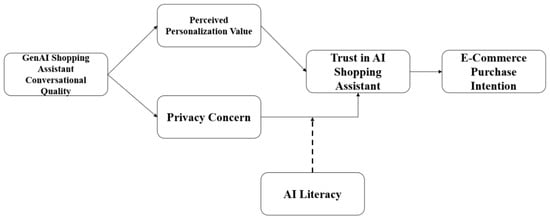
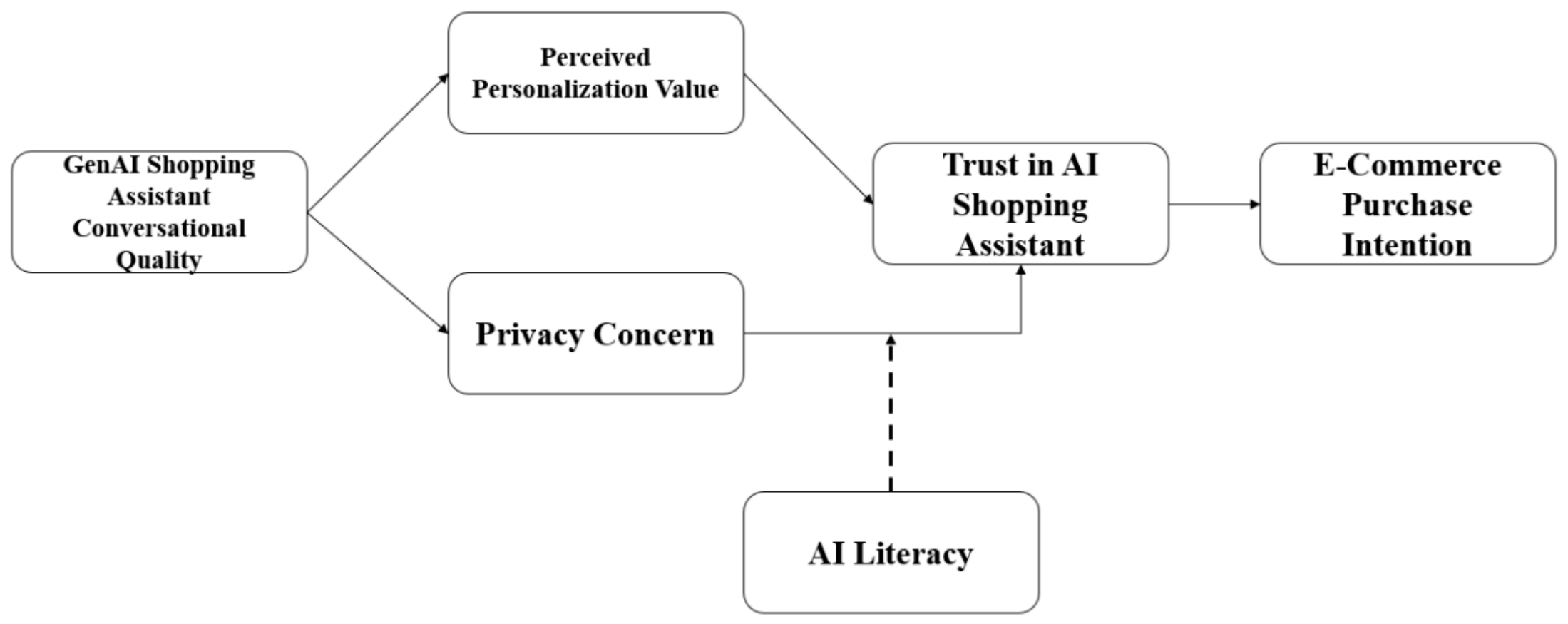
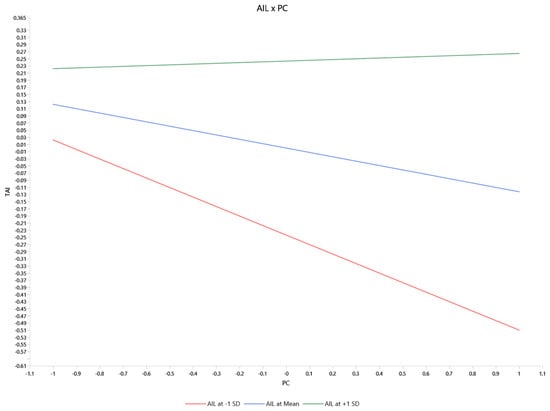
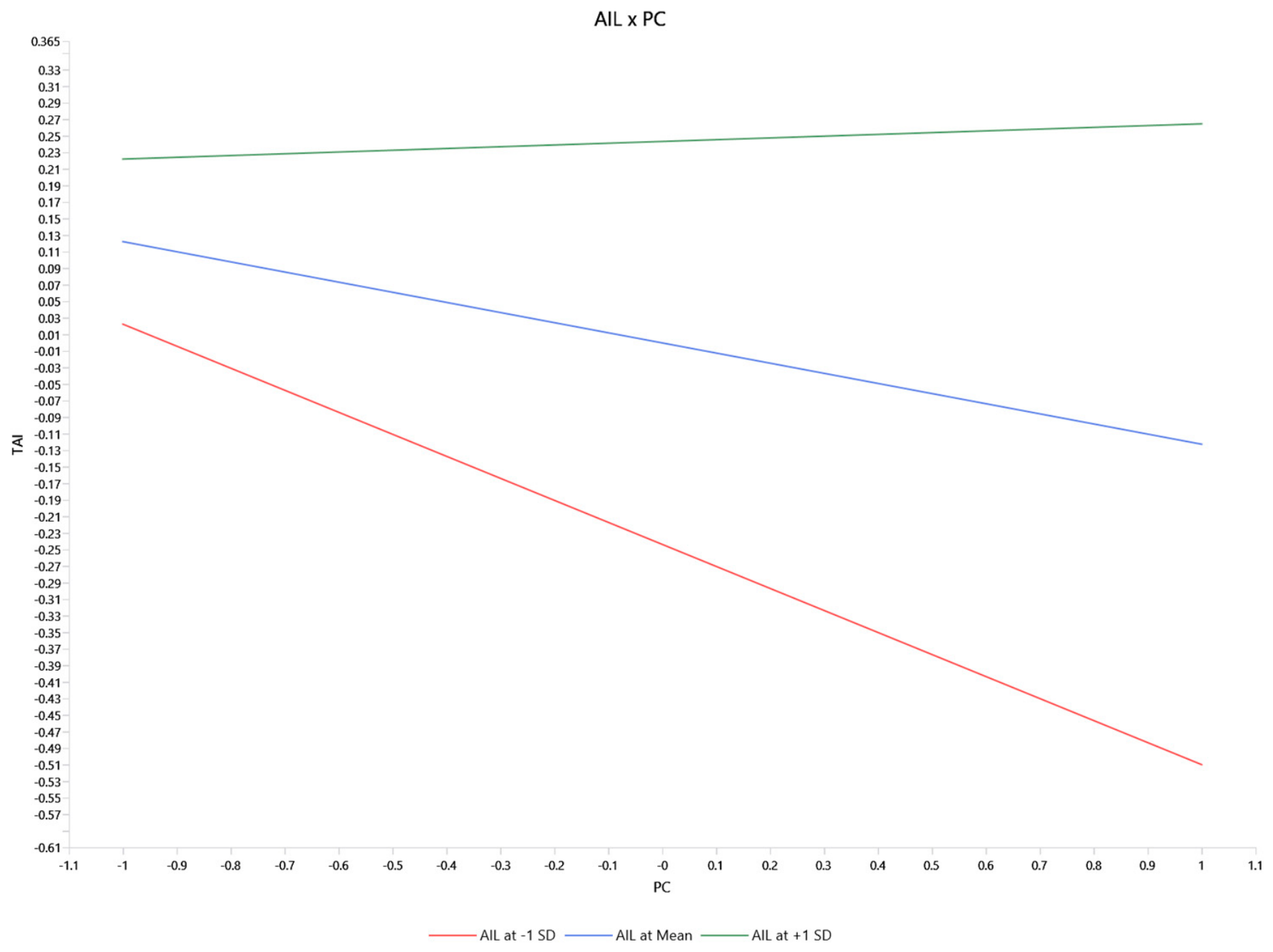
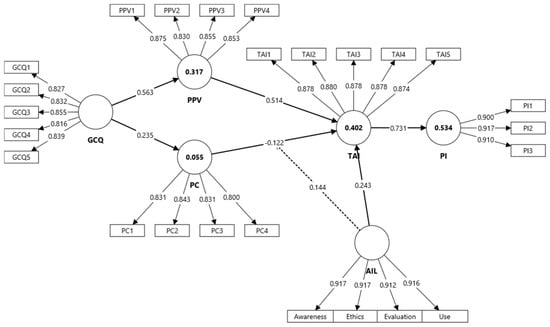
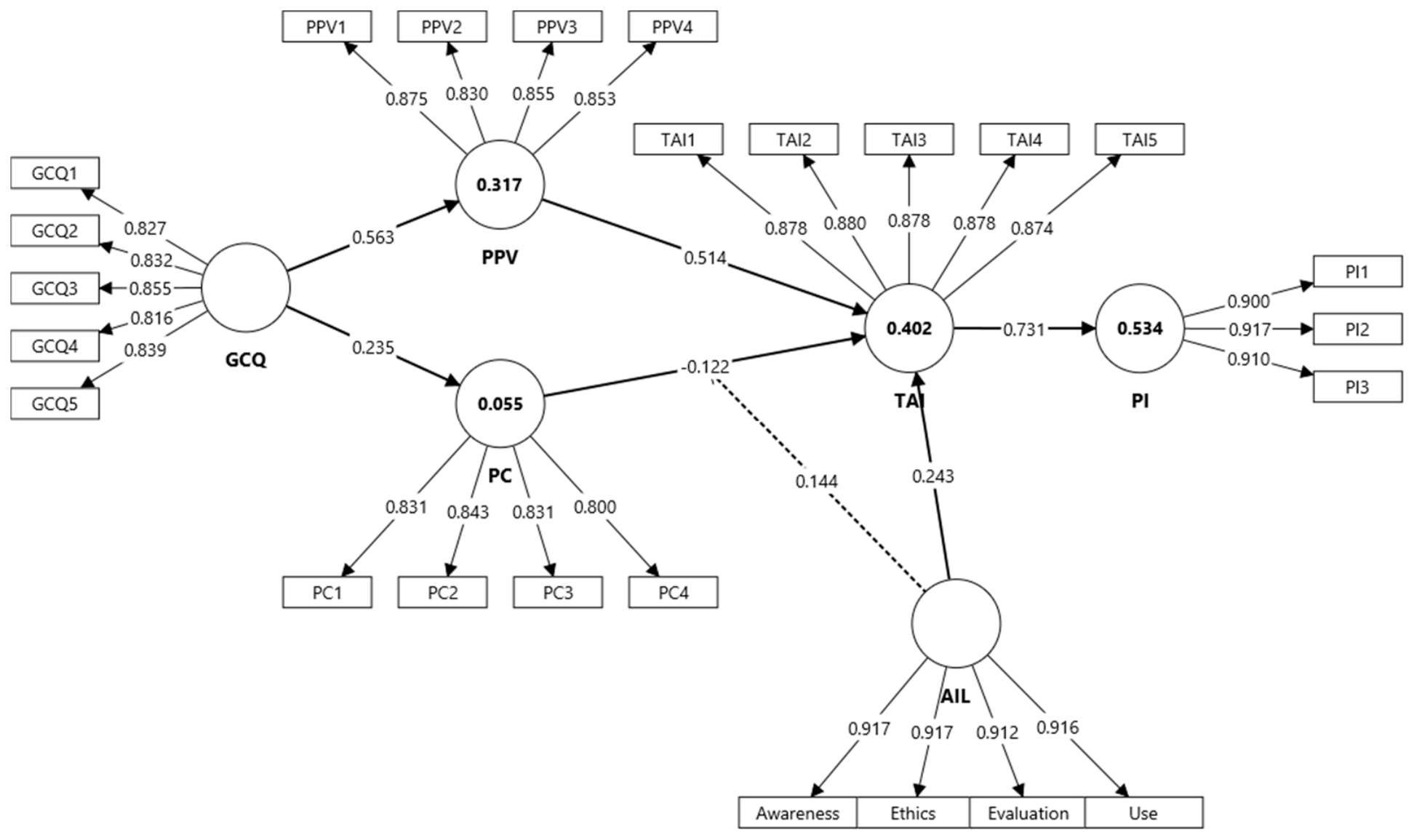

Disclaimer/Publisher’s Note: The statements, opinions and data contained in all publications are solely those of the individual author(s) and contributor(s) and not of MDPI and/or the editor(s). MDPI and/or the editor(s) disclaim responsibility for any injury to people or property resulting from any ideas, methods, instructions or products referred to in the content. |
© 2026 by the author. Licensee MDPI, Basel, Switzerland. This article is an open access article distributed under the terms and conditions of the Creative Commons Attribution (CC BY) license.