


Abstract
The emergence of increasingly autonomous Artificial Intelligence (AI) agents is reshaping how consumers search for information, evaluate alternatives, and make purchasing decisions. While existing consumer journey models have incorporated AI primarily as a decision-support technology, they provide limited conceptual guidance for understanding situations in which AI agents perform purchasing activities on consumers’ behalf. Drawing on consumer journey theory, AI-enabled commerce, and human–AI collaboration research, this conceptual paper adopts a theory-adaptation approach to examine how established frameworks may be extended to account for emerging forms of delegated decision-making. We propose the Human–AI Collaborative Consumer Journey, a framework that conceptualizes purchasing as a collaborative process involving consumers and consumer-authorized AI agents across different stages of the journey. Its central contribution is the concept of Delegated Consumer Agency (DCA), defined as the configuration of authority consumers grant AI agents to perform cognitive or operational purchasing activities within predefined goals and constraints. The framework highlights how human and AI participation may vary across purchasing contexts and identifies implications for consumer autonomy, decision-making, and e-commerce management. Finally, six research propositions and a future research agenda are presented to guide empirical investigation.
1. Introduction
The evolution of commerce can be understood not simply as a progression in technological sophistication, but as a gradual redistribution of agency across the commercial process. Each stage represents a distinctive configuration of the relationship between human actors, digital infrastructures, and artificial intelligence, with corresponding changes in how information is accessed, decisions are made, and transactions are executed.
In traditional commerce, commercial activity is predominantly human-centered, with consumers and organizations directly responsible for the core activities of exchange. The emergence of e-commerce digitized these activities without fundamentally altering the locus of decision-making, as digital infrastructures mainly served to facilitate human-controlled transactions. The recent integration of AI introduced progressively greater forms of computational support, first through recommendation and personalization, and later through systems capable of participating more directly in decision-making.
Table 1 summarizes this evolution from human-controlled commerce towards increasingly distributed forms of commercial agency, culminating in AI commerce, where AI agents may perform substantial cognitive and operational activities on behalf of consumers. This progression is consistent with the broader evolution of AI in marketing, from technologies that augment existing processes towards systems increasingly capable of undertaking complex activities traditionally performed by humans [1,2,3].
Table 1.
Evolution from traditional commerce to AI commerce: authors’ conceptual synthesis.
The stages are distinguished by the locus and degree of decision authority: AI-assisted commerce involves computational support while decision authority remains human; AI-mediated commerce involves shared human-AI decision-making while the consumer retains final transaction authority; and AI commerce introduces delegated authority, whereby an AI agent may perform and, when authorized, execute purchasing activities within predefined human constraints. These five stages should not be interpreted as mutually exclusive technological eras in which one configuration completely replaces the previous one. Rather, they represent progressively greater AI involvement and corresponding changes in the distribution of commercial agency. The progression depicted in Table 1 reflects a shift from digitization and AI assistance towards mediation and delegation, with corresponding changes in the distribution of decision-making authority. This transformation raises questions about how established consumer journey models account for AI agents that participate in purchasing decisions and, when authorized, execute transactions within consumer-defined constraints [4,5,6].
This article adopts a theory-adaptation approach to conceptual research [7], using established consumer journey theory as a point of departure to examine how its assumptions may need to be extended in the context of increasingly autonomous AI agents. Rather than conducting a systematic literature review, the paper draws on a purposive, iterative selection of theoretically relevant literature across consumer and customer journey research, AI-enabled commerce and marketing, recommendation and shopping agents, consumer autonomy and algorithmic decision-making, and emerging agentic AI. Seminal contributions were combined with recent studies as the conceptual argument developed, with sources selected for their relevance to clarifying the changing roles of consumers and AI agents in commercial decision-making. This literature provides the conceptual basis for developing Delegated Consumer Agency and the Human-AI Collaborative Consumer Journey.
Accordingly, the objective of this conceptual paper is to examine how the growing capacity of AI agents to perform cognitive and operational purchasing activities challenges existing conceptualizations of the consumer journey and to develop a framework for theorizing the distribution of decision authority between consumers and AI agents. The paper first reviews the evolution of consumer journey theory and the transition from AI-assisted to increasingly agentic forms of e-commerce. It then identifies the theoretical limitations that arise when AI agents become active participants in purchasing activities and introduces the Human–AI Collaborative Consumer Journey and the concept of Delegated Consumer Agency. Finally, the paper discusses the theoretical and managerial implications of the framework and develops an agenda for future empirical research.
2. The Consumer Journey: The Dominant Paradigm in E-Commerce
The consumer journey is widely recognized as one of the dominant conceptual frameworks for understanding consumer decision-making and informing marketing strategy. Rather than viewing purchasing as a single transaction, the concept recognizes consumption as a process composed of multiple interconnected stages through which consumers search for information, evaluate alternatives, make purchasing decisions, and develop post-purchase relationships with brands. Over time, the consumer journey has evolved from a relatively simple linear model into a dynamic and increasingly complex framework that incorporates multiple touchpoints, channels, and interactions [8].
Early sequential models of consumer decision-making include AIDA, conventionally traced to E. St. Elmo Lewis and later formalized by [9], which conceptualized purchasing as a sequential process in which consumers move through four distinct stages: Attention, Interest, Desire, and Action [10].
As markets became increasingly competitive and digital technologies transformed consumer behavior, scholars began questioning the linearity of traditional decision models. One of the most influential developments was the Consumer Decision Journey proposed by [11], which challenged the assumption that consumers simply move forward through predefined stages. Instead, the authors argued that purchasing decisions involve continuous evaluation, comparison, and feedback loops, making the journey inherently circular rather than linear. Consumers repeatedly revisit information sources, compare alternatives, and refine their preferences before and after purchase, while post-purchase experiences directly influence future decision-making through loyalty and advocacy. This perspective represented an important conceptual shift by recognizing consumer decision-making as an ongoing process rather than a discrete sequence of isolated stages.
Further developments reinforced this more dynamic understanding of consumption. Ref. [12] proposed the 5 As framework, including the stages Aware, Appeal, Ask, Act, and Advocate. This model reflects the increasingly connected and socially influenced nature of consumer behavior. The framework acknowledges the influence of social interactions and digital networks on purchasing decisions and post-purchase advocacy. The rapid growth of e-commerce further transformed how consumer journeys were conceptualized. Rather than replacing traditional journey models, e-commerce research adapted them to reflect the unique characteristics of online shopping environments, including digital interfaces, website navigation, search functionalities, and checkout processes. One of the earliest comprehensive models specifically developed for e-commerce was proposed by [13], who conceptualized the online customer journey as a sequence of five key stages: landing on the website, product identification, product presentation, shopping cart management, and order completion and payment. Their framework emphasized the importance of website usability and the broader digital purchasing experience.
Subsequent research further expanded this perspective by recognizing that digital customer journeys are characterized by multiple online and offline touchpoints that interact continuously throughout the purchasing process. Ref. [14] proposed one of the most influential contemporary conceptualizations by distinguishing pre-purchase, purchase, and post-purchase stages while emphasizing that customer experience emerges from interactions across numerous brand-owned, partner-owned, customer-owned, and social touchpoints. Rather than viewing the journey as a controlled marketing funnel, this perspective acknowledges its dynamic, omnichannel, and experiential nature, in which consumers navigate increasingly complex ecosystems of information and interactions.
More recent studies have incorporated AI into these digital journeys, particularly through recommendation systems, personalized advertising, chatbots, virtual assistants, and predictive algorithms [15]. However, these studies continue to conceptualize AI primarily as a technological mechanism that enhances customer experiences rather than fundamentally transforming the structure of the journey itself. For example, Ref. [16] examines how AI-driven recommendations and personalized advertising reshape customer experiences by influencing engagement, autonomy, and perceptions of personalization across multiple touchpoints. Similarly, the work of [17] on AI-enabled e-commerce highlights how chatbots, recommendation engines, and virtual assistants support product discovery, customer service, and purchase decisions while improving personalization and customer satisfaction.
Across these diverse conceptualizations, the consumer journey has undergone substantial evolution. It has progressed from a linear persuasion model to a dynamic, omnichannel, and technology-enabled process characterized by continuous interactions across multiple touchpoints. Nevertheless, despite incorporating digital platforms, algorithmic recommendations, and AI-powered interfaces, the dominant paradigm remains fundamentally anthropocentric. Whether in traditional marketing, omnichannel environments, or contemporary e-commerce, existing consumer journey models generally position the human consumer as the main actor, who searches, evaluates, decides, purchases, and reflects upon consumption experiences. Within consumer journey theory, this human-centered assumption has remained remarkably persistent, even as adjacent streams of research have increasingly examined algorithmic decision-making, autonomous AI systems, and the delegation of consumer activities to intelligent agents.
3. From AI Tools to AI Agents: The Emergence of AI Commerce
AI has become increasingly integrated into e-commerce, supporting activities such as personalized recommendations, intelligent search, customer service, and purchasing decisions [1,16,18,19].
The first wave of AI adoption in e-commerce was largely characterized by AI-assisted commerce, in which intelligent systems were designed to support human decision-making. Machine learning algorithms analyzed vast amounts of behavioral and transactional data to personalize product recommendations, optimize search results, predict consumer preferences, and improve customer segmentation. These technologies reduced information overload while enabling firms to deliver increasingly relevant and personalized shopping experiences [1,2]. Within this paradigm, however, AI remained fundamentally assistive: although it supported information search, comparison, and evaluation, consumers retained final decision-making and transaction authority. Existing research suggests that AI-driven personalization can positively influence customer satisfaction, engagement, perceived usefulness, and purchase intentions by improving the relevance of digital interactions [3,20].
Generative AI and Large Language Models (LLMs) have expanded conversational shopping capabilities, enabling consumers to clarify preferences, compare products, and receive context-sensitive recommendations through natural language interactions [6,17].
The evolution of conversational AI has been accompanied by increasing interest in agentic AI, particularly within online retail environments. Recent research suggests that AI-powered virtual assistants, AI stylists, and conversational shopping applications can contribute to value co-creation by engaging customers in personalized interactions throughout the purchasing process [6]. Although these applications are not necessarily agentic, they illustrate how conversational AI enables consumers to articulate preferences in natural language, receive tailored recommendations, refine product choices, and obtain immediate feedback, thereby creating more engaging and collaborative shopping experiences. Importantly, these developments should not be interpreted as evidence that fully autonomous agentic purchasing is already widespread. AI-assisted personalization, recommendation systems, and conversational shopping tools are already deployed across e-commerce environments, whereas more autonomous forms of agentic purchasing remain emergent, ranging from early deployments and pilots to capabilities anticipated in current conceptual and industry discussions. The framework developed in this paper therefore addresses an evolving configuration of commerce rather than assuming its uniform or widespread adoption. Additionally, these interactions increasingly blur the distinction between human and technological participation in commercial decision-making, as AI moves beyond responding to queries and begins shaping the trajectory of the shopping process itself.
In this paper, an AI agent is defined as an AI system capable of pursuing user-defined goals through autonomous planning and multi-step actions, with limited need for continuous human prompting and, when authorized, the capacity to execute actions on the user’s behalf. This distinguishes AI agents from conventional recommendation systems or chatbots that primarily provide information or respond to individual prompts. AI agents may retrieve information from multiple sources, adapt to changing conditions, interact with external applications, and execute complex workflows with limited human intervention. In commercial settings, such agents may independently search for products, compare prices across retailers, analyze customer reviews, monitor promotional campaigns, identify optimal purchasing opportunities, and even complete transactions according to user-defined preferences and constraints [21]. Consequently, AI is no longer restricted to supporting consumer decisions. It increasingly performs activities that have traditionally been undertaken by consumers themselves. The AI and e-commerce literature has therefore begun to recognize the growing potential for consumers to delegate portions of their purchasing activities to intelligent systems, particularly for routine and low-risk decisions [22,23].
These developments have given rise to what is increasingly described as AI commerce. While traditional e-commerce refers to commercial transactions conducted through digital platforms, AI commerce represents an emerging configuration of e-commerce in which artificial intelligence actively participates in commercial processes rather than merely facilitating them [24]. Consumers may increasingly rely on intelligent agents to identify products, compare alternatives, negotiate preferences, monitor prices, and execute purchases on their behalf. At the same time, firms are redesigning digital retail environments to accommodate AI-mediated interactions alongside conventional human browsing, recognizing that future customers may increasingly be represented by intelligent software agents rather than interacting directly with online interfaces [25].
The allocation of decision-making responsibilities therefore becomes dynamic rather than fixed, varying according to consumers’ trust in AI, the complexity of the purchase, and the level of autonomy delegated to intelligent systems. As [6] argues, agentic AI increasingly functions as a co-creator of value rather than simply as a technological intermediary.
The participation of computational systems in consumer decision-making is not entirely new. Research on shopping and recommendation agents has long examined how algorithmic systems can support product search, evaluation, and choice [26], with subsequent meta-analytic evidence demonstrating the established role of online recommendation agents in supporting consumers’ information search and evaluation [27]. More recent research has shifted attention towards increasingly autonomous AI assistants and the consequences of transferring decision-making autonomy from consumers to AI [28]. Related work on algorithmic consumers has further examined the implications of delegating purchasing decisions to computational systems, particularly for consumer autonomy and protection [29].
Existing research has already examined different aspects of AI participation in consumer decision-making. Gal and Elkin-Koren [29] discuss the implications of algorithmic consumers for consumer autonomy and market relationships, while Frank and Otterbring [28] examine how increasing AI autonomy influences consumer acceptance. More recent contributions address delegation and its governance mechanisms in agentic commerce [23], as well as the implications of generative AI shopping agents for consumer behavior and the customer journey [30]. These studies provide important insights into autonomous purchasing, consumer responses, and the conditions under which delegation takes place. Building on these contributions, DCA focuses on how consumers configure the authority granted to AI agents across specific purchasing activities and journey stages, and how these arrangements may change following purchasing experiences. This distinction matters because consumers using agents with similar technological capabilities may authorize different activities, while similar purchasing activities may be performed under different permission arrangements. For example, extensive authorization for information search does not necessarily imply greater delegated authority than permission to execute the automatic repurchase of a predetermined product. By considering task scope, discretion, spending constraints, authorization duration, and approval requirements together, DCA offers a more differentiated account of human-AI participation in the consumer journey.
4. Extending Consumer Journey Models to Include AI Agents
Although consumer journey theory has progressively evolved from linear purchasing models to dynamic, omnichannel, and experience-based frameworks, its primary analytical focus has remained on consumers’ experiences, decisions, and interactions across the purchasing process [8,14]. Digital technologies, including recommendation systems, personalized advertising, chatbots, and conversational interfaces, have increasingly been incorporated into these frameworks as touchpoints and decision-support mechanisms [15,31]. Existing consumer journey models are therefore not necessarily incompatible with AI-agent participation. For example, the distinction between brand-owned, partner-owned, customer-owned, and social/external touchpoints proposed in [14] could accommodate interactions involving AI agents. However, such frameworks primarily classify the ownership and locus of touchpoints rather than explicitly explaining how consumers grant, monitor, and revise decision-making authority across purchasing activities. The contribution proposed here is therefore not to introduce AI into an otherwise exclusively human journey, but to conceptualize delegated authority as a mechanism shaping the distribution of decision-making responsibilities between consumers and AI agents.
An important limitation of existing customer journey frameworks concerns their limited explicit treatment of AI agents coordinating activities across multiple stages [14]. This raises questions about how purchasing activities and decision-making authority are distributed and governed across the journey.
AI agents may alter some of the constraints traditionally associated with bounded rationality by expanding consumers’ capacity to search, compare, and process large volumes of marketplace information. However, delegation does not eliminate bounded rationality; rather, it may introduce additional constraints associated with data quality, model errors, opacity, and potential misalignment between consumer goals and agent behavior. Agent decisions may also depend on how information and offers are presented to the system [22]. AI commerce may therefore change the sources and distribution of decision constraints rather than simply overcoming them.
A second limitation concerns the conceptualization of consumer autonomy. Existing customer journey models generally interpret autonomy as consumers’ ability to independently navigate information, evaluate alternatives, and make informed purchasing decisions [4]. Within AI commerce, however, autonomy becomes considerably more complex. Research on AI-driven recommendations has also highlighted the relevance of consumer autonomy in shaping satisfaction with AI-supported purchasing experiences [32].
Delegating decision-making activities to AI agents should not automatically be interpreted as either reducing or enhancing consumer autonomy. Delegation may constitute one form through which consumers exercise agency by defining the goals, permissions, and constraints within which AI agents operate. However, delegation should not be assumed to strengthen consumer agency in all circumstances. Consumers may resist algorithmic involvement, prefer human judgment in particular decision contexts, or experience delegation as a threat to autonomy or identity, particularly when automated activities are closely associated with their sense of self [33]. Research on algorithm aversion and algorithm appreciation further suggests that responses to algorithmic advice are contingent rather than uniformly positive [34,35,36]. Delegation may also entail experiential and psychological costs when consumers value direct participation in decision-making [37,38], while reliance on AI advice may create risks of overreliance rather than enhanced agency [5]. Consequently, autonomy may reside not only in making decisions directly but also in governing how AI participates in those decisions [39]. DCA should therefore be understood as a context-dependent form of consumer agency whose consequences depend on the consumer, task, and characteristics of the AI system.
The emergence of AI commerce also introduces new forms of interaction that are insufficiently represented within traditional customer journey theory. Existing models largely conceptualize interactions as occurring between consumers and firms across multiple touchpoints. AI agents introduce an additional layer of interaction in which communication increasingly occurs between consumers and AI, AI and retailers, and potentially between multiple AI agents representing different commercial actors. Consumers may increasingly rely on personal AI assistants that negotiate with retailers’ AI systems, compare offers across competing platforms, verify product authenticity, or coordinate subscriptions and recurring purchases. Commercial exchanges therefore evolve from predominantly human-centered interactions towards multi-agent ecosystems in which both human and artificial actors jointly contribute to value creation [6]. Therefore, existing customer journey frameworks cannot fully explain such ecosystems because the unit of analysis expands beyond individual consumers and firms.
Equally important, current consumer journey models devote relatively limited attention to governance mechanisms that become central in AI-mediated purchasing environments. When AI systems actively participate in commercial decisions, constructs such as trust, explainability, transparency, accountability and algorithmic governance become integral components of the purchasing process rather than peripheral contextual factors. Consumers must decide not only which products to purchase but also whether to trust an AI agent to identify alternatives, negotiate preferences, or complete transactions autonomously. The quality of the customer journey therefore increasingly depends on consumers’ willingness to delegate decision authority, their understanding of AI recommendations, and their confidence that intelligent systems accurately represent their preferences and values. These dimensions are particularly important because they extend beyond traditional customer experience research by incorporating questions of human oversight, responsibility, and ethical governance into the consumer journey itself.
Finally, although existing consumer journey models encompass interactions across multiple online and offline touchpoints, they offer limited explicit guidance on purchasing processes coordinated by autonomous AI intermediaries. AI commerce introduces an additional configuration in which consumers may rely more extensively on personal AI assistants capable of navigating multiple platforms simultaneously. Retailers, consequently, may optimize not only for human users but also for machine-readable information, interoperable product data, API accessibility, and AI-compatible commercial infrastructures. The competitive landscape therefore expands from attracting consumer attention to becoming visible, understandable, and preferred by AI agents acting on behalf of consumers [22,25]. The traditional customer journey, centered on interface design and consumer interaction, consequently becomes only one component within a broader AI-mediated commercial ecosystem.
Taken together, these developments suggest that contemporary customer journey theory calls for further theoretical development. The emergence of AI agents does not merely introduce additional technological touchpoints. It changes the identity of the actors participating in commercial decision-making and redistributes agency across human and artificial participants. Existing consumer journey frameworks therefore need to be extended to explain how decision-making authority is distributed, monitored, and revised when consumers delegate purchasing activities to AI agents. The Human-AI Collaborative Consumer Journey proposed in the following section addresses this specific theoretical challenge.
5. The Human-AI Collaborative Consumer Journey
The emergence of AI commerce does not imply the replacement of human consumers by AI. Rather, it signals an important shift in how purchasing decisions are made [22,23]. Although existing customer journey models account for technological mediation across purchasing activities [8], they offer limited explicit explanation of how consumers authorize AI agents to undertake specific tasks, establish the boundaries of their authority, and subsequently monitor or revise these arrangements. As AI agents become increasingly capable of searching, comparing, recommending, negotiating, and executing purchases, these questions become central to understanding the distribution of decision-making responsibilities in digital commerce.
The framework focuses on consumer journey configurations involving a consumer-authorized AI agent. AI-assisted commerce, in which conventional recommendation systems or chatbots provide support without exercising autonomous agency, serves as a reference point rather than falling within the framework itself. The framework is particularly concerned with the transition from assistance to shared and delegated agency, as cognitive and operational activities become distributed between consumers and AI agents.
To capture this transformation, we introduce the concept of Delegated Consumer Agency (DCA), defined as the configuration of authority consumers’ grant to an AI agent to perform specific cognitive or operational activities within the consumer journey, while retaining authority over the overarching goals, preferences, and constraints that guide the agent’s actions. Delegation is the mechanism through which this authority is granted, whereas DCA captures its multidimensional configuration across purchasing activities and contexts. Delegation does not necessarily imply the relinquishment of consumer agency; consumers may retain control by determining how, when, and to what extent intelligent systems participate in their purchasing decisions. Human authority does not necessarily require approval of each individual action or transaction. Consumers may grant authority ex ante by defining goals, permissions, and constraints within which an AI agent can subsequently act and, where authorized, execute transactions without additional approval.
DCA is conceptualized as a multidimensional configuration of consumer-granted authority rather than a single continuum of AI autonomy. This configuration is specific to the activities undertaken within each journey stage and encompasses five interrelated dimensions: the scope of authorized tasks, the agent’s discretion in selecting products or alternatives, financial constraints such as spending limits, the duration of authorization, and requirements for consumer approval. Within this configuration, discretion refers specifically to the freedom granted to the agent to select products or alternatives, while transaction authority concerns permission to complete purchases within defined financial constraints and approval requirements. For example, extensive authorization for information search does not necessarily represent greater DCA than permission to automatically repurchase a predetermined product. The two arrangements differ in their scope, discretion, and transactional authority. Accordingly, DCA profiles should be examined across these dimensions rather than assumed to be directly comparable through a single aggregate measure.
The explanatory value of DCA lies in treating delegated authority as an activity-specific and revisable arrangement rather than equating it with agent autonomy or observed AI participation. Moreover, successful or unsuccessful purchasing experiences may lead consumers to adjust subsequent permissions, even when the agent’s technical capabilities remain unchanged. DCA thus provides a conceptual basis for examining variation in authorized decision-making authority within and across consumer journeys.
DCA specifically concerns authority granted by consumers to AI agents acting on their behalf, regardless of who owns or deploys the agent. Agent ownership, consumer authorization, and interest alignment are therefore distinct dimensions. A platform- or retailer-owned agent may receive consumer authorization to perform particular purchasing activities, even when its operation is also shaped by commercial incentives. From a principal-agent perspective, such arrangements raise questions of information asymmetry and potential misalignment between consumers’ interests and those embedded in the systems acting on their behalf [29,40]. However, ownership alone does not determine whether DCA occurs: the defining condition is that consumers authorize the activities undertaken by the agent. Automated interventions that influence purchasing decisions without consumer authorization fall outside DCA as defined here. Authorization requires an identifiable act through which the consumer grants an AI agent permission to undertake specified purchasing activities, whether by configuring permissions individually or accepting a predefined set of permissions. However, authorization should be distinguished from the consumer’s understanding of those permissions, the voluntariness of the decision, and the practical ability to revise or revoke them. A consumer who actively accepts a default permission package may therefore grant authorization even with limited understanding of its scope. These conditions are relevant to evaluating the quality and consequences of authorization, but do not necessarily determine whether DCA is present.
The principal-agent perspective further clarifies why consumer authorization does not necessarily ensure outcomes aligned with consumer interests. Information asymmetry may arise when consumers cannot fully observe how agents select, prioritize, or evaluate alternatives. Monitoring may also be imperfect, particularly when agents perform multiple activities without requiring approval at each step. Moreover, agents deployed by platforms or retailers may operate within systems shaped by commercial incentives that do not fully coincide with consumer preferences. These mechanisms suggest that the effectiveness of delegated authority depends not only on the permissions granted but also on the transparency of agent actions, opportunities for consumer intervention, and perceived alignment of interests. Importantly, consumers’ perceptions of agent reliability, control, and alignment of interests may differ from the agent’s actual behavior. Consumers may grant authority based on expectations that are not subsequently confirmed, while perceived opportunities for intervention do not necessarily translate into effective oversight. Purchasing outcomes may therefore lead consumers to reconsider the permissions initially granted.
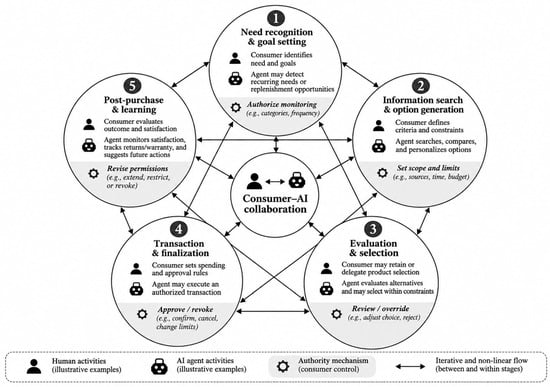
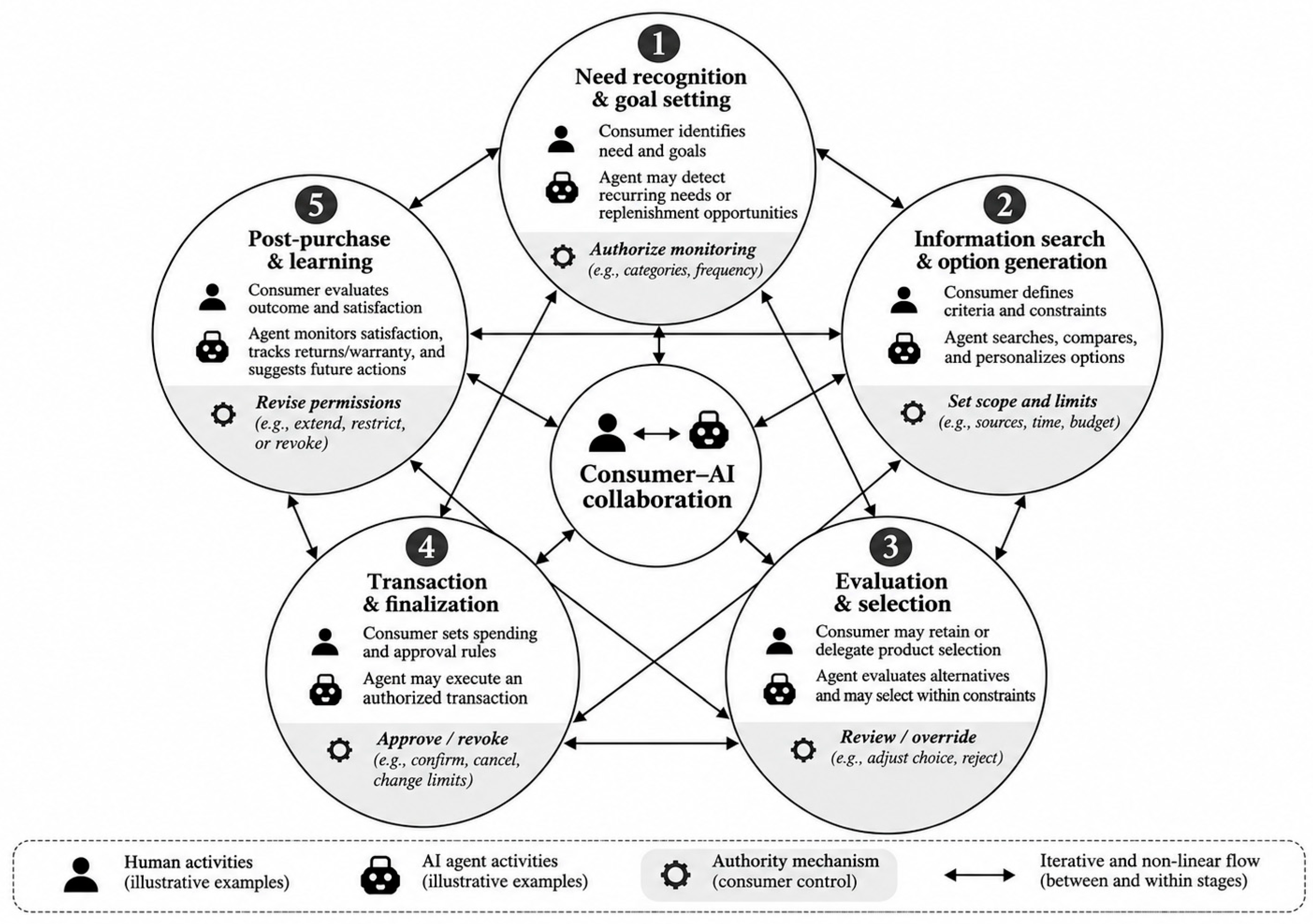
Building on this concept, we propose the Human-AI Collaborative Consumer Journey (represented in Figure 1), a conceptual framework that reconceptualizes the consumer journey as a dynamic process of shared agency between human consumers and AI agents. While existing journey models can accommodate AI-related touchpoints, our framework explicitly recognizes AI agents as active participants capable of undertaking substantial elements of the purchasing process and examines how consumers authorize and govern their participation. In this sense, AI agency refers to the functional or computational capacity of an AI system to pursue predefined goals and execute multi-step actions with varying degrees of operational autonomy. This differs from the intentional or moral agency held by humans. AI agents operate within goals, permissions, and constraints established by human actors; they are not assumed to possess independent intentions or normative authority.
Figure 1.
The Human–AI Collaborative Consumer Journey. The framework illustrates an iterative and non-linear purchasing journey in which human consumers and AI agents may perform different activities across five stages. Delegated Consumer Agency (DCA) is represented through stage-specific configurations of consumer-granted authority, including opportunities to authorize agent activities, review or override agent decisions, and revise or revoke delegated authority.
The five stages represented in the framework are not intended to reproduce or replace a single established consumer decision model. Rather, they synthesize recurring phases identified across the evolution of consumer and customer journey models reviewed in Section 2, from early sequential models such as AIDA to more recent iterative journey frameworks. They are therefore used as analytical reference points for examining how human and AI participation may vary throughout the consumer journey. Importantly, the framework does not assume a fixed progression between these stages: consumers and AI agents may move iteratively between and within them, while configurations of Delegated Consumer Agency may differ across stages.
The proposed framework retains three central assumptions of established consumer journey theory: purchasing involves distinct but interconnected activities, these activities unfold across multiple touchpoints, and the journey may be iterative rather than strictly linear [8,14]. Building on research into AI-mediated consumption and autonomous agents [22,23,30], the framework extends the analytical focus of existing models by explicitly considering activities performed by AI agents within consumer-defined permissions. It also extends the analysis of the journey beyond the distribution of activities to include the allocation, monitoring, and revision of decision-making authority. In this sense, the framework adapts established journey models to account for changes in who performs purchasing activities and under what conditions, rather than proposing an entirely new sequence of stages.
For example, a consumer may authorize an AI agent to monitor prices and compare alternatives for a frequently purchased brand of coffee, while retaining authority over final product selection and payment. The agent may identify a suitable offer and recommend it to the consumer, who then decides whether to complete the purchase. Although the agent was authorized to monitor several retailers, it may only need to consult two before identifying an appropriate offer, illustrating that granted authority does not necessarily correspond to the activities actually performed. Following a satisfactory purchase, the consumer may extend authorization for automatic repurchasing of the same product within a predefined spending limit. If the agent subsequently purchases a different product without authorization, this would constitute an action outside the granted permissions and could lead the consumer to introduce additional approval requirements or revoke transaction authority. This example illustrates how authorized activities, actual agent behavior, and subsequent changes in permissions can be distinguished within successive consumer journeys.
The delegation of decision-making authority constitutes a central mechanism underlying human-AI collaboration. The distribution of activities between consumers and AI agents is not fixed but may vary according to the purchasing context and the configuration of authority granted by the consumer. Human consumers may define objectives, budgets, personal preferences, ethical boundaries, and acceptable levels of risk, while AI agents may undertake computationally intensive, repetitive, or information-rich activities such as searching across retailers, filtering products, analyzing reviews, comparing prices, monitoring promotions, and generating personalized recommendations. Depending on the activities authorized and the applicable constraints, however, consumers may remain directly involved in these activities, while AI agents may also participate in evaluation, decision-making, and, when authorized, transaction execution. DCA therefore does not imply a wholesale transfer of human agency; rather, it involves variable delegation of authority over specific activities while the consumer retains authority to define goals and constraints within which the AI agent operates. Importantly, activities such as searching, filtering, comparing, and recommending products are not inherently agentic, as they may also be performed by conventional AI tools. Within the proposed framework, these activities are understood as AI agent activities when performed by a consumer-authorized agent capable of pursuing predefined goals and coordinating multiple actions with a degree of operational autonomy.
Delegation configurations are also likely to vary across consumption contexts. Routine, low-risk and frequently repeated purchases are particularly well suited to higher levels of AI autonomy, as consumers may prioritize convenience and efficiency overactive engagement. By contrast, purchases characterized by greater financial value, emotional significance, symbolic meaning, or perceived risk are likely to involve closer human supervision, even when AI provides extensive analytical support. Rather than necessarily replacing human judgment, AI may complement it by performing information-intensive tasks, while allowing consumers to retain oversight of normative and value-based decisions where desired.
Consequently, the consumer journey can also be examined as a collaborative decision process involving human consumers and AI agents acting on their behalf, within a broader commercial ecosystem that includes brands, digital platforms, and other actors. Value creation may emerge from the interaction between human intentionality and artificial computational capability, reflecting the growing relevance of collaborative intelligence in digital environments.
Ultimately, the Human-AI Collaborative Consumer Journey extends rather than replaces existing consumer journey theory. Established models remain valuable for understanding consumer experiences, decisions, and interactions across the purchasing process, including those mediated by digital technologies. However, the emerging context of AI commerce raises additional questions concerning how consumers authorize, monitor, and revise the authority granted to AI agents. The proposed framework addresses these questions by examining how human consumers and AI agents participate in purchasing activities under different authorization arrangements while retaining the established understanding of the consumer journey as a dynamic and iterative process.
6. Theoretical and Managerial Implications
The proposed framework makes three interrelated theoretical contributions. First, it introduces the concept of Delegated Consumer Agency to explain how decision-making responsibilities are intentionally redistributed between consumers and AI agents. Second, it explains how the distribution of decision-making authority between consumers and AI agents may vary across purchasing activities and journey stages. Third, it broadens the unit of analysis of consumer journey research by incorporating interactions between human consumers and AI agents alongside individual consumer behavior.
Introducing the concept of Delegated Consumer Agency also extends current understandings of consumer autonomy. Marketing research has traditionally associated autonomy with consumers’ ability to perform information search, evaluation, and purchasing activities independently. In AI commerce, however, autonomy may also involve deciding how decision-making responsibilities are allocated between humans and intelligent systems. Delegation may therefore constitute one form through which consumers exercise agency by determining the configuration of AI participation according to the characteristics of the purchase, their confidence in AI, and their preferences for involvement. However, as discussed above, the implications of delegation for consumer agency remain context-dependent and may include resistance, perceived loss of control, or overreliance on AI. This perspective opens new theoretical avenues for integrating consumer behavior research with emerging scholarship on algorithmic governance, human–AI collaboration, and augmented decision-making [5,23].
From a managerial perspective, companies should translate delegated authority into explicit and manageable permissions across the consumer journey. Consumers could authorize information search and comparison while retaining product selection and payment authority or permit autonomous transactions within predefined spending limits. E-commerce platforms should therefore provide stage-specific permission settings, configurable approval thresholds, and accessible records of agent actions, including product selections and transactions. Consumers should also be able to review, revise, or withdraw authorizations, particularly following unexpected or unsatisfactory outcomes. These mechanisms would support transparency, accountability, and meaningful consumer oversight without requiring approval of every individual action. Rather than encouraging maximum automation, firms should enable consumers to configure delegated authority according to their preferences and purchasing contexts.
AI commerce also requires organizations to rethink the design of digital customer experiences. Alongside interfaces designed for human consumers, firms must increasingly develop structured product information, interoperable data architectures, transparent pricing mechanisms, and machine-readable product descriptions that facilitate AI interpretation and comparison. Retailers that fail to make themselves accessible to AI agents may experience reduced visibility within emerging purchasing ecosystems. At the same time, digital environments should continue to provide rich and transparent interfaces that allow consumers to compare alternatives, exercise value judgments, and retain direct control when desired. Firms should therefore enable fluid transitions between automated and human-led purchasing.
AI-mediated journeys may also reshape the relationship between consumers and brands. As AI agents increasingly perform search, comparison, and evaluation activities, some brand encounters may occur primarily at the agent level rather than through direct consumer exposure. This may alter how brand awareness, engagement, trust, and loyalty develop across the journey. The post-purchase stage is particularly relevant because reviews, recommendations, and advocacy may themselves become partially mediated by AI, complicating traditional assumptions about the consumer as the sole author of brand-related communication. AI commerce therefore raises questions not only about who makes purchasing decisions, but also about who encounters, interprets, and communicates the brand experience.
Ultimately, the Human-AI Collaborative Consumer Journey encourages researchers and practitioners to consider how AI participation may reshape the organization of commercial decision-making, with implications for both consumer research and e-commerce management.
7. Future Research Agenda
The emergence of AI commerce opens a broad research agenda that extends well beyond the adoption of AI-powered technologies within existing e-commerce environments. If the Human-AI Collaborative Consumer Journey accurately reflects the evolution of digital consumption, future research must increasingly move from studying how AI influences consumer behavior to understanding how human and artificial agents jointly construct commercial decision-making. Rather than treating AI as an independent technological variable, researchers should investigate collaborative systems in which agency is dynamically distributed between human consumers and intelligent agents.
7.1. Measuring Delegated Consumer Agency
A research priority is the empirical validation of Delegated Consumer Agency as the central mechanism underlying AI-mediated consumption. Although this paper conceptualizes DCA as the multidimensional configuration of authority consumers grant to AI agents for specific cognitive and operational purchasing activities, empirical evidence remains limited regarding how consumers determine appropriate levels of delegation across different purchasing situations. Future research should distinguish between four analytically distinct elements of the delegation process: willingness to delegate, the authority granted to an AI agent, the activities actually executed by that agent, and the resulting consumer outcomes. Within this sequence, granted authority constitutes the core of DCA, while willingness to delegate can be examined as an antecedent, executed activities as behavioral manifestations of delegation, and decision quality and satisfaction as potential outcomes. Trust and perceived control may operate as antecedents, moderators, or consequences, depending on the relationships under investigation. This distinction would prevent conceptually different aspects of delegation from being combined within a single measure. Future operationalization should therefore capture DCA as a multidimensional profile of granted authority. Illustrative indicators could include the number and type of tasks authorized, whether agents may select products independently, the maximum expenditure permitted without additional approval, the duration of permissions, and the purchasing actions requiring explicit consumer confirmation. These indicators could be assessed separately across journey stages, with any aggregate measure requiring subsequent theoretical justification and empirical validation. An initial qualitative phase, using interviews or focus groups, could identify how consumers understand and experience delegation, informing the subsequent development and validation of measurement scales through quantitative studies. Quantitative studies could further examine how demographic characteristics, AI literacy, digital experience, and personality traits influence consumers’ readiness to transfer decision-making responsibilities to intelligent systems.
7.2. Delegation Across Purchasing Contexts
Second, future studies should investigate how delegation varies across product categories and decision contexts. It is unlikely that consumers will adopt identical patterns of AI collaboration for all purchases. Routine, low-cost and frequently repeated purchases may become highly automated, whereas products characterized by greater financial value, symbolic meaning or emotional significance are likely to involve greater human participation. Product involvement, perceived risk, time pressure, ethical sensitivity and consumption visibility may therefore serve as important boundary conditions that can influence the configuration of delegated authority. The routine nature of a purchase may facilitate transaction delegation when consumer preferences remain relatively stable and predefined constraints adequately reflect those preferences independently of the level of involvement. Perceived risk, by contrast, may encourage delegation of information-intensive activities while increasing consumers’ reluctance to authorize autonomous selection or payment. Accordingly, we formulate the following propositions for future empirical investigation:
P1. Consumers will be more likely to authorize AI agents to execute transactions autonomously for routine purchases than for non-routine purchases.
P2. Higher perceived purchase risk will be associated with more restrictive authorization for autonomous product selection and payment.
Experimental studies could compare the permissions consumers grant to AI agents across purchasing scenarios that vary in product value, involvement, perceived risk, or emotional significance. Participants could be asked to configure the activities agents are authorized to perform, including product selection and transaction execution, rather than simply indicating their willingness to delegate. Such findings could help e-commerce providers determine when greater automation is likely to be accepted and when stronger human involvement should be preserved. Understanding these contingencies will contribute to a more nuanced theory of collaborative purchasing behavior.
7.3. Trust, Control and Risk in AI Commerce
A third research direction concerns the evolving relationship between trust and control in AI commerce. Existing research has largely examined trust in AI as a determinant of technology adoption or recommendation acceptance. Within AI-mediated purchasing, however, trust increasingly governs whether consumers authorize AI agents to search, evaluate, or even complete transactions independently. Future research should therefore examine the roles of explainability, transparency, accountability, and perceived fairness in shaping delegation decisions. Confidence in recommendation quality concerns the usefulness and accuracy of information provided by AI, whereas confidence in agent reliability concerns its capacity to respect authorized goals and constraints when acting autonomously. Confidence in reliable execution may be particularly relevant to transaction authorization, as consumers must trust that agents can complete purchases accurately and respect predefined spending limits and approval requirements. Similarly, perceived control should be distinguished from the permissions constituting DCA: consumers may authorize autonomous transactions while differing in their confidence that they can monitor or intervene in the agent’s actions. In this context, perceived control refers to the consumer’s confidence that opportunities for intervention are available, accessible, and effective, rather than to the frequency of actual monitoring. Although continuous supervision may reduce the convenience associated with delegation, the perceived ability to intervene when necessary may contribute to a more satisfactory purchasing experience. Future research should therefore examine perceived control before transaction execution and assess satisfaction after the purchasing experience, distinguishing expectations about oversight from evaluations of the resulting process. We therefore formulate additional propositions for future empirical research:
P3. Higher consumer confidence in the reliable execution of purchasing activities by AI agents will be positively associated with the authorization of autonomous transactions.
P4. The relationship between autonomous transaction authority granted to AI agents and consumer satisfaction with the purchasing process will be more positive when consumers perceive that they can effectively monitor and intervene in agent actions.
Experimental research could also manipulate levels of AI autonomy, transparency, and human control to examine their effects on trust, willingness to delegate, and the permissions consumers actually grant to AI agents. Empirical studies should distinguish confidence in the agent’s ability to execute purchasing tasks accurately from the specific transaction permissions granted by consumers, measuring these constructs independently rather than relying on similarly worded indicators. Longitudinal studies may be particularly valuable for understanding how repeated interactions with AI agents influence the gradual calibration of trust over time. These findings could inform the design of transparency, oversight, and risk-management mechanisms appropriate to different levels of AI autonomy.
7.4. Multi-Actor AI Commerce Ecosystems
Future research should also expand the unit of analysis beyond individual consumers. AI commerce increasingly involves interactions among multiple actors, including consumers, AI agents, retailers, digital platforms, and potentially competing AI systems negotiating on behalf of different market participants. Consequently, future studies should examine how different forms of agent ownership and control shape the relationships among consumers, AI agents, retailers, and platforms. Building on the principal-agent perspective discussed above, perceived alignment between the consumer’s interests and those represented by the AI agent may be particularly important in determining willingness to delegate authority. We therefore formulate one additional proposition for empirical study:
P5. Among AI agents that have received consumer authorization, higher perceived alignment with consumers’ interests will be associated with greater discretion granted to the agent in selecting products or alternatives.
Taken together, P3 to P5 address the roles of perceived agent reliability, control, and interest alignment in shaping the authority consumers grant to AI agents and their satisfaction with the purchasing process. These relationships should be examined alongside agents’ actual behavior and purchasing outcomes, since perceived reliability, control, and alignment do not necessarily ensure that delegated activities are performed in accordance with consumers’ interests. Subsequent experiences may, in turn, influence how consumers revise the permissions granted to AI agents.
Given the emerging nature of these interactions, qualitative studies and case studies could first examine how consumers, AI agents, retailers, and platforms distribute roles and responsibilities in real purchasing situations. As these practices become more established, quantitative and experimental approaches could examine how different configurations affect consumer outcomes and commercial relationships. Such a perspective may benefit from integrating insights from service ecosystems, actor-network theory, and value co-creation research to better explain how commercial value emerges through interactions among both human and artificial actors. Future research should also examine whether agent ownership influences perceived alignment or moderates the relationship between perceived alignment and the authority consumers grant to AI agents.
7.5. Ethical, Societal and Cross-Cultural Implications
Equally important are the broader societal and ethical implications of delegated consumer agency. As AI agents assume greater responsibility for commercial decisions, questions regarding privacy, algorithmic bias, accountability, market transparency and consumer protection become increasingly central. Future research should investigate how regulatory frameworks, governance mechanisms and industry standards can ensure that AI agents operate in ways that remain aligned with consumers’ interests while preserving fairness and competition within digital marketplaces. Cross-cultural comparative studies could examine differences in consumers’ willingness to delegate purchasing authority according to cultural values, institutional trust, regulatory environments, and levels of AI adoption. Such evidence could help firms and policymakers identify context-specific governance and consumer-protection requirements rather than assuming uniform responses to AI commerce across markets.
7.6. Rethinking Consumer Behavior Constructs
Finally, the proposed framework invites scholars to reconsider the theoretical foundations of consumer behavior itself. Established consumer behavior constructs have primarily been developed to explain consumers’ information processing, evaluation, and purchasing decisions. The increasing delegation of purchasing activities to AI agents raises questions about how these constructs operate when cognitive and operational responsibilities are distributed between consumers and intelligent systems. Future theoretical work should therefore explore how classical constructs, including information search, decision quality, consumer expertise, loyalty, and post-purchase behavior, should be reconceptualized when significant elements of consumption are performed by autonomous AI agents. Comparative studies could examine whether established constructs operate differently when purchasing activities are performed directly by consumers, collaboratively with AI, or delegated to AI agents. This reconceptualization is particularly relevant to bounded rationality, as AI agents may reduce some human information-processing constraints while simultaneously introducing new technological and informational constraints.
Delegated purchasing introduces distinct but potentially interacting sources of decision error. Consumer-related specification errors arise when the goals, preferences, or constraints communicated to an AI agent do not adequately reflect the consumer’s underlying needs. An agent may execute these instructions correctly and still produce an unsuitable purchasing outcome. Agent-related errors, by contrast, occur when the agent processes information incorrectly or fails to execute authorized tasks as intended. For example, a consumer may specify an insufficient budget for a product that must meet particular quality requirements, leading the agent to select an unsuitable alternative despite correctly following the instructions. If the agent also fails to identify relevant product limitations, the initial specification error and the agent’s information-processing error may reinforce one another, further reducing the suitability of the purchase. In this context, decision quality should be assessed in relation to the consumer’s underlying needs and preferences, rather than solely through compliance with the instructions provided. Future research should therefore examine whether inaccurate consumer specifications increase the negative effects of agent-related errors on purchasing decision quality. Accordingly, we formulate the following proposition for future empirical investigation:
P6. In consumer journeys involving delegated purchasing activities, agent-related errors will have a stronger negative effect on purchasing decision quality when consumer-defined goals and constraints inaccurately reflect the consumer’s underlying needs and preferences.
7.7. Brand Engagement and Post-Purchase Social Interaction
The growing participation of AI agents in consumer journeys also raises questions about brand engagement and post-purchase social interaction. Existing perspectives on consumer journeys generally assume that consumers encounter brand-related information, evaluate brand experiences, and subsequently engage in behaviors such as reviewing, recommending, or advocating for brands. In AI commerce, some of these interactions may instead be mediated by an AI agent. When an agent searches for alternatives, evaluates product information, or selects among competing offers, the consumer may have limited direct exposure to the brands considered during the process. This raises the possibility that delegation may reshape not only purchasing decisions but also the conditions under which brand relationships are formed and maintained. Future research should therefore examine whether authorizing AI agents to undertake information search, product evaluation, and selection reduces direct consumer-brand engagement, transforms it into a mediated form of engagement, or shifts the aspects of brand experience that remain salient to consumers.
Similar questions arise after the transaction. Reviews, recommendations, and other forms of electronic word-of-mouth have traditionally been conceptualized as expressions of consumer experience and social interaction. However, AI commerce complicates the authorship of these practices. A review may be written entirely by the consumer, generated by an AI agent from consumer-provided information, produced collaboratively, or potentially generated by an agent based on transaction and usage data. These configurations raise questions concerning authenticity, disclosure, trust, and the meaning of consumer advocacy when communicative activities are partially delegated. Empirical research could compare consumer responses to human-authored, AI-assisted, and agent-generated reviews and examine how the configuration of AI participation affects perceived authenticity, credibility, brand engagement, and electronic word-of-mouth. For brands and e-commerce platforms, these developments also suggest that future relationship-building strategies may need to address both human consumers and the AI agents increasingly mediating their encounters with brands.
8. Limitations
As a conceptual study, this paper has several limitations. First, the proposed framework is theoretically developed rather than empirically validated. The relationships proposed between purchasing context, perceived risk, trust, control, agent ownership, and Delegated Consumer Agency therefore require testing across different consumer populations, product categories, and AI-agent configurations. Second, AI commerce remains an emerging and rapidly evolving phenomenon. The capabilities, levels of autonomy, and commercial roles attributed to AI agents in this paper may consequently change as technologies, consumer practices, business models, and regulatory frameworks develop.
The literature supporting the framework was selected purposively for its theoretical relevance rather than through a systematic review protocol. Although this approach is appropriate for the theory-adaptation purpose of the paper, it does not provide exhaustive coverage of all research on AI-enabled commerce or human–AI decision-making. Future systematic and empirical studies can therefore refine the boundaries of the framework, test its propositions, and examine whether Delegated Consumer Agency operates consistently across technological, commercial, and cultural contexts.
9. Conclusions
The emergence of AI commerce introduces new possibilities for the organization of commercial decision-making, as AI agents become capable of performing cognitive and operational activities traditionally undertaken by consumers. This paper has proposed the Human–AI Collaborative Consumer Journey as an extension of existing consumer journey theory, accounting for configurations in which consumers and consumer-authorized AI agents participate in purchasing decisions.
The framework’s central contribution is the concept of Delegated Consumer Agency (DCA), understood as the multidimensional configuration of authority consumers grant to AI agents across purchasing activities and journey stages. By distinguishing between performing purchasing activities and determining the conditions under which those activities may be delegated, DCA offers a perspective on consumer autonomy that accommodates varying degrees of human involvement. Importantly, delegation is not assumed to enhance consumer agency in every context; its implications depend on consumer preferences, purchasing circumstances, and the characteristics of the AI system.
The proposed framework also encourages consumer research to examine interactions between consumers and AI agents alongside individual consumer behavior. For businesses, this development may require greater attention to how products, information, and commercial offerings are accessed and interpreted by AI agents, while preserving transparency, consumer oversight, and opportunities for direct human participation.
As a conceptual contribution, the framework requires empirical validation. Future research should examine how delegation varies across purchasing contexts, how trust and perceived control shape consumers’ willingness to delegate, and how different agent configurations influence decision-making outcomes. Particular attention should be paid to the development and validation of DCA measures and to the longer-term implications of AI-mediated purchasing for consumer autonomy.
Ultimately, the significance of AI commerce lies not simply in the automation of purchasing tasks but in the possibility of new configurations of human–AI collaboration. Understanding how consumers authorize, supervise, and govern AI participation may therefore become an increasingly important dimension of consumer journey research.
Author Contributions
Conceptualization, P.D. and A.D.; Methodology, P.D. and A.D.; Investigation, P.D. and A.D.; Resources, P.D. and A.D.; Writing—original draft, P.D. and A.D.; Writing—review & editing, P.D. and A.D.; Project administration, P.D. All authors have read and agreed to the published version of the manuscript.
Funding
This research received no external funding.
Institutional Review Board Statement
Not applicable.
Informed Consent Statement
Not applicable.
Data Availability Statement
No new data were created or analyzed in this study. Data sharing is not applicable to this article.
Acknowledgments
The authors would like to thank the Research Centre for Communication and Culture (CECC), Universidade Católica Portuguesa, and ICNOVA—Instituto de Comunicação da NOVA, Universidade Nova de Lisboa, for their institutional support in the development of this work. During the preparation and revision of this manuscript, the authors used ChatGPT 5 (OpenAI) for language refinement, editorial support, and the visual development of the proposed conceptual framework. All AI-assisted material was critically reviewed and revised by the authors, who retain full responsibility for the manuscript’s content.
Conflicts of Interest
The authors declare no conflicts of interest.
References
- Huang, M.-H.; Rust, R.T. A Strategic Framework for Artificial Intelligence in Marketing. J. Acad. Mark. Sci. 2021, 49, 30–50. [Google Scholar] [CrossRef] [Scilit]
- Rana, J.; Gaur, L.; Singh, G.; Awan, U.; Rasheed, M.I. Reinforcing Customer Journey through Artificial Intelligence: A Review and Research Agenda. Int. J. Emerg. Mark. 2022, 17, 1738–1758. [Google Scholar] [CrossRef] [Scilit]
- Gouveia, J.; Santos, S. Rethinking the Customer Journey: Impact of AI for Consumers and Businesses—A Systematic Literature Review and Research Agenda. Int. J. Consum. Stud. 2025, 49, e70136. [Google Scholar] [CrossRef] [Scilit]
- Wertenbroch, K.; Schrift, R.Y.; Alba, J.W.; Barasch, A.; Bhattacharjee, A.; Giesler, M.; Knobe, J.; Lehmann, D.R.; Matz, S.; Nave, G.; et al. Autonomy in Consumer Choice. Mark. Lett. 2020, 31, 429–439. [Google Scholar] [CrossRef] [Scilit] [PubMed]
- Keding, C.; Meissner, P. Managerial Overreliance on AI-Augmented Decision-Making Processes: How the Use of AI-Based Advisory Systems Shapes Choice Behavior in R&D Investment Decisions. Technol. Forecast. Soc. Change 2021, 171, 120970. [Google Scholar] [CrossRef] [Scilit]
- Ranjan, A.; Upadhyay, A.K. Value Co-Creation by Interactive AI in Fashion E-Commerce. Cogent Bus. Manag. 2025, 12, 2440127. [Google Scholar] [CrossRef] [Scilit]
- Jaakkola, E. Designing Conceptual Articles: Four Approaches. AMS Rev. 2020, 10, 18–26. [Google Scholar] [CrossRef] [Scilit]
- Santos, S.; Gonçalves, H.M. The Consumer Decision Journey: A Literature Review of the Foundational Models and Theories and a Future Perspective. Technol. Forecast. Soc. Change 2021, 173, 121117. [Google Scholar] [CrossRef] [Scilit]
- Strong, E.K. The Psychology of Selling and Advertising; McGraw-Hill: New York, NY, USA, 1925. [Google Scholar]
- Barry, T.E. The Development of the Hierarchy of Effects: An Historical Perspective. Curr. Issues Res. Advert. 1987, 10, 251–295. [Google Scholar] [CrossRef] [Scilit]
- Court, D.; Elzinga, D.; Mulder, S.; Vetvik, O.J. The Consumer Decision Journey. McKinsey Q. 2009, 3, 96–107. Available online: https://www.mckinsey.com/capabilities/growth-marketing-and-sales/our-insights/the-consumer-decision-journey (accessed on 24 August 2026).
- Kotler, P.; Kartajaya, H.; Setiawan, I. Marketing 4.0: Moving from Traditional to Digital; Wiley: New York, NY, USA, 2017. [Google Scholar]
- Mangiaracina, R.; Brugnoli, G.; Perego, A. The eCommerce Customer Journey: A Model to Assess and Compare the User Experience of eCommerce Websites. J. Internet Bank. Commer. 2009, 14, 1–11. Available online: https://EconPapers.repec.org/RePEc:ris:joibac:0486 (accessed on 24 August 2026).
- Lemon, K.N.; Verhoef, P.C. Understanding Customer Experience throughout the Customer Journey. J. Mark. 2016, 80, 69–96. [Google Scholar] [CrossRef] [Scilit]
- Metsai, A.I.; Tabakis, I.M.; Karamitsios, K.; Kotrotsios, K.; Chatzimisios, P.; Stalidis, G.; Goulianas, K. Customer Journey: Applications of AI and Machine Learning in E-Commerce. In New Realities, Mobile Systems and Applications; Auer, M.E., Tsiatsos, T., Eds.; Lecture Notes in Networks and Systems; Springer: Cham, Switzerland, 2022; Volume 411. [Google Scholar] [CrossRef] [Scilit]
- Hardcastle, K.; Vorster, L.; Brown, D.M. Understanding Customer Responses to AI-Driven Personalized Journeys: Impacts on the Customer Experience. J. Advert. 2025, 54, 176–195. [Google Scholar] [CrossRef] [Scilit]
- Jangra, M.; Jangra, G.; Attri, R.; Anguralia, N. Enhancing Consumer Experience and Purchase Decisions through AI-Based Chatbot Systems in Ecommerce. In Proceedings of the 2025 2nd Global AI Summit—International Conference on Artificial Intelligence and Emerging Technology (AI Summit); IEEE: Noida, India, 2025; pp. 768–773. [Google Scholar] [CrossRef] [Scilit]
- Thiebaut, R. AI Revolution: How Data Can Identify and Shape Consumer Behavior in Ecommerce. In Entrepreneurship and Development in the 21st Century; Sergi, B.S., Scanlon, C.C., Eds.; Emerald Publishing: Bingley, UK, 2019. [Google Scholar]
- Ingriana, A.; Rolando, B. Revolutionizing E-Commerce: Investigating the Effectiveness of AI-Driven Personalization in Influencing Consumer Purchasing Behavior. J. Ilm. Manaj. Kewirausahaan 2025, 4, 549–565. [Google Scholar] [CrossRef] [Scilit]
- Iqbal, F.; Afiat, A.; Shoily, M.M.; Turzo, S.S.; Arafat, S. AI-Driven Personalization in E-Commerce: Evaluating the Transformative Effects on Consumer Behavior. Int. J. Sci. Res. Arch. 2025, 16, 264. [Google Scholar] [CrossRef] [Scilit]
- Vasileva, S. The Impact of AI along the Customer Journey Mapping: How AI Agents Are Changing Customer Journey. In Proceedings of the International Conference on Business Excellence; Sciendo: Warsaw, Poland, 2025; Volume 19, No. 1, pp. 1088–1102. [Google Scholar] [CrossRef] [Scilit]
- Allouah, A.; Besbes, O.; Figueroa, J.; Kanoria, Y.; Kumar, A. What Is Your AI Agent Buying? Evaluation, Implications, and Emerging Questions for Agentic E-Commerce. arXiv 2025, arXiv:2508.02630. [Google Scholar] [CrossRef] [Scilit]
- Balaskas, S. From Recommendations to Delegation: A Systematic Review Mapping Agentic AI in E-Commerce and Its Consumer Effects. Information 2026, 17, 222. [Google Scholar] [CrossRef] [Scilit]
- Sharma, D. Impact of AI on E-Commerce. In Applications of Artificial Intelligence in Business and Finance; Apple Academic Press: Waretown, NJ, USA, 2021; pp. 1–28. [Google Scholar]
- Raji, M.A.; Olodo, H.B.; Oke, T.T.; Addy, W.A.; Ofodile, O.C.; Oyewole, A.T. E-Commerce and Consumer Behavior: A Review of AI-Powered Personalization and Market Trends. GSC Adv. Res. Rev. 2024, 18, 66–77. [Google Scholar] [CrossRef] [Scilit]
- Häubl, G.; Trifts, V. Consumer Decision Making in Online Shopping Environments: The Effects of Interactive Decision Aids. Mark. Sci. 2000, 19, 4–21. [Google Scholar] [CrossRef] [Scilit]
- Blut, M.; Ghiassaleh, A.; Wang, C. Testing the Performance of Online Recommendation Agents: A Meta-Analysis. J. Retail. 2023, 99, 440–459. [Google Scholar] [CrossRef] [Scilit]
- Frank, D.-A.; Otterbring, T. Autonomy, Power and the Special Case of Scarcity: Consumer Adoption of Highly Autonomous Artificial Intelligence. Br. J. Manag. 2024, 35, 1700–1723. [Google Scholar] [CrossRef] [Scilit]
- Gal, M.S.; Elkin-Koren, N. Algorithmic Consumers. Harv. J. Law Technol. 2017, 30, 309–353. [Google Scholar]
- Chang, W.; Park, J. Factors Affecting Changes in the Customer Journey with Generative AI Shopping Agents: Aspects of Purchase Decision-Making. J. Mark. Manag. 2026, 1–43. [Google Scholar] [CrossRef] [Scilit]
- Duarte, A.; Neumaier, A. Chatvertising: How Chatbots Are Shaping the Future of Advertising. Comun. Pública 2022, 17. [Google Scholar] [CrossRef]
- Cho, E.; Rha, J.-Y. Does Consumer Autonomy Matter? Consumer Perceptions of AI-Driven Recommendations and the Mediating Role of Consumer Autonomy in Consumer Satisfaction. Int. J. Hum.-Comput. Interact. 2026, 42, 10949–10971. [Google Scholar] [CrossRef] [Scilit]
- Leung, E.; Paolacci, G.; Puntoni, S. Man versus Machine: Resisting Automation in Identity-Based Consumer Behavior. J. Mark. Res. 2018, 55, 818–831. [Google Scholar] [CrossRef] [Scilit]
- Dietvorst, B.J.; Simmons, J.P.; Massey, C. Algorithm Aversion: People Erroneously Avoid Algorithms after Seeing Them Err. J. Exp. Psychol. Gen. 2015, 144, 114–126. [Google Scholar] [CrossRef] [Scilit] [PubMed]
- Logg, J.M.; Minson, J.A.; Moore, D.A. Algorithm Appreciation: People Prefer Algorithmic to Human Judgment. Organ. Behav. Hum. Decis. Process. 2019, 151, 90–103. [Google Scholar] [CrossRef] [Scilit]
- Castelo, N.; Bos, M.W.; Lehmann, D.R. Task-Dependent Algorithm Aversion. J. Mark. Res. 2019, 56, 809–825. [Google Scholar] [CrossRef] [Scilit]
- André, Q.; Carmon, Z.; Wertenbroch, K.; Crum, A.; Frank, D.; Goldstein, W.; Huber, J.; van Boven, L.; Weber, B.; Yang, H. Consumer Choice and Autonomy in the Age of Artificial Intelligence and Big Data. Cust. Needs Solut. 2018, 5, 28–37. [Google Scholar] [CrossRef] [Scilit]
- Puntoni, S.; Reczek, R.W.; Giesler, M.; Botti, S. Consumers and Artificial Intelligence: An Experiential Perspective. J. Mark. 2021, 85, 131–151. [Google Scholar] [CrossRef] [Scilit]
- Bjørlo, L.; Moen, Ø.; Pasquine, M. The Role of Consumer Autonomy in Developing Sustainable AI: A Conceptual Framework. Sustainability 2021, 13, 2332. [Google Scholar] [CrossRef] [Scilit]
- Eisenhardt, K.M. Agency Theory: An Assessment and Review. Acad. Manag. Rev. 1989, 14, 57–74. [Google Scholar] [CrossRef] [Scilit]

Disclaimer/Publisher’s Note: The statements, opinions and data contained in all publications are solely those of the individual author(s) and contributor(s) and not of MDPI and/or the editor(s). MDPI and/or the editor(s) disclaim responsibility for any injury to people or property resulting from any ideas, methods, instructions or products referred to in the content. |
© 2026 by the authors. Licensee MDPI, Basel, Switzerland. This article is an open access article distributed under the terms and conditions of the Creative Commons Attribution (CC BY) license.