


Abstract
This scoping review of UK evidence aimed to describe what is known about Lesbian, Gay, Bisexual, and Trans (LGBT+) health inequalities in relation to cancer, mental health, and palliative care to inform research, policy and public health interventions. Using a scoping review methodology, we identified studies from database searches, citation tracking, and expert consultation. The in/exclusion criteria was based on the PICOS framework. The data were charted and then summarised to map the theoretical approaches and the main types of evidence and identify knowledge gaps. In total, 279 articles were screened and 83 were included in the final review. We found that there is limited UK research examining LGBT+ health inequality in cancer, mental health and palliative care. We would argue that this thin evidence base is partly due to national policy discussions of LGBT+ health inequality that are framed within a depoliticised ‘it’s getting better’ narrative, and an unwillingness to adequately acknowledge the unjust social and economic relations that produce LGBT+ health inequality. In addition, LGBT+ health inequality is depoliticised by existing public health explanatory theories, models and frameworks that exclude sexual orientation and gender diversity as dimensions of power that interlock with those of socio-economic, race and ethnicity. This is a barrier to developing public health interventions that can successfully tackle LGBT+ health inequality
Keywords:
LGBT; health; inequality; scoping review; UK; mental health; palliative care; end of life care; cancer 1. Introduction
There is now a body of research evidence that demonstrates that lesbian, gay, bisexual, and trans (LGBT+) people experience significant health inequalities in terms of health outcomes, health care service provision and health risk factors in comparison to cis-heterosexual populations [1]. Recent research has highlighted how LGBT+ experiences of health and well-being require specific or specialised identity-centred interventions to better support LGBT+ health in a range of specialties [1,2,3,4,5,6]. Current research across multiple types of service provision has highlighted how LGBT+ people perceive current health or social care provision as in need of improvement in relation to their treatment and sexual and/or gender identity [7,8,9].
Increasingly, these inequities have been recognised by the UK Government and national health bodies (e.g., NHS England and Public Health England). In particular, policy attention on LGBT+ health was sparked by the 2017 Government Equalities Office survey of UK-based LGBT+ people [1]. This survey received more than 108,000 responses from LGBT+ people who highlighted the significant everyday experiences of discrimination that LGBT+ people live through [1]. One outcome from the survey was the UK Government 2018 LGBT Action Plan with a specific target of improving health policy and health care provision for LGBT+ people [1]. Since then, the UK Government Women and Equalities Committee launched an inquiry into LGBT+ health and social care and made policy recommendations based on their findings [10]. However, preliminary work to define this scoping review showed that very few actionable suggestions have been made, with most policy and health care strategies calling for more research into LGBT+ health inequalities.
Critics have suggested that the reluctance to develop policies to seriously tackle LGBT+ inequality is explained less by the absence of robust evidence and instead more likely to demonstrate the entrenched resistance to LGBT+ equality in the UK [11]. We would argue that policy discussions of LGBT+ health inequality are ‘depoliticised’ because they are framed by a ‘it’s getting better’ narrative [12] and an unwillingness to adequately acknowledge the unjust social and economic relations that produce LGBT+ health inequality. In addition, LGBT+ health inequality is depoliticised by existing public health explanatory theories, models and frameworks that exclude sexual orientation and gender diversity as dimensions of power that interlock with those of socio-economic, race and ethnicity, etc. [13]. For example, neither the influential Social Determinants of Health ‘Rainbow Model’ [14] nor Ecosocial Theory [15] include sexual orientation or gender diversity in their explanations of health inequality.
Against this background, the aim of this scoping review study was to draw together the LGBT Health Advisor at NHS England, policy makers, LGBT+ third-sector organisations and academics to consider the type of research required to develop policy and practice interventions to tackle LGBT+ health inequality. The aim of this study was to: (a) identify UK research on LGBT+ health inequalities to support policy development aimed at reducing LGBT+ health inequalities; (b) to develop recommendations on future health research and policy that aim to reduce LGBT+ health inequalities.
The focus of the review was developed in collaboration following a discussion of the strategic direction of key national health care policies, government equality policy and the UK research councils. The decision was taken to concentrate on cancer, mental health and palliative care because these were national health priorities where there was some recognition, in both policy and research, of the inequalities faced by LGBT+ populations. Collaborative meetings resulted in the following research question: What is known from the existing UK research literature and policy on LGBT+-relevant risk factors, prevention strategies, and health care experiences across (a) cancer, (b) mental health, and (c) palliative care?
2. Methods
This study used a scoping review methodology which is a more recent addition to evidence synthesis methods [16] but has been gaining increased interest in health research [16,17,18]. Scoping reviews are conducted for different purposes than systematic reviews. The purpose of scoping reviews is to ‘describe the nature of a research field rather than synthesise findings’ [19]. Scoping reviews can be conducted to identify knowledge gaps, scope a body of literature, clarify concepts, set research agendas or provide a roadmap for a subsequent full systematic review [16,17,18].
Despite the different purpose to systematic reviews, scoping reviews follow a similar structured approach and use rigorous transparent methods [19]. Since Arksey and O’Malley [20] developed the framework for scoping reviews, there has been growing acknowledgement of the need to establish methodological standardisation and reporting guidelines [16,17,18]. This scoping review follows the five recommended steps in completing scoping reviews [17,18,20]: (a) identifying the research question; (b) identifying relevant studies; (c) study selection; (d) charting the data; (e) collating, summarising and reporting the results.
2.1. Search Strategy
Studies were identified through electronic database searches, reference citation, online grey literature searches and expert consultation. The electronic database searches were restricted to PubMed and Web of Science databases to ensure both clinical and social science research were located. Experts in each subfield (cancer, mental health, and palliative care) were contacted with preliminary database findings to gain clarity on any papers that had not emerged during the database search.
The search terms were adapted for each electronic database (see Table 1 and Table 2) but included 3 domains: sexual and gender identity; health condition; and geographical location. Searches were conducted across cancer, mental health, and palliative care using either keywords or ‘mesh’ searches depending on database.
Table 1.
Keywords used in Web of Science Searches.
Table 2.
PubMed search strategy.
2.2. Study Selection
The PICOS framework was utilised to define the inclusion/exclusion criteria (see Table 3) which is recommended when time and resources are limited [21]. Two reviewers screened the titles and abstracts from the electronic databases and then applied the inclusion/exclusion criteria to the full-text papers. In the course of conducting the scoping review, two reviewers made additional decisions to exclude from the review medical case studies and treatment guidelines because they did not address population health concerns. The final included studies were collated in the Endnote reference management system. Two reviewers independently checked the inclusion and exclusion criteria against all studies found in the course of database searches, citation tracking, journal hand searching, and expert consultation.
Table 3.
Inclusion and exclusion criteria.
2.3. Data charting and Summarising Results
All data were reported according to PRISMA guidelines. A scoping review does not synthesise results but rather present an overview of all material reviewed [20]. Data were charted to allow for a narrative review. Arksey and O’Malley [20] borrow the term ‘charting’ to refer to Ritchie and Spencer’s [22] technique for synthesising and interpreting qualitative data by filtering, categorising and organising material according to key issues and themes.
In this scoping review, two reviewers designed a standardised data chart excel template that allowed for data to be both extracted from each full-text study, and to develop an overall narrative review. The data chart template contained the main study details (e.g., study population, aim, methodology, key results) but also included ‘conceptual framework’ and ‘interpretation’ categories. The characteristics for each full text article was charted by a single reviewer with a second reviewer regularly assessing the data charting process to resolve any conflicts. This process was used to develop an overall narrative that summarised the results in a way that was consistent with the scoping review research question and purpose [17].
3. Results
3.1. Search Results
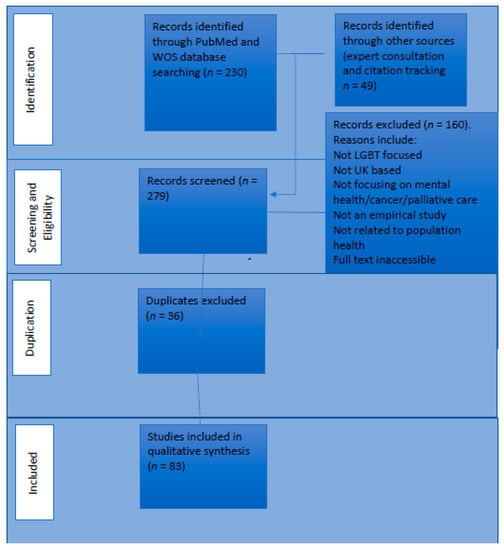
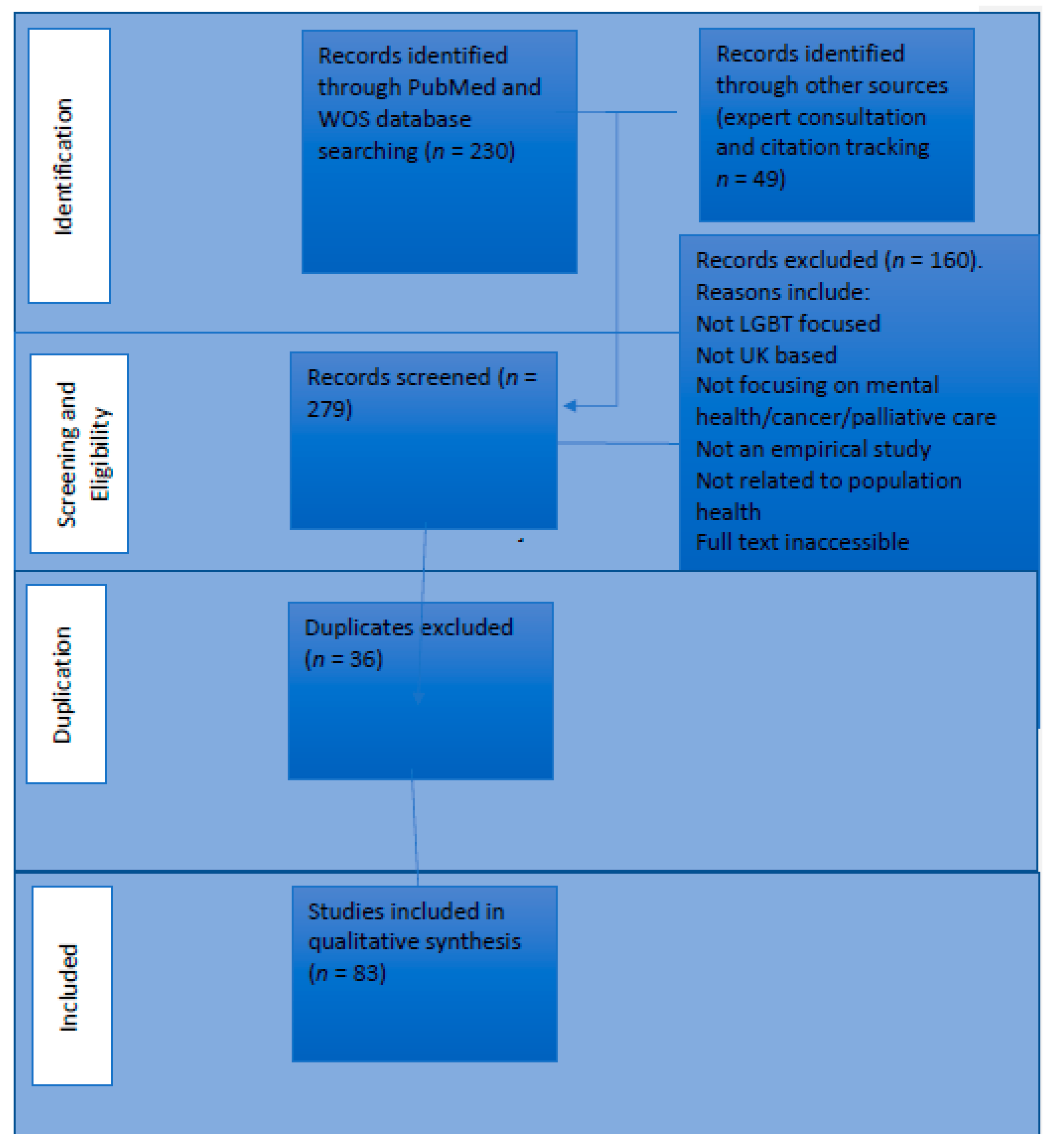
The search was conducted between February and March 2020. In total, 279 articles were screened and 83 studies were included in the final review (see Figure 1 for PRISMA flowchart and Appendix A for included studies and a data extraction chart).
Figure 1.
Search results.
3.2. Results Summary
In this section, we summarise the broad UK research trends in relation to understanding LGBT+ health inequalities in (a) cancer, (b) palliative care, and (c) mental health.
3.3. Cancer
The scoping review yielded 31 studies relevant to LGBT+ cancer care in the United Kingdom. Of these studies, 12 focused on anal and/or prostate cancer [23,24,25,26,27,28,29,30,31,32,33,34], 2 focused on cervical cancer [35,36], 5 focused on unspecified cancers [37,38,39,40,41], 3 focused on breast cancer [42,43,44], and 9 focused on HPV-related work [45,46,47,48,49,50,51,52,53]. These studies used a range of methods including qualitative studies (7) [26,32,38,39,42,49,51], quantitative studies (9) [28,35,40,41,44,47,48,50,52], systematic reviews (2) [43,54], meta-syntheses (2) [23,31], mixed-methods studies (1) [45], summit papers (1) [37], cost-efficacy papers (2) [24,29], clinical papers (4) [25,33,46,55], and literature reviews (3) [30,36,53]. Overall, these studies are largely focused on sexual organs, i.e., HPV, AIDS, cervical cancer, anal cancer, and prostate cancer.
Each paper represented different foci of interest. A total of 7 papers looked at LGBT+-specific screening, cost efficiencies, prevalence and risk factors [24,29,41,43,46,47,53]. A total of 8 papers looked at LGBT+ patient experiences pre, during, and/or post-treatment [23,26,31,32,35,38,39,40]. A total of 11 studies explored LGBT+ people’s cancer awareness and the efficacy/acceptability of treatments/testing/screening [25,27,28,33,36,42,44,45,50,51,54]. A total of 5 studies focused on health provider and expert attitudes towards LGBT+ patients’ treatment and diagnoses [30,37,48,49,52].
The results from all studies indicated that LGBT+ people were more likely to have a negative experience or outcome when being diagnosed, receiving treatment, or in post-treatment in comparison to the cis-heterosexual population. The majority of authors acknowledged that LGBT+ people’s poorer experience and outcomes were due to the absence of LGBT+-specific care and attention from health care providers. Qualitative studies highlighted a significant area of concern was that LGBT+ people struggle to ‘come out’ in a cancer treatment setting [39], and consequently not receiving culturally competent care [32,35,40,42,44,56]. Fish and Williamson’s work [38] found, for example, that some LGB people hid their sexual identities during cancer care treatment and in support environments [38]. Some studies indicated heteronormative institutional practices that implicitly marginalised LGBT+ people, such as Doran’s study, which demonstrated how gay men with prostate cancer were treated with heteronormative assumptions that did not meet their needs [26].
The absence of UK large-scale comparative data and epidemiological data was a deficiency in the research studies identified. The implications of this lack of data were underlined by expert consultants as a key problem in developing understandings of cancer prevalence and recovery rates in LGBT+ populations. It was suggested that including sexual identity and gender diversity characteristics in the cancer registry would enable the study of cancer prevalence and epidemiology in LGBT+ populations. Experts also raised issues regarding the underfunding of LGBT+ cancer scholarship and barriers, i.e., ‘institutional homophobia’ in attempting to access data, gain funding, and enact health care policies to better support LGBT+ cancer patients.
3.4. Palliative Care
The scoping review provided 10 articles relevant to palliative care and LGBT+ people in the UK. A total of 8 papers were qualitative studies [8,57,58,59,60,61,62,63] and two papers were systematic reviews [7,64]. One paper explored how older LGB individuals felt about the ‘right to die’ [60], two systematic reviews assessed current work in bereavement, palliative care, and palliative treatments [7,64], and seven qualitative studies assessed the experience of loss and bereavement for gay and lesbian elders [8,57,58,59,61,62,63].
All 10 studies demonstrated that palliative care and bereavement considerations were different for LGBT+ older people. Almack et al.’s [57] study found, for example, that older LGBT+ people may have had to live closeted lives and therefore may not have their same-gender partners recognised after their deaths [57]. Ingham et al. [59] found that older LGB women may face complex barriers following the death of their partner due to persistent heterosexist and heteronormative attitudes in the UK [59]. Similar to research on cancer and LGBT+ populations, this small body of research suggests that culturally dominant norms surrounding cis-heteronormativity contributed to LGB people’s poor experience of palliative care and bereavement support.
Palliative care research experts also emphasized the absence of large datasets as a barrier to developing evidence to improve palliative care and policy for LGBT+ populations. Furthermore, experts argued that palliative care more broadly was not on the national agenda of the current government.
3.5. Mental Health
The review yielded 42 studies relating to LGBT+ mental health. Of these included papers, 10 were qualitative papers [65,66,67,68,69,70,71,72,73,74], 22 were quantitative papers [75,76,77,78,79,80,81,82,83,84,85,86,87,88,89,90,91,92,93,94,95,96], 6 were review papers [97,98,99,100,101,102], and 4 were mixed-methods papers [103,104,105,106]. Broadly, these papers were thematically divided across three areas. Firstly, six papers focused on professional opinions and treatment outcomes of LGBT+ mental health [70,77,82,87,98,99]. Secondly, 22 papers were concerned with the incidence of mental health problems, and the risk factors associated with the elevated rates of mental health problems within LGBT+ populations [75,76,78,79,80,81,83,84,85,86,90,91,92,93,94,95,96,97,100,101,102,106]. Thirdly, 14 papers were concerned with LGBT+ people’s experiences of having mental health problems and treatment, and explaining the factors contributing to their poor mental health [65,66,67,68,69,71,72,73,74,88,89,103,104,105].
A total of 22 of the studies examined young people’s experiences of mental health and consistently reported an increased incidence of LGBT+ youth poor mental health compared to their cis-heterosexual counterparts. Studies in mental health focused on conditions including depression, eating disorders, anxiety, suicidality and self-esteem, with no research conducted into exploring rarer diagnosis such as schizophrenia or dissociative identity disorder for example.
The evidence base is more developed in LGBT+ mental health inequality in the UK. This is facilitated by the recent inclusion of measures of sexual orientation (less so gender diversity) on large-scale datasets, e.g., the Adult Psychiatric Morbidity Survey [78]. This has produced some robust evidence such as a pooled analysis of 12 UK population surveys that demonstrates adults who identified as lesbian/gay have higher prevalence of common mental disorders when compared to heterosexual adults [91]. Importantly, the evidence base includes longitudinal datasets such as the Millennium Cohort Study that enable the tracking of poor mental health over the life course of LGBT+ populations. Amos and colleagues’ [75] study indicates that by age 10 years, depressive symptoms were higher in sexual minorities than in heterosexuals. Reflecting the greater availability of large-scale data, studies have been able to provide robust statistical analysis of the differences between identity groups particularly bisexual, trans, non-binary and gender non-conforming identities. In Colledge et al.’s study, for example, bisexual women were 37% more likely to have self-harmed compared to lesbians [79]. Rimes et al [88] found that female SAAB (sex assigned at birth) participants (aged 16–25) (binary and non-binary) were more likely to report a current mental health condition and history of self-harm than male SAAB participants (binary and non-binary).
The majority of papers utilised (implicitly) the minority stress theory [107] as a theoretical paradigm to explore the relationship between LGBT+ status and the increased risk of poor mental health. The minority stress theory is a psychological conceptual framework that is critiqued by some studies [108] as inadequate to explain the broader social and cultural norms that impact on LGBT+ people’s mental health.
4. Discussion
This review of UK evidence aimed to describe what is known about LGBT+ health inequalities in relation to cancer, mental health, and palliative care to inform research, policy and public health interventions. The UK has a long tradition of research on health inequalities but until recently LGBT+ population groups were not included in public health research, policies and practice that attempt to tackle persistent health inequalities between population groups. Since the Equality Act 2010 [109], there has been a substantial increase in recognition that LGBT+ populations have a disproportionate health burden in comparison to cis-gendered heterosexual populations. This is evident in numerous health policies, e.g., Suicide Prevention Strategy [110], Transforming Children and Young People’s Mental Health Provision: a Green Paper [111]. In addition, the Equality Act 2010 public sector duty has driven a concern within the health care sector to demonstrate that it is providing services and care equally regardless of sexual orientation (and, to lesser degree, gender identity). There is much greater appetite from the UK Government, policy makers, NHS England, health staff and Public Health England to address LGBT+ health inequality.
However, the findings from this scoping review suggest that the evidence base, on mental health, cancer and palliative care, is insufficient to address this nationally recognised health inequality. The current body of UK LGBT+ health inequality research is relatively small but there is clear evidence of health inequities between LGBT+ and cis-heterosexual populations. The research is strongest in terms of demonstrating the elevated rates of poor mental health in comparison to cis-heterosexual populations [91,110,112], reproductive and sexual health cancers, risk/transmission rates and barriers [113,114,115,116], and late diagnoses of cancer [2,117]. The evidence base for palliative care [4,7,8,63,64,118,119,120,121] is very small. Across all three areas of this review, there is consistent evidence that a significant proportion of health care providers are not well trained in LGBT+ identities, and consequently misunderstand the needs of LGBT+ populations [9,122]. This is particularly acute for trans and/or non-binary people who encounter difficulties engaging with gender identity services and health providers, and experience considerable barriers to reproductive and sexual health services [5,108,114,123].
The majority of LGBT+ health research in the three areas homogenise LGBT+ identities by using a single identity category, ‘LGBT’. This has the effect of obscuring health differences between identity categories. The notable exception is a small subset of LGBT+ mental health research where substantial population-based datasets are available for reliable statistical analysis of differences between identity categories. These studies have suggested that when compared to heterosexuals and people who identify as gay and/or lesbian, bisexual-identifying people experience more significant rates of suicidality, eating problems, self-harm, and addiction [79,112], and trans and/or non-binary people have significantly higher incidences of poor mental health and greater risk of suicide and self-harm [124]. Furthermore, little research examines the ways in which intersectional minoritised identities may mediate LGBT+ health inequality. There is a lack of exploration of race, ethnicity, faith, immigration status, social class, (dis)ability, aging, etc. This is a substantial omission in the evidence base to support public health interventions. The UK has decades of research that establishes the ways in which major social inequalities such as socio-economic status, gender and race/ethnicity are determinants of poor health. If LGBT+ health inequality is to be successfully addressed, then it is imperative that research consistently examines the intersectionality of LGBT+ health inequality.
The results of this review suggest three key recommendations for the development of research on mental health, cancer and palliative care that can inform public health interventions to tackle LGBT+ health inequality. Firstly, there is often an absence of large datasets, with representative samples and administrative datasets on which to base our understanding of the extent of health inequality. Examples include differential cancer prevalence rates, access to health services, and treatment outcomes. Without large-scale datasets it is difficult to generate research that convinces policy makers and health care providers of the scale of the inequality. LGBT+ mental health research ‘weight’ of evidence has gained impetus at a national government level as large datasets have started to include measures of sexual orientation and gender identity, e.g., the Millennium Cohort Study, the Avon Bristol Study, the British Cohort Study 2012, the Health Survey for England 2011, 2012 and 2013, the Longitudinal Study of Young People in England 2009/10 and Understanding Society 2011/12. These are still missing for cancer and palliative care.
Secondly, LGBT+ health inequality research has a tendency to ‘fix’ or essentialise identity. The impact of this is the homogenisation of the categories LGBT+, especially bisexuality and trans/non-binary. In most cases, research prioritises LGBT+ identity and ignores other interlocking systems of oppression/power relating to class, age, disability and race/ethnicity. Public health research and policy must work with a framework that has central the multiple experiences of inequality (race, gender class, etc.) that are mutually constitutive of health outcomes and experience for LGBT+ populations. It is crucial that if we want to address LGBT+ health inequality that we have reliable data on the ways in which health differs between LGBT+ people.
Thirdly, the majority of LGBT+ health inequality research is conducted within the dominant frame of clinical, biomedical and lifestyle risk factors. Far less research employs an alternative theory using social models of health inequality such as socio-political, psychosocial or socio-ecological. The biomedical and lifestyle theories are individualistic approaches that primarily focus on decontextualised individual-level pathology, biology, and behaviour. In contrast, more social theories posit that there are interconnecting and complex social, cultural, political, economic factors that shape health inequality [15]. Much of the research included within our scoping review acknowledged that heteronormativity or LGBT+ discrimination and stigma were partly to blame for limiting access to services or poor experience of services. Very little UK research attempted to explain the underlying social mechanisms that influence LGBT+ health inequality. McDermott et al.’s [124] paper examining the social determinants of LGBT+ youth mental health inequality is a rare example (see also [120]).
The dominance of the biomedical and lifestyle risk approach decontextualises LGBT+ health inequality and reduces the ways of addressing the problem to individual biological pathology and improving access to treatment and services. While clearly it is important to provide equity of access to health services and treatments, this does not, from a public health perspective, address the inequality between LGBT+ and cis-heterosexual populations. Why, for example, is there poorer mental health? Why are there low rates of cervical screening? The theories we use to understand LGBT+ health inequality impact on the questions we ask, the data we collect, our analysis, and eventually our ability to address LGBT+ health inequality at a population level [13]. The lack of alternative social theory leads to de-politicised descriptions of LGBT+ health inequality that do not recognise power and the unjust social relations that produce LGBT+ health inequities. This is a barrier to developing public health interventions that can successfully tackle LGBT+ health inequality.
The purpose of this review was to provide a tentative direction for LGBT+ health inequality research that would improve the ability of public health interventions to successfully reduce this inequality. A scoping review is a methodology that is used when there are few resources, to give an overview, and should not replace a more in-depth systematic review. Despite these methodological limitations, scoping reviews such as ours can be adaptable tools to direct future research that informs policy and practice. In our view, future research on LGBT+ health inequalities in mental health, cancer and palliative care needs to: (1) be resourced through large-scale datasets; (2) utilise theories/models that recognise the unequal social relations that produce health equality; (3) and pay attention to the health differences between LGBT+ populations.
Author Contributions
Conceptualisation, E.M.; Methodology, E.M. and H.W.; Formal Analysis, E.M. and R.N.; Data Curation, R.N.; Writing—Original Draft Preparation, R.N.; Writing—Review and Editing, H.W., R.N. and E.M.; Supervision, E.M.; Project Administration, R.N.; Funding Acquisition, E.M. All authors have read and agreed to the published version of the manuscript.
Funding
UK Research and Innovation’s Strategic Priorities Fund.
Acknowledgments
We would like to thank the LGBT+ Consortium, the National LGB&T Partnership, and Michael Brady (LGBT Health Advisor, NHS England) for their input and ideas relating to the development of this paper. With great thanks to the following experts who assisted in the production of this systematic review: Catherine Meads, Julie Fish, Katherine Johnson, Katherine Rimes, and Kathryn Almack. All authors have read and agreed to the published version of the manuscript.
Conflicts of Interest
The authors declare no conflict of interest.
Appendix A
Table A1.
Mental Health UK LGBT+ Studies.
Table A2.
UK Cancer and LGBT+ Studies.
Table A3.
Palliative UK LGBT+ Studies.
References
- Government Equalities Office. LGBT Action Plan; Government Equalities Office: London, UK, 2018.
- Harding, R.; Bensley, J.; Corrigan, N. Targeting smoking cessation to high prevalence communities: Outcomes from a pilot intervention for gay men. BMC Public Health 2004, 4, 43. [Google Scholar] [CrossRef] [Scilit] [PubMed]
- McDermott, E.; Roen, K.; Scourfield, J. Avoiding shame: Young LGBT people, homophobia and self-destructive behaviours. Cult. Health Sex. 2008, 10, 815–829. [Google Scholar] [CrossRef] [Scilit] [PubMed]
- Hafford-Letchfield, T.; Simpson, P.; Willis, P.B.; Almack, K. Developing inclusive residential care for older lesbian, gay, bisexual and trans (LGBT) people: An evaluation of the Care Home Challenge action research project. Health Soc. Care Community 2018, 26, e312–e320. [Google Scholar] [CrossRef] [Scilit] [PubMed]
- Pearce, R. Understanding Trans Health: Discourse, Power and Possibility; Policy Press: Bristol, UK, 2018. [Google Scholar]
- Hunt, R.; Bates, C.; Walker, S.; Grierson, J.; Redsell, S.; Meads, C. A Systematic Review of UK Educational and Training Materials Aimed at Health and Social Care Staff about Providing Appropriate Services for LGBT plus People. Int. J. Environ. Res. Public Health 2019, 16, 4976. [Google Scholar] [CrossRef] [Scilit] [PubMed]
- Harding, R.; Epiphaniou, E.; Chidgey-Clark, J. Needs, experiences, and preferences of sexual minorities for end-of-life care and palliative care: A systematic review. J. Palliat. Med. 2012, 15, 602–611. [Google Scholar] [CrossRef] [Scilit]
- Almack, K. ‘I didn’t come out to go back in the closet’: Ageing and end-of-life care for older LGBT people. In Older Lesbian, Gay, Bisexual and Trans People; Routledge: Abington, UK, 2018; pp. 158–171. [Google Scholar]
- Bachmann, C.L.; Gooch, B. LGBT in Britain Health Report; Stonewall: London, UK, 2018. [Google Scholar]
- WEC. Health and Social Care and LGBT Communities; Parliament: London, UK, 2019. [Google Scholar]
- Browne, K.; Nash, C.J. Resisting LGBT Rights Where “We Have Won”: Canada and Great Britain. J. Hum. Rights 2014, 13, 322–336. [Google Scholar] [CrossRef] [Scilit]
- Lawrence, M.; Taylor, Y. The UK government LGBT Action Plan: Discourses of progress, enduring stasis, and LGBTQI+ lives ‘getting better’. Crit. Soc. Policy 2020, 40, 586–607. [Google Scholar] [CrossRef] [Scilit]
- Fish, J.; Karban, K. LGBT Health Inequalities: International Perspectives in Social Work; Policy Press: Bristol, UK, 2015. [Google Scholar]
- Dahlgren, G.; Whitehead, M. What Can be Done about Inequalities in Health? Lancet 1991, 338, 1059–1063. [Google Scholar]
- Krieger, N. Methods for the scientific study of discrimination and health: An ecosocial approach. Am. J. Public Health 2012, 102, 936–944. [Google Scholar] [CrossRef] [Scilit]
- Munn, Z.; Peters, M.D.; Stern, C.; Tufanaru, C.; McArthur, A.; Aromataris, E. Systematic review or scoping review? Guidance for authors when choosing between a systematic or scoping review approach. BMC Med. Res. Methodol. 2018, 18, 143. [Google Scholar] [CrossRef]
- Pham, M.T.; Rajić, A.; Greig, J.D.; Sargeant, J.M.; Papadopoulos, A.; McEwen, S.A. A scoping review of scoping reviews: Advancing the approach and enhancing the consistency. Res. Synth. Methods 2014, 5, 371–385. [Google Scholar] [CrossRef] [Scilit] [PubMed]
- Tricco, A.C.; Lillie, E.; Zarin, W.; O’Brien, K.; Colquhoun, H.; Kastner, M.; Levac, D.; Ng, C.; Sharpe, J.P.; Wilson, K. A scoping review on the conduct and reporting of scoping reviews. BMC Med. Res. Methodol. 2016, 16, 15. [Google Scholar] [CrossRef] [Scilit] [PubMed]
- Gough, D.; Oliver, S.; Thomas, J. An Introduction to Systematic Reviews; Sage: London, UK, 2017. [Google Scholar]
- Arksey, H.; O’Malley, L. Scoping studies: Towards a methodological framework. Int. J. Soc. Res. Methodol. 2005, 8, 19–32. [Google Scholar] [CrossRef] [Scilit]
- Methley, A.M.; Campbell, S.; Chew-Graham, C.; McNally, R.; Cheraghi-Sohi, S. PICO, PICOS and SPIDER: A comparison study of specificity and sensitivity in three search tools for qualitative systematic reviews. BMC Health Serv. Res. 2014, 14, 579. [Google Scholar] [CrossRef] [Scilit]
- Ritchie, J.; Spencer, L. Qualitative data analysis for applied policy research. In Analyzing Qualitative Data; Bryman, A., Burgess, R.G., Eds.; Abingdon Routledge: Oxfordshire, UK, 1994; pp. 173–194. [Google Scholar]
- Alexis, O.; Worsley, A.J. The Experiences of Gay and Bisexual Men Post-Prostate Cancer Treatment: A Meta-Synthesis of Qualitative Studies. Am. J. Mens. Health 2018, 12, 2076–2088. [Google Scholar] [CrossRef] [Scilit]
- Czoski-Murray, C.; Karnon, J.; Jones, R.; Smith, K.; Kinghorn, G. Cost-effectiveness of screening high-risk HIV-positive men who have sex with men (MSM) and HIV-positive women for anal cancer. Health Technol. Assess. 2010, 14, iii–iv, ix–x, 1–101. [Google Scholar] [CrossRef] [Scilit]
- Dalla Pria, A.; Alfa-Wali, M.; Fox, P.; Holmes, P.; Weir, J.; Francis, N.; Bower, M. High-resolution anoscopy screening of HIV-positive MSM: Longitudinal results from a pilot study. Aids 2014, 28, 861–867. [Google Scholar] [CrossRef] [Scilit]
- Doran, D.; Williamson, S.; Margaret Wright, K.; Beaver, K. It’s not just about prostate cancer, it’s about being a gay man: A qualitative study of gay men’s experiences of healthcare provision in the UK. Eur. J. Cancer Care 2018, 27, e12923. [Google Scholar] [CrossRef] [Scilit]
- Fox, J.; White, P.J.; Macdonald, N.; Weber, J.; McClure, M.; Fidler, S.; Ward, H. Reductions in HIV transmission risk behaviour following diagnosis of primary HIV infection: A cohort of high-risk men who have sex with men. Hiv. Med. 2009, 10, 432–438. [Google Scholar] [CrossRef] [Scilit] [PubMed]
- Heyworth, B.; Gilliver, A.; Ralph, S.; Hewitt, P.; Mackereth, P. Prostate cancer awareness survey to proud postcards. Sex. Relatsh. Ther. 2016, 31, 462–472. [Google Scholar] [CrossRef] [Scilit]
- Karnon, J.; Jones, R.; Czoski-Murray, C.; Srnith, K.J. Cost-utility analysis of screening high-risk groups for anal cancer. J. Public Health 2008, 30, 293–304. [Google Scholar] [CrossRef] [Scilit]
- Kelly, D.; Sakellariou, D.; Fry, S.; Vougioukalou, S. Heteronormativity and prostate cancer: A discursive paper. J. Clin. Nurs. 2018, 27, 461–467. [Google Scholar] [CrossRef] [Scilit] [PubMed]
- Matheson, L.; Watson, E.K.; Nayoan, J.; Wagland, R.; Glaser, A.; Gavin, A.; Wright, P.; Rivas, C. A qualitative metasynthesis exploring the impact of prostate cancer and its management on younger, unpartnered and gay men. Eur. J. Cancer Care 2017, 26. [Google Scholar] [CrossRef] [Scilit] [PubMed]
- McConkey, R.W.; Holborn, C. Exploring the lived experience of gay men with prostate cancer: A phenomenological study. Eur. J. Oncol. Nurs. 2018, 33, 62–69. [Google Scholar] [CrossRef] [Scilit] [PubMed]
- Schofield, A.M.; Sadler, L.; Nelson, L.; Gittins, M.; Desai, M.; Sargent, A.; McMahon, R.F.; Hill, J.; Crosbie, E.J.; Patnick, J.; et al. A prospective study of anal cancer screening in HIV-positive and negative MSM. Aids 2016, 30, 1375–1383. [Google Scholar] [CrossRef] [Scilit]
- Ong, J.J.; Walker, S.; Grulich, A.; Hoy, J.; Read, T.R.; Bradshaw, C.; Chen, M.; Garland, S.M.; Hillman, R.; Templeton, D.J.; et al. Incorporating digital anorectal examinations for anal cancer screening into routine HIV care for men who have sex with men living with HIV: A prospective cohort study. J. Int. AIDS Soc. 2018, 21, e25192. [Google Scholar] [CrossRef] [Scilit]
- Darwin, Z.; Campbell, C. Understandings of Cervical Screening in Sexual Minority Women: A Q-Methodological Study. Fem. Psychol. 2009, 19, 534–554. [Google Scholar] [CrossRef] [Scilit]
- Henderson, H.J. Why lesbians should be encouraged to have regular cervical screening. J. Fam. Plann. Reprod. Health Care 2009, 35, 49–52. [Google Scholar] [CrossRef] [Scilit]
- Burkhalter, J.E.; Margolies, L.; Sigurdsson, H.O.; Walland, J.; Radix, A.; Rice, D.; Buchting, F.O.; Sanchez, N.F.; Bare, M.G.; Boehmer, U.; et al. The National LGBT Cancer Action Plan: A White Paper of the 2014 National Summit on Cancer in the LGBT Communities. Lgbt Health 2016, 3, 19–31. [Google Scholar] [CrossRef] [Scilit]
- Fish, J.; Williamson, I. Exploring lesbian, gay and bisexual patients’ accounts of their experiences of cancer care in the UK. Eur. J. Cancer Care 2018, 27. [Google Scholar] [CrossRef] [Scilit] [PubMed]
- Fish, J.; Williamson, I.; Brown, J. Disclosure in lesbian, gay and bisexual cancer care: Towards a salutogenic healthcare environment. BMC Cancer 2019, 19, 678. [Google Scholar] [CrossRef] [Scilit] [PubMed]
- Hulbert-Williams, N.J.; Plumpton, C.O.; Flowers, P.; McHugh, R.; Neal, R.D.; Semlyen, J.; Storey, L. The cancer care experiences of gay, lesbian and bisexual patients: A secondary analysis of data from the UK Cancer Patient Experience Survey. Eur. J. Cancer Care 2017, 26. [Google Scholar] [CrossRef] [Scilit] [PubMed]
- Saunders, C.L.; Meads, C.; Abel, G.A.; Lyratzopoulos, G. Associations between Sexual Orientation and Overall and Site-Specific Diagnosis of Cancer: Evidence from Two National Patient Surveys in England. J. Clin. Oncol. 2017, 35, 3654. [Google Scholar] [CrossRef] [Scilit] [PubMed]
- Fish, J. Co-producing knowledge about lesbian and bisexual women with breast cancer: Messages for nursing professionals from a knowledge exchange project. J. Res. Nurs. 2016, 21, 225–239. [Google Scholar] [CrossRef] [Scilit]
- Meads, C.; Moore, D. Breast cancer in lesbians and bisexual women: Systematic review of incidence, prevalence and risk studies. BMC Public Health 2013, 13, 1127. [Google Scholar] [CrossRef] [Scilit] [PubMed]
- Fish, J.; Anthony, D. UK national Lesbians and Health Care Survey. Women Health 2005, 41, 27–45. [Google Scholar] [CrossRef] [Scilit]
- Kesten, J.M.; Flannagan, C.; Ruane-McAteer, E.; Merriel, S.W.D.; Nadarzynski, T.; Shapiro, G.; Rosberger, Z.; Prue, G. Mixed-methods study in England and Northern Ireland to understand young men who have sex with men’s knowledge and attitudes towards human papillomavirus vaccination. BMJ Open 2019, 9. [Google Scholar] [CrossRef] [Scilit]
- King, E.M.; Gilson, R.; Beddows, S.; Soldan, K.; Panwar, K.; Young, C.; Jit, M.; Edmunds, W.J.; Sonnenberg, P. Oral human papillomavirus (HPV) infection in men who have sex with men: Prevalence and lack of anogenital concordance. Sex. Transm. Infect. 2015, 91, 284–286. [Google Scholar] [CrossRef] [Scilit]
- King, E.M.; Gilson, R.; Beddows, S.; Soldan, K.; Panwar, K.; Young, C.; Prah, P.; Jit, M.; Edmunds, W.J.; Sonnenberg, P. Human papillomavirus DNA in men who have sex with men: Type-specific prevalence, risk factors and implications for vaccination strategies. Br. J. Cancer 2015, 112, 1585–1593. [Google Scholar] [CrossRef] [Scilit]
- Merriel, S.W.D.; Flannagan, C.; Kesten, J.M.; Shapiro, G.K.; Nadarzynski, T.; Prue, G. Knowledge and Attitudes of General Practitioners and Sexual Health Care Professionals Regarding Human Papillomavirus Vaccination for Young Men Who Have Sex with Men. Int. J. Environ. Res. Public Health 2018, 15. 151. [Google Scholar] [CrossRef] [Scilit]
- Nadarzynski, T.; Llewellyn, C.; Richardson, D.; Pollard, A.; Smith, H. UK healthcare professionals’ uncertainties, barriers and facilitators to the introduction of targeted human papillomavirus vaccination for men who have sex with men. Sex. Health 2017, 14, 372–377. [Google Scholar] [CrossRef] [Scilit]
- Nadarzynski, T.; Smith, H.; Richardson, D.; Bremner, S.; Llewellyn, C. Men who have sex with men who do not access sexual health clinics nor disclose sexual orientation are unlikely to receive the HPV vaccine in the UK. Vaccine 2018, 36, 5065–5070. [Google Scholar] [CrossRef] [Scilit] [PubMed]
- Nadarzynski, T.; Smith, H.; Richardson, D.; Pollard, A.; Llewellyn, C. Perceptions of HPV and attitudes towards HPV vaccination amongst men who have sex with men: A qualitative analysis. Br. J. Health Psychol. 2017, 22, 345–361. [Google Scholar] [CrossRef] [Scilit] [PubMed]
- Nadarzynski, T.; Smith, H.E.; Richardson, D.; Ford, E.; Llewellyn, C.D. Sexual healthcare professionals’ views on HPV vaccination for men in the UK. Br. J. Cancer 2015, 113, 1599–1601. [Google Scholar] [CrossRef] [Scilit] [PubMed]
- Soe, N.N.; Ong, J.J.; Ma, X.; Fairley, C.K.; Latt, P.M.; Jing, J.; Cheng, F.; Zhang, L. Should human papillomavirus vaccination target women over age 26, heterosexual men and men who have sex with men? A targeted literature review of cost-effectiveness. Hum. Vaccin. Immunother. 2018, 14, 3010–3018. [Google Scholar] [CrossRef] [Scilit] [PubMed]
- Ong, J.J.; Chen, M.; Grulich, A.E.; Fairley, C.K. Regional and national guideline recommendations for digital ano-rectal examination as a means for anal cancer screening in HIV positive men who have sex with men: A systematic review. BMC Cancer 2014, 14, 557. [Google Scholar] [CrossRef] [Scilit]
- Fox, P. Anal cancer screening in men who have sex with men. Curr. Opin. Hiv. Aids. 2009, 4, 64–67. [Google Scholar] [CrossRef] [Scilit]
- Hulbert-Williams, N.J.; Plumpton, C.; McHugh, R.; Semlyen, J.; Flowers, P.; Storey, L.; Rearn, E.; Neal, R. What are the Experiences of Cancer Care in Gay, Lesbian and Bisexual Patients, and How do These Differ from Heterosexual Cancer Patients. 2015. Available online: https://chesterrep.openrepository.com/bitstream/handle/10034/555442/hulbert-williams+et+al+-PO2015.pdf?sequence=8 (accessed on 15 November 2020).
- Almack, K.; Seymour, J.; Bellamy, G. Exploring the Impact of Sexual Orientation on Experiences and Concerns about End of Life Care and on Bereavement for Lesbian, Gay and Bisexual Older People. Sociology 2010, 44, 908–924. [Google Scholar] [CrossRef] [Scilit]
- Fenge, L.A. Developing understanding of same-sex partner bereavement for older lesbian and gay people: Implications for social work practice. J. Gerontol. Soc. Work 2014, 57, 288–304. [Google Scholar] [CrossRef] [Scilit]
- Ingham, C.F.A.; Eccles, F.J.R.; Armitage, J.R.; Murray, C.D. Same-sex partner bereavement in older women: An interpretative phenomenological analysis. Aging. Ment. Health 2017, 21, 917–925. [Google Scholar] [CrossRef] [Scilit]
- Westwood, S. Older Lesbians, Gay Men and the ‘Right to Die’ Debate: ‘I Always Keep a Lethal Dose of Something, Because I don’t Want to Become an Elderly Isolated Person’. Soc. Leg. Stud. 2017, 26, 606–628. [Google Scholar] [CrossRef] [Scilit]
- Bristowe, K.; Hodson, M.; Wee, B.; Almack, K.; Johnson, K.; Daveson, B.A.; Koffman, J.; McEnhill, L.; Harding, R. Recommendations to reduce inequalities for LGBT people facing advanced illness: ACCESSC are national qualitative interview study. Palliat. Med. 2018, 32, 23–35. [Google Scholar] [CrossRef] [Scilit]
- Almack, K.; Smith, T.; Moss, B. Lesbian, Gay, Bisexual and Trans Health Inequalities; Policy Press and Bristol University Press: Bristol, UK, 2015. [Google Scholar]
- Almack, K.; Yip, A.; Seymour, J.; Sargeant, A.; Patterson, A.; Makita, M.; Smith, A.; Jenkins, C.; Jones, R. The Last Outing: Exploring end of life experiences and care needs in the lives of older LGBT people. Final Report. Nottm. Univ. Nottm. 2015. [Google Scholar] [CrossRef]
- Bristowe, K.; Marshall, S.; Harding, R. The bereavement experiences of lesbian, gay, bisexual and/or trans* people who have lost a partner: A systematic review, thematic synthesis and modelling of the literature. Palliat. Med. 2016, 30, 730–744. [Google Scholar] [CrossRef] [Scilit] [PubMed]
- Gabb, J.; McDermott, E.; Eastham, R.; Hanbury, A. Paradoxical family practices: LGBTQ plus young people, mental health and wellbeing. J. Sociol. 2019. [Google Scholar] [CrossRef] [Scilit]
- McAndrew, S.; Warne, T. Coming out to talk about suicide: Gay men and suicidality. Int. J. Ment. Health Nurs. 2010, 19, 92–101. [Google Scholar] [CrossRef] [Scilit]
- McAndrew, S.; Warne, T. Gay children and suicidality: The importance of professional nurturance. Issues Ment. Health Nurs. 2012, 33, 348–354. [Google Scholar] [CrossRef] [Scilit]
- McDermott, E. Surviving in dangerous places: Lesbian identity performances in the workplace, social class and psychological health. Fem. Psychol. 2006, 16, 193–211. [Google Scholar] [CrossRef] [Scilit]
- McDermott, E. Asking for help online: Lesbian, gay, bisexual and trans youth, self-harm and articulating the ‘failed’self. Health 2015, 19, 561–577. [Google Scholar] [CrossRef] [Scilit]
- Page, S.; Burgess, J.; Davies-Abbott, I.; Roberts, D.; Molderson, J. Transgender, Mental Health, and Older People: An Appreciative Approach Towards Working Together. Issues Ment. Health Nurs. 2016, 37, 903–911. [Google Scholar] [CrossRef] [Scilit]
- Rivers, I.; Gonzalez, C.; Nodin, N.; Peel, E.; Tyler, A. LGBT people and suicidality in youth: A qualitative study of perceptions of risk and protective circumstances. Soc. Sci. Med. 2018, 212, 1–8. [Google Scholar] [CrossRef] [Scilit]
- Roen, K.; Scourfield, J.; McDermott, E. Making sense of suicide: A discourse analysis of young people’s talk about suicidal subjecthood. Soc. Sci. Med. 2008, 67, 2089–2097. [Google Scholar] [CrossRef] [Scilit] [PubMed]
- Scourfield, J.; Roen, K.; McDermott, E. The non-display of authentic distress: Public-private dualism in young people’s discursive construction of self-harm. Sociol. Health Illn. 2011, 33, 777–791. [Google Scholar] [CrossRef] [Scilit] [PubMed]
- Scourfield, J.; Roen, K.; McDermott, L. Lesbian, gay, bisexual and transgender young people’s experiences of distress: Resilience, ambivalence and self-destructive behaviour. Health Soc. Care Community 2008, 16, 329–336. [Google Scholar] [CrossRef] [Scilit] [PubMed]
- Amos, R.; Manalastas, E.J.; White, R.; Bos, H.; Patalay, P. Mental health, social adversity, and health-related outcomes in sexual minority adolescents: A contemporary national cohort study. Lancet Child Adolesc. Health 2020, 4, 36–45. [Google Scholar] [CrossRef] [Scilit]
- Argyriou, A.; Goldsmith, K.A.; Tsokos, A.; Rimes, K.A. Psychosocial mediators of the relations between sexual orientation and depressive symptoms in a longitudinal sample of young people. Psychol. Sex. Orientat. Gend. Divers. 2020, 7, 142–153. [Google Scholar] [CrossRef] [Scilit]
- Bartlett, A.; Smith, G.; King, M. The response of mental health professionals to clients seeking help to change or redirect same-sex sexual orientation. BMC Psychiatry 2009, 9, 11. [Google Scholar] [CrossRef] [Scilit]
- Chakraborty, A.; McManus, S.; Brugha, T.S.; Bebbington, P.; King, M. Mental health of the non-heterosexual population of England. Br. J. Psychiatry 2011, 198, 143–148. [Google Scholar] [CrossRef] [Scilit]
- Colledge, L.; Hickson, F.; Reid, D.; Weatherburn, P. Poorer mental health in UK bisexual women than lesbians: Evidence from the UK 2007 Stonewall Women’s Health Survey. J. Public Health 2015, 37, 427–437. [Google Scholar] [CrossRef] [Scilit]
- Gnan, G.H.; Rahman, Q.; Ussher, G.; Baker, D.; West, E.; Rimes, K.A. General and LGBTQ-specific factors associated with mental health and suicide risk among LGBTQ students. J. Youth Stud. 2019, 22, 1393–1408. [Google Scholar] [CrossRef] [Scilit]
- Hickson, F.; Davey, C.; Reid, D.; Weatherburn, P.; Bourne, A. Mental health inequalities among gay and bisexual men in England, Scotland and Wales: A large community-based cross-sectional survey. J. Public Health 2017, 39, 266–273. [Google Scholar] [CrossRef] [Scilit]
- Hughes, E.; Rawlings, V.; McDermott, E. Mental Health Staff Perceptions and Practice Regarding Self-Harm, Suicidality and Help-Seeking in LGBTQ Youth: Findings from a Cross-Sectional Survey in the UK. Issues Ment. Health Nurs. 2018, 39, 30–36. [Google Scholar] [CrossRef] [Scilit] [PubMed]
- Irish, M.; Solmi, F.; Mars, B.; King, M.; Lewis, G.; Pearson, R.M.; Pitman, A.; Rowe, S.; Srinivasan, R.; Lewis, G. Depression and self-harm from adolescence to young adulthood in sexual minorities compared with heterosexuals in the UK: A population-based cohort study. Lancet Child Adolesc. Health 2019, 3, 91–98. [Google Scholar] [CrossRef] [Scilit]
- Jones, A.; Robinson, E.; Oginni, O.; Rahman, Q.; Rimes, K.A. Anxiety disorders, gender nonconformity, bullying and self-esteem in sexual minority adolescents: Prospective birth cohort study. J. Child Psychol. Psychiatry 2017, 58, 1201–1209. [Google Scholar] [CrossRef] [Scilit] [PubMed]
- Oginni, O.; Robinson, E.; Jones, A.; Rahman, Q.; Rimes, K. Mediators of increased self-harm and suicidal ideation in sexual minority youth: A longitudinal study. Psychol. Med. 2019, 49, 2524–2532. [Google Scholar] [CrossRef] [Scilit]
- Rasmussen, S.; Cramer, R.J.; McFadden, C.; Haile, C.R.; Sime, V.L.; Wilsey, C.N. Sexual Orientation and the Integrated Motivational-Volitional Model of Suicidal Behavior: Results from a Cross-Sectional Study of Young Adults in the United Kingdom. Arch. Suicide Res. 2019. [Google Scholar] [CrossRef] [Scilit] [PubMed]
- Rimes, K.A.; Broadbent, M.; Holden, R.; Rahman, Q.; Hambrook, D.; Hatch, S.L.; Wingrove, J. Comparison of treatment outcomes between lesbian, gay, bisexual and heterosexual individuals receiving a primary care psychological intervention. Behav. Cogn. Psychother. 2018, 46, 332–349. [Google Scholar] [CrossRef] [Scilit] [PubMed]
- Rimes, K.A.; Goodship, N.; Ussher, G.; Baker, D.; West, E. Non-binary and binary transgender youth: Comparison of mental health, self-harm, suicidality, substance use and victimization experiences. Int. J. Transgenderism 2019, 20, 230–240. [Google Scholar] [CrossRef] [Scilit]
- Rimes, K.A.; Ion, D.; Wingrove, J.; Carter, B. Sexual orientation differences in psychological treatment outcomes for depression and anxiety: National cohort study. J. Consult. Clin. Psychol. 2019, 87, 577. [Google Scholar] [CrossRef] [Scilit]
- Rimes, K.A.; Shivakumar, S.; Ussher, G.; Baker, D.; Rahman, Q.; West, E. Psychosocial Factors Associated With Suicide Attempts, Ideation and Future Risk in Lesbian, Gay, and Bisexual Youth The Youth Chances Study. Crisis-J. Crisis Interv. Suicide Prev. 2019, 40, 83–92. [Google Scholar] [CrossRef] [Scilit]
- Semlyen, J.; King, M.; Varney, J.; Hagger-Johnson, G. Sexual orientation and symptoms of common mental disorder or low wellbeing: Combined meta-analysis of 12 UK population health surveys. BMC Psychiatry 2016, 16. [Google Scholar] [CrossRef] [Scilit]
- Taylor, P.J.; Dhingra, K.; Dickson, J.M.; McDermott, E. Psychological correlates of self-harm within gay, lesbian and bisexual UK university students. Arch. Suicide Res. 2018, 24, 1–16. [Google Scholar] [CrossRef] [Scilit] [PubMed]
- Timmins, L.; Rimes, K.A.; Rahman, Q. Minority stressors and psychological distress in transgender individuals. Psychol. Sex. Orientat. Gend. Divers. 2017, 4, 328. [Google Scholar] [CrossRef] [Scilit]
- Timmins, L.; Rimes, K.A.; Rahman, Q. Minority stressors, rumination, and psychological distress in monozygotic twins discordant for sexual minority status. Psychol. Med. 2018, 48, 1705–1712. [Google Scholar] [CrossRef] [Scilit] [PubMed]
- Timmins, L.; Rimes, K.A.; Rahman, Q. Minority stressors, rumination, and psychological distress in lesbian, gay, and bisexual individuals. Arch. Sex. Behav. 2020, 49, 661–680. [Google Scholar] [CrossRef] [Scilit]
- Woodhead, C.; Gazard, B.; Hotopf, M.; Rahman, Q.; Rimes, K.A.; Hatch, S.L. Mental health among UK inner city non-heterosexuals: The role of risk factors, protective factors and place. Epidemiol. Psychiatr. Sci. 2016, 25, 450–461. [Google Scholar] [CrossRef] [Scilit]
- Bridge, L.; Smith, P.; Rimes, K.A. Sexual orientation differences in the self-esteem of men and women: A systematic review and meta-analysis. Psychol. Sex. Orientat. Gend. Divers. 2019, 6, 433–446. [Google Scholar] [CrossRef] [Scilit]
- Dhejne, C.; Van Vlerken, R.; Heylens, G.; Arcelus, J. Mental health and gender dysphoria: A review of the literature. Int. Rev. Psychiatry 2016, 28, 44–57. [Google Scholar] [CrossRef] [Scilit]
- King, M.; Semlyen, J.; Killaspy, H.; Nazareth, I.; Osborn, D. A Systematic Review of Research on Counselling and Psychotherapy for Lesbian, Gay, Bisexual & Transgender People; BACP: Ludwig, UK, 2007. [Google Scholar]
- King, M.; Semlyen, J.; Tai, S.S.; Killaspy, H.; Osborn, D.; Popelyuk, D.; Nazareth, I. A systematic review of mental disorder, suicide, and deliberate self harm in lesbian, gay and bisexual people. BMC Psychiatry 2008, 8, 70. [Google Scholar] [CrossRef] [Scilit]
- Lewis, N.M. Mental health in sexual minorities: Recent indicators, trends, and their relationships to place in North America and Europe. Health Place 2009, 15, 1029–1045. [Google Scholar] [CrossRef] [Scilit]
- Marshall, E.; Claes, L.; Bouman, W.P.; Witcomb, G.L.; Arcelus, J. Non-suicidal self-injury and suicidality in trans people: A systematic review of the literature. Int. Rev. Psychiatry 2016, 28, 58–69. [Google Scholar] [CrossRef] [Scilit]
- Foy, A.A.; Morris, D.; Fernandes, V.; Rimes, K.A. LGBQ+ adults’ experiences of Improving Access to Psychological Therapies and primary care counselling services: Informing clinical practice and service delivery. Cogn. Behav. Ther. 2019, 12, e42. [Google Scholar] [CrossRef] [Scilit]
- McDermott, E.; Hughes, E.; Rawlings, V. Norms and normalisation: Understanding lesbian, gay, bisexual, transgender and queer youth, suicidality and help-seeking. Cult. Health Sex. 2018, 20, 156–172. [Google Scholar] [CrossRef] [Scilit] [PubMed]
- McDermott, E.; Hughes, E.; Rawlings, V. The social determinants of lesbian, gay, bisexual and transgender youth suicidality in England: A mixed methods study. J. Public Health 2018, 40, E244–E251. [Google Scholar] [CrossRef] [Scilit] [PubMed]
- Sherr, L.; Lampe, F.; Fisher, M.; Arthur, G.; Anderson, J.; Zetler, S.; Johnson, M.; Edwards, S.; Harding, R. Suicidal ideation in UK HIV clinic attenders. Aids 2008, 22, 1651–1658. [Google Scholar] [CrossRef] [Scilit]
- Meyer, I.H. Prejudice, social stress, and mental health in lesbian, gay, and bisexual populations: Conceptual issues and research evidence. Psychol. Bull. 2003, 129, 674. [Google Scholar] [CrossRef] [Scilit]
- McDermott, E.; Roen, K. Queer Youth, Suicide and Self-Harm: Troubled Subjects, Troubling Norms; Palgrave Macmillan: Basingstoke, UK, 2016. [Google Scholar]
- Equality Act 2010. Available online: https://www.legislation.gov.uk/ukpga/2010/15/contents:UnitedKingdom (accessed on 11 January 2021).
- Department of Health. Preventing Suicide in England: A Cross-Government Outcomes Strategy to Save Lives; Department of Health: London, UK, 2012.
- Department for Health; Department for Education. Transforming Children and Young People’s Mental Health Provision: A Green Paper; Department of Health/Department of Education: London, UK, 2017.
- Jorm, A.F.; Korten, A.E.; Rodgers, B.; Jacomb, P.A.; Christensen, H. Sexual orientation and mental health: Results from a community survey of young and middle–aged adults. Br. J. Psychiatry 2002, 180, 423–427. [Google Scholar] [CrossRef] [Scilit]
- Greene, G.J.; Fisher, K.A.; Kuper, L.; Andrews, R.; Mustanski, B. “Is this normal? Is this not normal? There is no set example”: Sexual health intervention preferences of LGBT youth in romantic relationships. Sex. Res. Soc. Policy 2015, 12, 1–14. [Google Scholar] [CrossRef] [Scilit]
- Hines, S. Intimate transitions: Transgender practices of partnering and parenting. Sociology 2006, 40, 353–371. [Google Scholar] [CrossRef] [Scilit]
- Elford, J.; Bolding, G.; Sherr, L. Seeking sex on the Internet and sexual risk behaviour among gay men using London gyms. Aids 2001, 15, 1409–1415. [Google Scholar] [CrossRef] [Scilit]
- Bourne, A.; Reid, D.; Hickson, F.; Torres-Rueda, S.; Weatherburn, P. Illicit drug use in sexual settings (‘chemsex’) and HIV/STI transmission risk behaviour among gay men in South London: Findings from a qualitative study. Sex. Transm. Infect. 2015, 91, 564–568. [Google Scholar] [CrossRef] [Scilit]
- Stall, R.D.; Greenwood, G.L.; Acree, M.; Paul, J.; Coates, T.J. Cigarette smoking among gay and bisexual men. Am. J. Public Health 1999, 89, 1875–1878. [Google Scholar] [CrossRef] [Scilit]
- Bristowe, K.; Hodson, M.; Wee, B.; Almack, K.; Daveson, B.; Koffman, J.; McEnhill, L.; Johnson, K.; Harding, R. What makes it worth the investment to say it?”–Care experiences of lesbian, gay, bisexual and/or trans* people facing life-limiting illness: A qualitative interview study. BMJ Support. Palliat. Care 2016, 6, 388. [Google Scholar] [CrossRef] [Scilit]
- Jones, R.L.; Almack, K.; Scicluna, R. Older bisexual people: Implications for social work from the ‘Looking Both Ways’ study. J. Gerontol. Soc. Work 2018, 61, 334–347. [Google Scholar] [CrossRef] [Scilit] [PubMed]
- Simpson, P.; Almack, K.; Walthery, P. ‘We treat them all the same’: The attitudes, knowledge and practices of staff concerning older lesbian, gay, bisexual and trans residents in care homes. Ageing Soc. 2018, 38, 869–899. [Google Scholar] [CrossRef] [Scilit]
- Westwood, S.; King, A.; Almack, K.; Yiu-Tung, S.; Bailey, L. Good practice in health and social care provision for LGBT older people in the UK. In Lesbian, Gay, Bisexual and Trans Health Inequalities: International Perspectives in Social Work; Policy Press and Bristol University Press: Bristol, UK, 2015; Volume 1, pp. 145–158. [Google Scholar]
- Hinchliff, S.; Gott, M.; Galena, E. ‘I daresay I might find it embarrassing’: General practitioners’ perspectives on discussing sexual health issues with lesbian and gay patients. Health Soc. Care Community 2005, 13, 345–353. [Google Scholar] [CrossRef] [Scilit] [PubMed]
- Pearce, R. (Im) Possible Patients?: Negotiating Discourses of Trans Health in the UK; University of Warwick: Warwick, UK, 2016. [Google Scholar]
- McDermott, E.; Hughes, E.; Rawlings, V. The social determinants of lesbian, gay, bisexual and transgender youth suicidality in England: A mixed methods study. J. Public Health 2017, 40, e244–e251. [Google Scholar] [CrossRef] [Scilit]

Publisher’s Note: MDPI stays neutral with regard to jurisdictional claims in published maps and institutional affiliations. |
© 2021 by the authors. Licensee MDPI, Basel, Switzerland. This article is an open access article distributed under the terms and conditions of the Creative Commons Attribution (CC BY) license (http://creativecommons.org/licenses/by/4.0/).