
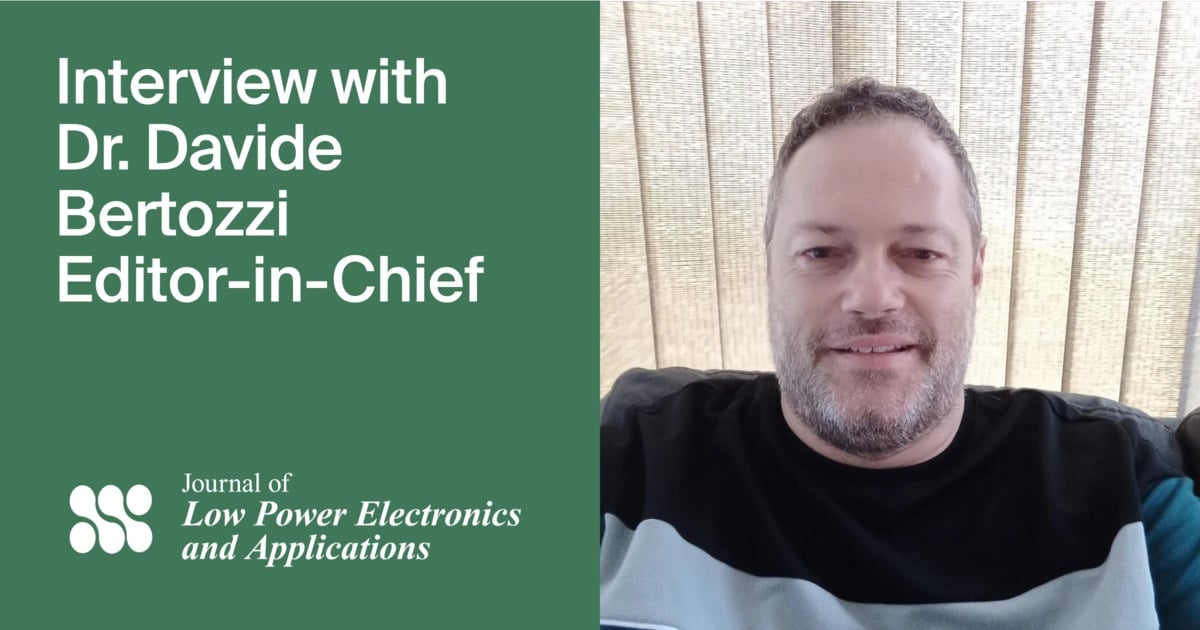
Journal of Low Power Electronics and Applications | Interview with the Editor-in-Chief—Dr. Davide Bertozzi
We are pleased to share the following interview with Dr. Davide Bertozzi (Department of Computer Science, University of Manchester, Manchester M13 9PL, UK), Editor-in-Chief of the Journal of Low Power Electronics and Applications (JLPEA, ISSN 2079-9268).
Dr. Davide Bertozzi received his PhD in electrical and computer engineering from the University of Bologna, Italy, in 2003. He was an Assistant Professor at the University of Ferrara from 2004 and an Associate Professor there from 2020, before joining the University of Manchester in 2023, where he is now a Reader in Computer Science and a member of the International Centre on Neuromorphic Computing.
His research mission is to stay at the forefront of system innovation by leveraging interconnection architectures and emerging technologies, with current interests spanning neuromorphic computing, interconnection networks and fault-tolerant computing. He has been a visiting researcher at Stanford University as well as at several semiconductor companies (NXP, STMicroelectronics, Samsung, NEC Laboratories America). In 2018, he received the “Wolfgang Mehr” Fellowship Award from IHP, a Leibniz Institute for Innovative Microelectronics in Germany. Dr. Bertozzi is a principal investigator in several EU-funded projects, including TAICHIP, EBRAINS 2.0, AIDA4Edge and TWIN-RELECT, co-leads the UK Innovation and Knowledge Centres CHIMES and Neuroware, and has authored roughly 200 peer-reviewed publications.
The following is an interview with Dr. Davide Bertozzi, who shared his vision for the journal with us, as well as his views of the research area:
1. Could you briefly introduce your research area and the focus of your recent work?
The overarching goal of my research is to foster system-level innovation across different application domains by exploiting the enabling features of communication architectures and emerging interconnect technologies.
My most recent research focuses on addressing the communication bottleneck in neuromorphic computing platforms, where the growing gap between the capabilities of on-chip interconnects and the highly interconnected nature of biological neural systems is becoming an increasingly critical challenge.
Next to this research direction, I specialize in the design of asynchronous Networks-on-Chip (NoCs), which complement the event-driven nature of spiking neural network computations with an equally event-driven paradigm for spike routing and communication in neuromorphic systems.
2. Are there any emerging technologies or trends that you believe will significantly influence this field?
AI researchers are increasingly looking at the brain for new ideas, for example, how it learns continuously from few examples, adapts to new situations, and does all this with very little energy. Neuromorphic engineers have always taken the brain as their reference, but the gap between what we know about biology and what we implement in hardware is still large. I expect the two communities to work much more closely. AI research can help identify which biological mechanisms really matter for intelligent behaviour, and neuromorphic engineering can show how to implement them efficiently in silicon. The result should be hardware designed around how the brain actually computes, rather than conventional machine-learning workloads with a spiking flavour. Within this broader convergence, a few specific developments stand out to me:
- Communication as a first-class concern: Most attention in neuromorphic research goes to computation: neuron models, synapses, learning rules. Yet, in the brain, and increasingly in neuromorphic chips, moving information costs as much as processing it, often even more. How spikes are routed, multiplexed and delivered across cores, chips and boards largely determines the scalability, latency and energy of the whole system. I expect neuromorphic communication to become a research focus in its own right, rather than an afterthought to the design of computing cores;
- Asynchronous design is finally entering the mainstream: Event-driven systems are naturally suited to asynchronous, clockless communication: nothing switches unless there is information to transmit. For a long time, the main obstacle has been that asynchronous circuits do not fit standard design tools and flows, which makes them hard to design, verify and integrate. This barrier is starting to erode. Full native tool support is still missing, but pragmatic techniques that adapt and constrain standard synchronous flows are proving increasingly effective, on custom silicon and FPGAs alike. Event-driven interconnects are, thus, becoming more accessible beyond a small community of specialists;
- Always-on intelligence at the sensor: I think the most convincing applications will be at the edge, wherever a system must sense, decide and act continuously on a tight energy budget: wearables, medical devices, robotics, event-based vision. Here, event-driven sensing, processing and communication fit together naturally;
- Neuroscience as a driver: Many design choices in neuromorphic systems are still limited by open questions about how biological circuits learn, store information and remain stable over time. Engineers often have to guess which biological details are essential and which can safely be left out, and these guesses directly affect what the hardware can do. New experimental techniques now make it possible to observe neural activity and connectivity at unprecedented scale, which should progressively replace guesswork with evidence. The exchange can also go the other way: hardware platforms can serve as testbeds for hypotheses about brain function. Making the most of this will require researchers who can work across biology, algorithms and hardware, and training such people will be as important as any technological advance.
Overall, I believe that in the near term, the central challenge will be closing the gap between the efficiency of biological systems and that of our hardware. Brains still outperform our best electronic systems by orders of magnitude in energy per useful operation, and narrowing this gap will not come from incremental optimization of existing designs. It will require radical architectural innovation: rethinking how computation and communication are organized, how information is represented, and how hardware adapts to its workload. This innovation will be fueled by a much tighter interaction with neuroscience, as new insights into how the brain computes become available, and by a new generation of researchers whose skills span biology, algorithms, and hardware design.
3. Many researchers are working in this area today. What specific unresolved question or challenge motivated your work?
What motivated my work was a simple observation. When people talk about neuromorphic systems, the discussion is almost always about computation: how to model neurons and synapses, which learning rules to implement, how many neurons fit on a chip. Much less attention goes to how these elements are connected. Yet, a key factor behind the capabilities of biological neural systems is probably their connectivity. Each neuron communicates with thousands of others, signals travel efficiently across very different distances, and the whole network is organized to move information where and when it is needed at a remarkably low energy cost. In the brain, the wiring is as much a part of the computation as the neurons themselves.
Coming from a background in on-chip interconnects, I found this imbalance striking. Neuromorphic hardware can integrate ever more neurons, but if communication does not scale with the same efficiency, it quickly becomes the real bottleneck for latency, energy, and system size. The question that drives my work is therefore: how can we give artificial neural systems a connection capability that comes closer to that of biology, with communication infrastructures that are scalable, event-driven and energy-efficient, from a single chip up to large multi-chip systems? Emerging interconnect technologies might have a fundamental enabling role in this respect.
4. What qualities do you think are essential for sustaining a long-term academic career?
I believe the essential quality is to keep alive a genuine curiosity about reality: about something that is given to us, not of our own making, and that for this very reason awakens the desire to investigate it. This curiosity is constantly tested by the difficulties of an academic career: a persistent sense of instability, the pressure to remain competitive, and working rhythms that can be exhausting. Yet, without it, everything slowly falls apart, including the quality of the research itself and, ultimately, our willingness to keep doing it.
The real challenge, then, is to find ways to keep that original experience of wonder from fading. Einstein described it memorably: “The most beautiful emotion we can experience is the mysterious. It is the fundamental emotion that stands at the cradle of all true art and science. He to whom this emotion is a stranger, who can no longer wonder and stand rapt in awe, is as good as dead, a snuffed-out candle”. In my view, this inexhaustible curiosity is what ultimately sustains a long-term academic career. Skills, productivity and resilience all matter, but without it they are like a body without a skeleton.
5. What other advice can you give to journals and publishers to better support young researchers and promote academic progress?
I would encourage journals and publishers to see themselves not only as gatekeepers but also as places where young researchers learn how science is done.
First, peer review should be constructive. A rejection or a major revision is far more useful to a young author when it explains clearly what is missing and how to fix it. Too often, negative reviews are not explicit. The reviewer forms an overall negative impression early on and then collects a list of secondary criticisms to justify it, without ever stating the real concern clearly and concisely. The author is left with a long list of comments but no understanding of the actual problem, and may spend months fixing details that were never the point. Journals should ask reviewers to state the main reasons for their assessment at the very beginning, in a few plain sentences, and editors should make sure that their decision letters do the same. Even when a paper is not ready, a well-argued and honest editorial decision can then turn into a real learning opportunity.
Second, young researchers should be actively involved in the editorial process. Co-reviewing schemes with experienced reviewers, early-career Editorial Board Members, and opportunities to guest-edit Special Issues help them learn the standards of the community from the inside and give them visibility.
Third, journals should value kinds of contributions that are often overlooked but essential for progress: careful experimental work, reproducible results with open code and data, and well-documented negative results. A paper does not need to present a revolutionary result to be valuable. Rigorous experiments, independent verification of previous findings, and fair comparisons between existing solutions are all important contributions, even if they do not claim to change the field. Too often, authors feel pushed to overstate the novelty of their work just to get it accepted. Likewise, a negative result can be just as worth publishing as a positive one. Knowing that a promising idea does not work, and why, saves other researchers time and helps the whole community. Finally, publishers should keep access fair.
In short, journals can support young researchers by setting high standards while at the same time helping people reach them.
6. Outside research, are there any personal interests or experiences that have influenced your way of thinking as a scientist?
Yes. In my case, the fundamental source of my enduring passion for understanding the technical truths of the world we live in has always been, and continues to be, my religious experience. I experience faith and reason to be not in conflict but deeply connected, and supporting each other. Faith grounds the rigour of reason and keeps it open to knowledge: it encourages me to approach reality as something to be understood rather than merely used, and to follow the evidence wherever it leads. Reason, in turn, grounds the rational demand of faith: it asks that faith be reasonable, that it can give an account of itself and engage with experience.
This experience did not come from abstract reflection. It grew out of spending time in places and with communities of exceptional human quality, where I encountered people whose way of living was compelling enough to make me ask where it came from. That encounter has shaped not only my personal life but also my attitude as a scientist: a sense of reality as given, which I find worth investigating with rigour and with an ever-renewed sense of wonder.