
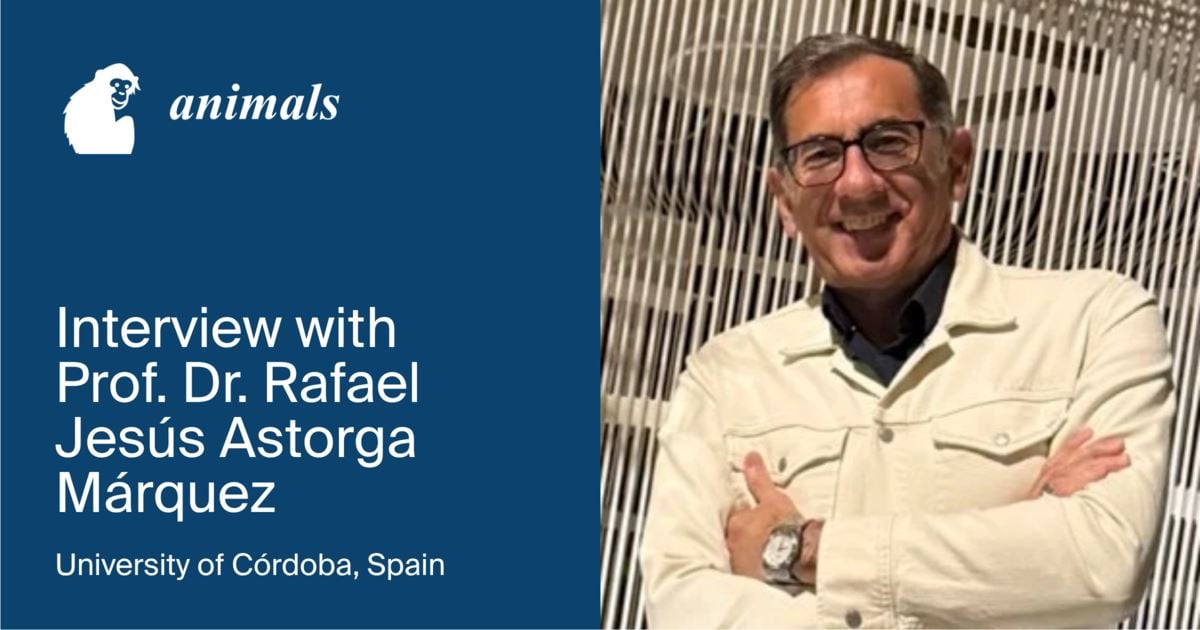
Animals | Interview with Editorial Board Member—Prof. Rafael Jesús Astorga Márquez
We had the pleasure of meeting Prof. Rafael Jesús Astorga Márquez from the University of Córdoba, Spain, to learn more about his academic career, research interests, and contributions to veterinary medicine. As a Full Professor in the Department of Animal Health, his research encompasses several important areas, including animal salmonellosis, antimicrobial resistance, food safety, and infectious diseases in both domestic and free-living animals.
In this interview, we discuss his scientific journey, the motivation behind his research, and the challenges and opportunities shaping the future of animal health and veterinary science.
1. Can you tell us a little bit about yourself and your current research?
My name is Rafael Jesús Astorga Márquez, and I am currently a Full Professor in the Department of Animal Health at the Faculty of Veterinary Medicine, University of Córdoba, Spain.
Regarding my teaching responsibilities, I coordinate two courses in the veterinary medicine degree program: One Health: A Global Health Strategy, taught in the first year, and Preventive Medicine and Health Policy, taught in the fifth year.
I am a member of the research group Animal Health: Disease Diagnosis and Control at the University of Córdoba. My main research focuses on Salmonella infections, particularly from a One Health perspective.
In recent years, I have also been working on the identification of genes associated with antimicrobial resistance in different pathogens of importance to animal health.
Another important area of my research involves the study and scientific communication of transboundary and emerging diseases, particularly zoonotic diseases.
I am also a member of the University of Córdoba’s Competitive Research Unit on Zoonotic and Emerging Diseases (ENZOEM), where I am involved in scientific communication and outreach activities.
Finally, regarding veterinary professional development, I would like to mention that, from December 2026, I will become a member of the Governing Board of the Official College of Veterinarians of Málaga, responsible for professional training and continuing education. Málaga is also the city where I currently live.
2. What initially inspired you to pursue a career in your research field?
My first research projects focused on serological studies of infections in waterbirds from the Guadalquivir Marshes, within Doñana National Park, one of the most remarkable natural areas in southern Spain.
This research formed the basis of my doctoral thesis, which I completed in 1992, and subsequently led to my first publications in indexed scientific journals.
Several years later, following research stays at national and international institutions, I became particularly fascinated by a pathogen of major importance in both animal health and public health: Salmonella.
Over the past twenty years, my research has mainly focused on epidemiological, prevention and control studies of Salmonella infections in different animal species, both domestic and wild.
For example, I have been particularly interested in developing alternative strategies to control Salmonella infections, especially approaches that could reduce the use of antimicrobials.
These topics have become the focus of my scientific career.
3. Looking back at your career, which achievements or milestones are you particularly proud of?
That is a very interesting question, and one that certainly makes me reflect on my professional journey.
I would probably highlight, first, becoming a Full Professor in June 2017. This achievement represented the recognition of many years of dedication to teaching, research and academic management at my university.
On both a personal and professional level, I am also particularly proud of having met and worked with so many excellent researchers and colleagues. Over the years, we have shared unforgettable experiences during research stays, conferences and scientific events. Gaining the respect and recognition of these colleagues for my research has undoubtedly been one of my greatest professional satisfactions.
Another achievement that makes me especially proud is my contribution to scientific communication through the coordination and editing of several books on different topics, including “biosecurity on pig farms”, “salmonellosis”, “vaccinology in dogs and cats”, and “zoonotic diseases transmitted by companion animals and non-traditional companion animals (NTCA)”.
And I am pleased to share some exciting news: our new book, One Health: A Global Health Strategy, is already in the printing process.
Finally, I would like to mention another important milestone in my career: joining the Editorial Board of Animals, specifically the “Veterinary Clinical Studies” Section, in 2026.
For me, this is both a significant professional achievement and an exciting opportunity to contribute to the scientific community.
4. Was there a person, experience, or particular moment that significantly influenced your development as a researcher?
I could not answer this question without mentioning my dear mentor, Professor Luís León Vizcaíno, who is now retired. He taught me so much about infectious diseases in wildlife, and together we visited numerous national parks and remarkable natural areas throughout Spain.
Thanks to his guidance, I developed a much deeper understanding of infectious diseases in their natural environments and animal reservoirs. More importantly, these experiences helped me appreciate the importance of biodiversity and taught me to respect and value nature.
Later, my first research stays at the National Centre for Microbiology, part of the Carlos III Health Institute (Madrid, Spain), were another turning point in my career.
Working in the Enterobacteria Unit under the guidance of Dr Aurora Echeita and Dr. Silvia Valdezate opened the door to what would become one of my main research interests: salmonellosis in animals.
These experiences had a profound influence on my scientific development and helped shape the direction of my research career.
5. What would you say has been the biggest challenge you have faced throughout your scientific career?
I would say that one of the greatest challenges has been progressing through the different stages of an academic career.
Moving from one academic position to another, from the early stages of teaching to becoming a Full Professor, involves considerable demands and responsibilities, particularly at the beginning.
Balancing teaching, research and academic management can sometimes make you feel like an orchestra conductor who must play several instruments at the same time!
The real challenge is ensuring that none of these responsibilities are neglected, because all of them are essential for academic development and promotion.
This requires a great deal of personal commitment, effort and perseverance.
In my opinion, an academic career is a long-distance race, rather than a sprint.
6. What are some of the most significant research questions you are currently trying to address?
One of my current research interests is the identification and characterization of genes associated with antimicrobial resistance in pathogens of importance to animal health and public health.
At the same time, I am particularly interested in understanding the relationship between climate change and the emergence and epidemiological patterns of certain vector-borne viral diseases. These include West Nile fever, Crimea–Congo hemorrhagic fever, bluetongue, epizootic hemorrhagic disease, and infections associated with Shamonda virus, among others.
In fact, this relationship between climate change and emerging infectious diseases is one of the topics addressed in a chapter of my new book, which will be published next December.
Another important research area involves the use of essential oils as potential alternatives to antimicrobials for controlling infections caused by multidrug-resistant Salmonella strains of porcine origin.
Within this research line, we are currently carrying out two particularly interesting studies:
- The first focuses on the pharmacokinetic and pharmacodynamic properties of cinnamaldehyde, one of the main active compounds found in cinnamon;
- The second investigates the potential synergistic effects between carvacrol, a major active compound of oregano, and tetracycline.
Our goal is to explore alternative strategies that could contribute to controlling antimicrobial-resistant bacteria and reducing the use of conventional antibiotics.
7. From your perspective, how has scientific publishing changed throughout your academic career?
Scientific research and the publication of results have undergone an extraordinary transformation throughout my career.
I still remember the 1990s, when searching for scientific literature often meant spending countless hours in university libraries. Those searches could be extremely time-consuming!
Fortunately, we have made tremendous progress since then.
Another major transformation has been the rapid development of new diagnostic methods. In our field, we have had to continuously update our knowledge and skills to keep pace with molecular techniques, genetic characterization methods and, more recently, whole-genome sequencing.
However, focusing specifically on scientific publishing, I believe that one of the greatest challenges today is the enormous volume of scientific publications. The number of manuscripts submitted to scientific journals has also increased dramatically.
There are now so many articles being published that it is practically impossible to keep up with all the latest research, even within a relatively specialized field.
For this reason, I believe that rigorous editorial procedures and high-quality peer review are more important than ever. These processes are essential to ensure the scientific quality, relevance and reliability of published research.
8. Could you share your experience with Animals journal?
Honestly, my experience has been extremely positive and professionally rewarding.
Regarding my collaboration with MDPI, between 2023 and 2026, I have participated in the peer-review process of 24 manuscripts submitted to different MDPI journals. These include Animals, Microorganisms, Foods, Veterinary Sciences, Genes, Antibiotics, Pharmaceuticals, the International Journal of Environmental Research and Public Health, and Encyclopedia.
Focusing specifically on Animals, I would like to highlight our experience as Guest Editors of two Special Issues, one of which is still ongoing.
The first Special Issue was entitled Salmonella and Salmonellosis: Implications for Public Health. It was completed on 31 December 2024 and included eleven scientific articles, which were subsequently compiled into a book.
I am particularly proud that this Special Issue ranked first among the Special Issues published in Animals over the past 36 months.
The second Special Issue is entitled Tackling Salmonella Resistance in Animals. This Special Issue is still open, with a submission deadline of 13 June 2027. We currently have three of the seven articles planned for this collection.
In addition to our editorial activities, between 2024 and 2026 we published five scientific articles in Animals and one in Microorganisms.
I would also like to highlight one of our review articles, published in Animals in 2023, entitled “Salmonella and Salmonellosis: An Update on Public Health Implications and Control Strategies”. According to Animals journal information, this review has been the most cited review article in the journal over the past 36 months, with 207 citations and more than 26,900 views.
Overall, my experience with Animals and MDPI has been very positive, both as an author and as a reviewer and Guest Editor. I particularly value the opportunity to contribute to the dissemination of scientific knowledge and to collaborate with researchers working in related fields.
9. What advice would you give to early career researchers who are trying to establish themselves in the academic community?
My first piece of advice would be that pursuing an academic career requires a genuine passion for both teaching and research.
I believe that having a strong vocation is essential because, once you enter academia, you soon realize that it is a long and demanding journey.
An academic career has always required perseverance, but today it is probably more competitive than ever.
Academic performance is often the first important step, so I would encourage students to work hard and make the most of their university education.
I must also say that I am truly impressed by the excellent training and preparation of today’s young researchers. Many of our research fellows have developed an extraordinary range of skills and are well prepared for different professional careers. When I see them working in the laboratories of our Department of Animal Health, I am often amazed by their abilities and by the scientific resources they have available.
Modern computer tools, advanced molecular diagnostic techniques and greater access to research funding have completely transformed the way we work.
Sometimes, I must admit, I feel a little nostalgic when I remember how difficult and time-consuming certain tasks were in the past. I often think about how much time we could have saved if we had had access to today’s technologies!
But coming back to your question, my advice to young researchers would be simple: stay motivated, work hard, believe in teamwork and, above all, be patient. Research requires time, reflection and perseverance. Results do not always come as quickly as we would like.
I would also like to emphasize something that I consider particularly important: the need to design a sound epidemiological study before starting any research project. A well-designed study is essential for obtaining meaningful and reliable results.
So, my final message is to be enthusiastic, remain committed, work as a team, and never lose your patience.
With dedication and perseverance, the results will eventually come.
10. You mentioned that you are currently working on a book about One Health with other scholars. Could you tell us a little more about this project, and the contribution you hope it will make to the field?
Of course! This is a very exciting project that is now almost complete.
I would also like to mention that, in the 2027–2028 academic year, we will become the first public university to offer the elective course One Health: A Global Health Strategy as part of the veterinary medicine degree program.
Since January, I have been coordinating this book, entitled One Health: A Global Health Strategy, which brings together contributions from professionals from a wide range of disciplines, including veterinarians with different professional backgrounds, medical specialists in preventive medicine and international health, clinical psychologists, and experts in plant and environmental health.
The book consists of fifteen chapters and 520 pages. It is already in the printing process with ExLibric Publishing and will be officially presented at several health-related institutions starting in December.
The book is primarily aimed at professionals working in animal health, public health, plant health and environmental health, as well as university students in different health and life sciences, including medicine, veterinary medicine, biology, environmental sciences, pharmacy, food science and technology, and nutrition and dietetics, among others.
This book reflects the fundamental principles of the well-established One Health approach, which recognizes that human, animal and environmental health are closely interconnected.
Its main objective is to promote communication and interdisciplinary collaboration among professionals working in these different fields, based on the understanding that the health of humans, animals and the environment is deeply interconnected.
Finally, I would like to thank you very much for this interview and for the opportunity to share my experiences and reflections. It has been a real pleasure.