
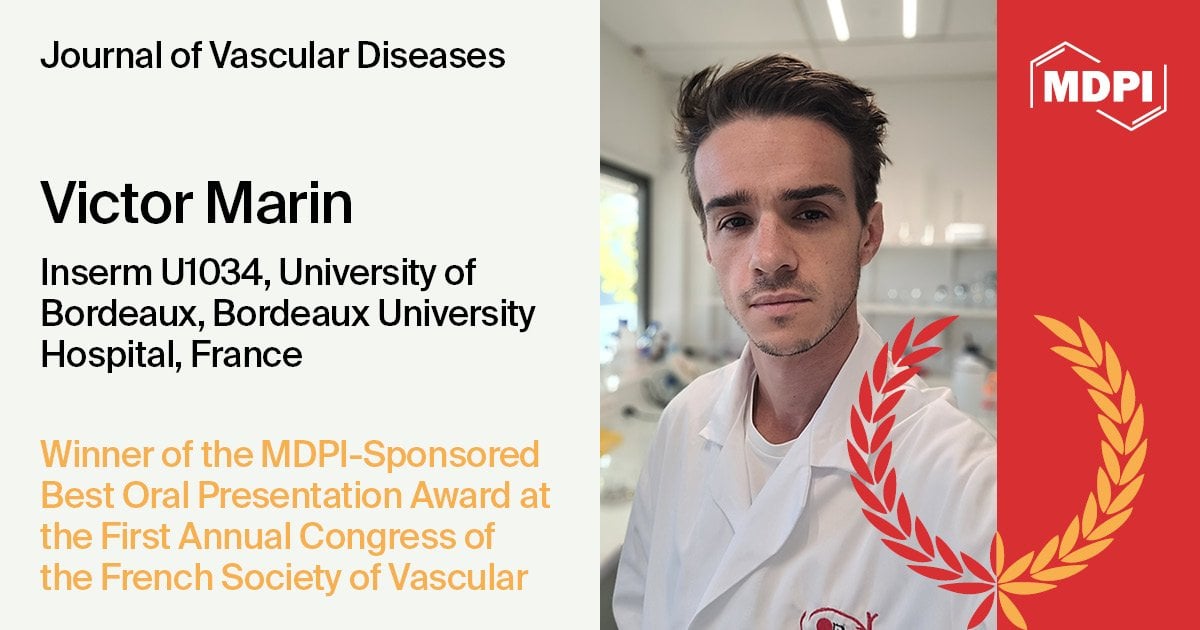
Journal of Vascular Diseases | Interview with Dr. Victor Marin—the Winner of the Best Oral Presentation Award at the First Annual Congress of the French Society of Vascular Biology
1. Congratulations on winning the Best Presentation Award! Could you briefly introduce yourself to the readers? Also, could you introduce your current research direction and provide an update on your progress?
I am a medical biology resident at Bordeaux University Hospital and a PhD candidate at the University of Bordeaux, France. My background combines clinical medicine, molecular biology, and genetics, and I am particularly interested in understanding how fundamental biological mechanisms contribute to human diseases. My current research at Inserm UMR1034 focuses on perivascular fibroblasts, a relatively understudied cell population associated with cerebral blood vessels. More specifically, I investigate whether these cells communicate with their neighbors through specialized cellular extensions called cytonemes. These thin, actin-based protrusions have been described as a mechanism allowing the targeted exchange of signaling molecules between cells. Our in vitro work has allowed us to characterize these protrusions and has provided evidence that they may participate in contact-dependent intercellular signaling. We are now investigating similar structures in the developing mouse brain, using genetic labeling and advanced microscopy to study them in their native environment. Ultimately, our goal is to understand whether cytonemes represent a previously overlooked communication mechanism within the neurovascular unit and what role they might play in blood–brain barrier biology.
2. What were some of the biggest challenges you faced during your research, and how did you overcome them?
One of the main challenges has been studying structures that are both extremely dynamic, thin, and fragile. Cytonemes can extend over considerable distances while remaining close to the resolution limit of conventional light microscopy. Observing them in cultured cells is already challenging, but identifying similar structures within the complex three-dimensional organization of brain tissue is even more difficult. To address this, we have been developing an approach based on mosaic genetic labeling of perivascular fibroblasts in mice, allowing us to visualize individual cells and their extensions within the brain vasculature. This has required adapting our experimental and imaging strategies to preserve and investigate these delicate structures in thick tissue sections. More generally, this project has required me to work across several disciplines, from cell biology and advanced microscopy to proteomics and bioinformatics. Coming from a medical background, learning to analyze complex imaging and transcriptomic datasets has been both challenging and rewarding. I think one of the most valuable lessons I have learned is that research rarely follows a straight path. Sometimes, the greatest progress comes from unexpected results.
3. Which research topics do you think will be of particular interest to the research community in the coming years?
I believe that the integration of multi-omics data, spatial biology, and artificial intelligence will be among the most exciting research directions in the coming years. The omics revolution is still ongoing, and we now have access to an extraordinary amount of biological data, from single-cell and spatial transcriptomics to proteomics and advanced microscopy. However, connecting these different layers of information to understand how cells interact and function within tissues remains a major challenge.
I think AI will play a key role, not only in analyzing increasingly complex datasets, but also in developing intuitive and interpretable tools that allow scientists to explore these connections without necessarily requiring extensive computational expertise. An enormous amount of information is already publicly available, and I believe many of tomorrow's discoveries are already hidden within these datasets. The challenge will be to move beyond simply accumulating data and focus on connecting the dots, identifying meaningful biological relationships, and translating them into hypotheses that can be clearly communicated and experimentally tested.
4. What impact do you think such awards can have on a researcher’s career?
I think awards can have a particularly meaningful impact on young researchers, especially during a PhD, when research often involves a great deal of uncertainty and many experimental challenges. Beyond the recognition itself as an individual, it provides confidence in the relevance of the scientific questions we are pursuing as a team in the lab. For young physician-scientists, I think this kind of recognition is particularly valuable. Combining medical training, clinical responsibilities, and fundamental research requires a significant commitment, and it is encouraging to see that this interdisciplinary path is recognized and supported. Of course, research is always a collective effort. I am very grateful to my PhD supervisor, Dr. Marie-Lise Bats, and to all my colleagues and collaborators whose expertise and support have been essential to this work.
5. Do you have any suggestions for how our journal could further support young researchers and the academic community?
I believe that initiatives such as young researcher awards and interviews are already valuable ways to recognize early career scientists and increase the visibility of their work. One initiative I would particularly encourage is the creation of a fast-track publication pathway for negative results, provided they are supported by rigorous experimental design and detailed, reproducible methodologies. A significant proportion of scientific research, particularly during master’s and PhD projects, produces results that never reach publication or general knowledge simply because they do not confirm the initial hypothesis. Yet, in an era of open science and AI-driven research, these findings represent an enormous, untapped resource. Making them accessible through short, standardized, and rigorously reviewed publications would not only give greater recognition to the work of young researchers but also expand our collective scientific knowledge, providing valuable data for meta-analyses, future research, and AI-driven discovery.
6. Finally, how do you plan to continue building on your research in the future, and what are your long-term career aspirations?
Looking beyond my PhD, as a physician, I am particularly interested in exploring the potential involvement of cytonemes in pathological processes, especially in diseases with a genetic component. While their role in physiological cell-to-cell communication is beginning to emerge, much remains unknown about how these mechanisms may be altered in disease. I believe connecting these fundamental discoveries to human pathology could open exciting new research directions. My long-term ambition is to pursue a hospital-based academic career combining clinical medical biology, fundamental research, and teaching. My experience in medical genetics and genomic diagnosis has shown me how much remains to be understood about the molecular mechanisms underlying human diseases, while my PhD has allowed me to explore fundamental mechanisms of intercellular communication through experimental biology. I see these two perspectives as deeply complementary. Ultimately, I hope to build my career around this dialogue between medicine and research, allowing clinical questions to inspire fundamental discoveries and bringing new biological insights closer to patient care, while contributing to the training of future physicians and scientists.