
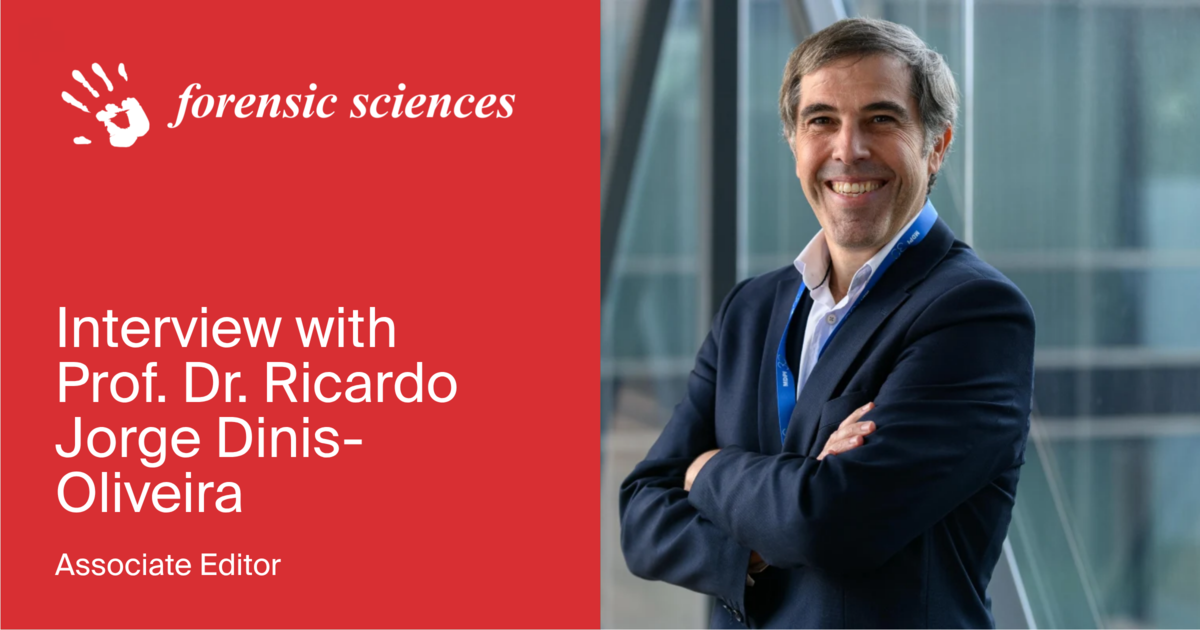
Interview with Prof. Dr. Ricardo Jorge Dinis-Oliveira—Associate Editor of Forensic Sciences
Prof. Dr. Ricardo Jorge Dinis-Oliveira is a Full Professor of Toxicology and Forensic Sciences at the University CESPU and the Faculty of Medicine of the University of Porto, Portugal. His research focuses on forensic science, toxicology, and pharmacology of psychoactive substances, pesticides, and medicines, encompassing preclinical, clinical, and forensic perspectives, as well as the development of mathematical models for postmortem interval estimation.
He is an Integrated Researcher, member of the Management Board, and Director of the Toxicology Research Group at UCIBIO - Research Unit on Applied Molecular Biosciences - CESPU. He has authored more than 280 peer-reviewed scientific articles, accumulating over 12,000 citations (h-index 46), approximately 45 book chapters, five books, and four patents. He has supervised numerous Master’s and PhD theses and contributed extensively to academic development, scientific publishing, and higher education accreditation, especially within forensic and biomedical sciences.
Recognized among the World’s Top 2% Scientists from 2021 to 2026, he ranked 1st worldwide in Legal Medicine and Forensic Sciences for single-year citations (2025) and 11th worldwide for career-long citation impact (2026). He is the Founder and President of the Portuguese Association of Forensic Sciences (APCF), an expert at the European Union Drugs Agency (EUDA) since 2024, and a member of several international scientific journal editorial boards. He also serves as a scientific consultant to forensic and pharmaceutical development companies and to judicial authorities and courts, acting as a forensic expert in criminal, civil, and other legal proceedings in the holistic dimension of forensic science.
The following is an interview with Prof. Dr. Ricardo Jorge Dinis-Oliveira:
1. Looking back at your scientific career, what initially inspired you to pursue forensic science, and which experiences have had the greatest influence on your development as a researcher?
What initially attracted me to forensic science was its distinctive position at the intersection of science, medicine, law, and society. It is a field in which scientific knowledge is not developed solely to explain phenomena, but also to help answer questions that may have profound consequences for individuals, families and the justice system. I was particularly interested in the challenge of reconstructing events from incomplete, complex and sometimes contradictory evidence, while maintaining scientific rigour and intellectual independence.
My development has been shaped by the combination of academic research, teaching and practical forensic work. Working with real cases has continually reminded me that analytical results do not exist in isolation: they must be interpreted in the context of the circumstances, the biological and environmental systems involved, the limitations of the methods, and the specific question being asked. This has influenced the way I approach research, particularly in forensic toxicology, where the relationship between a measured concentration and its biological or forensic meaning is rarely straightforward.
Equally important have been transdisciplinary collaborations and the opportunity to work with researchers from different scientific and geographical backgrounds. They have taught me that progress often occurs at disciplinary boundaries. I have also learned a great deal from supervising students and early-career researchers: explaining complex problems to others forces us to question our own assumptions.
Ultimately, I see forensic science as a public-interest discipline. Its credibility depends not only on technological sophistication, but also on transparency, reproducibility, ethical responsibility, and the ability to communicate uncertainty honestly. For me, the real beauty of forensic science lies in its continuous pursuit of scientific truth, even when the available evidence is incomplete, and the answers are far from being easy.
2. According to the 2026 Stanford ranking, you ranked first worldwide in Legal Medicine and Forensic Sciences for single-year citation impact and 11th for career-long impact. What do these achievements mean to you personally, and what do you consider the most important factors behind your scientific success?
I received these distinctions with gratitude, humility, and a profound sense of responsibility. In fact, the recognition came as a complete surprise. I only gradually became aware of this achievement and its significance when I started receiving messages of congratulations from colleagues and researchers from all over the world. It was a genuinely unexpected and humbling experience, which made me reflect on the scientific journey behind these achievements. Being placed first worldwide for single-year citation impact and eleventh for career-long impact in legal medicine and forensic sciences is certainly meaningful, but I do not regard rankings as an end in themselves. They are, at most, one indicator of the visibility and influence that the body of scientific work I produced has achieved. Science should not exist merely to be cited; it should exist to make a difference, and that is my major objective: use science to find justice. In other words, I believe that the true purpose of science is to translate knowledge into tangible benefits for society. Moreover, personally, I see these results as recognition of a collective effort involving students, doctoral researchers, colleagues, collaborators, technical teams, and institutions. I am particularly grateful to the people who have challenged my ideas, strengthened my work, and helped translate research questions into meaningful scientific contributions.
I would identify four factors as especially important. First, curiosity and persistence: the willingness to investigate difficult questions and remain engaged when the answers are not immediate. Second, relevance: choosing research problems that matter scientifically and address genuine needs in forensic practice and society. Third, collaboration: bringing together complementary expertise rather than working within narrow disciplinary boundaries. Fourth, independence and critical thinking: being prepared to question established interpretations, including one’s own, when the evidence requires it, always with integrity.
3. Which emerging research directions or technological breakthroughs do you believe have the greatest potential to transform forensic science over the next 5–10 years?
I would frame the future in terms of the evolution of forensic science across its different specialities, rather than focusing on a single technology or treating forensic science as one homogeneous discipline. The most important transformation will come from the integration of advances in several areas, while respecting the specific scientific questions, evidential standards and limitations of each speciality.
Artificial intelligence and machine learning will have a growing role in pattern recognition, image and video analysis, digital evidence, forensic pathology, anthropology, ballistics and the interpretation of complex datasets. Their value, however, will depend on validation, explainability, transparency and careful assessment of bias. An algorithm should support, not replace, expert reasoning and accountability.
In forensic biology and genetics, next-generation sequencing, advanced DNA analysis, microbiome research and molecular approaches may provide new ways to investigate identity, biological traces, time-related questions and the circumstances surrounding death. In forensic pathology, radiology and anthropology, the combination of postmortem imaging, three-dimensional reconstruction, digital tools and computational analysis will increasingly complement conventional examination.
Forensic toxicology, my main area of expertise together with pathology, will also undergo a profound transformation, which I would describe as Toxicology 2.0. This new paradigm goes beyond the conventional identification and quantification of toxic substances. An essential part of this evolution will be the transition from concentration-centred toxicology towards biologically informed and quantitatively contextualised toxicological interpretation. In other words, identifying a substance and measuring its concentration should be only the starting point. We need to understand what that concentration actually means in a particular individual, considering therapeutic exposure, toxicological thresholds, potentially lethal concentrations, dose–response relationships, pharmacokinetics, postmortem redistribution and the specific biological context. I believe that the development of integrated quantitative frameworks, such as biological exposure scales and therapeutic-to-lethal exposure relationships, will be particularly important. These approaches may help establish more meaningful comparisons between therapeutic, toxic and potentially fatal exposures, while acknowledging biological variability and the limitations of available reference data. This will be particularly important in complex intoxications, emerging psychoactive substances, drug interactions, paediatric poisonings and cases in which the relationship between exposure and death is difficult to establish.
I would also highlight digital forensics, cybercrime investigation, environmental and wildlife forensics, forensic microbiology, and the growing relevance of One Health and One Forensics. The boundaries between human, animal and environmental evidence will become increasingly important.
The central challenge will be interoperability: ensuring that data, methods and interpretations from different specialities can be meaningfully integrated. The future is not simply more technology; it is better-validated technology, stronger cross-disciplinary collaboration and a more coherent evidential framework. Finally, we must move from “forensic sciences” to “forensic science”.
4. In your opinion, what are the most important scientific assumptions or traditional approaches in forensic science that researchers should critically re-examine in the coming years?
One of the most important assumptions to re-examine is that a technically accurate measurement necessarily leads to a reliable forensic conclusion. Analytical validity and interpretative validity are different things. A method may identify or quantify a substance, material or biological trace with excellent precision, but the meaning of that result depends on context, alternative explanations, transfer or contamination mechanisms, artifacts, persistence, background prevalence and the limitations of the available reference data.
A second issue is the continued use of categorical language when the evidence is probabilistic or uncertain. Forensic conclusions should be proportionate to the strength of the data. We need to move away from overstated certainty and towards transparent statements of evidential weight, uncertainty and competing propositions. This is essential for scientific credibility and for the fair administration of justice.
Third, many traditional approaches rely on thresholds, reference ranges or interpretative rules that may have been adopted historically and then treated as universal. These values must be periodically reassessed against contemporary data, population variability, analytical developments and the specific circumstances in which they are applied. For instance, in forensic toxicology, the presence or concentration of a compound cannot automatically establish impairment, toxicity or causation.
Finally, we should question the assumption that technological novelty is synonymous with scientific progress. New methods must demonstrate fitness for purpose, reproducibility, robustness and real-world value. Therefore, the future of forensic science will depend as much on improving the quality of our reasoning as on improving the sophistication of our instruments.
5. As an Associate Editor of Forensic Sciences since its inception in 2021, how do you reflect on the journal’s development over the past five years?
Having been involved as an Associate Editor since the journal’s inception in 2021, I have had the privilege of witnessing its development from an early-stage publication into an increasingly visible international platform for multidisciplinary forensic research. The progress achieved over five years is encouraging, particularly because the journal has sought to represent the breadth of forensic science rather than confining itself to a single speciality.
The milestones are substantial. The journal was launched in 2021, indexed in the Directory of Open Access Journals in 2023, entered Scopus in 2024, and was indexed in the Emerging Sources Citation Index in 2025. In 2026, it received its first Impact Factor of 1.5, while its CiteScore increased to 3.3. These developments reflect a sustained effort to establish the journal’s visibility, editorial processes, and standing within the scientific community. The journal has also expanded its international reach and its portfolio of article types and Special Issues.
However, I believe the most important achievement is the creation of a community. The Forensic Sciences journal is not defined only by its metrics; it is defined by the quality of the questions it publishes, the fairness and rigour of its peer review, the diversity of its contributors and its capacity to stimulate constructive scientific debate. The next stage should consolidate these foundations, strengthen representation across forensic specialties and geographical regions, and continue to prioritize scientific quality over publication volume.
Finally, and perhaps most importantly, what I particularly value about the Forensic Sciences journal is its openness to emerging and developing areas of forensic research. The journal is not restricted to traditionally established disciplines such as forensic medicine, forensic toxicology or forensic genetics. Instead, it has embraced the evolution of the entire field, providing a platform for emerging forensic specialties, innovative methodologies and new scientific perspectives. In doing so, it has helped promote a more unified vision of forensic science, recognizing that, despite their different methodologies and areas of expertise, all these disciplines contribute to a common scientific purpose.
I would also like to emphasize the dedication of the editorial structure and, particularly, the professionalism and commitment of the Editorial Office. Beyond the administrative and publishing processes, I have witnessed a genuine commitment to research integrity, supported by increasingly sophisticated screening and alert systems, the sharing of experiences, and continuous communication with Academic Editors and Editorial Board Members. This collaborative culture is essential in a scientific environment where credibility and trust are fundamental.
Ultimately, I believe the journal’s greatest contribution may be precisely this: helping us move from a fragmented landscape of forensic specialties towards a more integrated, inclusive and unified concept of forensic science.
6. Forensic Sciences recently received its first Impact Factor, marking an important milestone in its development. In your view, what have been the key factors contributing to the journal’s growing visibility and scientific impact?
The first Impact Factor is an important milestone that should be understood as the result of several mutually reinforcing factors rather than a single achievement. First, the journal has a broad and genuinely transdisciplinary scope. Forensic science encompasses many specialties, and a platform that encourages dialogue between forensic medicine, toxicology, genetics, chemistry, anthropology, geology, digital forensics and many other forensic areas can reach a wider scientific community and create opportunities for cross-disciplinary citation and collaboration.
Second, the journal has progressively strengthened its editorial and peer-review processes. The contributions of committed Academic Editors, qualified reviewers, and an engaged Editorial Board are fundamental. Scientific impact depends on selecting work that is methodologically sound, relevant, and capable of advancing knowledge. Therefore, the editorial decisions have been guided by scientific merit, research integrity, and a clear understanding of the journal’s scope.
Third, international participation and community engagement have been important. Special Issues, conference relationships, webinars, society partnerships, and the promotion of relevant papers help connect the journal with researchers and practitioners. The affiliation with the Portuguese Association of Forensic Sciences is one example of how professional and scientific communities can support visibility and exchange.
Fourth, the journal has also benefited from the diversity of its published content, including original research, reviews, case reports, systematic reviews and technical contributions. High-quality reviews helped to consolidate emerging fields, while carefully documented case reports and technical articles were fundamental in communicating lessons that are directly relevant to practice.
Looking forward, I would place particular emphasis on attracting high-quality submissions from underrepresented regions, broadening the Editorial Board’s geographical and disciplinary diversity, increasing the visibility of outstanding papers, and developing strategic Special Issues around significant scientific questions. The journal’s long-term reputation will depend on trust, scientific integrity, and the value it delivers to the forensic community.
We are all familiar with the so-called CSI Effect, which has shaped public expectations of forensic investigations, sometimes creating an unrealistic perception of what forensic science can achieve. I believe that the Forensic Sciences journal can help foster a new and much more meaningful paradigm: what I would call the Holistic Forensic Science Effect. This would mean promoting a unified, transdisciplinary and scientifically integrated vision of forensic science, in which different specialities, emerging technologies and scientific knowledge converge to produce stronger, more reliable and socially relevant evidence. I see this as an opportunity to contribute to Forensic Science 2.0: a new era of scientific sophistication, integration, critical thinking and methodological excellence, elevating forensic science to an even higher level of scientific maturity and societal relevance.
7. What advice would you give to early career researchers who aspire to make a meaningful contribution to forensic science, particularly those whose findings may challenge established scientific views?
My first advice would be to develop scientific curiosity and intellectual courage, but to combine both with methodological discipline. What matters is whether the evidence is robust, the methods are appropriate, the reasoning is transparent, and the conclusions are proportionate to the data.
Young researchers should begin by understanding the foundations of their speciality: its history, accepted methods, strengths, limitations and unresolved questions. Only then can they identify where genuine progress is possible. They should learn to distinguish between what is known, what is assumed and what remains uncertain. In forensic science, that distinction is particularly important because research findings may ultimately influence legal decisions and people’s lives.
I would encourage them to work across disciplinary boundaries. The most relevant questions increasingly require expertise from different fields, and collaboration should be seen as a scientific strength rather than a loss of independence. They should also seek mentors who are willing to challenge them constructively, engage with international research communities, communicate their findings clearly, and become familiar with research integrity, data management, reproducibility, and responsible use of emerging technologies.
When findings challenge established scientific views, researchers must be especially careful. They should anticipate alternative explanations, test the robustness of their results, disclose limitations and avoid overstating implications. Finally, I would remind early-career researchers that forensic science is ultimately a service to society. Our responsibility extends beyond publishing papers or developing technologies. It is to produce knowledge that is reliable, transparent, ethically grounded, and useful. Be ambitious in the questions you ask, rigorous in the way you answer them, open to being wrong, and persistent when the evidence points in an unexpected direction. That is how meaningful scientific contributions are made. Young researchers must remain open to new approaches while preserving the principles that give forensic evidence its value: validity, transparency, reproducibility, impartiality, and respect for the truth.