
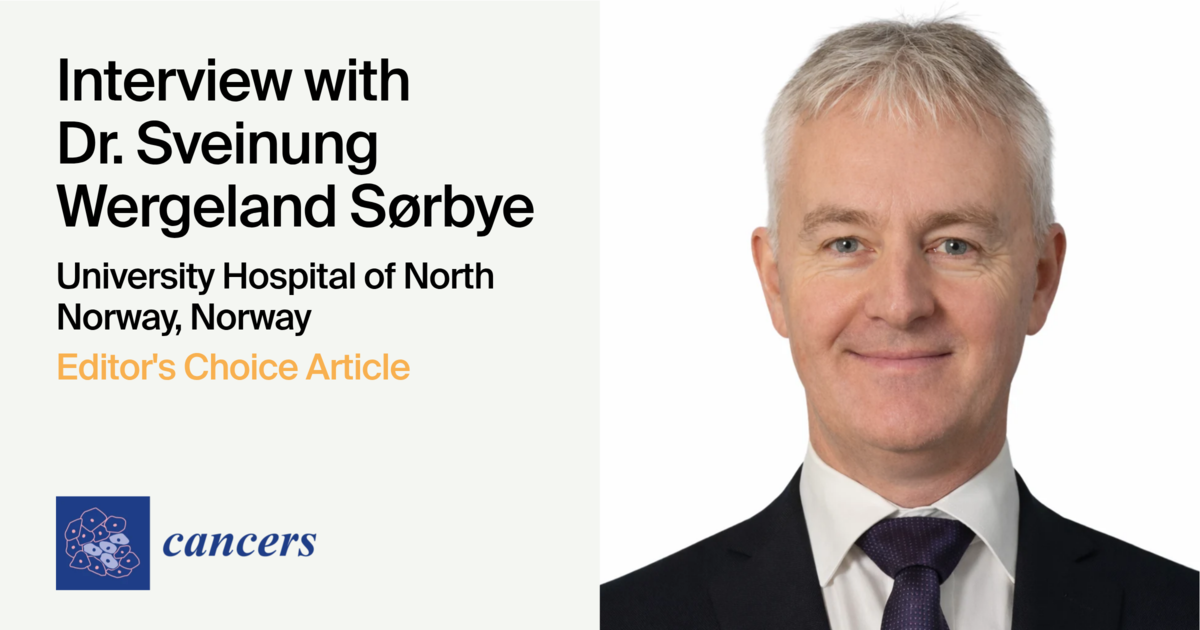
Cancers | Interview with One of the Authors of Editor’s Choice Article—Dr. Sveinung Wergeland Sørbye
We had the pleasure of speaking with Dr. Sveinung Wergeland Sørbye, first and corresponding author of an Editor’s Choice Article published in Cancers (ISSN 2072-6694). He shares insights into his paper, research, and reflections.
“Cervical Cytology and HPV16/18/45 mRNA Co-Testing Improve Risk Stratification in Routine Clinical Practice”
by Sveinung Wergeland Sørbye, Bente Marie Falang, Mona Antonsen and Elin Richardsen
Cancers 2026, 18(5), 834; https://doi.org/10.3390/cancers18050834
Available online: https://www.mdpi.com/2072-6694/18/5/834
Dr. Sveinung Wergeland Sørbye is a consultant pathologist at the University Hospital of North Norway, Tromsø. He leads the laboratory’s work in cervical cytology and HPV screening for Troms and Finnmark. His research focuses on how we can use HPV testing, cytology, and follow-up to detect and treat cervical precancer before it becomes invasive.
Below is an interview with Dr. Sveinung Wergeland Sørbye.
1. What initially inspired you to pursue this specific research topic?
When I was a child, a friend of mine lost his mother to cervical cancer. That loss stayed with me. As a doctor, I came to understand how much of this disease we can prevent through HPV vaccination, screening, and timely treatment of high-grade cervical lesions. When we started this project in 2016, cervical screening in Norway still relied mainly on cytology. There had been reports of young women dying of cervical cancer despite attending screening, some after a Pap test had been reported as normal. That raised a practical question for us. Could we use the sample we already had to identify women who needed a second look?
2. What is the core problem or critical gap in the field that your study addresses?
A Pap test can miss abnormal cells, and a woman whose result is reported as normal may wait several years before her next screening test. We used the material left over from the Pap test to look for E6/E7 mRNA from HPV types 16, 18, and 45. In our initial quality assurance work, a positive mRNA result prompted an independent review of slides originally reported as normal. About one in three of the reviewed slides showed abnormal cells on reassessment. The larger study asked a further question. How much could each combination of cytology and HPV mRNA results tell us about the likelihood of finding a serious lesion during follow-up?
3. What was the biggest challenge your team faced during the research process, and how did you overcome it?
The biggest challenge was linking 116,217 co-test samples collected from 2016 to 2020 to biopsy and cone specimen results through December 2025. We used Norway’s unique personal identifiers to link records and SPSS syntax to document and rerun the data cleaning and linkage steps. Our department is the sole pathology service for Troms and Finnmark, so we could capture follow-up specimens processed across the region in a single laboratory information system. The national screening programme sends invitations and reminders, and our laboratory tracks recommended follow-up samples that have yet to arrive.
4. Were there any unexpected or surprising findings during the study?
What surprised me most was the size of the risk difference among women with normal cytology. In the study, CIN3 or worse, an outcome that includes severe precancer and cervical cancer, was found in 13.0% of women with normal cytology and a positive HPV mRNA result, compared with 0.2% when both tests were negative. The group with normal cytology and positive HPV mRNA accounted for just 1.1% of co-test samples. What struck me was how much the HPV result could change our understanding of a Pap test reported as normal.
5. How far do you think this discovery is from routine clinical application, and what are the next steps?
We were able to run the mRNA test on the same liquid-based sample in routine practice. The question now is where it adds value in programs such as Norway’s, which use HPV DNA testing as the primary screening test. I would like to see prospective studies compare follow-up strategies for women who test positive for HPV DNA, including those with normal cytology. The outcomes I would focus on are how many serious lesions are detected, how soon they are detected, and how many colposcopies are needed.
6. What does being selected as an Editor’s Choice Article mean to you and your team?
This study grew out of daily work in our laboratory. A positive HPV result sometimes gave us a reason to go back to a slide, look again, and bring a woman back for follow-up sooner. Being selected as an Editor’s Choice Article is meaningful to me because it recognizes the work that went into turning those individual cases into a study that others can learn from. That work involved colleagues who reviewed the slides, performed the HPV tests, and helped link years of follow-up data.