
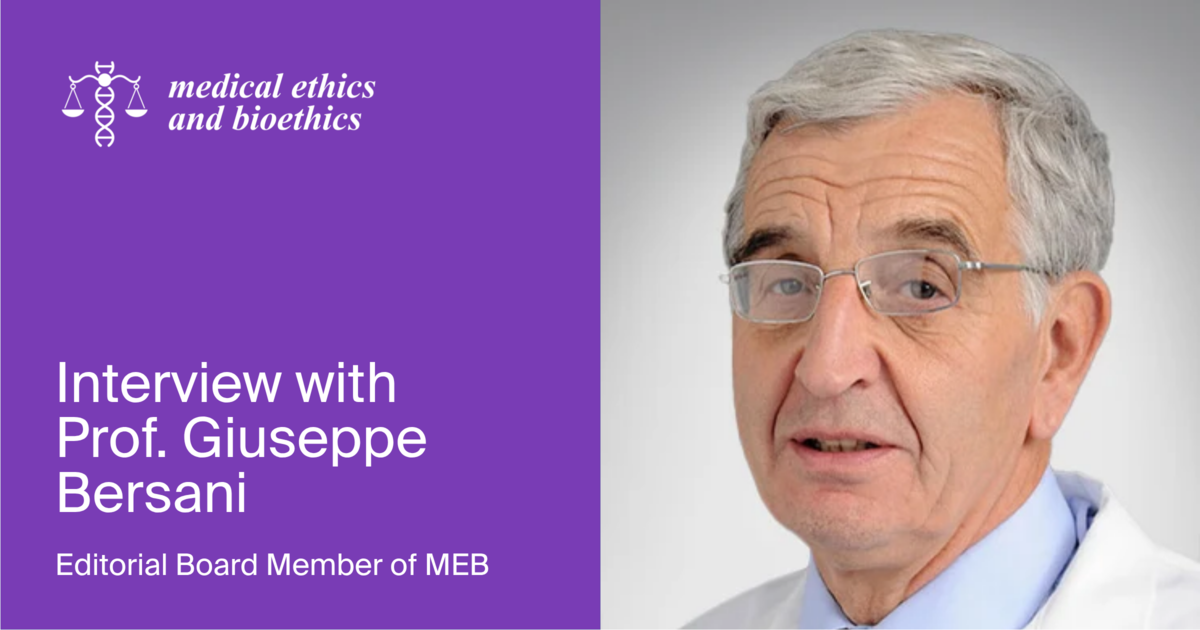
Medical Ethics and Bioethics | Interview with Editorial Board Member—Prof. Giuseppe Bersani
We are pleased to share the following interview with Prof. Giuseppe Bersani, Founding Editorial Board Member of Medical Ethics and Bioethics (MEB, ISSN 3043-1891).
We are delighted to have Prof. Bersani as a Founding Editorial Board Member of Medical Ethics and Bioethics. With his expertise in psychiatry, clinical psychopharmacology, forensic psychiatry, clinical criminology, and psychiatric bioethics, he brings valuable perspectives to the journal and its mission to advance meaningful discussions in medical ethics and bioethics.
Prof. Bersani is affiliated with the Rome Sapienza Foundation at Sapienza University of Rome, Italy. His research focuses on clinical psychopharmacology, psychiatric genetics, neurobiology of mental disorders, neuroimaging, and the effects of substance abuse on mental health. His clinical and research work also highlights the importance of ethical considerations in psychiatric practice, particularly regarding patient autonomy, informed consent, and the treatment of individuals with mental disorders.
MEB greatly appreciates Prof. Bersani’s support and contributions as a member of the Editorial Board. We look forward to his continued insights and expertise as the journal develops its international community in medical ethics and bioethics.
In this interview, Prof. Bersani reflects on his career in clinical psychiatry and research, shares his perspectives on the importance of integrating scientific knowledge with patient care and ethical responsibility, and discusses his vision for MEB as a platform for promoting medical ethics in clinical practice and scientific research.
1. What is the most satisfying discovery or achievement you have attained in your laboratory?
It should first be noted that I am a clinical psychiatrist; consequently, my research has focused primarily on clinical issues, with laboratory-based research playing a secondary role. In clinical practice—particularly within psychiatry—research is an intrinsic part of the encounter with, the study of, and the treatment of every individual patient. Each person who has experienced an improvement in their mental suffering represents the most significant outcome of my work and research. More specifically, however, my most notable findings have concerned the therapeutic potential of new medications, the factors associated with early deviations in brain development in psychotic patients, the neurobiological underpinnings of mental disorders, and the pathogenic impact that various substances of abuse—both traditional and novel—can have on the mind. In a field as vast and complex as that of mental disorders, even the slightest advancement in knowledge is an objective of immense importance, and the pursuit of such knowledge constitutes a fundamental clinical and ethical commitment.
2. Looking back on your academic journey, which failure or unsatisfying research experience has provided you with the deepest inspiration? When you encountered repeated failed experiments and long-term bottlenecks in the early stages of your research, did you ever consider giving up scientific research? What kept you going?
Failures or unsatisfactory outcomes occurred in cases where I was unable to achieve the treatment goals I had reasonably anticipated. Yet each of these instances—especially the most severe and challenging ones—served as a catalyst for greater dedication, deeper study, and the refinement of my clinical and research methodologies. Despite inevitable moments of disappointment, regret, or even genuine discouragement, I do not believe I ever truly considered scaling back my work by stripping the research component from my clinical practice. This is partly because I have always viewed the work of a physician—and even more so that of a psychiatrist—as being inextricably linked to an ethical purpose, one that demands commitment even in the face of adversity or failure. Furthermore, it is no mere idealistic abstraction to say that every unresolved clinical or scientific conundrum has inspired me to further develop my expertise and has driven me to pursue my profession with even greater resolve. In my view, the central role of ethical reflection is even more critical in psychiatric practice than in other medical disciplines, as it requires grappling with complex issues such as a patient’s capacity to provide informed consent for current or future treatments, their very will to live, requests for assisted suicide or euthanasia, and the prevalence of aggressive behaviors linked to specific illnesses or personality profiles.
3. Could you discuss the individuals or experiences that have significantly influenced your research career?
Naturally, my initial clinical experiences and my relationships with my first mentors provided the foundational knowledge and operational models upon which the style and objectives of my career were subsequently built. Throughout my professional life, encountering clinicians and scientists of the highest caliber—whom I shall not name, so as not to slight those I might inadvertently omit—offered me models for clinical practice and research that profoundly shaped my own choices and perspectives. Furthermore, one must not overlook the significance of collaborating with younger colleagues; I have always worked closely with them, and their insights and motivation have been instrumental in refining my own professional stance. I have never doubted the importance of sharing goals, nor the role this plays in defining the broader meaning—both professional and ethical—of one’s own work.
4. In your opinion, what role do academic journals play in scientific communication?
I have no doubt that reputable academic journals represent the primary channel for the dissemination of scientific knowledge—certainly more in-depth and far-reaching than scientific conferences, more enduring and accessible than distance-learning materials, and significantly more serious and reliable than the vast, yet unvetted and often distorted, scientific information found online. I am referring, of course, to scientific journals that strictly uphold the criteria ensuring the objectivity and verifiability of information, employ rigorous peer review, and are included in online indices that are directly accessible to researchers.
5. As an Editorial Board Member, what are your primary expectations for the future development of MEB?
I believe that MEB can fill an editorial gap in the field of medical ethics—an area that remains only partially addressed by the current landscape of academic journals. A primary objective of the journal should be to emphasize that the ethical dimension is an essential, unavoidable component of the work of physicians and researchers, and that fundamental ethical principles can never be overlooked or disregarded in clinical practice or theoretical research. While this may seem self-evident, it is often not reflected in the actual practices of various professional groups within the medical and scientific fields—a point of particular significance when it comes to psychiatric conditions. Successfully advancing this perspective would secure a unique position for MEB. Naturally, this goal can only be achieved through the most rigorous evaluation of contributions across all clinical and research areas, coupled with a thoughtful, deliberate reflection on all the ethical perspectives presented.
6. In your view, what are the essential components of a high-quality research paper? Is it primarily the result of groundbreaking research with substantial scientific merit, or does it depend on well-conceived ideas and proficient writing?
High-quality work, aimed at achieving an outstanding standard across various areas, must necessarily be grounded in the authors’ deep expertise—specifically, their extensive background in scientific knowledge in general and in the subject matter of the work itself. It requires clarity of conception and reflection, the ability to present one’s reasoning in a logical and accessible manner, and the capacity to translate even complex ideas into written text that is straightforward and easy to understand. While these conditions may appear simple in isolation, it is only when they are all present and in a balanced relationship that one can produce a research work of appropriate scientific value.