
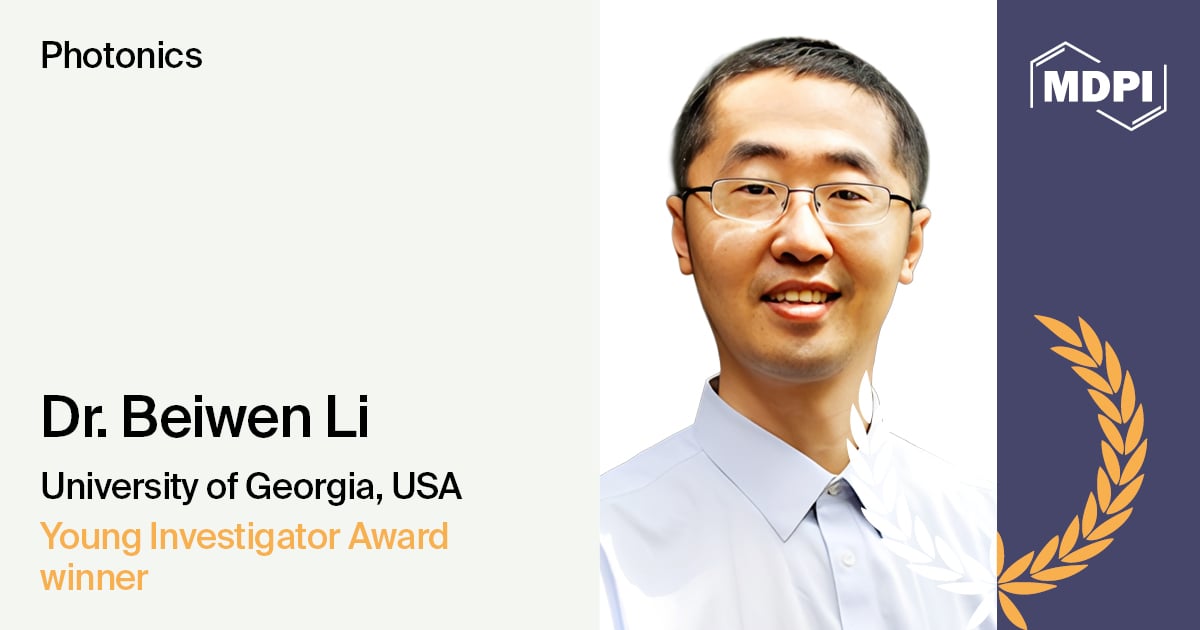
Interview with Dr. Beiwen Li—Winner of the Photonics Young Investigator Award
6 November 2026
- Congratulations again on winning the Photonics Young Investigator Award. Could you briefly introduce yourself and your main research interests?
My name is Beiwen Li, and I am an Associate Professor at the University of Georgia and a Fellow of SPIE.
My main research interests include optical metrology, 3D optical sensing, machine and computer vision, and optical fringe image analysis. I am also working on the application of optical fringe imaging techniques for in situ monitoring of manufacturing and remanufacturing processes. - How did you hear about this award, and what impact do you think such awards can have on a researcher’s career?
I first learned about the Photonics Young Investigator Award through internal email communications while I was serving on the journal’s Editorial Board.
I believe that awards of this kind are particularly inspiring for young researchers. Receiving external recognition can motivate researchers to continue pursuing exciting and innovative work. It can also help increase their visibility and recognition, both within their own institutions and in the broader optics and photonics community.
Such recognition allows young researchers to demonstrate the impact of their work and can positively contribute to their career development, while encouraging them to pursue further research achievements. - Could you describe your current research projects and their practical applications? What challenges have you encountered during the research process, and how have you overcome them?
I have worked in optical metrology throughout my research career, and it remains my primary area of interest. Recently, I have been gradually shifting my focus from fundamental research in optical metrology toward more applied research, particularly in manufacturing, remanufacturing, and agriculture.
One of the main challenges I have encountered is the difference between developing a technology in a controlled laboratory environment and applying it under real-world conditions.
In fundamental research, we often concentrate on developing novel theories and validating them experimentally. However, when these technologies are applied to practical applications, new challenges arise that may not have been apparent during the initial research.
For example, manufacturing environments are often much less stable than laboratory conditions. Similarly, agricultural applications involving field measurements introduce many uncertainties that are difficult to reproduce in a controlled setting.
These experiences have highlighted the importance of making optical metrology technologies more robust so that they can perform reliably in different environments and become genuinely useful for practical applications. - Which research topics do you think will receive particular attention from the research community in the coming years?
Optical sensing and optical metrology have been active research areas for many years, with significant progress in fundamental research.
Looking ahead, I believe that the intersection of optical metrology with other disciplines will become an increasingly important research direction.
As optical metrology technologies continue to mature and more companies become involved in their commercialization, obtaining funding for research focused solely on the fundamental technology may become increasingly challenging.
However, I see considerable opportunities in applying optical metrology to fields such as manufacturing and agriculture.
The integration of these technologies into practical applications is still relatively immature, and many important research problems remain unresolved. I believe these interdisciplinary areas offer promising opportunities for future research and development. - Do you have any advice for aspiring young researchers looking to make a meaningful impact in their respective fields?
I still consider myself a young researcher, but one thing I have reflected on is that, at the beginning of my career, I spent too much time working alone in my office.
Looking back, I believe I should have spent more time communicating with other researchers, particularly senior academics and people working in fields different from my own.
If I had done so earlier, I might have gained inspiration sooner for some of the research directions I am currently pursuing.
Therefore, my advice to young researchers would be not to limit themselves to working within their own offices or research groups. Instead, they should actively seek opportunities to meet and communicate with researchers from different disciplines, particularly those whose work may intersect with their own research interests.
Attending conferences, exchanging ideas, and developing professional connections can provide valuable inspiration and open new research opportunities.
I would also encourage young researchers to pursue opportunities for external recognition, such as the Photonics Young Investigator Award. - What are your thoughts on the open access (OA) publication model?
I believe that the Open Access publication model has both advantages and challenges.
One of its major benefits is that it makes scientific research more accessible, particularly to researchers in developing countries who may not have access to institutional journal subscriptions.
By allowing readers to access articles freely, open access can increase the visibility of research and help scientific findings reach a broader audience.
However, one challenge is that open access publishing often requires authors to pay publication fees.
For established researchers with sufficient research funding, these costs may not present a major difficulty. However, early career researchers who are just beginning their academic careers may have limited financial resources and need to carefully consider whether they can afford the publication fees.
Therefore, while I recognize the benefits of open access, I believe it is important to consider how we can better support young researchers and reduce the financial challenges associated with publication costs. - Do you have any thoughts or suggestions about how Photonics can further support young researchers and the academic community?
I believe that initiatives such as the Photonics Young Investigator Award are already valuable opportunities for recognizing and encouraging young researchers.
In addition to these awards, the journal could consider introducing special collections dedicated to emerging leaders in optics and photonics.
Such collections could encourage promising young researchers to contribute their work while providing them with additional visibility and recognition within the scientific community.
It would also be beneficial to consider waiving publication fees for contributions to these collections, as financial support could help early career researchers who have limited research funding.
The recognition provided through these initiatives would not necessarily need to take the form of another formal award. For example, researchers could be recognized as emerging leaders in their fields through their participation in these special collections.
I believe this combination of publication opportunities, financial support, and professional recognition could provide meaningful encouragement to young researchers. - Is there anyone you would especially like to thank as the winner of this award?
First of all, I would like to sincerely thank my PhD advisor, Professor Song Zhiyong, who nominated me for this award.
He has been extremely supportive throughout my career. Whenever I have questions, I can always reach out to him, and he provides valuable advice and insights. He has also consistently supported me by providing recommendation letters whenever needed.
I would also like to thank Professor Lin Zhiyong Yang from Oakland University, who provided the second recommendation letter for my nomination. As a senior researcher in my field, he has always been willing to support younger researchers, and I greatly appreciate his encouragement and assistance.
Finally, I would like to express my gratitude to my colleagues at the University of Georgia, as well as my former colleagues at Iowa State University.
They have provided valuable advice and guidance throughout my career, including helpful reminders whenever I needed to reconsider my direction or approach. I have greatly benefited from their support and have always enjoyed working with them.