
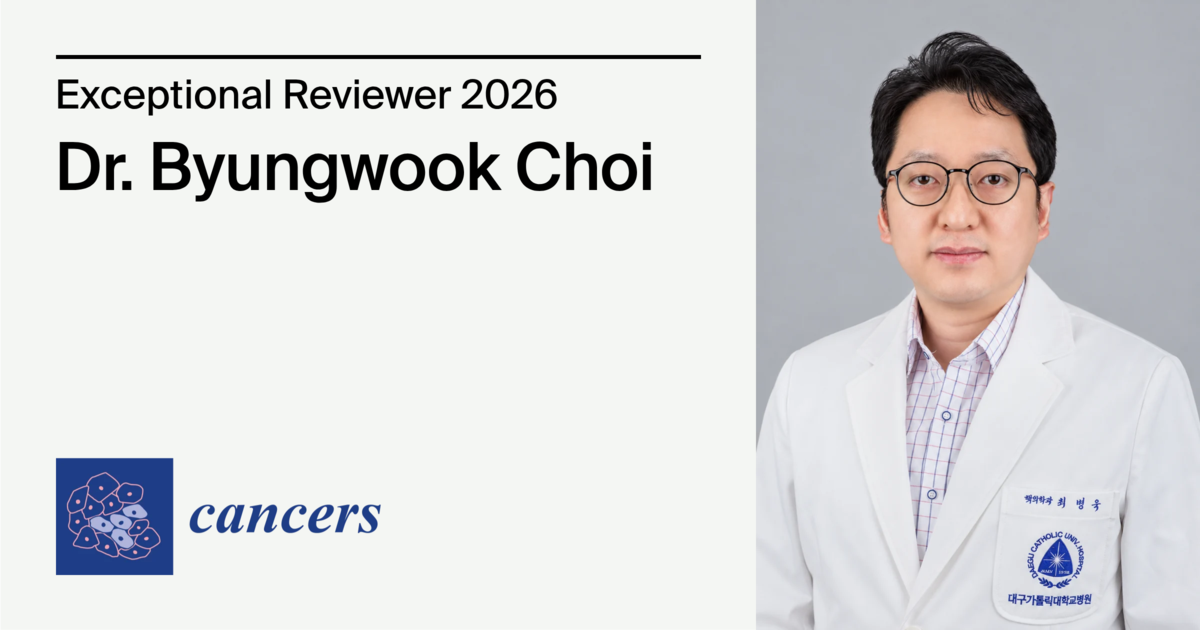
Interview with Dr. Byungwook Choi—Cancers Exceptional Reviewer 2026
To express our appreciation to our reviewers, the Editorial Office of Cancers (ISSN 2072-6694) will announce its Exceptional Reviewers each quarter. You can find the list of award recipients here: https://www.mdpi.com/about/announcements/16047.
We would like to congratulate Dr. Byungwook Choi (Daegu Catholic University) on being included in this list. He also shared his professional perspectives on the current peer-review process.
Dr. Byungwook Choi is an Associate Professor in the Department of Nuclear Medicine at Daegu Catholic University School of Medicine, Republic of Korea. His research interests include nuclear medicine, PET imaging in neurodegenerative diseases and oncology, particularly lymphoma, peripheral artery disease, and the clinical application of artificial intelligence in medical imaging.
He is particularly interested in quantitative imaging biomarkers, their clinical significance, and the translation of advances in medical imaging into clinical practice. As both a researcher and a peer reviewer, he values methodological rigor, scientific integrity, and the critical interpretation of research findings.
The following is an interview with Dr. Byungwook Choi:
1. What motivated you to become a reviewer for Cancers, and what do you find most rewarding about the peer-review process?
I initially became interested in peer review as another opportunity to learn. Beyond attending scientific meetings and conferences or pursuing independent study, reviewing manuscripts allows me to explore new research questions, methodologies, and perspectives that I might not otherwise encounter.
Over time, I came to appreciate that peer review is not simply about evaluating the work of others. Critically examining a manuscript also encourages me to reflect on my own research practices and scientific reasoning.
What I find most rewarding is the opportunity to contribute to improving the quality and reliability of scientific research. When my comments help authors recognize an important issue, clarify their findings, or strengthen their conclusions, I feel that I have made a meaningful contribution.
For me, peer review is both a responsibility to the scientific community and a continuous learning experience.
2. In your opinion, what are the key elements of a truly constructive and high-quality peer review report?
I believe that a high-quality peer review should be scientifically rigorous, fair, and constructive. Its purpose is not merely to identify weaknesses but to help authors improve their research and ensure that their conclusions are supported by the evidence.
When reviewing a manuscript, I try to distinguish fundamental methodological problems that may affect the validity of the findings from issues that can be addressed through clarification or reasonable revision. I believe reviewers should explain why a particular concern matters and, whenever possible, suggest practical ways to address it.
Importantly, requesting additional experiments or analyses does not necessarily make a review better. Such requests should be scientifically justified and relevant to the original research question.
Ultimately, the value of a review lies not in the number of criticisms raised but in how effectively those comments improve the scientific quality and clarity of the manuscript.
3. When evaluating a manuscript, what specific aspects (e.g., methodology, data integrity, novelty) do you pay the closest attention to?
When evaluating a manuscript, I place the greatest emphasis on methodological rigor and data integrity. Regardless of how interesting or novel a research question may be, the findings must be supported by reliable data, appropriate analytical methods, and scientifically sound interpretations.
I pay particular attention to study design, patient selection, potential sources of bias, statistical analyses, and the transparency and consistency of the reported data and results. Even subtle methodological weaknesses can substantially influence the interpretation of research findings.
Novelty is also important, but I do not believe meaningful scientific contributions must always come from entirely new ideas or technologies. Revisiting established research questions or existing data with a different, well-designed methodological approach can reveal important findings and provide valuable new insights.
Ultimately, I value research that produces trustworthy and meaningful evidence, whether its originality lies in the research question, methodology, or interpretation.
4. Looking ahead, what emerging field or breakthrough in cancer research are you most excited about?
I am particularly excited about the rapid advancement of artificial intelligence and its growing integration into clinical medicine. The pace of AI development has been truly remarkable, and I believe its potential impact on cancer research and patient care is substantial.
From my perspective, the greatest potential of AI lies not in replacing physicians but in enhancing their capabilities and advancing precision medicine. In oncologic imaging, AI can improve the consistency and reproducibility of quantitative assessments, including tumor segmentation and the measurement of metabolic tumor burden. It may also help integrate imaging findings with clinical and molecular information to support more individualized treatment decisions.
I believe AI will increasingly become a valuable partner in clinical practice, complementing physicians’ expertise rather than replacing their judgment. With rigorous validation and appropriate clinical integration, these advances could represent a major step forward in precision oncology.
5. From your perspective as an expert, what is one of the most critical gaps in current cancer research that needs more attention?
One of the most important gaps in cancer research, in my view, is our incomplete understanding of tumor heterogeneity, even among patients with the same histological diagnosis.
Large B-cell lymphomas, including diffuse large B-cell lymphoma, provide a good example. Differences in cell-of-origin subtypes, genetic alterations, and EBV-associated biology highlight the complexity of these diseases. However, we still do not fully understand how these molecular and biological factors interact with one another and the tumor microenvironment, or how their effects are reflected in PET imaging characteristics.
As a nuclear medicine physician, I find it particularly interesting that patients with the same type of lymphoma can exhibit markedly different metabolic activity, tumor burden, and disease distribution on PET. These imaging differences may be associated with treatment response and prognosis, yet their underlying biological mechanisms remain incompletely understood.
I believe integrating molecular imaging with pathological and genomic information will be essential to understanding this heterogeneity and translating these insights into more accurate prognostic assessments and individualized treatment strategies.
6. Cancers is a fully open access journal. What do you see as the primary benefits of open access publishing for the global oncology community?
I believe the greatest benefit of open access publishing is that scientific knowledge becomes accessible to researchers and clinicians regardless of their institutional resources.
During my own research, I have often encountered difficulties accessing articles published in subscription-based journals. I also serve on a committee that reviews journal subscription expenditures at my institution, where I have witnessed the increasing financial burden of subscription costs, particularly in the years following the COVID-19 pandemic.
From this perspective, I welcome the expansion of open access publishing. However, I also recognize that open access does not necessarily reduce the overall financial burden on academic institutions, as article processing charges may shift costs from accessing research to publishing it.
I believe the long-term success of open access will depend on sustainable and transparent publishing models that balance accessibility, affordability, and scientific quality. Ultimately, the goal should be to make reliable scientific knowledge widely available without creating new financial barriers for researchers or their institutions.
If you are interested in reviewing new research, please contact the Cancers Editorial Office. You can also apply to become a volunteer reviewer via the following link: https://www.mdpi.com/reviewers.
Cancers Editorial Office