
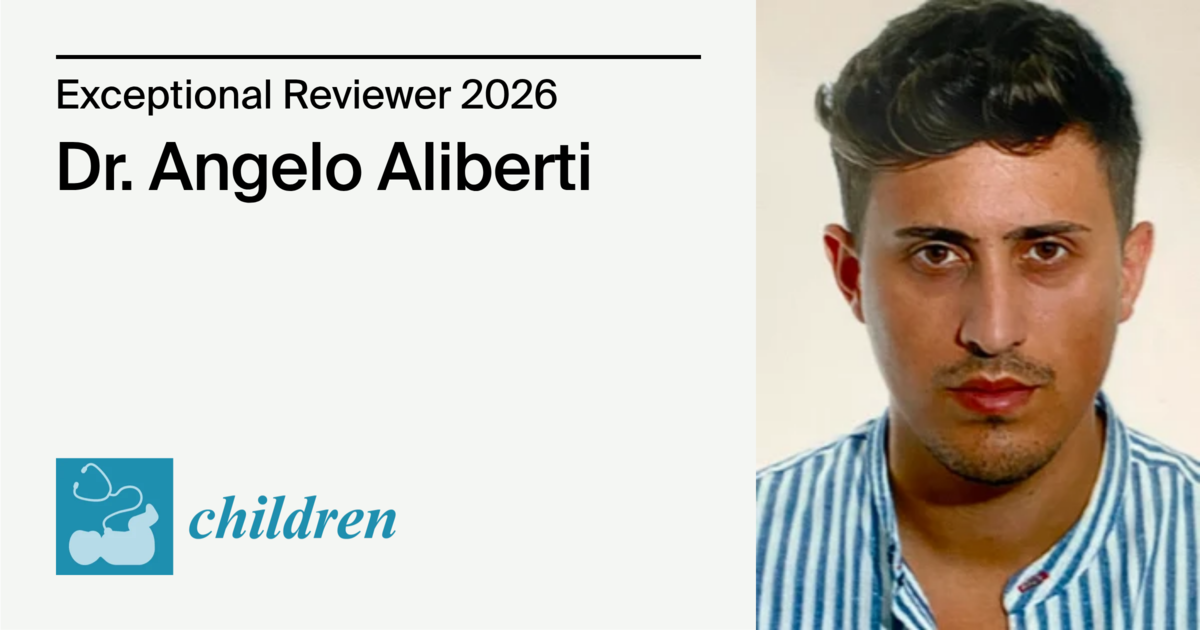
Interview with Dr. Angelo Aliberti—Children Exceptional Reviewer 2026
To thank our reviewers, the Children (ISSN 2227-9067) Editorial Office will announce our Exceptional Reviewers each month. You can get the award list here.
We wish to congratulate Dr. Angelo Aliberti (University of Naples Federico II) on this list. He also shared some professional opinions about the current peer-review process.
The following is an interview with Dr. Angelo Aliberti:
1. Could you briefly introduce yourself and your current research topic to our readers, as well as the important role of your research area in promoting children’s health?
I am Dr. Angelo Aliberti, a dentist and specialist in oral surgery at the University of Naples Federico II, Italy. My research activities primarily focus on oral surgery, implant dentistry, dental biomaterials, and the biological interactions between restorative materials and oral tissues.
A particular area of my research concerns the biocompatibility and potential biological effects of dental materials, including the release of chemical compounds from restorative materials under different experimental conditions. These investigations are especially relevant to pediatric dentistry, where the selection of safe and effective materials is essential for protecting developing oral tissues and supporting long-term oral health.
I believe that improving children’s oral health requires an integrated approach combining clinical evidence, materials science, preventive strategies, and biological research. Advancing our understanding of dental materials and their interactions with the oral environment can contribute to safer treatments, more informed clinical decisions, and better health outcomes for pediatric patients.
2. What criteria do you consider most important when evaluating a manuscript? How do you view the role of a reviewer in shaping the quality and integrity of newly submitted research?
When evaluating a manuscript, I consider scientific originality, methodological rigor, transparency, and clinical relevance to be fundamental criteria. Particular attention should be given to the appropriateness of the study design, the reliability of the statistical analysis, the consistency between the reported findings and the conclusions, and the extent to which the research contributes meaningful knowledge to existing literature.
I believe that peer review should be a constructive scientific dialog rather than merely a process of identifying weaknesses. Reviewers have a responsibility to critically assess the evidence while providing clear, respectful, and actionable recommendations that help authors strengthen their work.
An effective reviewer should remain objective, recognize the limitations of the available evidence, and distinguish between methodological concerns that compromise scientific validity and aspects that can be improved through clarification or revision. Ultimately, peer review plays an essential role in maintaining scientific integrity, promoting transparency, and ensuring that published findings provide a reliable foundation for future research and clinical practice.
3. What are your thoughts on the use of AI tools in the academic publishing industry, and what are your recommendations for ensuring quality control in the future?
Artificial intelligence is increasingly influencing academic research and publishing, offering valuable opportunities to support literature analysis, scientific writing, data processing, and editorial workflows. When used appropriately, these technologies may improve efficiency and facilitate certain aspects of scientific communication.
However, AI-generated content also raises important concerns regarding accuracy, reproducibility, transparency, and scientific accountability. In particular, the possibility of fabricated references, unsupported interpretations, and misleading scientific statements requires careful consideration.
I believe that AI should be regarded as a supporting instrument rather than a substitute for scientific expertise, independent judgment, or critical reasoning. Authors must remain fully responsible for the accuracy and integrity of their manuscripts, while reviewers and editors should critically evaluate the scientific content regardless of whether AI-assisted tools have been employed.
Looking ahead, academic publishing would benefit from clear policies regarding AI disclosure, appropriate verification procedures, and continued emphasis on methodological transparency. Most importantly, the scientific community should preserve human expertise and accountability as the foundations of trustworthy research.
4. What advice would you give to early career researchers who want to become strong peer reviewers? Or any suggestions for the current peer-review process?
My principal advice to early career researchers is to approach peer review as both a scientific responsibility and an opportunity for continuous professional development. Becoming an effective reviewer requires a solid understanding of research methodology, critical appraisal, and the ethical principles underlying scientific publication.
Young researchers should familiarize themselves with reporting guidelines, strengthen their knowledge of statistical methods, and develop the ability to evaluate scientific findings objectively. Reading high-quality publications and carefully examining how research questions, methodologies, and conclusions are connected can significantly improve reviewing skills.
I would also encourage early career reviewers to provide constructive, specific, and respectful feedback. A good review should not simply identify limitations but should explain their scientific implications and, whenever possible, suggest realistic improvements.
Regarding the peer-review process, I believe that greater recognition of reviewers’ contributions, structured mentoring opportunities, and clearer editorial guidance could further improve review quality. Supporting the professional development of young reviewers is particularly important for ensuring the long-term sustainability, independence, and scientific rigor of academic publishing.
Above all, I believe that reviewing should always be guided by intellectual honesty, scientific curiosity, and a genuine commitment to improving the quality of published research.
Please contact the Children Editorial Office (children@mdpi.com) if you also want to review some new research; you can also apply for the volunteer reviewer via the link here: https://www.mdpi.com/reviewers.
Children Editorial Office