
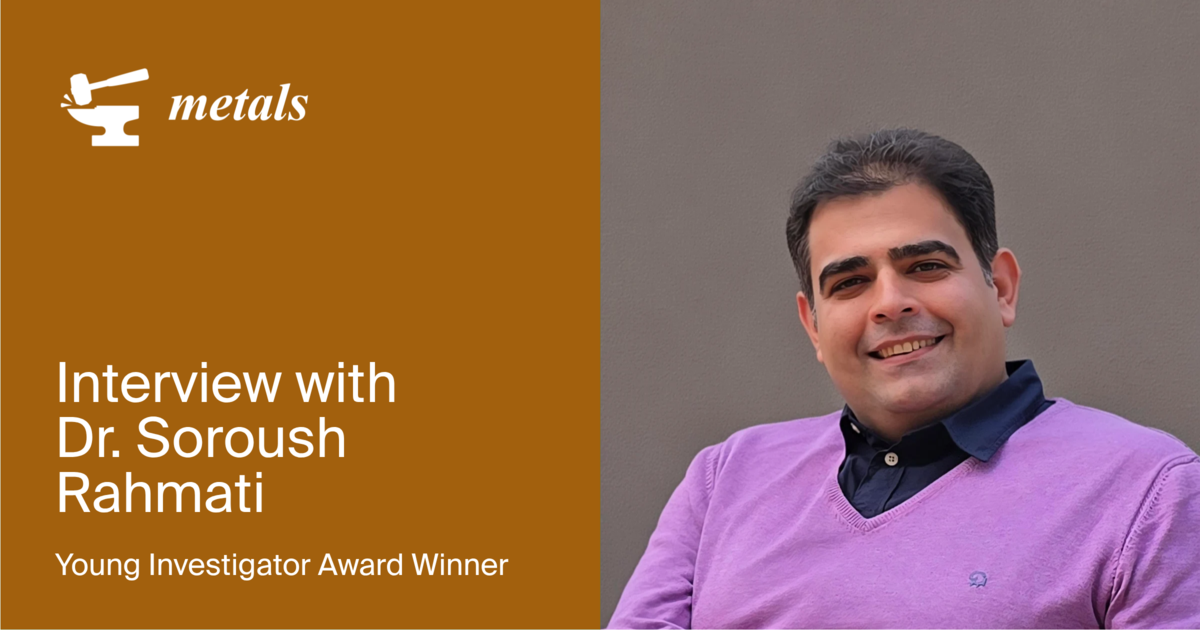
Interview with Dr. Soroush Rahmati—Winner of the Metals Young Investigator Award
1. Could you please briefly introduce yourself?
My name is Soroush Rahmati, and I am currently a researcher at the Department of Industrial and Information Engineering and Economics at the University of L’Aquila, Italy. I obtained my PhD in 2018, specializing in mineral processing and hydrometallurgy.
I have over 12 years of industrial experience in metal recovery from primary resources, particularly copper, lead, zinc, and iron ores, using techniques such as flotation, solvent extraction, and physical separation.
In 2022, I moved into academic research, focusing on hydrometallurgical processes for recovering valuable metals, particularly critical raw materials and precious metals, from secondary sources such as electronic waste and spent catalysts. My research includes the recovery of REEs (such as Nd and Pr), PGMs (particularly Pt and Pd), and valuable metals from spent batteries. Although the materials I work with have changed, my industrial experience still influences how I approach research, especially when considering whether a process can be applied beyond the laboratory.
2. What does receiving this award mean to you, both personally and professionally?
Receiving the Metals Young Investigator Award is a great honour, particularly given its international scope. Having spent much of my career in industry before moving into academic research, I find this recognition especially meaningful.
For me, one of the most rewarding aspects of being a researcher is knowing that the work you have dedicated your time and effort to is appreciated by other scientists. This award gives me a real sense of satisfaction, both personally and professionally. I am sincerely grateful to Metals for this recognition, which also encourages me to continue my research with greater confidence and motivation.
3. Which research topics do you think will be of particular interest to the research community in the coming years?
With the increasing demand for metals and the technical, economic, and environmental challenges associated with extracting primary resources, I expect metal recovery from secondary sources to attract even greater attention in the coming years.
Spent batteries, end-of-life NdFeB magnets, printed circuit boards, and spent catalysts are particularly promising because of their valuable metal content and the growing volumes of waste generated. For example, spent magnets can be an important source of REEs. However, recovering these metals efficiently is only part of the challenge. Secondary materials often have complex and variable compositions, and a process that performs very well in the laboratory may not necessarily be practical on an industrial scale.
One of the main research priorities will be developing selective, economically viable, and reliable recovery processes that can be implemented in industry. Progress in this area could make electronic waste and other metal-rich secondary resources an increasingly important part of securing the future supply of critical raw materials.
4. Could you tell us about your experience with Metals, either as an author, reviewer, or reader?
I have had the opportunity to work with Metals both as an author and as a reviewer, and both experiences have been valuable to me.
As an author, I appreciate the wider visibility that open access publishing offers. I have also benefited from the constructive comments received during peer review. Some of these comments have made me reconsider certain aspects of my research, look at the results from a different perspective, or explain my findings more clearly.
These experiences have also shaped the way I review manuscripts. I try to provide feedback that is thorough, fair, and genuinely helpful to the authors. Having been on both sides of the process, I know how valuable a thoughtful review can be. Identifying weaknesses is certainly part of reviewing, but helping authors strengthen their work is just as important.
5. What role do you think scientific journals such as Metals play in advancing research and fostering scientific exchange within the community?
Scientific journals have an important responsibility beyond publishing research findings. With the growing number of papers published every year, maintaining scientific quality through rigorous peer review and encouraging meaningful scientific discussion have become increasingly important.
In experimental research, for example, reporting a high metal recovery efficiency is valuable, but understanding why the process works, which factors control its performance, and where its limitations lie is equally important. I would like to see journals continue encouraging this kind of detailed scientific discussion, as it helps other researchers understand the findings and build upon them.
Journals such as Metals also provide a platform for researchers working on different materials and technologies to exchange ideas. Sometimes, an approach developed for one system can offer useful insights into a seemingly different problem. This is one of the ways scientific publishing can encourage new ideas and further research.
6. What advice would you give to graduate students, postdoctoral researchers, and other young scientists who are at the beginning of their academic careers?
My advice to young researchers is to take the time to understand a research problem thoroughly before moving too quickly into experiments. Even when a topic has been studied extensively, it does not mean that every question has been answered. Different researchers may approach the same problem from different perspectives, and sometimes looking at a familiar subject in a new way can lead to unexpected insights. This is something I find particularly fascinating about scientific research.
I would also encourage young researchers to study their systems systematically and pay attention to the reasons behind their observations. Rather than simply recording whether an experiment worked, try to understand why it worked, or why it did not. This deeper understanding often reveals gaps in existing knowledge and helps identify questions worth investigating further. Even a well-established method may have aspects that have not yet been fully explored.