
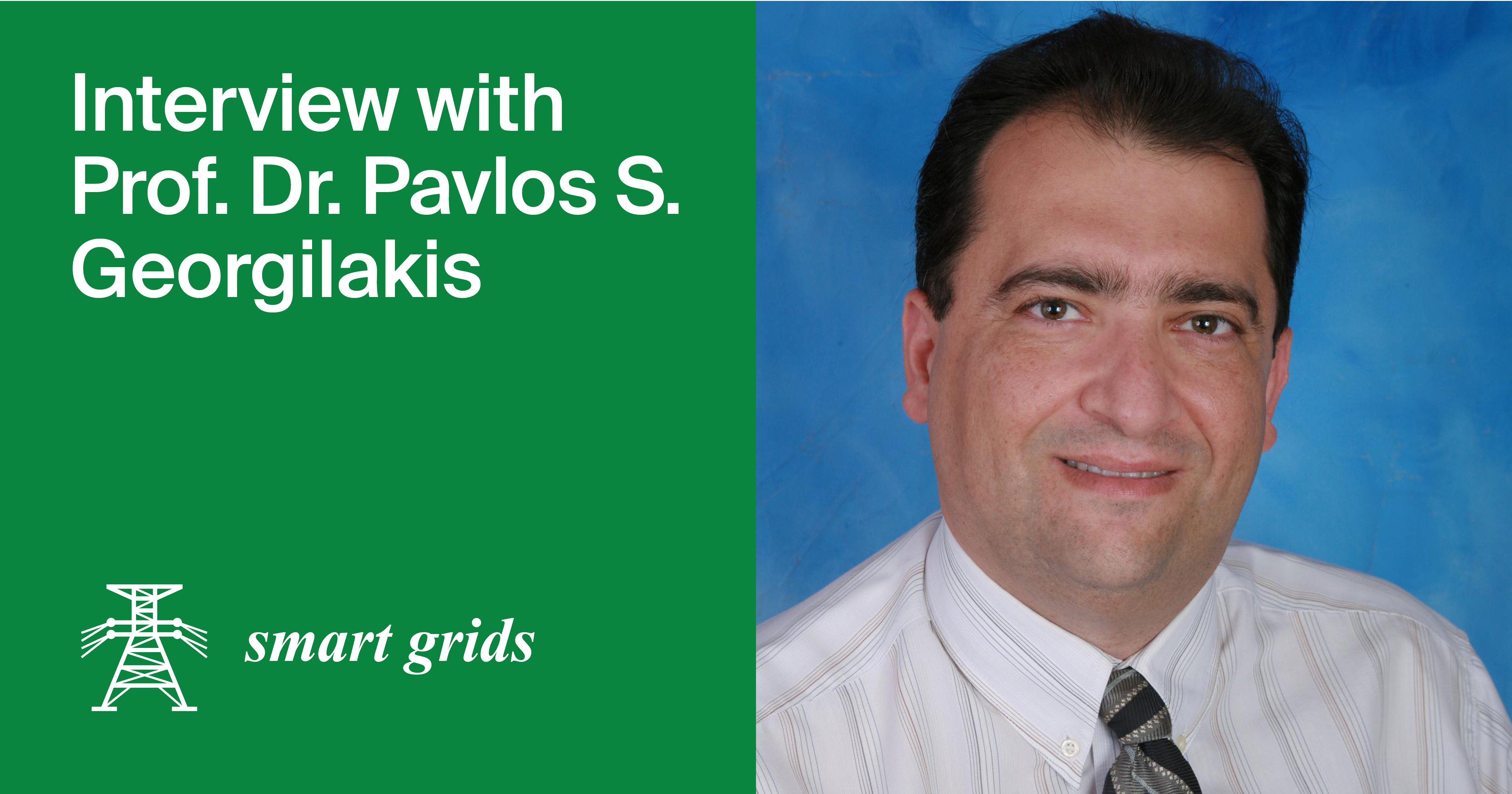
Prof. Dr. Pavlos S. Georgilakis Appointed Editor-in-Chief of Smart Grids
We are pleased to announce the appointment of Prof. Dr. Pavlos S. Georgilakis as Editor-in-Chief of Smart Grids (ISSN 3043-2723) and to share our interview with him.
Smart Grids is fortunate to have Prof. Dr. Pavlos S. Georgilakis as the Editor-in-Chief. We appreciate his trust in the journal and his willingness to contribute his expertise, vision and leadership to its development. We look forward to building a strong, internationally connected journal under his guidance.
The following is a short Q&A with Prof. Dr. Pavlos S. Georgilakis, who shared his vision for the journal with us, as well as his views of the research area:
1. Could you briefly introduce yourself and share a little about your academic journey and research background?
I am currently a Full Professor at the School of Electrical and Computer Engineering of the National Technical University of Athens (NTUA) in Athens, Greece, where I am a faculty member since 2009. I received the Diploma and Ph.D. degrees in electrical and computer engineering from the same University, in 1990 and 2000, respectively.
From 2004 to 2009 I was an Assistant Professor at the School of Production Engineering and Management of the Technical University of Crete (TUC) in Chania, Greece. From 1994 to 2003 I was with Schneider Electric AE, the Greek subsidiary of Schneider Electric, where I worked as quality control engineer, transformer design engineer, research and development manager, and low voltage products marketing manager.
I have always researched in the area of smart grids, particularly in optimization algorithms and computational intelligence techniques for the optimal operation and planning of smart distribution systems. My current research interests include smart grid management, distributed energy resources, energy storage management, artificial intelligence and data analytics, and smart grid optimal operation.
2. How do you see smart grids evolving in the coming years, and which trends deserve more attention?
I see smart grids evolving from largely passive systems into intelligent, flexible, and increasingly autonomous infrastructures. The growing integration of renewable energy sources, energy storage, electric vehicles, and prosumers will require advanced monitoring, real-time control, and closer coordination between transmission and distribution system operators.
Several trends deserve particular attention. First, artificial intelligence and digital twins can improve forecasting, predictive maintenance, and operational decision-making. Second, flexibility management, including demand response, local energy markets, and coordinated storage, will be essential for maximizing renewable energy integration. Third, cybersecurity and resilience must become fundamental design priorities as networks become more digitalized and interconnected. Finally, research should bridge the gap between theoretical advances and practical implementation, ensuring that innovations deliver measurable improvements in reliability, affordability, and sustainability.
3. Which emerging technologies or research directions do you think will shape the future of smart grids?
I believe that the future of smart grids will be shaped by the convergence of artificial intelligence (AI), advanced power electronics, distributed energy resources, and digital technologies. AI-driven control, predictive analytics, and digital twins will enable more accurate forecasting, autonomous operation, and faster fault detection. Grid-forming inverters, advanced energy storage, and coordinated electric vehicle charging will be crucial for integrating high shares of renewable energy while maintaining stability and power quality. Another promising direction is the development of local flexibility markets and advanced coordination mechanisms between transmission and distribution system operators. Equally important are cybersecurity, resilient communication infrastructures, and interoperable standards. Ultimately, research should combine technological innovation with practical implementation, ensuring that future distribution networks are not only smarter, but also more reliable, flexible, secure, and sustainable.
4. You have recently taken on the role of Editor-in-Chief of Smart Grids. What attracted you to this role, and what does this appointment mean to you?
Taking on the role of Editor-in-Chief of Smart Grids is both a great honor and an important responsibility. What attracted me most to this position is the opportunity to contribute to a rapidly evolving field that is fundamental to the global energy transition. Smart electric power grids are essential for integrating renewable energy sources, enhancing system flexibility and resilience, and ensuring a reliable, sustainable, and affordable electricity supply. I am particularly motivated by the opportunity to bring together researchers, engineers, and industry professionals from around the world to exchange knowledge and promote innovative solutions. This appointment represents a commitment to scientific excellence, interdisciplinary collaboration, and impactful research. I hope to help establish Smart Grids as an internationally recognized platform for advancing knowledge and shaping the future of intelligent electric power systems.
5. In your opinion, what role do academic journals play in scientific communication?
Academic journals play a fundamental role in scientific communication by providing a trusted platform for disseminating new knowledge, validating research findings through peer review, and fostering collaboration across disciplines and international research communities. They help transform individual research efforts into a collective body of knowledge that advances science and supports technological innovation. Beyond publishing results, journals encourage rigorous methodologies, constructive scientific debate, and the reproducibility of research. In rapidly evolving fields such as smart electric power grids, they are particularly important for connecting theoretical developments with practical applications and emerging societal needs. I also believe that academic journals have a responsibility to promote research integrity, inclusivity, and open scientific dialogue, ensuring that high-quality research reaches both the scientific community and the wider society it ultimately serves.
6. What advice would you give to researchers who are considering submitting their work to Smart Grids?
My advice to researchers considering submitting their work to Smart Grids is to focus on scientific quality, originality, and relevance to the evolving challenges of modern electric power systems. We welcome contributions that advance knowledge in areas such as renewable energy integration, distributed energy resources, microgrids, artificial intelligence, demand response, cybersecurity, and advanced control and optimization. I encourage authors to clearly articulate the novelty of their research, support their findings with rigorous methodologies, and explain the practical implications of their results. Equally important is the connection between theoretical advances and real-world applications. Above all, I invite researchers from different disciplines and countries to contribute their perspectives, share innovative ideas, and engage in constructive scientific dialogue. Our goal is to make Smart Grids a welcoming and respected platform for impactful research.
7. Finally, if you could give one message to the smart grids community as you begin your term as Editor-in-Chief, what would you like to say?
My message to the smart grids community is simple: let us work together to turn scientific innovation into meaningful progress towards a more sustainable, resilient, and intelligent energy future. The challenges facing modern power systems are too complex to be addressed by any single discipline or institution. We need collaboration among researchers, engineers, industry professionals, policymakers, and utilities, as well as stronger connections between theoretical advances and practical applications. As Editor-in-Chief, I am committed to fostering a scientific environment that values excellence, originality, integrity, and open dialogue. I warmly invite the international research community to contribute its ideas, share its discoveries, and engage with Smart Grids. Together, we can advance knowledge, accelerate innovation, and help shape the next generation of electric power networks.
We wish Prof. Dr. Pavlos S. Georgilakis every success in their new position, and we look forward to his contributions to the journal.