
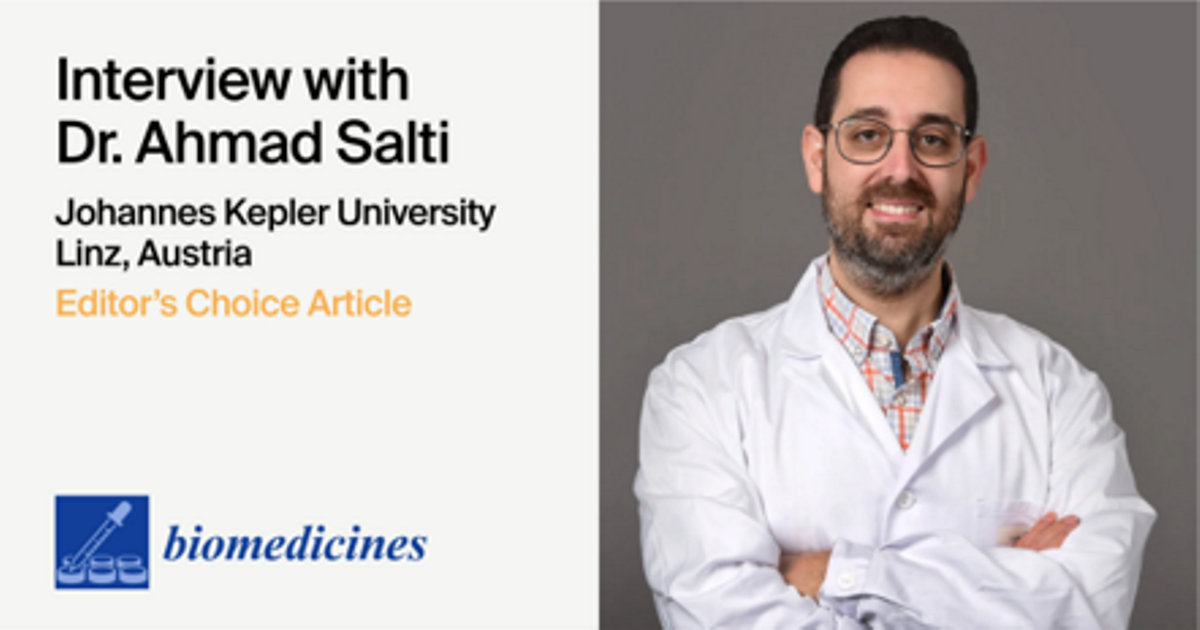
Biomedicines | Interview with One of the Authors of an Editor’s Choice Article—Dr. Ahmad Salti
Dr. Ahmad Salti is one of the authors of the Editor’s Choice Article titled “Single-Cell Transcriptomics on PRPF31-Mutated Retinal Organoids Reveal Early Müller Glial Activation and Progressive Photoreceptor Degeneration” published in Biomedicines (ISSN 2227-9059).
Ass. Prof. Ahmad Salti, Dr. Phil., is currently an Assistant Professor and leads the Research Group of Cellular and Molecular Ophthalmology at the University Clinic for Ophthalmology and Optometry in Johannes Kepler University Linz, Austria. Prof. Salti’s focuses on harnessing the potential of patient-specific cells for biomedical applications such as disease modeling and cell therapy of neurodegenerative diseases, particularly retinal dystrophies and Parkinson’s disease.
Below is an interview with Dr. Salti:
1. Congratulations on your published paper! Could you briefly introduce its main research content?
Thank you very much for selecting the paper as the Editor’s Choice. This paper presents the establishment of a human cellular in vitro model of PRPF31-associated retinal degeneration. We used commercially available patient-derived hiPSC lines that carry the c.1115-1125del11 PRPF31 mutation, and a healthy control iPSC line, to generate retinal organoids (ROs) following a 2D/3D protocol. These ROs from both lines were characterized through morphological, molecular, and functional analyses across early (day 60–90) and late (day 180–250) differentiation stages. The in vitro RO characterization revealed an early mis-organization of retinal layers with a more prominent disease phenotype at later stages as shown by a reduction in brush border length and photoreceptor markers. The single-cell RNA sequencing at both timepoints further confirmed these observations and unveiled unexpected early activation of Müller glial cells, progressive degeneration of photoreceptors, and stress signatures in inner retinal neurons.
2. Can you tell us about yourself and your current research?
I am currently an Assistant Professor and lead a small research group at the Ophthalmology department of JKU Linz. Our research in the laboratory aims to use the potential of stem cell-derived retinal organoids as human in vitro models to investigate the effects of different retinal dystrophy mutations on retinal cell degeneration and to understand the disease mechanism. We are also using retinal organoids to study the biocompatibility and efficiency of novel photovoltaic materials as potential material for retinal prostheses.
3. Would you mind sharing what inspired your research?
Vision is one of the most important sensory functions. It serves as the basis for our perception of the outside world and our ability to detect forms, images, colours and movement of objects. Any impairment of retinal neurons remains a leading cause of irreversible blindness worldwide. Disruption at different stages of image and information processing can lead to a spectrum of ocular disorders that profoundly diminishes quality of life. Our research on the retina using human models aims to dissect several aspects of the disease mechanisms, as in this paper with PRPF31 mutation and retinitis Pigmentosa, hoping to prevent or repair retinal degeneration and therefore restore vision to blind patients.
4. What was the biggest challenge you faced while writing this paper and how did you overcome it?
The biggest challenge was the data analysis. The scRNAseq technique provides a high amount of data that needs to be well analyzed for proper clustering and better interpretation of the results. To overcome this problem, we collaborated with a bioinformatician from another group in our university to help with data analysis.
5. How did feedback during your research influence your direction?
I consider constructive feedback to be very beneficial, and it can help in shaping the future direction of the research. For example, during the review process of our paper, a reviewer suggested including an isogenic control line in the comparison in order to improve the quality of the analysis. We are indeed now including such controls in our research.
6. What role did you play in your research team and how did teamwork affect the paper’s outcome?
My role as an Assistant Professor and leader of the research group is to ensure proper conduct of the experimental work and to guide and assist in the experimental design and research ideas. In our research group, each researcher has their own project and expertise. We meet on a regular basis to discuss our data and research and to share ideas and solve potential problems. All members of the group work as a team in order to achieve the goals of our research topics. When necessary, we collaborate with other departments to ensure high-quality research deliverables. In this paper, authors from different fields, including biology, ophthalmology, neuroscience, bioinformatics and electrophysiology, collaborated together to deliver high-quality research.
7. Why did you choose Biomedicines as a platform for publishing your work and how was your experience?
The scope of Biomedicines aligns very well with our research topic. In addition, I served as a Guest Editor for a Special Issue of the journal, and I know the efficient review process and the very good quality of papers that are selected for publication. Therefore, I did not hesitate to publish our paper in this journal and the experience did not disappoint.
8. What impact do you hope your research will have and what key innovation do you see in your paper?
I hope that this paper will advance our understanding one step further on the role of PRPF31 mutation on retinal degeneration. The key finding of this paper resides in the early activation of Müller glia in the disease effect, implying a role of early inflammation in the disease progression. This finding of course needs further investigation, but it might open further opportunities for therapeutic intervention.
9. What do you think the future directions for your research are?
Following this paper, further investigation and validation are needed. This includes the optimization of the in vitro model by using assembloid models combining both retina and brain organoids. Also, these results need to be validated on other patients, so additional stem cell lines derived from different retinitis pigmentosa patients, and their corresponding isogenic controls will be necessary.