
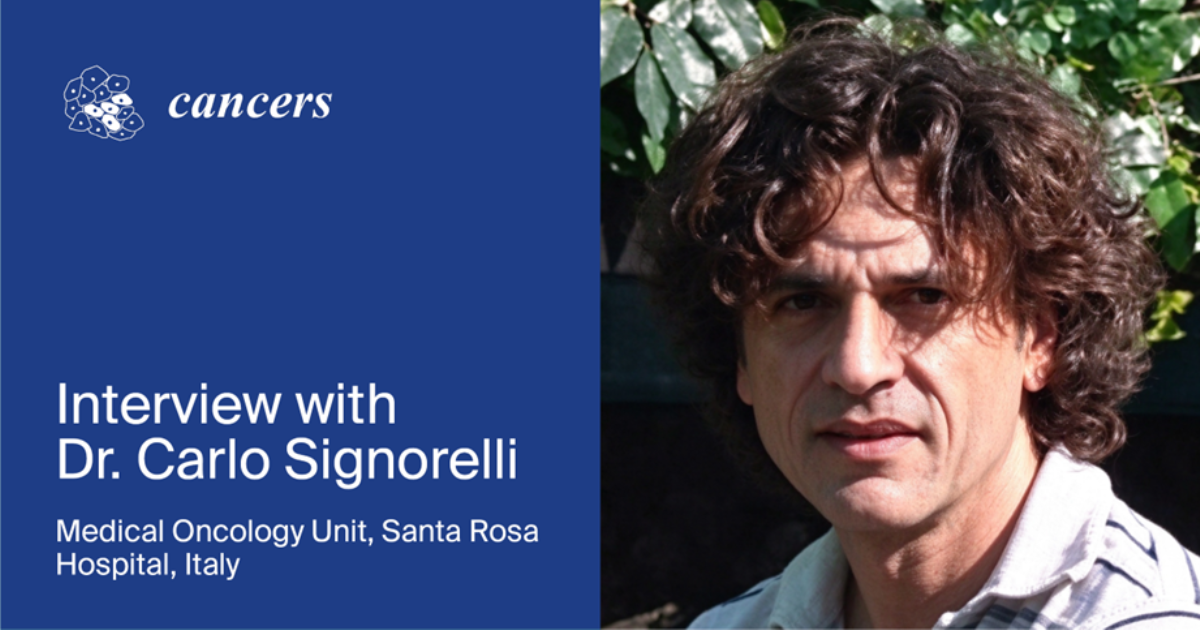
Interview with Dr. Carlo Signorelli—Editorial Board Member of Cancers
We are pleased to share the following interview with Dr. Carlo Signorelli, Editorial Board Member of Cancers (ISSN 2072-6694).
Dr. Carlo Signorelli is a medical oncologist at Santa Rosa Hospital in Viterbo, Italy. Most of his clinical and research work has been in gastrointestinal oncology, particularly colorectal cancer.
He has spent much of his professional life treating patients with cancer, which has inevitably shaped the way he looks at research. Over the years, he has seen treatments change, new drugs become available, and molecular testing take on an increasingly important role in clinical decisions. However, he has also learned that every patient is different and that applying the results of a clinical trial to an individual patient is not always straightforward.
Trying to understand how the knowledge gained from studies can be used to make better decisions for patients is what keeps him interested in clinical research.
The following is a short Q&A with Dr. Carlo Signorelli, who shared his vision for the journal with us, as well as his views on the research area.
1. As a senior scholar in your field, what initially motivated you to join the Editorial Board of Cancers?
I was pleased to be invited to join the Editorial Board of Cancers, mainly because I see it as an opportunity to take part in scientific discussion from a different perspective.
As clinicians, we rely on published research every day. We read papers, discuss new findings with colleagues, and try to understand whether they should change the way we treat our patients. Being involved in the editorial process gives me the chance to contribute to that discussion more directly.
I also like the fact that Cancers covers many different aspects of oncology. I work mainly in gastrointestinal cancers, but some of the most interesting ideas come from looking beyond our own field.
I hope I can bring a practical clinical perspective to the journal, particularly when evaluating research that may have implications for everyday patient care.
2. As an Editorial Board Member, what do you think is the key role of this position in advancing academic exchange?
For me, one of the most important aspects of this role is encouraging communication between researchers who may approach the same clinical problem in different ways.
In oncology, we are used to working together. When we discuss a complex case at a multidisciplinary meeting, the surgeon, the radiologist, the pathologist, and the oncologist may all see something different. Very often, it is precisely this exchange that helps us reach a better decision.
I think something similar happens in research. Sharing experiences, questioning established ideas, and discussing results openly are essential if we want to make progress.
I would also like to see more opportunities for young researchers to participate in this process. They often bring new questions and different ways of looking at familiar problems, and I think journals have an important role in giving them space.
3. In recent years, the use of AI tools (such as ChatGPT) in academic writing has attracted much attention. As an Editorial Board Member, how do you view the role of AI in academic publishing? How can we balance its convenience with preventing academic misconduct?
I think artificial intelligence is something we need to approach with an open mind, but also with a certain degree of caution.
There is no doubt that these tools can be helpful. They can make it easier to organize information, improve the language of a manuscript, or deal with some of the more repetitive aspects of scientific writing. For researchers who are not native English speakers, this can be particularly useful.
At the same time, I would be concerned if we started relying on AI to interpret scientific findings or formulate conclusions without carefully checking the results ourselves.
Writing a scientific paper is not simply about producing a well-written text. It involves understanding the data, recognizing the limitations of a study, and being able to explain why the findings matter. These responsibilities belong to the authors.
I do not think the answer is to discourage the use of AI altogether. What matters is being transparent about its use and making sure that researchers remain responsible for everything they publish.
In the end, a manuscript should reflect the authors’ own scientific thinking, regardless of which tools they used to prepare it.
4. As an Editorial Board Member, how do you evaluate the novelty and scientific value of a manuscript? What aspects do you value most during the peer review process?
When I review a paper, I usually start with a fairly simple question: does this study tell us something that is worth knowing?
Naturally, I look at the methodology, the quality of the data, and whether the conclusions are justified. These are essential aspects of any scientific work. But I also try to understand why the authors decided to investigate that particular question.
Not every valuable study needs to report a major breakthrough. In clinical oncology, we still face many questions that may appear relatively simple but are difficult to answer in practice.
For example, understanding which patients are most likely to benefit from a treatment, how to manage toxicity, or how best to sequence available therapies can be extremely useful.
I am also interested in real-world studies, provided they are carefully designed and their limitations are properly acknowledged. They cannot replace randomized trials, but they can help us understand what happens when treatments are used outside the controlled setting of a clinical study.
For me, a good paper is one that presents reliable data, acknowledges its limitations, and leaves the reader with a clearer understanding of the problem being investigated.
5. Considering your current research area (e.g., colorectal cancer/gastrointestinal cancers), what do you think will be the most promising or groundbreaking research direction in the next 3–5 years?
What has always interested me most about colorectal cancer research is the possibility of offering patients new treatment options while also trying to answer the questions we face every day in clinical practice.
Of course, the development of new drugs is exciting. Over the years, we have seen treatments become more effective and increasingly tailored to the molecular characteristics of individual tumors. But having more treatments available does not necessarily mean that choosing the best option for each patient has become easier.
In my daily practice, I often find myself thinking about how we can make better use of the treatments we already have, how to select patients more accurately, and how to decide on the most appropriate therapeutic sequence.
I believe these questions will become even more important in the coming years, particularly as molecular profiling, circulating tumor DNA, and new targeted therapies continue to develop.
What I hope is that research will help us move towards a more personalized approach, not only based on tumor biology but also on the patient’s clinical condition, previous treatments, and individual needs.
For me, this is where research becomes particularly meaningful: when scientific progress helps us make better decisions for the person sitting in front of us.
6. From your perspective as an expert, what is one of the most critical gaps in current cancer research that needs more attention?
If I had to choose one issue, I would probably say the difference between the patients we see in clinical trials and those we treat in our hospitals.
Clinical trials are essential. Without them, we would not have the treatments we use today. But anyone working in clinical oncology knows that patients in everyday practice are often more complex than those enrolled in studies.
Some are elderly, others have several medical conditions, and many have already received multiple lines of treatment. In these situations, choosing the next therapy is not always easy, even when we have good evidence from randomized trials.
This is particularly true in metastatic colorectal cancer, where treatment decisions become increasingly difficult as the disease progresses.
I think we need more research that reflects this complexity. Real-world studies can help, especially when they are conducted across different centers and collect reliable information on treatment outcomes, toxicity, and quality of life.
There is also another aspect that I feel deserves more attention: the patient’s own priorities. We often focus on response rates or survival outcomes, which are obviously important, but we should not forget how treatment affects daily life.
For me, good cancer research should help us answer not only whether a treatment works, but also for whom it works, at what cost in terms of toxicity, and whether it offers a meaningful benefit to the patient.