
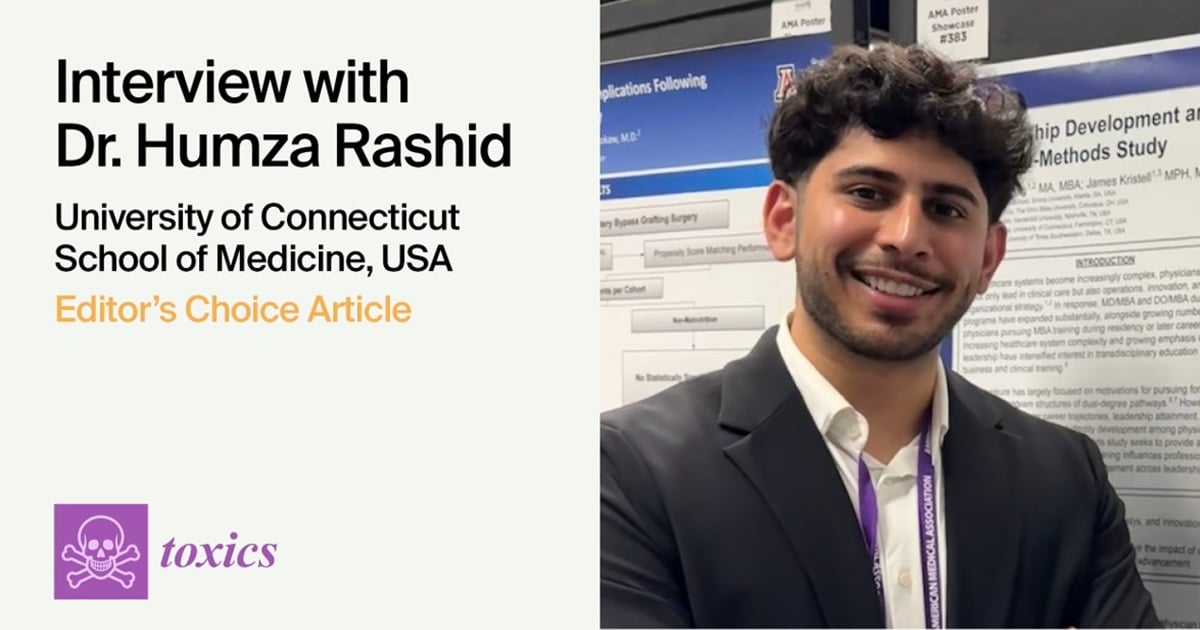
Toxics | Interview with One of the Authors—Dr. Humza Rashid
We had the pleasure of speaking with Dr. Humza Rashid, the first author of an Editor’s Choice Article in Toxics (ISSN 2305-6304). Here, he shares insights into his academic journey, research focus, and the motivation behind his recent work.
Article:
“Ultrafine Particles and Mortality: A Scoping Review of Epidemiologic Evidence and Exposure Assessment Limitations”
by Humza Rashid, Edward Wilson, Haya Alhmly, Amy A. Hunter, Wig Zamore, Misha Eliasziw and Doug Brugge
Toxics 2026, 14(8), 664; https://doi.org/10.3390/toxics14080664
Dr. Humza Rashid is an MD/MPH candidate at the University of Connecticut School of Medicine and Harvard T.H. Chan School of Public Health, and an MBA graduate of Emory University’s Goizueta Business School. Based in the Department of Public Health Sciences at UConn School of Medicine, his research sits at the intersection of environmental health, cardiovascular medicine, and health systems strategy. His work spans in-home air filtration and cardiovascular risk, cardio-oncology, and AI-derived imaging biomarkers from routine CT scans. He presented an early version of this scoping review at the 2025 Joint ISEE–ISES International Conference on Environmental Epidemiology. He previously conducted molecular parasitology research on Toxoplasma gondii at Boston College.
The following is an interview with Dr. Humza Rashid:
1. Could you please briefly introduce the main research content of the published paper?Our scoping review mapped the epidemiologic evidence linking mortality to ambient ultrafine particles (UFPs), defined as particles smaller than 100 nanometers, with particular attention to how studies measured exposure. UFPs reach deep into the lungs, enter the bloodstream, and drive inflammation, oxidative stress, and endothelial dysfunction, yet ambient air quality standards still do not regulate them. Following PRISMA-ScR guidelines, we screened 704 articles from PubMed and Scopus and included 21 studies published between 2007 and 2025: 14 on short-term exposure and 7 on long-term exposure.
Key findings:
- A majority of studies reported positive associations with mortality (10 of 14 short-term and 6 of 7 long-term), most consistently for respiratory deaths;
- Reported UFP size ranges varied by instrument, from 10–100 nm to 3–800 nm, limiting comparability across studies;
- Studies using higher-resolution or source-specific exposure methods tended to report stronger associations.
These findings suggest that pooling studies that define a “particle” in fundamentally different ways may mask a consistent pattern, which helps explain why recent meta-analyses found null or low-confidence pooled estimates. The field needs standardized measurement before quantitative synthesis can do its job, and we present the link between exposure resolution and effect size as a hypothesis to test.
2. Could you tell us a little bit about yourself and your current research?
My research keeps returning to one question from different angles: how do we detect cardiovascular risk earlier, and how do we build systems that act on it? With Dr. Doug Brugge, I am now leading an analysis of whether in-home HEPA air filtration changes blood lipids, which extends our earlier HEPA trial on blood pressure to another pathway linking air pollution and heart disease. At Emory Radiology, I am writing a scoping review on AI models that extract multi-organ risk phenotypes from routine non-contrast CT. It asks a question similar to this paper’s: when one scan can yield many biomarkers, which ones carry distinct prognostic information and which are redundant? I also work on clinical trial governance at UConn Health, and my MBA and ongoing MPH training shape how I think about turning findings into programs that health systems will actually adopt.
3. How do you evaluate research trends in this field, and what advice would you give to early career researchers who are interested in this research area?
Exposure science is moving in the right direction. Mobile monitoring, machine learning models, and source apportionment now produce estimates at the scale of a city block rather than a metropolitan region, and long-term studies in our review that used 50–100 m models reported some of the largest associations. What the field still lacks is harmonization: until studies agree on instruments, size cutoffs, and reporting increments, each new study adds evidence that is hard to combine with the last. My advice to early career researchers is to learn the measurement before the statistics. Read methods sections and supplements closely, find out which instrument produced the numbers and where its lower size cutoff sat, and ask how exposure was assigned to each participant. Most of what I learned on this project came from comparing those details across 21 papers. Finally, treat heterogeneity as information: when studies disagree, the reasons often point to the next study worth doing.
4. Why did you choose Toxics as a platform for publishing your work, and how was your experience? Would you consider publishing your future research in Toxics?
Toxics reaches both toxicologists and epidemiologists, and our paper needed both audiences. The case for UFPs rests on mechanistic evidence of inflammation, oxidative stress, and translocation across biologic barriers, while our argument about exposure assessment speaks directly to population researchers. The editorial process was efficient: we submitted in June and the paper was published about six weeks later, after thorough and constructive peer review. I would gladly publish in Toxics again, particularly as our HEPA air filtration work continues.
5. How do you think the open access way of publishing impacts authors?
Open access matters most for research that people outside academia need to read. Our coauthor Wig Zamore represents the Somerville Transportation Equity Partnership, a community partner in this work, and the neighborhoods most exposed to UFPs rarely have journal subscriptions. Open access lets residents, advocates, local health departments, and regulators read the full evidence for themselves. For authors, it means a wider readership and faster engagement, including from colleagues at institutions without broad library access.
First, standardized UFP measurement and its path toward regulation. The European Union’s revised Ambient Air Quality Directive introduces UFP monitoring requirements, and harmonized protocols will decide whether those data can eventually support health-based standards. Second, source-specific effects. Fresh traffic emissions appear more harmful than aged secondary aerosols, and highways, airports, and industrial corridors each produce distinct particle mixtures that deserve their own evidence base. Third, disparities. Only a few studies in our review examined differences by race, income, or immigration status, yet those that did reported larger associations in disadvantaged groups. Fourth, interventions. Indoor filtration, building design, and land-use planning can reduce exposure now, and randomized trials like our HEPA work can show whether those reductions translate into better health. Finally, I expect more work linking UFP exposure to intermediate markers of organ damage, including imaging biomarkers extracted automatically from routine scans, which could shorten the long follow-up that mortality studies require.