
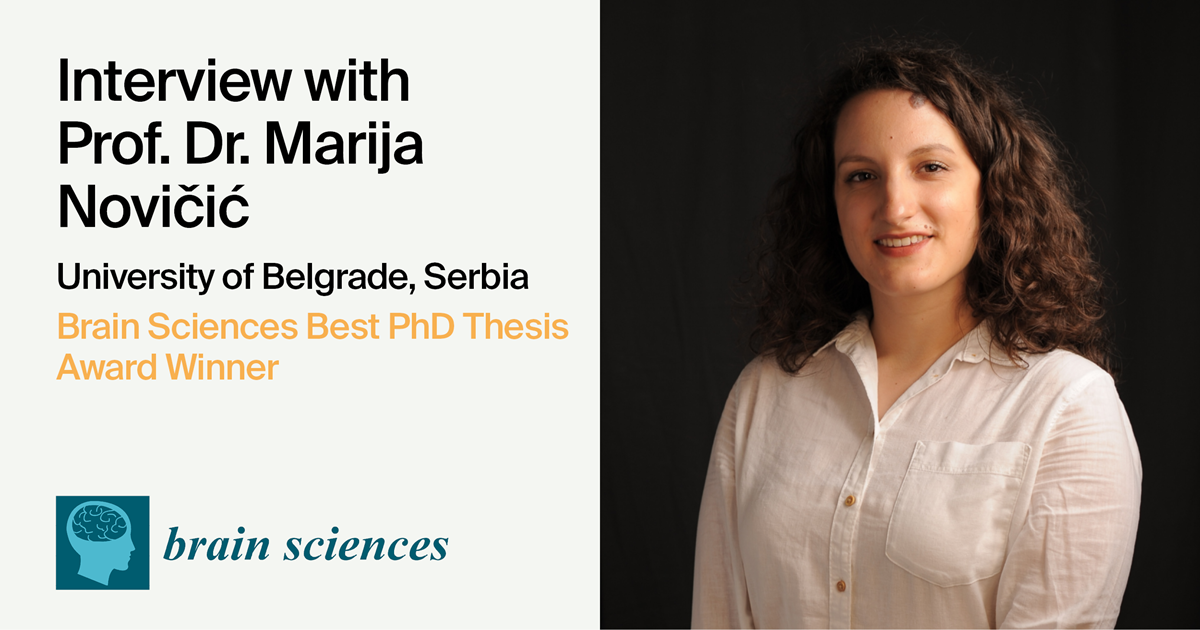
Interview with Dr. Marija Novičić—Winner of the Brain Sciences Best PhD Thesis Award
1. What motivated you to pursue a PhD in your field?
During my studies, I became fascinated by how the brain and the nervous system work. At the same time, it was important to me that my work as an engineer could have a meaningful impact on people’s lives. Neural engineering and neurorehabilitation seemed like a perfect combination of these two interests, bringing together engineering and technology with the possibility of helping people. This is what ultimately motivated me to pursue a PhD in this field.
2. Could you give us a brief overview of your research topic, and what motivated you to pursue it?
My PhD research focused on developing a new brain–computer interface paradigm based on somatosensory event-related potentials evoked by electrical stimulation. The main idea was to investigate whether selective attention to somatosensory stimuli could be detected from EEG signals and potentially used for BCI control in post-stroke neurorehabilitation. I had the opportunity to enter this research field thanks to Dr. Andrej Savić, who involved me in the HYBIS project—Hybrid Brain Computer Interface for Control of Sensory-Motor Coupling in Post-Stroke Rehabilitation. My main motivation throughout the research was the possibility that our work could eventually contribute to technologies that have a real impact on patients’ recovery.
3. How did you manage your time and prioritize your tasks during your PhD program, and what strategies did you use to stay focused and motivated?
Balancing my PhD research with my responsibilities as a teaching assistant at the university was not always easy. For me, the most important strategy was good organization and setting realistic short-term goals. Instead of constantly focusing on the final goal of completing a PhD, I tried to divide the work into smaller tasks and concentrate on what needed to be done next. Reaching these smaller milestones gave me a sense of progress and helped me stay focused and motivated throughout the process.
4. What were some of the biggest challenges you faced during your PhD journey, and how did you overcome them?
The biggest challenge was data collection. In addition to healthy participants, my research included patients undergoing post-stroke rehabilitation at the Dr. Miroslav Zotović Clinic for Rehabilitation. Working with patients was particularly challenging because their availability was limited and the experimental procedure sometimes required more time and explanation. This part of my PhD required a lot of patience and flexibility, but it was also one of the most valuable parts of the entire experience.
5. Looking back, is there anything you would do differently during your PhD?
Overall, I am very pleased with how the whole PhD process went. The one thing I would do differently is start writing my thesis much earlier. I spent most of my time focusing on experiments, data analysis, publications, and other research activities, and left most of the thesis writing until the end. Looking back, I would write each part as the corresponding research was being completed. Leaving the writing until the final stage made the end of my PhD much more demanding and time-consuming than it needed to be.
6. What advice would you give to students starting or coming to the end of their theses?
For students who are just starting, my advice would be to start writing early and document their work carefully along the way. Do not think of writing as something that begins only when the research is finished. For those approaching the end, my advice would be to recognize when it is time to finish. In research, there is always another experiment to perform, another analysis to conduct, or another question to answer. At some point, you need to stop searching for what else could be added and recognize that you already have a complete research story. There will always be opportunities to explore the remaining questions in future work.
7. How did you become familiar with Brain Sciences, and what prompted you to apply for this award?
I first became familiar with Brain Sciences when Dr. Andrej Savić and I published our paper, “Somatosensory Event-Related Potential as an Electrophysiological Correlate of Endogenous Spatial Tactile Attention: Prospects for Electrotactile Brain-Computer Interface for Sensory Training”, in the journal in 2023. The scope of Brain Sciences is closely aligned with my research interests, and my experience with the journal during the publication process was very positive. When I learned about the Best PhD Thesis Award, I felt that the topic of my dissertation was a very good fit with the journal’s scope, which encouraged me to apply. I am very grateful that my work was recognized with this award.
8. Finally, how do you plan to continue building on your research in the future, and what are your long-term career aspirations?
I plan to continue my academic career and research in neural engineering, building on the knowledge and experience I gained during my PhD. In the long term, I would like to continue developing as both a researcher and an educator, contribute to advances in neural engineering, and strengthen interdisciplinary and international collaborations. I find the combination of research and teaching especially rewarding, as it allows me not only to work on new scientific challenges but also to share knowledge and work with the next generation of engineers and researchers.