
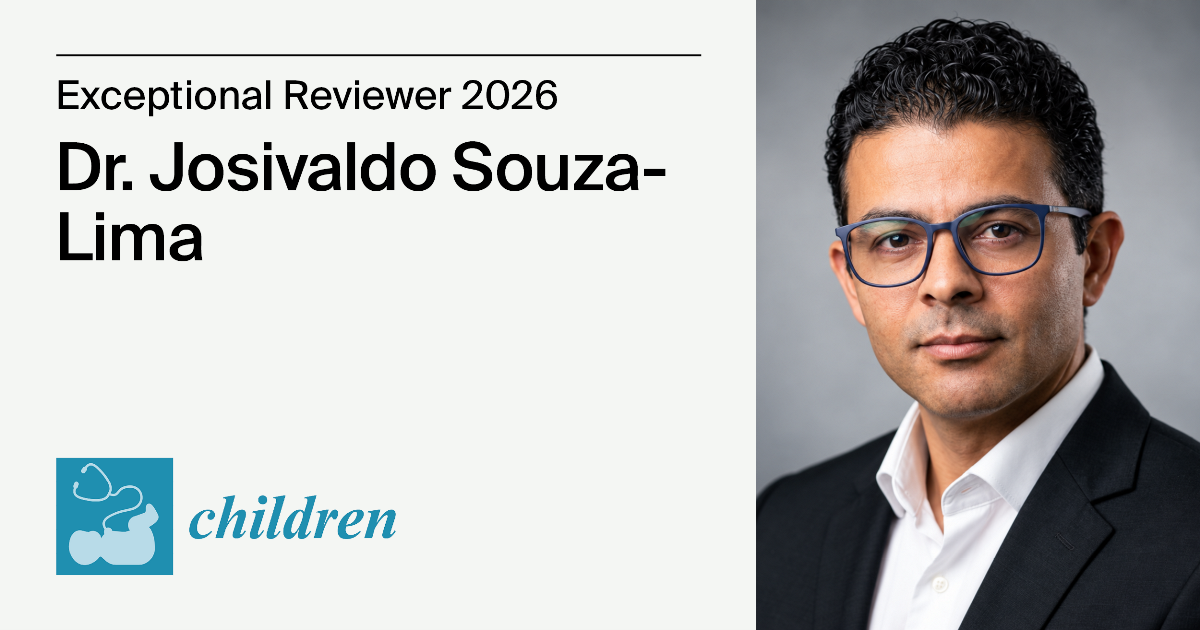
Interview with Dr. Josivaldo Souza-Lima—Children Exceptional Reviewer 2026
To express our appreciation to our reviewers, the Children (ISSN 2227-9067) Editorial Office will announce its Exceptional Reviewers each month. You can find the list of award recipients here: https://www.mdpi.com/about/announcements/15639.
We would like to congratulate Dr. Josivaldo Souza-Lima (Universidad Andrés Bello) on being included in this list. He also shared his professional perspectives on the current peer-review process.
The following is an interview with Dr. Josivaldo Souza-Lima:
1. Could you briefly introduce yourself and your current research topic to our readers, as well as the important role of your research area in promoting children’s health?
I am a professor and researcher in sport sciences, physical activity, and health at Universidad Andrés Bello in Chile, with a particular interest in children and adolescents. My research focuses on understanding how physical activity, school environments, health behaviors, and social factors are associated with physical, psychological, and educational outcomes. I am especially interested in population-based research and in identifying inequalities that may influence opportunities for children to be active and healthy. This area is important because childhood is a critical period for establishing behaviors and experiences that can influence health across the life course. Generating robust evidence can help schools, health professionals, and policymakers design more inclusive and effective strategies to promote physical activity, well-being, and healthy development.
2. What criteria do you consider most important when evaluating a manuscript? How do you view the role of a reviewer in shaping the quality and integrity of newly submitted research?
When evaluating a manuscript, I focus primarily on the relevance of the research question, methodological rigor, transparency of the analyses, consistency between the results and conclusions, and the contribution of the study to the existing literature. I also pay close attention to ethical issues, reporting quality, and whether the limitations are adequately acknowledged. I see peer review as more than a process of identifying weaknesses. A reviewer should provide constructive, respectful, and technically justified feedback that helps authors strengthen their work. At the same time, reviewers have an important responsibility in protecting the scientific integrity of the literature by identifying methodological problems, unsupported interpretations, and issues that could compromise the reliability of the evidence.
3. What are your thoughts on the use of AI tools in the academic publishing industry, and what are your recommendations for ensuring quality control in the future?
AI tools can be valuable in academic publishing when they are used responsibly. They may assist researchers and reviewers with language improvement, organization of information, literature exploration, or other supportive tasks. However, they should not replace scientific judgment, methodological expertise, or the responsibility of authors, reviewers, and editors. In peer review in particular, confidentiality must be carefully protected, and unpublished manuscripts should not be uploaded to AI systems unless their use is explicitly permitted and appropriate safeguards are in place. Transparency regarding AI use is also important. In the future, quality control should combine appropriate technological support with strong editorial oversight, clear policies, methodological expertise, and human accountability. Ultimately, responsibility for scientific decisions must remain with researchers and editors.
4. What advice would you give to early career researchers who want to become strong peer reviewers? Or do you have any suggestions for the current peer-review process?
I would encourage early career researchers to approach peer review as both a scientific responsibility and an opportunity for continuous learning. A good review should be structured, evidence-based, respectful, and focused on helping authors improve their manuscript. Reviewers should remain within their areas of expertise, distinguish major methodological concerns from minor issues, and avoid requesting unnecessary analyses or citations. Keeping up to date with methodological and reporting guidelines is also essential. For the peer-review system more broadly, I believe that journals should continue investing in reviewer training, recognition, and clearer guidance. Constructive reviews benefit not only authors and journals, but also the reviewer, because critically evaluating research is one of the best ways to improve one’s own scientific practice.
If you are interested in reviewing new research, please contact the Children Editorial Office. You can also apply to become a volunteer reviewer via the following link: https://www.mdpi.com/reviewers.
Children Editorial Office