
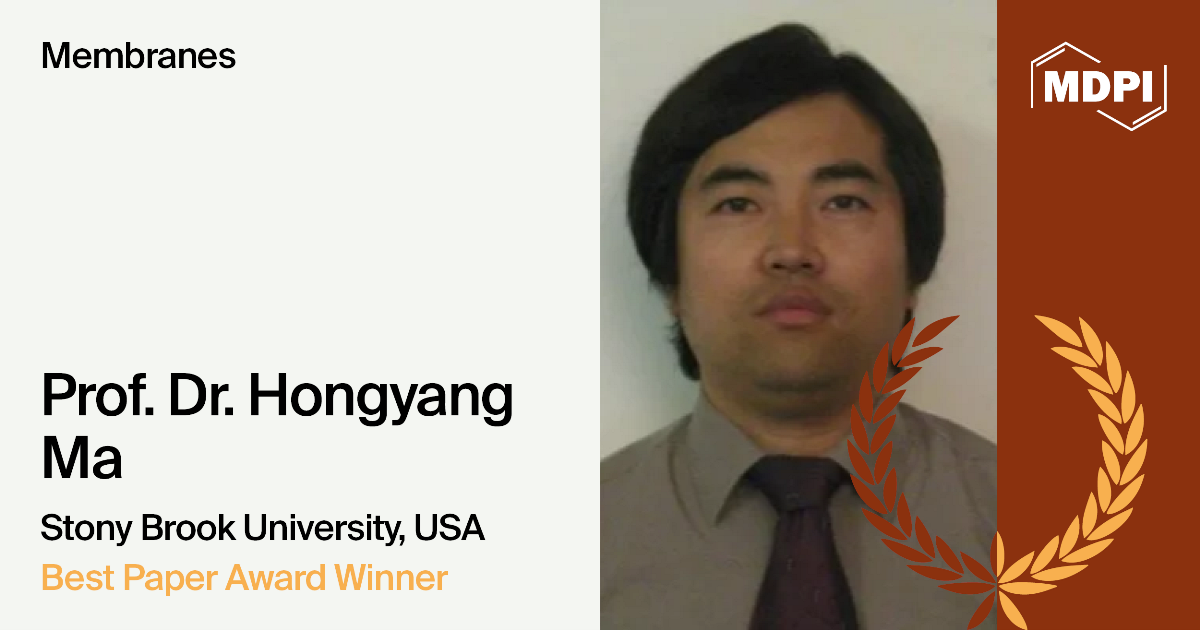
Interview with Prof. Dr. Hongyang Ma—Winner of the Membranes Best Paper Award
1. Could you introduce yourself or your research group? What role did you play in your research team, and how did teamwork affect the paper’s outcome?
My research group is dedicated to the fabrication of highly efficient membranes for water purification and water electrolysis, employing novel material designs. As the PI, I lead the group in developing newly designed materials for a wide range of membrane applications.
2. Could you tell us the core question that this review paper addresses? What are the current challenges in the anion exchange membranes research field, and how can they be addressed?The core question this review addresses is: how can we design anion exchange membranes (AEMs) that simultaneously achieve high hydroxide conductivity and long-term alkaline stability—to meet the practical requirements of AEM-based electrochemical devices such as water electrolyzers and fuel cells? Our review systematically summarizes strategies to address these challenges: (1) Molecular design of cations: developing alkaline-stable headgroups such as piperidinium, imidazolium with steric protection, and metal-cation-based structures; (2) Backbone engineering: using aryl-ether-free backbones (polyphenylene, polystyrene, polyolefin) to avoid ether-bond cleavage; (3) Morphology control: block copolymer architecture and crosslinking strategies to form well-connected ionic channels with restrained swelling; (4) Device-level integration: linking membrane properties to AEM water electrolyzer performance, and outlining benchmarks for commercialization. In summary, our review provides a critical overview of the structure–property–performance relationships in AEMs, offering researchers a roadmap for rationally designing next-generation AEMs toward durable, low-cost hydrogen production technologies.
3. Given the number of papers published in this field, as a review article, what was your core criterion for selecting which studies to cite and which to leave out? How did you ensure that a balanced and forward-looking selection of the vast literature from this field was included in this article?(1) Establish a clear, systematic selection framework; (2) address the “balanced and forward-looking” aspect explicitly; and (3) acknowledge the inherent limitation.
4. Why did you choose to publish with Membranes, and how was your experience?We prefer to publish research papers in Membranes because it is a specialized journal in the field of membrane science and technology. The experience was great.
5. What trends and technologies do you see shaping the future of membrane technology in the energy field?The development trend of membranes for water electrolysis is toward anion exchange membranes (AEMs), and the design and synthesis of new membrane materials will be a key focus of future research.
6. As a Best Paper Award recipient, what message or advice would you share with future authors who aim to submit high-quality research to Membranes?I advise future authors to not only solve today’s problems but to anticipate tomorrow’s challenges. Consider how advanced tools like machine learning and data science can be applied to membrane design and process optimization, and how your work aligns with sustainability and circular economy principles. Membranes is a platform that welcomes such forward-thinking studies, so framing your research in the context of broader global goals can make it stand out.