
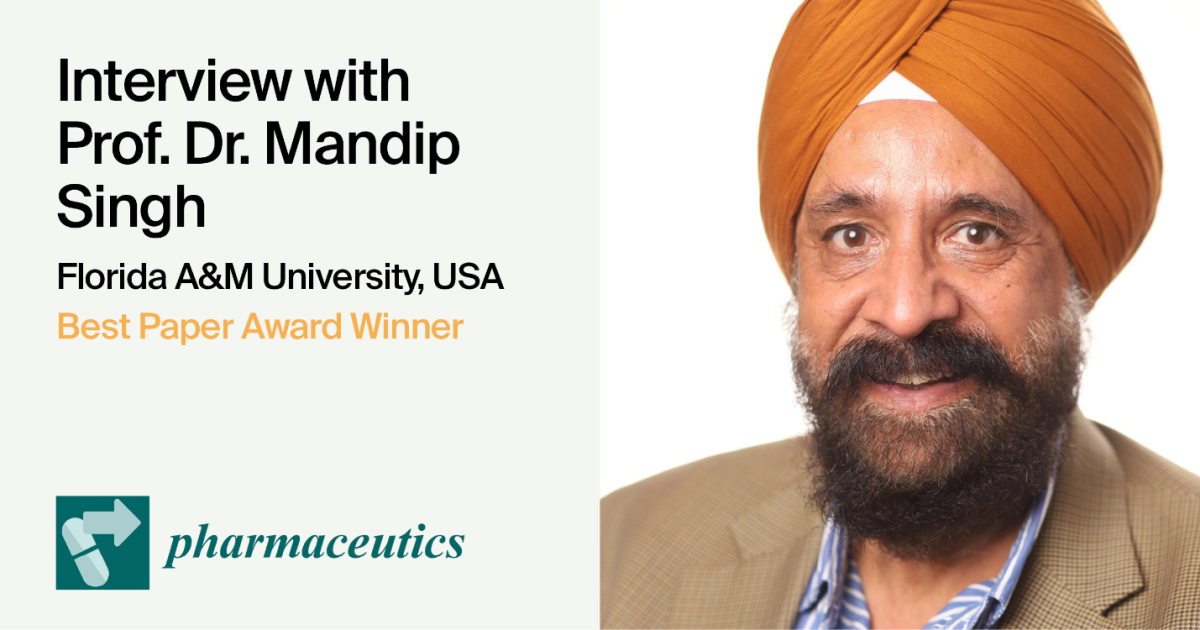
Interview with Prof. Dr. Mandip Singh—Winner of the Pharmaceutics Best Paper Award
All papers published in 2024 in Pharmaceutics (ISSN 1999-4923) were considered for the Pharmaceutics 2024 Best Paper Award.
After a thorough evaluation of the originality and significance of the papers, citations, and downloads, the following winner was selected:
“Combined Role of Interleukin-15 Stimulated Natural Killer Cell-Derived Extracellular Vesicles and Carboplatin in Osimertinib-Resistant H1975 Lung Cancer Cells with EGFR Mutations”
by Aakash Nathani, Li Sun, Islauddin Khan, Mounika Aare, Arvind Bagde, Yan Li and Mandip Singh
Pharmaceutics 2024, 16(1), 83; https://doi.org/10.3390/pharmaceutics16010083
Available online: https://www.mdpi.com/1999-4923/16/1/83
1. Congratulations on receiving the Pharmaceutics Best Paper Award! To start, could you briefly introduce yourself and tell us about the winning paper—its title, focus, and the main question you sought to answer?
Thank you very much. I am a Professor and Section Leader of Pharmaceutics at Florida A&M University. My research has focused on drug delivery, nanotechnology, extracellular vesicles, and the development of translational therapeutic approaches, particularly for cancer.
The award-winning paper, “Combined Role of Interleukin-15 Stimulated Natural Killer Cell-Derived Extracellular Vesicles and Carboplatin in Osimertinib-Resistant H1975 Lung Cancer Cells with EGFR Mutations”, investigated whether extracellular vesicles derived from activated natural killer (NK) cells could provide a novel approach for treating drug-resistant lung cancer.
Osimertinib has significantly improved the treatment of EGFR-mutated non-small-cell lung cancer; however, acquired resistance remains a major clinical challenge. We therefore asked whether the natural antitumor activity of NK cells could be harnessed in a cell-free form through NK-cell-derived extracellular vesicles, and whether these vesicles could enhance the activity of carboplatin against osimertinib-resistant cancer cells.
We stimulated NK cells with interleukin-15 (IL-15) and characterized the extracellular vesicles they produced, including their expression of NK-associated cytotoxic proteins, such as perforin and granzyme B. We then evaluated their anticancer activity alone and in combination with carboplatin. The study demonstrated that NK-derived extracellular vesicles retained biologically relevant antitumor properties and supported the concept that they could be developed as a therapeutic platform for treatment-resistant cancers.
What particularly interested us was that these vesicles are not simply passive drug carriers. They possess intrinsic biological activity inherited from their parent NK cells, while also providing a nanoscale platform that can potentially be engineered to carry additional therapeutic molecules.
2. Have you or your team continued to explore questions that arose from this paper? Are there follow-up studies or new directions that have emerged from these findings?
Yes. In fact, this paper became an important foundation for a much broader NK-exosome research program in our laboratory.
One of the questions that emerged was whether we could go beyond the intrinsic anticancer activity of NK-derived extracellular vesicles and use them as engineered delivery vehicles for therapeutic nucleic acids. We subsequently investigated NK-derived extracellular vesicles for the delivery of selected microRNAs, including miR-5193 and miR-149-5p, targeting pathways associated with tumor progression, immune escape, and drug resistance, including PD-L1/PD-1 and FOXM1. We have extended these studies into osimertinib-resistant lung cancer models and patient-derived tumor models and have continued to investigate their combination with chemotherapy.
A second major question was one that affects the entire extracellular vesicle field: how do we produce enough functionally active exosomes for translation? Conventional culture methods can provide relatively limited EV yields. We therefore developed approaches combining biophysical and microenvironmental stimulation to enhance NK-exosome production. This work has evolved into our ECHO platform, which incorporates electrical stimulation and controlled hypoxic conditions to increase exosome production while maintaining their functional properties.
We are also extending the NK-EV platform to other difficult-to-treat malignancies, including pediatric brain tumors, and investigating their ability to deliver therapeutic microRNAs and other agents. Thus, what began as a study of IL-15-stimulated NK-EVs in resistant lung cancer has evolved into a broader effort involving EV engineering, therapeutic cargo delivery, combination therapy, and scalable manufacturing.
For me, this progression is particularly exciting because it illustrates how an initial biological observation can develop into a pharmaceutical platform with potential applications across multiple cancers.
3. Receiving the Best Paper Award is a significant achievement. What does this award mean to you personally and professionally?
It is a tremendous honor, and I am very grateful to Pharmaceutics for this recognition.
Personally, the award is especially meaningful because this research represents the collective effort of our students, postdoctoral researchers, collaborators, and colleagues. Research of this nature requires expertise from several disciplines, and the success of the paper reflects that teamwork.
Professionally, I view the award as recognition of an area of research that we have continued to develop substantially since the original publication. Extracellular vesicle therapeutics are still an emerging field, and many scientific, pharmaceutical, and manufacturing questions remain to be solved. Recognition of this work reinforces our belief that NK-cell-derived extracellular vesicles represent an important and potentially versatile therapeutic platform.
At the same time, awards are milestones rather than endpoints. The most meaningful outcome would be to see concepts originating from this research eventually translated into better therapeutic strategies for patients with treatment-resistant cancers.
4. For many of our readers, publishing high-impact work is an important goal. What advice would you offer to researchers, particularly early career scientists, about designing studies, writing manuscripts, or navigating the publication process?
My first advice is to focus on an important scientific question rather than on publishing a paper. Strong publications usually result from strong questions. Before beginning a study, researchers should be able to clearly explain what gap exists in current knowledge, why that gap matters, and how their experiments will address it.
Second, design the study as a complete scientific story. Individual experiments can be interesting, but impactful research usually requires multiple complementary lines of evidence. Appropriate controls, rigorous characterization, mechanistic understanding, reproducibility, and meaningful biological models are extremely important.
Third, keep the manuscript focused. Scientific writing should make it easy for the reader to understand the problem, the innovation, the major findings, and why those findings matter. Complexity should come from science when necessary and not from writing.
I also tell young researchers not to be discouraged by critical reviews or rejection. Peer review is an integral part of science. Some of the most useful reviewers are those who identify weaknesses that we did not initially recognize. If a reviewer raises a valid scientific concern, addressing it can make the eventual publication substantially stronger.
Finally, I encourage early-career investigators to think across disciplines and collaborate. Modern pharmaceutics increasingly intersects cell biology, immunology, engineering, molecular biology, computational science, and clinical medicine. Our NK-EV research itself would not have developed in the same way without bringing together concepts from several of these areas.
5. Finally, what message would you like to share with the Pharmaceutics community—readers, future authors, and fellow researchers—as our newly recognized Best Paper Award winner?
I would first like to thank the editors, reviewers, and readers of Pharmaceutics for this recognition and for creating a forum in which emerging concepts in pharmaceutical science can be critically evaluated and shared with the scientific community.
This is an exceptionally exciting period for pharmaceutics. Our field is expanding beyond conventional drug-delivery systems toward increasingly sophisticated platforms involving extracellular vesicles, nucleic acid therapeutics, targeted nanoparticles, biologics, cell-derived systems, and personalized therapies. At the same time, we must remain focused on the fundamental principles of pharmaceutics, reproducibility, characterization, stability, scalability, safety, and ultimately clinical translation.
To young investigators and future authors, I would encourage you to remain curious and to pursue ideas that may initially appear unconventional. Some of the most interesting research directions begin with a relatively simple question and then evolve in unexpected ways. Our own NK-EV program is an example: an investigation into the therapeutic potential of IL-15-stimulated NK-derived vesicles has subsequently expanded into engineered therapeutic cargo delivery and strategies for scalable exosome production.
Finally, I accept this recognition on behalf of all the students, postdoctoral fellows, collaborators, and colleagues who contributed to this work. Science is a collective endeavor, and mentoring the next generation of scientists and watching them develop new ideas is one of the most rewarding aspects of an academic career. I hope that our work contributes, even in a small way, to advancing extracellular-vesicle therapeutics and ultimately to developing better treatments for patients with cancers that remain difficult to treat.