
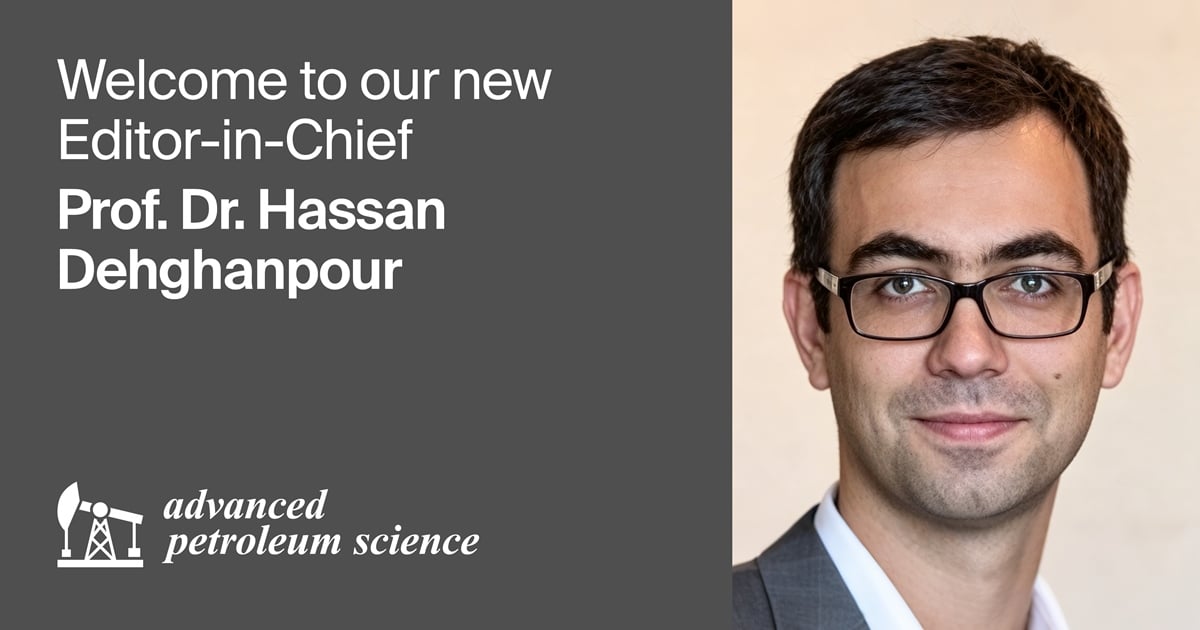
Prof. Dr. Hassan Dehghanpour Appointed Editor-in-Chief of Advanced Petroleum Science
We are pleased to announce that Prof. Dr. Hassan Dehghanpour has been appointed as Editor-in-Chief of Advanced Petroleum Science (ISSN 3043-1603).
Name: Prof. Dr. Hassan Dehghanpour
Affiliation: Department of Civil and Environmental Engineering, University of Alberta, Edmonton, AB, Canada
Interests: hydraulic fracturing; enhanced oil recovery; reservoir characterization; wettability evaluation; multiphase flow in porous media; underground hydrogen storage
Prof. Dr. Hassan Dehghanpour is a Professor and Co‑Director of the School of Petroleum Engineering, Senior Research Chair in Subsurface Energy Systems, and Co‑lead of the Center for Hydrogen Innovation, Workforce Development and Outreach at the University of Alberta. He is a pre-eminent mid‑career scholar globally recognized for pioneering research in unconventional reservoir engineering.
His research focuses on multiphase porous-media fluid flow, integrating experimental testing, microscopic characterization (SEM/AFM), and mathematical modelling to advance hydraulic fracturing, enhanced oil recovery (EOR), and subsurface energy development. His key research themes include tight reservoir wettability evaluation, petrophysical correlation, pore structure characterization, gas huff‑n‑puff flooding, PVT phase analysis, and surfactant flooding optimization for low-permeability unconventional formations.
Internationally, he is best known for his groundbreaking work on flowback transient analysis for multi-fractured horizontal wells. He developed widely adopted field workflows that integrate flowback rate, pressure, and salinity data to characterize complex fracture networks, forecast post-flowback production, and interpret fracturing fluid retention mechanisms, supporting sustainable flowback water reuse. He also proposed and validated the influential triple-porosity model, which incorporates matrix, secondary natural fractures, and primary hydraulic fractures, significantly improving flow simulation accuracy for fractured tight reservoirs.
A leading figure in North American unconventional petroleum research, he has an h-index of 41, over 6,500 citations, and more than 170 peer-reviewed publications in top journals including SPE Journal, Energy & Fuels, and Fuel. His prestigious professional honors include serving as an SPE Distinguished Lecturer (2019–2020) and receiving the SPE A Peer Apart award. He currently serves as an associate editor for multiple leading petroleum engineering journals and regularly chairs key SPE technical sessions, actively driving disciplinary development.
Strongly connecting academia and industry, his findings have guided the field development of Canada’s major tight oil and gas plays (Montney, Duvernay), optimizing fracturing design and EOR field operations. His research is continuously funded by NSERC, Alberta Innovates, and industrial partnerships. In recent years, he has expanded his research to low-carbon subsurface energy, covering underground hydrogen storage in salt caverns, produced water treatment and recycling, and AI-driven energy data analytics to improve operational efficiency and economic performance.
The following is a short Q&A with Prof. Dr. Hassan Dehghanpour, who shared his vision for the journal with us, as well as his views on the research area and open access publishing:
1. What unique qualities of Advanced Petroleum Science attracted you to accept the role of Editor-in-Chief?
The learning and innovation challenges we are facing in the oil and gas industry are fundamental to our current situation. For sustainable development, how do we manage extraction? Generally, because the easy-to-access, high-carbon resources have already been produced, we are now limited to very challenging underground reservoirs. We need new materials and new technologies. On top of that, we are limited to underground formations for resources and energy—and not only for production, but also for energy storage. I think the time is right to advance this, and we really need to do so.
2. What is your vision for Advanced Petroleum Science over the next three to five years?
I hope that we will be able to publish high-quality articles. My aspiration is that the emerging areas will be highly cited and acknowledged by the community. I hope that the journal can be included in related databases as soon as possible.
3. How do you define the scope of Advanced Petroleum Science, especially regarding the balance between traditional petroleum topics and emerging energy transition fields?
I think to have a successful energy transition, we must build on traditional petroleum topics. Since all emerging topics require material resources and energy, and currently we are limited to hydrocarbon resources for energy, we have to build on the existing technologies. We have included additional portfolio topics regarding the transition. I would consider it “energy addition” rather than “energy transition”, because as the world grows; to address challenges related to energy poverty, security, and accessibility, we need to add more energy resources on top of existing ones. So, of course, both the additional and the existing topics must be addressed.
4. How do you view the current state and future of open access publishing in the petroleum sciences?
You know, most of the research grants and general funding programs for research activities are from the government, so essentially from taxpayers. It is very important for us to ensure the public has access to the outcomes of the research they pay for. Strategically, it is very critical for us to publish in open access journals. This ensures that people with different levels of expertise and from different parts of society can access the research results.
5. What do you see as the most promising future directions in petroleum science, and how will Advanced Petroleum Science help lead the way?
As I mentioned, we are limited to underground resources in terms of materials and energy, and we need to develop new types of technologies for deeper drilling—specifically for drilling deeper wells for more efficient extraction of hydrocarbons through novel materials such as diamond particles. For more efficient recovery of hydrocarbons, you often need new technologies. Underground energy storage in the form of hydrogen and other forms such as ammonia, etc., which are considered very effective energy sources nowadays. So, we are in a very interesting era in terms of the sustainable use of subsurface formations for diverse applications. I would say material science will be the key in the coming years.
6. What advice would you give to researchers who are considering submitting their work to Advanced Petroleum Science?
I know researchers have many options to publish their research, but I encourage them to look at our aim and scope and to see if there is any opportunity to publish their research in this journal. We have a diverse and technical editorial team that will provide detailed review comments to improve their work. So, it is not only a platform for open access publication, but we will help them to improve the quality of their papers, and we also make sure to promote their published papers to a broad audience to get the required leadership and impact in the field.