
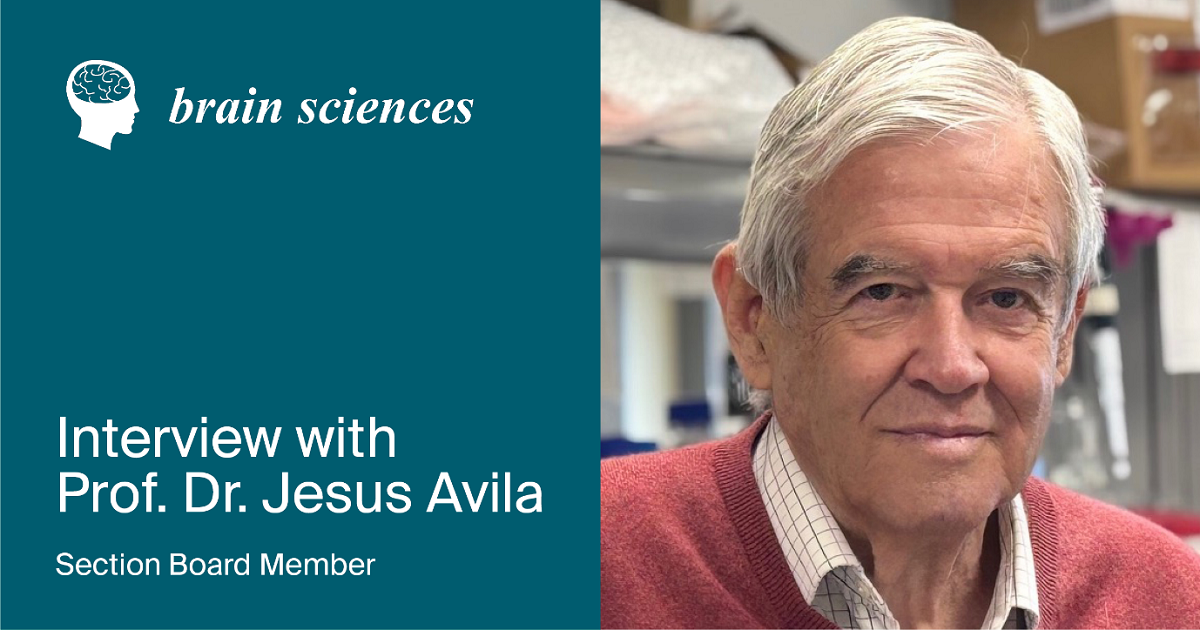
Brain Sciences | Interview with Editorial Board Member—Jesús Avila
Prof. Dr. Jesús Avila was the Director of the Centro de Biología Molecular Severo Ochoa (CBM) in Madrid, Spain, and has also been associated with CIBERNED. Over the last forty years, he has dedicated his research to studying the neuronal cytoskeleton, focusing primarily on the tau protein’s role in neurodegenerative disorders, particularly tauopathies like Alzheimer’s disease.
1. Can you briefly introduce your research and what motivated you to work in this area?
My main research interest is the neuronal cytoskeleton and how it changes during aging and in neurodegenerative disorders such as Alzheimer’s disease, with a particular focus on the tau protein.
My interest in this field began with the study of microtubular proteins. Since tubulin, the main component of microtubules, is especially abundant in neurons, I became interested in neuronal microtubules at a time when microtubule-associated proteins were first being discovered. This led me to investigate these proteins, particularly tau, and its role in tauopathies, including Alzheimer’s disease.
2. What do you think about the development of open access in the publishing field?
I believe that the development of open access has been highly beneficial. It allows scientific information to be disseminated more widely and rapidly, making research findings accessible to a broader audience and facilitating scientific progress.
3. What about the journal made you want to take on the role of Editorial Board Member?
I was motivated by the opportunity to support the publication of high-quality, innovative research in my field of expertise and to contribute to maintaining the journal’s scientific standards.
4. In your view, what makes a particular topic timely and important for the research community right now?
Research is driven by important new discoveries. Significant findings in any area can reshape our understanding of a field and open new avenues of investigation. Such advances are always relevant to the scientific community and often stimulate widespread interest (fashions) and further research.
5. What advice would you offer to young researchers?
I would encourage young researchers to pursue original and innovative questions. It is equally important to conduct research rigorously, ensuring that experiments are carefully designed, results are thoroughly validated, and conclusions are supported by solid evidence.