
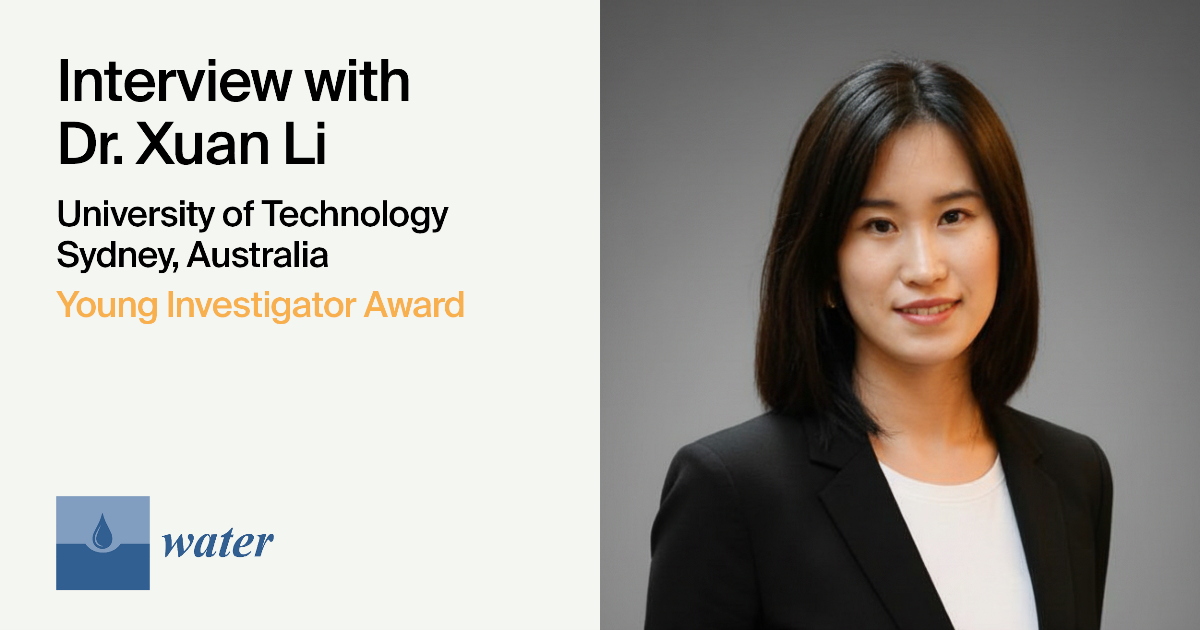
Interview with Dr. Xuan Li—Winner of the Water Young Investigator Award
Water (ISSN 2073-4441) is proud to present the first prize of the Water Young Investigator Award to Dr. Xuan Li!
Dr. Li is an ARC DECRA fellow, Senior Lecturer, and Chancellor’s Research Fellow at the Centre for Technology in Water and Wastewater (CTWW) at UTS.
Dr. Li’s research focuses on sewer concrete corrosion, energy recovery, microalgae, biofuel, wastewater treatment, and wastewater-based epidemiology. Her research aims at (1) mitigating concrete corrosion in sewers; (2) enhancing the energy recovery from wastewater; (3) a wastewater-based early disease warning system; and (4) microalgae-based carbon-neutral wastewater treatment.
The following is a short Q&A with Dr. Li, who talked about her recent research and shared her views on her research area:
1. Could you briefly introduce yourself to the readers?
I am a Senior Lecturer at the University of Technology Sydney (UTS), Australia. My research sits at the intersection of environmental engineering, microbiology, and urban water systems. I am particularly interested in understanding how microorganisms and environmental conditions drive the deterioration of water infrastructure and in developing innovative technologies to make urban water systems more resilient and sustainable.
Over the past decade, I have worked across several aspects of the water cycle, including sewer corrosion and odour, wastewater-based epidemiology, resource recovery from wastewater sludge, and emerging approaches for protecting water infrastructure.
2. Could you introduce your current research direction and provide an update on your progress? What do you consider to be your most representative research achievement over the past few years?
My current research focuses on building resilient and sustainable urban water systems.
One major direction of my research is sewer corrosion. Conventional approaches often treat corrosion as a materials problem, but I have been investigating it as a coupled microbiological–chemical–materials process. This has led to the development of new strategies that target the biological processes responsible for corrosion rather than simply repairing the damage after it occurs.
At the same time, I am expanding this work toward wastewater resource recovery. For example, my research explores how wastewater sludge can be converted from a disposal challenge into a source of energy and valuable resources. I am also interested in wastewater-based epidemiology and how wastewater can provide population-level information that complements conventional public-health surveillance.
Over the past few years, I have been fortunate to build a growing research programme. I consider my most representative achievement to be developing a research program that connects fundamental microbiology with real-world water infrastructure problems. For me, the most rewarding aspect is seeing ideas move from laboratory observations toward technologies that could ultimately be useful to water utilities.
3. Which research topics are likely to receive special attention in the academic community in the coming years?
I think the water sector is entering a period where climate change, urbanisation, and emerging contaminants will increasingly intersect.
One important area will be the climate resilience of water systems. Climate change is not only changing water availability; it can also alter rainfall patterns, salinity, biological activity, and the chemical environment in water systems. In particular, for urban cities, an important challenge will be understanding how existing water and wastewater systems will perform under future environmental conditions to ensure reliable, safe, and sustainable water services for growing populations.
4. How do you view the application of artificial intelligence (AI) in your research field? In what ways do you think AI will transform scientific research in the future?
I see AI as a very powerful tool for accelerating scientific discovery, but not as a replacement for scientific understanding.
In water research, we generate increasingly large and complex datasets—from microbial sequencing and chemical measurements to sensor networks and infrastructure-monitoring data. AI can help us identify patterns that would be difficult to detect using conventional approaches. For example, it could help identify relationships between environmental conditions and microbial community dynamics or optimise water and wastewater treatment processes in real time.
However, I see AI as a tool that complements rather than replaces researchers. There are many aspects of scientific research, particularly fundamental experimental research, that still require researchers to design experiments, work in the laboratory, and make observations that may not be predictable from existing data. AI can identify patterns and generate hypotheses, but those hypotheses still need to be tested experimentally and interpreted within the broader scientific context.
I also think researchers will need to maintain a critical perspective when using AI. AI-generated information is not necessarily accurate or scientifically valid, and its outputs can reflect limitations or biases in the underlying data. Therefore, researchers will still need strong domain knowledge to evaluate AI-generated hypotheses, assess the quality of evidence, and determine whether the results are scientifically meaningful. Ultimately, I think the most powerful approach will be a combination of AI’s ability to process large amounts of information and researchers’ ability to ask meaningful questions, design experiments, and critically evaluate new knowledge.
5. What challenges have you encountered in your research, and how did you address them?
One of the biggest challenges in my research is translating scientific findings from controlled laboratory environments into practical solutions for real-world applications. In the laboratory, we can isolate individual processes and carefully control experimental conditions. However, real-world systems are much more complex, with biological, chemical, physical, environmental, and operational factors interacting simultaneously.
This means that demonstrating that a process or technology works under controlled conditions is only the first step. A much more important question is whether the same principles remain effective under realistic and changing conditions and whether they can be implemented reliably at a meaningful scale.
I have addressed this challenge by taking an interdisciplinary approach and working closely with researchers and industry partners. Combining different areas of expertise allows us to better understand the underlying mechanisms, while collaboration with industry and end users helps us assess whether our findings are relevant to real operational conditions.
6. How do you view the opportunities and challenges facing “young researchers” in today’s scientific community? Do you have any advice for aspiring young researchers looking to make a meaningful impact in their respective fields?
Young researchers today face a somewhat paradoxical situation. There are enormous opportunities to collaborate internationally, access advanced technologies, and work across disciplinary boundaries. At the same time, competition for funding, publications, and academic positions is intense.
Early in a career, it is tempting to follow every interesting opportunity. But over time, I think it is much more valuable to develop a research question or capability that people begin to associate with you. This does not mean restricting yourself to one narrow topic; rather, it means having a clear intellectual thread connecting your work.
I would also encourage young researchers to take risks. Some of my most interesting research directions emerged from questions that initially seemed outside my immediate research area. Interdisciplinary collaboration can be particularly valuable because important problems increasingly sit between traditional disciplines.
7. How did you learn about the MDPI Water Young Investigator Award? What does receiving this award mean to you personally? What suggestions do you have for this award?
I learned about the Water Young Investigator Award through the academic water-research community and MDPI’s activities in the field.
Receiving the award is a great honour. As an early-career researcher, recognition from an international journal is particularly encouraging because research can sometimes feel like a long-term process in which the impact of your work is not immediately visible.
I also appreciate that the award highlights the importance of supporting researchers who are developing new ideas and building independent research programmes. I am particularly grateful for the opportunity to use this recognition to share the importance and impact of our research with a broader audience and hopefully inspire the next generation to see science not just as a career but as a powerful way to address real-world challenges.
One suggestion I would have is to continue using the award to build connections among young researchers internationally. For example, activities such as early-career workshops, research forums, or opportunities for previous awardees to collaborate could create a community that extends beyond the award itself.
8. As the winner of this award, would you like to take a moment to share your thoughts with our readers or express gratitude to those who have played a significant role in your research accomplishments?
I am very grateful to receive this award. Research is never an individual achievement, and I have been extremely fortunate to work with talented students, collaborators, colleagues, and industry partners who have contributed to the development of my research.
I would like to thank my colleagues, mentors, and family for their support throughout my research career. I would particularly like to thank my research students. Much of the research that eventually becomes a publication or a technology begins with their curiosity, persistence, and willingness to tackle difficult experiments.
I am also grateful to my collaborators and industry partners, especially those who have allowed us to work on real-world water and wastewater challenges. Their perspectives have helped me understand that impactful research needs to go beyond demonstrating something in the laboratory—it needs to address problems that matter in practice.
I think open access has fundamentally changed how scientific knowledge can be shared. For water research in particular, this is important because our research community extends well beyond universities. For authors, open access can increase the visibility and accessibility of research and make it easier for findings to reach audiences outside traditional academic circles.
For Water, I hope the journal continues to strengthen its role as a platform connecting fundamental water science with engineering, policy, and real-world applications. I would also encourage continued support for interdisciplinary research and early-career researchers.