
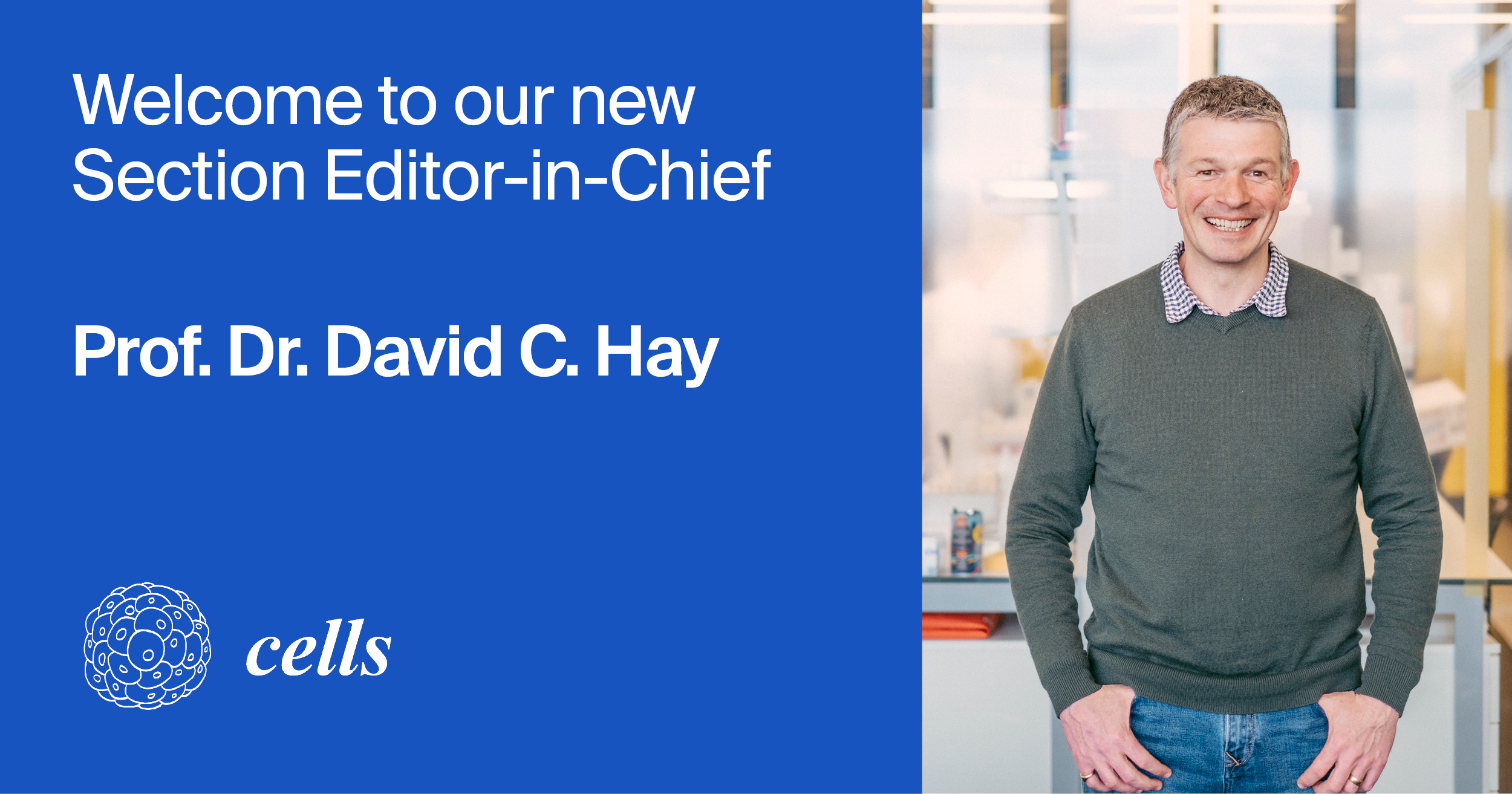
Prof. Dr. David C. Hay Appointed Section Editor-in-Chief of Section “Cell and Gene Therapy” in Cells
We are honored to welcome Prof. Dr. David C. Hay from the University of Edinburgh as the new Section Editor-in-Chief of the “Cell and Gene Therapy” Section.
On this occasion, we had the pleasure of speaking with Prof. Dr. Hay about his new role, his vision for the Section, and his thoughts on the future of the field. It will be exciting to see the Section continue to grow under his leadership and further strengthen its role as a platform for high-quality, innovative research.
1. Could you briefly introduce yourself and your main research interests?
I studied my undergraduate and postgraduate cell and biochemistry degrees at the University of St Andrews. I then moved to the Roslin Institute, the home of Dolly the sheep, to study human pluripotent stem cell biology. Following this, I moved to the University of Edinburgh to continue this work and develop my independent scientific career. My main research interests lie in liver tissue engineering from pluripotent stem cells, using a range of techniques and technologies that allow us to model complex disease in vitro and modify disease in vivo.
2. You have achieved many significant milestones throughout your career, from being elected a Fellow of the Royal Society of Biology to receiving recognition for innovation, technology transfer, and the development of new medical technologies. Looking ahead, what would you consider the next major milestone in your career?
The next major milestones in my career are to develop state-of-the-art liver tissue engineering processes to build higher-fidelity human liver tissue; use this to model complex human disease and physiology, including sex differences, in the dish; and to develop new therapeutic options for chronic human liver disease.
3. You served as an Editorial Board Member of Cells before stepping into your new role as Section Editor-in-Chief. What motivated you to accept this leadership position, and how will your experience as an Editorial Board Member shape your approach to the role?
The motivating factor is that cell- and gene-based therapies are already transforming human translational medicine. With a number of clinical trials underway. This is very exciting indeed. A few good examples of this are the development of stem-cell-based therapies being developed to treat neurodegeneration and chronic liver disease, and gene therapies for blood disorders and cancers. They have deepened our understanding of fundamental human cell biology and provided game changing interventions for complex and age-related diseases. As these fields mature, I expect greater precision and long-term efficacy, these are key challenges that currently exist. As an Editor, I will look to feature such transformative studies in our section.
4. What is your vision for the Section over the coming years, and which research topics or emerging trends would you particularly like it to promote?
My vision over the coming years is simply to build interdisciplinary capacity in the fields of cell and gene therapies. This must address many of the key challenges that currently limit the delivery of transformative human medicines. This includes the following:
- Building higher-fidelity tissue grafts that display stability and phenocopy the organ of interest.
- Maximizing the specificity of precision genetic engineering technologies to ensure safe performance.
- Resolving the key barriers to cell or gene therapies that involve the immune system, toxicity, safety issues, and durable performance of treatments.
- Developing real time and non-invasive tracking to assess therapeutic responses.
5. In your opinion, what distinguishes an excellent scientific paper from an average one, and what advice would you give to early-career researchers on preparing a high-quality manuscript?
An excellent scientific paper deals with an important subject and/or unmet need. The study displays a clear rationale, is focused in its approach, and also underpinned by good experimental design. This is key to testing the question at hand and delivering multiparameter reporting that provides a better basic understanding and allows for mechanistic modelling and/or therapeutic development.
6. How do you think the peer-review process will evolve in the future?
In the future, I think the post publication scientific review and discussion forums will become more common. Taking this approach will create a ‘real-time’ document that can be used to retest, consolidate and/or develop new hypotheses and interdisciplinary research approaches.
7. Finally, what message would you like to share with the readers and the wider scientific community of Cells?
I look forward to working with authors and the editorial team to deliver an exciting section underpinned by robust basic science. I encourage authors who have used interdisciplinary research approaches to solve complex biological problems to consider submitting their work for publication in our Section.