
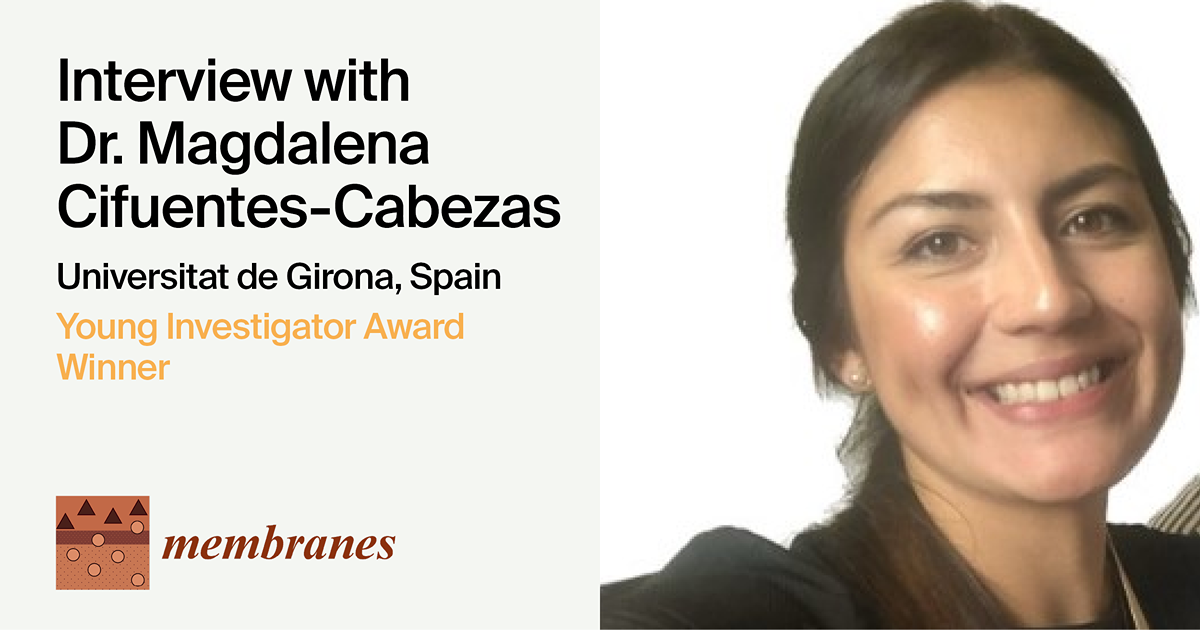
Interview with Dr. Magdalena Cifuentes-Cabezas—Winner of the Membranes Young Investigator Award
1. Could you please briefly introduce yourself, including your current affiliation and the specific focus of your membrane research?
I am Dr. Magdalena Cifuentes-Cabezas, a Juan de la Cierva postdoctoral researcher at the University of Girona, where I work in the Analytical and Environmental Chemistry Research Group. I am a chemical engineer and completed my PhD in Engineering and Industrial Production at the Universitat Politècnica de València. My background is in membrane process engineering and environmental engineering, particularly in the development and application of membrane-based processes for wastewater treatment, water reuse, and the recovery of high-value compounds from complex waste streams. More recently, I have specialized in analytical chemistry, expanding my research toward the use of functionalized membranes for selective separation and environmental monitoring. My current work focuses on the fabrication, functionalization, and application of membrane-based systems for the selective extraction, transport, preconcentration, and recovery of metals from complex aqueous matrices. Within the group, I am particularly involved in developing reusable functional membrane filters and advancing these materials from laboratory-scale studies toward practical and scalable filtration systems.
2. What motivated you to focus your career on membrane science and technology?
What first attracted me to membranes was their ability to solve several problems simultaneously: they can separate, concentrate, purify, and even enable the recovery of valuable compounds while often using less energy and fewer chemicals than conventional processes. During my PhD, I worked on the treatment and valorization of wastewater from the olive oil industry using processes such as ultrafiltration, nanofiltration, forward osmosis, adsorption, and biological treatment. That experience showed me that wastewater should not be viewed only as a waste requiring treatment, but also as a potential source of water and valuable compounds. It also sparked my interest in understanding how the properties of both the membrane and the target compounds govern their interactions, transport mechanisms, and separation performance, particularly in complex real matrices. Since then, my work has expanded from pressure- and osmotically driven processes to functionalized membranes. What continues to motivate me is the possibility of combining a fundamental understanding of membrane–compound interactions and transport phenomena with the development of selective and practical solutions to real environmental challenges.
3. How does it feel to be recognized with the Membranes Young Investigator Award?
It is a tremendous honor, and I feel both grateful and encouraged. Research is built through many years of experiments, failed approaches, revisions, collaboration, and continuous learning, so receiving this recognition makes me reflect on the entire journey rather than on a single result. I am especially grateful to the supervisors, collaborators, students, and research groups in Spain and abroad who have contributed to my development as a scientist. The award came at a particularly meaningful moment in my career, as I was expanding my research into analytical chemistry. It made me appreciate even more the strong connections among process engineering, fundamental chemistry, and analytical chemistry, and how bringing these perspectives together can open new research possibilities. As an early-career researcher, there are moments when the future can feel uncertain, despite working very hard and believing in the scientific questions you are pursuing. This award gives me confidence that the direction of my research is relevant to the membrane community and motivates me to be more ambitious in developing sustainable membrane systems that can move beyond laboratory proof-of-concept studies toward real applications.
4. Can you tell us about the specific research project or breakthrough that led to this recognition? What potential impact do you foresee this work having on the broader membrane community (e.g., in water treatment, energy, or biomedical applications)?
Rather than being linked to a single project or breakthrough, I believe this recognition reflects the progression and coherence of my research journey. During my time at the Universitat Politècnica de València, I had the opportunity to work alongside supervisors and colleagues who trained me in the application of a wide range of membrane processes, including ultrafiltration, nanofiltration, forward osmosis, membrane distillation, and membrane contactors. These technologies were applied to very different and often complex water matrices, including agro-industrial, textile, and urban wastewaters. This experience gave me a broad understanding of how membrane processes must be adapted to the characteristics of each water stream and strengthened my interest in water treatment and valorization.
More recently, at the University of Girona, I have built on this background by developing functionalized membranes for selective metal separation, preconcentration, recovery, and environmental monitoring. This work includes reducing polymer and hazardous-component consumption in polymer inclusion membranes and developing reusable porous filters based on biodegradable polymers, in which selective carriers are incorporated directly into the membrane. We have applied these systems to metals such as cadmium and palladium in challenging matrices, including seawater and desalination brines, and we are extending the concept to rare-earth elements and field samples. The potential impact lies in creating compact and reusable materials that combine water treatment, selective separation, and preconcentration. For the broader membrane community, I believe the contribution of this research path is its consistent focus on water, while progressing from conventional treatment processes toward more selective, sustainable, and practical membrane systems validated with real samples.
5. What have been some of the major technical or career challenges you faced when transitioning from a student to an independent faculty member or group leader? How did you overcome them?
I am still progressing toward a more senior research position rather than currently serving as a faculty member or group leader. However, I do not see scientific independence as working alone, because research is always a team effort. What changes is your role within the team: you move from mainly receiving guidance to proposing research directions, making decisions, supporting others, and taking greater responsibility. Learning to become a leader while remaining a good team member has been one of the main challenges of this transition.
I now supervise students, teach classes, coordinate experimental work, contribute to research proposals, and help transform initial ideas into concrete results. Through the LLAVOR technology-transfer project, funded by Government of Catalonia, I have also learned to think beyond scientific results and consider how a membrane could become a practical product. Organizing the international ISFMEM conference in Girona was another major challenge that required extensive coordination, teamwork, and problem-solving.
Moving between institutions, countries, and research areas has also pushed me outside my comfort zone. Entering analytical chemistry required me to learn new concepts while finding ways to draw on my background in chemical and membrane process engineering. At the same time, my research stays at NOVA University Lisbon and ITM-CNR in Italy, together with conferences and collaborations with different universities, have allowed me to build an international network that has been essential to my growth. These experiences have taught me that leadership does not mean having every answer. It means listening, learning from others, making thoughtful decisions, supporting the team, and taking responsibility when challenges arise.
6. In your view, what are the most promising or exciting emerging directions in membrane science right now (e.g., novel materials, AI-assisted design, or new separation processes)? Where do you see the field heading in the next five years?
One of the most exciting directions in membrane science is the development of materials designed for a specific function, rather than membranes that act only as passive barriers. By incorporating selective carriers, responsive groups, catalysts, or sensing elements, membranes can combine separation with recovery, preconcentration, monitoring, or reaction. To design these systems effectively, however, we need a deeper understanding of membrane–compound interactions and the mechanisms controlling transport.
Sustainability will also become increasingly important. Membranes should not be evaluated only according to their initial permeability or selectivity, but also by considering the solvents and materials used in their preparation, their stability, regeneration, lifetime, and end-of-life options. Their capacity to recover water and valuable resources should also be part of this assessment.
Over the next few years, I expect closer integration between experimental research, mechanistic modelling, and data-driven tools, including artificial intelligence. These tools can help identify relationships and accelerate material and process design, but their value will depend on reliable and comparable experimental data. I also believe the field will move toward more realistic conditions, including complex matrices, long-term operation, fouling, and reuse. In this context, the most relevant advances may not be the membranes showing the highest initial performance in the laboratory, but those that are selective, stable, regenerable, safe, and practical under real operating conditions.
7. Based on your journey, what specific advice would you give to young researchers or PhD students who are just starting their careers in membrane science and technology?
My most important advice is to build a strong and diverse support network. Talk to people, attend conferences, ask questions, and connect with researchers from different disciplines, institutions, and countries. These relationships are not only important for future collaborations; conversations with people who have different experiences and perspectives can generate new ideas, challenge your assumptions, and help you see your research from another point of view. A good network also provides support during the more difficult and uncertain stages of an academic career.
From a scientific perspective, try to understand the mechanism behind a result rather than focusing only on achieving a high rejection, flux, or extraction percentage. A result becomes much more valuable when you can explain why it occurs, identify its limitations, and determine whether it will persist under different conditions. I would also recommend working with real samples as early as reasonably possible. Model solutions are essential for understanding a system, but real matrices reveal the questions that truly matter.
Learn to collaborate across disciplines and communicate your work clearly, both in writing and when speaking with people outside your immediate specialty. My own work has benefited enormously from combining chemical engineering, analytical chemistry, materials characterization, modelling, and environmental science. Bringing together different areas of knowledge can lead to questions, ideas, and solutions that would be difficult to develop from a single perspective.
It is also important to develop discipline and learn to trust yourself and your abilities. Results, publications, and career opportunities do not always arrive when you expect them to, and a setback does not necessarily mean that your work is not good enough. Research requires time, continuity, and the patience to keep working even when progress is not immediately visible. Do not interpret rejection as a verdict on your potential, because research careers are rarely linear. Be rigorous, remain curious, ask for help, and support the people around you. Persistence is important, but so are reflection, openness, and the willingness to change direction when the evidence requires it.
8. What are your main research goals or upcoming projects for the next few years?
In the next few years, I would like to continue developing my research at the intersection of membrane processes, material design, and analytical chemistry. Building on my experience with functionalized membranes and selective transport, I aim to expand my work toward membrane distillation and deepen my understanding of how membrane and compound properties determine separation performance. This includes studying adsorption, desorption, diffusion, and surface interactions, particularly for volatile and semi-volatile compounds in complex water matrices.
I am especially interested in connecting a fundamental understanding of membrane–compound interactions with process performance. Better knowledge of these mechanisms could help explain why certain compounds are transported, retained, or accumulated within a membrane and support the design or modification of materials with more controlled properties. I would also like to combine experimental research with advanced characterization, modelling, and data-driven tools to improve both membrane materials and process design.
This direction brings together the different areas that have shaped my career: chemical and membrane process engineering, environmental applications, functional materials, and analytical chemistry. I also intend to continue collaborating internationally and working in different research environments, as mobility and interaction with researchers from other disciplines have been essential to the development of my ideas. In the longer term, I aim to establish a research line that connects fundamental transport mechanisms and membrane material design with practical solutions for water treatment and the recovery of valuable compounds.