
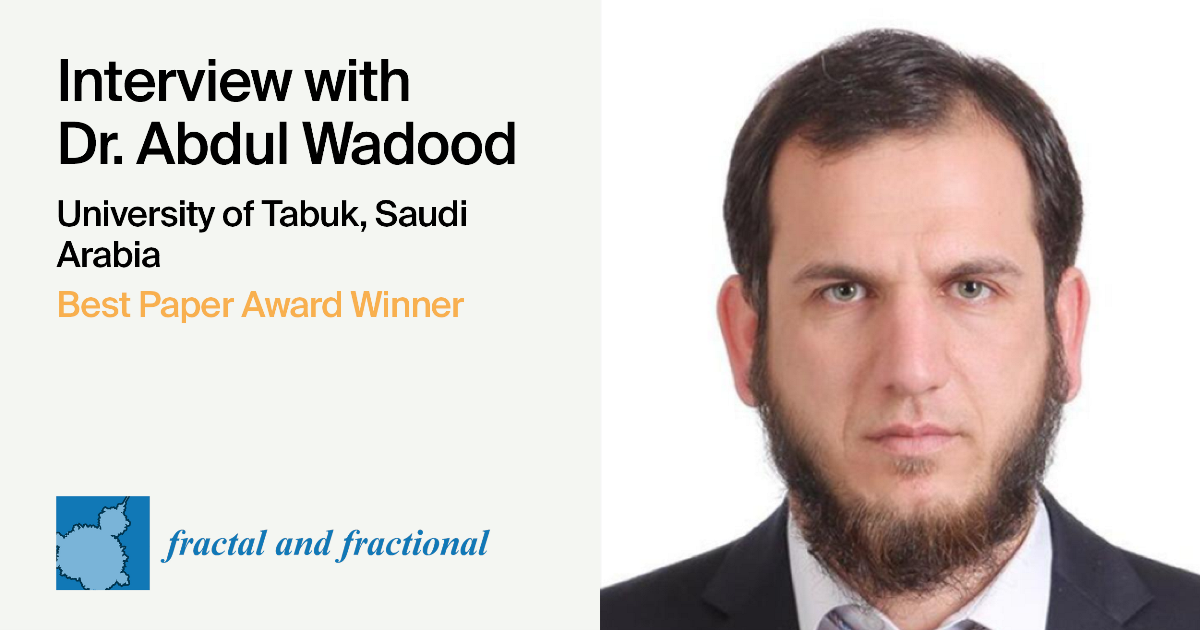
Interview with Dr. Abdul Wadood—Winner of the Fractal and Fractional Best Paper Award
We are honored to announce that Dr. Abdul Wadood has been selected as the winner of the Fractal and Fractional Best Paper Award 2024.
“A Novel Application of Fractional Order Derivative Moth Flame Optimization Algorithm for Solving the Problem of Optimal Coordination of Directional Overcurrent Relays”
by Wadood, Abdul, and Herie Park
Fractal Fract. 2024, 8, 251. https://doi.org/10.3390/fractalfract8050251
The following is an interview with Dr. Abdul Wadood
1. Congratulations on winning the Best Paper Award for your published paper! We are curious about what inspired you to choose this research field. Could you briefly share your story?
My research background is in electrical power-system protection and optimization. I became particularly interested in the coordination of directional overcurrent relays because it is a complex and highly constrained engineering problem that directly affects the reliability and security of modern power networks. At the same time, I was exploring fractional calculus and its ability to improve the search behavior of optimization algorithms. This motivated our team to integrate fractional-order derivatives with the Moth–Flame Optimization algorithm and investigate their effectiveness in solving relay-coordination problems.
2. Why did you choose to submit your work to Fractal and Fractional? What was your overall experience during the submission process?
We selected Fractal and Fractional because of its strong reputation and its clear focus on innovative applications of fractional calculus. Our work closely aligned with the journal’s scope by demonstrating how fractional-order concepts can enhance an optimization algorithm for a practical power-system problem. The submission and peer-review process was professional, efficient, and constructive. The reviewers’ comments helped us improve the technical clarity, presentation, and overall quality of the manuscript.
3. What was the biggest challenge you faced while writing this paper, and how did you overcome it?
The main challenge was developing a fractional-order optimization framework that could achieve a suitable balance between exploration and exploitation while satisfying the strict coordination constraints of directional overcurrent relays. We addressed this challenge through careful mathematical formulation, extensive simulations, repeated parameter evaluations, and comparisons with established optimization methods. This systematic validation helped us demonstrate the robustness and effectiveness of the proposed approach.
4. How did feedback during your research influence your direction?
Feedback from my co-authors, research colleagues, and peer reviewers played an important role in shaping the study. Their observations encouraged us to strengthen the methodology, expand the comparative analysis, and explain the practical significance of the results more clearly. Constructive feedback also helped us identify areas requiring further validation and ultimately made the research more rigorous and impactful.
5. As a Best Paper Award recipient, what message or advice would you share with future authors who aim to submit high-quality research to Fractal and Fractional?
My advice is to focus on a meaningful research problem and ensure that fractional calculus is not used merely as a mathematical addition but contributes clearly to the novelty and effectiveness of the proposed solution. Authors should provide a sound mathematical foundation, comprehensive comparisons, transparent experimental settings, and an honest discussion of limitations. Most importantly, they should treat reviewers’ comments as an opportunity to strengthen their work. High-quality research requires originality, technical rigor, persistence, and clear communication.
I sincerely thank the Best Paper Award Committee and the editorial team of Fractal and Fractional for this recognition. I am also deeply grateful to my co-author, Professor Herie Park, who contributed to this research effectively.