
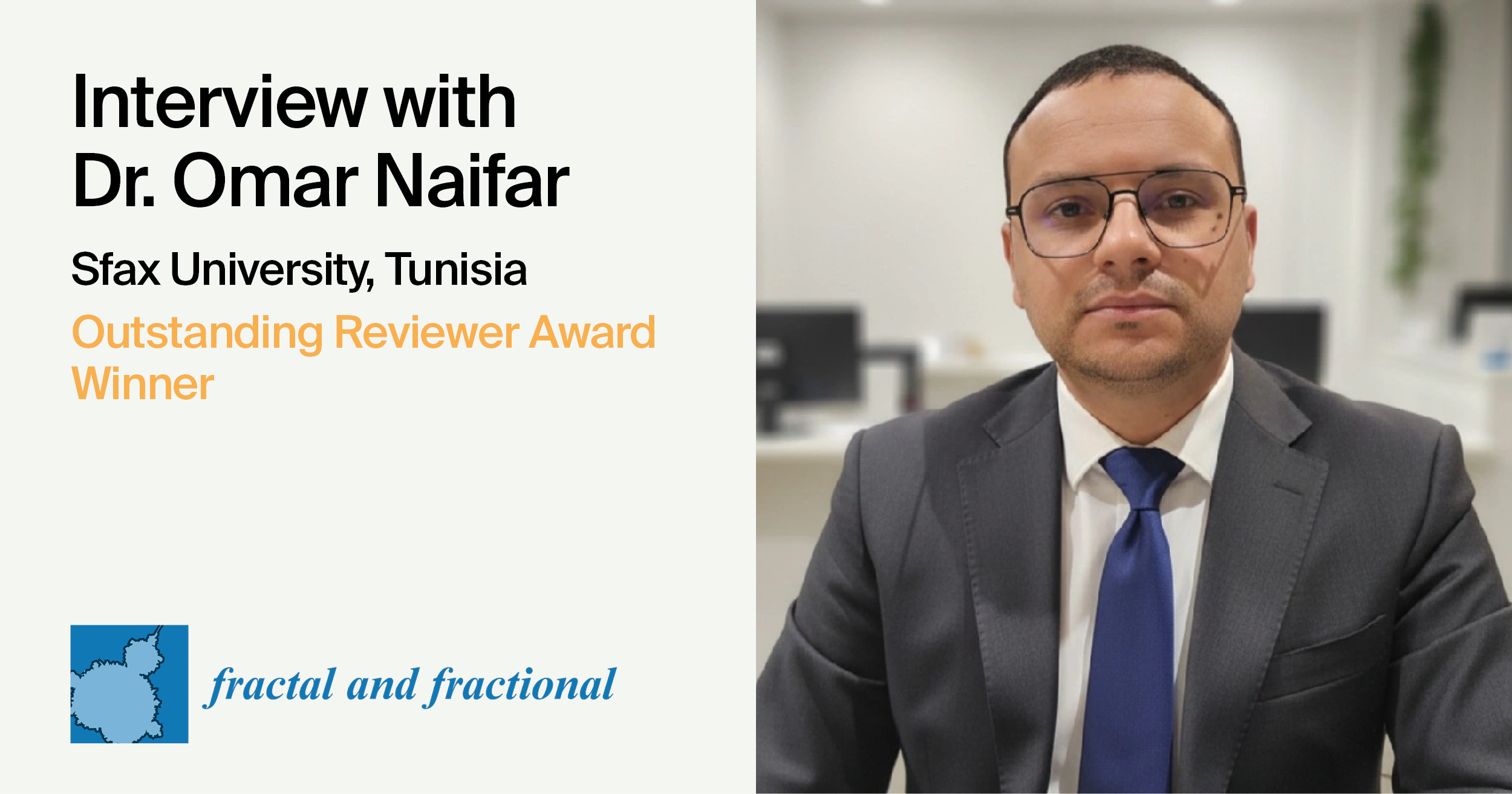
Interview with Dr. Omar Naifar—Winner of the Fractal and Fractional Outstanding Reviewer Award
1. Could you introduce yourself to our readers? What is your current research area?
I am Omar Naifar, an Associate Professor at ISSAT Kairouan in Tunisia. I hold a PhD and a University Habilitation in electrical engineering from the National School of Engineering of Sfax. My work is situated at the intersection of automatic control, applied mathematics, signal processing, and artificial intelligence. I am also an Associate Editor of the Asian Journal of Control, a member of the doctoral school committee at the National School of Engineering of Sfax, and I contribute to several academic, editorial, and conference activities.
My principal research interests include fractional-order systems, observer design, robust and adaptive nonlinear control, fault detection, finite-time stability, and AI-based optimization. I am particularly interested in connecting rigorous mathematical methods with practical applications in renewable energy, wind-turbine systems, intelligent manufacturing, induction-motor control, smart healthcare, and data-driven diagnostics. More recently, I have been investigating fractional-order optimization methods for machine learning, including fractional gradient-based algorithms designed to improve robustness, convergence, and learning performance.
2. What are your tips on how to prepare a detailed review report?
A strong review report should be rigorous, constructive, well organized, and proportionate to the manuscript. I usually begin with a complete reading to understand the objective, contribution, methodology, and overall structure. I then perform a second, more technical reading focused on the assumptions, mathematical arguments, experimental design, comparison methods, reproducibility, and consistency of the conclusions.
I recommend opening the report with a short summary of the paper and its potential contribution. The main comments should then address issues that affect validity, novelty, clarity, or scientific impact, while minor comments can cover presentation, notation, language, figures, and references. Each criticism should be specific and, whenever possible, accompanied by a practical suggestion. Reviewers should clearly distinguish essential revisions from optional improvements, maintain a respectful tone, and verify that citations are relevant rather than requesting unnecessary references. Before submission, the reviewer should reread the report to ensure that the recommendation is fully consistent with the comments.
3. Based on your reviewing experience, what are some common problems that authors face?
Common problems include an insufficiently defined research gap, an unclear statement of novelty, and a weak connection between the proposed method and the existing literature. In technical manuscripts, authors may also use restrictive assumptions without adequate justification, omit important derivation steps, or provide simulations that do not convincingly demonstrate robustness and practical relevance. Comparisons are sometimes limited to outdated or weak baselines, and parameter choices may not be explained.
Other recurring difficulties concern reproducibility and presentation. Algorithms, datasets, initial conditions, computational settings, or evaluation metrics may be incompletely reported. Conclusions can overstate what the evidence supports, particularly when results are based only on a small number of numerical examples. Authors benefit from checking the logical alignment among the research question, methodology, results, and conclusions, and from asking an independent colleague to review the manuscript before submission.
4. What advice would you give to early career researchers who are starting to participate in peer reviews?
Early career researchers should accept invitations only when the manuscript genuinely matches their expertise and when they can meet the deadline. They should first study the journal’s reviewer guidelines and evaluate the work rather than the authors. Confidentiality, impartiality, and disclosure of potential conflicts of interest are fundamental.
A useful approach is to follow a consistent checklist: significance and novelty, technical correctness, adequacy of methods, quality of validation, reproducibility, clarity, and relevance of references. Comments should be evidence-based and written in a professional, encouraging tone. It is better to identify the few issues that most influence the paper’s reliability than to produce a long list of superficial corrections. Reviewing also offers an excellent learning opportunity: it strengthens critical thinking, improves one’s own writing, and exposes researchers to emerging questions. However, unpublished ideas or results encountered during review must never be used or shared.
5. How do you see the role of reviewers evolving with the advancements in artificial intelligence and automated tools in research publishing?
Artificial intelligence can assist reviewers by screening language, detecting possible duplication, checking references and equations, identifying reporting omissions, or highlighting inconsistencies in data and figures. These tools may reduce the time spent on routine checks and allow reviewers to focus more deeply on originality, reasoning, methodological validity, and scientific significance.
Nevertheless, AI should support rather than replace expert judgment. A reviewer remains responsible for the accuracy, fairness, and confidentiality of the report. Automated outputs can contain errors, miss disciplinary nuance, or reproduce biases. Journals and reviewers therefore need transparent policies governing the use of AI, especially because manuscripts under review are confidential and should not be uploaded to external systems without explicit authorization. In the future, the reviewer’s role will likely become more interpretive and integrative: validating claims, challenging assumptions, assessing real scientific value, and ensuring that automated analyses are used responsibly.
6. Based on your extensive review experience, have you identified which research topics will attract particular academic attention in the coming years?
I expect strong attention to research that combines advanced control theory, fractional calculus, and trustworthy artificial intelligence. Promising directions include fractional-order learning and optimization, explainable and physics-informed AI, data-driven control with stability guarantees, digital twins, resilient and cybersecure control, and intelligent fault diagnosis. The integration of model-based knowledge with machine learning will be particularly important for systems in which safety and interpretability cannot be compromised.
Applications connected to the energy transition will also remain central, including renewable-energy integration, wind-energy conversion, smart grids, energy storage, and efficient electric drives. In healthcare, IoT-enabled monitoring, explainable diagnostics, and privacy-aware intelligent systems are likely to expand. Across these topics, the most impactful work will combine theoretical depth with reproducible validation, realistic constraints, and clear societal or industrial relevance.
7. Could you share your views on how open access (OA) impacts the author community?
Open access can substantially increase the visibility and accessibility of research by making results available to readers regardless of institutional subscription. This is especially valuable for researchers, students, practitioners, and institutions in regions where access to scientific literature may be limited. Wider availability can encourage collaboration, accelerate knowledge transfer, support education, and increase the practical reach of published work.
At the same time, publication charges can create barriers for authors with limited funding. A sustainable open access ecosystem should therefore include transparent fees, rigorous peer review, clear editorial standards, and equitable waiver or discount mechanisms. Authors must also distinguish reputable journals from outlets that prioritize payment over scientific quality. When implemented responsibly, open access strengthens the dissemination of knowledge while preserving the essential values of quality, integrity, and fairness.
8. As the winner of this award, is there something you want to express or someone you want to thank most?
I am sincerely honored to receive the Outstanding Reviewer Award from Fractal and Fractional. I would like to thank the Editor-in-Chief, the Editorial Board, and the journal’s editorial team for this recognition and for their confidence in my contribution. I also thank the authors whose work I have had the privilege to review. Peer review is a shared process, and thoughtful exchanges between authors, reviewers, and editors help strengthen the scientific record.
I am equally grateful to my colleagues, collaborators, students, and family for their continuous support. This award encourages me to remain committed to timely, fair, and constructive peer review. I consider reviewing not only a professional responsibility, but also an important service to the research community and a meaningful way to contribute to scientific progress.