
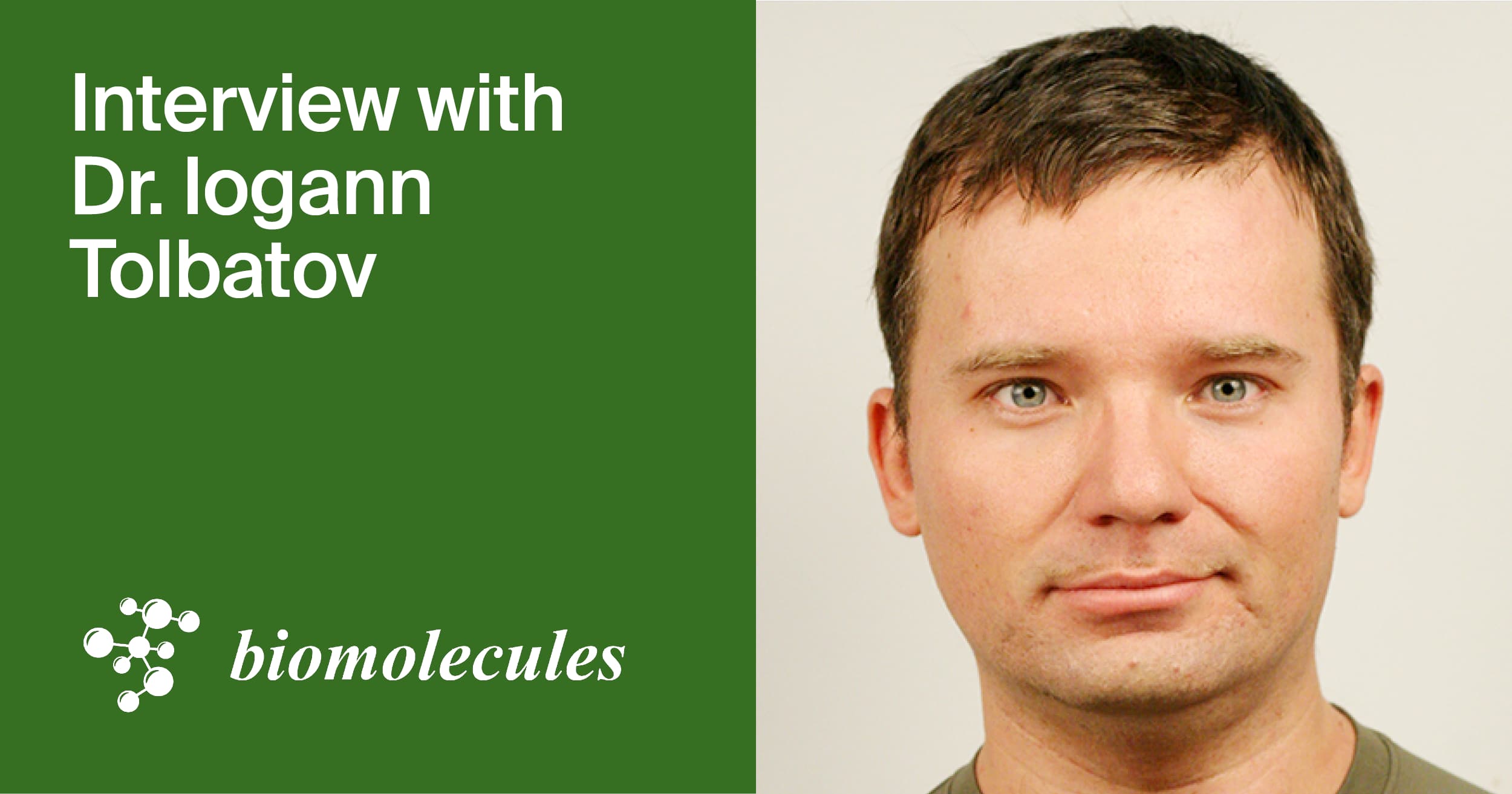
Interview with Dr. Iogann Tolbatov—Section Board Member of “Biomacromolecules: Proteins, Nucleic Acids and Carbohydrates” Section
We are pleased to share the following interview with Dr. Iogann Tolbatov, Section Board Member of the “Biomacromolecules: Proteins, Nucleic Acids and Carbohydrates” Biomolecules (ISSN 2218-273X) Section.
Name: Dr. Iogann Tolbatov
Affiliation: Department of Chemical, Physical, Mathematical and Natural Sciences, University of Sassari, 07100 Sassari, Italy
Interests: computational bioinorganic chemistry; inorganic medicinal chemistry; protein metalation; metalloproteins; anticancer, antimicrobial, and antiviral metallodrugs; artificial intelligence in drug discovery; machine learning interatomic potentials; quantum chemistry; molecular dynamics
The following is a short Q&A with Dr. Iogann Tolbatov, who shared his vision for the journal with us:
1. Could you give a brief introduction of yourself and your current research direction to our readers, highlighting any aspects of your work that you feel are particularly relevant to readers of Biomolecules?
I am an Assoc. Prof. of general and inorganic chemistry at the University of Sassari, where I lead a “Digital Laboratory” for computational modeling. My group focuses on designing next-generation metallodrugs and characterizing metalloproteins at the atomic scale. For Biomolecules readers, my work is simple to describe—we identify the electronic and structural factors governing how metal complexes recognize and interact with biological macromolecules, providing insights missing from experimental studies.
2. Your path runs from a PhD at Notre Dame through Bonn, Chieti-Pescara, Burgundy, ICIQ, and Padova before your professorship at Sassari, with your earliest work in theoretical physics. Was there a moment in that journey that significantly shaped your scientific perspective?
Moving across different research cultures in five countries changed how I work. It taught me that scientific progress is not just about the data you gather; it is about how you navigate different approaches to the same problem. My defining moment was not a single event. It was a stretch during my postdoc years when I realized my simulations were explaining experiments my experimentalist colleagues could not interpret. That is when I stopped viewing computation as a support role and started treating it as a primary discovery tool. It is a perspective I have directly brought directly to my work as a reviewer for major funding bodies today.
3. You describe your research environment as a “Digital Laboratory”. Could you explain to our readers what that means, and give an example of a question that computational modeling can answer more effectively than experiments alone?
Think of the “Digital Laboratory” as a virtual lab. We combine quantum chemistry and classical molecular dynamics—and, increasingly, AI—to track chemical reactivity inside complex biomacromolecules. Good examples are mapping ultra-transient transition states or the dynamic pathways of pre-covalent recognition within protein pockets. These are details experiments can rarely track in real time, making computation essential.
4. Could you tell us how you first came to know about Biomolecules, and what prompted your interest in joining the Editorial Board?
I noticed Biomolecules for its scientific rigor and rapid publication turnaround. I joined the Editorial Board in 2025 to contribute to the journal’s growth. Seeing our shared vision and strict peer-review standards translate into global recognition has been rewarding—our IF has just jumped from 4.8 to 5.6!
5. As an Editorial Board Member, and given your focus on how metals interact with proteins and nucleic acids, how do you see the study of biomacromolecules and metallodrugs evolving, and what gaps in the field are you most excited about seeing future submissions address?
The field is moving away from looking at isolated metal–macromolecule interactions. Instead, we are starting to decode how metallodrugs behave within the complex multi-metal networks revealed by modern metallomics. I want to see future submissions that unite experimental metallomics with atomic-scale simulation, especially those using machine learning to map out competitive metal binding and transport pathways. Biomolecules brings together computation and experimental biochemistry, where other journals often keep them separate.
6. Computational and bioinformatics submissions have risen rapidly across many journals, and they vary widely in rigor and biological relevance. Drawing on your experience as both a computational scientist and a reviewer, what defines a strong and impactful in silico study, and how important is experimental validation in making computational findings convincing?
A strong in silico study is never a collection of automated software outputs. If I am reviewing a paper and see “black box” results without a physical chemistry foundation, it gets sent back. Collaboration with experimentalists is great, but a computational study should hold its own. It needs to drive new discovery, not just mirror existing data. If you are not explaining an anomaly or showing us something new, then why do you want to publish?
7. Looking back, is there a piece of advice you wish you had received earlier in your career, particularly for young scholars hoping to work at the interface of chemistry, biology, and computation?
Never treat computational chemistry software as a “black box”; real mastery requires digging into the underlying mathematics and physics first. Beyond technical skills, the most valuable asset you can develop is communication. Leadership belongs to those who learn to speak the languages of the synthetic chemist, the data scientist, and the structural biologist fluently, connecting them.