
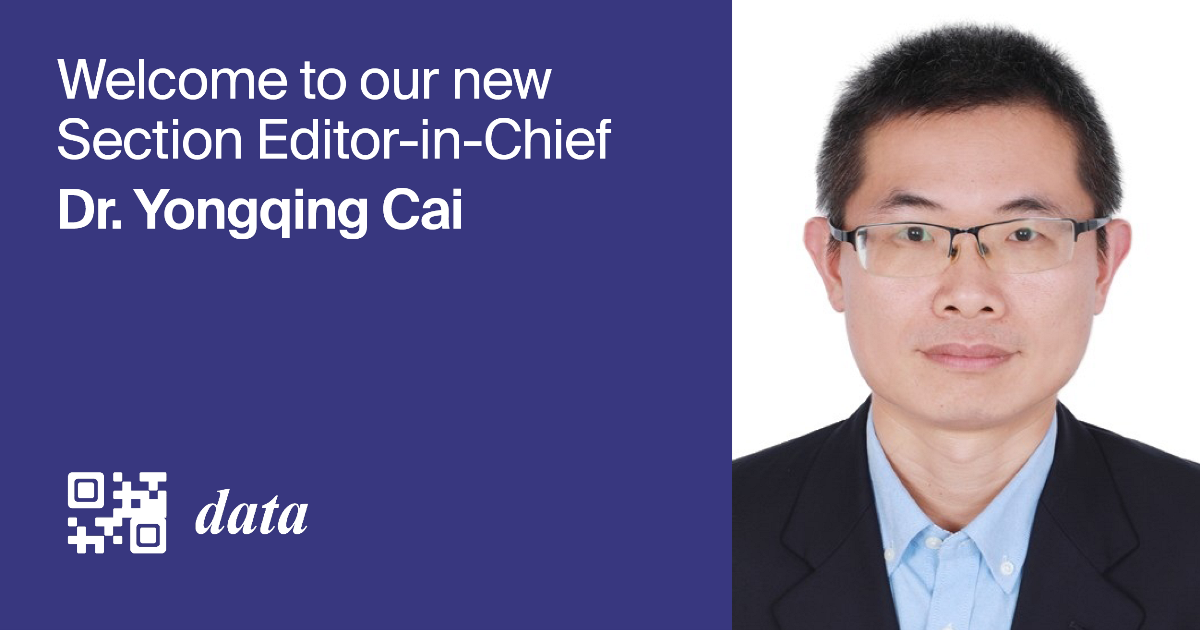
Dr. Yongqing Cai Appointed Section Editor-in-Chief of Section “Data Science for Chemistry, Energy and Materials” in Data
Data (ISSN 2306-5729) is pleased to announce the appointment of Dr. Yongqing Cai (University of Macau, China) as Section Editor-in-Chief (SEiC) of the Section “Data Science for Chemistry, Energy and Materials”.
Dr. Yongqing Cai earned his BSc and MSc degrees in materials science from Northwestern Polytechnical University, China in 2004 and 2007, respectively, followed by a PhD in physics from the National University of Singapore in 2012. From 2013 to 2019, he worked at the Institute of High Performance Computing (IHPC) in Singapore. He is currently an Associate Professor at the Institute of Applied Physics and Materials Engineering (IAPME), University of Macau. Dr. Cai’s research focuses on first-principles materials simulations for nanoelectronics, photonics, and energy applications, as well as materials informatics and artificial intelligence.
The following is a short Q&A with Dr. Yongqing Cai, who shared his vision for the journal with us, as well as his views of the research area and open access publishing:
1. What about the journal appealed to you and made you want to take the role of Section Editor-in-Chief?
I have always believed that scientific progress depends not only on new discoveries but also on high-quality, reusable research data. Over the past decade, chemistry, energy, and materials science have entered the era of data-intensive research, driven by high-throughput computations, advanced characterization techniques, autonomous experiments, and artificial intelligence. These developments have created unprecedented opportunities for data sharing and reuse. As Section Editor-in-Chief, I see an exciting opportunity to help build an interdisciplinary platform where researchers can share not only datasets, but also workflows, benchmarks, databases, and computational methodologies that accelerate scientific discovery across chemistry, energy, and materials research.
2. What is your vision for the Section “Data Science for Chemistry, Energy and Materials”?
My vision is to establish this section as a leading international platform connecting data science with fundamental and applied research in chemistry, energy, and materials. I hope the section will publish not only high-quality datasets, but also data descriptors, benchmark databases, computational workflows, and experimental protocols. Another important goal is to encourage interdisciplinary collaboration. Future breakthroughs will increasingly emerge from the integration of chemistry, materials science, physics, computer science, and artificial intelligence. By providing a venue where researchers from different backgrounds can exchange data and methodologies, we can help accelerate innovation while reducing duplicated efforts. Ultimately, I hope the section will serve as an open scientific infrastructure that supports both scientific discovery and the development of next-generation data-driven materials research.
3. What does the future of this field of research look like?
I believe we are entering a new paradigm of scientific research where data and artificial intelligence become indispensable components of discovery. Traditionally, research in chemistry and materials science has largely relied on intuition, trial-and-error experiments, and individual expertise. Today, the combination of high-performance computing, automated experiments, machine learning, and large scientific databases is fundamentally changing how new materials are designed and understood. However, AI models are only as good as the data they learn from. Therefore, generating high-quality, standardized, interoperable, and trustworthy datasets will become increasingly important. Future progress will rely not only on larger datasets, but also on better-curated data, richer metadata, uncertainty quantification, and reproducible computational workflows. Looking ahead, I expect AI-assisted materials discovery, and autonomous laboratories for chemistry and materials to become increasingly common.
4. What suggestions do you have for journals and publishers to better support young scholars and serve the academic community?
Journals today play a much broader role than simply publishing papers. They are becoming important partners in building healthy research communities. For young scholars, I believe journals can provide more opportunities for academic growth through early-career editorial boards and research awards, as well as reviewing opportunities. Finally, journals should continue fostering interdisciplinary communication by organizing special issues, academic forums, and community activities that connect researchers from different disciplines and career stages.
5. What do you think of the development of open access in the publishing field?
Open Access has significantly transformed scientific communication over the past two decades. By removing barriers to accessing research, it enables scientists, educators, students, policymakers, and industry to benefit from scientific knowledge more rapidly and more equitably. For data-driven research, open access is especially valuable because it facilitates the sharing of not only publications but also datasets, software, and computational workflows, thereby improving reproducibility and accelerating innovation. I believe the future of scientific publishing lies in combining open access with open data, open code, and open science. Together, these principles will foster greater collaboration, transparency, and trust, ultimately enabling scientific discoveries to have a broader and more lasting impact on society.
We warmly welcome Dr. Yongqing Cai as the Section Editor-in-Chief of “Data Science for Chemistry, Energy and Materials”, and we look forward to his leadership in guiding Data to achieve many more milestones.