
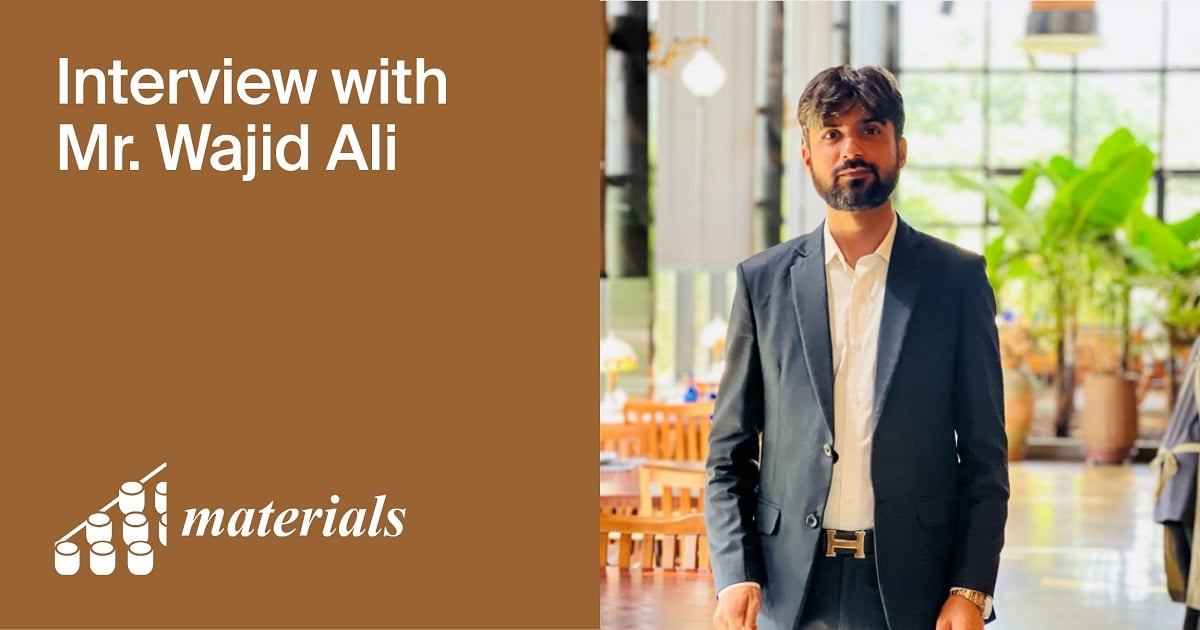
Materials | Interview with the Newsletter Author—Mr. Wajid Ali
Mr. Wajid Ali is one of the authors of the newsletter paper entitled “A Comprehensive Review on Sustainable Triboelectric Energy Harvesting Using Biowaste-Derived Materials” published in Materials (ISSN 1996-1944).
Author’s introduction:
My name is Wajid Ali. I completed my master’s degree at Jeju National University, South Korea, and I am currently pursuing my PhD at the same university in the Department of Electronic Engineering. My research interests are centered on energy harvesting devices, including triboelectric nanogenerators (TENGs), moisture-driven electricity generators (MEGs), and piezoelectric nanogenerators (PENGs), which are promising technologies for converting ambient energy into usable electrical power. In addition, I am working on humidity sensors, which are important for self-powered sensing, environmental monitoring, and sustainable electronic systems.
Along with these areas, I am also interested in machine learning for materials property prediction. Through this work, I aim to combine experimental materials research with data-driven methods to better understand structure–property relationships and accelerate the development of advanced functional materials. Overall, my research focuses on sustainable energy conversion, smart sensing, and the integration of materials science with emerging computational approaches for next-generation applications.
Based on the positive evaluations by the reviewers and academic editors for Mr. Wajid Ali’s group article, the article has been selected for inclusion in the journal’s newsletter.
“A Comprehensive Review on Sustainable Triboelectric Energy Harvesting Using Biowaste-Derived Materials”
by Wajid Ali, Tabinda Shabir, Shahzad Iqbal, Syed Adil Sardar, Farhan Akhtar and Woo Young Kim
Materials 2026, 19(3), 592; https://doi.org/10.3390/ma19030592
The following is an interview with Mr. Wajid Ali:
1. Congratulations on your published paper. Could you please briefly introduce the main research content of the published paper?
Many thanks for the complimentary congratulations and for choosing our review article for the newsletter. This is an incredible honor for me, and I am highly appreciative of the recognition of our work in the journal.
In our review article, we address the growing area of biowaste-based triboelectric nanogenerators, which convert waste materials like agricultural residues, marine biowaste, medical waste and expired pharmaceuticals into functional materials for sustainable energy harvesting. This article summarizes the processing methods and modification methods of various waste sources and their structural characteristics, working principles and electrical performance in a systematic manner. We also discussed their potential applications in the field of self-powered sensors, wearable electronics, and IoT-based systems.
The primary objective of this review was to demonstrate that waste materials are not only an environmental problem but also a valuable resource for next-generation energy-harvesting technologies. This study provides a contribution towards the sustainable development of energy and circular waste management by transforming waste materials into functional layers of use. Meanwhile, we highlighted some of the major challenges remaining that need to be overcome to bring these technologies closer to practical application, such as material variability, humidity sensitivity, mechanical durability, standardization and scalability.
I think this review is insightful and a much-needed overview of the valorization of biowaste for triboelectric energy applications. I appreciate the journal very much for this opportunity and for helping to spread the word on our work via the newsletter.
2. What are the key takeaways you hope readers will gain from your paper?
The overall message I want to convey to the reader with this paper is that biowaste should not be viewed only as waste to be disposed of but also as a useful resource for sustainable technologies for energy generation. According to our review, the materials that are discarded in agriculture, food processing, marine industries, medical systems and pharmaceuticals can be used as effective triboelectric layers in energy harvesting and self-powered sensing.
The other key message is that the efficiency of the triboelectric nanogenerators based on biowaste depends critically on the intrinsic structure, chemistry and surface morphology of the waste materials. The use of the right processing or surface-engineering techniques, coupled with a careful choice of the waste source, can greatly enhance charge generation, stability of output and device functionality. It is not merely re-use but rational design of materials on the basis of the structure–property relationships in waste valorization.
I also hope that readers know that there is great potential in this field for supporting the transition towards a circular economy. In addition to using synthetic polymers and non-renewable materials, it is possible to design environmentally friendly systems based on the triboelectric effect that can tackle waste management and clean energy generation at the same time. To me this is one of the best features of the research, because it is dual: it can help you both live healthier and save money.
Concurrently, the paper emphasizes some remaining challenges that must be addressed for broad-scale adoption to be realized. These include batch-to-batch variability, humidity sensitivity, long-term durability, scalability, the need for improved standardization and lifecycle assessment. This review is meant to be a summary of advances but also a blueprint for future research in sustainable triboelectric materials.
All in all, the take-home message is that the biowaste-based triboelectric nanogenerators are a great potential bridge between waste mitigation, materials innovation, and renewable energy harvesting.
3. Was there a specific experience or event in your research career that led you to focus on your current field of research?
The primary area of research that I am working on has slowly evolved from both my academic studies and practical experience in materials science, focusing on sustainable energy harvesting materials and their efficient operation. As I progressed through my research career, the need to create a next generation of materials, which are high-performance, environmentally friendly, and practically useful, grew more and more of an interest to me. The stimulation of this interest was particularly pronounced when I started applying my work on triboelectric nanogenerators and other composite materials to energy harvesting and related sustainable materials, as this is a clear area in which materials innovations can both contribute to and be applied to energy harvesting and sustainability.
The turning point for me was when I came to understand that there are a lot of wasted resources that can be used for a lot of valuable functional materials. As I learned about biomaterials, composite systems, and surface engineering strategies, I realized that agricultural waste products, marine waste, and other waste materials could become useful triboelectric layers that have real device potential. The insight was really motivating as it combined my interests to develop materials for renewable energy and environmental aspects in one research direction.
Meanwhile, my current interest was informed by my background in machine learning and data-driven materials research as well. The use of predictive models, structural-property relationships, and computational validation enabled me to gain insight into the potential for using modern research to speed up materials discovery and provide guidance for rational design. This mix of experimental experience, computational thinking, and problem-solving in a sustainable direction naturally lured me towards functional materials and energy harvesting systems derived from biowaste.
Instead of a single event, it's been a series of research experiences that led me to my present line of work. I became more interested in the idea of developing sustainable, high-value materials from abundant and underutilized resources with each project. That's why, in that regard, scientific curiosity is one of my current motivations as well as a deep interest in finding solutions to practical problems concerning energy and the environment.
4. How do you evaluate research trends in this field, and what advice would you give to other young researchers?
It is a research area that is taking a very promising direction as it integrates sustainable materials design, waste valorization and self-powered sensing. Recent reviews demonstrate that the TENGs fabricated from biowaste are gaining momentum as a promising, low-cost, and environmentally friendly energy harvesters to be used for bioelectronics and allied applications. Meanwhile, recent studies are starting to move beyond mere waste re-use to more systematic material processing, surface engineering and application-focused device design.
To me, the most significant thing is that the field is becoming more interdisciplinary. Today, materials scientists, device engineers, environmentalists, and even machine learning algorithms are being used in tandem to make rapid progress toward discovery and performance. I also believe that the field is slowly moving from a proof-of-concept demo to something more practical like long-term stability, humidity resistance, standardization and scalability which are crucial to making it a reality.
For young researchers my main piece of advice is to establish a solid base in understanding materials and have a base understanding of the device level. Replication of high output values is not only important, but understanding the underpinning of why a material works, and how its structure influences charge generation and what it is limited by in terms of durability/scalability is essential. They also need to be able to work in interdisciplinary fields, as advances in this area frequently require experimental work, computational analysis, surface engineering and application testing to be combined to achieve progress.
Another important tip is to take the time to develop a real solution, not just numbers. What matters most in a field such as biowaste-based TENGs is creative work that bridges the three aspects of sustainability, manufacturability and usefulness in realistic scenarios, like wearable sensors, environmental monitoring and low power electronics. Last but not least, I hope young researchers will be patient and curious since the innovation of emerging energy materials will typically happen by gradual improvement, reasonable validation, and an attitude to explore new ideas.