
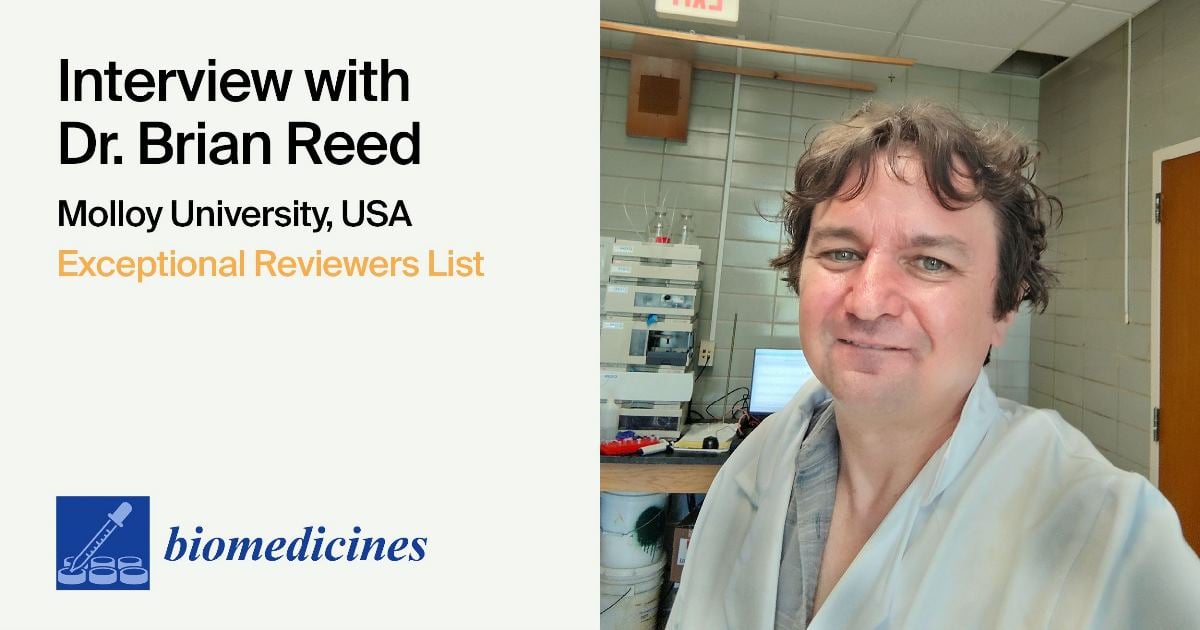
Interview with Dr. Brian Reed—Biomedicines Exceptional Reviewer
We are pleased to announce that Dr. Brian Reed has been recognized as one of the Exceptional Reviewers of Biomedicines (ISSN 2227-9059).
This program was established to recognize and honor scholars who have consistently provided outstanding review reports for our journal. Dedicated to advancing rigorous research and encouraging the exchange of knowledge, Biomedicines acknowledges the vital contributions of our reviewers in upholding the quality, credibility, and integrity of the articles we publish.
Dr. Brian Reed is a tenure-track assistant professor of chemistry and biology at the Department of Biology, Chemistry, Earth & Environmental Sciences at Molloy University on Long Island, NY. Prior to this, he spent over two decades at Rockefeller University in the Laboratory of the Biology of Addictive Diseases, led by the late Dr. Mary Jeanne Kreek. He initially joined her lab as a postdoctoral fellow from 2001 to 2006—holding a co-appointment in Dr. Brian Chait’s Laboratory of Mass Spectrometry and Gaseous Ion Chemistry—and subsequently continued his work there as a senior scientist, focusing on the role of the endogenous opioid system in substance use disorders.
Read our interview with Dr. Reed below:
1. Can you share your current research direction and latest progress?
My current research at Molloy University investigates the endogenous opioid system using diverse cell culture disease models. One of my primary projects focuses on elucidating the mechanisms behind kappa opioid receptor agonist-induced remyelination. Additionally, in an exciting new collaboration with my Molloy colleague, Dr. Jodi Evans, we are investigating the co-regulation of the melanocortin and opioid systems in cartilage preservation using cell culture models of osteoarthritis.
2. Could you please share your feelings about winning the award? What does this award mean for your academic career?
As I approach the tenure application process, having this award for my portfolio is fantastic. Peer review is a vital cornerstone of the scientific community, yet it is traditionally an anonymous and thankless task. Simply logging a review doesn't capture whether the feedback was thorough or constructive. Because this work is hidden, it can be difficult to properly document for tenure evaluation. This award validates my rigorous approach to peer review and provides tangible, high-profile evidence of my service to the field.
3. What role do you think reviewers play in the process of paper publication?
Reviewers are critical not just for vetting manuscripts, but for elevating them. While scientific rigor occasionally requires us to recommend rejection, I believe our most valuable contribution is helping authors refine their work. The iterative review process—where exciting findings are shaped into an even clearer, more impactful communication for the scientific community—is easily the most rewarding aspect of peer review.
4. How do you balance the comprehensiveness and efficiency of the review process? Can you share some specific methods or principles for reviewing?
I split my review into two distinct phases to balance depth and speed. First, I print the manuscript and read it in a single sitting—often during my morning train commute—marking up the margins and circling references that require a closer look. Second, back at my computer with reference databases open, I systematically address my margin notes, verify literature data, and draft my formal comments. Going through the paper twice in this manner ensures I don’t miss macro-level narrative flaws or micro-level technical issues.
5. In your opinion, what key qualities should an excellent manuscript have? From what perspectives will you help authors improve the quality of their papers?
An excellent manuscript must be well-written and clearly contextualize its findings within the current state of the field. Technically, it requires robust, highly detailed methodology and meticulously organized figures that allow readers to easily discern relevant details. Finally, the literature cited must be up-to-date and relevant. When reviewing, I actively provide feedback across all of these dimensions to help authors maximize their paper’s clarity and impact.
6. How do you hope that journals and publishers can further support the work of reviewers?
I was pleasantly surprised by this recognition. I think more publishers should adopt reviewer awards to honor this critical service. Beyond recognition, publishers should continue to balance rapid publication timelines with a realistic appreciation for reviewers' busy schedules. Lastly, offering article processing charge (APC) waivers or discounts to active reviewers is a highly practical and appreciated way to reciprocate our time and effort.
7. Please briefly describe your experience with our services and journals so far?
I have had an excellent experience with MDPI as both an author and a reviewer. The editorial process is highly efficient, turnaround times are swift, and communication with the editorial staff is always professional and pleasant.