
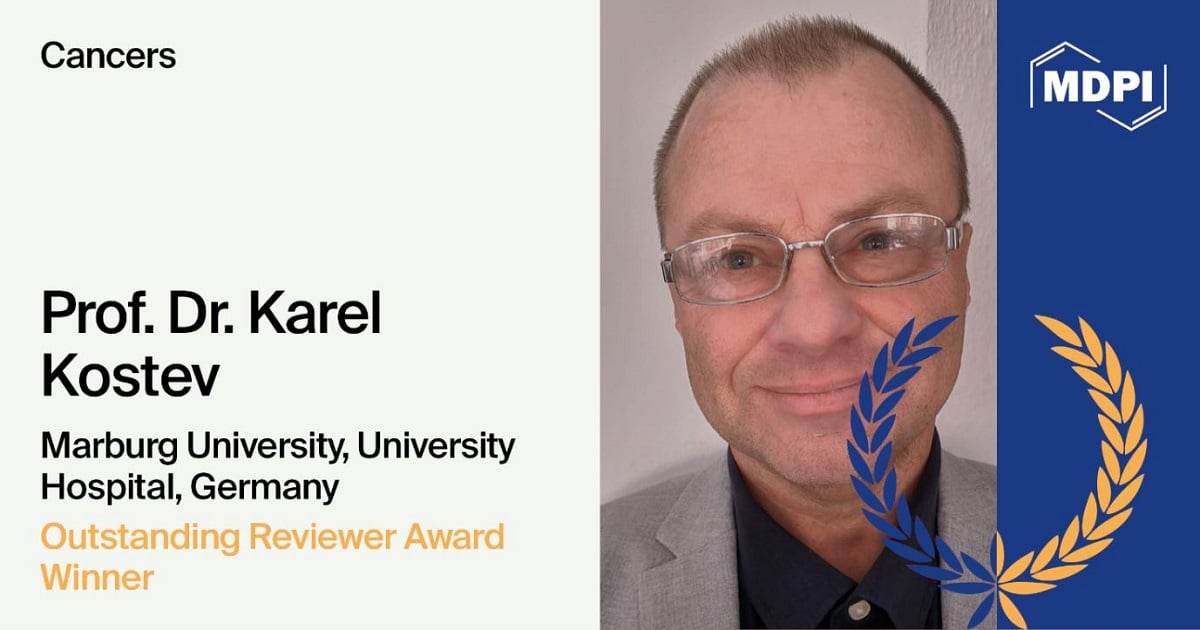
Interview with Prof. Dr. Karel Kostev—Winner of the Cancers Outstanding Reviewer Award
Prof. Dr. Karel Kostev is the Senior Scientific Principal for Epidemiology Research at IQVIA in Frankfurt (Germany). After completing his studies in sociology and statistics at the University of Freiburg i.Br., he obtained a doctorate degree in evidence-based medicine at the University of Leipzig. He subsequently pursued postdoctoral studies in epidemiology at the University of Marburg and was appointed as a professor at the University Hospital of Marburg. He also holds various SAS certifications. He has been working at IMS health/IQVIA for 25 years and has extensive experience in managing and performing epidemiological analyses using observational data. He is the author or co-author of more than 800 papers. His core research specialization is the epidemiology of chronic diseases (diabetes, heart failure, atrial fibrillation, MAFLD, cancer, depression, dementia, epilepsy, and others). Prof. Dr. Kostev also offers epidemiology seminars at the University Hospital Marburg.
The following is an interview with Prof. Dr. Karel Kostev.
1. What motivated you to become a reviewer for Cancers, and what do you find most rewarding about the peer-review process?
My background is in epidemiology, with a focus on real-world evidence—comorbidity, risk factors, survival analysis, and population-level outcomes in cancer patients. When I looked at the landscape of oncology journals, Cancers stood out immediately: it publishes a genuinely large volume of real-world studies from across the globe, covering exactly the kind of epidemiological work I understand deeply. That made it a natural fit. What motivates me most, however, is something more specific: the turnaround speed. Cancers moves from submission to publication with a speed that has become almost exceptional in today’s scientific publishing environment. I have seen manuscripts languish in review at other journals for six months, a year, sometimes longer—during which time important findings sit unpublished and unavailable to clinicians, policymakers, and other researchers who need them. My core motivation is to help authors publish sound, methodologically rigorous studies quickly. That is a concrete contribution I can make, and it is deeply rewarding.
2. In your opinion, what are the key elements of a truly constructive and high-quality peer-review report?
The most important quality is that a review must be genuinely useful to the authors—not a gatekeeping exercise, but a collaborative one. That means being specific: if there is a methodological concern, I describe exactly what the problem is, why it matters for the validity of the conclusions, and ideally what the authors can do about it. Vague objections waste everyone’s time. I also believe strongly in proportionality: not every issue warrants rejection. A study can have a solid epidemiological design, a well-described cohort, appropriate statistical methods, and a genuinely new finding, yet still have minor terminological imprecision or a suboptimal table layout. Those are fixable, and they should be fixed—not used as a pretext to delay or reject. I distinguish clearly between what must be addressed for scientific validity and what would simply improve the presentation. The goal is always to help a good study reach publication in the best possible shape.
3. When evaluating a manuscript, what specific aspects (e.g., methodology, data integrity, novelty) do you pay the closest attention to?
As an epidemiologist, methodology is unquestionably my first priority—and within methodology, study design comes before everything else. I ask immediately: is the design appropriate for the research question? Is this a cohort study, a case–control, a cross-sectional analysis? Are the inclusion and exclusion criteria clearly defined and epidemiologically justified? Then I move to statistics: are the chosen tests appropriate for the data structure, the outcome type, and the sample size? Are confounders adequately addressed, whether through matching, adjustment, or stratification? Is survival analysis, where used, conducted with correct methods—Kaplan–Meier, Cox regression, competing risks where appropriate? The second area I scrutinize closely is the use of epidemiological terminology. This may sound minor, but it is not: confusing incidence with prevalence, or describing association as causation, are substantive errors that distort how findings are interpreted. Novelty matters too—but I evaluate it in context. A well-executed population study from a country or a patient subgroup not previously described in the literature has real value, even if the clinical question itself is not entirely new.
4. Balancing peer review with your own research and academic commitments can be challenging. How do you manage your time effectively to maintain such a high standard of review?
Honestly, the speed of Cancers’ process is itself a structural help here. Because the journal operates efficiently and the editorial team is responsive, reviewing does not drag on with repeated back-and-forth over many months, which is where a large amount of reviewer time gets invisibly consumed at slower journals. I accept an invitation only when I am certain I can deliver a substantive report within the requested timeframe—I decline when I cannot, because a late or superficial review defeats the entire purpose. In practice, I approach each manuscript in two passes: a first read to understand the overall design, data source, and main findings, and a second, more detailed pass focused specifically on methodology, statistics, and terminology. Because epidemiological review follows a fairly consistent logic, I have developed an internal checklist over the years that makes the process efficient without making it mechanical. I am also honest about my scope: when a manuscript involves a biological dimension outside my expertise, I note that clearly so the editor can seek complementary input.
5. What advice would you give to early career researchers who are just beginning as peer reviewers?
Learn to read a methods section the way a detective reads a crime scene. Everything important is there, and everything suspicious is also there. For those of us working in epidemiology and real-world evidence, this means developing a sharp eye for study design choices and understanding why those choices matter: why a retrospective cohort is not the same as a prospective one, why the definition of the index date in a database study can introduce or eliminate bias, and why missing data handling is never a footnote issue. I would also encourage early career reviewers to read extensively beyond their immediate subspecialty. Cancer epidemiology spans cardiovascular comorbidity, pharmacoepidemiology, health economics, and survival methodology—broad reading makes you a more versatile and more credible reviewer. And perhaps most practically: remember that the authors are colleagues. Your job is not to find reasons to reject. It is to read their work as carefully as you would want someone to read yours, and to help them make it better.
6. How have you seen the landscape of oncology research evolve during your time as a reviewer?
From an epidemiological standpoint, the single most significant shift has been the explosion of real-world evidence studies, driven by the expanding availability of large administrative databases, cancer registries, electronic health records, and linked datasets. When I began reviewing, population-based analyses of cancer outcomes were relatively rare; today they constitute a substantial fraction of the submissions I evaluate. This is broadly positive, it means that findings from randomized trials are being tested against the messy reality of clinical practice, in real patient populations with the comorbidities and treatment heterogeneity that trials deliberately exclude. The methodological sophistication of these studies has also grown: propensity score methods, competing risks analysis, and time-varying covariates are now routinely encountered where they would once have been exceptional. The challenge, which I encounter often as a reviewer, is that the growth in volume has not always been matched by growth in methodological literacy. Epidemiological errors—particularly around causal language, selection bias, and confounding—remain stubbornly common and correcting them is one of the most concrete contributions I can make.
7. From your perspective as an expert, what is one of the most critical gaps in current cancer research?
The gap that I encounter most consistently, both in my own work and in manuscripts I review, is the insufficient attention paid to comorbidity in cancer research. The typical cancer patient—particularly as the population ages—is not a person with cancer alone. They have diabetes, cardiovascular disease, chronic kidney disease, or any combination thereof. These comorbidities affect treatment eligibility, treatment tolerance, competing risks of death, and quality of life in ways that profoundly shape real-world outcomes. Yet a great many studies still analyze cancer patients as though comorbidity were a nuisance variable to be adjusted away rather than a substantive dimension of the clinical picture. There is also a persistent gap in how we handle competing causes of death in survival analyses: cancer-specific mortality and all-cause mortality tell different stories and conflating them or choosing between them without epidemiological justification leads to conclusions that can genuinely mislead clinical practice. These are not exotic methodological concerns—they are foundational, and they deserve more systematic attention.
8. Cancers is a fully open access journal. What do you see as the primary benefits of open access publishing for the global oncology community?
Open access matters enormously for epidemiological research in particular, because so much of what we study is inherently global and population specific. A paper describing cancer survival disparities in a middle-income country, or comorbidity patterns in an elderly population in Eastern Europe or Southeast Asia, should be freely available to researchers and clinicians in those regions—not locked behind a subscription that their institution cannot afford. Real-world evidence is only genuinely useful if it can reach the real world. Beyond equity, open access accelerates the feedback loop between research and practice: a clinician who encounters an unusual comorbidity pattern in their patients can immediately access the latest epidemiological literature on that topic rather than waiting for institutional access or requesting reprints. For systematic reviews and meta-analyses—which are increasingly central to evidence-based oncology guidelines—open access also removes a significant source of publication bias by making studies from lower-resource settings visible and retrievable.
9. How do you feel high-quality peer review directly impacts the overall integrity and progression of cancer research worldwide?
In real-world evidence research, the consequences of poor peer review are very direct and very practical. An epidemiological study that confuses association with causation, or that draws survival conclusions from a design incapable of supporting them, does not just represent an academic error—it can inform clinical guidelines, hospital protocols, or health policy decisions that affect patients. High-quality peer review is the mechanism by which methodological errors are caught before they enter the permanent scientific record and propagate through citations and secondary analyses. For cancer epidemiology specifically, where findings are often used to estimate population-level disease burden, identify high-risk groups, or evaluate the real-world effectiveness of treatments, methodological rigor is inseparable from public health relevance. Beyond error prevention, I believe rigorous review also raises the overall standard of the field: when authors know their methodology will be scrutinized carefully—their choice of design, their statistical approach, their use of epidemiological language—they invest more care in getting those things right from the start. That cumulative effect, multiplied across thousands of manuscripts over many years, genuinely matters.